




- Gloroots converts contractors to compliant employees once classification risk grows.
- Gig payroll software disburses payments but never removes employer misclassification liability.
- Remote offers misclassification indemnity up to $100,000 per contractor.
- Rippling starts at $8/employee/month plus a mandatory flat fee.
- Wingspan targets 500+ gig workers with compliance gating and instant payouts.
Gig worker payroll software is a category of platforms that calculate, schedule, and disburse payments to independent contractors, freelancers, and platform-based workers. Most also add invoicing, tax reporting, and basic compliance workflows.
The wrong platform does more than slow payments down. It exposes the company to employee and independent contractor misclassification, tax filing failures, and audit risk.
This article covers a comparison table of top gig worker payroll platforms, the criteria that actually separate them, and the point where software alone stops being enough for compliant global employment.
Best Gig Worker Payroll Software at a Glance
1. Gloroots

Gloroots is a global workforce management platform hat helps companies hire, manage and pay gig workers compliantly
Gloroots is a global HR platform that provides compliant infrastructure to manage a global team, run payroll accurately across countries, and standardize employment across entities and regions. It automates contractor onboarding, contracts, payroll, and compliance across 150+ countries, serving both contractor and employee use cases.
Where pure gig payroll tools focus on disbursing contractor payments, Gloroots covers the full employment lifecycle. Its Employer of Record services allow companies to employ workers in countries where they lack local entities, making it the infrastructure for converting contractor relationships into statutory employment when classification rules demand it.
Core Features
- Reliable global payroll compliance across multiple countries, incorporating local tax and labor rules
- Employer of Record services enabling entity-free employment in 150+ countries
- Contractor management automation covering onboarding, contracts, payroll, and compliance for hiring and managing remote contractors across 150+ countries
- Centralized reporting and governance across entities, vendors, and regions
- Compliance & Employment Governance with audit-ready documentation and country-specific expertise
Pros
- Consolidates payroll execution, compliance management, and employment governance into one platform, reducing administrative complexity for distributed global teams
- EOR capabilities allow companies to enter new markets and hire international employees without setting up local entities, accelerating expansion while reducing regulatory burden
- Structured contractor automation decreases errors, delays, and non-compliance that arise from ad hoc payment methods when managing contractor payroll
Cons
- Best suited to companies with sufficient scale to benefit from a comprehensive workforce management solution rather than very small businesses seeking minimal contractor payment tools
- Pricing requires a custom quote; no publicly listed per-worker or per-transaction rates are available for direct comparison
Pricing
$29 /contractor/month



2. Remote
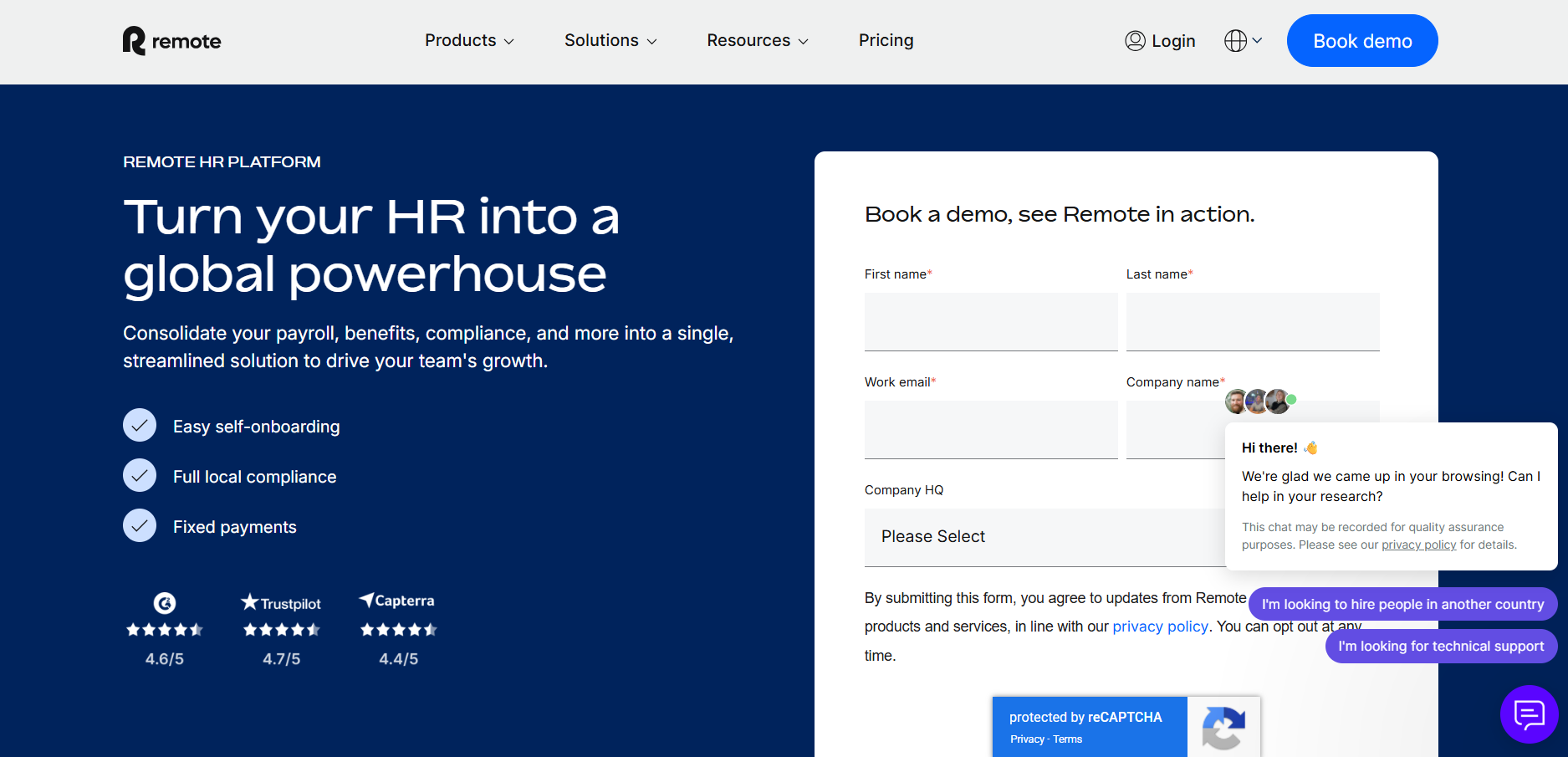
Remote is a global HR platform combining contractor management, contractor payments, and Employer of Record services across 70+ countries.
Remote lets companies schedule payments to one or multiple contractors, monitor those payments in real time, and consolidate contractor management within a single interface. It is built for teams that pay international contractors alongside full-time staff and need both payment workflows and legal infrastructure under one roof.
Unlike pure gig payment tools focused only on disbursement, Remote adds compliance infrastructure. Its Contractor Management Plus product provides misclassification indemnity covering penalties up to $100,000 per contractor and $1 million per client when companies follow Remote's guidance. This connects payment software to classification risk mitigation in a way most contractor-only platforms do not.
Core Features
- Contractor invoicing and payments with real-time monitoring and scheduled disbursements
- Contractor Management Plus with misclassification indemnity coverage
- EOR services for employing workers in 70+ countries through Remote's local entities
- Standardized workflows for contractor onboarding, tax information collection, and invoice documentation
- Global payments to contractors across borders from a centralized platform
Pros
- Integrated environment for managing contractors and employees internationally through a single vendor
- Transparent subscription pricing at $29 per contractor per month for the contractor management platform
- Misclassification indemnity through Contractor Management Plus is a distinctive compliance feature rarely offered by competitors with explicit dollar limits
Cons
- Per-contractor subscription pricing rises linearly with headcount, which can become significant at scale for companies with hundreds or thousands of contractors
- Misclassification indemnity has caps ($100,000 per contractor, $1 million per client) and requires following specific guidance, which may constrain how companies structure contractor relationships
- EOR and broader payroll services entail additional costs not captured in the contractor management subscription
Customer Review
"Instead of juggling contracts, compliance, payroll, tax documentation, benefits, and HR processes across different systems, everything is available in one place... Salaries have been processed accurately and on time." Mohak S., Director – Enterprise Solutions & Strategic Accounts, Mid-Market (G2, Jul 2026)
Pricing
From $29 per contractor per month for the contractor management platform; EOR services priced separately.
3. Papaya Global

Papaya Global is a comprehensive global payroll and workforce management platform built for enterprises scaling contractor and employee operations across multiple countries.
Papaya Global offers multiple pricing tiers, including a dedicated Contractor plan starting at $30 per contractor per month and a Workforce Payments plan at $2.50 per transaction designed for companies that need to pay international contractors compliantly in local currencies. It aggregates data from local vendors into a single dashboard, providing visibility into payroll costs and workforce metrics across regions.
Compared to pure gig payroll tools, Papaya Global emphasizes analytics and aggregation. Its multi-tier structure supports employees, contractors, and transaction-based payments within a single system, creating structured pathways for companies to evolve from contractor-heavy arrangements to formal employment. It is considered on the higher end of the pricing spectrum for payroll software.
Core Features
- Multi-tier pricing covering employee payroll, contractor management, and per-transaction workforce payments
- Unified dashboard consolidating payroll data from multiple local vendors across countries
- Local payment rails and multi-currency support through the Workforce Payments plan
- EOR services starting at $599 per employee per month for statutory employment in countries without local entities
- Centralized workforce analytics for payroll cost monitoring across entities and regions
Pros
- Breadth of functionality allows companies to manage contractors, employees, and transaction-based payments from one platform as they scale
- Multi-currency payments and local payment rails reduce friction in cross-border contractor payments
- Strong analytics orientation gives Finance and HR teams real-time visibility into global payroll costs
Cons
- Explicitly described as higher-end pricing; multiple tiers and add-on costs (customization fees, onboarding fees, additional wallets) can make total cost of ownership significant
- For smaller companies needing primarily gig worker payments, the richness of Papaya's stack may represent more than what's needed
- Specific mechanisms for misclassification analysis or automated compliance gating are not detailed in publicly available materials
Customer Review
"We were struggling with 15 different payroll vendors across 27 countries, which created massive data silos and required over 600 hours of manual work every week. Papaya solved this by providing a 'one system, one platform' approach." Öykü D., Global People Operations & EMEA Business Partner Associate Director, Mid-Market (G2, Feb 2026)
Pricing
Contractor plan from $30/contractor/month; Workforce Payments from $2.50/transaction; EOR from $599/employee/month.
4. Rippling
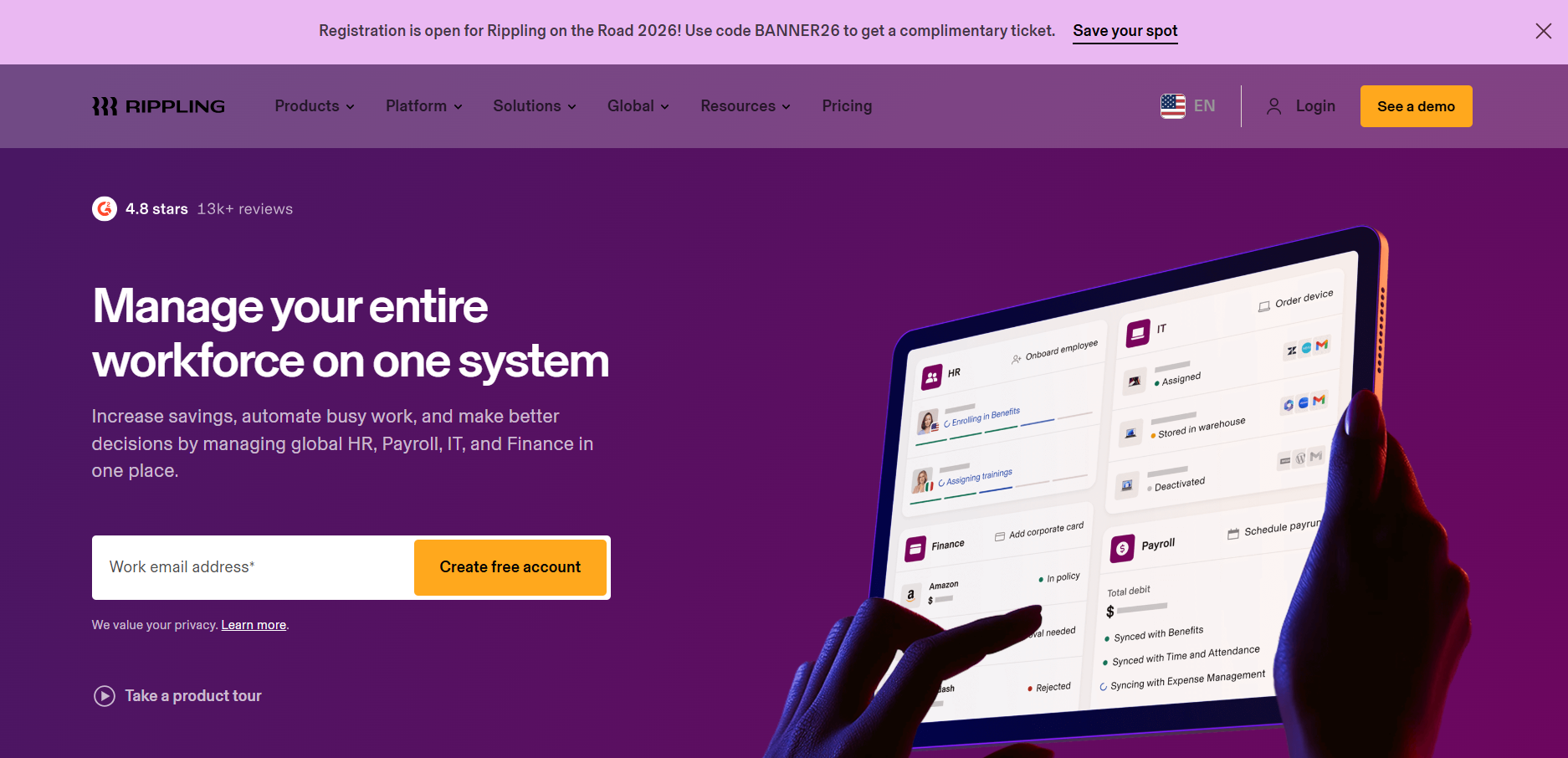
Rippling is an integrated HR, payroll, and IT management platform where contractor payments sit within a modular stack alongside employee management, benefits, recruiting, and device oversight.
Rippling's Unity module serves as the required base: an employee database and compliance foundation priced at $8 per employee per month plus a mandatory $35–$40 monthly flat fee. On top of Unity, companies add modules such as payroll (with W-2 and 1099 processing), benefits administration, recruiting, and IT/device management. See Rippling pricing for a detailed breakdown.
Rippling is best understood as a unified system for HR, payroll, and IT that includes contractor support, not a specialized gig worker payment tool. There is no dedicated "gig worker payroll" branding. For companies that combine employees and contractors and value tight integration of HR and IT, Rippling can be a relevant option, though it lacks the specialized contractor compliance gating or misclassification indemnity found in tools built specifically for large gig workforces.
Core Features
- Automated payroll runs and tax filing covering both W-2 employee and independent contractor 1099 form processing
- Modular platform with Unity base, add-on payroll, benefits, COBRA, recruiting (ATS), IT/app, and device management
- Employee database with org charts, time-off policies, SSO, and compliance foundations
- IT and device management modules integrating identity management, app provisioning, and security enforcement
- Recruiting module (ATS) enabling job postings, applicant tracking, interview scheduling, and offer letters
Pros
- High degree of integration across HR, payroll, IT, and device management reduces system fragmentation and improves data consistency
- Modular pricing lets companies add only the functions they need on top of the mandatory Unity base
- Supports both employee and contractor payments within a larger operational framework for mixed workforces
Cons
- Pricing complexity increases as modules are added; typical configurations land between $20–$35 per employee per month, with median annual contracts around $39,720–$40,122 based on verified purchase records
- No publicly documented misclassification indemnity or specialized contractor compliance gating features
- Recruiting capabilities require the Unity base and cannot be purchased standalone
Customer Review
"Massive ROI but Modular Pricing: While add-on modules can drive up the monthly cost, the ROI is huge because it replaces your standalone IT, device management, and international compliance software." Ananya B., Applied AI Engineer, Mid-Market (G2, Jul 2026)
Pricing
Unity base at $8/employee/month + $35–$40 flat fee; most companies pay $20–$35/employee/month with common modules added.
5. ADP WorkMarket
ADP WorkMarket is an enterprise contractor management platform with automated verification guardrails and transaction-level audit trails, built for large organizations managing mixed W-2 and independent contractor workforces.
WorkMarket enables companies to use automated guardrails during worker verification to help ensure contractors have the right qualifications before entering the system. It provides an audit trail for every transaction, automated invoice generation, and year-end tax filings for contractors — making it a governance-focused layer for enterprises with heavy compliance documentation requirements.
Relative to pure gig payment tools, WorkMarket's emphasis on verification and documentation differentiates it. Automated guardrails prevent unauthorized or unqualified workers from entering the system, which is particularly important in industries with strict licensing or certification requirements. The audit trail and automated invoicing provide traceability crucial for demonstrating compliance during regulatory scrutiny.
Core Features
- Contractor onboarding and verification with automated compliance guardrails
- Transaction-level audit trail for every payment and interaction
- Automated invoice creation for contractor engagements
- Year-end tax filings for independent contractors (e.g., U.S. 1099 forms)
Pros
- Automated guardrails and audit trails provide a high level of governance for enterprises managing large, mixed workforces
- Automated invoice generation and tax filings reduce manual workload and help ensure documentation consistency
- Association with ADP, a widely recognized payroll provider, signals maturity and reliability to enterprise buyers
Cons
- Pricing is not publicly disclosed; sold via custom enterprise quotes
- No explicit mention of misclassification indemnity or advanced classification analytics in publicly available materials
- Detailed payment scheduling and batch payment workflow specifics are not documented in accessible sources
Customer Review
"It's a solid platform for handling independent contractors with decent features... not necessarily great value, as we (and probably most companies) can manage ICs without a standalone program." Lam H., Small-Business (G2, Apr 2024, 2.5/5)
Pricing
Custom quote (enterprise pricing; no per-contractor or per-transaction rates publicly listed).
6.Wingspan
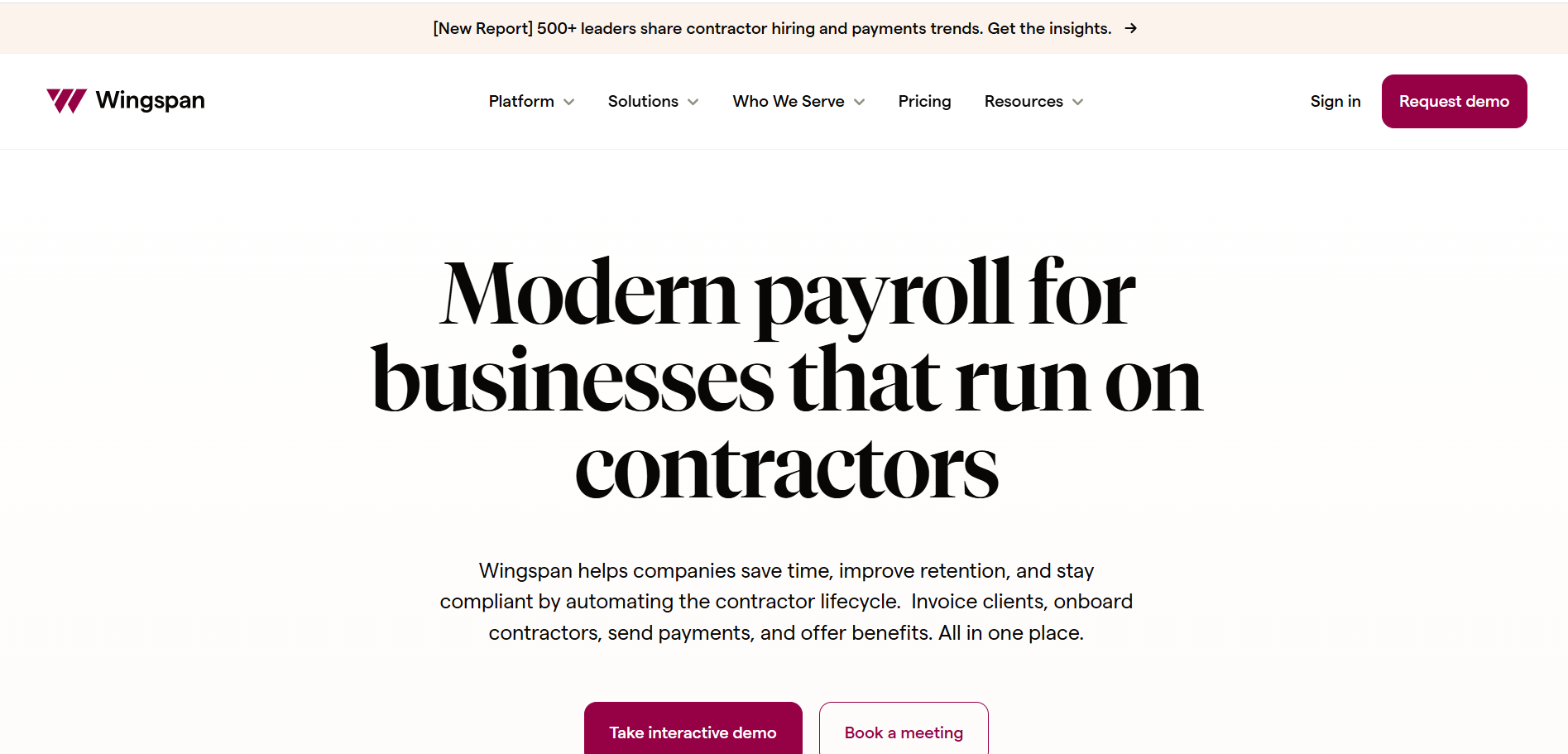
Wingspan is a contractor payroll platform focused on payment speed, compliance gating, and worker experience at scale, particularly for organizations managing 500 or more gig workers.
Wingspan offers instant payouts or a set payment schedule, giving companies flexibility between immediate disbursement and traditional periodic cycles. Its configurable compliance gating engine blocks payments when requirements are not met, such as missing tax forms or incomplete documentation, enforcing compliance workflows before funds leave the system. Wingspan also provides contractor access to worker benefits, though specific benefit types are not detailed in public materials.
Compared to other gig payroll tools, Wingspan specifically targets large contractor groups. The compliance gating engine directly addresses the risk of paying contractors in crypto or traditional methods without proper documentation in place. Instant payouts improve contractor cash flow and may be particularly attractive in gig economy contexts where workers expect rapid payment. However, its compliance gating description focuses on U.S. federal and state requirements, which may limit applicability in non-U.S. jurisdictions.
Core Features
- Instant payouts and scheduled payment options for contractors
- Configurable compliance gating engine that blocks payments when requirements (tax forms, documentation) are incomplete
- Automated compliance processes for federal and state requirements
- Access to worker benefits for contractors using the platform
Pros
- Compliance gating enforces documentation requirements before payments are disbursed, reducing the risk of filing penalties and incomplete tax records
- Instant payouts can improve contractor satisfaction and make the company more attractive to gig workers compared to organizations paying on slower schedules
- Worker benefits access provides a quasi-employee experience that helps address concerns about gig workers lacking traditional employment benefits of being an independent contractor
Cons
- Pricing is custom and may be based on Monthly Active Payees; no concrete figures are publicly available for direct comparison
- Compliance gating is focused on U.S. federal and state requirements, which may limit applicability for companies with international contractor populations
- No documented EOR or employee payroll pathway for converting contractors to full-time employees within the platform
Customer Review
"Wingspan manages all of my client invoicing as well as subcontractors... Customer service has been great." Mark B., Small-Business (G2, Nov 2023)
pricing
Custom pricing, reportedly based on Monthly Active Payees (no publicly listed rates).
What to Evaluate Before Choosing Gig Worker Payroll Software
A tool that looks adequate in a demo can break down once gig worker volume increases or the company expands across borders into unfamiliar regulatory territory.
- Classification risk flags at onboarding: Does the platform catch employment-pattern payments before they compound through compliance gating, misclassification indemnity, or automated guardrails, or does it simply process whatever classification the employer has already chosen?
- Payout speed and rails: Consider whether the platform supports domestic bank transfers, cross-border wire transfers, local payment methods, and instant payout options, since each choice affects operational complexity, costs, and alignment with local regulatory requirements for how to pay international contractors without hidden fees.
- Tax documentation handling: Evaluate whether the platform automates U.S. Forms 1099-MISC vs. 1099-NEC filings, TDS, and local equivalents by country since cross-border scenarios require adherence to each country's reporting obligations, not just U.S. 1099 processes.
- Integration depth with existing accounting stack: As gig worker volume grows, manual exports from payment platforms into accounting systems become error-prone and time-consuming, making native integration a key determinant of operational scalability and payroll management accuracy.
- Scalability past a few hundred gig workers without a re-platform: Platforms like Wingspan are explicitly framed for 500+ workers, while global HR platforms like Papaya Global and Gloroots target enterprise-scale operations, but simpler contractor tools may hit workflow limits well before that threshold.
- Whether the platform supports a path to employment when a gig relationship outgrows contractor status: The U.S. Department of Labor emphasizes that employers must classify workers correctly based on the nature of the relationship, and long-term, employer-like engagements may require employee status and statutory payroll, meaning platforms without EOR or employee payroll capabilities leave companies to manage the EOR vs contractor transition using separate tools or local legal counsel.
Where Gloroots Fits When Gig Worker Payroll Software Isn't Enough
Most platforms in this comparison optimize gig worker payments and contractor workflows. Gloroots exists for the point where a gig worker relationship needs to become compliant employment under local law.
Gloroots' Employment Lifecycle Management supports contractor-to-employee transitions. Global Payroll runs statutory, country-specific payroll once a worker is reclassified. Compliance & Employment Governance maintains audit-ready records across the full employment relationship.
- Employment Lifecycle Management: Converts gig and contractor engagements into compliant local employment contracts, supporting how to extend your independent contractor agreement to a full-time opportunity when classification rules demand it
- Global Payroll: Runs statutory, country-specific payroll once the worker is reclassified, covering tax withholding, benefits contributions, local reporting requirements, and international payroll processing
- Compliance & Employment Governance: Maintains audit-ready records documenting contracts, payroll data, and compliance decisions in a centralized system across cross-border employment relationships
The outcome: predictable, country-specific payroll and audit-ready compliance records once a gig worker is reclassified, replacing ad hoc gig payments with global payroll best practices and centralized governance.
Conclusion
No gig payroll platform on this list eliminates misclassification risk on its own. Each one automates whatever payment pattern the company has already chosen, compliant or not. The U.S. Department of Labor is clear: employers, not software, are responsible for determining whether a worker is an employee, and misclassified workers may be deprived of minimum wage and overtime protections.
For teams whose gig workforce is approaching the threshold where contractor arrangements must be re-evaluated growing headcount, longer engagements, increasing control over how work is performed gig worker payroll software alone is not enough.
Frequently Asked Questions
What is gig worker payroll software?
Gig workers are independent contractors performing short-term, flexible, on-demand jobs for one or more clients or platforms. Gig worker payroll software refers to platforms that calculate, schedule, and disburse payments to these workers, often providing tools for invoicing, independent contractor 1099 form generation, and reporting. These platforms do not take on the legal responsibilities of an employer. The category includes contractor-focused tools and broader HR platforms with modules for contractor payments.
Is gig worker payroll software the same as contractor payment software?
Industry materials frequently use "contractor payroll software" and "contractor payment software" interchangeably. Both describe platforms that help businesses pay independent contractors and manage related tax and reporting obligations. Because gig workers are defined as independent contractors performing short-term, flexible jobs, software designed to pay contractors effectively serves gig worker payroll needs. The differences between independent contractors and employees determine which payment and tax reporting processes apply, but the "gig worker" label emphasizes on-demand work patterns, whereas "contractor" may encompass a broader range of independent arrangements.
Can gig worker payroll software replace an EOR or PEO?
No. Gig worker payroll software automates payments and handles contractor tax documentation, but it does not assume the legal responsibilities of an employer of record or a PEO. An EOR becomes the legal employer of workers in specific countries, handling statutory payroll, benefits, and compliance with local labor laws. When workers meet the criteria for employee status, they are entitled to minimum wage and overtime protections, and gig worker payroll software cannot change the underlying legal classification. Those functions belong to EOR and PEO services.
What's the biggest compliance risk when buying gig worker payroll
software?
The most prominent risk is misclassifying workers who function as employees as independent contractors, then using gig worker payroll software to automate payments under that employee and independent contractor misclassification. The U.S. Department of Labor warns that misclassified employees may not receive minimum wage and overtime protections, exposing companies to back wages and penalties. Platforms with compliance gating or misclassification indemnity help, but no software independently determines worker status. Employers must make and uphold correct classification decisions under applicable laws.
How much does gig worker payroll software typically cost?
Costs vary widely. Remote's contractor management platform charges $29 per contractor per month. Papaya Global's contractor plan starts at $30 per contractor per month, with a Workforce Payments plan at $2.50 per transaction. Rippling's base module costs $8 per employee per month plus a $35–$40 flat fee, with most companies paying $20–$35 per employee per month after adding common modules. Platforms like Wingspan and ADP WorkMarket use custom pricing. Understanding the cost of an employee vs. the cost of a contractor helps frame total cost expectations beyond software fees alone.
Do gig worker payroll platforms support international payments?
Many do, particularly those positioned as global HR or payroll solutions. Papaya Global's Workforce Payments plan supports local currencies starting at $2.50 per transaction. Remote's contractor payment tools are designed for cross-border disbursement. Gloroots automates contractor payroll and compliance across 150+ countries and runs global payroll accurately across jurisdictions. However, some platforms, especially those focusing on U.S. federal and state compliance, may primarily target domestic markets. Companies should verify specific country coverage and supported currencies before committing.
When should a company move a gig worker from software-managed payments to
full employment?
When the nature of the relationship begins to resemble employee status under applicable labor laws. Indicators include long-term, ongoing engagement; significant company control over how and when work is performed; integration of the worker's role into core operations; and reliance on the worker as a key contributor rather than an occasional service provider. At that point, continuing to pay through gig worker payroll software increases misclassification risk. Companies should consider using employment infrastructure such as Gloroots' Employer of Record to convert the relationship into statutory employment.