




- An Employer of Record (EOR) legally employs workers on your behalf, managing payroll, taxes, benefits, contracts, and compliance while you retain full control over daily work and performance.
- EORs enable companies to hire employees globally without setting up local legal entities, reducing market entry timelines from months to days.
- By taking on local labor law compliance and HR administration, EORs significantly reduce legal risk, administrative burden, and exposure to non-compliance penalties.
- Businesses use EORs to accelerate global expansion, simplify remote workforce management, and maintain consistent HR operations across countries.
- An EOR model is ideal when entering new markets quickly, managing international teams, or avoiding the complexity of foreign employment laws.
Global expansion presents significant growth opportunities for businesses. However, it also introduces a major hurdle: navigating the ever-changing labor laws across different countries.
In fact, almost 70% of business leaders say that enhancing global connectivity is a must-have priority for 2025–26. As companies expand across borders and build distributed teams, Employer of Record (EOR) services play a critical role in enabling compliant, scalable global hiring without operational friction. This is where Employer of Record (EOR) services step in as a game-changer.
What exactly is an Employer of Record (EOR), and how can it help you manage a global workforce while avoiding compliance risks?
This guide explores how EORs work, the role they play in international hiring, and the key criteria to consider when choosing the right EOR service provider for your business.
What is an Employer of Record?
An Employer of Record (EOR) is a service provider that acts as the legal employer for an organization's workforce, managing essential HR functions like payroll, compliance, and administration.
The EOR assumes employment's legal responsibilities and risks, while the client company maintains direct control over its employees' day-to-day operations.
Understanding EOR Through a Real Scenario
Consider Sarah, a US-based tech startup founder who needs to hire a software engineer in Germany. Without an EOR, Sarah would need to:
- Establish a legal entity in Germany (3-6 months, €10,000-25,000)
- Navigate German employment law, which she doesn't understand
- Set up local payroll systems and bank accounts
- Handle German tax compliance and social security contributions
- Manage ongoing legal and accounting requirements
Instead, Sarah partners with an EOR. Within 48 hours, the EOR:
- Becomes the legal employer of her German engineer
- Handles all compliance, payroll, and benefits
- Ensures the employment contract meets German labor law requirements
- Manages tax withholdings and social contributions
Sarah directly manages the engineer's work, projects, and performance while the EOR handles all administrative and legal responsibilities. She's hiring globally without the complexity or cost of entity establishment.
What are the Services Provided by an Employer of Record?
An EOR plays a vital role in managing various aspects of employment for client organizations. In 2026, EORs typically provide the following core services:
1. Legal Compliance
EORs ensure adherence to local labor laws, employment regulations, and industry-specific legal requirements across all employment aspects, including:
- Employment contracts
- Payroll processing
- Benefits administration
- Other statutory employment obligations
By staying updated with evolving legal frameworks across different countries, an EOR effectively mitigates legal risks for client companies. With over 150 countries updating employment laws in 2025 alone, this expertise has become invaluable.
2. Payroll Management
EORs specialize in handling all payroll-related tasks, such as:
- Salary calculations
- Tax deductions
- Benefits administration
- Timely and accurate salary payments
By leveraging advanced payroll systems and remaining compliant with local regulations, an EOR streamlines payroll operations. Modern EORs now process payroll in 120+ currencies and manage multi-country payroll from a single platform, eliminating the need to operate separate systems for each location.
3. Tax Compliance
Tax compliance is a complex area that requires specialized knowledge and close attention to detail. EORs take full responsibility for managing tax-related obligations, including:
- Withholding and remitting taxes
- Filing tax returns
- Maintaining accurate tax records
By staying current with tax laws across jurisdictions, an EOR helps minimize tax liabilities for clients. In 2026, with increased global tax transparency requirements and automatic information exchange between tax authorities, this service has become even more critical.
4. HR Administration
EORs manage employees throughout their entire employment lifecycle, covering key HR functions such as:
- Employee onboarding and offboarding
- Benefits administration
- Performance management
- Leave and absence management
- Compliance with HR policies and procedures
They also support employee relations, disciplinary processes, and the resolution of HR-related issues to maintain a compliant and productive work environment. Advanced EOR platforms now offer self-service portals, allowing employees to access documents, submit requests, and track benefits in real time.
How Does Hiring Through an Employer of Record Work?
Understanding the hiring process through an EOR helps you see how seamless global hiring can be. Here's a step-by-step breakdown:
Step 1: Identify Your Hiring Needs
- You identify the role, location, and specific requirements for your international hire.
- You determine whether you need full-time employees, part-time workers, or project-based contractors.
Step 2: Partner with an EOR
- You select an EOR that operates in your target country.
- You share the job details, compensation structure, and any specific requirements with the EOR team.
Step 3: Candidate Selection and Offer
- You conduct your recruitment process independently or with your recruitment partners.
- Once you've selected the ideal candidate, you inform the EOR, who then prepares a compliant employment offer based on local labor laws.
Step 4: Employment Contract Creation
- The EOR drafts a legally compliant employment contract in the local language (if required) that meets all statutory requirements.
- This includes terms around compensation, benefits, working hours, notice periods, and termination clauses specific to that country.
Step 5: Onboarding and Documentation
- The EOR handles all onboarding paperwork, including tax forms, work permits (if needed), background checks, and benefit enrollments.
- The employee is legally employed by the EOR, while you manage their day-to-day work and responsibilities.
Step 6: Ongoing Payroll and Compliance
The EOR processes
- Monthly payroll
- Deducts and remits taxes
- Manages statutory benefits
- Ensures ongoing compliance with local labor laws
You approve timesheets or confirm salary payments, and the EOR handles the rest.
Step 7: Continuous HR Support
Throughout the employment relationship, the EOR provides HR support to the employee for questions about
- Benefits
- Tax documents
- Employment terms
- Local regulations
You focus on managing work performance and projects
Step 8: Offboarding (When Needed)
If the employment ends, the EOR manages the termination process according to local laws, including
- Notice periods
- Severance calculations (if applicable)
- Final payments
- All required documentation
The entire process from partnering with an EOR to having an employee start work typically takes 48-72 hours in most countries, compared to 3-6 months for entity establishment.
Why Should Your Organization Consider Hiring Through an Employer of Record?

An Employer of Record is a practical solution for companies that need to hire globally while staying compliant. EOR services are especially valuable in the following situations.
1. Global Expansion
EORs help companies expand into new markets quickly without the complexity of setting up local entities. Instead of navigating foreign corporate laws, banking, and tax registrations, the EOR acts as the legal employer so operations can begin faster. This is especially valuable when hiring in countries like India, where partnering with an EOR in India simplifies local compliance, PF, ESI, and TDS management.
- Enter new markets without establishing a legal entity
- Launch operations in weeks instead of months
- Test new regions without long-term financial commitment
By managing payroll, taxes, and benefits across jurisdictions, EORs allow businesses to focus on growth rather than administrative overhead.
2. Building and Managing Remote or Distributed Teams
EORs simplify the process of hiring and managing employees across multiple countries from a single framework. This makes it easier to build global teams without adding HR complexity.
- Hire talent globally without geographic limitations
- Centralize payroll, benefits, and HR administration
- Deliver a consistent employee experience across locations
Accurate payroll in local currencies and streamlined HR processes make EORs especially valuable for teams working across time zones.
3. Avoiding Employee Misclassification
As governments increase scrutiny on worker classification, ensuring compliance has become critical. EORs help companies apply the correct employment framework in every jurisdiction.
- Reduce exposure to fines, back taxes, and legal disputes
- Apply country-specific classification rules correctly
- Stay aligned with evolving labor regulations
This is particularly important in regions with strict labor protections, where misclassification penalties can be significant.
4. Short-Term Projects
For international projects lasting six to eighteen months, setting up a legal entity often adds unnecessary cost and complexity.
- Support temporary hiring without permanent infrastructure
- Manage compliance, payroll, and HR for project teams
- Simplify offboarding when the project ends
This flexible approach works well for consulting, construction, and technology teams that rely on short-term international assignments.
What are the Benefits of Partnering with an EOR?
Partnering with an Employer of Record simplifies global hiring by removing much of the legal, payroll, and compliance burden from internal teams. Instead of managing multiple country-specific requirements, businesses work with one partner while staying focused on growth.
1. Reduced Legal and Compliance Risk
Employment laws differ by country and change frequently. EORs manage compliance across the entire employment lifecycle, including:
- Employment contracts and local labor law adherence
- Payroll execution and statutory deductions
- Benefits administration and lawful terminations
By taking on these responsibilities, EORs significantly reduce exposure to legal disputes, fines, and reputational damage. This protection is increasingly important in 2026 as governments tighten enforcement and expand employment audits.
2. Lower Costs and Operational Overhead
Setting up and maintaining local entities is expensive and time-consuming. An EOR eliminates these costs by removing the need for:
- Entity formation and ongoing legal maintenance
- Local accounting, tax filings, and administrative overhead
- Large in-house HR and payroll teams
Through centralized operations and economies of scale, EORs help businesses reduce total employment costs by 40–60% compared to managing international hires through local entities.
3. Faster and Safer Global Expansion
EORs allow companies to hire employees in new countries without waiting months for legal setup. This is particularly valuable when entering markets with complex regulations or unfamiliar labor frameworks.
By handling onboarding, compliance, and, where required, work authorization, EORs help companies scale globally with speed while minimizing risk.
4. Access to Specialized Global Expertise
EORs provide direct access to experienced HR, legal, and compliance professionals who continuously monitor regulatory changes across more than 150 countries. This removes the burden of tracking evolving employment laws internally.
Many EORs also deliver workforce insights such as:
- Local salary benchmarks and employment cost comparisons
- Country-specific hiring trends and workforce data
These insights support better planning and help businesses make informed, data-driven global hiring decisions.


EOR vs New Entity vs PEO vs Staffing Agency
Instead of partnering with an Employer of Record, businesses can engage a professional employer organization (PEO), work with staffing agencies, or open a new entity in a foreign country.
Let's delve into the key differences between these approaches:
By evaluating these options based on these criteria, companies can determine which workforce solution best aligns with their needs, budget, and growth objectives.
How Much Does an EOR Cost?
The cost of an EOR varies depending on factors such as the services required, the number of employees, geographic locations, and the EOR provider's pricing model. The two common types of pricing models are:
1. Fixed Pricing
Fixed pricing involves a set monthly fee for the EOR services per employee. This fee remains consistent regardless of the services provided. Fixed pricing offers predictability, allowing businesses to budget effectively without unexpected cost fluctuations.
Some EORs offer tiered fixed pricing plans based on the number of employees, allowing for scalability as the business grows. Typical fixed pricing ranges from $199 to $799 per employee per month, depending on the country and service level.
When to Choose Fixed Pricing:
- When you need budget certainty and predictable costs
- For long-term employment relationships (12+ months)
- When managing multiple employees across various countries
- If your finance team prefers straightforward, consistent billing
- When comparing total employment costs across different locations
Fixed pricing works best for companies building stable, long-term international teams where headcount planning is predictable.
2. Variable Pricing
Certain EORs charge clients based on a variable pricing model, where the fee is based on using EOR services. This could include a percentage of payroll (typically 8-15%) and charges for specific services rendered.
When to Choose Variable Pricing:
- For short-term projects or contracts (3-12 months)
- When the workforce size fluctuates significantly month-to-month
- For high-value employees, where fixed fees become disproportionate
- When testing new markets before committing to regular headcount
- If you prefer aligning costs directly with payroll expenses
Variable pricing suits companies with dynamic hiring needs or those piloting international expansion before scaling.
When choosing pricing models, businesses should assess their budget, workforce size, growth projections, and the level of flexibility required. The models should align with the company's financial goals and operational needs. Many modern EORs offer hybrid models that combine elements of both approaches.
How to Choose the Right Employer of Record?
Choosing the right EOR service provider is critical for businesses planning global expansion while maintaining compliance and operational efficiency. Rather than focusing only on coverage or pricing, it’s important to evaluate how well the EOR can support your long-term hiring and growth goals.
1. Global Capabilities
Start by assessing whether the EOR can operate effectively in the countries where you plan to expand. A strong provider should demonstrate:
- Proven experience across multiple countries or regions
- Deep knowledge of local labor laws and employment regulations
- Access to in-country legal and compliance experts
It’s also important to understand how they operate locally. Verify whether the EOR has its own entities and banking relationships or relies on third-party partners, as direct infrastructure often leads to faster issue resolution and better service quality.
2. Reputation and Experience
An EOR’s track record is a strong indicator of reliability. Look for providers with experience supporting businesses similar to yours and managing complex workforce and compliance scenarios.
- Review client testimonials and case studies
- Check independent review platforms such as G2 or Capterra
- Ask about experience in your target countries and industries
Consistent positive feedback, especially around compliance handling and responsiveness, is a good sign of a mature provider.
3. Technology and Support Infrastructure
The EOR's technology stack plays a major role in day-to-day efficiency.
Evaluate whether their platform supports key functions such as payroll, HR
administration, compliance tracking, and reporting. Modern
EOR software centralizes all these functions into one dashboard, offering self-service
portals, automated workflows, and real-time visibility into your global
workforce.
Look for practical features that reduce manual effort, including:
- Employee self-service portals
- Real-time dashboards for clients
- Automated workflows and approvals
- Integrations with HRIS, accounting, and project management tools
Seamless integration with your existing systems helps avoid operational bottlenecks as you scale.
4. Cost Analysis and Transparency
Request a clear and detailed pricing breakdown before committing. This should cover setup fees, ongoing charges, and any additional costs that may apply over time.
Pay close attention to:
- What is included in the base fee
- Charges for contract changes, offboarding, or compliance updates
- Whether pricing is fixed or variable
Transparent pricing and clear communication help prevent unexpected cost increases and make budgeting more predictable.
5. Client References and Testimonials
Speaking directly with existing or past clients can provide valuable insight into how the EOR performs in real-world scenarios.
- Ask about their overall experience and satisfaction
- Understand how the EOR handles compliance issues and urgent requests
- Evaluate the quality and responsiveness of their support team
Consistent feedback from clients often reveals strengths and potential red flags that aren’t visible in sales materials.
Choose Gloroots as Your Employer of Record
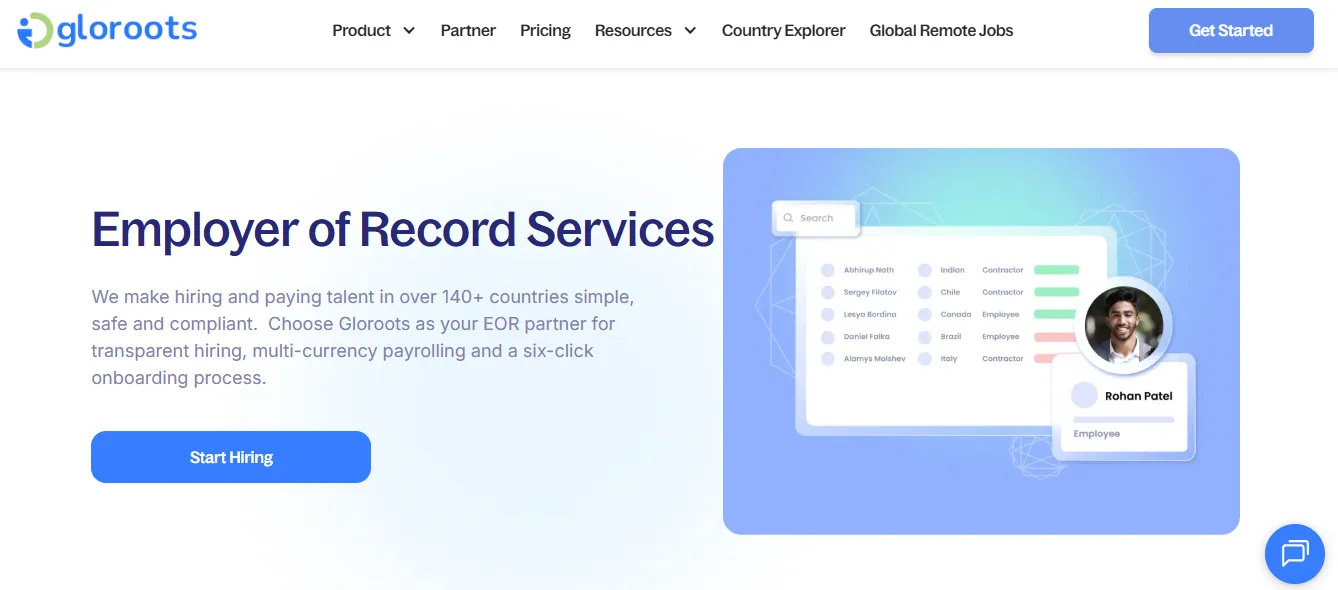
Gloroots offers comprehensive EOR services and unmatched support to help you overcome the challenges and complexities of international operations.

Our expertise in global compliance, robust technology infrastructure, and client-centric approach make us the ideal choice for businesses seeking to streamline their global workforce management.
With coverage across 150+ countries, fixed transparent pricing, 24x7 support, and a proven track record of processing millions in payroll with zero compliance violations, Gloroots simplifies global hiring so you can focus on growth.
Choose Gloroots as your EOR partner and get started in days.
Ready to expand globally with confidence? → Book a demo to see how Gloroots handles compliance, payroll, benefits, and HR administration for your international team all from one platform.
Frequently Asked Questions
1. What is the difference between an EOR and a PEO?
An EOR becomes the legal employer and enables global hiring without setting up local entities. A PEO works under co-employment and requires you to already have a legal entity.
2. What are the potential cons of using an EOR?
EORs may offer less direct HR control and can be costlier at scale for large permanent teams. They may also limit highly customized benefit structures.
3. Is it easier to open an entity in another country or use an EOR?
Using an EOR is much faster, typically taking days instead of months. It also avoids high upfront setup and ongoing entity maintenance costs.
4. Can you onboard contractors through an EOR?
Yes, many EORs support contractor onboarding, payments, and compliance. It’s important to confirm the provider offers dedicated contractor management services.
5. When should you consider Employer of Record vs. a staffing agency?
Use an EOR for long-term employees in countries where you lack entities. Staffing agencies are better suited for short-term or temporary hiring needs.