

![Top 6 Crypto Payroll Software for Global Teams [2026]](https://cdn.prod.website-files.com/68c510b68e14d08336fa01cd/6984267f6cd22438f0ba27a2_652cd5e734643bdb170e3dde_Best%2520crypto%2520payroll%2520software.avif)

Crypto payroll software lets companies pay employees and contractors in Bitcoin, Ethereum, stablecoins, or other digital assets alongside or instead of traditional currency.
- Over a third of millennials and half of Gen Z are open to receiving 50% of their salary in crypto, making crypto payroll a talent attraction tool for global teams
- The best crypto payroll platforms handle both fiat and crypto payouts from a single dashboard, with automatic tax compliance and multi-currency support
- Key factors to evaluate are tax compliance, data security, supported cryptocurrencies, integration capability, and pricing transparency
- Gloroots supports crypto pay-in and payouts alongside full EOR and contractor management, starting at $199/month per employee and $29/month per contractor
- Not all providers are full employment stacks: some handle payments only (Bitwage) while others cover full EOR compliance (Gloroots, Deel)
Cryptocurrency is reshaping how global teams get paid. Bitcoin, Ethereum, and stablecoins are now serious payroll management options, not just speculative assets, for companies hiring across borders. Gen Z and millennials are driving this global shift faster than most finance teams expected. According to a Nasdaq press release in 2026, over half of Gen Z employees are open to receiving 50% of their salary in cryptocurrency, a number that has only grown since 2023.
Here is what that means practically for businesses running international payroll processing today:
• Crypto payroll reduces cross-border transfer fees compared to traditional wire transfers
• Stablecoins like USDC remove the volatility risk that concerns most finance teams
• Global hiring and crypto compensation are increasingly linked as a talent retention strategy
This guide covers the top 6 crypto payroll platforms vetted for 2026, what they each do well, where they fall short, and which fits your team.
Quick Overview of the Top 6 Crypto Payroll Software
{{eor-solution="/components"}}
Top 6 Crypto Payroll Software
There are many crypto payroll software to consider. Here are some of the best ones.
1. Gloroots - Best for Multi-Country Teams

If you're running payroll across multiple countries and want crypto in the mix, Gloroots is built for exactly that. It covers 150+ countries as an EOR platform where you fund payroll in crypto or fiat, and employees decide how they receive it: Bitcoin, Ethereum, USDC, or local currency.
A single employer payment automatically splits into multiple currencies and wallets. FX rates, EOR fees, and compliance status are visible before anything is processed. No surprises mid-cycle.
The part most crypto payroll tools miss is global payroll compliance. Gloroots handles local tax withholding, regulatory filings, and employment contracts alongside the crypto conversion and distribution. You are not stitching together a separate crypto tool with a separate EOR.
For teams managing contractor payroll across several regions, Gloroots runs unlimited contractor payments in one transaction. For companies exploring global payroll outsourcing, it handles EOR, payroll processing, and crypto distributions in a single platform.
Key features:.
• Crypto pay-in and customizable payouts (BTC, ETH, USDC, USDT) — employees choose their preferred currency at payout, giving global teams payment flexibility without adding Finance team complexity or requiring additional vendor coordination.
• Single-click multi-currency payroll with automatic conversion — one payroll run converts and distributes across currencies simultaneously, reducing manual processing overhead and eliminating per-transfer FX errors for globally distributed teams.
• Full EOR compliance alongside crypto distribution — local tax withholding, statutory filings, and employment contracts are managed in the same platform as crypto payouts, removing the need for a separate compliance vendor as headcount scales.
• Unlimited contractor payments in one transaction — companies with large contractor networks across multiple regions can process all payments simultaneously, cutting processing time and reducing per-transaction costs at scale.
Best for:
Mid-to-large companies (20+ employees) expanding into emerging markets. Web3 businesses using crypto as a talent differentiator. Teams managing multi-country payroll who need compliance built in, not bolted on.
Pricing:
- Contractors: $29/month
- EOR employees: $199/month
- Multi-currency and crypto payouts included



2. Papaya Global – Best for Enterprise-Scale Operations
Papaya Global is a full workforce management system. Think centralized HR data, benefits administration, compliance tracking, and AI-powered payroll validation across 100+ countries. Crypto is one payment option in a much larger toolkit.
What sets Papaya Global apart is AI audits every payroll run before processing. It checks gross-to-net calculations, compliance requirements, and policy adherence automatically. The platform syncs with your ERP, time tracking, and expense tools through cloud connectors.
Papaya becomes your compliance hub. It calculates local taxes, manages social contributions, processes benefits enrollment, and generates journal entries for your accounting system. Employees can opt for crypto payments, but the real value is in automated compliance management.
Key features:
- Payroll processing in 100+ countries with crypto options
- Centralized employee data and benefits tracking
- Automated tax and compliance calculations
- ERP system integration
Where it struggles:
EOR costs start at $599 per employee monthly—one of the priciest options available. Implementation takes 4+ weeks and demands significant internal resources. The learning curve is steep, especially for small HR teams.
Best for:
Large enterprises (100+ employees) with complex ERP systems. Companies managing benefits at scale across diverse jurisdictions. Organizations expanding aggressively who need implementation support and deep compliance expertise.
Pricing:
- Contractors: $2/month
- Full-service payroll: $12/employee/month
- EOR services: $599/employee/month
- Payment processing: $3/employee/month
3. Deel – Best for Fast-Moving Startups
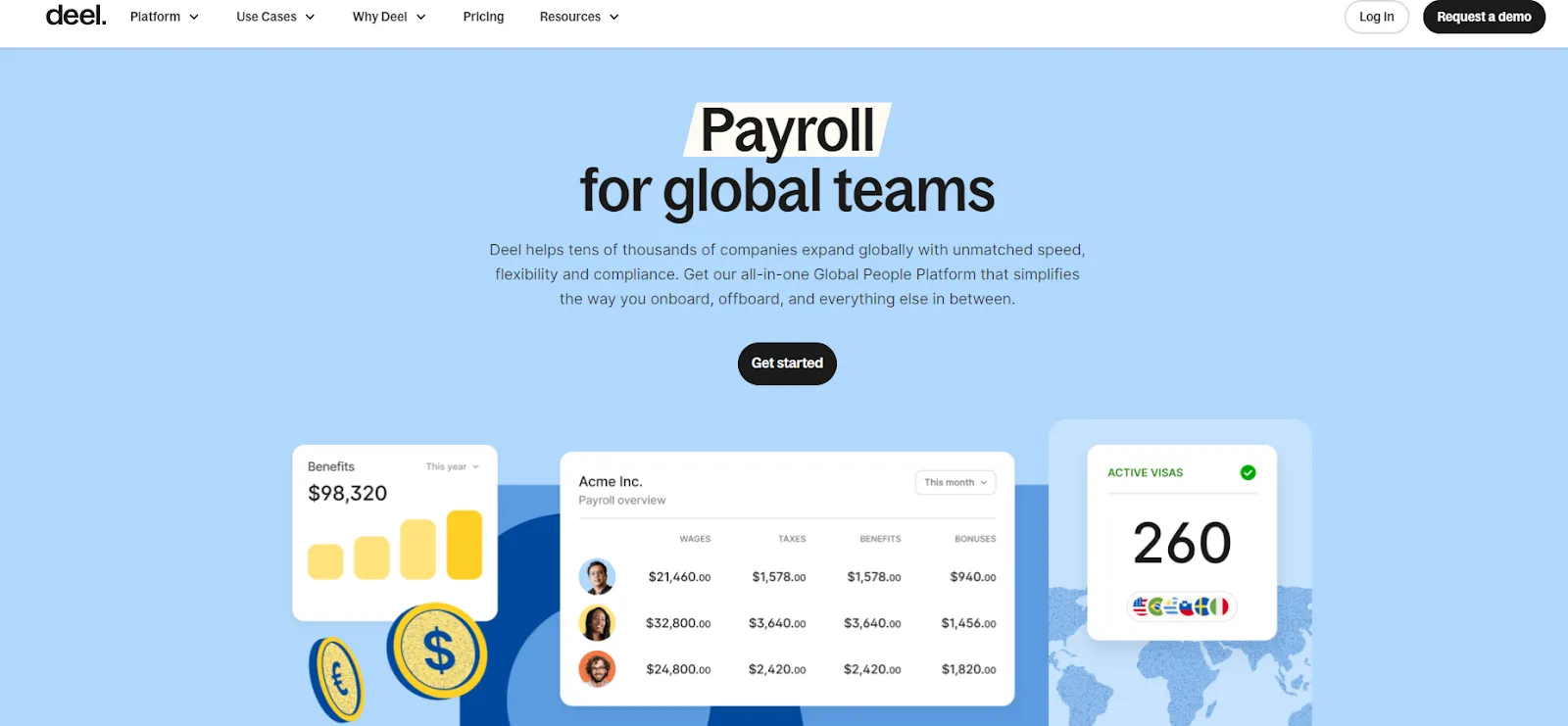
Deel built its reputation on speed. Fast onboarding, responsive support, and straightforward processes make it popular with founders hiring internationally for the first time. It handles both contractors and full-time employees (via EOR) in 150+ countries.
You can onboard a contractor in hours, not days. Deel handles compliance, contracts, and payments through one interface. Crypto payouts are available for employees who want them, though most still choose fiat.
For contractors, Deel processes payments and manages invoicing. For employees, it becomes your legal employer in the target country—handling contracts, tax filings, benefits, and regulatory requirements. You manage both through a single dashboard.
Key features:
- Contractor and EOR onboarding in 150+ countries
- Real-time payments in multiple currencies
- Automated tax filings and compliance documentation
- Crypto payout options
Where it struggles
EOR pricing hits $599 per employee monthly—expensive when scaling. Users report payment date inconsistencies that create cash flow headaches. Benefit customization is limited compared to specialized HR platforms.
Best for
Early to mid-stage tech companies (10-50 employees) hiring globally for the first time. Startups mixing contractors and full-time staff. Web3, AI, and SaaS teams that value speed over deep customization.
Pricing:
- Contractors: $49/month
- EOR employees: $599/month
- Global payroll only: $29/employee/month
4. Bitwage – Best for Crypto-Native Companies
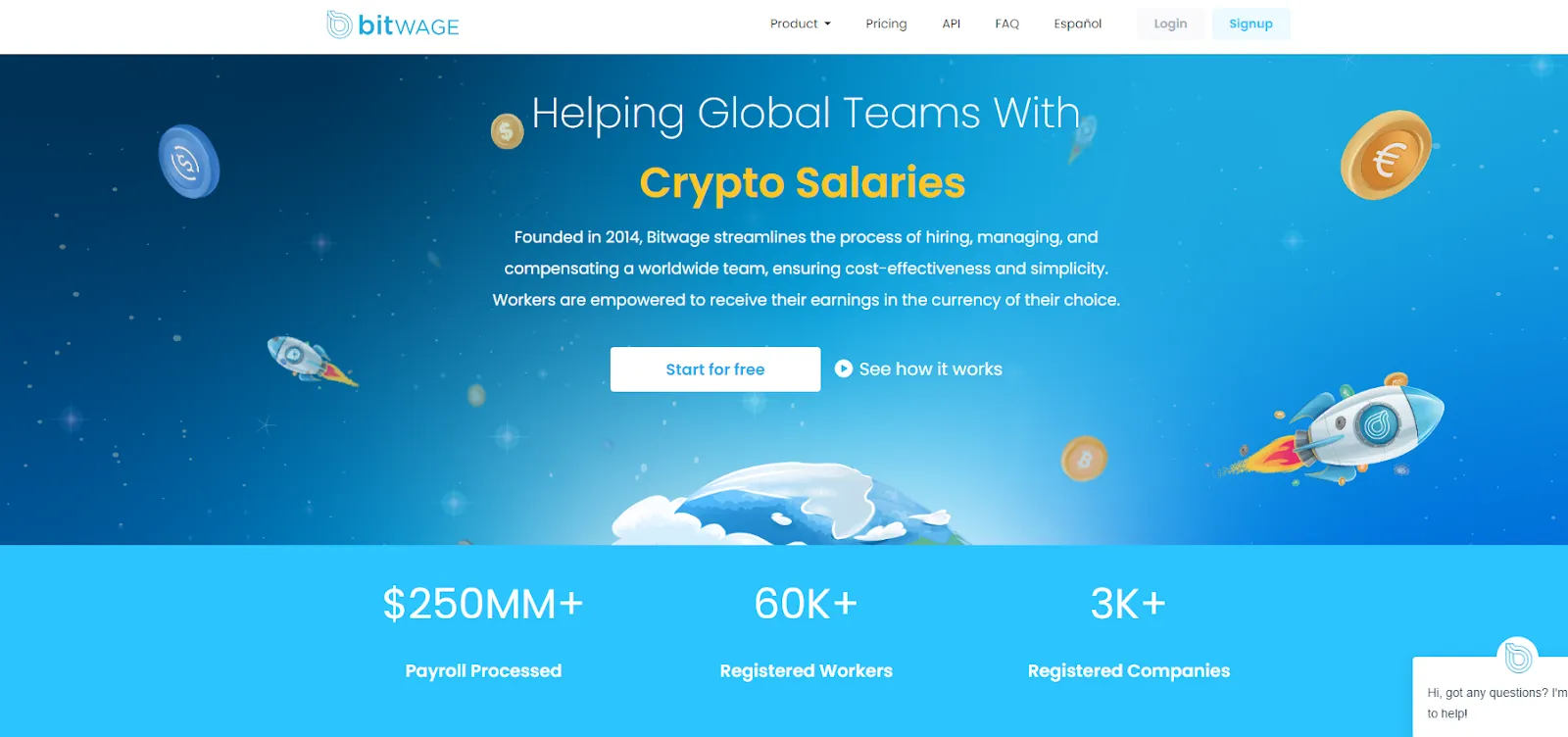
Bitwage does one thing exceptionally well: it adds crypto payment flexibility to your existing payroll system. It's not an EOR. It doesn't handle compliance. It's a payment layer that plugs into ADP, Gusto, TriNet, and similar platforms.
Employees choose their own payment mix—stablecoins, Bitcoin, Ethereum, or fiat in any combination. Bitwage converts and routes payments without holding your crypto. It's non-custodial, reducing security risks.
You fund payroll in crypto or fiat. Bitwage converts based on employee preferences and distributes to wallets or bank accounts. Your existing payroll provider still handles taxes, employment contracts, and compliance. Bitwage just manages the payment mechanism.
Key features:
- Multi-currency crypto-to-fiat conversion
- Non-custodial payment processing
- Integration with major payroll providers
- Support for nearly 200 countries
Where it struggles
Zero compliance support—you're responsible for taxes, employment law, and regulatory filings. Recent regulations have limited stablecoin options for U.S. employees. You need an existing payroll system; Bitwage can't operate standalone.
Best for
Web3 and crypto-native companies with payroll infrastructure already in place. Organizations with employees actively requesting crypto compensation. Companies in crypto-friendly jurisdictions like Singapore, Puerto Rico, or Malta.
Pricing:
- Free plan: Limited features, 2% fee on stablecoins, 1% on fiat
- Premium: $7.99/employee/month, zero stablecoin fees
5. OnTop – Best for Culture-Focused Startups
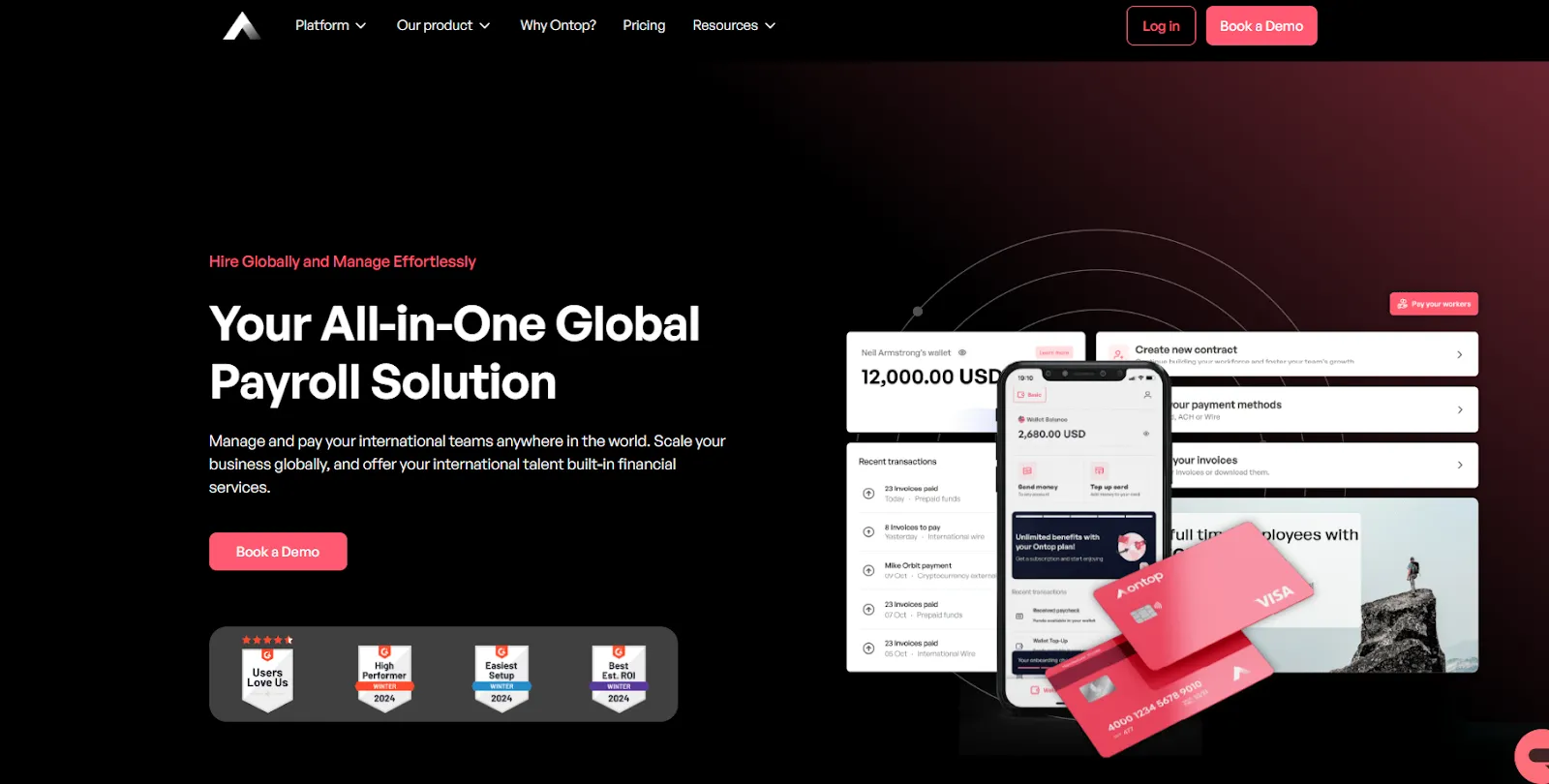
OnTop bundles payroll with performance management and employee recognition. It's less about compliance depth and more about consolidating HR operations. Crypto payouts are available, but they're secondary to the engagement features.
You can run performance reviews, peer feedback cycles, and recognition programs in the same system that processes payroll. It's designed to reduce software sprawl for smaller teams.
OnTop replaces multiple HR tools with one platform. You manage compensation, reviews, feedback, and recognition through shared employee data. Crypto payments are an option, but you'll still need a traditional payroll or EOR provider for compliance and taxes.
Key features:
- Customizable performance review cycles
- Employee recognition and rewards programs
- Crypto payment support
- Integrated HR and payroll data
Where it struggles
Limited support for complex payroll structures—multiple benefit tiers, custom deductions, or unusual arrangements don't work well. The feature set creates a learning curve for administrators. Support can be slow during peak periods.
Best for
Early to growth-stage tech companies (under 100 employees) prioritizing culture. Startups wanting to consolidate HR and payroll tooling without complex international needs. Teams that value internal engagement over deep compliance features.
Pricing
Not publicly listed - contact for custom quotes.
6. Rise – Best for Maximum Crypto Flexibility
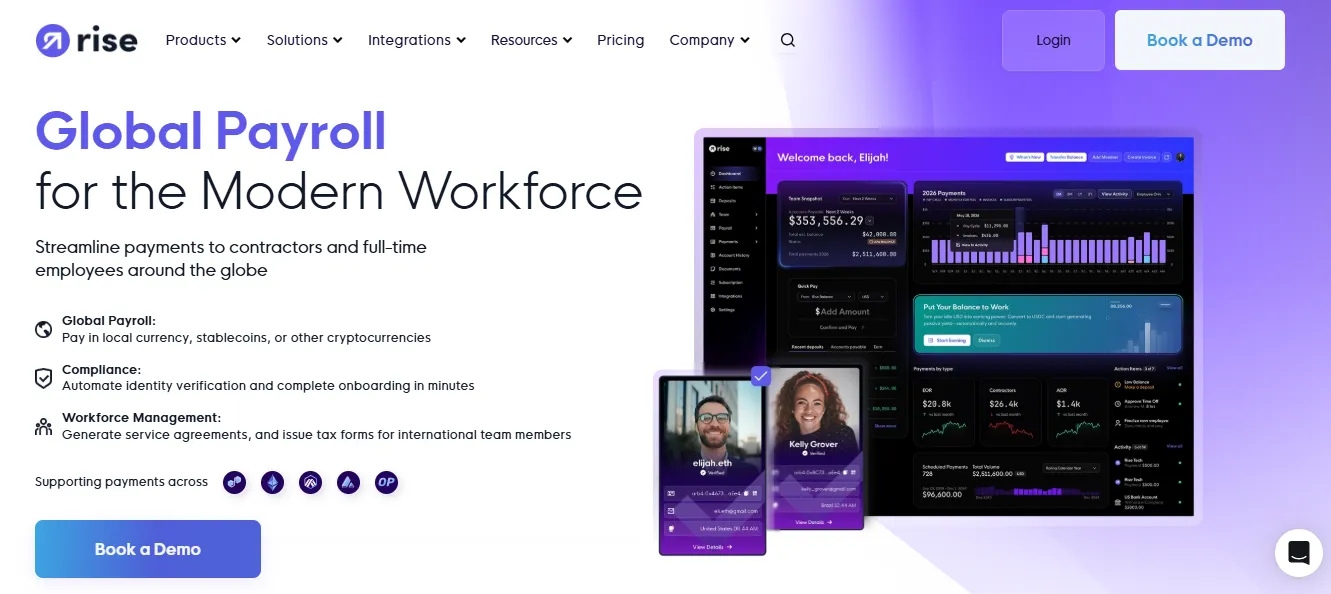
Rise (formerly Rise Works) is built for teams that want crypto payroll without locking into one blockchain or token. It supports over 100 cryptocurrencies and 90+ fiat currencies, making it one of the most flexible payment platforms for global teams.
Rise works as a global payroll and contractor payment platform. Employees and contractors set up wallets within Rise and choose how they receive earnings: Bitcoin, stablecoins, Ethereum, or fiat. Payments run with low fees and near-instant transfers. For finance teams prioritising global payroll automation, Rise handles scheduling, conversion, and wallet distribution automatically.
What separates Rise from most alternatives is the breadth of crypto support combined with compliance documentation. The platform covers international contractor agreements, payment scheduling, and tax paperwork. It is not a full EOR, but it handles the payment and compliance layer well.
Key features:
- Support for 100+ cryptocurrencies and 90+ fiat currencies
- Automated low-fee global payroll runs
- Contractor and employee payment management
- Built-in compliance documentation and payment scheduling
Where it struggles:
Rise lacks full EOR capabilities, so you will still need a separate legal employer for full-time hires in new markets. The breadth of crypto options can feel excessive for teams that only need stablecoin or BTC payouts.
Best for:
Web3 companies, crypto-native startups, and distributed teams wanting maximum currency flexibility. Organisations with contractors across multiple regions who want automated, low-cost crypto distribution.
Pricing:
Contact Rise for current pricing. Plans vary based on team size and payment volume.
What are the benefits of crypto payroll software?
Best crypto payroll software integrates cryptocurrency payments into businesses' accounting processes, automating invoicing management and settlement. Understanding global payroll benefits helps you evaluate whether adding crypto to your payroll mix makes sense for your business. Here are the core benefits of using crypto payroll software:
1. Low cost
Crypto payroll solutions can be cheaper than traditional remittance and payout solutions, as they often have lower transaction fees.
2. Increased efficiency, accuracy, and cost savings
Crypto payroll software can help streamline the payroll process, reducing the time and resources needed to manage employee payments. This can increase efficiency and accuracy, along with cost savings.
3. Enhanced security and privacy
Crypto transactions take place on a peer-to-peer network. No intervention of an intermediary financial institution or government organization occurs here. Best crypto payroll software enhances security and privacy, for example, by keeping the employee data safe.
4. Global accessibility
Crypto payroll can be particularly beneficial for companies with global workforces, as cryptocurrency transactions are near-instant and have low transaction fees.
5. Flexibility
Best crypto payroll software can offer greater flexibility in payment options, allowing employees to receive payments in various cryptocurrencies.

6 Factors to consider in a crypto payroll software
1. Regulatory & Tax Compliance
Make sure the tool can handle crypto-specific tax rules, local labor compliance, and automatic conversion to fiat for reporting. It should simplify filings, not add manual work.
2. Security & Data Protection
Since payroll deals with wallets and private data, ensure the platform uses encryption, cold storage for funds, and strong access controls. Robust security also reduces exposure to fraud risks, including those covered under payroll detection and preventing ghost employee practices.
3. Multi-Currency & Blockchain Support
Choose software that supports major tokens (BTC, ETH, USDC) and lets you switch or add currencies easily as your payment strategy evolves.
4. Automation & Accuracy
Prioritize software that automates payroll runs, crypto conversions, and deductions. Manual calculations or wallet transfers increase risk and error.
5. Integrations with Existing Systems
Check that it connects smoothly with HR, accounting, and ERP tools so payroll data flows automatically—no duplicate entries.
6. Scalability & Support
Pick a vendor with proven reliability, responsive support, and the capacity to handle global teams as you grow. A weak vendor choice can introduce compounding payroll risk management challenges as headcount and jurisdictions scale.
How to Set Up Crypto Payroll with Gloroots in 7 Steps
Implementing crypto payments isn't just flipping a switch. You need infrastructure, employee buy-in, and bulletproof compliance. Here's how to roll out crypto payroll using Gloroots without the guesswork.
1. Lay the Groundwork
Three things come first. Secure admin access to your Gloroots account and verify your company profile is complete. Have legal review of crypto wage requirements in every country you operate, withholding rules and labor laws differ drastically.
Decide your treasury strategy: pay directly in crypto or convert fiat at payout time. Most teams pick stablecoins like USDC to sidestep volatility.
2. Build Your Payment Policy
Who gets paid in crypto? Make it clear upfront. Some companies offer it across the board, others let employees opt in, and some restrict it by region.
Choose your supported currencies (USDC, USDT, ETH, or BTC) Then tackle exchange rate risk: lock in fiat amounts (you absorb fluctuations) or fixed crypto units (employees carry the risk). Stablecoins solve most of this problem.
3. Configure Your Gloroots Account
Open your Gloroots dashboard and head to Company Settings. Turn on crypto payments under your payment methods. Connect your funding source (bank wire, ACH, card, or direct crypto deposit)
Set conversion preferences so the platform knows when to trade and which liquidity provider to tap.
4. Onboard Employees the Right Way
Crypto doesn't erase compliance obligations. Collect signed consent forms spelling out volatility risks and tax treatment. Capture wallet addresses and double-check them.
You still need tax IDs, signed contracts, and withholding paperwork. Crypto is a payment method, not a regulatory shortcut.
5. Fund Your Payroll and Run Payments
Move funds into Gloroots as fiat or crypto. Paying in fiat? Set your conversion window and slippage tolerance. Using crypto? Add extra for gas fees. When you trigger payroll, Gloroots handles gross pay calculations, deductions, and local tax compliance automatically. Select crypto distribution for eligible workers.
The platform converts currencies and pushes payments to wallets in one go. Save those transaction hashes for your records.
6. Reconcile and Report
Pull payroll reports from Gloroots after each cycle. Log crypto payments at their fiat value for tax filings. Track gains or losses if crypto sits on your balance sheet. Gloroots gives you clean reporting, but local accounting standards still matter. Loop in your accountant early.
7. Review and Optimize
Confirm employees received their payments using transaction IDs and payslips. Check your currency mix quarterly. Seeing complaints about volatility? Shift more people to stablecoins. Run compliance checks every few months to verify withholding across jurisdictions.
Gloroots covers 150+ countries, but local rules are your responsibility.
Conclusion
The best crypto payroll software should be easy to use, solve complex multi-country transactions easily, ensure accuracy, and offer the benefits of cryptocurrency payroll.
If you’re looking for trustworthy crypto payroll software, choose Gloroots. We offer payment through cryptocurrency and ensure all your payroll needs are taken care of.
If you’re looking for a reliable employee EOR that helps in contractor onboarding compliantly, payroll for international contractors, tax split according to the countries in the contractor payroll, and managing payroll through crypto, check out Gloroots.

Frequently Asked Questions
1. What is crypto payroll software?
Crypto payroll software automates paying employees and contractors in cryptocurrency, handling wallet distributions, crypto-to-fiat conversions, and tax compliance. Platforms like Gloroots combine EOR services with crypto payments, making global hiring and multi-currency payroll manageable in one place.
2. Is crypto payroll legal?
Crypto payroll legality depends on your jurisdiction. Most countries permit it but require tax calculations in local fiat currency. Platforms like Deel and Gloroots manage local compliance requirements, ensuring businesses meet reporting obligations while employees receive cryptocurrency compensation.
3. Which crypto payroll software is best for global teams?
Gloroots is the strongest choice for global teams, covering 150+ countries with full EOR support and flexible crypto payout options. Deel and Rise are solid alternatives for companies needing fast onboarding or a broader cryptocurrency variety across international contractors and employees.
4. How do stablecoins reduce risk in crypto payroll?
Stablecoins like USDC and USDT are pegged to fiat currencies, eliminating volatility. Employees receive predictable payment values regardless of market conditions. Platforms including Gloroots and Bitwage prioritise stablecoin support, giving employers crypto efficiency without the exchange rate exposure.
5. Can small businesses use crypto payroll software?
Yes. Tools like Bitwage and OnTop are accessible for smaller teams and integrate with existing payroll infrastructure. Bitwage adds crypto payment capability to platforms like Gusto or ADP at low monthly cost, making it a practical entry point for businesses exploring cryptocurrency compensation.

Ready to take the first step?
Request a demo now and learn how you can focus on building, without worrying for compliance, ever!