





%2520(1).webp)

- An EOR for independent contractors legally employs the worker while you retain full control over day-to-day tasks and deliverables. This creates a compliant middle ground between freelancers and full-time employees.
- By handling contracts, payroll, taxes, and statutory benefits, an EOR removes administrative complexity. It also reduces misclassification risk by aligning engagements with local labor laws.
- EORs make global contractor hiring faster by eliminating the need for local entities. Companies can onboard talent in new countries quickly without navigating unfamiliar regulations.
- This model is best used when contractor roles become long-term or business-critical. It provides legal protection during international expansion while offering contractors more stability and structure.
With the global gig economy valued at USD 582.2 billion in 2025 and projected to grow to USD 2,178.4 billion by 2034 at a CAGR of 15.79%, businesses are increasingly turning to independent contractors for specialized expertise.
However, this rapid expansion also introduces compliance challenges, including worker classification requirements, cross-border payment complexities, tax obligations, and variations in local labor laws.
Employer of Record(EOR) services solve these problems.
EOR can:
- Simplify contracts
- Enable seamless international payments
- Reduce contractor onboarding to days instead of weeks
With the EOR market growing at 6.8% CAGR, using EORs for contractor engagement is becoming essential for competitive businesses.
This guide shows you how to work with an employer of record for independent contractors and choose the right partner.
How Does an Employer of Record Help Businesses Work With Independent Contractors?

An EOR helps you onboard and pay contractors from countries where you don't have a legal presence. The EOR becomes the legal employer, handling payroll, tax compliance, and benefits while you direct the work. This lets you focus on your business instead of administrative tasks.
1. Ensuring Proper Worker Classification
Employee misclassification happens when companies incorrectly classify workers as contractors (or vice versa).
This typically occurs when businesses:
- Don't offer benefits or social security contributions (treating them like contractors)
- But control their work location, hours, and methods (treating them like employees)
Misclassification carries serious consequences:
- Workers lose fundamental rights like minimum wage and overtime pay
- Compliant employers face unfair competition from those who misclassify workers
- Penalties can reach hundreds of thousands of dollars in some jurisdictions
EORs like Gloroots prevent this by ensuring workers are classified correctly according to each country's legal standards. We understand the nuances: what's compliant in the US differs from the UK, India, or Germany.
2. Minimizing Global Compliance Risks
Each country has unique rules for:
- Contractor agreements
- Payment terms
- Tax obligations
- Benefit requirements
Countries like India, the UK, and several EU nations have tightened classification rules recently. For companies hiring contractors or employees in India, partnering with an EOR in India ensures compliance with TDS, local labor laws, and contractor classification requirements without needing a local entity
EORs handle: contract generation, disputes, and legal complexities while staying current with regulatory changes. This protects you from penalties and audit risks without needing specialist resources in every country.
3. Streamlined Payroll and Payment Services
Managing contractor payments across countries means dealing with:
- Currency fluctuations and conversion fees
- Varying payment methods and banking requirements
- Different tax withholding rules
An EOR pays your contractors on time, accurately, in their local currency. We handle tax withholdings when required and eliminate the need for multiple payment providers or banking relationships.
4. Providing Administrative Support
Contractors need ongoing support:
- Contract amendments
- Documentation
- Payment queries
- Tax form assistance
Managing these across time zones and languages strains internal resources.
EORs provide dedicated support for contractors, handling inquiries and documentation in compliance with local regulations. Your HR team focuses on strategic work while contractors get professional support.
What Is The Difference Between an EOR for an Employee and an Independent Contractor?
An EOR handles employees and contractors differently based on legal relationships and regulatory requirements. Here's how:
The key difference: EORs for employees create full employment relationships. EORs for contractors maintain independence while ensuring compliance.
What are the Key Responsibilities of an EOR for Independent Contractors?
When Maria's fintech startup needed blockchain developers from Estonia and Argentina, she hit a wall.
- No legal entities in those countries
- No knowledge of local contractor laws
- No way to handle payments in euros and pesos.
Within two weeks of partnering with an EOR, both contractors were onboarded with compliant contracts and local currency payments set up.
Here's what an EOR actually does:
1. Onboarding and Offboarding
The EOR manages the complete contractor lifecycle:
- Conducts background checks and verifies employment eligibility
- Drafts contracts in local language when required (France, Germany, etc.)
- Defines scope, deliverables, payment terms, and IP ownership clearly
- Handles offboarding with proper notice periods and final payments
- Archives documentation according to local record-keeping requirements
2. HR Administration
The EOR becomes your contractor support system:
- Maintains contractor records in GDPR-compliant systems
- Answers questions about contracts, payments, and tax documentation
- Manages contract amendments when scope changes
- Handles documentation requests and maintains audit trails
- Frees your HR team to focus on strategic work
3. Tax Compliance and Documentation
Tax rules vary dramatically by country. The EOR handles:
- US: W-9 forms and 1099-MISC/NEC forms at year-end
- India: TDS (Tax Deducted at Source) when payments exceed thresholds
- EU: VAT considerations and country-specific invoicing requirements
- All necessary tax filings and comprehensive compliance records
4. Payment Processing
The EOR manages the complete payment workflow:
- Reviews and processes contractor invoices
- Pays in local currencies at competitive exchange rates
- Uses local payment rails to reduce fees and transfer times
- Generates payment records compliant with local accounting standards
- Resolves payment issues directly with contractors
5. Compliance Monitoring
Labor laws change constantly. The EOR:
- Monitors regulatory developments across all countries
- Updates contract templates when laws change
- Conducts regular compliance audits
- Notifies you proactively about changes affecting your contractors
- Maintains insurance coverage for compliance-related risks
How to Choose a Suitable Employer of Record? (Checklist)


Choosing the right EOR affects your compliance, contractor experience, and operational efficiency. Here's what matters:
1. Expertise and Experience
Look for proven experience managing contractor services, not just employees.
Ask about:
- Their track record with contractor classification issues
- How do they stay current with regulatory changes
- What happens if the classification is challenged by authorities
- Case studies from companies similar to yours
The best EORs have in-house legal expertise or partnerships with established law firms in each operating country.
2. Geographic Coverage
Wide coverage means one vendor instead of juggling multiple providers per country. But dig deeper:
- Do they have local entities and banking relationships?
- Or do they just partner with third-party providers?
- Direct infrastructure usually means better service and faster resolution
Check if they can scale as you expand into new markets without switching providers.
3. Technology and Integration
Manual processes create inefficiency and errors. Look for:
- Modern EOR software provides self-service portals for contractors (update info, upload invoices, track payments)
- Client dashboards (view contractors, approve payments, access reports)
- Integration with accounting systems like QuickBooks or Xero
- API connections to your HRIS or project management tools
Request a platform demo before committing.
4. 24x7 Client Support
Contractors work across time zones. Questions arise at any time. Evaluate:
- Average response time for contractor inquiries
- How urgent issues like payment problems are handled
- Available support channels (email, phone, chat)
- Whether you get a dedicated account manager
A dedicated contact who understands your business solves problems faster than generic support tickets.
5. Transparent and Fixed Pricing
Fixed pricing gives you budget predictability and simplicity:
- No surprises from percentage-based fees on payments
- No setup fees for each new contractor
- No monthly minimums misaligned with your contractor volume
- Easier financial planning and management
Avoid variable costs that make budgeting difficult and increase total ownership costs.
6. Payment in Local Currency
Contractors prefer local currency because it eliminates conversion uncertainty. The EOR should offer:
- Competitive exchange rates through strong banking relationships
- Multiple payment methods (bank transfers, digital wallets, local options)
- Fast processing timelines with transparent fees
Exchange rate markups and transfer fees vary significantly between providers and impact your total cost.
7. Transparent Reporting and Analytics
Real-time visibility helps you make informed decisions. Look for:
- Dashboards showing contractor status, payment history, contract dates
- Exportable reports for internal analysis and auditing
- Analytics on costs by country, department, or project
- Compliance risk indicators and future cost forecasting
Consolidated data beats scattered spreadsheets across multiple systems.

Why Choose Gloroots as Your Employer of Record?
When partnering with an EOR for contractors, consider Gloroots as your reliable partner for global contractor management.

Gloroots enables fast, compliant contractor hiring across 150+ countries, allowing you to onboard contractors within 48 hours without setting up local entities. One platform and one partner simplify global expansion while keeping full control over deliverables and timelines.
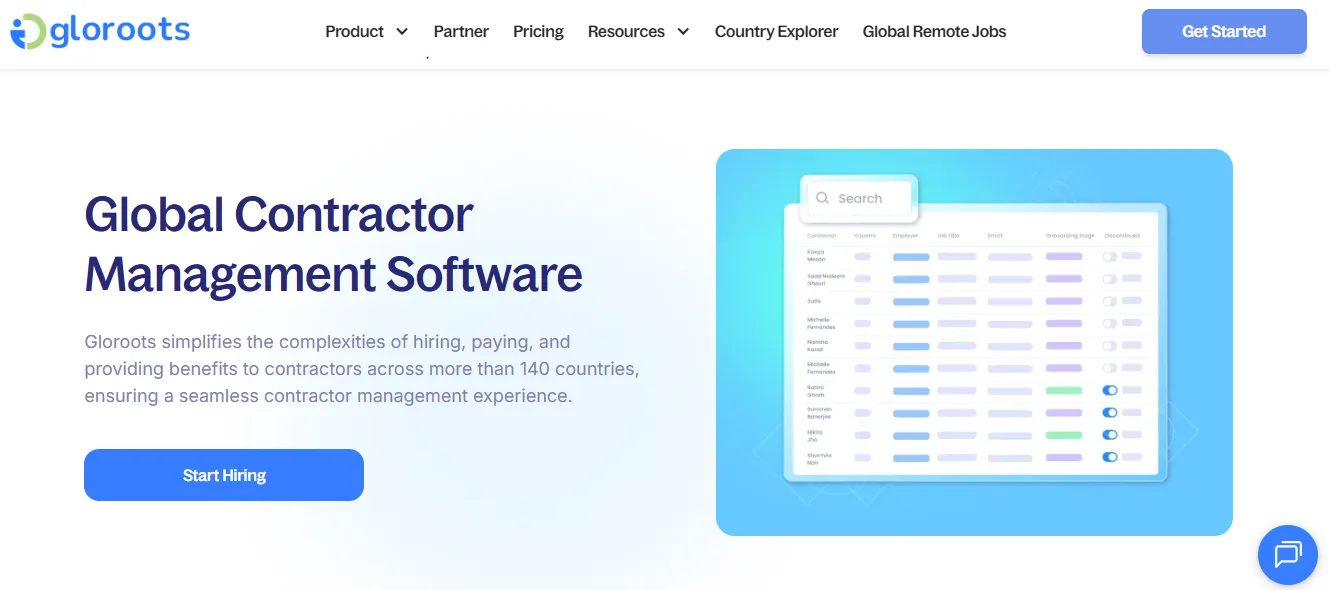
Compliance is built into the platform, with in-house experts and local legal counsel monitoring regulatory changes and ensuring correct contractor classification in every country.
This reduces misclassification risk and protects your business from evolving labor laws.
Gloroots offers transparent, fixed pricing and a technology-first platform where contractors manage invoices and payments independently, and clients approve payments, access reports, and monitor compliance from a single dashboard. Every client also receives a dedicated account manager and 24x7 support, backed by a 99.8% on-time payment rate and zero compliance violations.
Ready to simplify global contractor management? → Book a demo to see how Gloroots handles onboarding, payments, compliance, and support for your international contractors → all from one platform with transparent pricing.
Frequently Asked Questions
1. What is the difference between an EOR and AOR?
An EOR employs workers directly and provides statutory benefits, while an AOR manages independent contractors without creating an employment relationship. The AOR handles contracts, payments, and compliance while contractors remain independent.
2. Should you use an AOR to hire independent contractors?
Yes, an AOR helps you stay compliant with local contractor laws and manage global payments efficiently. It is especially useful when hiring internationally without local entities.
3. How does an AOR work?
An AOR drafts compliant contracts, processes invoices and payments, and manages tax documentation. You control the work, while the AOR handles administration and compliance.
4. When should businesses use a Contractor of Record?
Use a Contractor of Record when hiring internationally, scaling contractors quickly, or navigating unclear classification rules. It’s ideal when compliance and administration start to slow down growth.