





Deel, Remote, and Oyster HR all promise a seamless global hiring experience. Choosing the right platform requires looking beyond marketing and evaluating how each handles payroll, compliance, and workforce management in practice.
Each platform has strengths and limitations depending on your team size, geographic spread, and contractor needs. User reviews often highlight differences in ease of use, integration capabilities, and support responsiveness.
This blog compares Deel, Remote, and Oyster HR based on features, pricing, and operational effectiveness to help you make a smart choice. Key factors to consider include:
- Effortless workforce management- Easy team management features, real-time project oversight, and user-friendly interface.
- Accurate payrolls- Timely payments and 100% compliance across countries, tailored benefits.
- Simplified contractor management- Smooth onboarding, transparent tracking, seamless integration with existing tech.
- Responsive customer support- Timely assistance, global employment expertise.
- Scalability- Flexibility and customization options that enable future expansion.
- Affordable pricing- No hidden charges and transparent structure.
You will learn how to improve global hiring decisions by understanding which platform fits your workforce model, payroll needs, and expansion plans.
Deel vs Oyster HR vs Remote: Quick Overview
Three platforms, three distinct philosophies. Here's where each one stands in 2026.
What Is Deel? Overview and Key Benefits
Deel, founded in 2019, is one of the fastest-growing platforms in global employment management. It operates through its own legal entities in more than 150 countries, giving it strong control over payroll, compliance, and local support without relying on third-party partners.
Key Capabilities:
- EOR Services in 150+ countries: Handles local contracts, statutory benefits, taxes, and labor law compliance.
- Contractor Management: Supports 15+ payout methods, including bank transfers, PayPal, Revolut, and Coinbase.
- Multi-Currency Payroll: Covers 100+ currencies with off-cycle payments, on-demand pay, and a payroll cutoff on the 20th of each month.
- Integrations: 120+ native integrations with Workday, SAP SuccessFactors, BambooHR, Xero, and Greenhouse.
- Compliance Hub: Provides real-time regulatory alerts and localized compliance tracking.
- 24/7 Support: Live chat, email, phone, WhatsApp, and Slack support with quick response times.
Best For:
Companies managing both contractors and full-time employees across multiple countries that require strong integration and payroll flexibility.
Ratings:
G2: 4.8/5 | Trustpilot: 4.8/5
What Is Remote? Overview and Key Benefits
Remote.com focuses on legal security and compliance, operating through 100% owned legal entities in every country it covers. No third-party partners or aggregator models are used, making it ideal for companies where IP protection and legal predictability are critical.
Key Capabilities:
- EOR Services in 100+ countries: Fully owned entities with no partner handoffs.
- Centralized HR & Payroll: Multi-currency payroll, tax management, equity compliance, and centralized HR documents.
- Platform Usability: Intuitive interface with employment documents, payslips, and vacation tracking.
- Compliance Expertise: Local legal knowledge embedded in each market.
What Users Appreciate:
Platform intuitiveness, centralized employment details, strong legal expertise, and digital efficiency.
What Users Flag:
Limited to statutory benefits, basic vacation tracking requiring dual reporting, slow offboarding support, and documented compliance gaps in some markets.
Pricing:
~$599/employee/month (EOR) | ~$25/contractor/month
Ratings:
G2: 4.6/5
What Is Oyster HR? Overview and Key Benefits
Oyster HR, launched in 2020, prioritizes ethical employment and compliance-first hiring. It is a Certified B Corporation and operates in 180+ countries through a combination of owned entities and local partners, offering employment liability insurance across all regions.
Key Capabilities:
- EOR Services in 180+ countries: Real-time compliance monitoring with localized contracts.
- Employment Liability Insurance: Adds a proactive risk layer unique in the market.
- Oyster Academy: Employee upskilling and team development resources.
- Dedicated Regional Specialists: HR, legal, and payroll experts beyond standard ticket support.
- Benefits & Tools: Benefits Advisor, Salary Insights Tool, and Employment Cost Calculator.
What Users Appreciate:
Automated hiring and onboarding, smooth international payments, user-friendly interface.
What Users Flag:
Slow support with back-and-forth emails, payroll errors, no global holiday calendar, and missing NPS deduction support for India-based teams.
Pricing
$699/employee/month (EOR) | ~$29/contractor/month
Ratings
G2: 4.4/5 | Trustpilot: 4.5/5
Deel vs Remote vs Oyster HR: Feature Comparison
Pros and Cons: Deel, Remote, and Oyster HR
Best Use Cases: When to Choose Deel, Remote, or Oyster HR
Choose Deel if:
- You manage a mixed workforce of contractors and full-time employees across multiple countries simultaneously
- Payroll flexibility — off-cycle, on-demand, crypto payouts is a functional requirement
- Your HR stack requires deep integrations with enterprise tools like Workday, SAP, or Xero
- Support response time is operationally critical and 24-hour SLAs are unacceptable
Choose Remote if:
- IP protection is a board-level priority and you cannot tolerate third-party entity risk
- You need statutory compliance with maximum legal predictability across 100+ markets
- Your workforce is predominantly full-time employees with standard benefits expectations
- Cost transparency and headcount modeling simplicity matter more than platform depth
Choose Oyster HR if:
- You're building a remote-first culture where ethical employment is a strategic differentiator
- Your hiring is predominantly full-time employees across Europe and APAC with limited contractor volume
- ESG commitments, B Corp alignment, or mission-driven employer branding influence your talent strategy
- You're willing to trade automation depth for stronger compliance assurance and advisory support
Why is Gloroots a Better Alternative to Deel, Remote, and Oyster HR?
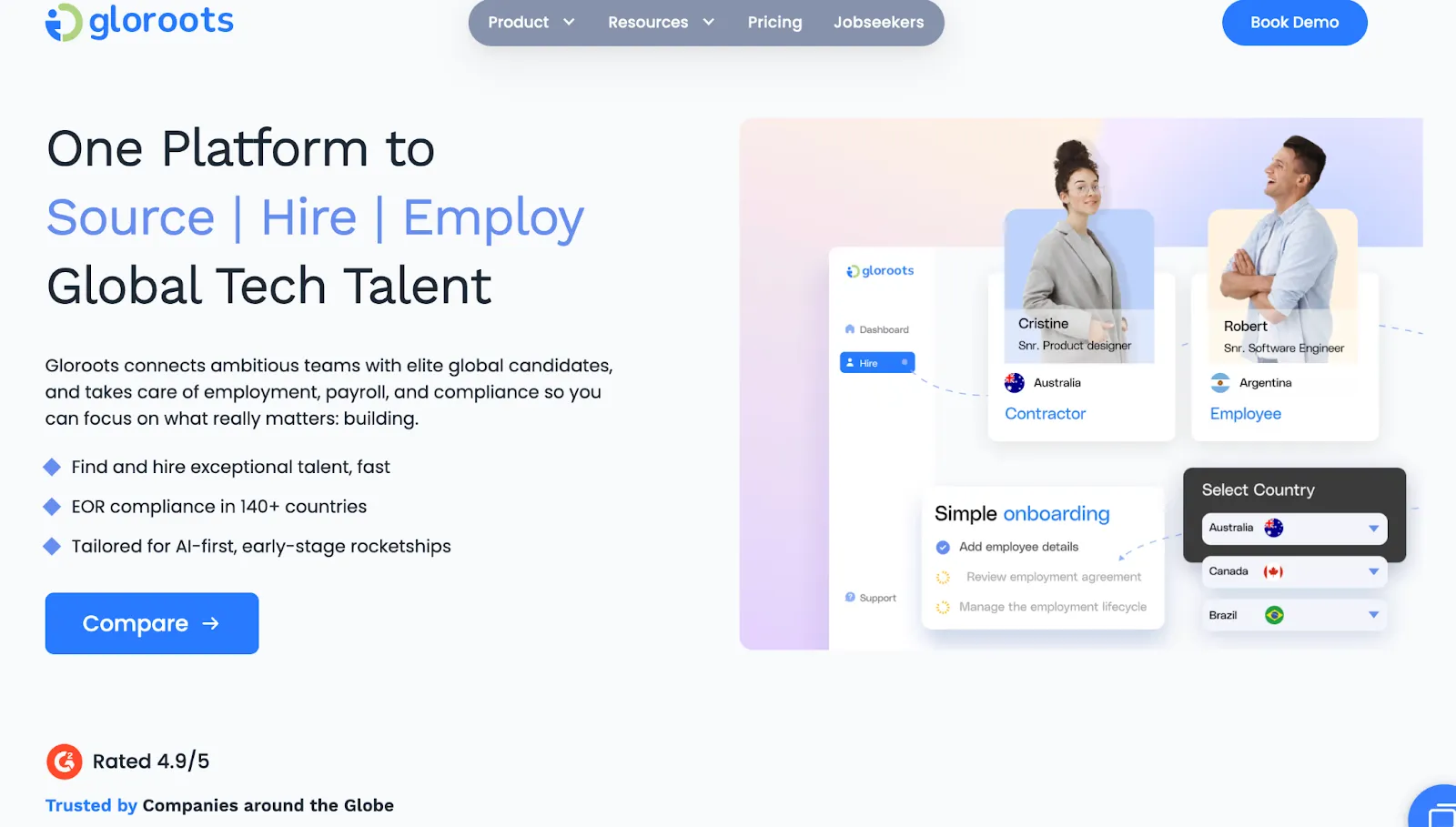
Deel, Remote, and Oyster HR are all capable platforms, but each is built for specific operating models. Deel excels with contractor flexibility and payroll options, Remote prioritizes legal security and IP protection, and Oyster HR focuses on full-time compliance and employee experience. Businesses that need a combination of these capabilities often find gaps in one or more platforms.
Gloroots was designed to bridge those gaps. By combining full EOR functionality with a managed service layer, it ensures contracts, payroll, compliance, and workforce transitions are handled end-to-end without operational friction. Unlike the other three platforms, Gloroots delivers both automation and hands-on support, making global hiring smoother and more predictable.
For companies scaling internationally or managing mixed workforces, Gloroots stands out by addressing the limitations that the others leave unhandled. It doesn’t just offer a platform—it delivers operational reliability and real-time guidance.
Key advantages of Gloroots over Deel, Remote, and Oyster HR include:
-
Managed service plus platform: Named Customer Success
Managers provide actionable guidance on compliance, payroll exceptions, and
operational edge cases, not just ticket queues or chat responses.
-
Finance transparency: Line-item invoices, country-level
cost breakdowns, and audit-ready reporting give CFOs full visibility, unlike
the standard invoicing and opaque fee structures on the other platforms.
-
Contractor-to-employee conversions: Handles every step of
workforce transitions seamlessly, reducing the friction and manual work that
Deel, Remote, and Oyster leave to HR teams.
-
Scalable for growth-stage companies: Supports 10 to 250
employees without requiring platform migrations or renegotiated pricing,
tailored for fast-growing organizations.
- Global compliance assurance: Provides consistent operational and regulatory support across multiple countries, removing the inconsistencies that may appear with partner-based models or limited support frameworks.
With Gloroots, companies get more than functionality they get a platform that is operationally reliable, transparent, and designed to simplify global hiring while reducing administrative overhead.
Ready to simplify global hiring?
Book a Demo and See how Gloroots
combines automation and hands-on support to make distributed workforce
management effortless.
Conclusion: Choosing the Right EOR for Your Business
Deel stands out for infrastructure depth, contractor flexibility, and fast support. Remote excels in legal security and IP protection. Oyster HR leads on compliance, employee experience, and mission-driven culture. Each platform solves a different set of challenges.
For HR leaders who need seamless contractor-to-employee conversions, hands-on advisory support, transparent finance reporting, and operational reliability across multiple countries, Gloroots is the alternative that bridges the gaps left by these platforms.
Your EOR choice today will shape how your teams are hired, paid, and retained for years to come. Choose a platform that scales with your business, not just the one that meets today’s needs.
Frequently Asked Questions
What is the main difference between Deel, Remote, and Oyster HR?
Deel excels in automation and contractor flexibility. Remote prioritizes owned-entity legal security and IP protection. Oyster HR focuses on compliance, employee experience, and ethical remote-first hiring practices.
How does compliance responsibility work with an EOR?
Contractually, your EOR assumes legal employer liability. However, reputational and operational risk never fully transfers any misclassification or labor dispute still reflects on your company.
When should I consider switching EOR providers?
Consider switching when your current platform can’t support your workforce model, whether due to new geographies, mixed workforce needs, or reporting requirements. Allow 60–90 days for a smooth transition, as mid-cycle changes can disrupt payroll and employee trust.
Why should I choose Gloroots over Deel, Remote, or Oyster HR?
Gloroots combines automation with hands-on managed service, line-item financial transparency, and seamless contractor-to-employee transitions. It’s specifically designed for companies scaling from 10 to 250 employees internationally, filling the operational gaps left by other platforms.