



Papaya Global calls itself an operating system for the global workforce, and the pitch is aimed squarely at large organizations. That shapes who loves it and who finds it a stretch. In this review I break down what reviewers praise, where invoicing, cost and detail work cause friction, and what the pricing covers. I also look at the teams that get the most out of Papaya and the ones that may be better served elsewhere. If you are comparing global payroll and employer of record providers, this adds the context a rating cannot. Read on, then run the questions at the end past any provider you shortlist. I keep it practical and honest, with no jargon and no hype.
Papaya Global holds a 4.5 out of 5 on G2, but its pitch is aimed at enterprise organizations running payroll at scale. If you are a ten-person startup, you are reading feedback written by someone else's kind of company.
I sorted the feedback by what it means for different buyers: what works, where invoicing and cost cause friction, what the pricing covers and who should look at simpler options.
What Is Papaya Global and Who Is It Built For?
A quick orientation first, because Papaya Global calls itself an operating system rather than a hiring provider.
Papaya Global is a global workforce platform that combines payroll, payments, employer of record, contractor management and analytics. Its pricing page says more than 35,000 businesses use it.
On G2, Papaya describes itself as an AI-first operating system for a borderless workforce, built for enterprise organizations operating at scale, and made up of three systems: Workforce OS, Payments OS and Contingent OS.
In plain terms, this is a platform pitched at larger organizations that manage payroll and payments in many countries at once.
Papaya Global at a Glance: Ratings, Coverage and Key Features
Before the detail, here is the quick view. If you only have a minute, this table shows how Papaya Global rates with customers and what it offers. It is built from Papaya Global's G2 listing and its own website.
| Detail | What I found |
|---|---|
| G2 rating | 4.5 out of 5 |
| Star split | About 78% five-star and 16% four-star |
| Low ratings | About 2% of ratings are one or two stars |
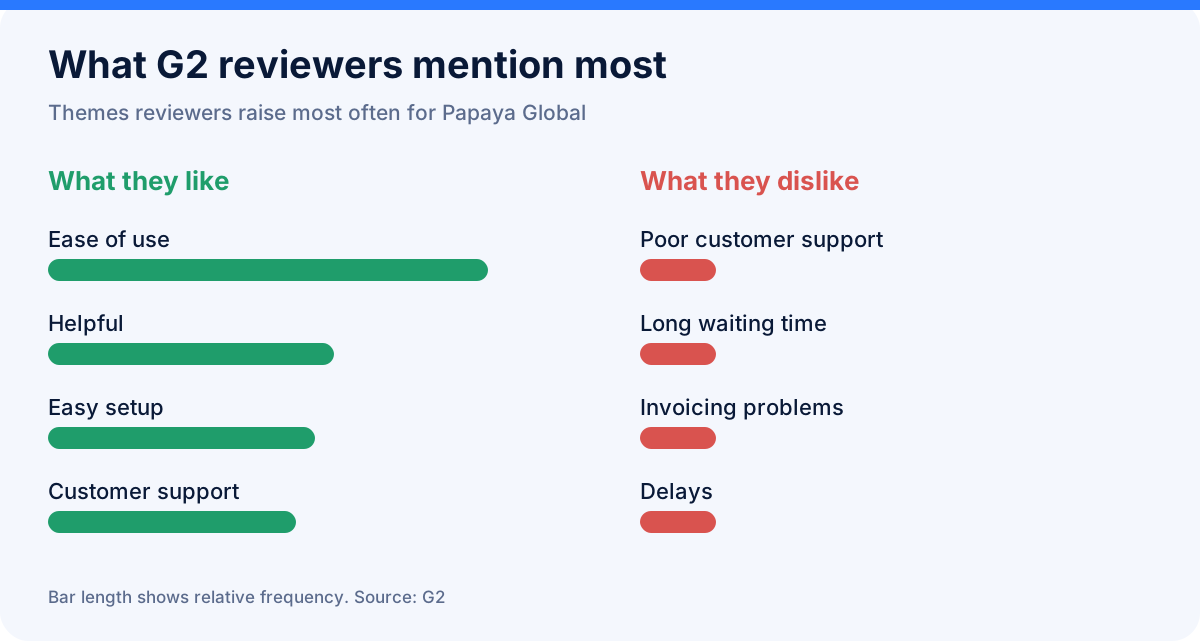
| Most-mentioned positives | Ease of use and Helpful |
| Most-mentioned negatives | Poor customer support and Long waiting time |
| Product type | Global payroll, payments and workforce platform |
| Positioning | Enterprise organizations operating at scale |
| Core systems | Workforce OS, Payments OS and Contingent OS |
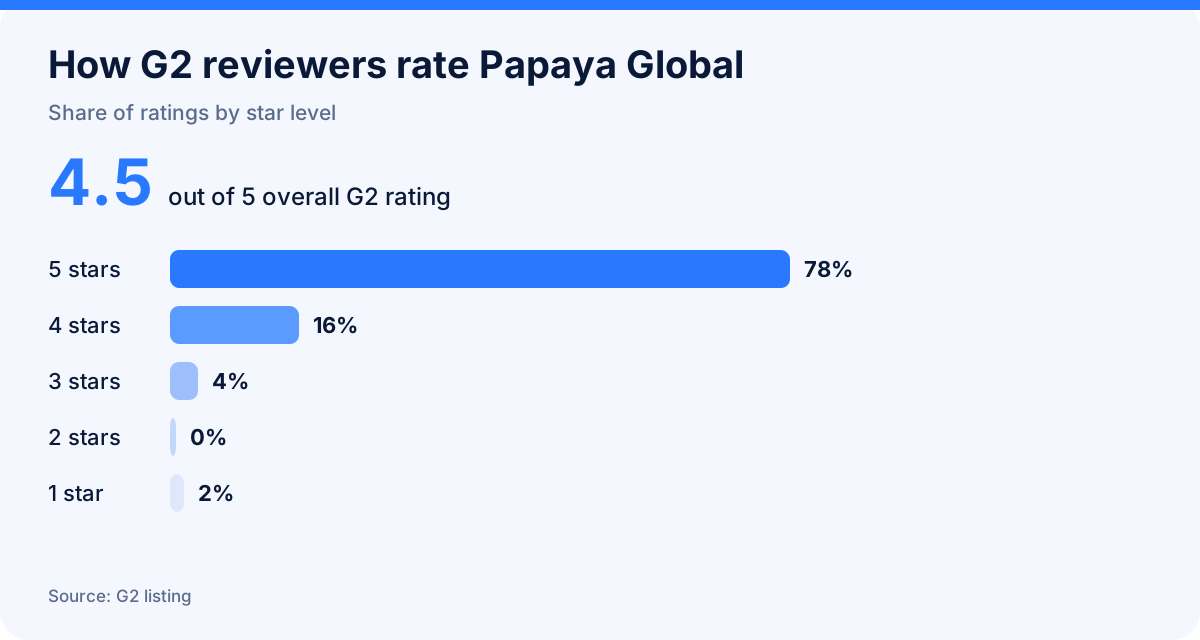
A strong score from users who tend to be experienced payroll buyers. Numbers only go so far though, so let's look at what customers say once they are actually using it.
What Do Users Like Most About Papaya Global?
When reviewers keep praising the same things, it usually means those things are real. Here is what comes up most.
Payroll in one place
Reviewers say Papaya consolidated fragmented payroll processes into a single platform and made compliance with payroll, tax and labor laws across countries easier to manage.
A supportive team
Customer support and helpful are both top positive tags. One HR generalist said the service had improved month after month, and another said the team is open to meetings with the in-country team.
Easy to use once you learn it
Ease of use and easy setup lead the tags. Reviewers call the interface user-friendly, with payroll and contractor payments handled from the same platform.
In short, customers who are happy are happy for solid reasons. Now for the other side of the story.
Want a second opinion?
Walk through your hiring plan with a Gloroots expert, no pressure.
The Most Common Papaya Global Complaints: Invoicing, Waiting Time and Cost
No provider escapes complaints. These are the ones that come up most often, and what sits behind them.
Invoicing problems
Invoicing problems and issues appear as a theme. One reviewer found invoices sent with errors during new project implementations, while another said reconciling invoices for internal compliance was hard and wanted a spreadsheet-friendly breakdown.
A learning curve and gaps in guidance
Reviewers mentioned a learning curve at the start and suggested more webinars or training sessions. One said legal assistance sometimes lacks precision and takes several follow-ups to get a clear answer.
Cost and integrations
One reviewer called it an expensive portal that small companies cannot afford. Another said a Bamboo integration does not always capture time off accurately and needs a double-check.
The picture is of a capable platform whose rough edges show up in detail work like invoices, integrations and answers to precise legal questions.
How Much Does Papaya Global Cost?
Papaya publishes starting prices for several products. Here is a summary from its pricing page.
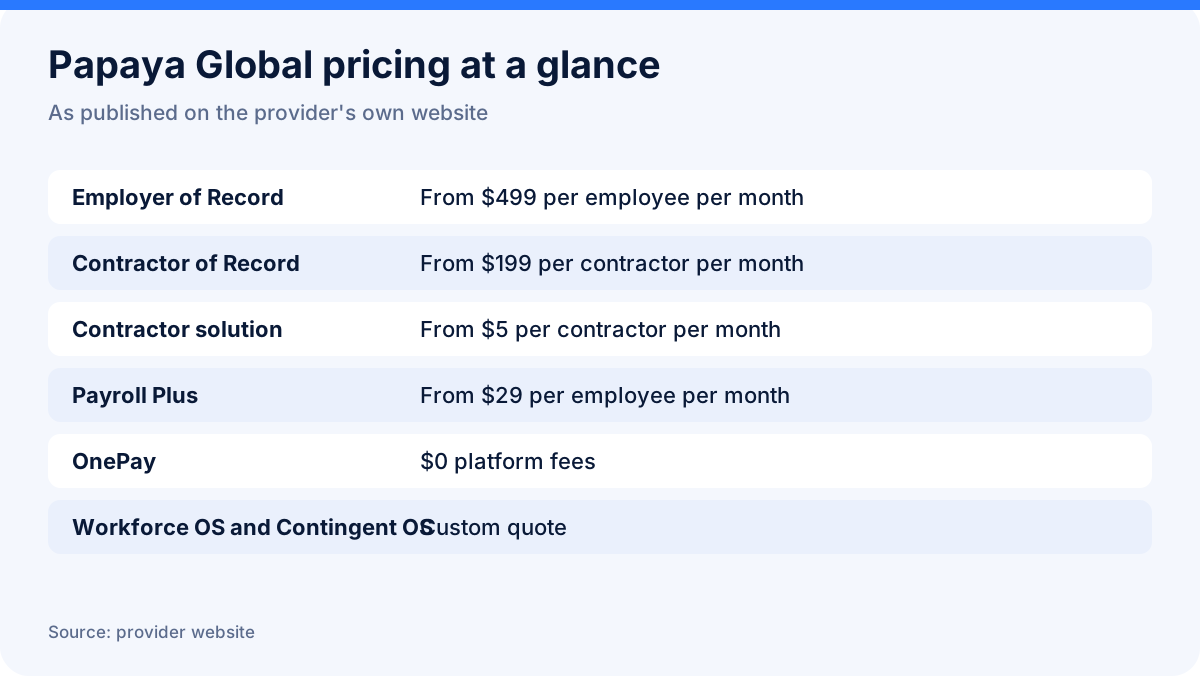
Papaya says OnePay has no platform fees and that you pay only when you pay, with guaranteed competitive FX. For line-by-line detail, see our Papaya Global pricing breakdown.
A headline rate is only half the picture. Our guide to hidden EOR fees is a good checklist to hold any quote against before you say yes.
Papaya Global Works Best for Larger, Multi-Country Payroll
Every platform fits some teams better than others. From what I read, Papaya Global works well in these situations:
- Companies running payroll in many countries. Consolidated payroll and compliance is the headline benefit.
- Enterprise teams. The platform is positioned for organizations operating at scale.
- Businesses that pay contractors worldwide. Payments and contractor tools sit in one place.
- Teams that want account support. Reviewers praise their account teams.
If that sounds like you, Papaya Global deserves a place on your shortlist.
Who Should Think Twice Before Choosing Papaya Global?
The flip side matters just as much. Be more careful if you are in one of these situations:
- You are a small team on a tight budget. One reviewer found it too expensive for small companies.
- You need exact answers on tricky legal points. Some reviewers needed several follow-ups.
- You rely on a HRIS integration. Check how it handles cut-off dates and time off.
- You want simple invoicing. Invoice errors and reconciliation come up.
If you recognise two or more of these, slow down and compare options. Our employer of record guide explains what you should expect from any provider, and how to switch EOR provider shows what changing later involves.
Where Gloroots Fits Next to Papaya Global
Papaya Global is pitched at enterprise organizations running payroll and payments across many countries. Gloroots is aimed at a different buyer: a growing team that wants to hire, employ and pay people abroad without a heavy platform. Here is where that difference shows.
- Team size. Papaya positions itself for organizations operating at scale, while Gloroots has no minimum headcount.
- Starting price. Papaya lists EOR from $499 per employee a month. Gloroots starts from $199, with the country-specific cost shown on a quote before the offer goes out.
- Invoice clarity. Reviewers mention invoice errors and reconciliation. Gloroots itemises salary, employer costs and fee on separate lines for each person and country.
- Hiring in India. Gloroots can also recruit for you there through Recruit, then employ the hire on the same account.
Papaya Global is the better pick if you need consolidated payroll, analytics and payments across a large, multi-country workforce. Gloroots is not that. It has no HR software suite and holds no SOC 2 or ISO 27001 today, so check that against your vendor review. For a closer look, see Gloroots vs Papaya Global.
Hiring in more than one country?
See how a single accountable partner can simplify it.
Five Questions to Ask Any Provider Before You Sign
Ratings can only take you so far. These are the questions I would put to Papaya Global, or to any provider on your list, before signing.
- Who is my named contact? You want a person, not just a ticket queue.
- How fast are legal and compliance questions answered? Ask for it in writing.
- Can I see the status of every request? Visibility is what reviewers miss most.
- Who is the legal employer in my country? It tells you who is accountable when something breaks.
- How will invoices and expenses be reconciled? Ask for a sample breakdown you can export.
A confident, specific answer to each is a good sign. A vague one is information too.
Verdict: Is Papaya Global Worth It?
Papaya Global earns its 4.5. The platform brings payroll together, the support team gets real praise and the product is easy to use once you get the hang of it.
The fit question is size. It is built for enterprise-scale needs, and reviewers flag cost, invoicing detail and legal precision as areas to watch. If you are a smaller team that mainly needs to employ people abroad, a simpler provider may fit better.
If you expect your hiring to get more complex, it is worth looking at providers built around accountability from day one. Teams that value direct ownership of compliance, a single legal employer and support that answers around the clock often end up at Gloroots, and our list of Papaya Global alternatives shows how the options line up.
Frequently Asked Questions
Is Papaya Global legit?
Yes. Papaya Global is a real provider, and its G2 rating of 4.5 out of 5 reflects customer feedback you can read yourself.
What is the Papaya Global rating on G2?
Papaya Global holds 4.5 out of 5 on G2.
How much does Papaya Global cost?
Papaya lists employer of record from $499 per employee per month, Contractor of Record from $199 and Payroll Plus from $29. See our Papaya Global pricing breakdown for detail.
What do users dislike about Papaya Global?
The most common negatives on G2 are poor customer support and long waiting time. One reviewer also called it expensive for small companies.
Who is Papaya Global best suited for?
It suits larger organizations running payroll and payments across many countries. Smaller teams focused on hiring abroad may prefer a simpler, more affordable provider.
Is there a good alternative to Papaya Global?
Yes. Gloroots is worth a look if you want a provider that acts as the legal employer, with employer of record from $199 per employee per month in 150+ countries.