






- This guide compares 10 Papaya Global alternatives: Gloroots, Deel, Remote, Oyster, Rippling, Multiplier, RemoFirst, Safeguard Global, Velocity Global, and G-P across pricing, compliance model, and implementation speed.
- Gloroots leads as the top alternative, offering compliance-first EOR from $199/employee/month with direct entity ownership, India GCC specialization, and faster onboarding timelines.
- Papaya Global suits large enterprises, but mid-market companies frequently encounter pricing opacity, long implementation timelines, and partner-network compliance gaps.
- The right EOR alternative depends on evaluating the entity ownership model, all-in pricing, implementation speed, support quality, and country-specific statutory depth.
- Deel, Remote, and Oyster serve distinct needs of contractor-heavy teams, employee-experience-first companies, and mid-market HR ops, while RemoFirst and Multiplier suit cost-conscious and API-first buyers.
- Velocity Global and Globalization Partners (G-P) offer enterprise-grade EOR for large multinationals scaling across 10+ countries simultaneously.
Companies evaluating alternatives to Papaya Global are not questioning the need for a global employment infrastructure. The question is whether enterprise-grade complexity actually serves their operational reality.
The calculus shifts quickly when finance teams spend more time reconciling invoices than building strategy.
According to Grand View Research, the global employer of record market will reach $7.9 billion by 2030, growing at 10.5% annually. Pricing opacity and compliance gaps drive mid-market switching decisions.
This guide evaluates ten platforms across the four dimensions HR leaders prioritize during vendor diligence:
- Implementation speed from contract signature to first employee onboarded
- Pricing accessibility: transparent rate cards versus enterprise-only custom quoting
- Support responsiveness, dedicated specialist access versus ticket-based systems
- Compliance accountability, direct entity ownership versus partner-network fragmentation
You already understand global payroll fundamentals. What you need now is clarity on how these ten platforms deliver compliance, cost predictability, and operational agility at scale.
The Top Papaya Global Competitors: A Quick Overview
See how entity-backed EOR with statutory depth compares to enterprise payroll platforms → Explore Gloroots
10 Best Alternatives to Papaya Global You Should Try
These platforms represent the realistic shortlist for companies moving past Papaya Global. Understanding the benefits of EOR helps clarify which model fits your operational needs.
We've led with Gloroots not as house bias, but because its compliance-first EOR model and operational simplicity address the gaps most commonly cited in Papaya migration conversations:
- Implementation complexity and timeline delays
- Pricing opacity that requires enterprise sales cycles
- Support responsiveness gaps for mid-market teams
- Statutory handling without multi-vendor fragmentation
Here are the top 10 alternatives to Papaya Global:
1. Gloroots — Recruit, Hire & Manage Global Teams on One Compliance-First Platform
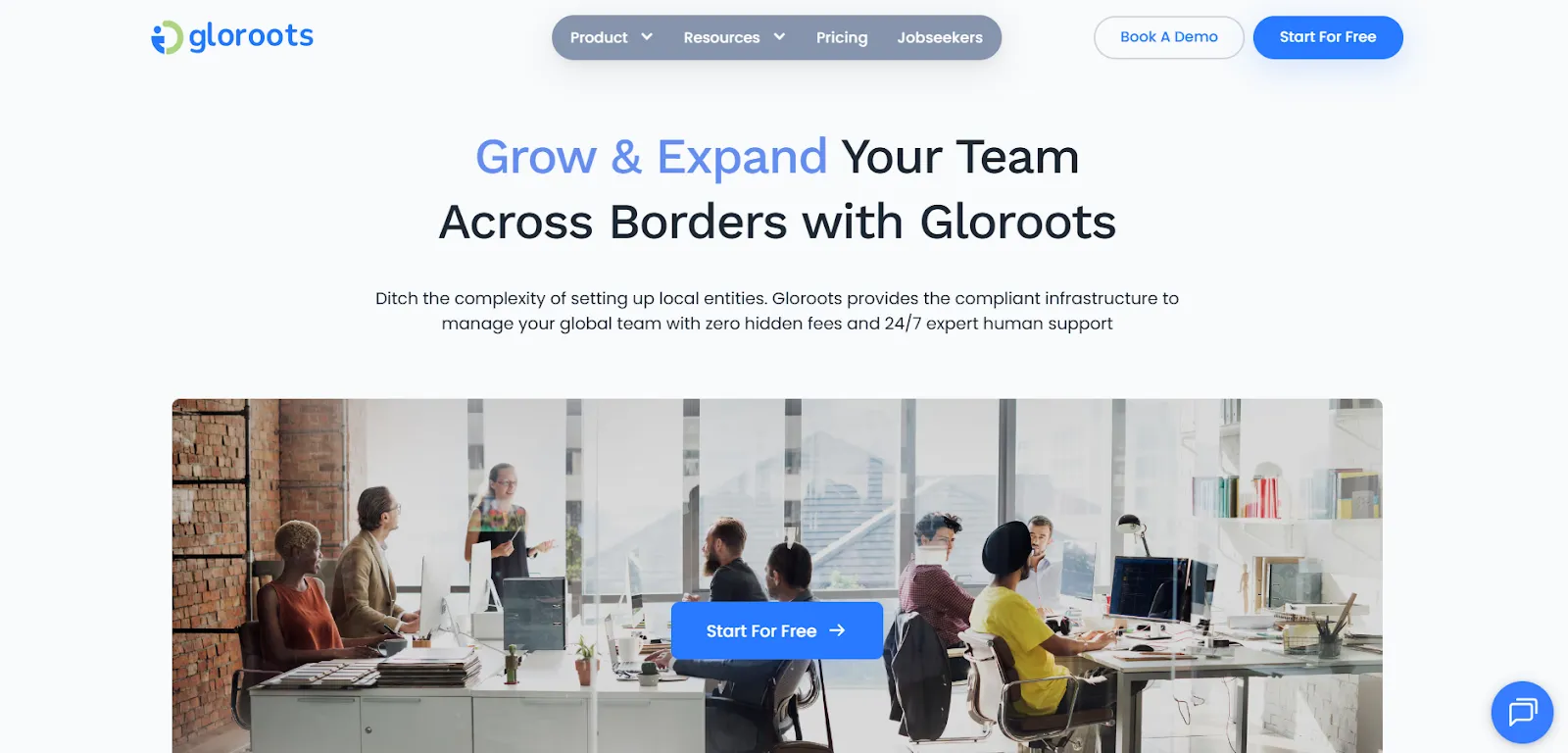
Gloroots is an Employer of Record and global hiring platform built for companies that treat international expansion as a compliance and execution challenge, not just a vendor selection exercise.
While many EOR providers compete on country coverage and surface-level features, Gloroots focuses on operational depth in complex employment markets. Payroll, tax, and labor law mistakes create real business risk.
Its model combines a technology platform with in-house legal and HR expertise, rather than relying solely on third-party partner networks.
Gloroots also supports companies from the hiring stage through ongoing employment. Recruitment services are available in select markets.
The platform connects hiring, onboarding, and EOR into one workflow. For teams planning how to hire international employees compliantly, this integrated approach reduces handoffs and delays.
By pairing self-serve tools with dedicated human support and transparent, country-specific pricing, Gloroots gives startups and mid-market teams a more predictable way to build and manage global teams.
Key Features
- Employer of Record services across 150+ countries with direct entity ownership in high-priority markets
- India GCC enablement: Accelerated setup for Global Capability Centers, including payroll management, PF/ESIC/gratuity, statutory filings, and local HR advisory
- Bridges the temporary stopgap needs while entities form, or supports long-term operations
- Contractor management with compliant conversion pathways to full-time employment as teams scale
- Country-specific legal playbooks reducing misclassification and regulatory exposure through jurisdiction-level compliance frameworks
- Consolidated global payroll with transparent FX handling, automated tax deductions, and local currency payouts
- Finance-grade reporting: Line-item invoices with country-level cost breakdowns, GL mapping, and audit-ready exports for CFO visibility
- Recruiting and talent advisory (India-focused): Local sourcing support, compensation benchmarking, and onboarding playbooks to retain GCC talent
- Hybrid service model: Self-service dashboard for contracts paired with assigned Customer Success Managers for compliance guidance
Pros
- Transparent pricing with no surprise fees or mid-contract cost escalations
- India's statutory depth is unmatched by global-first platforms, critical for GCC operations, where PF compliance and gratuity calculations require local expertise
- Faster activation timelines: Hire-to-onboard in days rather than weeks, with entity setup bypassed entirely
- Direct legal employer accountability, where Gloroots assumes statutory compliance risk rather than externalizing it to third-party partners
- Finance integration quality: Detailed invoicing and GL exports reduce month-end reconciliation burden for distributed finance teams
Cons
- Fewer enterprise add-ons compared to platforms targeting Fortune 500 workforce management (no native performance management or learning modules)
- Coverage footprint smaller than Remote or RemoFirst, though 150+ countries covers 95%+ of global hiring demand
- Less brand recognition in the North American market relative to Deel or Remote
Pricing
Gloroots starts at $199 per employee per month for full EOR services. This positions between budget providers and enterprise platforms like Papaya Global.
For a detailed breakdown of employer of record cost structures across providers, our dedicated guide offers a comparison framework.
Pricing remains consistent across geographies with transparent add-on costs for benefits upgrades or compliance advisory.
What People Say About Gloroots
"It's been fantastic to work with Gloroots. They got set up really fast. As a startup, it was important that our Hiring and EOR partner really understood our challenges, timelines, and needs. Gloroots has done just that."
Richie Khandelwal, Co-founder, PriceLabs
Best For
- Companies establishing or scaling GCCs in India where statutory expertise and local HR advisory differentiate operational success from compliance exposure.
- Startups and mid-market teams (10–250 employees) prioritizing cost predictability and dedicated support over enterprise feature sprawl.
- Organizations are converting contractors to employees across multiple markets, where Gloroots handles classification risk and benefits transitions smoothly.
- Finance-conscious teams requiring audit-ready reporting and transparent month-end reconciliation without enterprise implementation timelines.
2. Deel — Flexible EOR for Contractors and Employees Across 150+ Countries
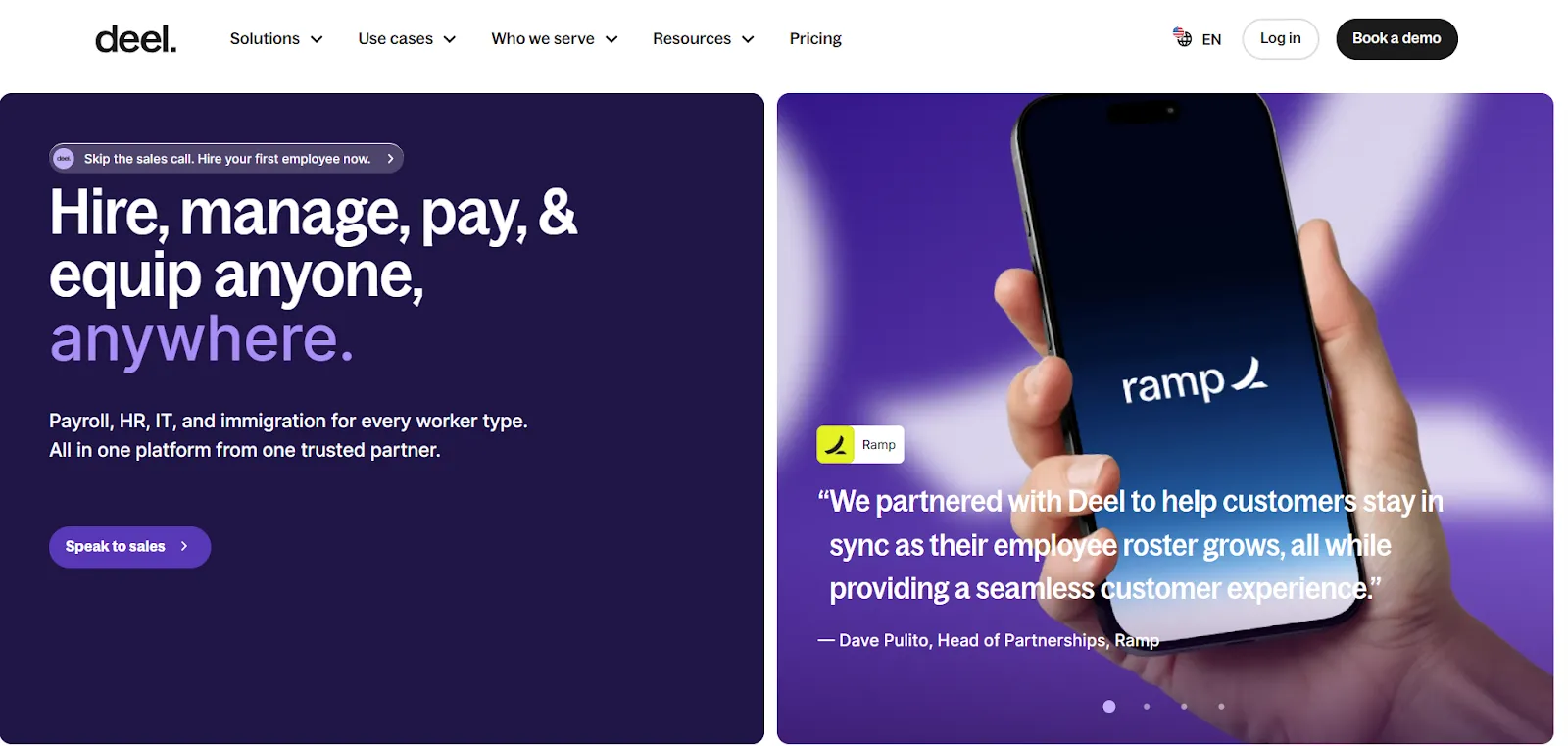
Deel built its market position on contractor payment infrastructure before expanding into full EOR services.
This heritage shows in the platform's strength in managing mixed workforce models, contractors, employees, and direct hires from a unified dashboard.
The company owns entities in key markets but relies on partner networks for long-tail country coverage. This creates variable service quality across geographies.
Key Features
- EOR coverage in 150+ countries with entity ownership in 80+ markets
- Contractor management with automated compliance screening and payment workflows
- Integrated HRIS and payroll for multi-country workforce consolidation
- Immigration and visa support for employee relocations
Pros
- Viable for early-stage international hiring
- Contractor-to-employee conversion workflows run smoother than most competitors due to the platform's dual infrastructure
- Strong API ecosystem for companies requiring payroll/HRIS integrations with existing tech stacks
- Quick onboarding timelines for standard employment scenarios
Cons
- Higher base pricing ($599/employee/month+) eliminates Deel from consideration for budget-conscious early-stage teams
- Partner reliance in many countries creates inconsistent employee experience and compliance gaps, particularly in regulated markets
- Support quality degrades at scale, with multiple customer reports citing delayed responses during payroll issues or regulatory questions
- Deel faced regulatory scrutiny in multiple jurisdictions for misclassification and licensing gaps
- Pricing opacity beyond the entry tier, where costs escalate quickly with benefits, equity, or compliance add-ons
Pricing
Deel's EOR pricing starts at $599 per month per employee, though this rate applies primarily to contractor management.
Full EOR services with benefits and statutory compliance typically range from $599 to $699/month, depending on country and service level.
What Do Deel Users Say?
User sentiment splits sharply based on workforce composition. Teams managing primarily contractors praise Deel's payment automation and global coverage.
However, companies scaling employee headcount cite support responsiveness issues, payroll accuracy problems, and compliance blind spots in markets where Deel lacks owned entities.
Best For
Startups are hiring primarily contractors with occasional employee conversions. High-volume hiring teams (100+ international workers) requiring API-first integrations.
3. Remote — Employee Experience-First EOR with Owned Entities in 80+ Countries
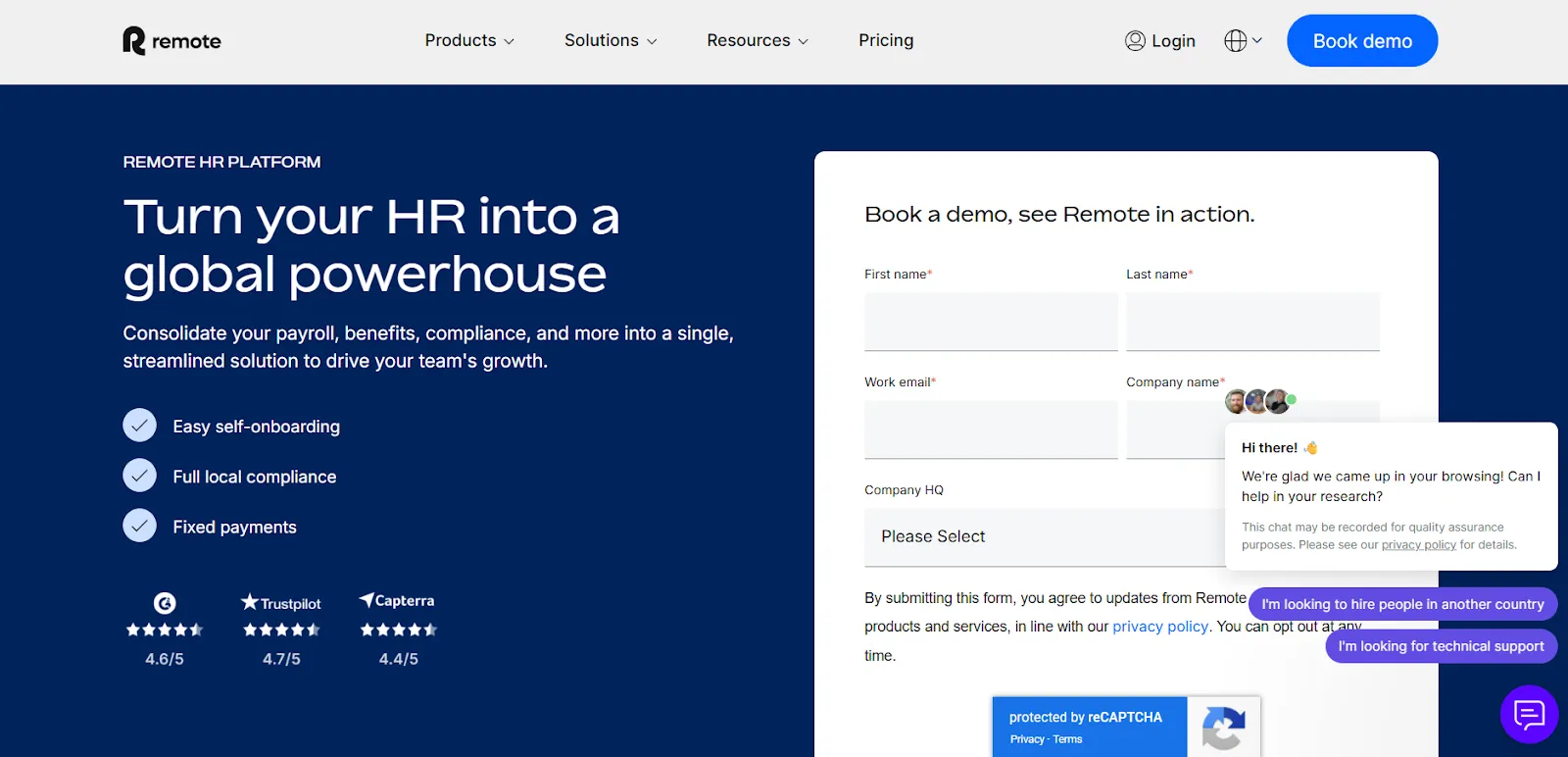
Remote markets itself as the employee experience-first EOR, emphasizing benefits quality, onboarding simplicity, and global employment brand over cost optimization.
For teams focused on hiring remote employees and retaining them long-term, the platform's employee-facing tools stand out.
The company owns entities in 80+ countries and partners for additional coverage. This creates better consistency than Deel but less statutory depth than compliance-focused alternatives like Gloroots.
Key Features
- Direct entity ownership in 80+ countries, total coverage across 170+ markets
- Global payroll with multi-currency support and automated tax compliance
- Benefits administration with region-specific health insurance, pensions, and statutory coverage
- Employee self-service portal for contracts, payslips, and benefits management
Pros
- Employee experience quality consistently rated above competitors, with onboarding that feels consumer-grade rather than HR-software clunky
- Benefits packages are competitive in high-cost markets (UK, Germany, Canada, Australia)
- Owned entities in priority markets reduce partner-related compliance gaps
Cons
- Higher base pricing ($599/employee/month+) eliminates Remote from consideration for budget-conscious early-stage teams
- Limited regional specialization with no equivalent to Gloroots' India GCC expertise or localized statutory advisory
- Support responsiveness declines as customer size increases, where dedicated CSMs are reserved for enterprise contracts
- Feature depth sacrificed for UX simplicity, where finance teams cite limited reporting granularity
Pricing
Remote's EOR services start at $599 per month per employee with transparent tier pricing based on country complexity and benefits level.
What Do Remote Users Say?
Customers consistently praise the employee onboarding experience and the benefits quality, particularly in EU markets where statutory requirements are complex.
However, finance and HR ops teams note limitations in reporting flexibility and cost forecasting as headcount scales.
Best For
Remote-first companies (50–500 employees) prioritize employee satisfaction and benefits quality over cost minimization.
4. Oyster — Mid-Market EOR with Compliance Automation Across 180+ Countries
Oyster positions itself as a global employment platform designed for distributed teams, emphasizing compliance automation, employee experience, and HR workflow integration.
The company operates through a hybrid model with owned entities in priority markets supplemented by partner networks for extended geographic coverage across 180+ countries.
Oyster differentiates through its focus on mid-market companies scaling internationally, offering standardized compliance frameworks and self-service tools alongside managed support tiers.
Key Features
- EOR services in 180+ countries with owned entities in 40–50 core markets
- Global payroll with automated tax compliance and multi-currency payments
- Benefits administration and equity management
- Contractor management with compliance screening
Pros
- Strong mid-market positioning with features balancing self-service and managed support
- Owned entities in key hiring markets reduce partner-related compliance variability
- Employee onboarding experience rated above enterprise platforms
- Compliance automation reduces manual HR ops work for standard employment scenarios
Cons
- Premium pricing ($699/employee/month) eliminates Oyster from budget-conscious teams
- Partner reliance in many countries creates variable service quality and compliance gaps
- Support responsiveness inconsistent in high-complexity markets like India, Brazil, and parts of the EU
- Pricing unpredictability at scale, with mid-contract price changes and undisclosed compliance fees reported
- Contractor management not native, creating friction during worker classification changes
- Scalability limits beyond 200 employees, where enterprise teams require bespoke SLAs and deeper compliance advisory
Pricing
Oyster's EOR services start at $699 per employee per month, positioning at the premium end of mid-market providers.
Pricing includes baseline compliance and benefits, though add-ons for enhanced support, equity management, or country-specific upgrades introduce cost variability.
What Do Oyster Users Say?
Mid-market teams praise Oyster's compliance automation and onboarding experience in low-regulation markets.
However, companies scaling past 50 employees or expanding into complex jurisdictions cite support delays, pricing surprises, and limited statutory depth compared to specialized providers.
Best For
Mid-market companies (50–200 employees) with strong internal HR ops capacity.
5. Rippling — Unified HR, IT, and EOR for US-Based Companies Going Global
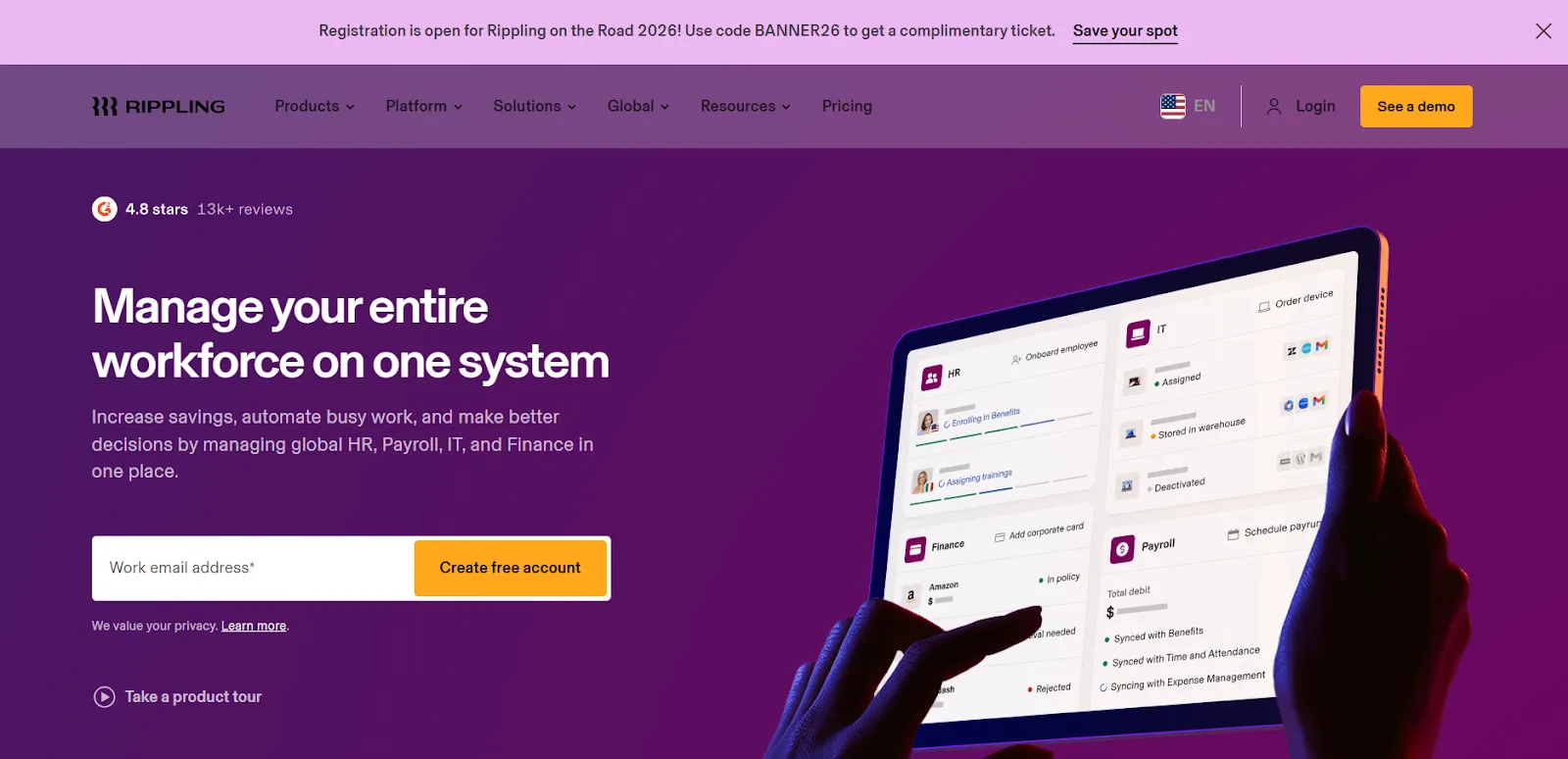
Rippling approaches EOR as one component of a unified HR, IT, and finance platform rather than a standalone global employment solution.
The company built its reputation on all-in-one workforce management for US companies, then expanded internationally through partner networks covering 90+ countries.
Rippling's differentiator lies in system consolidation: managing employee devices, software licenses, payroll, benefits, and compliance from a single interface. However, this breadth comes with trade-offs in EOR depth and international compliance expertise.
Key Features
- EOR services in 90+ countries through a partner network model
- Unified platform managing HR, IT, payroll, and device management
- Automated employee onboarding and offboarding workflows syncing across systems
- Benefits administration with US-focused depth
Pros
- Platform consolidation reduces vendor sprawl for companies wanting unified HR and IT management
- Strong US payroll and benefits administration superior to international-first EOR providers
- Automated workflows reduce manual work during employee lifecycle changes
- IT device management unique among EOR competitors, appealing to tech companies
Cons
- Partner-heavy international model creates compliance gaps and inconsistent service quality outside the US
- EOR functionality feels secondary to the core HR/IT platform, lacking depth of dedicated providers like Gloroots or Remote
- Pricing complexity where base platform costs exclude meaningful EOR services, with add-ons escalating quickly
- Limited country-specific expertise in complex markets like India, Brazil, or Germany
- Support quality for international employment issues rated below specialized EOR providers
- Entity ownership unclear in most international markets, raising compliance accountability questions
Pricing
Rippling advertises base pricing from $499 per employee per month, but this covers only basic HR features.
True all-in pricing for global EOR often exceeds $500–600/month per international employee once compliance, benefits, and support tiers are included.
What Do Rippling Users Say?
US-focused companies praise platform consolidation and IT management capabilities.
However, teams expanding internationally cite frustration with international EOR limitations, partner-network compliance gaps, and support quality below dedicated EOR specialists.
Best For
US-based tech companies (50–500 employees) with a primarily domestic workforce wanting unified HR and IT management.
6. Multiplier — API-First EOR Built for Tech Companies with Custom HR Stacks
Multiplier targets tech companies requiring API-first integrations with existing HRIS, payroll, and finance systems.
The platform owns entities in 40+ priority markets and partners for extended coverage, balancing operational control with geographic reach. Multiplier's differentiator lies in developer-friendly infrastructure rather than HR service depth.
Teams that rely on Multiplier's API ecosystem also use it to manage non-standard payment workflows, including, in some cases, crypto payroll for contractor-heavy teams operating across crypto-native environments.
Key Features
- EOR services in 150+ countries with owned entities in tech hubs (US, UK, Germany, India, Singapore)
- Robust API for payroll, employee data, and compliance automation
- Global payroll with real-time FX rates and multi-currency support
- Contractor management with classification screening
- Benefits administration and equity management
- Finance integrations (NetSuite, Xero, QuickBooks)
Pros
- API quality enables headless EOR workflows for companies building custom HR tech stacks
- Tech hub coverage prioritizes markets where engineering teams concentrate (Bangalore, Berlin, London, Singapore)
- Finance system integrations reduce manual data entry and month-end reconciliation work
- Equity management handles stock options and RSUs across jurisdictions, relevant for startups with global cap tables
Cons
- Custom pricing lacks transparency and requires sales conversations to understand true costs
- Support model assumes technical sophistication with less hand-holding than managed service providers
- Benefits packages are standard rather than competitive, focusing on compliance minimums
- Regional expertise limited outside tech-forward markets
Pricing
Multiplier uses custom pricing based on employee count, country mix, and integration requirements.
Market feedback suggests per-employee costs range $400–$500/month for full EOR services with API access. This is competitive with mid-tier providers but without transparent rate cards.
What Do Multiplier Users Say?
Technical teams praise API reliability and integration depth, while HR ops teams note gaps in proactive compliance guidance.
Companies with existing HR tech investments value Multiplier's flexibility. Those seeking managed service simplicity often find the platform under-supportive.
Best For
Tech companies (50–500 employees) with engineering resources to build on EOR APIs.
7. RemoFirst — Budget-Friendly EOR Covering 185+ Countries for Early-Stage Teams.
RemoFirst competes primarily on price, offering EOR services starting at $199/month across 185+ countries the widest coverage among Papaya Global alternatives.
However, geographic breadth comes at a cost. RemoFirst relies heavily on third-party partnerships for entity infrastructure and payroll execution.
This creates compliance exposure that only surfaces during audits or regulatory changes. Teams with active payroll risk management requirements in complex markets often find RemoFirst's reactive compliance model insufficient.
Key Features
- EOR coverage in 185+ countries via partner network
- Global payroll with multi-currency payments
- Contractor and employee management from a unified platform
- Basic benefits administration and compliance documentation
Pros
- Aggressive pricing makes international hiring accessible for bootstrapped startups
- Widest geographic coverage among mid-tier EOR providers
- Fast setup timelines for standard employment scenarios
- Contractor payment infrastructure reduces multi-vendor complexity for mixed workforces
Cons
- Partner-heavy compliance model externalizes risk, where accountability becomes murky when employment disputes or regulatory issues arise
- Minimal local expertise in complex markets like India, Brazil, or Germany, where statutory nuances require in-country advisory
- Support quality is inconsistent, where customer success teams lack depth to handle payroll exceptions or misclassification questions
- Benefits packages basic compared to Remote or Gloroots, often statutory minimums rather than competitive offerings
Pricing
RemoFirst's headline rate of $199 per month per employee applies globally with limited variation by country complexity.
This pricing reflects a cost-optimized service model. Customers should expect self-service compliance research and reactive (not proactive) support.
Teams focused on reducing payroll cost without sacrificing compliance accountability should weigh total risk exposure alongside the headline rate.
What Do RemoFirst Users Say?
RemoFirst users' feedback centers on value for money and geographic reach, with early-stage companies citing RemoFirst as their entry point into international hiring.
However, teams scaling beyond 20–30 employees commonly migrate to providers with stronger compliance infrastructure.
Best For
Early-stage startups (fewer than 25 international employees) are testing global hiring hypotheses.
8. Safeguard Global — Enterprise Payroll Consolidation Across 170+ Countries
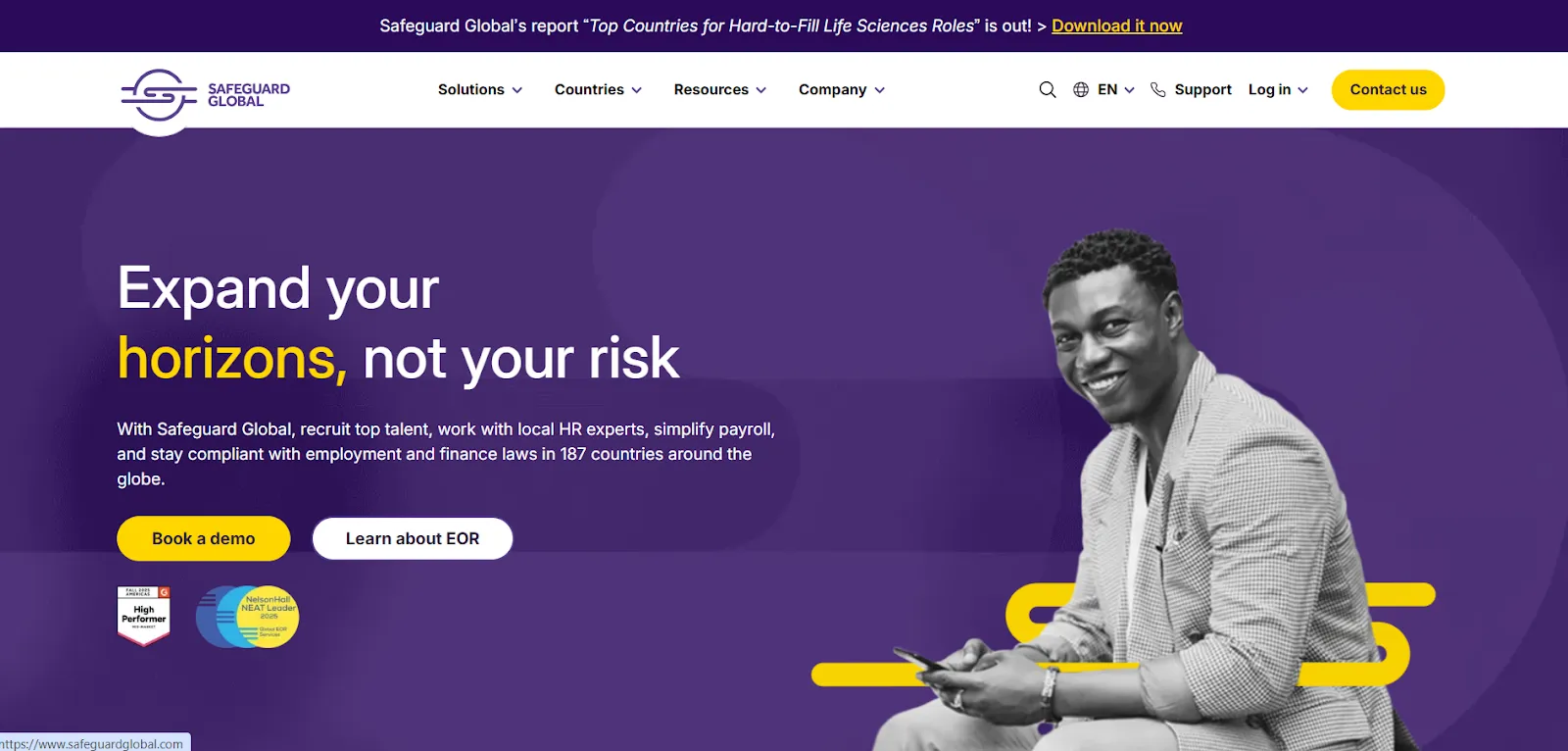
Safeguard Global operates as an enterprise-focused global employment and payroll consolidation platform, targeting multinational corporations managing complex, multi-country workforce operations.
The company combines owned entities in select markets with an extensive partner network spanning 170+ countries, positioning itself as a managed service provider for organizations requiring vendor consolidation and regulatory oversight at scale.
Safeguard differentiates through white-glove service, dedicated account teams, and customized compliance frameworks rather than self-service technology or standardized pricing.
Key Features
- EOR and global payroll services across 170+ countries with a hybrid entity ownership model
- Payroll consolidation engine unifying multiple countries into a single payment run
- Managed compliance services with dedicated legal and HR advisory teams
- Immigration and relocation support for executive and technical talent
Pros
- Enterprise-grade service model with dedicated account management and legal advisory
- Strong compliance oversight for highly regulated industries (finance, pharma, energy)
- Payroll consolidation reduces the finance team's burden for companies operating in 15+ countries
Cons
- Enterprise-only pricing eliminates Safeguard from mid-market and startup consideration
- Implementation timelines typically 8–12 weeks, longer than agile EOR providers
- Partner reliance in many countries introduces variable service quality similar to enterprise competitors
- Limited self-service functionality, requiring account team involvement for routine tasks
- The technology platform less modern than newer EOR competitors
- Pricing opacity requires lengthy enterprise sales cycles
Pricing
Safeguard Global uses custom enterprise pricing with no published rates. Market feedback suggests costs align with or exceed Papaya Global's enterprise tier, positioning Safeguard for organizations with 500+ global employees and complex compliance requirements.
What Do Safeguard Global Users Say?
Enterprise HR and legal teams praise dedicated account management and compliance advisory quality.
However, organizations cite implementation complexity, higher costs, and limited agility compared to modern EOR platforms designed for faster deployment.
Best For
Large enterprises (1,000+ employees) operating in 15+ countries requiring consolidated global payroll.
9. Velocity Global — Direct Entity EOR Designed for Compliance-First Expansion
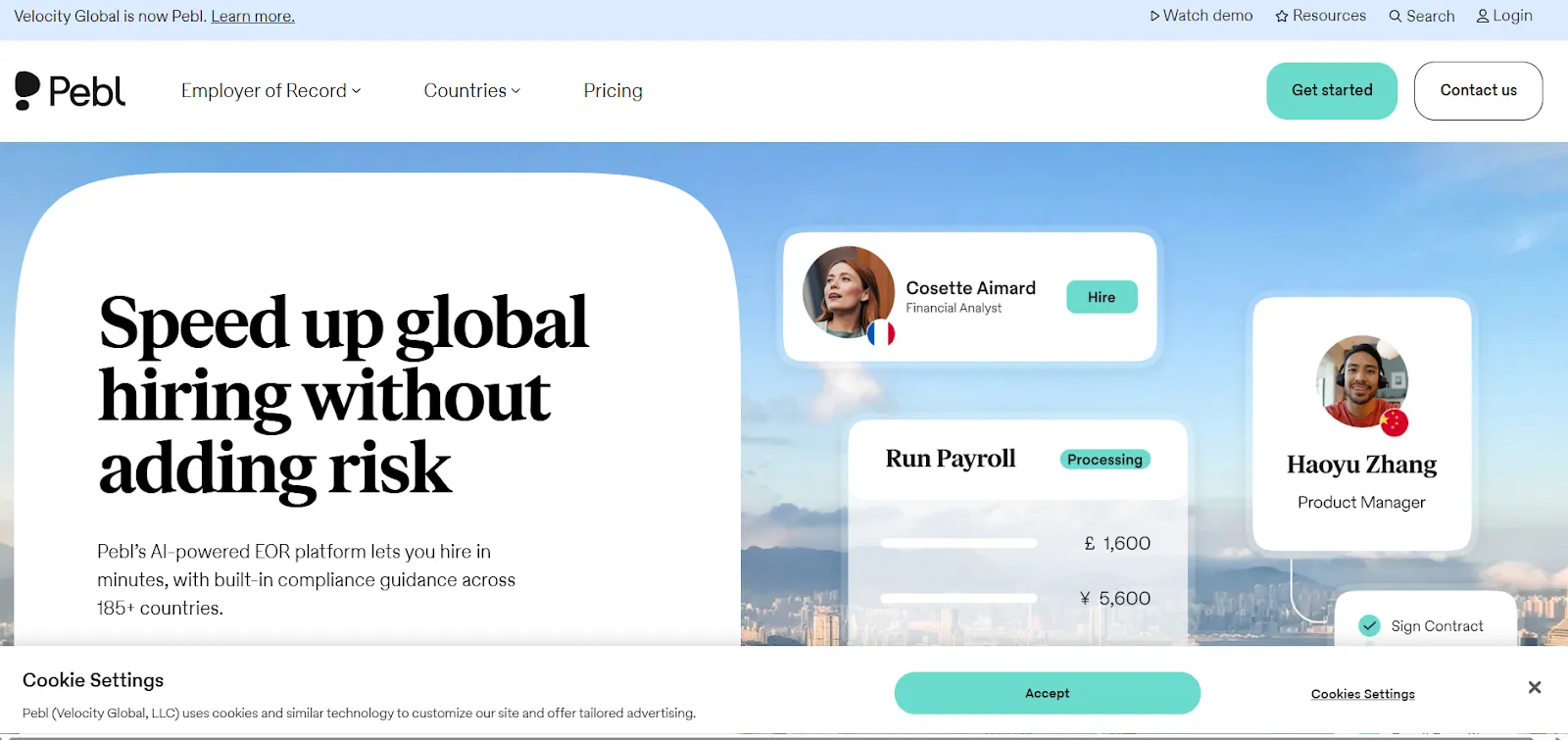
Velocity Global is an EOR provider focused on compliant international employment across 185+ countries. The company has invested significantly in direct entity infrastructure, reducing reliance on partner networks for core employment markets.
Its differentiator lies in geographic depth combined with dedicated compliance teams, rather than competing primarily on price or platform features.
Key Features
- EOR coverage in 185+ countries with direct entity ownership in priority markets
- Global payroll with local currency payments and automated tax compliance
- Immigration and visa support are integrated into employment workflows
- Benefits administration with country-specific statutory coverage
- Contractor management with compliant worker classification support
Pros
- Broad geographic coverage with strong entity infrastructure reduces partner-network compliance gaps
- Dedicated compliance teams handling labor law changes in real time
- Suitable for mid-market to enterprise companies needing compliant coverage beyond tech hubs
- Immigration support is integrated directly into employment workflows, reducing handoffs
Cons
- Premium pricing positions Velocity Global above budget EOR providers and most mid-market alternatives
- Less India-specific statutory depth compared to Gloroots for GCC operations
- Platform UX trails newer competitors' enterprise feel over self-service design
- Customer support model is more account-manager-gated than direct-access oriented
Pricing
Velocity Global operates on custom enterprise pricing. Market feedback suggests per-employee costs typically range between $499 and $700+ per month, depending on country, service scope, and headcount volume.
What Do Velocity Global Users Say?
Mid-market and enterprise teams cite Velocity Global's compliance reliability and entity footprint as primary strengths. Users in regulated industries, financial services, life sciences, and energy particularly value the direct entity model.
However, smaller teams and budget-conscious buyers consistently cite pricing as a barrier, and support response times draw mixed reviews at scale.
Best For
Mid-market to enterprise companies (100–1,000 employees) needing reliable, direct-entity EOR across multiple geographies simultaneously.
10. Globalization Partners (G-P) — AI-Powered EOR Platform for Enterprise Global Employment
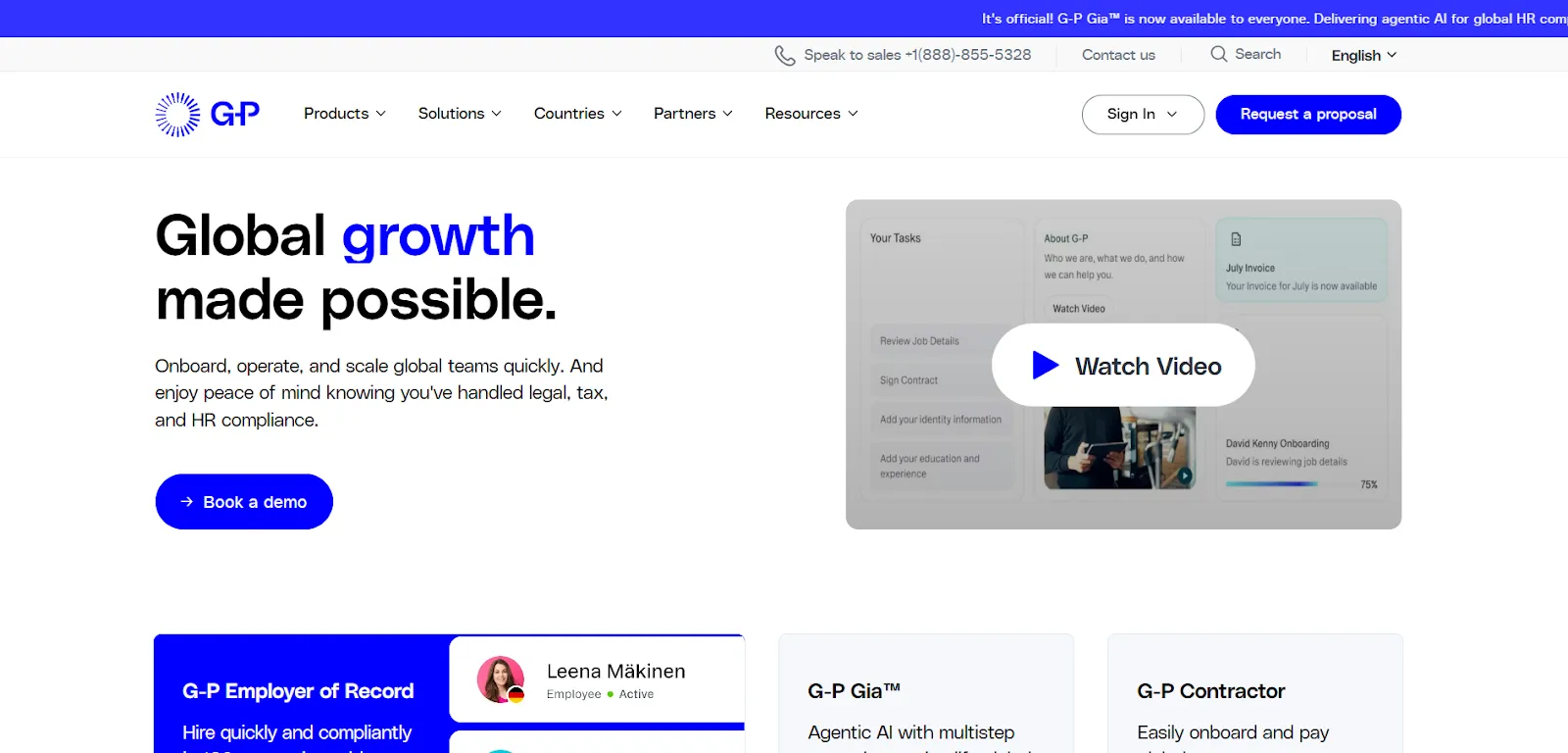
Globalization Partners (G-P) built its reputation as a pioneer in the EOR market, with a platform positioning around AI-assisted compliance and a large direct entity footprint in 180+ countries.
The company targets enterprise accounts and has invested in automation to reduce manual processing in employment, payroll, and compliance workflows. Its G-P Meridian platform aims to speed up the hire-to-onboard cycle for global employees.
Key Features
- EOR services across 180+ countries with owned entity infrastructure
- AI-powered compliance automation for employment contracts and statutory filings
- Global payroll with real-time dashboards and multi-currency support
- Benefits administration by country, including statutory and supplemental coverage
- HR integrations with major HRIS platforms (Workday, SAP, Oracle HCM)
Pros
- Large owned-entity footprint reduces partner-network compliance variability
- AI-assisted compliance speeds up onboarding and regulatory documentation
- Strong HRIS integrations suit enterprise teams with existing tech stacks
- Long-standing market presence with demonstrated enterprise deployments
Cons
- Enterprise pricing eliminates G-P from mid-market and startup consideration
- Sales cycle complexity mirrors Papaya Global's enterprise model, with custom quotes and multi-stakeholder approvals
- Support quality inconsistent in non-priority markets based on user feedback
- Platform complexity may exceed the operational needs of lean HR teams
- AI-led features still maturing; compliance automation does not yet fully replace human review in complex markets
Pricing
G-P uses custom enterprise pricing with no published rates.
Market feedback suggests per-employee costs from $599 to $999+/month based on country and service tier, positioning it at the premium enterprise end of the EOR market.
What Do G-P Users Say?
Enterprise teams praise G-P's entity footprint and integration capabilities. Mid-market companies, however, consistently cite pricing opacity, implementation complexity, and support inconsistency as reasons to evaluate alternatives.
Best For
Large enterprises (500+ employees) need a well-established EOR with strong HRIS integrations and AI-assisted compliance automation.
Why Should You Consider Alternatives to Papaya Global?
Evaluating alternatives to Papaya Global rarely stems from dissatisfaction with features. It is about operational fit.
As teams scale, implement new systems, or tighten budget controls, misalignments surface that warrant reassessment.
1. Enterprise Complexity for Mid-Market Needs
- Papaya Global's platform is architected for Fortune 500 workforce management, introducing complexity that mid-market teams (50–500 employees) don't require.
- Implementation timelines of 4–6 weeks, multi-tiered approval workflows, and vendor management overhead create friction when hiring timelines compress.
- Teams cite needing dedicated resources just to manage the Papaya relationship, a cost that smaller organizations cannot absorb.
2. Pricing Opacity and Enterprise Sales Cycles
- Transparent pricing is absent. Accessing rate cards requires enterprise sales conversations, RFP processes, and custom quoting based on employee count, country mix, and service tiers.
- This model works for procurement teams managing annual vendor reviews but creates forecasting challenges for finance leaders at growing companies.
- Mid-contract price changes and undisclosed compliance fees introduce budget volatility that alternatives like Gloroots eliminate through transparent, published pricing.
3. Implementation Timelines Misaligned with Hiring Speed
- Papaya Global's managed service model prioritizes thoroughness over speed.
- While this suits enterprises planning 12-month hiring roadmaps, it creates bottlenecks for companies needing to onboard international employees within 1–2 weeks.
- Integration requirements, account setup processes, and multi-stakeholder approvals delay activation compared to agile EOR providers optimized for rapid deployment.
4. Partner Network Fragmentation in Key Markets
- While Papaya owns entities in select corporate markets (US, UK, Germany, Israel), extended country coverage relies on third-party partners.
- This creates variable service quality and accountability gaps, particularly in high-growth markets like India, Brazil, Southeast Asia, and Eastern Europe, where employment law complexity demands in-country statutory expertise.
- Compliance risk fragments across multiple vendors rather than consolidating under a single legal employer.
5. Support Model Designed for Enterprise Resourcing
- Papaya Global's support infrastructure assumes customers have dedicated HR ops, legal, and finance teams managing vendor relationships.
- Mid-market companies without these resources find the support model under-responsive for time-sensitive payroll issues, regulatory questions, or employee experience problems.
- Ticket-based systems and account manager gatekeeping slow resolution compared to providers offering direct access to payroll specialists and compliance advisors.
6. Limited Accessibility for Startups and Early-Stage Teams
- Minimum contract sizes, enterprise pricing tiers, and implementation requirements effectively exclude startups and companies with fewer than 100 global employees.
- Early-stage teams testing international expansion hypotheses need accessible entry points, not enterprise procurement processes.
- This creates a market gap that alternatives like Gloroots, Deel, and RemoFirst address through transparent pricing and self-service onboarding.
In short, Papaya Global remains a capable enterprise platform, but growing organizations must assess whether its complexity, pricing model, and implementation requirements align with their operational reality, not just their long-term aspirations.
How to Choose the Right Papaya Global Alternative?
Selecting the right alternative to Papaya Global requires moving past enterprise feature checklists and focusing on operational realities that determine day-to-day success.
Use the framework below to validate whether a provider can support your hiring roadmap without introducing hidden costs or implementation delays.
Here is the checklist for choosing the right alternative to Papaya Global:
1. Compliance Depth: Entity Ownership vs. Partner Networks
Not all global coverage models carry the same compliance risk. EOR providers typically operate using one of two structures:
Owned-Entity Model
- The EOR owns and operates local legal entities in-country and assumes full employer responsibility.
- Employment contracts, payroll taxes, statutory filings, and regulatory updates are handled directly, with compliance risk fully absorbed by the provider.
Partner-Network Model
- The EOR relies on third-party local partners to employ workers on its behalf.
- While this enables rapid country expansion, it fragments accountability and introduces variability in service quality and compliance execution.
- Compliance gaps often surface during audits or contractor-to-employee transitions, particularly in high-risk jurisdictions.
Best practice: Prioritize owned-entity coverage for your core hiring countries. Use partner-network models only for limited, low-risk, or exploratory hires.
2. Pricing Transparency: All-In Costs, Not Base Rates
Advertised pricing often excludes benefits, compliance services, FX fees, or support tiers. Enterprise platforms may appear cost-competitive until implementation fees, account management charges, and country-specific add-ons are factored in.
Request sample invoices and validate:
- What drives cost variation between countries?
- Are FX fees transparent or bundled?
- How much do benefits upgrades cost?
- What compliance services are included versus billed separately?
- Are there minimum contract sizes or setup fees?
Transparent pricing models reduce forecasting risk and month-end surprises.
3. Implementation Speed: Weeks vs. Months
Enterprise EOR platforms prioritize customization and vendor integration over rapid deployment. This creates bottlenecks when hiring timelines compress.
Evaluate:
- Time from contract signature to first employee onboarded
- Integration requirements with existing HRIS or payroll systems
- Approval workflows and account setup processes
- Whether self-service onboarding is available for standard scenarios
EOR service models vary significantly in activation speed. Choose platforms aligned with your hiring velocity.
4. Support Model: Self-Service vs. Managed Service
Platform features matter less than support quality when issues arise. Differentiation appears during payroll errors, regulatory changes, misclassification reviews, and statutory deadlines.
Evaluate:
- Whether you receive a dedicated Customer Success Manager or shared support
- Guaranteed response times for payroll issues
- Proactive versus reactive regulatory updates
- Access to local employment law experts
- Support availability across time zones
Hybrid support models combining self-service dashboards with responsive human expertise outperform ticket-only or enterprise account manager approaches.
5. Country-Specific Expertise: Generic vs. Localized
Global EOR platforms often deliver baseline compliance that satisfies statutory requirements but fails to account for regional complexity. This approach works in simple markets but increases risk in countries with nuanced labor laws and enforcement practices.
- Generic EORs apply standardized compliance frameworks with minimal local optimization
- Complex markets like India require deeper handling of PF, ESIC, gratuity, bonuses, and statutory leave
- Providers with in-country legal and HR teams deliver more reliable, audit-ready execution
Choosing a localized compliance model reduces operational friction and ensures regulatory changes are handled proactively, not reactively.
6. Scalability: 10 Employees vs. 100 vs. 500
An EOR that works at 10 employees may fail at 100 or introduce unnecessary complexity at 50. As scale increases, payroll exceptions, benefits administration, and compliance oversight compound.
Assess:
- Service tier thresholds for dedicated support
- Pricing stability as headcount grows
- Finance-grade reporting and country-level cost visibility
- API and HRIS integration readiness
- Whether the platform is designed for enterprise or startup operational models
In short, the right Papaya Global alternative is the provider whose compliance ownership, cost transparency, implementation speed, and support depth align with your current operational reality and 18–24 month growth trajectory, not with your aspirational enterprise state.
Take your HR Solutions Global
Onboard 2x faster across 150+ countries with Gloroots.
What Are The Common Mistakes To Avoid When Choosing Papaya Global Alternatives?
Below are the most frequent mistakes teams make when evaluating Papaya Global alternatives. Each appears manageable early on but often leads to expensive EOR migrations later.
1. Assuming Enterprise Features Equal Better Execution
- Papaya Global's enterprise-grade payroll consolidation, multi-vendor integration, and customizable compliance frameworks appeal during vendor evaluations.
- However, mid-market teams often discover they're paying for capabilities they don't use while sacrificing speed and support responsiveness.
Evaluate: Whether your team has the internal resourcing to manage enterprise vendor relationships, or whether a simpler EOR service model delivers better operational outcomes.
2. Optimizing for Price Over Compliance Accountability
- Low-cost EORs reduce fees by relying on partner networks, limited benefits, and reactive compliance.
- This model shifts legal and regulatory risk to your business, not the provider. Misclassification, payroll tax errors, and labor disputes can quickly outweigh upfront savings.
Always evaluate: Total risk exposure, not just per-employee pricing. Owned-entity models with direct legal employer accountability protect your business during audits and regulatory changes.
3. Underestimating Implementation Complexity
- Enterprise platforms require integration planning, data migration, multi-stakeholder approvals, and vendor onboarding processes that compress hiring timelines.
- Teams often underestimate the operational burden of managing these implementations while simultaneously trying to hire and onboard employees.
Best practice: Validate actual time-to-first-hire, not vendor-provided estimates. Hiring international employees should take days, not months.
4. Ignoring Country-Specific Statutory Depth
- Employment laws vary significantly by country and cannot be handled with generic frameworks.
- Complex markets require in-country expertise for payroll, benefits, terminations, and audits. Outsourced or third-party compliance models fragment accountability.
Prioritize: EOR providers with demonstrated depth in your priority markets over platforms with impressive country counts but shallow execution.
5. Overlooking Support Accessibility and Response Times
- "Dedicated account managers" often means gatekeepers requiring scheduled calls for routine questions.
- Ticket-based systems introduce delays when payroll issues surface hours before processing deadlines or when employees face onboarding problems across time zones.
Evaluate: Actual support SLAs, response time guarantees, and whether you have direct access to payroll specialists and compliance advisors, not just account coordinators.
6. Choosing Platforms Without Transparent Pricing
- Custom enterprise pricing creates forecasting challenges and budget surprises.
- Mid-contract price changes, undisclosed compliance fees, and opaque FX handling introduce financial risk that alternatives eliminate through published rate cards.
Request: Sample invoices showing country-level cost breakdowns, FX fees, benefits costs, and compliance charges.
Employer of record software with transparent pricing reduces month-end reconciliation burden and enables accurate headcount forecasting.
7. Failing to Validate Entity Ownership Models
- Broad country coverage often hides reliance on third-party partners.
- Partner models introduce inconsistent employee experience and compliance blind spots. Accountability gaps surface during disputes or audits.
Providers should clearly disclose: Owned entities, partner usage, and risk controls. If a vendor cannot specify where they own entities versus relying on partners, assume partner-heavy coverage with fragmented compliance accountability.
These mistakes are avoidable with a structured evaluation approach. The right Papaya Global alternative supports scalable growth, compliance confidence, and operational simplicity without requiring enterprise vendor management resources.
Why Choose Gloroots?
Gloroots is built for companies that view global hiring as a long-term employment strategy, not a procurement exercise.
Teams moving from Papaya Global choose Gloroots to eliminate implementation delays, reduce compliance risk in complex markets, and gain cost predictability without sacrificing support quality.
How Gloroots supports global teams:
- Compliance-first infrastructure with owned entities and country-specific legal playbooks that reduce misclassification and regulatory exposure
- Proactive compliance monitoring to keep contracts, payroll, and statutory filings current as labor laws change
- Transparent pricing from $199 per employee per month with no hidden fees, mid-contract escalations, or surprise add-ons
- Line-item invoicing and finance-grade reporting, including country-level cost breakdowns, GL mapping, and audit-ready exports
- Deep India specialization and GCC enablement covering PF, ESIC, gratuity, bonus structuring, and localized onboarding for major tech hubs
- Hybrid service model combining self-service workflows with assigned Customer Success Managers and responsive payroll support SLAs
- Support for contractor-to-employee transitions with reduced classification risk and payroll continuity
Gloroots replaces enterprise complexity, opaque pricing, and fragmented compliance with clarity, accountability, and in-country depth, giving growing teams confidence as they scale internationally without requiring dedicated vendor management resources.
Hire Globally Without Enterprise Complexity
Scale your international workforce with Gloroots' compliance-first EOR model. Get transparent pricing, deep in-country expertise, and dedicated support that grows with your team without implementation delays or hidden fees.