




- Nigeria EOR compliance covers multiple statutory layers including PENCOM pension contributions, NSITF social insurance, NHF housing fund deductions, state-level PAYE remittance, and ITF levies. Confirm that any provider you evaluate handles all of these directly rather than passing obligations back to the client.
- Pricing among the eight providers ranges from approximately $199 per employee per month (Gloroots) to $599 per employee per month (Remote, Deel, Oyster HR), with Borderless AI, Horizons, Mercans, and Rippling using custom or undisclosed pricing models.
- Onboarding speed for Nigerian employees varies significantly across providers, from 48 hours (Mercans, Oyster HR) to 2.3 days (Remote), with PENCOM Retirement Savings Account registration for employees without an existing account adding one to four weeks to any provider's standard timeline.
- Before signing with any provider, request PENCOM remittance proof and PAYE filing history. Providers that cannot supply these on request carry higher compliance risk for Nigerian operations.
- Using an EOR removes the need to register a local entity through the Corporate Affairs Commission, a process that typically takes three to six months, allowing companies to activate Nigerian employment in two to five weeks from provider selection to first payroll.
Nigeria produces roughly 600,000 university graduates each year, recorded 3.4% GDP growth in 2024, and hosts one of Africa's most active technology ecosystems in Lagos. Foreign companies hiring in this market face a layered compliance environment that includes PENCOM pension contributions, NSITF social insurance, NHF housing fund deductions, and state-level PAYE remittance across multiple tax zones.
An best employer of record partner manages each of these statutory obligations on behalf of the client company, removing the need to register a local entity through the Corporate Affairs Commission before making a first hire.
This guide compares eight EOR providers operating in Nigeria in 2026, covering pricing, compliance coverage, and key strengths to support a structured provider evaluation.
Our Top 8 Picks: Nigeria EOR Comparison 2026
The eight providers below cover the range of pricing models, compliance depth, and platform types available to companies hiring in Nigeria in 2026. G2 ratings are sourced from G2.com where publicly available.
| Provider | Pricing per month | Country coverage | Onboarding speed | Platform experience | Customer support | Scalability |
|---|---|---|---|---|---|---|
| Gloroots | From approximately $199 per employee/month | 150+ countries | 3–5 working days | Centralized contracts, payroll, compliance and workforce management on one platform | Human-led account support with dedicated specialists | Supports startups through enterprises across 150+ countries |
| Borderless AI | Custom/quote-based pricing | 170+ countries | Typically 3–5 business days; varies by country | AI-native global employment platform with automated onboarding, payroll, compliance and workforce management | Dedicated support and local compliance expertise | Supports startups, SMBs and enterprises hiring globally |
| Horizons | Custom pricing | 180+ countries | Typically 2–5 business days; varies by country | Global EOR and payroll platform with centralized workforce management, onboarding and compliance | Dedicated account management and local HR support | Supports SMBs through enterprise organizations with global workforces |
| Mercans | Custom/quote-based pricing | 160+ countries | Up to 48 hours in supported situations; country requirements may vary | HR Blizz platform for EOR, payroll, HR administration, compliance and workforce management | Dedicated account management with local HR and payroll specialists | Enterprise-focused platform designed for complex multinational workforces |
| Remote | From $599 per employee/month with annual billing; $699 monthly | 90+ EOR countries | Onboarding can be completed in hours in supported markets; exact timing varies by country | Remote-first global HR platform covering EOR, payroll, contractors, benefits and compliance | Dedicated in-house support and localized country expertise | Supports growing companies through enterprise-scale global teams |
| Deel | From $599 per employee/month for EOR | 150+ countries | Typically a few days; exact timing varies by country | Global workforce platform covering EOR, payroll, contractors, equity, benefits, immigration and compliance | 24/7 support with local HR, legal and tax expertise | Supports startups, SMBs and enterprises across multiple workforce types |
| Rippling | From approximately $499 per employee/month for EOR; final pricing is quote-based | 80+ EOR countries | Automated onboarding; exact country-specific timing varies | Integrated HR, payroll, IT, finance and workforce platform with centralized employee data and automation | Local experts combined with centralized platform support | Strong fit for mid-market and enterprise distributed workforces |
| Oyster HR | Custom/quote-based pricing; country-specific pricing varies | 180+ countries | Exact timing varies by country and documentation | Global employment platform focused on EOR, payroll, benefits, compliance and distributed workforce management | Dedicated support with HR and compliance specialists | Designed for startups, SMBs and distributed teams scaling internationally |

Top 8 Best EOR Platforms in Nigeria
Providers in this guide were evaluated on Nigeria compliance depth, pricing transparency, platform capability, support model, and onboarding speed. Each profile covers Nigeria-specific compliance capabilities, pricing, strengths, limitations, and G2 rating where available.
The list includes both global generalists and Africa-specialist providers. This range serves buyers with different priorities, from cost control and platform integration to local compliance depth and dedicated account support.
Gloroots
Gloroots is a global hiring and employment platform that supports compliant full-time employment across 150+ countries, including Nigeria. Its core service pillars are Global Employer of Record (EOR), Global Payroll, Compliance and Employment Governance, and Benefits and Statutory Coverage.
In Nigeria, Gloroots manages employment contracts, monthly Naira payroll, PENCOM pension contributions, and NSITF remittance without requiring a local entity. The platform handles the 2.5% employee National Housing Fund (NHF) deduction and remittance as part of its statutory coverage. Gloroots’ Nigeria guide lists the employee Housing Fund at 2.5% among statutory contributions.
FX conversion for Nigerian payroll is processed at mid-market rates. Gloroots states there are no hidden fees or surprise FX markups, with transparent rates based on live market pricing. Companies receive full cost visibility before onboarding, with no percentage-of-salary pricing and no hidden fees.
Gloroots provides human-led account support with retained business context, meaning the account team carries knowledge of each client's workforce structure across engagements. Nigerian employment can typically be activated within 3-5 days of engagement.
Strengths:
-
Predictable, country-specific pricing with full cost visibility before onboarding and no percentage-of-salary fees gives Finance teams reliable Nigerian employment cost forecasting.
-
Compliance and Employment Governance is a named service pillar, covering Nigerian Labour Act requirements, PENCOM pension, NSITF, and NHF obligations within a centralized platform.
-
Human-led account support with retained business context reduces repeated onboarding of account teams and supports consistent compliance execution across payroll cycles.
Limitations:
-
Smaller brand recognition than established providers like Deel or Remote may require additional internal stakeholder education during procurement.
Best for: Companies that need transparent, fixed-fee Nigerian EOR with centralized compliance governance and human-led account support across a global workforce.


Borderless AI
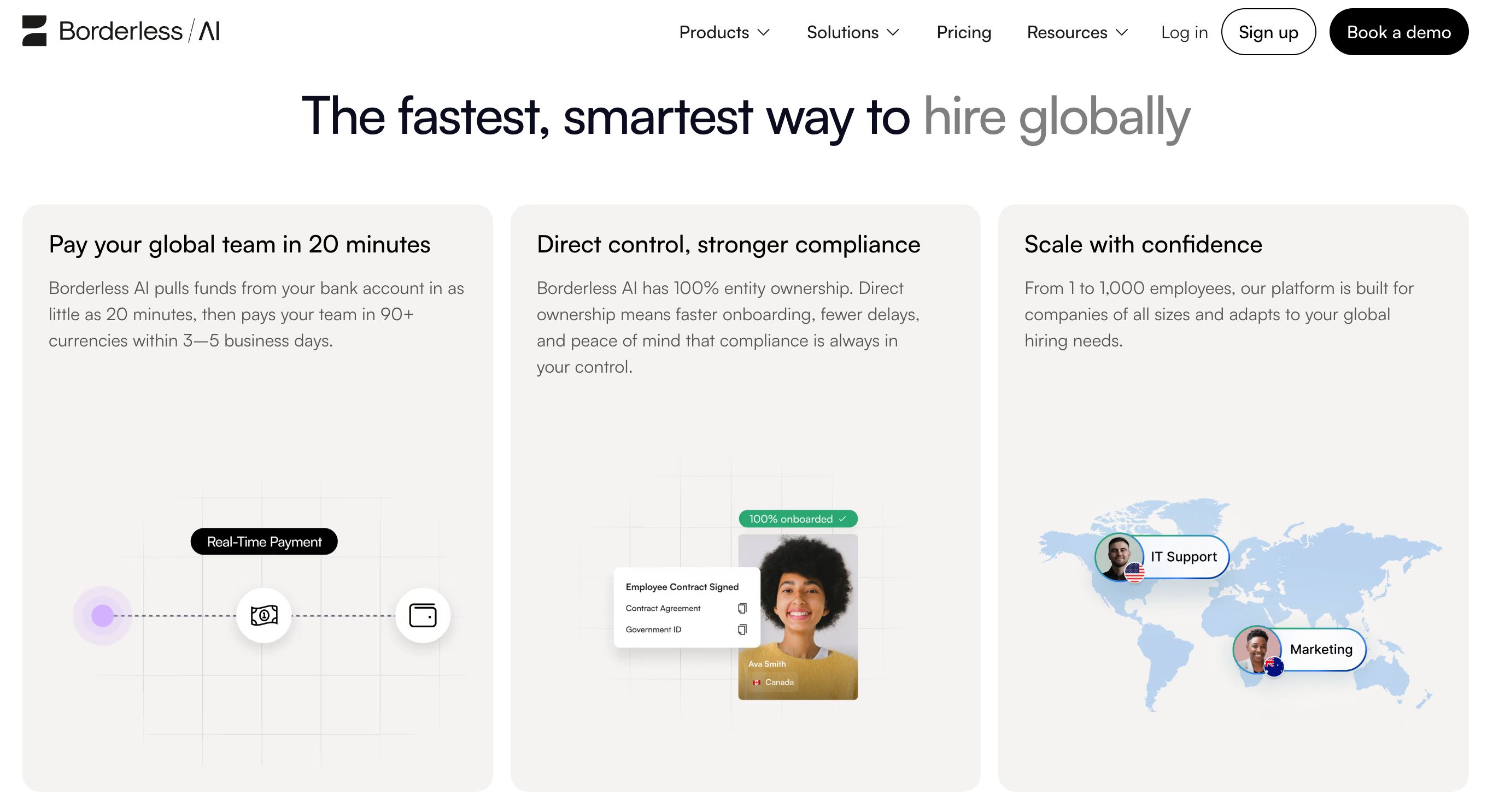
Borderless AI is a global EOR platform that supports compliant employment across multiple countries, including Nigeria. The platform manages employment contracts, payroll, and statutory filings for companies hiring without a local entity.
In Nigeria, Borderless AI covers core compliance obligations including PENCOM pension contributions, NSITF remittance, PAYE withholding, and NHF deductions. These filings are managed through the platform on behalf of the client company.
Pricing is not publicly listed in researched sources. Borderless AI is not yet rated on G2.
Strengths:
-
Manages PENCOM, NSITF, PAYE, and NHF compliance for Nigerian employees without requiring a client-side local entity.
-
Covers employment contract management aligned with Nigeria Labour Act requirements.
-
Supports multi-country hiring, giving companies a single platform for Nigeria alongside other markets.
Limitations:
-
Pricing is not publicly available, which makes upfront cost comparison difficult for budget-conscious buyers evaluating Nigerian EOR options.
Best for: Companies that need Nigeria-compliant employment with full statutory coverage and are comfortable engaging vendors on custom pricing terms.
No attributed customer reviews specific to Nigeria operations were found in researched sources.
Horizons
Horizons is a global EOR platform covering 185+ countries, including Nigeria. The platform supports compliant employment for companies that need entity-free hiring with dedicated account management.
In Nigeria, Horizons manages PENCOM pension contributions, NSITF remittance, PAYE withholding, and NHF deductions. Employment contracts are structured to meet Nigeria Labour Act requirements, including probation terms, notice periods, and statutory leave entitlements.
Horizons uses custom pricing. Pricing per employee per month is not publicly listed in researched sources. Horizons is not yet rated on G2 based on sources reviewed.
Strengths:
-
Covers PENCOM, NSITF, PAYE, and NHF compliance for Nigerian employees, managing statutory filings without requiring client-side entity registration.
-
Dedicated account management gives HR teams direct support for Nigeria-specific compliance questions and payroll execution.
-
Coverage across 185+ countries supports companies that need Nigeria as part of a broader multi-country hiring program.
Limitations:
-
Custom pricing with no publicly listed rates makes it difficult to compare costs against fixed-fee providers before entering a sales conversation.
Best for: Mid-size and enterprise companies hiring in Nigeria as part of a multi-country expansion that require dedicated account support and full statutory compliance coverage.
No attributed customer reviews specific to Nigeria operations were found in researched sources.
Mercans
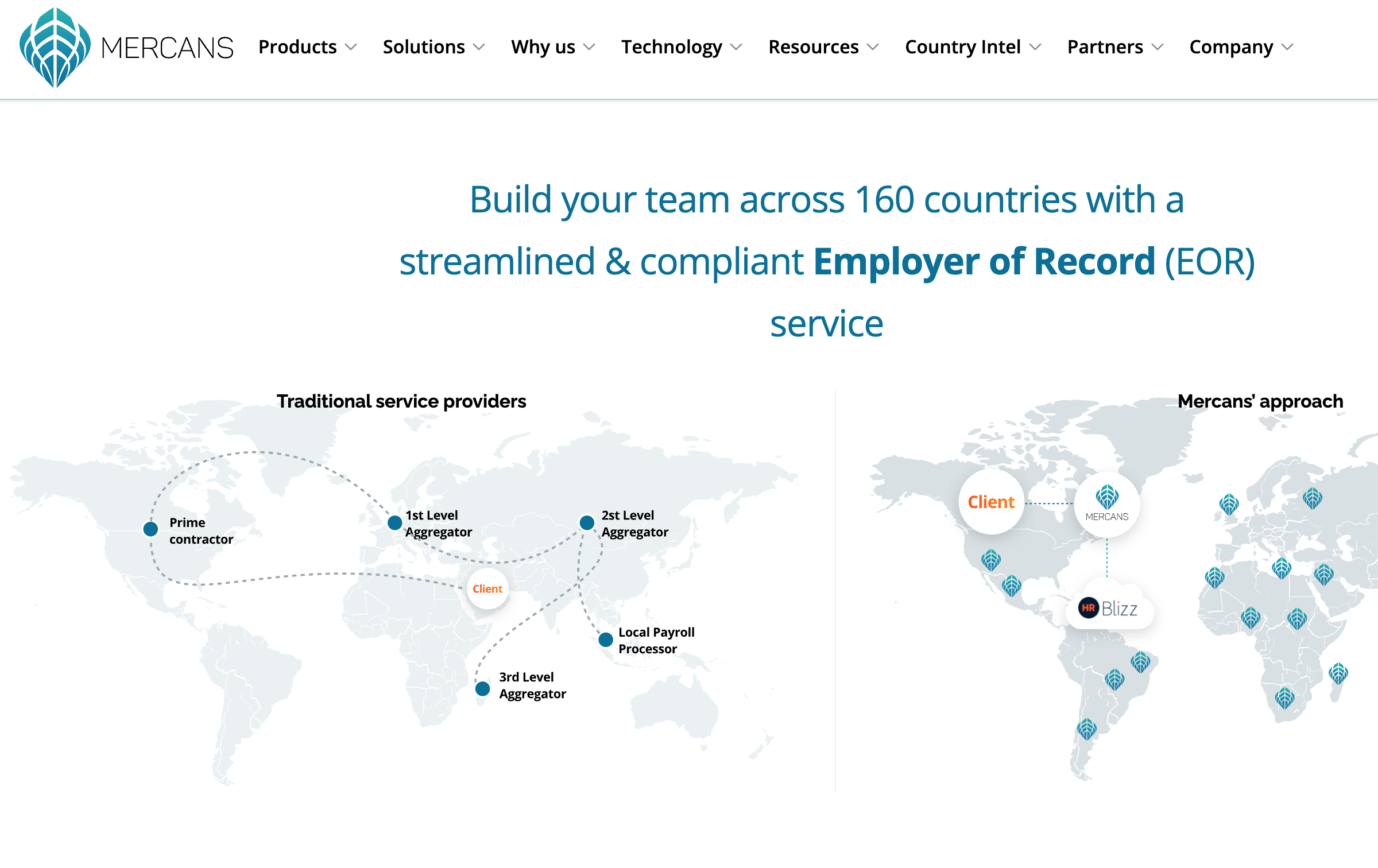
Mercans is a global payroll and EOR provider with a dedicated Nigeria employment offering, covering statutory compliance across PENCOM pension contributions, NSITF remittance, PAYE withholding, National Housing Fund deductions, and Industrial Training Fund obligations for qualifying employers.
Pricing is custom and not publicly listed. Mercans does not publish standard per-employee monthly rates for Nigerian EOR engagements.
G2 rating: Mercans PEO is listed on G2 with a 4.8 out of 5 rating based on 20 reviews.
Key features for Nigeria operations:
-
PENCOM pension compliance covering employer and employee contribution remittance to licensed pension fund administrators.
-
NSITF remittance management for workplace injury insurance obligations under Nigerian law.
-
PAYE withholding across state tax zones, including Lagos and Abuja, with remittance to the relevant state internal revenue service.
-
NHF and ITF handling for employers meeting the statutory thresholds under Nigerian regulations.
Onboarding speed for Nigeria: Mercans states your employee can begin working within 48 hours after onboarding.
Strengths: Mercans covers the full set of Nigerian statutory obligations, including PENCOM, NSITF, PAYE, NHF, and ITF, within a single EOR engagement. This reduces the compliance coordination burden for companies entering Nigeria without a local entity.
Limitations: Custom pricing with no published rates makes it difficult for Finance teams to benchmark Nigerian employment costs before entering a sales process.
Mercans offers an EOR and payroll service in Nigeria, though no independently attributable customer review specific to its Nigeria offering was identified in publicly available sources.
Best for: Companies that need comprehensive statutory compliance coverage across all Nigerian contribution schemes and are comfortable with a custom-quoted engagement model.
Remote
Remote is a remote-first EOR covering 100+ countries, suited for companies that need quick Nigerian employment activation, built-in insurance coverage, and equity management tools for distributed teams.
In Nigeria, Remote manages employment contracts, monthly Naira payroll, PAYE withholding, and PENCOM pension contributions.
Remote's foreign exchange policy for NGN payroll: Remote uses a monthly fixed Remote FX Rate for currency conversions to provide predictable costs and protect customers from currency fluctuations.
Onboarding speed for Nigeria: Remote’s average onboarding time is 2.3 days.
Remote carries a G2 rating of 4.6. This figure should be confirmed against the current G2 listing before publication.
Key features for Nigeria operations:
-
Equity management tools allow companies to administer stock options for Nigerian employees within the Remote platform.
-
Insurance coverage included in Nigerian employment packages provides benefit protection beyond statutory pension and NSITF requirements.
-
Local compliance experts give HR teams access to Nigeria-specific guidance on PAYE zones, PENCOM remittance, and Labour Act requirements.
-
Employment contract management covers Nigerian Labour Act requirements, including probation periods, notice obligations, and pro-rata annual leave.
Pricing is $599 per employee per month for Nigerian EOR services.
Strengths: Remote includes insurance coverage and equity management within its standard Nigeria EOR package, reducing the need for separate benefit and equity administration vendors. The platform is designed for remote-first workforce operations, which suits companies hiring distributed Nigerian talent.
Limitations: Pricing at $599 per employee per month places Remote at the higher end of the Nigerian EOR market, which creates cost pressure for growth-stage companies with limited hiring budgets.
Remote offers Nigeria-specific EOR documentation confirming local payroll and compliance capabilities, though publicly available customer reviews do not identify Nigeria as the market discussed.
Best for: Companies hiring Nigerian employees who also need equity administration and built-in insurance coverage within a single EOR platform.
Deel
Deel is a global HR platform covering 150+ countries, suited for companies that need flexible Nigerian payroll management, equity administration, and integrated employment operations across multiple workforce types.
In Nigeria, Deel manages PAYE withholding across tax bands from 7% at lower income levels to 24% above $2,376 (NGN 3.2 million) annually, PENCOM pension contributions, and NSITF remittance through a platform with dedicated local compliance expertise. Deel explicitly lists ITF remittance handling for qualifying employers. Deel supports Nigeria EOR contracts in NGN or USD, and the employee must have a bank account denominated in the contract currency.
Deel claims Nigerian employment onboarding in approximately two days, though no independent third-party source was identified that verifies this timeline specifically for Nigeria; the two-day figure is supported only by Deel's own Nigeria EOR documentation.
-
Customized payroll management handles Nigeria's multi-band PAYE structure, ensuring accurate withholding for each employee without manual HR intervention.
-
Equity and benefits administration allows companies to offer Nigerian employees stock options and supplementary benefits within the Deel platform.
-
Local compliance experts provide Nigeria-specific guidance on PENCOM pension, NSITF remittance, ITF contributions, and state-level tax board requirements.
-
Employment onboarding covers Nigerian Labour Act requirements, including written contracts, probation terms, and statutory leave entitlements.
Reviewers note that Deel provides responsive local compliance experts for Nigerian operations, giving HR teams direct access to PAYE and pension guidance. Capterra review titled “Unmatched payout speed for Nigeria remote workers” notes NGN withdrawals in under 5 minutes and mentions NGN conversion not always at mid‑market rate; verified on Capterra.
Pricing starts at $599 per employee per month for EOR services in Nigeria. This places Deel at the higher end of the Nigerian EOR market for growth-stage companies managing limited hiring budgets. Companies that need flexible payroll handling across Nigeria's state-level PAYE zones and multiple workforce types will find Deel's platform well-suited to that complexity.
Rippling
Rippling is a combined HR suite and EOR platform suited for companies that need payroll, HR administration, device management, and Nigerian employment operations integrated into a single system.
In Nigeria, Rippling enables companies to manage employment onboarding and payroll through a fully integrated HR platform with end-to-end workflow management for distributed teams. Rippling states that its global payroll calculates and remits local payroll taxes and mandatory benefits, though its public Nigeria material does not specifically confirm handling of PENCOM, NSITF, PAYE, NHF, or ITF requirements.
Rippling's platform integrates HR, payroll, and IT device management in one system, which reduces the number of separate tools companies need when scaling a Nigerian workforce alongside global operations.
-
End-to-end HR suite integration connects payroll, benefits, and device management for Nigerian employees within a single platform.
-
Workflow automation reduces manual HR administration for companies managing Nigerian employment alongside multi-country operations.
-
Rippling provides automated global payroll with localized tax and compliance workflows, plus a unified HR platform covering onboarding, payroll, benefits, time tracking, and employee data management. The platform also supports contractor management and misclassification workflows for international workers.
Rippling has a 4.8/5 rating from 12,372 reviews on G2.
Rippling provides automated global payroll with localized tax and compliance workflows, plus a unified HR platform covering onboarding, payroll, benefits, time tracking, and employee data. The platform also supports contractor management and misclassification workflows for international workers. Rippling holds a 4.8/5 rating from 12,372 reviews on G2.
Pricing is not publicly available. Companies should contact Rippling's sales team for a Nigeria-specific quote. The integrated HR suite model suits mid-size and enterprise companies that want a single platform for Nigerian employment, global payroll, and IT operations, rather than a standalone EOR tool.
Oyster HR
Oyster HR is a global EOR platform covering 180+ countries, built around remote-first employment and consistent statutory benefits delivery for distributed teams.
In Nigeria, Oyster HR manages employment contracts, monthly Naira payroll, PENCOM pension contributions, NSITF remittance, NHF deductions, and state-level PAYE withholding.
Oyster HR's G2 rating is Oyster is rated 4.4 out of 5 on G2 from 1,464 reviews..
Strengths:
-
Coverage across 180+ countries gives companies a consistent employment model for Nigeria within a platform that supports multi-market expansion without switching providers.
-
Remote-first platform design supports statutory benefits delivery for Nigerian employees, covering pension, NSITF, and NHF within the base employment package.
-
Consistent benefits administration reduces manual compliance tracking for HR teams managing Nigerian employment obligations across multiple statutory layers.
Limitations:
-
Pricing at $599 per employee per month places Oyster HR at the higher end of the Nigerian EOR market, creating cost pressure for startups with limited hiring budgets.
Best for: Companies with an established remote-first culture that need consistent statutory benefits delivery for Nigerian employees across a multi-country workforce.
FX policy for NGN payroll: Oyster invoices the total cost of employment using the mid‑market FX rate on the invoice day and pays team members in their local currency.. Onboarding speed for Nigeria: Compliant onboarding in as fast as 48 hours in 180+ countries.. Customer review: G2 Verified User in Computer Software: “Great service by Oyster, manages all the stuff working remotely.” (08/25/2026)..
What Are the Key Services of an EOR in Nigeria?
An EOR in Nigeria must cover statutory obligations that go well beyond basic payroll processing. Providers must handle PENCOM pension contributions, NSITF social insurance, NHF housing fund deductions, ITF training fund remittance, and state-level PAYE filings for each employee's registered tax zone.
Not all EOR providers handle every statutory layer. Some platforms manage payroll and PAYE but leave pension remittance or ITF compliance to the client, creating gaps that expose companies to regulatory risk under Nigerian law.
Verifying a provider's full service scope before signing is a practical step. The subsections below explain each core EOR service and the Nigeria-specific compliance obligations it covers, giving procurement teams a structured basis for comparing providers.
Employment Contracts and Local Compliance
Nigerian law requires all employment contracts to be in writing under the Labour Act. Each contract must specify the employee's role, compensation denominated in Nigerian Naira, probation terms, notice period, and leave entitlements.
Both fixed-term and indefinite contracts are permissible under Nigerian law. The contract type should reflect the nature of the engagement and the agreed duration of employment.
State-level PAYE registration is part of the employment setup process. The EOR registers each employee with the relevant state tax board, such as the Lagos Internal Revenue Service for Lagos-based employees or the Federal Inland Revenue Service for employees in the Federal Capital Territory.
Payroll and Tax Administration
Nigerian payroll involves several statutory contributions managed by the EOR on behalf of the employer and employee. PAYE is withheld at progressive rates: 7% on the first $223 (NGN 300,000) of annual income, rising to 24% on income above $2,376 (NGN 3.2 million) annually. PAYE is remitted to the state where the employee resides, not where the employer is registered.
Pension contributions under PENCOM require the employer to contribute 10% of monthly emolument and the employee to contribute 8%. The National Social Insurance Trust Fund levy is 1% of total monthly payroll, paid by the employer only.
-
National Housing Fund: 2.5% of employee basic salary, remitted to the Federal Mortgage Bank of Nigeria.
-
Industrial Training Fund: 1% of annual payroll, applicable to employers with five or more employees or annual turnover of $37,132 (NGN 50 million) or above.
Benefits Administration
Nigerian EOR providers manage two distinct layers of employee benefits: statutory and supplementary.
Statutory benefits include PENCOM pension contributions, NSITF social insurance, and NHF housing fund deductions. These are mandatory for all employers operating in Nigeria. Under the Pension Reform Act, employers with three or more employees must also provide group life insurance at a minimum of three times each employee's annual total emolument.
Supplementary benefits are not universally mandated but are common in competitive hiring markets. Private health insurance is standard practice in the Lagos technology sector, where companies use it to attract and retain skilled workers. A 13th-month payment is not required under Nigerian law but is offered by some employers as a market-competitive addition to base compensation.
Employee Onboarding
Onboarding a Nigerian employee through an EOR involves several country-specific steps that go beyond a signed employment contract.
The EOR collects three core identity documents from each new hire: a National Identification Number (NIN), a Bank Verification Number (BVN), and a tax identification number. These are required before payroll and statutory registrations can proceed.
Registration steps include:
-
PENCOM Retirement Savings Account verification or new registration for employees without an existing account
NSITF registration for social insurance coverage
NHF registration for housing fund contributions
State PAYE registration with the relevant state tax board
PENCOM registration is the most time-sensitive step. New employees without an existing Retirement Savings Account can take one to four weeks to complete registration, which affects the start date for pension contributions.
Onboarding speed varies across providers. Some complete Nigerian employment activation in two to five days. Others require two to three weeks depending on document readiness and internal processing capacity.
Ongoing HR Support
An EOR in Nigeria runs a recurring compliance calendar on behalf of the client company. Monthly obligations include PAYE remittance to the relevant state tax board, PENCOM pension contributions, NSITF remittance, and any applicable NHF deductions.
State-level PAYE follows the employee's state of residence, not the employer's registered address. Companies with staff across Lagos, Abuja, and other states must remit to each state's tax board separately each month.
The EOR also handles annual employer tax returns and processes employee Tax Clearance Certificates. On the Labour Act side, the EOR tracks leave balances, probation completion dates, and contract renewal schedules to keep each employment record current and compliant.
Employee Offboarding
Nigeria's Labour Act requires a minimum of one month's notice for monthly-paid employees, or the notice period specified in the employment contract if longer. The EOR manages this notice period and coordinates final pay calculations.
Nigeria does not impose a statutory severance payment requirement for standard terminations. Redundancy situations carry additional obligations, including consultation with affected employees and notification to the Federal Ministry of Labour and Employment before the process concludes.
Final pay must cover accrued salary, pro-rata annual leave pay, and any contractual entitlements. The employee's PENCOM Retirement Savings Account remains with the employee after termination. The EOR closes employer contributions only and does not transfer or liquidate the RSA. Wrongful termination claims may be brought before the National Industrial Court.
How to Hire Through an EOR in Nigeria
Hiring through an EOR in Nigeria involves two phases: provider selection and setup, followed by employee onboarding and compliance activation. For a detailed explanation of how does EOR work in practice, that guide covers the full mechanism.
The process removes the need for CAC incorporation, which typically takes three to six months. The EOR's existing Nigerian legal entity acts as the employer of record, absorbing statutory obligations under the Nigeria Labour Act, PENCOM, NSITF, and state PAYE frameworks.
From provider selection to first payroll, most companies complete the process in two to five weeks, depending on the provider's Nigeria compliance infrastructure and the complexity of the compensation structure.
Selection and Setup
When evaluating providers, confirm the EOR holds its own Nigerian legal entity rather than operating through a local partner. Ask specifically about PENCOM and NSITF registration status, and verify whether the provider handles NHF and ITF obligations directly or passes those to the client.
To assess Nigeria compliance track record, request PENCOM remittance proof and PAYE filing history before signing. Providers that cannot supply these on request carry higher compliance risk for your Nigerian operations.
Once a provider is selected, the client signs a service agreement establishing the co-employment relationship. The EOR then collects the job description, compensation structure including base salary and allowances, and the desired start date.
Confirm all pricing in writing before engagement, including statutory filing costs. Gloroots uses predictable, country-specific pricing with full cost visibility before onboarding and no percentage-of-salary pricing, which simplifies budget forecasting for Nigerian hires.
Onboarding and Compliance
Compliant onboarding in Nigeria requires the EOR to execute a written employment contract under the Nigeria Labour Act, verify or register the employee's PENCOM Retirement Savings Account (RSA), register the employee with NSITF and NHF, and complete state PAYE registration with the relevant State Internal Revenue Service.
Employees must provide the following documents before payroll activation:
National Identification Number (NIN)
Bank Verification Number (BVN)
Tax Identification Number (TIN)
Nigerian bank account details for Naira payroll disbursement
Once documents are confirmed, the EOR sets up NGN payroll and confirms the first payroll date with the client. For employees without an existing PENCOM RSA, new pension registration adds one to four weeks to the standard onboarding timeline.
Companies transitioning from an existing Nigerian payroll to an EOR should supply prior payroll records, existing PENCOM RSA pins for each employee, and PAYE filing history to the new EOR to support a complete and accurate compliance handover.
What Are the Benefits of Using an EOR in Nigeria?
Using an EOR in Nigeria reduces compliance exposure across a set of obligations that most foreign companies are not equipped to manage independently. State-level PAYE registration, PENCOM pension contributions, NSITF social insurance, NHF housing fund remittances, and ITF levies each carry separate filing requirements and deadlines.
The following subsections cover six primary benefits of using an EOR in Nigeria. These benefits apply equally to companies hiring in Nigeria for the first time and to companies moving away from self-managed payroll toward a governed employment model.
Faster Market Entry
Incorporating a Nigerian entity through the Corporate Affairs Commission typically takes three to six months. An EOR reduces that to days or weeks by using an existing local legal entity, removing the need for a local director, registered office, and share capital requirements.
Speed matters in the Lagos tech talent market. Candidates in high-demand engineering and product roles routinely drop off during extended hiring processes. Faster employment activation reduces that risk directly.
EOR also allows companies to test Nigerian market demand before committing to the fixed costs of entity setup. If the market does not perform as expected, the company exits without unwinding a registered entity.
Reduced Compliance Risk
Nigeria's compliance obligations span multiple agencies and state tax boards. An EOR manages PAYE withholding and remittance, PENCOM pension contributions, NSITF default obligations, NHF contributions, and ITF filings, reducing the risk of penalties across each of these requirements.
Companies with employees in multiple Nigerian states face simultaneous exposure to several state-level tax boards. Under-remittance to any one of them can trigger separate penalty proceedings. An EOR handles state-level PAYE remittance across all active locations.
The National Industrial Court can impose significant awards for wrongful termination. An EOR manages employment contracts and termination procedures under the Nigeria Labour Act, reducing that exposure. Under the Pension Reform Act 2014, PENCOM non-compliance can also result in criminal liability for company directors, making accurate pension remittance a governance priority, not only an administrative one.
Simplified Payroll Administration
Nigeria payroll involves multiple concurrent obligations: state-level PAYE remittance to the relevant tax authority, monthly PENCOM pension contributions, monthly NSITF remittance, NHF deductions from employee basic salary, and annual ITF filing.
NGN foreign exchange volatility means payroll costs in USD terms can shift significantly from month to month. EOR providers that bill in USD and execute payroll in NGN give Finance teams cost predictability that direct Naira billing cannot provide.
An EOR consolidates all statutory filings into a single monthly invoice for the client. Multi-currency payroll, USD fees paired with NGN execution, is a standard EOR capability for Nigeria operations. Gloroots supports this model through its EOR services, giving Finance teams a single, predictable monthly cost that covers all Nigerian statutory obligations.
Access to Local Benefits
An EOR in Nigeria administers the full set of statutory benefits on behalf of the client. These include PENCOM pension contributions at 10% employer and 8% employee, NSITF at 1% employer, NHF deductions at 2.5% of employee basic salary, and group life insurance equivalent to three times annual emolument for employers with three or more employees.
Beyond statutory requirements, the Lagos technology sector has established market practices that candidates expect. Private health insurance through an HMO and 13th-month pay are common supplementary benefits, though neither is mandated by statute.
EOR providers with established Nigeria benefits networks can offer competitive HMO plans at group rates that individual employers cannot access independently. This gives companies hiring through an EOR a practical advantage in attracting Nigerian talent without building a local HR infrastructure.
Lower Entity Setup Costs
Setting up a Nigerian legal entity through the Corporate Affairs Commission involves CAC registration fees, legal fees, registered office costs, local director requirements, and annual filing fees. Total first-year costs typically run into several thousand dollars before a single employee is paid.
For companies hiring one to five Nigerian employees, EOR is more cost-effective than entity setup. At 15 to 20 or more employees, entity setup may become cost-competitive, but ongoing compliance costs remain: annual returns, audited accounts, and company secretary fees add recurring overhead that EOR pricing already covers.
EOR allows companies to redirect entity setup capital toward hiring and operations. That capital stays productive from day one rather than funding registration and compliance infrastructure that takes months to activate.
More Flexible Workforce Scaling
Nigeria's Labour Act does not impose minimum employment duration requirements. An EOR can onboard and offboard Nigerian employees as business needs change, without triggering statutory penalties tied to contract length.
EOR supports scaling from one to 50 or more Nigerian employees without creating entity setup obligations at any headcount threshold. Companies already engaging Nigerian talent on a contractor basis can also convert those contractors to full-time employees through the EOR without a separate legal process.
This flexibility is particularly valuable for project-based hiring in Nigeria's technology and fintech sectors, where team size shifts with product cycles and client demand rather than fixed annual headcount plans.

How to Find the Right EOR for Nigeria
Selecting an EOR for Nigeria requires evaluating capabilities that go well beyond generic global coverage. Nigeria's compliance structure is layered across federal and state obligations, and providers vary significantly in how they handle each layer.
The criteria below are weighted toward Nigeria's specific compliance complexity: state-level PAYE remittance, PENCOM pension registration and monthly contributions, NSITF social insurance, NHF deductions, and ITF filings for qualifying employers. A provider that manages these obligations accurately is a different product from one that simply offers Nigeria on a country list.
When shortlisting providers, request Nigeria-specific compliance references or case studies. Reviewing employer of record software capabilities alongside compliance track records gives a more complete picture of operational fit.
Local Compliance Expertise
Evaluate providers across five Nigeria compliance axes: state-level PAYE remittance to the correct state tax board for each employee's residence state, PENCOM registration and monthly pension contributions, NSITF social insurance compliance, NHF deduction and remittance, and ITF filing for employers that meet the qualifying headcount threshold.
State-level PAYE is a key differentiator. Nigeria has 36 states plus the FCT, each with its own tax board. A provider must remit to the correct board based on where each employee resides, not where the client company operates. Providers that apply a single Lagos-based remittance for all Nigerian employees create compliance exposure.
When evaluating shortlisted providers, ask the following:
-
Do they operate through a dedicated Nigeria legal entity or through a local partner?
-
How many Nigerian employees do they currently manage under active EOR contracts?
-
Can they provide documented proof of PENCOM remittance for existing clients?
Clear Service Scope
Service scope varies significantly between EOR providers operating in Nigeria. Before signing, confirm whether the provider handles National Housing Fund deduction and remittance, Industrial Training Fund filing for qualifying employers, group life insurance administration, and multi-state PAYE remittance across Lagos, Abuja, Rivers, and other active states.
Some providers treat NHF and ITF as add-on services rather than included obligations. Buyers who assume these are covered by default may face compliance gaps after onboarding. Confirm the full scope in writing before engagement.
The Master Service Agreement is the binding document. Service scope confirmed only in sales calls or marketing materials does not carry contractual weight. Require explicit scope language in the MSA before signing.
Support Model
Nigeria's state-level PAYE structure requires EOR support teams with working knowledge of the Lagos Internal Revenue Service, the Federal Inland Revenue Service, and other state tax boards. A generic support desk is not sufficient for multi-state compliance queries.
Confirm whether the provider assigns a dedicated account manager with Nigeria compliance knowledge, publishes a response time SLA for PAYE and PENCOM queries, and operates during West Africa Time (WAT, UTC+1) business hours.
The support model should also include a defined escalation path for Labour Act disputes and matters that may reach the National Industrial Court. Ask providers directly: what is your average response time for Nigeria compliance queries?
Technology and Reporting
A capable EOR platform for Nigeria must produce the specific records that Finance and HR teams need for internal review and regulatory audit.
Monthly payroll reports should show PAYE withheld per employee per state, since Nigeria operates state-level tax boards with separate remittance obligations. The platform should also generate PENCOM contribution statements, NSITF remittance receipts, NHF deduction records, and ITF filing confirmations as discrete outputs, not bundled summaries.
Finance teams managing Nigerian headcount need both NGN and USD cost views given ongoing naira exchange rate volatility. A platform that shows only one currency forces manual reconciliation each month.
Audit-ready payroll records matter because FIRS and state tax boards conduct periodic reviews of employer withholding and remittance accuracy. Gaps in documentation create exposure during those reviews.
Employee self-service access to payslips and PENCOM contribution statements reduces HR administrative load and gives Nigerian employees direct visibility into their statutory deductions each pay cycle.
Scalability for Your Hiring Plans
Nigerian hiring rarely stays in one state. As teams grow across Lagos, Abuja, Port Harcourt, and other commercial centers, the EOR must handle multi-state PAYE registration and remittance without requiring separate vendor arrangements per state.
Contractor-to-employee conversion is a practical scalability requirement. Companies that start with Nigerian contractors and later bring those workers onto full-time employment need an EOR that can execute that transition without a platform change or a new onboarding process.
For companies planning pan-Africa expansion, the EOR's coverage beyond Nigeria matters. Verify whether the provider manages employment in Ghana, Kenya, and South Africa from the same platform, since fragmented regional vendors add compliance and coordination overhead.
EOR-to-entity transition support is a longer-term scalability consideration. When Nigerian headcount grows to a level that justifies a local entity, the EOR should be able to support CAC incorporation and transfer employment records to the new entity without disruption. Providers that treat entity setup as outside their scope create a gap at exactly the point when a company's Nigeria operations are maturing.
Gloroots covers 140+ countries from a single platform, giving companies a consistent employment model for Nigeria alongside other African and global markets. For companies at different growth stages, Gloroots offers dedicated support through its EOR for startups and EOR for enterprises tracks.

Why Gloroots Is a Strong EOR Partner in Nigeria
Companies hiring in Nigeria without a local entity need a partner that manages compliance precisely and prices it predictably. Gloroots supports compliant full-time employment across 150+ countries, with Nigeria-specific coverage built into its core service model.
In Nigeria, Gloroots manages PENCOM pension contributions at the 10% employer share, NSITF remittance, state-level PAYE filing, and NHF handling. These obligations run on a fixed monthly schedule with no manual coordination required from the client's HR or Finance teams.
Gloroots uses predictable, country-specific pricing with full cost visibility before onboarding. There is no percentage-of-salary pricing. Clients see the complete cost of Nigerian employment before the first contract is signed. See Gloroots pricing for current rates.
The platform combines four named service pillars:
-
Global Employer of Record (EOR) for entity-free employment in Nigeria and 150+ other countries
-
Global Payroll for monthly NGN payroll execution with FX handling for cross-border payments
-
Compliance and Employment Governance for statutory filings, contract management, and Labour Act adherence
-
Benefits and Statutory Coverage for PENCOM, NSITF, NHF, and supplementary benefit administration
Centralized workforce visibility gives HR and Finance teams a single view of Nigerian headcount, payroll costs, and compliance status. Human-led account support means clients work with a consistent team that retains context across the employment lifecycle, not a rotating help desk.
Companies that need EOR for small business or are scaling as EOR for mid-market companies can use Gloroots to hire in Nigeria without entity setup, with transparent pricing and compliance governance built in from day one. Learn more about Gloroots EOR services.
FAQs About the Best EOR in Nigeria
The questions below address the most common Nigeria-specific EOR topics raised by buyers evaluating providers for the first time. They cover both operational questions, such as how an EOR employs workers without a local entity, and compliance questions covering PENCOM pension contributions, state-level PAYE remittance, and NHF obligations.
Buyers comparing providers often ask about onboarding timelines, payroll currency, and how statutory filings are handled month to month. The answers below draw on Nigerian Labour Act requirements, pension regulations, and standard EOR operating practice to give Finance, HR, and Legal teams a clear reference point before engaging a provider.
How does an EOR work in Nigeria?
An EOR becomes the legal employer under Nigerian law, using its own Corporate Affairs Commission-registered entity to execute employment contracts on behalf of the client company.
The EOR manages PENCOM registration and monthly pension contributions, NSITF remittance, NHF deductions, state PAYE registration and monthly remittance, and ITF filing where applicable. The client company retains full day-to-day management of the employee's work and output.
The arrangement is governed by a service agreement between the client and the EOR, which defines responsibilities, liability boundaries, and termination procedures. For a detailed breakdown of how this model operates across markets, see how does EOR work.
What does an EOR cost in Nigeria?
EOR pricing for Nigeria ranges from $199 per employee per month at the lower end, where Gloroots and RemoFirst sit, to $599 to $1,000 per employee per month from providers such as Remote, Deel, and G-P.
The quoted fee typically covers the EOR service itself. Buyers should confirm whether PENCOM contributions, NSITF remittance, NHF deductions, and ITF filing costs are included or billed as separate line items, since treatment varies by provider.
Nigeria's NGN exchange rate introduces additional cost variability. Confirm whether your provider bills at the mid-market rate or applies a markup, as this affects the total USD cost of each payroll cycle. For a full breakdown of what drives employer of record cost across markets, that guide covers fee structures in detail.
Contractor management is typically cheaper, running $29 to $49 per contractor per month depending on the provider.
When should a company use an EOR in Nigeria?
An EOR in Nigeria is appropriate when a company needs to hire between one and fifteen Nigerian employees without incorporating through the Corporate Affairs Commission.
Common use cases include testing the Nigerian market before committing to a full CAC registration, hiring urgently without absorbing a three-to-six-month entity setup delay, and managing PAYE compliance across multiple Nigerian states with different tax boards.
An EOR also suits companies transitioning Nigerian contractors to full-time employment, where direct employment obligations under the Nigeria Labour Act apply but a local entity does not yet exist.
At fifteen to twenty or more employees, entity setup may become more cost-effective than ongoing EOR fees. Companies at that threshold should model both paths before committing to either structure. For a detailed breakdown of cost factors, see employer of record cost.
Can an EOR hire both local and foreign employees in Nigeria?
An EOR can employ both Nigerian nationals and expatriates in Nigeria. The compliance requirements differ significantly between the two groups.
Expatriate employment in Nigeria requires additional government approvals, including an Expatriate Quota from the Federal Ministry of Interior, a Subject to Regularisation visa, and a Combined Expatriate Residence Permit and Aliens Card. These requirements sit outside standard payroll and pension compliance and add processing time and documentation obligations.
EOR providers vary in their ability to manage expatriate quota applications and immigration compliance. Buyers should confirm that a prospective provider handles these steps directly rather than referring them to a separate immigration firm.
Expatriate payroll may also receive different Pay As You Earn treatment depending on the individual's residency status and the terms of any applicable tax treaty. Companies should verify how their EOR handles this distinction before onboarding foreign employees in Nigeria.
How do I choose the right EOR in Nigeria?
Five criteria matter most when selecting a Nigeria EOR: legal entity status in Nigeria, payroll compliance capability, statutory coverage, multi-state PAYE handling, and pricing transparency.
Before shortlisting, ask each provider these due diligence questions:
-
Does the provider operate through a CAC-registered Nigerian entity?
-
Can they supply PENCOM remittance proof for current clients?
-
Do they handle NHF and ITF contributions as part of the standard service?
-
What is their capability for multi-state PAYE remittance across Lagos, Abuja, and other states?
Request a Nigeria-specific compliance reference or case study from each shortlisted provider. Pricing structure is also a key differentiator: fixed monthly fees give Finance teams reliable cost forecasting, while custom quotes make budget planning harder to execute before headcount decisions are made.