

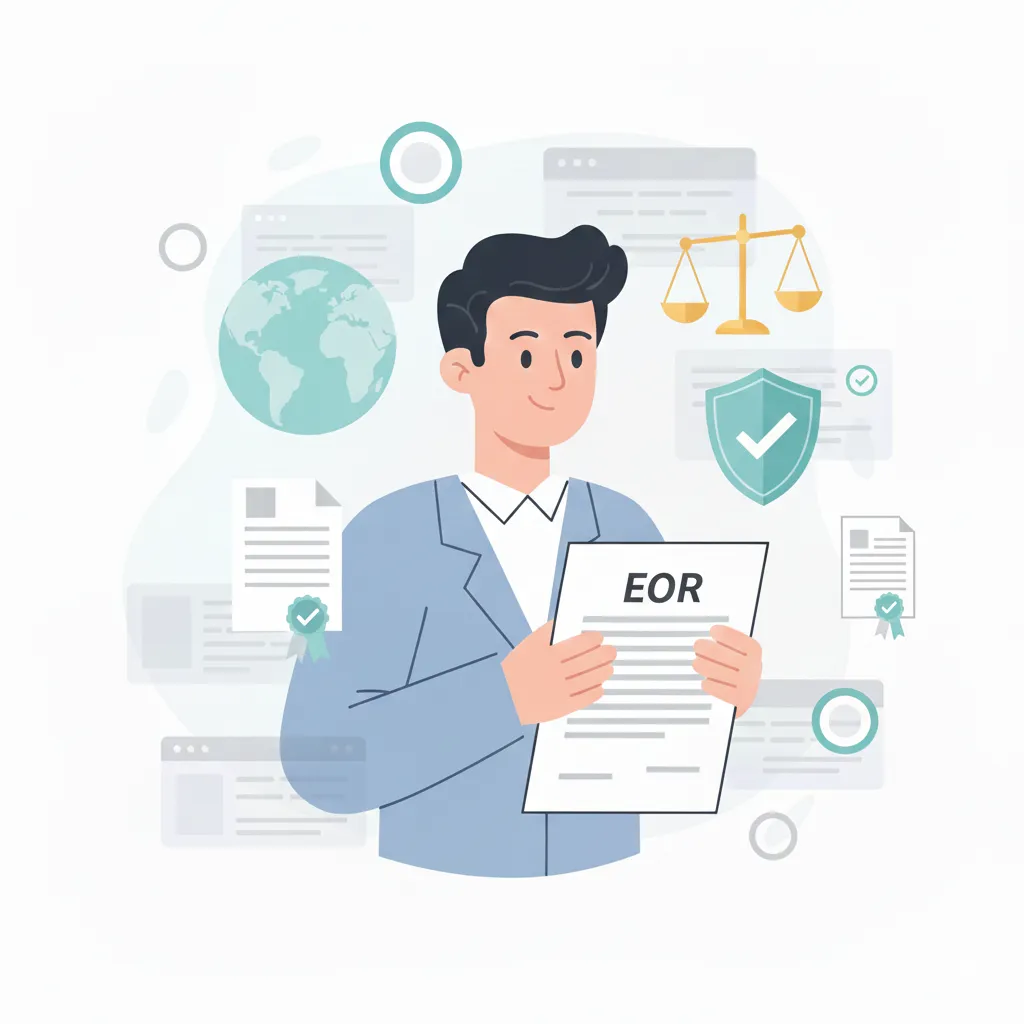

- An Employer of Record (EOR) becomes the legal employer locally, handling payroll, taxes, benefits, and compliance while you retain full control over daily work and performance.
- EORs use their existing in-country entities to issue compliant contracts, run payroll in local currency, and manage ongoing labor law obligations on your behalf.
- The hiring flow is simple: you choose the talent, the EOR onboards and manages legalities, and you fund salaries via a single consolidated invoice.
- EORs enable fast, low-risk global hiring without setting up foreign entities, making them ideal for quick expansion and market testing.
Most explanations of EOR mechanics stop at "they become the legal employer" which tells you nothing about what happens when you're managing 15 people across 6 countries and one of them needs to be terminated in Germany.
The real question isn't what an EOR is.
It's how the model functions under operational pressure:
- who owns what decisions
- where liability splits
- when the arrangement stops making financial sense
This breakdown walks through the seven stages of EOR engagement, the hidden cost structures most providers won't surface upfront, and the signals that tell you it's time to switch from rented infrastructure to owned entities.
How Does an Employer of Record Work?
An Employer Of Record (EOR) functions by becoming the legal employer of your international hires on paper while you retain complete operational control. This isn't delegation. It's bifurcation. Employment splits into two distinct layers:
- legal responsibilities (handled by the EOR)
- business management (handled by you).
The operational flow involves seven stages. Each carries different risk profiles and control boundaries.
Step 1: You Identify the Role and Select the Talent
You own the entire talent acquisition process before the EOR enters. You source candidates, conduct interviews, negotiate compensation, and define role scope. The EOR isn't a recruiting agency unless you've specifically contracted for talent advisory services.
Decisions required before involving an EOR:
- Job title, responsibilities, and reporting structure
- Gross salary (the EOR adds employer costs later)
- Start date and work location
- Full-time employee vs. contractor classification
Most misalignment traces back to this stage. If you haven't clarified employee vs. contractor status, or if compensation misses local norms, the EOR can't fix structural problems. They execute what you've decided.
Step 2: The EOR Becomes the Legal Employer
Once you've selected your hire, the EOR steps in as legal employer through their existing local entity. The EOR already has legal entities established and places your hire under their umbrella, issuing an employment contract governed by local labor law.
The EOR's name appears on
- tax filings
- social security registrations
- employment contracts
Regulators see your hire as their employee. But operationally, this creates a three-party relationship: the EOR employs the worker, you direct their work, and the employee receives instructions from you while being paid by the EOR.
The EOR drafts contracts using vetted templates that comply with local labor codes, statutory benefit requirements, and termination rules. You should review it to ensure role description, compensation, and reporting manager reflect what you've agreed with the candidate.
Step 3: Onboarding and Employment Setup
Before your hire's first day, the EOR manages the full employment lifecycle setup:
- Documentation
- Statutory registrations
- Compliance paperwork
What the EOR handles:
- Tax forms and social security registration
- Bank account verification for local payroll
- Background checks if legally required
- Work permits or visa documentation
In markets like India, UAE, and parts of APAC, background verification or right-to-work checks are legally required before employment begins. The EOR coordinates this. Delays here can push start dates. If you're hiring for time-sensitive roles, build 2 to 3 weeks of lead time.
Strong EORs like Gloroots co-brand communications and provide white-labeled onboarding portals. Weak EORs send generic emails from shared inboxes.
Step 4: Payroll, Taxes, and Benefits Administration
Once employment begins, the EOR takes full responsibility for running payroll: withholding taxes, issuing payslips, and handling government reporting.
How payroll flows:
- EOR invoices you for gross salary + employer costs
- You remit payment to the EOR
- EOR pays the employee in local currency
Timing matters. If you're slow to fund payroll, your employee misses payday, a compliance violation in many jurisdictions. The EOR typically requires payment 3 to 5 business days before the pay date.
The EOR calculates and withholds income tax, social security, and unemployment insurance. They also pay employer-side contributions (typically 15 to 30% on top of gross salary).
In France, employer contributions can hit 45% of gross wages.
In India, it's closer to 20%.
The EOR doesn't set these rates, but a good EOR like Gloroots provides accurate cost estimates upfront.
Step 5: Compliance and Ongoing HR Administration
EOR providers manage employment lifecycle compliance including labor law adherence, wage-hour regulations, and statutory reporting.
The EOR monitors changes to local employment law:
- minimum wage updates
- overtime rules
- mandatory leave policies
- termination notice periods
When India updates PF contribution rates or France changes pension thresholds, the EOR adjusts payroll automatically.
Each pay period, the EOR:
- Issues compliant payslips to employees
- Files employer tax returns with local authorities
- Remits social contributions and withholdings
- Maintains employment records for audits
In highly regulated markets (Germany, Brazil, India), penalties for late or incorrect submissions are steep. The EOR absorbs this burden. But if you provide incorrect data (wrong salary, missed bonuses), the payroll error is on you.
How responsibility splits:
The grey zone is co-employment risk. Unilaterally change an employee's benefits or terminate without consulting the EOR? You've stepped into employer territory. Strong EOR service models include approval workflows that keep you compliant.
Step 6: You Manage Day-to-Day Work and Performance
The EOR is not an HR outsourcing provider. They're a legal employment wrapper.
What you fully control:
- Daily work assignments and project direction
- Performance feedback and goal setting
- Team structure and reporting lines
- Promotions and compensation reviews (routed through the EOR for contract updates)
What the EOR controls:
- Employment contract modifications
- Payroll processing and benefits enrollment
- Statutory leave compliance verification
- Termination execution following local rules
Where leaders commonly overstep:
- Directly modifying employment terms without notifying the EOR
- Approving extended unpaid leave that violates local labor law
- Terminating employees without consulting the EOR on notice periods
These mistakes expose you to employment claims. In markets with strong labor protections (France, Germany, Brazil), employees can sue for wrongful termination even when you're using an EOR.
Step 7: Offboarding and Termination Management
When employment ends, the EOR manages the legal mechanics while you handle the business transition.
Notice periods are set by local law.
- In the UK, statutory notice is 1 week minimum.
- In Germany, it can be 3 to 7 months depending on tenure.
Want an employee gone immediately? You can negotiate garden leave or pay in lieu of notice, but you're paying for it.
Severance is non-negotiable in many jurisdictions. In India, gratuity is required after 5 years of service. In Brazil, FGTS accrues throughout employment and must be paid on termination. The EOR calculates this and includes it in your final invoice.
Risk during exits:
If an employee files a wrongful termination claim, the EOR is legally liable. But if you ignored their advice and terminated in violation of local law, you may be on the hook for damages.
Exit planning should start before you hire through an EOR. For guidance, see the pros and cons of EOR models.
Who Is Actually Liable When You Hire Through an EOR?
The most dangerous misconception about EORs: they eliminate employment risk. They don't. They redistribute it.
Liability the EOR assumes:
- Employment law compliance in the host country
- Payroll tax accuracy and timely remittance
- Statutory benefits provision
- Employment contract enforceability
Liability that remains with you:
- Business risk: project failure, revenue shortfalls, strategic pivots
- Performance management and termination decisions
- Co-employment exposure if you overstep boundaries
- Data privacy and IP protection
- Reputational risk if the EOR delivers poor employee experience
The EOR becomes the legal employer, but you're still the business employer.
Hire someone in Germany, decide 6 months later the role isn't needed, and want to terminate without cause? German labor law still applies. The EOR executes the termination compliantly, but you're paying severance, notice periods, and potentially legal fees.
EORs don't protect you from misclassification risk if you're using them to engage workers who should be contractors.
Regulators are increasingly scrutinizing EOR arrangements, particularly in markets like India where GCC setups are common but not always structured compliantly.
Treat the EOR as legal infrastructure, not a risk shield. Build your hiring strategy assuming you'll eventually own employment directly. Use the EOR as a bridge, not a permanent foundation.
What Are The Key Benefits of the EOR Model?
When deployed correctly, EORs solve specific problems that matter to leadership.
1. Speed to hire in new markets:
Setting up a legal entity in India takes 3 to 6 months and costs $15K to $50K. An EOR lets you hire in 7 to 14 days. For sales leaders closing Q4 pipeline with local reps, or product teams needing engineering talent in Bangalore, speed is the entire value proposition.
But speed comes with trade-offs:
- You're renting someone else's infrastructure rather than owning your entity
- At 50+ employees in a single country, EOR costs often exceed what you'd spend on entity setup and internal payroll
- The tipping point between EOR efficiency and entity ownership varies by market see EOR trends shaping 2026 for timing guidance
2. Compliance coverage:
EORs handle payroll tax filings, social contributions, statutory leave tracking, and termination procedures. This matters most in high-regulation markets like Brazil, France, Germany, and India, where non-compliance triggers audits and penalties.
But compliance coverage isn't compliance insurance:
- Misclassifying a contractor as an employee still exposes you to legal risk
- Terminating someone without following the EOR's documented process leaves you liable
- The EOR manages process execution, but you own strategic employment decisions
3. Cost efficiency vs. entity setup:
For small teams (1 to 10 employees per country), EORs are cheaper than entity incorporation. You avoid:
- Legal incorporation fees ranging from $15K to $50K
- Registered office costs and ongoing administrative overhead
- The burden of hiring and managing local finance and HR staff
At scale, the math reverses:
- EOR fees typically run $300 to $800 per employee per month
- At 50 employees, you're paying $216K to $576K annually for services an in-house payroll team could manage for significantly less
- The break-even point usually hits between 30 and 50 employees per country
The strategic question isn't "EOR vs. entity." It's "EOR until when?"
For more on cost structures and pricing models across providers, see employer of record pricing models.
What Are The Cost and Pricing Models of an EOR?
EOR pricing is rarely transparent. Leaders often discover hidden costs only after contracts are signed.
Pricing structures:
- Flat fee: Fixed monthly charge per employee (e.g., $499/month), regardless of salary. More predictable but can be expensive for junior hires.
- Percentage-based: Fee calculated as a percentage of gross salary (e.g., 8 to 12%). Scales with compensation but becomes costly for senior hires.
- Hybrid models: Flat base fee + variable component tied to benefits or services used.
Most enterprise EOR providers (Gloroots included) use flat or hybrid models for predictability.
What's typically included:
- Legal entity usage
- Employment contract drafting
- Payroll processing and tax filings
- Statutory benefits (health insurance, pension, social security)
- Basic HR support (onboarding, offboarding)
Often excluded and charged separately:
- Supplemental benefits beyond statutory minimums
- Visa sponsorship and work permit processing
- Background checks and pre-employment screening
- Equipment provisioning (laptops, monitors)
- Termination-related severance and notice pay
Hidden costs to anticipate:
- FX spreads: EORs pay employees in local currency. Most build in a 1 to 3% markup on currency conversion.
- Employer tax burden: You pay employer-side taxes on top of the EOR's service fee. This adds 20 to 45% to gross salary depending on country.
- Onboarding/offboarding fees: Some EORs charge setup fees ($200 to $500 per employee).
- Amendment fees: Changing an employee's salary, title, or work location mid-contract may incur administrative fees.
- Compliance audit costs: In high-risk jurisdictions, the EOR may pass through legal or tax advisory fees.
Before signing, get a fully loaded cost estimate that includes service fees, employer taxes, benefits, and ancillary charges. If the EOR won't provide this, it's a red flag.
EOR vs. PEO: The Difference That Actually Matters
Leaders often confuse EORs and PEOs because both involve outsourcing employment administration. But the structural difference changes who's liable when things go wrong.
When to use each:
- Use an EOR when you're expanding into a new country and don't have a local entity.
- Use a PEO when you already have an entity and want to outsource HR admin but retain direct employment.
In the US, PEOs are common because entity setup is straightforward. Internationally, EORs dominate because cross-border entity formation is complex and expensive. For a detailed comparison, see PEO vs. EOR: when to use which model.
When an EOR Model Makes Sense (And When It Doesn't)
EORs solve specific problems. They're not a universal solution.
Strong-fit scenarios:
- Testing a new market with 1 to 5 hires before committing to entity setup
- Hiring specialized talent in a country where you don't plan to build a larger team
- Scaling GTM teams rapidly across multiple geographies
- Supporting remote employees who relocate to countries where you don't have legal presence
- Building a GCC in India while entity formation is in progress (Gloroots specializes in India GCC enablement)
Weak-fit scenarios:
- Scaling beyond 50 employees in a single country
- Hiring in your home market where you already have HR infrastructure
- Managing highly variable contractor workforces
- Long-term strategic hires where direct employment and equity participation are critical
Signals it's time to switch models:
- EOR fees exceed $30K per month in a single country
- You're making 5+ contract amendments per quarter
- Employees are asking for equity or benefits the EOR can't facilitate
- Local regulators are scrutinizing your EOR arrangement
- You're planning to stay in the market for 3+ years
The best EOR relationships include an exit plan from day one. If your provider doesn't discuss entity transition timelines upfront, they're optimizing for their revenue, not your growth.
Frequently Asked Questions
1. What’s the difference between an EOR and hiring contractors?
An EOR hires full-time employees and manages payroll, benefits, and compliance. Contractors are self-employed, and misclassification can trigger serious legal penalties.
2. How much does an EOR cost per employee per month?
Most EORs charge $300–$800 per employee per month, excluding salary. Employer taxes add another 15–45% depending on the country.
3. Can an EOR help with contractor-to-employee conversions?
Yes. EORs handle local contracts, benefits setup, and statutory registrations during the conversion. This reduces compliance risk during the transition.
4. Does using an EOR protect my company from all employment liability?
No. The EOR covers legal employment tasks, but business and co-employment risks remain. Overstepping boundaries can still expose your company.
5. How long does it take to hire someone through an EOR?
Most hires take 7–14 days. Highly regulated countries may take 2–3 weeks, while simpler markets can be as fast as 5–7 days.

Ready to take the first step?
Request a demo now and learn how you can focus on building, without worrying for compliance, ever!