




An honest comprehensive comparison of 15+ EOR providers across the market. This guide breaks down what each one actually charges, how many countries it really covers, and what its own customers says from user reviews, so you can shortlist the right provider before your next international hire's offer expires.
Your next great hire might be 5,000 miles away. What happens when you don’t have an entity there?
You could spend months setting one up, figure out local payroll and employment laws yourself, or use an Employer of Record (EOR) to hire compliantly without opening a local entity.
But choosing an EOR isn’t just about finding the lowest monthly price. Country coverage, onboarding speed, compliance expertise, support, features, and pricing can vary widely between providers.
So, which EOR providers are worth considering in 2026?
We compared 15+ leading EOR companies across pricing, country coverage, features, customer reviews, and overall fit. Whether you’re hiring your first employee abroad or building a global team, this guide will help you find an EOR that fits your needs and budget.
What Is an Employer of Record (EOR), and How Does It Actually Work?
Before comparing 15+ EOR companies by price and country coverage, it helps to understand what an EOR actually does.
An Employer of Record (EOR) legally employs workers for your company in countries where you don't have a local entity. The EOR manages the employment contract, payroll, taxes, mandatory benefits, and local compliance. You still manage the employee’s day-to-day work, including what they do, who they report to, and when they leave. This is useful because hiring in another country isn't as simple as paying someone a salary. Without a local entity, you may not be able to legally employ people, run payroll, provide benefits, or handle local taxes. Setting up your own entity can take months and cost thousands of dollars. An EOR lets you hire in days because the local entity and compliance setup are already in place.
The main trade-off is speed versus long-term control. Setting up your own entity gives you more control, but it makes more sense when you have a larger team in that country. For your first few hires or when you're testing a new market, an EOR is usually the faster and more practical option. So, that's how an EOR works. The bigger question is: when should your company use one?
Why Do Growing Companies Actually Need an EOR Provider?
Not every company needs an EOR, and the ones that do usually don't realize it until the decision is already urgent. The clearest trigger is deceptively simple: you've found the right person, and you have no legal entity in their country. That single situation - qualified candidate plus missing entity - covers most EOR purchases, regardless of company size, industry, or funding stage. A few recurring scenarios sit underneath it:
- Market testing. You want to hire one or two people in a new country to see if it's worth a real investment, without committing to entity setup before you know the answer.
- Speed-critical hires. A deal, a product launch, or a client contract depends on someone starting within days, not the months a local entity takes to stand up.
- Converting contractors to employees. A contractor relationship has quietly become a full-time one, and misclassification risk is now a real legal exposure rather than a theoretical one.
- Distributed and remote-first teams. The best candidate for a role doesn't live where your office does, and increasingly, that's fine, if someone handles the local compliance.
- Expansion without commitment. Leadership wants a foothold in a region before deciding whether to build out a full local operation.
If any of that sounds familiar, you're shopping for an EOR whether you've called it that yet or not. The question that follows isn't whether to use one - it's which one, and that's where most of the confusion, and most of the hidden cost, actually lives.
Already know you need one? See Gloroots country-specific pricing before you talk to anyone else. Get a quote →
The 15+ Best EOR Providers in 2026, Compared at a Glance
Here's the entire field in one table, before the deep dive on each one.
A few things jump out immediately: starting price alone swings more than 3.5x across this list, review transparency varies wildly from 5,221 reviews down to zero, and more than a third of these providers won't tell you their real EOR price until you're already on a sales call. None of that tells you which one is right for you, that takes the full picture, provider by provider.
Skip ahead: see exactly what Gloroots charges for your countries and headcount. Get a quote →
1. Gloroots
Best for: Growing companies that want transparent pricing, responsive human support, and global employment without unnecessary platform complexity.
Overview
Gloroots is a global employment platform covering Employer of Record (EOR), Contractor of Record (COR), contractor payments, global mobility, and India recruitment. Its EOR service enables companies to hire employees across 150+ countries without setting up local entities, while Gloroots manages employment contracts, payroll, taxes, benefits, compliance, and employee administration.
The platform is positioned around straightforward global employment rather than a broad HR-tech suite. EOR pricing starts at $199 per employee/month, with no minimum headcount, while its wider workforce offering also includes COR and contractor payment services.
For companies evaluating EOR providers, Gloroots stands out particularly where pricing visibility and human support matter as much as country coverage.
Pros
- Transparent starting EOR pricing
- Human support for payroll, compliance, and country-specific issues
- 150+ country coverage
- Fast onboarding, typically within 3–5 working days
- EOR, COR, contractor payments, crypto to fiat payments, and mobility under one provider
- Strong user feedback around onboarding and payroll execution
Cons
- Some users may want deeper reporting and customization capabilities
- Certain onboarding workflows can require additional coordination
- Less suited to companies looking for a full HRIS, IT, recruiting, and finance operating system in one platform
Pricing
From $199/employee/month for EOR. Country-specific employment costs, statutory contributions, benefits, and other services may affect the final cost.
G2 Rating
4.9/5
Bottom Line
Gloroots is particularly compelling for companies that want the core EOR job done well: hire internationally, stay compliant, pay employees correctly, and have a real person available when something gets complicated. Its strongest argument is the combination of transparent pricing, broad coverage, faster onboarding, and human support without requiring companies to adopt a much larger HR technology stack.
2. Deel
Best for: Companies looking for a large, mature global employment platform with extensive workforce-management capabilities.
Overview
Deel is one of the most established names in global employment and offers EOR, contractor management, payroll, immigration, US PEO, HR, recruiting, and other workforce services. Its EOR offering covers 130+ countries, while its broader platform extends further across global workforce management.
Deel's EOR service handles employment contracts, payroll, taxes, benefits, compliance, onboarding, and other country-specific requirements. The platform is designed to scale from individual international hires to large multi-country workforces. Its broad product portfolio makes Deel attractive to organizations that expect their global employment requirements to expand beyond EOR into contractors, HR, immigration, and payroll.
Pros
- Broad global hiring and workforce-management platform
- Strong international country coverage
- Mature contractor and EOR infrastructure
- Extensive product ecosystem
- Generally easy-to-use workflows
- Strong user feedback around payments and contract management
Cons
- Higher EOR starting price than many challengers
- Broader product suite can mean more complexity than an EOR-only requirement needs
- Some users report occasional support or resolution delays
- Costs can rise as additional products and services are added
Pricing
From $599/employee/month for EOR. Contractor management starts at $49/month, with other workforce services priced separately.
G2 Rating
4.8/5
Bottom Line
Deel is a strong choice for companies that want an established global workforce platform and expect to use multiple HR, payroll, contractor, or immigration products over time. Its main advantage is breadth. The trade-off is that companies buying only EOR may find themselves paying for a much larger technology ecosystem than they actually need.
Hiring abroad? See how Gloroots makes it simpler.
3. Remote
Best for: Companies that prioritize direct entity ownership, compliance control, and intellectual-property protection.
Overview
Remote focuses heavily on global employment, EOR, contractor management, payroll, benefits, equity, and global HR operations. Its EOR model has historically emphasized directly owned entities rather than relying primarily on third-party partners, giving it a narrower but more controlled country footprint.
Remote's EOR offering covers employment contracts, payroll, benefits, taxes, compliance, and employee administration. It also has dedicated capabilities around intellectual-property protection, which can be particularly relevant for technology companies hiring engineers, designers, and other IP-generating employees internationally.
Pros
- Strong owned-entity model
- Compliance-focused approach
- Good platform usability
- Strong global employment infrastructure
- IP protection capabilities
- Positive feedback around onboarding and employee management
Cons
- Higher starting EOR pricing
- Owned-entity strategy means coverage can be narrower than providers claiming 150–180+ countries
- Some country-specific workflows can require additional coordination
- Less attractive for buyers whose primary criterion is lowest monthly cost
Pricing
From approximately $699/employee/month, depending on plan and country.
G2 Rating
4.5/5
Bottom Line
Remote is worth considering when entity ownership and compliance control matter more than simply maximizing country count. It is particularly relevant to technology businesses and companies hiring employees whose work involves valuable intellectual property. Buyers should compare Remote's narrower owned-entity footprint against providers offering broader partner-supported coverage.
4. Multiplier
Best for: Cost-conscious companies looking for global EOR coverage with particular strength across Asia-Pacific.
Overview
Multiplier provides EOR, global payroll, contractor management, benefits, immigration, and workforce-management services across 150+ countries. Its positioning combines international coverage with a relatively price-conscious approach compared with several larger EOR platforms. The platform supports compliant employment contracts, payroll, benefits, tax handling, and employee administration. Multiplier has built particular visibility in APAC, making it a relevant option for companies expanding into India, Singapore, Australia, Southeast Asia, and other fast-growing markets.
Pros
- Competitive EOR pricing
- 150+ country coverage
- Strong APAC relevance
- Relatively straightforward platform
- EOR and payroll capabilities in one system
- Positive feedback around ease of use and onboarding
Cons
- Pricing and billing can become less straightforward once additional services are included
- Some users have raised concerns around support or country-specific execution
- FX costs should be examined carefully
- May not offer the same breadth of adjacent HR products as larger platforms
Pricing
From approximately $599/employee/month for EOR based on current published/G2 pricing information. Country, billing term, and service requirements can change the final price.
G2 Rating
4.7/5
Bottom Line
Multiplier is a strong contender for companies that want global EOR coverage without immediately moving into the highest-priced tier of the market. It is especially interesting for APAC-heavy expansion plans. The important buying question is not just the base fee but what the final invoice looks like after benefits, FX, country-specific requirements, and additional services are included.
5. Papaya Global
Best for: Mid-market and enterprise companies that prioritize global payroll, payments infrastructure, reporting, and financial visibility.
Overview
Papaya Global combines EOR with global payroll, contractor management, payments, workforce management, and payroll analytics. Its infrastructure is particularly oriented toward companies managing complex international payroll operations across multiple countries and currencies.
The platform claims coverage across 160+ countries and supports payments in a large number of currencies. Its strength is less about being a lightweight EOR and more about giving finance and payroll teams centralized visibility across international workforce costs.
Pros
- Strong global payroll infrastructure
- Extensive payments and currency capabilities
- Detailed reporting and financial visibility
- Suitable for large multi-country payroll operations
- Broad workforce-management functionality
- Strong integration potential
Cons
- Historically higher cost than leaner EOR providers
- Implementation can become expensive for new countries
- Pricing can vary substantially based on geography and service scope
- More platform complexity than a company hiring only a few international employees may need
- Some users report slower support responses for payroll questions
Pricing
From approximately $499/employee/month for EOR.
G2 Rating
4.5/5
Bottom Line
Papaya Global makes the most sense when global payroll and financial infrastructure are as important as EOR. Finance teams managing large international workforces may value its reporting and payments depth. For smaller companies making their first overseas hires, however, its broader architecture and potential implementation costs may be more than necessary.
6. Globalization Partners (G-P)
Best for: Enterprise organizations that prioritize global compliance, local expertise, and high direct-entity coverage.
Overview
G-P, formerly Globalization Partners, is a long-established global employment provider offering EOR, contractor services, payroll, compliance, and workforce-management technology. It claims coverage across 180+ countries, with a particularly strong emphasis on direct employment infrastructure.
G-P combines its technology platform with local HR and compliance expertise. The offering is designed for companies that need to hire internationally while reducing the legal, payroll, tax, and employment complexity associated with entering multiple jurisdictions.
Pros
- Very broad country coverage
- Strong local compliance expertise
- High level of owned-entity coverage
- Strong account-management experience
- User-friendly platform
- Helpful onboarding and country-specific guidance
Cons
- EOR pricing is not positioned as a low-cost option
- Some workflows require navigating multiple areas of the platform
- Users have reported occasional delays in support resolution
- Some customers want deeper HRIS integrations
- Cost can be harder to justify for very small international teams
Pricing
From approximately $599/employee/month based on current G2 pricing information. Enterprise pricing can be customized.
G2 Rating
4.4/5
Bottom Line
G-P is built for buyers who want compliance depth and global scale rather than the lowest EOR price. Its local expertise and owned-entity footprint are meaningful advantages for enterprises operating across complicated markets. For smaller companies, however, the premium may be difficult to justify unless they need G-P's broader enterprise capabilities.
See how Gloroots handles global employment →
7. Oyster HR
Best for: Companies making their first international hires and looking for guided, user-friendly global employment workflows.
Overview
Oyster HR is a distributed employment platform focused on EOR, contractor management, payroll, benefits, and global hiring. Its EOR coverage extends across 120+ countries, while its broader contractor footprint is larger.
The platform is designed around simplifying international employment for companies without dedicated global HR teams. Oyster handles compliant contracts, payroll, benefits, tax requirements, and employee administration while giving employers a centralized dashboard.
Its positioning around transparent, all-inclusive pricing and guided international hiring makes it particularly relevant to startups and growing businesses entering global markets for the first time.
Pros
- Clean and approachable platform
- Strong onboarding experience
- Helpful customer support
- Guided international hiring workflows
- Transparent pricing positioning
- Strong employee experience
Cons
- Higher EOR starting price
- Reporting and analytics can feel restrictive for more advanced requirements
- Some users report rigid support processes
- Country-specific execution can vary
- Contractor and EOR coverage are not identical
Pricing
From $699/employee/month for EOR.
G2 Rating
4.4/5
Bottom Line
Oyster is a strong option for companies that want a guided experience rather than a highly technical global payroll environment. It is particularly attractive for first-time international employers. The key consideration is whether its higher starting price and more structured workflows make sense as the company's global workforce becomes larger and more operationally complex.
8. Pebl
Best for: Companies looking for broad country coverage combined with increasingly automated, AI-enabled global employment workflows.
Overview
Pebl is the rebranded successor to Velocity Global, with the company repositioning itself around an AI-first global hiring platform. It claims coverage across 185+ countries and combines EOR with contractor management, payroll, immigration, benefits, equity, and other global workforce services.
A key part of its newer positioning is Alfie, its AI assistant designed to provide country-specific hiring and compliance information while reducing the need for manual research.
Pros
- Very broad country coverage
- Established EOR experience
- AI-assisted global hiring workflows
- Large range of workforce services
- Immigration and benefits capabilities
- Strong G2 satisfaction
Cons
- Pricing can become less predictable with additional services
- Country-specific and currency-related fees need careful review
- The transition from Velocity Global to Pebl adds some brand complexity
- Companies looking for high-touch service may prefer a more service-led provider
- Final cost can be significantly different from the headline EOR rate
Pricing
Starts from $399/employee/month. Pebl's actual pricing may vary by country and service requirements, so this should be treated as indicative.
G2 Rating
4.6/5
Bottom Line
Pebl is an interesting choice for organizations that want broad geographic coverage and increasingly automated global employment operations. Its AI-first repositioning gives it a different angle from traditional EOR providers. Buyers should nevertheless examine the full pricing structure carefully, especially if they require immigration, HR advisory, or other add-on services.
9. Rippling
Best for: Companies that already use or want a broader HR, IT, finance, and workforce-management operating system.
Platform / Service Overview
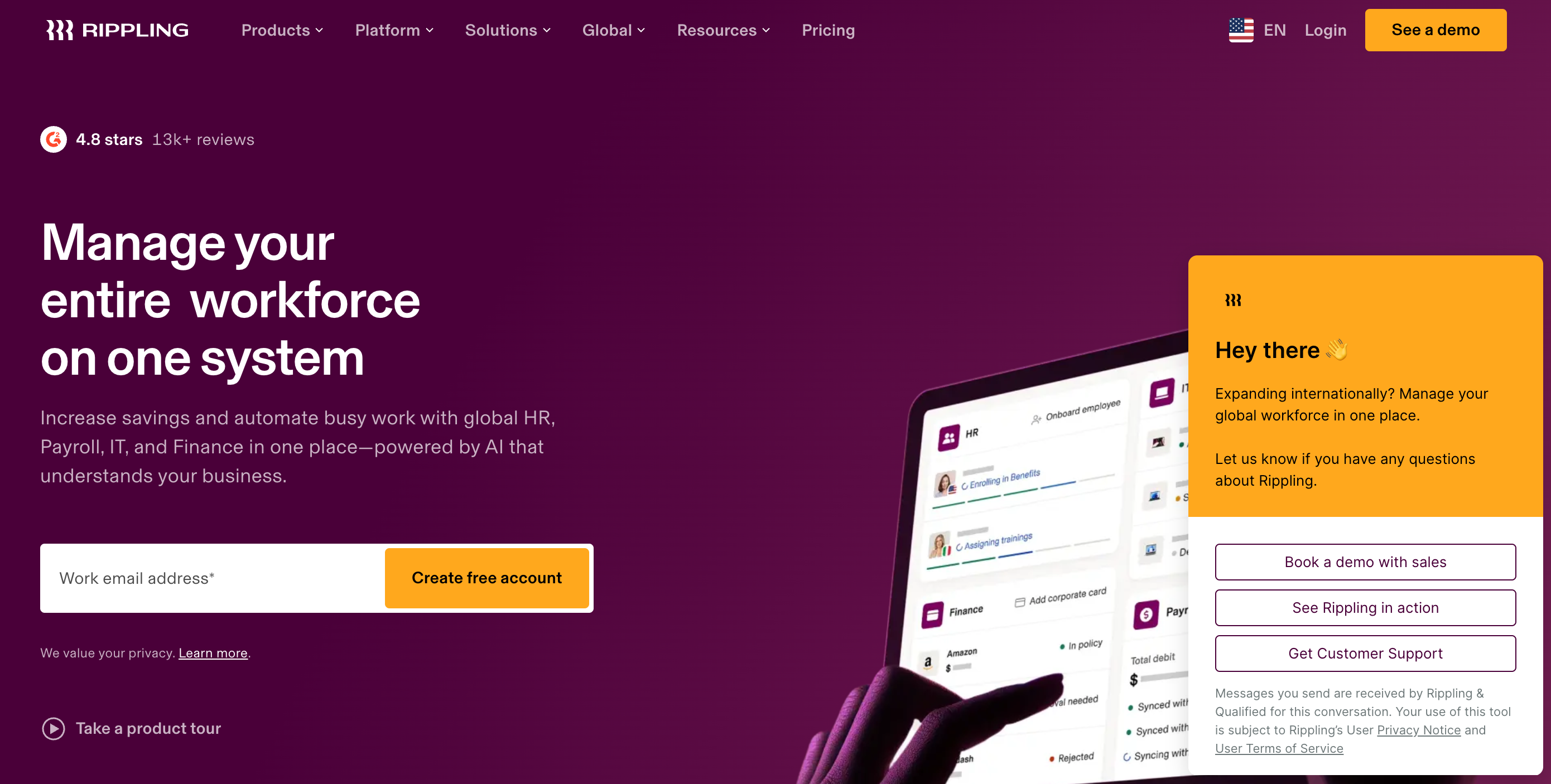
Rippling approaches international employment differently from specialist EOR providers. EOR and global payroll sit inside a much broader platform covering HR, payroll, benefits, IT, device management, finance, recruiting, and workforce administration.
Its global employment offering covers 185+ countries, but the main value proposition is the ability to connect international employment with domestic HR and IT workflows. This can be particularly powerful for companies already running their workforce infrastructure on Rippling.
Pros
- Extremely broad HR and workforce platform
- Strong automation capabilities
- HR, IT, payroll, and finance connected in one system
- Excellent overall G2 rating
- Strong integrations
- Attractive for companies already using Rippling
Cons
- EOR pricing is not transparently published as a simple standalone rate
- Platform fees and additional modules can increase total cost
- More complex than a dedicated EOR may need to be
- Advanced configuration can involve a learning curve
- Some users report limitations or friction with certain payroll and tax workflows
Pricing
Custom pricing for EOR. Rippling's broader platform is modular, meaning the total cost depends on the products and services selected.
G2 Rating
4.8/5
Bottom Line
Rippling is less an EOR company and more a full workforce operating system that includes EOR. That distinction matters. If you want HR, IT, payroll, finance, devices, and international employment connected in one environment, Rippling can be compelling. If you simply need to employ ten people across five countries, a specialist EOR may be simpler and more economical.
10. Plane
Best for: Startups and smaller companies looking for a straightforward, flat-fee global employment platform.
Overview
Plane's positions itself as a simpler alternative to large enterprise workforce platforms, with EOR services across 100+ countries and significantly broader contractor-payment coverage. Its EOR model uses a flat monthly fee rather than building the product around a large collection of HR modules. The platform also provides contractor payments, payroll, onboarding, and international workforce administration.
Pros
- Simple platform
- Flat-fee EOR positioning
- No minimum headcount
- Startup-friendly approach
- Broad contractor-payment capabilities
- Easy onboarding and payment workflows
Cons
- EOR country coverage is narrower than several large competitors
- Immigration and country-specific services can add significant costs
- Buyers should examine security-deposit requirements
- Some external customer feedback raises concerns around payment reliability and support
- Less enterprise depth than larger global employment platforms
Pricing
Approximately $499/employee/month for EOR. Additional country-specific costs, immigration services, FX, and security requirements may apply.
G2 Rating
4.6/5
Bottom Line
Plane is worth considering when simplicity and predictable base pricing matter more than having the largest possible country footprint. Its contractor-payment infrastructure is particularly notable. However, companies should perform deeper operational due diligence around payroll reliability, support, deposits, and country-specific add-ons before committing.
11. Atlas HXM
Best for: Companies that want a fully owned-entity EOR model with centralized compliance responsibility.

Overview
Atlas HXM positions itself around a direct-entity model, claiming 160+ owned entities and no third-party EOR partners. This is one of its strongest differentiators for buyers concerned about accountability and control. The platform covers EOR, contractor management, payroll, benefits, compliance, and integrations with established HR systems. It is designed to give companies one accountable provider rather than routing employment through multiple local partners.
Pros
- 160+ direct entities
- No third-party EOR partner model
- Strong compliance positioning
- Centralized global employment platform
- Multiple HRIS integrations
- Dedicated customer support
Cons
- Higher starting price
- Platform can require a learning curve
- Some users report slower page or document loading
- Workflow customization can be limited
- Payroll timing requirements may be restrictive for some companies
- Some users perceive the service as expensive relative to the value received
Pricing
From $599/employee/month for companies onboarding 1–5 employees. Larger deployments are custom quoted.
G2 Rating
4.2/5
Bottom Line
Atlas HXM is compelling for buyers who consider direct entity ownership a non-negotiable. Its model gives customers a single accountable employment provider across a broad global footprint. The trade-off is cost and, according to some users, a platform experience that still has room to improve in performance and workflow flexibility.
12. Safeguard Global
Best for: Enterprises hiring across complex emerging markets and needing deep local workforce expertise.

Overview
Safeguard Global is one of the more established global workforce providers, offering EOR, global payroll, contractor management, HR, workforce analytics, and compliance services.
It claims coverage across roughly 180+ countries, with a hybrid infrastructure combining direct operations and local partners. The company has particular relevance for businesses expanding across Africa, Latin America, Asia-Pacific, and other markets where local employment complexity can be significant.
Pros
- Long operating history
- Broad global coverage
- Strong local-market expertise
- Dedicated account management
- Wide workforce-management capabilities
- Strong presence in emerging markets
Cons
- Pricing is not publicly straightforward
- Base EOR cost can be higher than leaner providers
- Country-specific benefits and processes may vary
- Reporting can be less real-time than some modern platforms
- Integration options can be narrower than larger HR technology suites
Pricing
Custom pricing.
G2 Rating
4.3/5
Bottom Line
Safeguard Global is most relevant when country complexity is the problem you're actually trying to solve. Its experience across emerging markets can matter more than a lower headline price when employment requirements are difficult. Buyers should request country-specific pricing and service details rather than comparing the headline platform fee alone.
Why wait months to enter a new market? Hire in days with Gloroots.
13. INS Global
Best for: SMEs and mid-market companies expanding into Asia-Pacific and looking for a relatively accessible EOR price point.
Overview
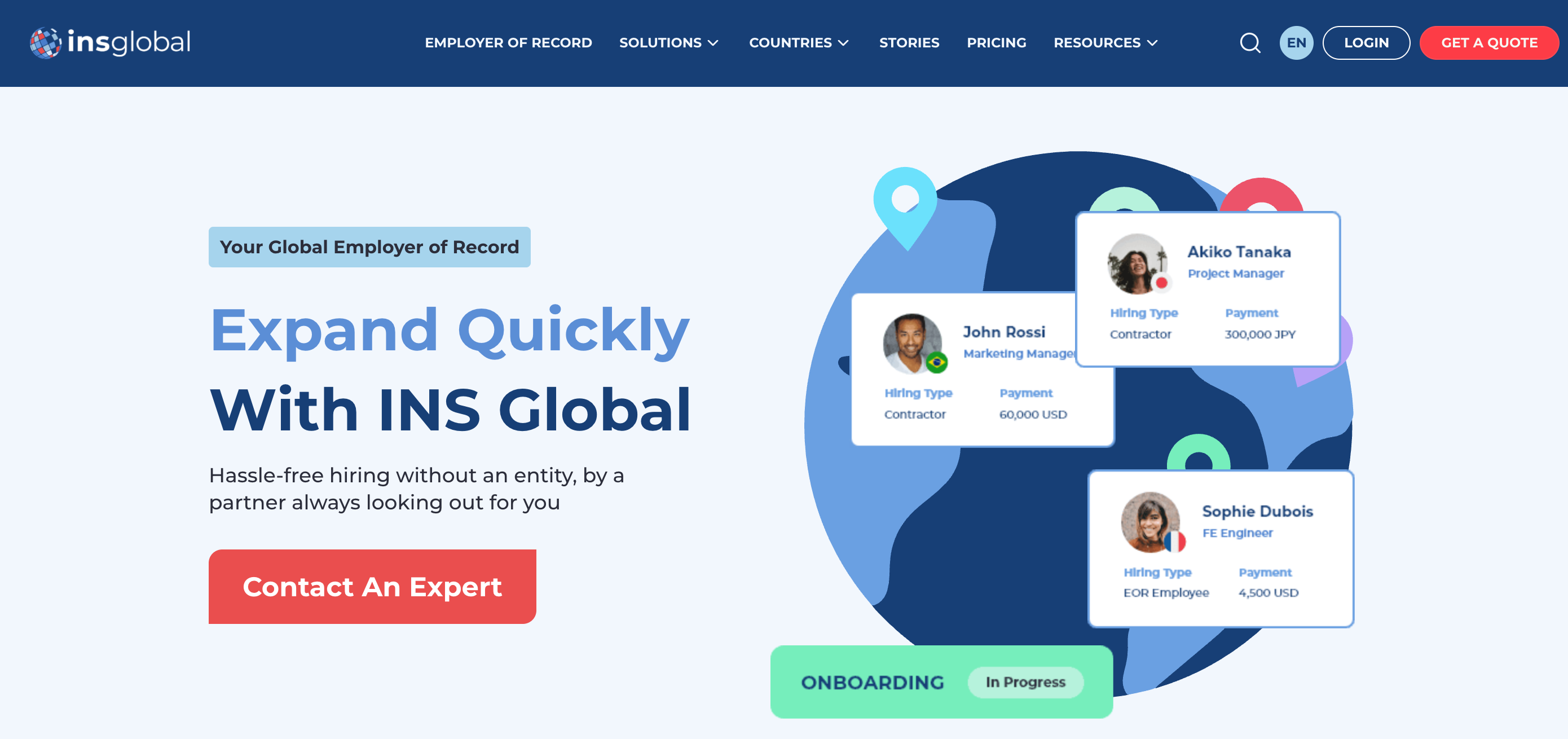
INS Global began as a China-focused market-entry and workforce consultancy and has expanded into global EOR, PEO, recruitment, payroll outsourcing, and workforce services.
The company claims coverage across 160 countries, with particular strength across APAC markets such as China, Japan, Singapore, and the Philippines. Unlike many enterprise EOR providers, INS Global has historically made its starting pricing relatively visible.
Pros
- Competitive published starting price
- Strong APAC expertise
- China and Asia market-entry experience
- EOR, recruitment, and payroll capabilities
- Human-led service model
- Positive feedback around responsiveness
Cons
- Smaller global footprint and brand presence than the largest providers
- Review depth is comparatively limited
- Some buyers report that initial cost estimates may not capture every country-specific obligation
- Support can be less convenient for customers outside APAC time zones
- Platform depth is narrower than larger workforce-management suites
Pricing
From approximately $299/employee/month for EOR.
G2 Rating
4.8/5
Bottom Line
INS Global is an interesting option for businesses where APAC expertise and lower entry pricing matter. Its China and regional experience can be valuable for companies entering Asian markets. The main diligence point is to obtain a detailed country-specific cost breakdown before signing, particularly around statutory employer costs and local requirements.
14. Remote People
Best for: Startups and SMBs that want flexible EOR pricing without a large platform commitment.
Overview
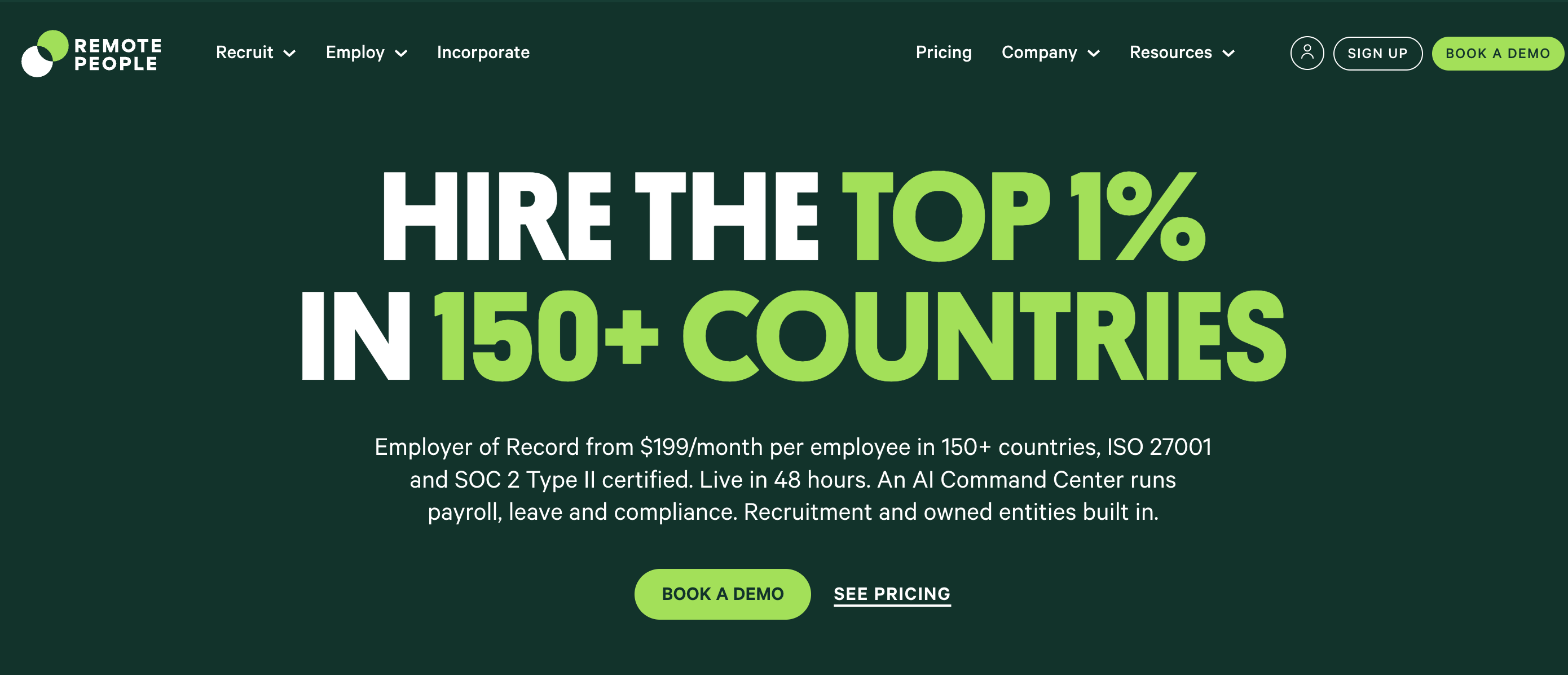
Remote People, formerly Horizons, provides EOR, contractor management, recruitment, global payroll, US PEO, immigration, benefits, mobility, and entity-related services. Its EOR offering covers 150+ countries, with the company's Flex model positioned around flexibility and no long-term commitment. This makes it particularly relevant for companies testing international hiring before committing to a larger global workforce program.
Pros
- Starting EOR price of around $199
- Flexible no-commitment option
- 150+ country coverage
- Broad workforce service portfolio
- Strong G2 satisfaction
- Useful combination of EOR, recruitment, payroll, and mobility
Cons
- Brand transition from Horizons can create some confusion
- Some users report limited integrations
- No native mobile experience may be a drawback for some teams
- Support experience can vary after onboarding
- Country coverage claims vary across sources
Pricing
From $199/employee/month for the Flex EOR offering, excluding salary and statutory employer costs.
G2 Rating
4.7/5
Bottom Line
Remote People is a strong option for companies that want low-commitment international hiring without paying enterprise-level EOR fees. Its broader services make it more than a simple EOR, although companies should clarify exactly which services are included in their selected plan and how the post-onboarding support model works.
15. Payoneer (Workforce Management, Formerly Skuad)
Best for: Companies managing employees and contractors together and looking for employment, compliance, and cross-border payments on one platform.
Overview
Payoneer Workforce Management combines Employer of Record, Agent of Record, and Contractor Management System capabilities in one workforce platform.
The offering covers 160+ countries, with EOR services that include local employment agreements, payroll, tax and labor-law compliance, benefits administration, onboarding support, and dedicated account management. Its payments heritage is a significant differentiator, with payroll and contractor payments supported across 70+ currencies. This makes Payoneer particularly relevant to companies managing a mixed workforce of full-time employees and independent contractors.
Pros
- 160+ country coverage
- EOR, AOR, and contractor management in one platform
- Payments infrastructure built into the broader offering
- Published EOR starting price
- Dedicated account-management support
- Strong fit for mixed employee and contractor workforces
Cons
- EOR coverage can differ from broader contractor coverage
- Country-specific costs still need to be evaluated
- Some features and workflows may be more relevant to payments-heavy teams than pure EOR buyers
- Buyers should clarify which services are included in the base EOR fee
- Newer workforce-management positioning means buyers should compare its EOR depth carefully against long-established specialists
Pricing
From $199/employee/month for EOR.
G2 Rating
4.6/5
Bottom Line
Payoneer Workforce Management is particularly interesting when employment and cross-border payments need to work together. Rather than treating EOR, contractor engagement, and payouts as separate systems, it brings them into one workforce infrastructure. It deserves a close look from finance-led organizations and companies managing mixed global workforces.
16. RemoFirst
Best for: Startups and cost-conscious companies looking for low-cost global EOR with broad country coverage.
Overview
RemoFirst is a global employment platform offering EOR, contractor management, payroll, compliance, benefits, insurance, background checks, equipment provisioning, and immigration support.
It claims EOR coverage across 185+ countries, giving it one of the broadest geographic footprints in the category. The company's positioning is deliberately cost-conscious, with a focus on startups and scaling companies that want to hire internationally without setting up local entities.
Pros
- Very competitive EOR starting price
- 185+ country EOR coverage
- Simple and accessible platform
- Contractor management alongside EOR
- Human customer support
- Strong feedback around onboarding and usability
Cons
- Some recent users have reported inconsistent country-specific guidance
- Offboarding and complex employee situations can require more coordination
- Support quality may vary depending on the issue
- Some users want better onboarding guidance and integrations
- Partner-dependent country operations should be examined carefully
Pricing
From $199/employee/month for EOR. Contractor management starts at $25/contractor/month.
G2 Rating
4.5/5
Bottom Line
RemoFirst is one of the more aggressive options for companies prioritizing cost and country coverage. Its $199 starting price puts it in the same broad pricing territory as other value-focused providers. The key question is whether its operational support and local execution are strong enough for the countries where your employees will actually work.
Which EOR Provider Should You Actually Choose?
Sixteen providers is a lot to hold in your head at once, so here's the shortcut: match the provider to your actual situation, not to whichever name you've heard of most.
- If you're a founder-led or price-sensitive startup making your first few international hires, the gap between a $199 and a $699 starting price compounds fast - on ten hires, that's roughly $60,000 a year in platform fees alone, before salary. Gloroots, INS Global, and Remote People's Flex tier sit at the bottom of that range.
- If you're an enterprise that needs the highest possible owned-entity ratio for audit and compliance reasons, G-P's 95% claim and Atlas HXM's zero-partner model are built specifically for that requirement.
- If you're already running HR, IT, and finance on one platform, Rippling's bundled module avoids adding a separate vendor, even without a standalone EOR price to compare directly.
- If your expansion map runs through Africa, Latin America, or Southeast Asia, Safeguard Global's regional depth and INS Global's APAC roots are worth a closer look than the generalist platforms.
- If payment reliability is non-negotiable and you have zero tolerance for delay, weigh Plane's 2.6/5 Trustpilot score seriously before signing, flat fee or not.
- If you're converting crypto treasury into contractor payouts in local currency, this is a genuinely underserved niche across the category, worth asking any shortlisted provider directly whether they've actually done it before, not just whether they say they can.
None of these are the full decision. They're the filter that narrows sixteen names down to the two or three you can actually compare properly, line by line, against your own hiring plan.
Want the comparison done for you? See Gloroots pricing for your specific countries, headcount, and timeline. Get a country-specific quote →
Final Thoughts: Choosing the Right EOR Provider
Choosing an Employer of Record isn’t simply about finding the lowest monthly price or the provider with the longest country list. The right EOR depends on where you’re hiring, how quickly you need to onboard, how much support you expect, and how your global workforce is likely to grow.
A provider that works well for a large enterprise may not be the best fit for a growing company hiring its first few employees abroad. Similarly, a provider with broad country coverage may not offer the level of local expertise, pricing transparency, or hands-on support your team needs.
Before making a decision, look beyond the headline price and compare:
- Pricing: What does the monthly fee include? Are there setup fees, FX charges, or additional costs for benefits and payroll services?
- Country coverage: Does the provider operate in the countries you hire in today—and the markets you plan to enter next?
- Onboarding speed: How quickly can your employee sign a compliant contract and start working?
- Compliance: Does the provider have strong local expertise and take responsibility for employment compliance?
- Customer support: Can you reach a real person when payroll, tax, or employment issues come up?
- Flexibility: Can the platform support your workforce as you move from a few international employees to a larger distributed team?
- Additional services: If you also hire contractors or need global payments, mobility, or recruitment support, can the provider handle those needs?
There is no single EOR provider that is right for every company. The best choice comes down to your hiring countries, workforce size, budget, growth plans, and the level of support you need.
If you're hiring your first employee abroad, expanding into a new market, or building a distributed team, start by comparing providers on the factors that matter beyond price. The right EOR should make global hiring feel less like managing a collection of different countries and more like managing one growing team.
Your next great hire could be anywhere. The right EOR can help you hire them without letting borders slow you down.
Explore EOR for your next hire with Gloroots!
Get a country-specific Gloroots quote →
Frequently Asked Questions
What is the cheapest EOR provider in 2026?
Based on published pricing, Gloroots (Starting from $199), INS Global (299/employee/month) and Remote People's no-commitment Flex plan(199/employee/month) carry the lowest headline rates among established providers with real coverage. Gloroots and Remofirst also start near $199, though Remofirst's figure comes from a secondary source rather than its own pricing page. The cheapest headline price isn't always the cheapest real cost, check what's included before comparing numbers directly.
What's the difference between an EOR and a PEO?
A PEO (Professional Employer Organization) co-employs staff alongside you and requires you to already have a legal entity in that country. An EOR (Employer of Record) becomes the sole legal employer and requires no entity at all. If you have no corporate presence in a market, only an EOR applies, a PEO isn't an option in that situation.
How much does an EOR actually cost, beyond the monthly fee?
The published monthly fee is the platform charge. Add salary, mandatory employer tax contributions, which vary significantly by country, and any statutory or supplementary benefits, these typically cost more than the EOR fee itself. Ask any shortlisted provider for a fully itemized, country-specific quote before comparing headline prices against each other.
How fast can an EOR onboard a new employee?
Most established providers quote 3 to 5 working days from signed contract to active employee, assuming no visa or professional licensing is required. Roles needing immigration sponsorship or local professional registration take meaningfully longer, regardless of which provider you choose, get a realistic timeline before you make the offer, not after.
Is Deel or a smaller provider better for a 10-person team?
For a team that size, Deel's breadth is genuinely more platform than most 10-person companies need, at roughly three times the starting price of leaner alternatives like Gloroots. Deel's scale advantage matters more once you're hiring across dozens of countries simultaneously; below that, a focused provider with lower pricing and more direct support access is usually the better fit.
Can I switch EOR providers if I'm not happy?
Generally yes, though the process requires offboarding employees from one provider and re-onboarding them with another, which takes real coordination and should be planned carefully to avoid gaps in pay or benefits. Check each provider's contract terms for minimum commitments and offboarding fees before signing, since switching costs vary significantly across this list.
Do EOR providers charge hidden fees?
Many do, in the form of setup fees, implementation costs per new country, security deposits, or markup folded into currency conversion that doesn't show up on the headline pricing page. The providers in this guide that publish full, itemized pricing upfront, rather than gating it behind a sales call, are generally the easier ones to budget against with confidence.