



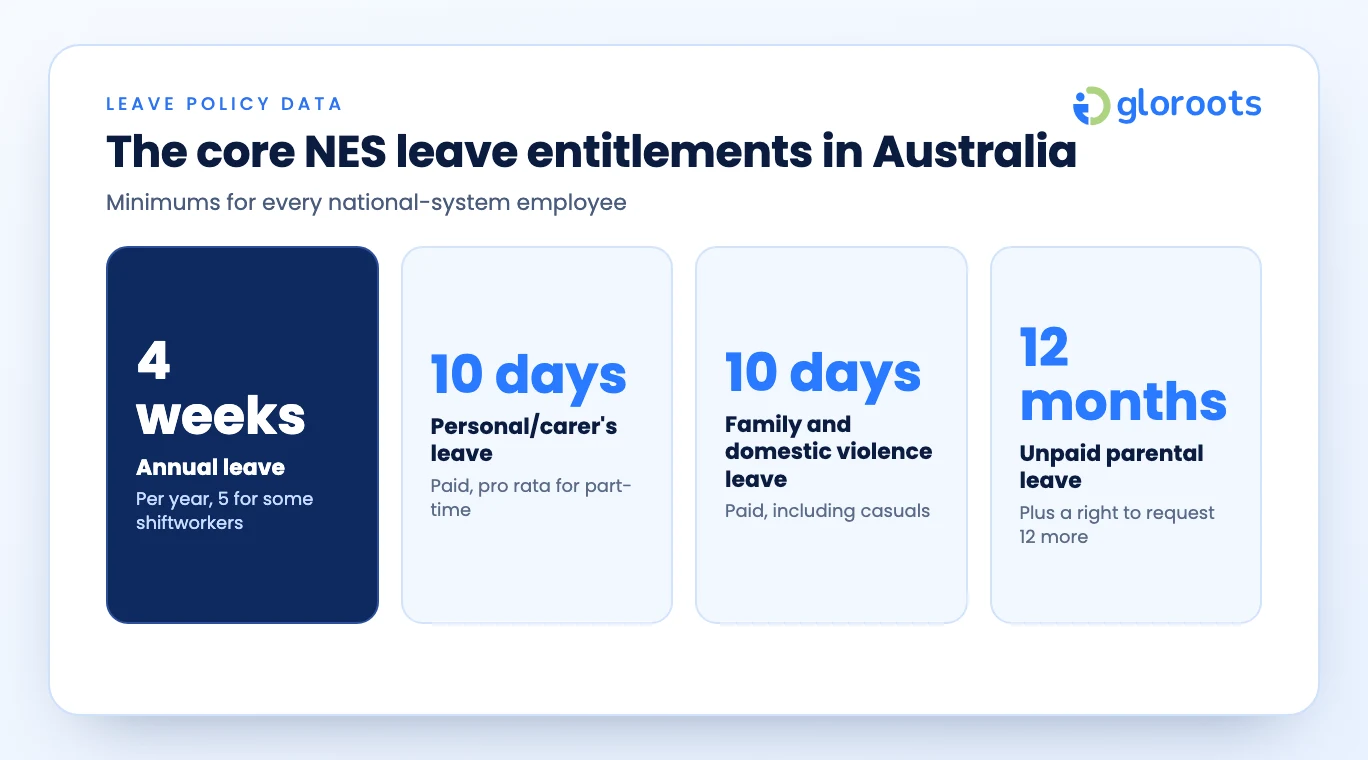
- The National Employment Standards (NES) guarantee 4 weeks of paid annual leave a year (5 for some shiftworkers) and 10 days of paid personal/carer's leave, pro-rated for part-time staff.
- Every employee, including casuals, can take 10 days of paid family and domestic violence leave a year.
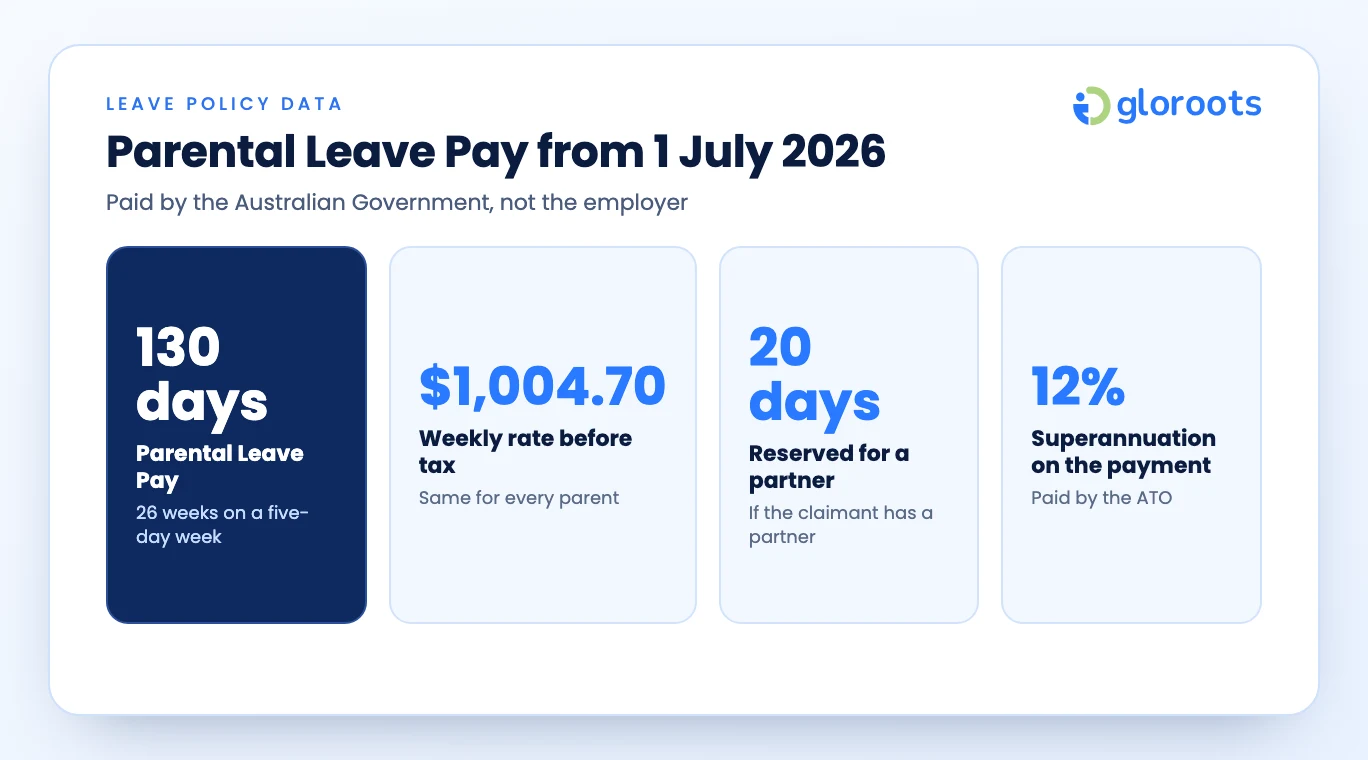
- For births or adoptions from 1 July 2026, the government's Parental Leave Pay rises to 130 days (26 weeks) at $1,004.70 a week before tax. The government pays it, not the employer.
- Employers still owe up to 12 months of unpaid parental leave (plus a right to request another 12) to staff with 12 months of service.
- Long service leave is set by state and territory law, so the rule depends on where the employee works.
Australia just made its government-paid parental leave longer, but the money does not come out of the employer's pocket. For births and adoptions from 1 July 2026, parents can claim 26 weeks of Parental Leave Pay from the government. What employers still owe is job protection, unpaid leave and a firm grip on the National Employment Standards. Knowing which obligations are yours and which belong to the state is the first step to hiring in Australia with confidence.
This guide sets out each statutory leave right under the Fair Work Act 2009, how it is funded and where employers most often go wrong. If you are new to hiring through a partner, start with our explainer on how an employer of record works.
Australia Leave Policy at a Glance
The National Employment Standards (NES) are a set of minimum workplace entitlements that apply to every national-system employee, whatever their contract says. Modern awards and enterprise agreements can add to them, but they can never go below them.
| Leave type | Statutory entitlement | Who pays |
|---|---|---|
| Annual leave | 4 weeks per year (5 weeks for some shiftworkers) | Employer |
| Personal/carer's leave | 10 days of paid leave per year, pro rata for part-time staff | Employer |
| Compassionate leave | 2 days per occasion | Employer (paid for permanent staff, unpaid for casuals) |
| Family and domestic violence leave | 10 days of paid leave per year | Employer |
| Unpaid parental leave | Up to 12 months, with a right to request 12 more | Unpaid; job protected |
| Parental Leave Pay (births from 1 July 2026) | 130 days (26 weeks) at $1,004.70 per week before tax | Australian Government |
| Public holidays | Paid day off when the holiday falls on a normal working day | Employer |
| Long service leave | Set by state and territory law | Employer |
Gloroots EOR
Hire in Australia without a local entity. Employment from $199 per employee per month.
Annual Leave in Australia: Four Weeks a Year
Answer in brief: a full-time or part-time employee earns four weeks of paid annual leave for each year of service, and some shiftworkers earn five. Part-time employees earn it pro rata, based on their ordinary hours. Leave accrues progressively through the year, so a new hire does not receive the full block on day one.
When an employee leaves, any accrued but untaken annual leave must be paid out. This is one of the largest hidden liabilities on an Australian balance sheet, so track balances monthly rather than discovering them at resignation.
Personal and Carer's Leave, Compassionate Leave and Family Violence Leave
Personal and carer's leave
Employees get 10 days of paid personal/carer's leave a year, which they can use when they are sick or injured, or to care for an immediate family or household member who is ill or has an emergency. Part-time employees accrue it pro rata. Unlike annual leave, unused personal leave is not paid out when the employment ends.
Casual employees do not get paid personal leave, but they can take 2 days of unpaid carer's leave per occasion when they need to care for someone.
Compassionate leave
When a close family or household member dies or has a life-threatening illness or injury, employees can take 2 days of compassionate leave per occasion. It is paid for permanent employees and unpaid for casuals.
Family and domestic violence leave
All employees, including casuals, can take 10 days of paid family and domestic violence leave a year. Employers should treat requests with strict confidentiality and avoid asking for more evidence than the law allows.
Compliance support
Not sure your Australian contracts and leave records meet the NES?
Parental Leave in Australia: Who Pays for What
Australia splits parental leave into two systems. Understanding both stops employers from assuming they must fund the entire period.
Unpaid parental leave (the employer's duty)
An employee with at least 12 months of service with the employer before the birth or adoption can take up to 12 months of unpaid parental leave, and can request another 12 months. The leave is unpaid, but the employer must hold the job and restore the employee to their role afterwards.
Parental Leave Pay (the government's payment)
For children born or adopted from 1 July 2026, eligible families receive 130 days of Parental Leave Pay, equal to 26 weeks on a five-day week. The weekly rate from 1 July 2026 is $1,004.70 before tax, the same for every parent regardless of their earnings. If the claimant has a partner, 20 of the days are reserved for the partner to use. For a child born or adopted from 1 July 2025, the Australian Taxation Office also adds a 12% superannuation contribution on the payment, paid from July 2026.
Some employers choose to top up the government payment to attract talent. That is optional: the law requires the unpaid leave and job protection, not the top-up.
Public Holidays and Long Service Leave
Public holidays: employees are entitled to a paid day off on a public holiday that falls on a day they would normally work. The employer can ask them to work if the request is reasonable, and the employee can refuse if it is not. Dates differ between states and territories, so a team across several states may have different holiday calendars.
Long service leave: this entitlement is set by state and territory laws, and some awards and agreements add their own rules. Because the qualifying period and rules differ by location, the working address of the employee determines the rule, not the head office.
Five Leave Mistakes Foreign Employers Make in Australia
- Treating unpaid parental leave as paid. Government pay and employer duties are separate; the employer's duty is unpaid leave and job protection.
- Forgetting the payout on exit. Accrued annual leave must be paid when employment ends.
- Ignoring modern awards. An award or enterprise agreement can give more than the NES, and the better term applies.
- Applying one state's rules nationwide. Public holidays and long service leave vary by state and territory.
- Over-asking for evidence. Employers can ask for evidence of sick or carer's leave only if it is reasonable, and family violence leave needs particular care.
Payroll and leave, handled
Let Gloroots apply Australian leave rules in payroll while you focus on the work.
How Gloroots Manages Leave for Your Australia Team
Through Gloroots' Employer of Record service, your team in Australia is employed on compliant local contracts without you registering a company. Gloroots acts as the legal employer, runs payroll and statutory contributions and applies the leave rules above, so your managers only approve time off.
- Transparent pricing: EOR from $199 per employee per month.
- Speed: onboarding in three to five working days.
- Coverage: 150+ countries, so Australia can sit alongside the rest of your team.
- Support: a dedicated team, reflected in a 4.9 G2 rating.
Planning a wider rollout? See our leave policy guides by country or the hiring process in Australia.
What to Watch in 2026
The federal government has launched an inquiry into the operation and adequacy of the National Employment Standards, so the baseline could change. Until it does, the NES described above remain the legal minimum. Keep an eye on the Fair Work Ombudsman's updates and review your policy each time the law moves.
Conclusion
Australia's leave system is generous on paper and precise in practice: four weeks of annual leave, ten days of personal leave, ten days of family violence leave and a long unpaid parental runway backed by 26 weeks of government pay. The employers who stay compliant are the ones who track balances, separate their duties from the state's and check awards and state laws before they finalise a contract. If you would rather not build that expertise from scratch, talk to Gloroots about hiring in Australia.
Frequently Asked Questions
How much annual leave do employees get in Australia?
Full-time and part-time employees get 4 weeks of paid annual leave a year, and some shiftworkers get 5 weeks. Part-time employees accrue it pro rata, and accrued leave is paid out when the job ends.
How many sick days do employees get in Australia?
Employees get 10 days of paid personal/carer's leave a year, pro rata for part-time staff. Casual employees do not get paid personal leave but can take 2 days of unpaid carer's leave per occasion.
How long is parental leave in Australia?
Eligible employees can take up to 12 months of unpaid parental leave and request another 12 months. Separately, for births or adoptions from 1 July 2026, the government pays 130 days (26 weeks) of Parental Leave Pay at $1,004.70 a week before tax.
Does the employer pay for parental leave in Australia?
Not by law. The employer must provide unpaid leave and protect the job, while the government funds Parental Leave Pay. Some employers choose to top up the payment as a benefit.
Is family and domestic violence leave paid in Australia?
Yes. All employees, including casuals, can take 10 days of paid family and domestic violence leave in a 12-month period.
Do I need an Australian entity to hire employees there?
No. With an employer of record such as Gloroots, the EOR employs your team locally, handles payroll and applies Australian leave rules, starting from $199 per employee per month.