



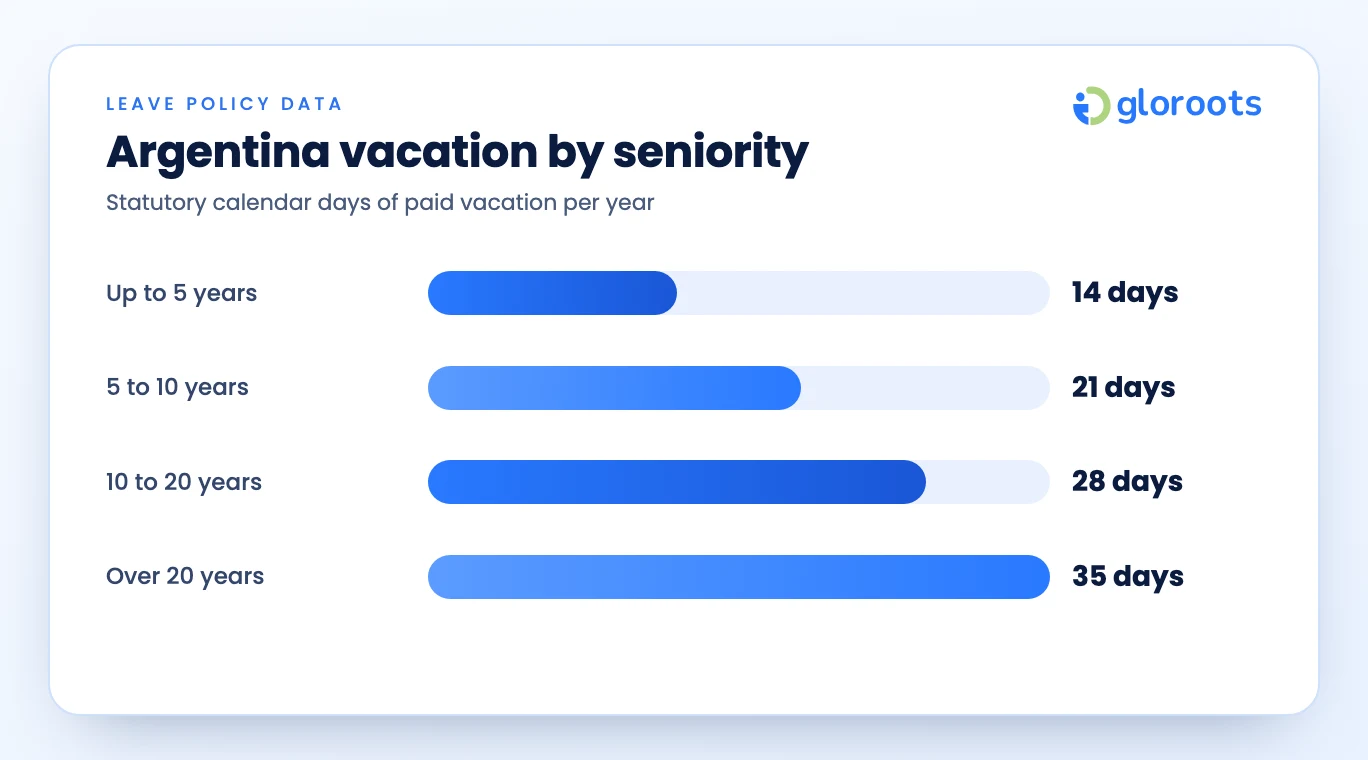
- Vacation is counted in calendar days and rises with seniority: 14 days under 5 years, 21 for 5 to 10 years, 28 for 10 to 20 years and 35 beyond 20 years.
- Since Ley 27.802 (published March 2026), employer and employee can agree to split vacation into blocks of at least seven days, and anyone whose team rotates vacations must get a summer break at least once every three years.
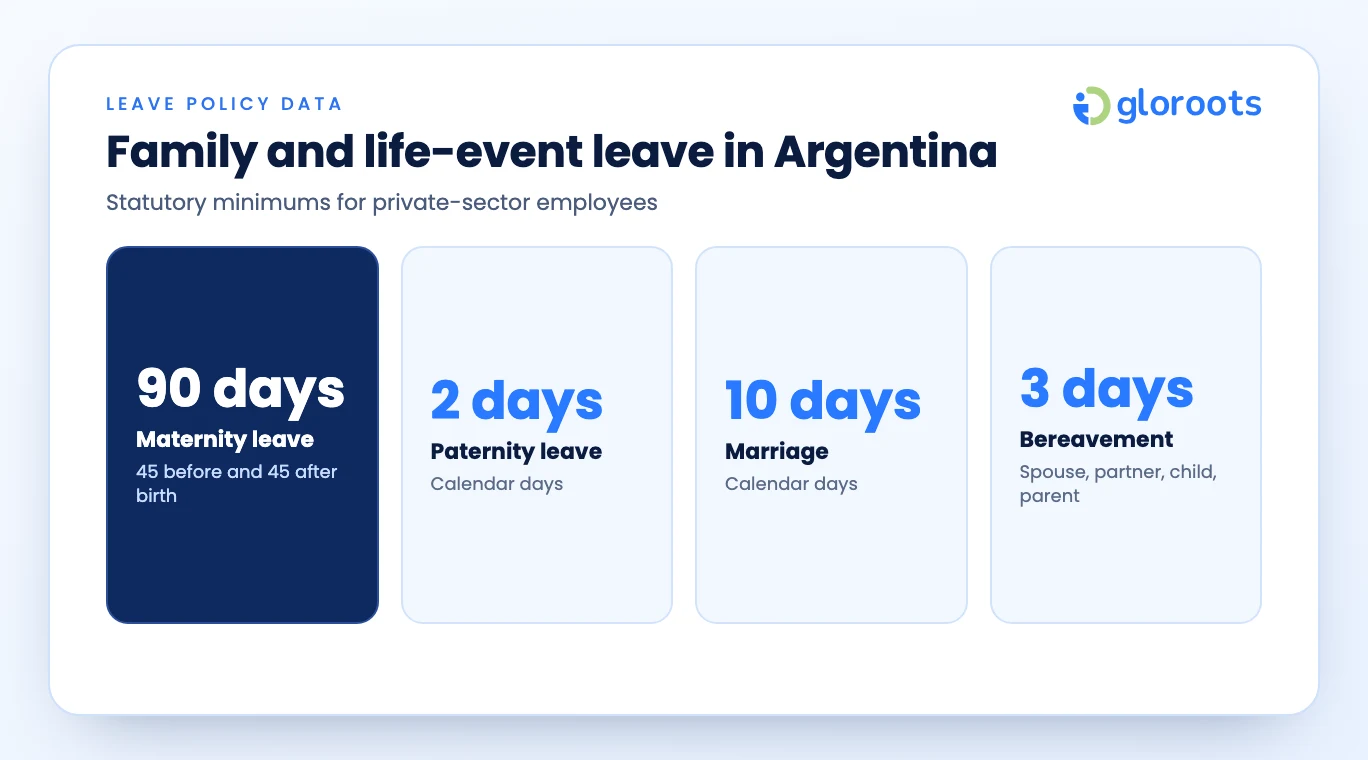
- Maternity leave is 90 days, paid by the social-security agency ANSES at the employee's gross salary. Paternity leave is only 2 calendar days.
- Sick pay is paid by the employer for 3 to 12 months, depending on the employee's seniority and family dependants.
- Argentina has 15 national holidays in 2026, plus optional non-working days that employers may grant for tourism.
For decades, Argentine employers could not split an employee's vacation into pieces. Since March 2026, they can, provided both sides agree and no piece is shorter than seven days. It is the clearest sign that Argentina's leave rules, long seen as rigid, are now moving, and any company hiring there has to track which parts of the old system still apply.
This guide covers every statutory leave right in Argentina: vacation by seniority, public holidays, sick leave, maternity and paternity leave and the shorter paid absences for life events. For a primer on hiring without a local company, read our guide to how an employer of record works.
Argentina Leave Policy at a Glance
Argentina's Ley de Contrato de Trabajo sets the floor for every private-sector employee. Collective bargaining agreements (convenios colectivos) frequently add to it, so checking your sector's agreement matters as much as reading the national law.
| Leave type | Statutory entitlement | Who pays |
|---|---|---|
| Annual vacation | 14, 21, 28 or 35 calendar days depending on seniority | Employer |
| Public holidays | 15 national holidays in 2026, plus optional tourism days | Employer |
| Sick leave (non-work illness) | 3 months (under 5 years, no dependants) up to 12 months (5+ years with dependants) | Employer |
| Maternity leave | 90 days: 45 before and 45 after birth | ANSES allowance equal to gross salary |
| Paternity leave | 2 calendar days | Employer |
| Marriage | 10 calendar days | Employer |
| Death of spouse, partner, child or parent | 3 calendar days (1 day for a sibling) | Employer |
| Exam leave | 2 calendar days per exam, up to 10 a year | Employer |
Gloroots EOR
Hire in Argentina without a local entity. Employment from $199 per employee per month.
Annual Vacation in Argentina: 14 to 35 Calendar Days
Answer in brief: Argentine employees earn paid vacation based on how long they have worked for the employer, measured at 31 December of the vacation year. The days are calendar days, weekends included, so 14 days equals two full weeks off.
| Seniority | Vacation entitlement |
|---|---|
| Up to 5 years | 14 calendar days |
| More than 5 and up to 10 years | 21 calendar days |
| More than 10 and up to 20 years | 28 calendar days |
| More than 20 years | 35 calendar days |
What changed with Ley 27.802 in 2026
Congress passed the Ley de Modernización Laboral on 27 February 2026, and the Official Gazette published Ley 27.802 on 6 March 2026. Its revised article 154 keeps the default vacation window of 1 October to 30 April, but employer and employee may agree to take vacation outside it. It also adds two rules that matter in practice:
- Splitting is now allowed. The parties can agree to divide vacation into blocks, as long as no block is shorter than seven days.
- Summer fairness. When vacations are not given to everyone at the same time, the employer must organise them so that each employee gets vacation in the summer season at least once every three years.
Parts of the reform have faced legal challenges, so confirm with a local adviser that the provision you rely on is currently in force before you change a policy.
Public Holidays in Argentina
Argentina's holiday regime sits in Law 27.399 and splits holidays into three groups. For 2026 the official calendar lists:
- Fixed holidays (12 days): 1 January, Carnival Monday and Tuesday, 24 March, Good Friday, 2 April, 1 May, 25 May, 20 June, 9 July, 8 December and 25 December.
- Movable holidays (3 days): 17 June, 17 August and 12 October, which shift to a nearby Monday under the law.
- Non-working days for tourism: 23 March, 10 July and 7 December in 2026. These are optional for private employers, who decide whether to grant them.
Employees who are required to work on a national holiday are entitled to double pay under Argentine law, so rostering around the 15 dates matters for cost as well as compliance.
Sick Leave in Argentina: Paid by the Employer
Answer in brief: under article 208 of the Ley de Contrato de Trabajo, an employee who cannot work because of an illness or accident unrelated to the job keeps receiving their normal pay for a fixed period, and the employer bears the cost.
| Seniority | No family dependants | With family dependants |
|---|---|---|
| Less than 5 years | 3 months | 6 months |
| 5 years or more | 6 months | 12 months |
The pay includes the employee's usual fixed and variable earnings, not just base salary. After the paid period ends, the job is held for a further year, and the rules for ending employment after that point are strict, so involve a local lawyer before acting.
Compliance support
Not sure your Argentine contracts match the law and your sector's agreement?
Maternity and Paternity Leave in Argentina
Maternity leave is 90 calendar days: 45 before the expected birth and 45 after. An employee can shorten the pre-birth period to as little as 30 days and add the remainder to the post-birth period. During leave, ANSES pays a maternity allowance equal to the gross salary, and the employer reports the amount to the tax authority through its monthly return.
Paternity leave is far shorter: 2 calendar days for the birth of a child. Legislators have introduced several bills to extend it, but the statutory minimum remains two days, so employers who want to compete for talent often add days voluntarily or through a collective agreement.
Other Paid Leave in Argentina
- Marriage: 10 calendar days of paid leave.
- Bereavement: 3 calendar days for the death of a spouse, partner, child or parent, and 1 day for a sibling.
- Exams: 2 calendar days for each exam, up to 10 days per year, for secondary and university students.
Five Leave Mistakes Foreign Employers Make in Argentina
- Counting working days. Vacation is in calendar days, so 14 days is two weeks, not ten working days.
- Ignoring the sector agreement. A convenio colectivo can give more than the law, and employees are entitled to the better terms.
- Assuming vacation can always be split. Splitting needs agreement and blocks of at least seven days.
- Treating paternity like maternity. Two days is the legal floor, but candidates compare offers on more.
- Missing the summer rule. Rotating teams need a record showing each employee got a summer break at least every third year.
Payroll and leave, handled
Let Gloroots apply Argentine leave rules in payroll while you focus on the work.
How Gloroots Manages Leave for Your Argentina Team
Through Gloroots' Employer of Record service, your team in Argentina is employed on compliant local contracts without you registering a company. Gloroots acts as the legal employer, runs payroll and statutory contributions and applies the leave rules above, so your managers only approve time off.
- Transparent pricing: EOR from $199 per employee per month.
- Speed: onboarding in three to five working days.
- Coverage: 150+ countries, so Argentina can sit alongside the rest of your team.
- Support: a dedicated team, reflected in a 4.9 G2 rating.
Comparing countries? Browse the Gloroots leave policy guides or read our guide to global payroll best practices.
Conclusion
Argentina's leave system now has two speeds: a stable core of seniority-based vacation, paid sick leave and a 90-day maternity period, and a newly flexible layer introduced by Ley 27.802 for scheduling vacation. Employers who track each employee's seniority at 31 December, record their sector agreement and document any agreed vacation split will stay on the right side of the law. If you would rather not build that expertise yourself, talk to Gloroots about hiring in Argentina.
Frequently Asked Questions
How many vacation days do employees get in Argentina?
Employees get 14 calendar days if they have up to 5 years of seniority, 21 days for 5 to 10 years, 28 days for 10 to 20 years and 35 days beyond 20 years. Seniority is measured at 31 December of the vacation year.
Can vacation be split in Argentina?
Yes, since Ley 27.802 took effect in March 2026. Employer and employee can agree to split vacation into blocks, provided each block is at least seven days long.
How long is maternity leave in Argentina?
Maternity leave is 90 calendar days, normally 45 days before the birth and 45 after. The pre-birth period can be cut to 30 days. ANSES pays an allowance equal to the employee's gross salary.
How long is paternity leave in Argentina?
The statutory paternity leave is 2 calendar days. Several bills propose extending it, but the current legal minimum is two days, although collective agreements and employers may offer more.
Who pays for sick leave in Argentina?
The employer pays the employee's normal salary during sick leave for non-work illnesses. The paid period is 3 months for employees under five years of seniority without dependants, rising to 12 months for those with five or more years and family dependants.
Do I need an Argentine entity to hire employees there?
No. With an employer of record such as Gloroots, the EOR employs your team locally, handles payroll and applies Argentine leave rules, starting from $199 per employee per month.