




- Austria's collective bargaining agreements cover approximately 98% of the workforce, making sector-specific CBA identification a required compliance step before any offer is issued, not an optional one.
- Employer severance fund contributions under the Employee Provision Fund Act apply from the first day of employment, and special payments equivalent to a 13th and 14th monthly salary are statutory obligations in most sectors, both of which must be factored into total employment cost projections before selecting a provider.
- EOR providers vary significantly in entity structure: some operate through wholly owned Austrian legal entities while others use third-party partner networks, and buyers should request written confirmation of entity structure before signing, as it directly affects compliance accountability.
- Pricing across the eight providers in this guide ranges from $199 to $699 per employee per month, but Austria-specific rates may differ from global headline figures, so buyers should request Austria-specific quotes directly from each provider.
- Pre-start registration with the Austrian Health Insurance Fund is a fixed legal requirement that must be completed before an employee's first working day, regardless of how fast a provider's onboarding platform operates.
Last reviewed: September 2026. Gloroots is one of the eight providers listed in this guide. No provider paid for inclusion or a ranking position. Providers were selected based on Austria-specific compliance coverage, entity structure, pricing transparency, and service model.
Austria covers nearly 98% of its workforce under collective bargaining agreements, making CBA compliance the primary operational risk for any foreign company hiring locally. Choosing the wrong best employer of record can expose a business to misclassified contracts, missed sector-specific entitlements, and regulatory penalties.
Two Austria-specific cost factors require attention before selecting a provider. The severance fund system (Abfertigung Neu) requires employer contributions from day one. Special payments, typically a 13th and 14th monthly salary, are statutory obligations in most sectors and must be factored into total employment cost projections. Austria also applies a 6% flat tax rate on special payments up to one-sixth of annual gross salary, which affects cost modelling for these payments. This guide includes a hiring-situation matrix and employer cost reference data to support provider selection.
Our Top 8 Picks: Austria EOR Comparison 2026
The table below compares eight employer of record software providers across seven dimensions relevant to hiring in Austria. Providers were evaluated on pricing, country coverage, onboarding speed, platform experience, customer support, and scalability. Austria-specific pricing may differ from global headline rates; request Austria-specific quotes directly from each provider. Full methodology is described in the selection-criteria section below.
| Provider | Pricing per month | Country coverage | Onboarding speed | Platform experience | Customer support | Scalability |
|---|---|---|---|---|---|---|
| Gloroots | From $199 per employee; $29 per contractor | 150+ countries | 3–5 working days | Self-service platform with centralized payroll, compliance and workforce visibility | 24/7 human support and dedicated account management | Startup to enterprise |
| Teamed | $599 flat fee per employee; FX absorbed at zero markup | Not publicly listed in researched sources | Not publicly listed in researched sources | Platform-led EOR solution with payroll, HR and compliance workflows | Real HR and legal experts included on every plan | Suited to rapidly growing companies |
| Multiplier | From $605 per employee for Austria | 150+ countries | As fast as 24 hours; country-dependent | Self-service global employment platform covering EOR, payroll, benefits and compliance | 24/7 support and dedicated account management | SMB to enterprise |
| Deel | From $599 per employee; $49 per contractor | 130+ countries for EOR | 1–3 days in many countries; country-dependent | All-in-one platform for EOR, contractors, payroll, HR and compliance | 24/7 multichannel support | Startup to enterprise |
| RemoFirst | From $599 per employee for Austria | 185+ countries | 1–5 days; country-dependent | Self-service dashboard for EOR, contractors, payroll, benefits and compliance | 24/7 support and dedicated account manager | Startup to enterprise |
| Atlas HXM | From $599 per employee | 160+ countries | Typically 7–15 business days; country-dependent | EOR platform with compliant contracts, localized onboarding, payroll and workforce management | Dedicated account management and local HR/legal support | Growing companies to enterprise |
| Rippling | Quote-based | 80+ countries for EOR | Country-dependent; no fixed Austria-specific timeline publicly stated | All-in-one HCM platform connecting HR, payroll, IT management, benefits and global EOR | Dedicated support and regional HR/compliance expertise | SMB to enterprise |
| Globalization Partners (G-P) | From $599 per employee/month | 180+ countries | As fast as 3–5 business days; country-dependent | Enterprise-grade global employment platform with onboarding, payroll, compliance and workforce management | Dedicated Customer Success Manager plus global HR/legal support | Mid-market to enterprise |

Top 8 Best EOR Platforms in Austria
The eight providers below are profiled in the order they appear in this guide. Each profile includes Austria-specific compliance details covering collective bargaining agreement mapping, severance fund contributions under the Employee Provision Fund Act (Abfertigung NEU), special payments (Sonderzahlungen), and works council handling where applicable.
Use the hiring-situation matrix in this guide as a companion tool to match the right provider type to your company stage, headcount, and Austria compliance requirements before reviewing individual profiles.
Gloroots
Gloroots is a global hiring and employment platform that supports compliant full-time employment across 150+ countries, including Austria. The platform combines Global Employer of Record (EOR), Global Payroll, Compliance and Employment Governance, and Benefits and Statutory Coverage into one employment operating layer.
Gloroots uses predictable, country-specific pricing with full cost visibility before onboarding. There is no percentage-of-salary pricing. Finance teams receive consolidated invoices covering salary, statutory contributions, and EOR fees in one bill. Gloroots states it delivers Austria employment through its own Austrian-registered legal entity, not via a partner.
Gloroots advises clients on collective bargaining agreement identification and compliance for each Austrian hire, covering sector-specific salary floors, overtime premiums, and 13th and 14th salary obligations, with CBA mapping occurring at the offer stage. Gloroots’ Austria guidance notes works council consultation duties under the Labour Constitution Act and states an EOR must manage these on the client’s behalf. Gloroots confirms it can sponsor and manage Austria Red-White-Red Card and EU Blue Card applications when acting as the legal employer via its Austrian entity.
Strengths:
-
Predictable, country-specific pricing with no percentage-of-salary fees gives Finance teams reliable Austria employment cost forecasting from the point of initial engagement.
-
The platform combines Global EOR, Global Payroll, Compliance and Employment Governance, and Benefits and Statutory Coverage, reducing the number of vendors needed to manage Austrian employment obligations.
-
Human-led account support with retained business context gives HR and Operations teams consistent guidance rather than rotating generalist ticket queues.
Best for:
Startups and SMBs that need transparent, fixed-fee EOR pricing with strong compliance coverage for Austrian employment operations, managed through a centralized platform with human-led support.


Teamed
Teamed is an expert-led employer of record positioned for companies hiring in Austria that need hands-on compliance support. Every plan includes real HR and legal professionals with Austrian employment-law credentials, not a ticket queue. The service covers works councils under the Labour Constitution Act, severance fund contributions under the Employee Provision Fund Act (Abfertigung NEU), 14-month salary payments (Sonderzahlungen), and notice periods tied to quarter-end dates under the Salaried Employees Act.
Teamed charges a flat fee of $599 per employee per month and absorbs foreign exchange costs at zero markup. Invoices are itemised, giving Finance teams a clear view of each cost component. Teamed also models the exact month a client's own Austrian entity becomes more cost-effective than continuing with EOR, providing a structured path from first Austrian hire to owned-entity operation.
Readers should confirm Austria entity structure (owned versus partner), current pricing, and visa support scope directly with Teamed before making procurement decisions.
Strengths:
-
Real HR and legal experts with Austrian employment-law credentials are included on every plan, covering works councils, severance fund obligations, and quarter-end notice periods.
-
Foreign exchange costs are absorbed at zero markup, and every invoice is itemised, giving Finance teams a clean, predictable monthly cost.
-
Teamed models the exact month a client's own Austrian entity becomes cheaper than EOR, providing a structured transition pathway from first hire to entity ownership.
Limitations:
-
Teamed trails Rippling and Deel on self-serve dashboard depth, which may limit teams that prefer platform-led, automation-first workflows.
Best for:
Rapidly growing companies that need expert-led compliance for works council and severance fund obligations in Austria, with a structured path toward entity ownership.
Multiplier
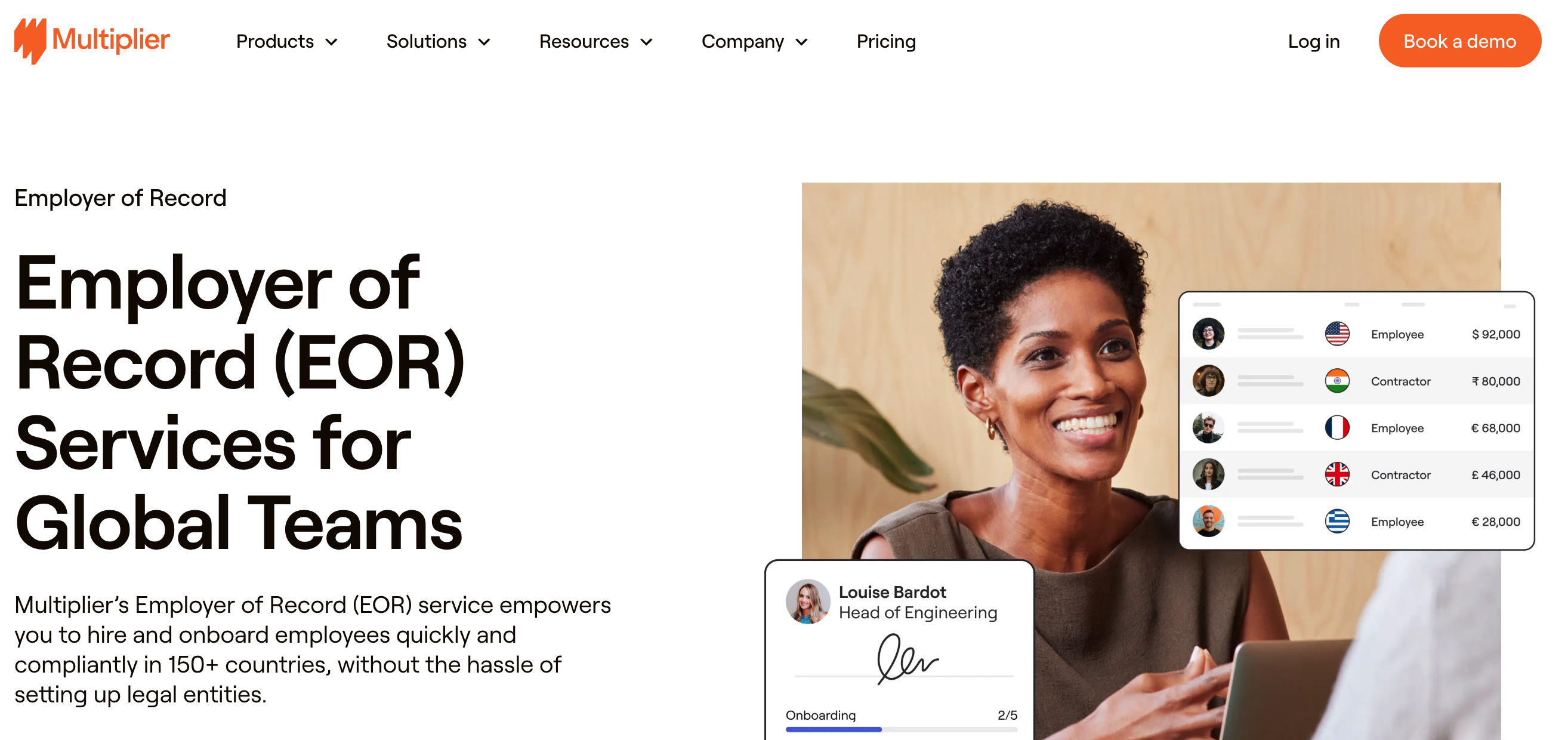
Multiplier is ranked the top overall employer of record for Austria by Employsome, evaluated across entity ownership, onboarding speed, collective bargaining agreement compliance, local HR support, visa sponsorship, and pricing. Employsome's ranking rewards Multiplier for operating through an owned Austrian entity, which provides stronger local execution and compliance accountability compared to partner-based models. Readers should confirm entity structure directly with Multiplier before signing.
Multiplier covers Austrian employment obligations including severance fund contributions (Abfertigung NEU) and 14-month salary payments (Sonderzahlungen). Austria pricing starts from $605 per employee per month per Employsome. Readers should confirm current Austria-specific pricing directly with Multiplier, as this figure may differ from the provider's global headline rate.
Readers should also confirm directly with Multiplier whether the platform maps sector-specific collective bargaining agreements at the offer stage and the extent of works council support available for Austrian hires.
Strengths:
-
Multiplier operates through an owned Austrian entity, which Employsome's ranking credits for stronger local compliance accountability compared to partner-based EOR models.
-
Ranked first overall for Austria EOR by Employsome, scored across six Austria-specific dimensions including onboarding speed, CBA compliance, local HR support, and visa sponsorship.
Limitations:
-
Collective bargaining agreement depth and works council support for Austria-specific hires require direct confirmation with Multiplier, as these details are not fully documented in reviewed public sources.
Best for:
Cost-conscious growth companies that need owned-entity compliance accountability for Austrian employment operations.
Deel
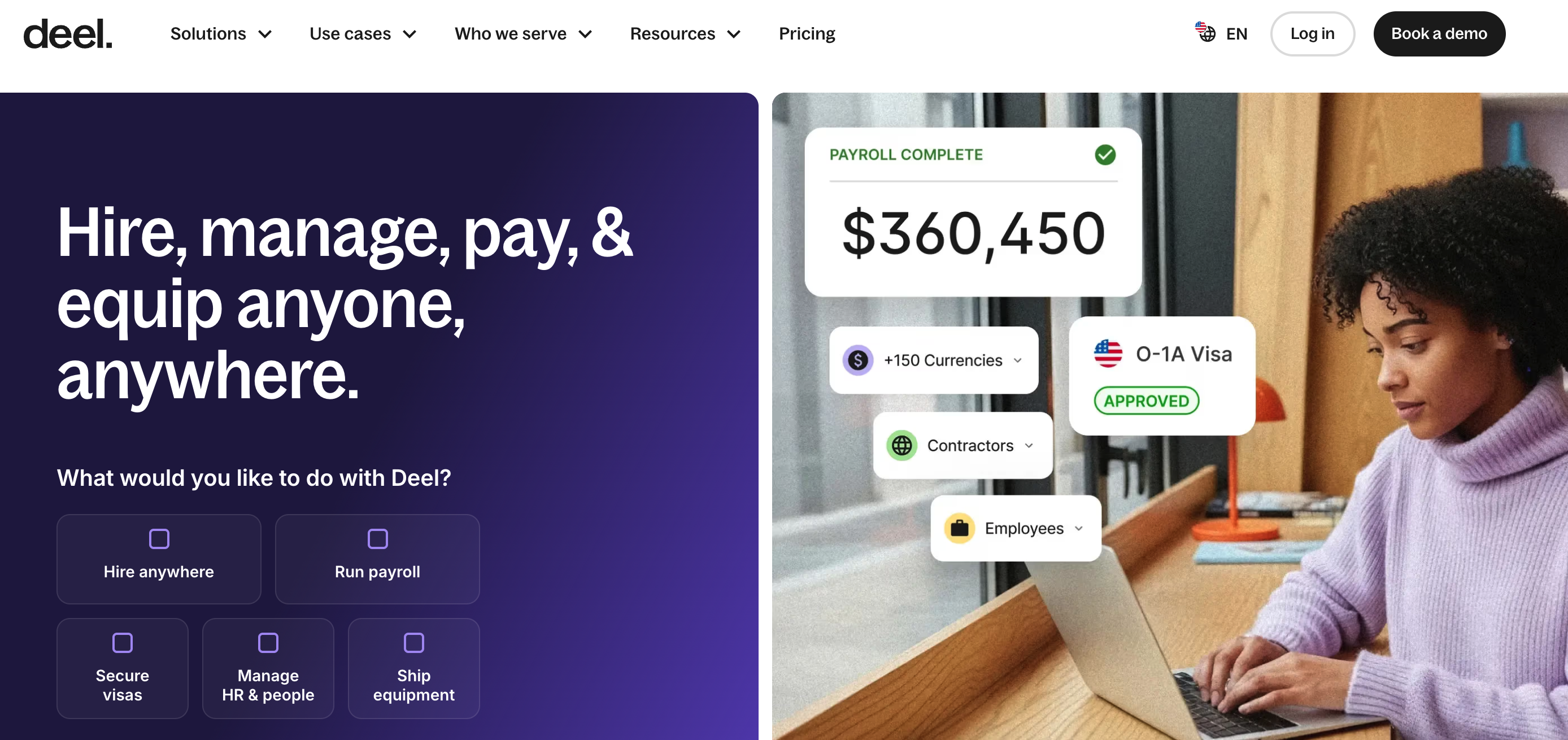
Deel is a global EOR platform serving 35,000+ businesses across 150+ countries. It starts at $599 per employee per month and offers a 1 to 3 day setup time in Austria. The platform covers EOR, contractor management, payroll, HR, and compliance through a single self-service interface.
Deel leads on platform depth and self-serve dashboard capabilities for Austria hiring. Its automation-first approach reduces manual HR workload for teams managing employment across multiple countries simultaneously. Austria-specific compliance coverage, including collective bargaining agreement handling, severance fund contributions, and special payment obligations, should be confirmed directly with Deel before signing. Entity structure for Austria, whether Deel operates through an owned Austrian entity or a partner model, should also be confirmed directly with Deel. Visa and work permit support for Austria, including the Red-White-Red Card and EU Blue Card, and works council handling capability should be verified with Deel before relying on those services.
Deel is rated 4.8 out of 5 based on 10,965 reviews. It is positioned for startups through to enterprise-scale companies that prioritise platform automation and digital-first support over expert-led service models.
Strengths:
-
Leads on self-serve dashboard depth and platform automation for Austria hiring, giving HR teams direct control over employment operations without relying on manual support queues.
-
Serves 35,000+ businesses across 150+ countries with a single platform covering EOR, payroll, contractor management, and compliance, reducing the number of tools needed to manage Austrian employment.
-
Rated 4.8 out of 5 from 10,965 reviews, reflecting strong user satisfaction with the platform experience and setup speed.
Limitations:
-
Austria-specific compliance scope, entity structure, visa support, and works council handling capability are not fully documented in public sources reviewed and require direct confirmation with Deel before purchasing.
-
Trails providers such as Teamed on expert-led service models and structured paths to entity ownership, which may matter for companies expecting hands-on Austrian employment law guidance.
Best for:
Platform-led global hiring teams that prioritise self-serve automation and digital-first support for Austrian employment operations.
RemoFirst
RemoFirst is ranked runner-up for Austria EOR by Employsome with a combined score of 4.3. It starts at $199 per employee per month for EOR services and $25 per contractor per month, with no minimum seat requirements. The platform covers EOR, contractors, payroll, benefits, and compliance through a self-service dashboard.
RemoFirst operates as a global EOR provider across 185+ countries. Public sources reviewed note that partners handle local legal and payroll infrastructure in Austria rather than a wholly owned Austrian entity. Buyers should request written confirmation of the entity structure directly from RemoFirst before signing. Visa and work permit support for Austria and works council handling capability should also be confirmed directly with RemoFirst.
RemoFirst holds a 4.7 out of 5 rating on G2 from verified reviews. Its transparent per-employee pricing and absence of volume minimums make it accessible for early-stage companies hiring one or two Austrian employees without committing to seat thresholds.
Strengths:
-
Pricing at $199 per employee per month with no minimum seat requirements gives startups and SMBs a cost-accessible Austria EOR entry point without long-term volume commitments.
-
Aggregated invoicing consolidates multiple Austrian and international employee billing into a single monthly invoice, reducing Finance team reporting overhead.
-
Multi-currency funding across five currencies supports companies billing in USD or EUR while paying Austrian employees in local EUR.
Limitations:
-
Support is available 24/5 rather than 24/7, which may create response delays for teams with weekend compliance queries on Austria-specific issues such as collective bargaining agreement obligations or severance fund contributions.
-
Public sources reviewed classify RemoFirst as a global EOR using partner infrastructure for local legal and payroll execution in Austria rather than a wholly owned entity, which buyers should verify directly before signing.
Best for:
Startups and SMBs seeking a low-cost Austria EOR entry point with transparent per-employee pricing, no volume minimums, and a self-service dashboard.
Atlas HXM

Atlas HXM operates as a direct employer of record with wholly owned entities in 160+ countries. The model removes third-party partners and aggregators from the employment chain, placing full compliance accountability with Atlas directly. The company reports 10+ years of EOR experience across its global entity network.
Atlas offers built-in compliant contracts, localized onboarding workflows, and in-region expert guidance as part of its EOR product. Services cover the full employee lifecycle from onboarding to offboarding, alongside an Agent of Record offering for contractor engagements. Austria-specific compliance details, including collective bargaining agreement handling, severance fund contributions, and special payment obligations, require direct confirmation with Atlas HXM before relying on any stated scope.
Pricing for Austria is not publicly listed in researched sources. Onboarding speed, support hours, and dedicated account management availability for Austrian engagements require direct confirmation with Atlas HXM.
Strengths:
-
Direct EOR model with wholly owned entities in 160+ countries removes intermediary partner risk and places compliance accountability with Atlas directly.
-
10+ years of EOR experience with built-in compliant contracts and localized onboarding workflows supports structured employment setup across its entity network.
-
Full employee lifecycle management from onboarding to offboarding, plus an Agent of Record offering for contractors, covers multiple engagement types within one provider.
Limitations:
-
Austria-specific platform self-service depth and collective bargaining agreement handling scope require direct confirmation with Atlas HXM; no verified Austria-specific detail was available in researched public sources.
Best for:
Companies that prioritise a direct-entity EOR model with no intermediary partner risk and want a provider with a long-standing owned-entity network across 160+ countries.
Rippling

Rippling is an all-in-one employment platform connecting HR, payroll, IT management, and benefits across 90+ countries. The platform is positioned for companies that prioritise automation and self-serve HR tooling, with software provisioning automation and multi-country payroll included alongside EOR services. It carries a 4.8 out of 5 rating based on 10,708 reviews and a reported three-day setup time in Austria.
Rippling starts at $450 per employee per month for EOR services. The platform leads on self-serve dashboard depth in Austria-focused comparisons, with automated onboarding workflows and strong integration across HR, finance, and IT functions. Austria-specific compliance scope, including collective bargaining agreement handling, severance fund contributions, and special payment obligations, requires direct confirmation with Rippling before relying on any stated coverage.
Entity structure for Austria, support hours, dedicated account management availability, and visa and work permit support require direct confirmation with Rippling. Works council handling under Austrian law also requires direct confirmation.
Strengths:
-
All-in-one platform connecting HR, payroll, IT management, and benefits in one system reduces the number of tools needed to manage Austrian employment operations.
-
Leads on self-serve dashboard depth in Austria-focused platform comparisons, with automated onboarding workflows suited to companies managing employment operations at scale.
-
Rated 4.8 out of 5 from over 10,700 reviews, with a reported three-day setup time in Austria.
Limitations:
-
Premium pricing structure, opinionated system design, and longer implementation timeline are noted as limitations in researched sources, which may affect companies with simpler or faster-start Austria hiring needs.
-
Austria-specific compliance scope, entity structure, and expert-led support availability require direct confirmation with Rippling; no verified Austria-specific detail was available in researched public sources.
Best for:
Tech companies and platform-first teams that want a unified HR, IT, and finance system with strong automation capabilities for Austrian employment operations.
Globalization Partners
Globalization Partners (G-P) is an enterprise-grade employer of record operating through owned legal entities in 180+ countries. The platform is positioned for Fortune 500 companies and large multinationals that require a proven global employment infrastructure. G-P starts at $699 per employee per month, with one independent scoring platform listing an average price of $940 per month.
G-P covers Austrian employment obligations including compliant contracts, payroll, and statutory contributions. Austria-specific services such as collective bargaining agreement handling, severance fund contributions under the Austrian Employee Provision Fund Act, special payment obligations, and works council support require direct confirmation with G-P before relying on any stated scope. Visa and work permit support for Austria also requires direct confirmation with G-P.
Readers should verify all G-P Austria-specific details, pricing, onboarding timelines, and support structures directly with the provider before making any purchasing or compliance decisions.
Strengths:
-
Owned legal entities in 180+ countries provide direct compliance accountability without reliance on third-party partner networks for employment execution.
-
Enterprise-grade positioning with a track record serving Fortune 500 companies gives large organizations a provider scaled to complex, multi-country employment programs.
-
A 3-day setup time in Austria is listed in researched sources, supporting faster onboarding for enterprise hiring programs. Confirm current timelines directly with G-P.
Limitations:
-
Pricing starts at $699 per employee per month and one source lists an average of $940 per month, making G-P a higher-cost option compared to flat-fee providers; less suited to early-stage startups or cost-sensitive hiring programs.
-
Pricing is custom and enterprise-focused, with less public transparency than flat-fee providers, which can complicate early-stage budget planning for Austria hiring.
Best for:
Large enterprises and multinationals that require a proven, enterprise-grade employer of record with owned legal entities and deep compliance infrastructure for Austrian employment operations.
What Are the Key Services of an EOR in Austria?
An employer of record in Austria manages the core employment obligations that apply in any jurisdiction: compliant contracts, monthly payroll, statutory employer contributions, benefits administration, and offboarding support.
Austrian employment adds specific layers on top of those standard categories. Collective bargaining agreement compliance is the primary operational layer, covering sector-specific salary floors, overtime premiums, and entitlements that apply to nearly 98% of the Austrian workforce. Severance fund contributions under the Austrian Employee Provision Fund Act and special payment obligations, typically a 13th and 14th monthly salary, are statutory requirements that affect payroll structure and total employment cost from day one.
Works council interaction is an additional Austria-specific service dimension. Where a works council operates at a client's Austrian workplace, the EOR must be able to support the information and consultation obligations that arise under Austrian labour law. This is covered in the relevant subsection below.
Employment Contracts and Local Compliance
Austrian employment contracts must comply with the collective bargaining agreement (Kollektivvertrag) that applies to the employee's sector. Nearly 98% of the Austrian workforce is covered by a collective bargaining agreement, making CBA identification a required step before any contract is issued.
Each contract must specify the relevant CBA, the applicable salary grade, and any sector-specific entitlements such as overtime premiums or additional leave. Omitting these details creates compliance exposure from the first day of employment.
Fixed-term contracts are restricted under Austrian law. They must meet statutory conditions or they convert automatically to indefinite contracts. EOR providers handle CBA identification and contract drafting as part of the onboarding process, reducing this risk for companies without a local entity.
The probation period in Austria is capped at one month and cannot be extended under any circumstances.
Payroll and Tax Administration
Austrian payroll includes monthly base salary plus accruals for a 13th and 14th monthly salary, known as special payments (Sonderzahlungen). These are typically paid in June and November and are a statutory obligation in most sectors.
The 13th and 14th salary payments are taxed at a preferential flat rate of 6% up to one-sixth of annual gross salary. Amounts above that threshold are taxed at the standard progressive income tax rate.
Employer social security contributions cover several categories. Approximate rates include: Pension at around 12.55%, Health at around 3.78%, Accident insurance at around 1.1%, Unemployment at around 3.0%, and the Insolvency Fund at around 0.2%. These rates apply up to the monthly earnings cap, which was set at $7,027 (6,060 EUR) in 2025. Buyers should confirm the 2026 figure directly with their provider.
Employers also contribute 1.53% of gross salary to the employee provision fund under the Austrian severance system (Abfertigung NEU). This contribution is paid from the first day of employment.
An EOR handles wage tax (Lohnsteuer) withholding and remittance on behalf of the employing company, covering both monthly payroll and the special payment cycles.
Benefits Administration
Austrian employees are entitled to a minimum of 25 days of paid annual leave per year, rising to 30 days after 25 years of service. Austria observes 13 public holidays per year.
Statutory benefits are funded through mandatory social contributions covering health, pension, accident, and unemployment insurance. Both employer and employee contribute to these schemes through the Austrian social security system.
Many collective bargaining agreements require benefits beyond statutory minimums. Common CBA-mandated additions include meal vouchers, transport allowances, and sector-specific supplements. EOR providers administer both statutory entitlements and CBA-mandated benefits on behalf of the client company, ensuring each hire receives the correct package for their sector.
Supplemental private health or life insurance is not a statutory requirement in Austria. Some employers offer it as an additional benefit to attract or retain staff.
Employee Onboarding
EOR onboarding in Austria requires pre-start registration with the Austrian Health Insurance Fund (Oesterreichische Gesundheitskasse). This registration must be completed before the employee's first working day. It is a fixed legal requirement regardless of how quickly a provider's platform operates.
CBA identification and salary grade confirmation occur at the offer stage, before the contract is issued. Employment contracts are issued in German or in a bilingual format, as required by Austrian practice.
Onboarding also includes setting up the employee's Abfertigung Neu (Employee Provision Fund) account and making the initial employer contribution. The contribution rate is set by statute and applies from day one of employment.
Onboarding timelines across providers typically range from one to five days. Pre-start social security registration remains a fixed legal step that no platform speed can bypass.
Ongoing HR Support
Ongoing HR support in Austria covers monthly payroll processing, statutory contribution remittance, and collective bargaining agreement compliance monitoring. Because CBAs are renegotiated periodically, EOR providers track sector-specific changes and apply updated salary floors and entitlements as they take effect.
Austria's Labour Constitution Act (Arbeitsverfassungsgesetz) grants elected works councils consultation rights over individual employment decisions, including dismissals and significant changes to working conditions. EOR providers advise clients on when works council consultation is required before acting on those decisions.
Providers also manage annual leave tracking, public holiday administration, and salary adjustments triggered by CBA renegotiations, keeping payroll records aligned with current statutory and sector obligations throughout the employment relationship.
Employee Offboarding
Austrian offboarding requires compliance with notice periods set by the Salaried Employees Act (Angestelltengesetz). Employer notice periods range from six weeks for employees with up to two years of service to five months for those with over 25 years of service, with termination effective at quarter-end dates. The employee notice period is one month, effective at month-end.
Under the Austrian severance fund system (Abfertigung NEU), the balance accumulated in the employee's provision fund account is paid out directly to the employee on termination. No additional employer severance payment is required beyond the fund contributions already made during employment.
Final settlement must include pro-rated 13th and 14th salary accruals. The EOR manages termination documentation, final payroll processing, and social security deregistration to close the employment relationship in full compliance with Austrian law.
How to Hire Through an EOR in Austria
Hiring through an EOR in Austria follows two main phases: selection and setup, then onboarding and compliance execution. Both phases apply whether you are hiring Austrian nationals or non-EU nationals, though non-EU hires require additional visa and work permit steps before employment can begin.
Austria's collective bargaining agreement system covers approximately 98% of the workforce. CBA identification is a required compliance step, not an optional one. The applicable agreement must be confirmed before any offer is made, because it determines the minimum salary grade, overtime rules, and entitlement structure for the role.
Selection and Setup
Start by selecting an EOR provider with confirmed Austrian compliance capability. Ask whether the provider operates through an owned Austrian legal entity or a third-party partner, and request written confirmation of its collective bargaining agreement mapping process and its approach to severance fund contributions under the Austrian Employee Provision Fund Act.
Share the role details with the provider: job title, sector, location, and proposed salary. The provider uses this information to identify the applicable collective bargaining agreement and the correct salary grade for the position.
Before signing, request a full employment cost breakdown. This should include gross salary, employer social security contributions, severance fund accrual, and 13th and 14th salary accrual. Reviewing this figure in full prevents cost surprises after the engagement begins.
Once the cost breakdown is confirmed and the terms are acceptable, sign the client services agreement with the EOR to proceed to onboarding.
Onboarding and Compliance
-
The EOR issues a compliant employment contract referencing the applicable collective bargaining agreement, salary grade, and statutory entitlements.
-
Pre-start social security registration with the Austrian Social Insurance Institution (OEGK) must be completed before the employee's first working day.
-
An employee provision fund account is established under the Abfertigung NEU system and the initial employer contribution is configured.
-
The employee completes onboarding documentation and the EOR registers for wage tax (Lohnsteuer) withholding with the relevant authority.
-
The first payroll run includes the monthly salary plus pro-rated 13th and 14th salary accruals.
Non-EU nationals require a Red-White-Red Card or EU Blue Card before starting work. The application must be initiated before the employee's first day. Confirm with your chosen EOR provider whether it supports this visa process directly.
If the client company has an existing works council, works council notification may be required before or during the onboarding process. Verify this obligation with qualified local legal counsel.
What Are the Benefits of Using an EOR in Austria?
Using an EOR in Austria gives foreign companies a compliant path to local employment without opening a legal entity. Austria's regulatory framework is more demanding than many comparable markets, which makes the EOR model particularly practical here.
Austria covers nearly 98% of its workforce under collective bargaining agreements. Employers must identify the correct agreement for each hire, apply sector-specific salary floors, and manage 13th and 14th salary obligations. An EOR handles this identification and application at the offer stage.
Six primary benefits apply to companies hiring in Austria through an EOR:
-
No local entity required. Companies can employ Austrian workers without incorporating a subsidiary or branch office.
-
Collective bargaining agreement compliance. The EOR maps each hire to the correct agreement and applies the applicable entitlements from day one.
-
Severance fund management. The EOR sets up and administers the mandatory employee provision fund contributions required under Austrian law.
-
Statutory payroll accuracy. The EOR calculates and pays 13th and 14th salary accruals, wage tax withholding, and employer social security contributions each month.
-
Works council coordination. Where a client company has an existing works council, the EOR can support required notification and consultation steps.
-
Visa process support. Select EOR providers support Red-White-Red Card and EU Blue Card applications for non-EU nationals, removing a significant administrative burden from the hiring company.
Austria's combination of mandatory collective bargaining coverage, the employee provision fund system, special payments, and works council rules creates a compliance load that is higher than many other European markets. An EOR absorbs that load and lets the hiring company focus on managing the employee's work rather than their employment administration.
Faster Market Entry
An EOR removes the requirement to form an Austrian limited liability company before making a first hire. Entity formation in Austria requires minimum share capital of $40,583 (35,000 euros), with at least $20,291 (17,500 euros) paid up at registration, plus notarisation and commercial register filing. Formation typically takes three to six weeks and costs between $5,798 (5,000 and 10,000 euros) in professional fees.
An EOR allows a company to employ an Austrian worker within one to five days. There is no share capital requirement, no notarisation, and no commercial register filing. Companies can test the Austrian market or secure a critical hire without committing to entity setup costs or timelines.
Reduced Compliance Risk
Austria's collective bargaining agreements cover approximately 98% of the workforce. Each agreement sets sector-specific salary floors, overtime rules, and entitlements. A company that misidentifies the applicable agreement, or applies the wrong salary floor, faces back-payment obligations and regulatory penalties.
Misclassifying an employee as a contractor carries additional risk. Austrian authorities can require back-payment of social security contributions plus penalties when misclassification is identified.
EOR providers with Austrian compliance expertise handle collective bargaining agreement identification, contract drafting, and ongoing monitoring when agreements are renegotiated. They also manage works council consultation obligations under the Labour Relations Act, which apply when a company reaches the relevant employee threshold. This reduces the compliance burden on the client company's HR and Legal teams.
Simplified Payroll Administration
Austrian payroll is more complex than most markets. Employers must accrue and pay a 13th and 14th monthly salary (Sonderzahlungen), contribute to the mandatory severance fund (Abfertigung NEU) from day one, and remit employer social security contributions across five separate categories.
Employer social contributions total approximately 21 to 22 percent of gross salary, subject to a monthly earnings cap. The cap was set at approximately $7,027 (6,060 EUR) in 2025. Buyers should confirm the 2026 cap and exact contribution rate directly with their chosen provider before finalising cost projections.
EOR providers handle all payroll calculations, statutory remittances, and consolidated invoicing on behalf of the client company. Finance teams receive a single monthly bill covering salary, contributions, and EOR fees, reducing the administrative workload of managing Austrian payroll obligations in-house.
Access to Local Benefits
Austrian employees receive two categories of benefits: statutory entitlements (health, pension, accident, and unemployment insurance) and collective bargaining agreement (CBA) mandated benefits specific to their sector. CBA-mandated benefits commonly include sector supplements, meal vouchers, and transport allowances.
Austrian employees treat CBA-mandated benefits as a baseline expectation. A company that fails to provide the correct benefit package for its sector faces both retention risk and potential compliance liability from day one of employment.
EOR providers with Austrian expertise identify the applicable CBA at the offer stage and administer the correct statutory and sector-specific benefit package from the start of employment. Some providers include supplemental global health or financial benefits within the base EOR fee, giving employees coverage beyond statutory minimums without additional vendor cost.
Lower Entity Setup Costs
Forming an Austrian GmbH requires a minimum share capital of $40,583 (€35,000), notarial and registration fees typically ranging from $5,798 (€5,000 to €10,000), and a formation timeline of three to six weeks. That is a significant upfront capital commitment before a single employee is paid.
EOR fees are operational costs, not capital outlays. Providers in this guide charge between $199 and $699 per employee per month, with no share capital requirement and no formation timeline.
For most companies, EOR becomes more expensive than owning an Austrian entity at approximately 8 to 12 employees. This threshold is illustrative and depends on entity maintenance costs including accounting, audit, and directorship fees, which an EOR also eliminates. Companies approaching that headcount range should model both options against their projected Austrian payroll before committing to either structure. See employer of record cost for a detailed breakdown of how EOR fees compare to entity ownership costs.
More Flexible Workforce Scaling
An EOR lets companies add or reduce Austrian headcount without the fixed overhead of a local entity. There is no office lease, no local director requirement, and no statutory audit obligation tied to employment volume.
Most EOR providers in this guide have no minimum seat requirements, or set minimums at one employee. A company can hire a single Austrian engineer without committing to volume thresholds or long-term contracts.
Workforce reduction is also simpler through an EOR. Closing an Austrian GmbH involves creditor notification periods, tax clearance, and court filings that can take months. An EOR handles termination compliance and final settlements without triggering that wind-down process.
Austrian law requires works council establishment once a company reaches a defined headcount threshold under the Labour Constitution Act. EOR providers can advise on the point at which works council consultation obligations become mandatory for your Austrian workforce. Confirm the applicable threshold directly with your provider before headcount reaches that level.

How to Find the Right EOR for Austria
Austria's employment framework is more demanding than most European markets. Nearly 98% of the workforce falls under collective bargaining agreements, and additional obligations around severance fund contributions, special payments, and works council consultation apply from the first day of employment.
Choosing an EOR provider without verifying Austria-specific capabilities creates real compliance exposure. The five criteria below reflect the country's legal environment and map directly to the evaluation dimensions used in the comparison table above.
Local Compliance Expertise
For Austria, local compliance expertise means more than general employment knowledge. A provider must identify the correct collective bargaining agreement for each hire, apply sector-specific salary floors, manage severance fund contributions under the Employee Provision Fund Act, accrue 13th and 14th salary payments, and advise on works council consultation obligations under the Labour Constitution Act.
Ask any provider two direct questions: which collective bargaining agreement applies to this hire, and how do you monitor renegotiations of that agreement?
Entity structure matters here. Providers operating through an owned Austrian entity carry direct compliance accountability. Providers using a partner network rely on a third party to employ workers locally. Request written confirmation of entity structure before signing any agreement.
Clear Service Scope
A clear service scope means the provider explicitly states what is included in the EOR fee versus what is billed separately for Austrian employment.
Buyers should confirm whether Abfertigung NEU contributions, Sonderzahlungen accruals, and employer social contributions are included in the quoted fee or passed through as additional costs. Some providers charge a flat fee covering all statutory costs. Others charge a base fee plus statutory cost pass-throughs. Both models are valid, but the structure must be understood before signing.
Visa and work permit support, including the Red-White-Red Card and EU Blue Card, should also be confirmed as in-scope or out-of-scope before contract execution.
Support Model
The support model matters for Austrian employment because collective bargaining agreement renegotiations, works council consultations, and termination compliance require expert-led guidance, not generalist ticket queues.
Buyers should ask whether they receive a dedicated account manager with Austrian employment-law knowledge or access to a shared support pool. The distinction between 24/7 human support and 24/5 or ticket-only support is also material. Weekend response gaps can affect time-sensitive compliance decisions.
-
Providers with Austrian HR and legal credentials on every plan are better suited for companies with works council obligations or complex collective bargaining agreement requirements.
-
Ticket-only or generalist support models may be adequate for companies with straightforward, single-employee Austrian hiring and no collective bargaining agreement complexity.
Technology and Reporting
Platform capabilities affect how efficiently Finance and HR teams manage Austrian employment operations day to day.
Key features to evaluate include self-serve payroll visibility, consolidated invoicing that combines salary, statutory contributions, and the EOR fee in one bill, collective bargaining agreement compliance tracking, and workforce reporting at the employee level.
Platform depth varies considerably across providers. Rippling and Deel lead on self-serve automation and dashboard depth. Other providers prioritise expert-led service over platform sophistication, which suits teams that prefer direct human support over self-service tooling.
Buyers managing multiple Austrian employees benefit from platforms that provide per-employee cost breakdowns, including Abfertigung Neu accruals and Sonderzahlungen projections, so Finance teams can forecast total employment costs accurately across the year.
Scalability for Your Hiring Plans
Scalability considerations for Austria go beyond headcount. Buyers should ask about minimum seat requirements, per-employee pricing at higher volumes, works council threshold management, and whether the provider supports a transition from EOR to an owned Austrian entity.
As Austrian headcount grows beyond approximately 8 to 12 employees, the cost-benefit calculation between EOR and an owned Austrian limited liability company (GmbH) shifts. Buyers should ask whether the provider models this crossover point and supports the transition process.
Providers that offer a structured path from EOR to an owned Austrian entity, including legal referrals, payroll migration support, and a defined handover process, add long-term value for growth-stage companies. Gloroots supports EOR for enterprises and can be evaluated as headcount scales.

Why Gloroots Is a Strong EOR Partner in Austria
Gloroots EOR services support compliant full-time employment across 150+ countries, including Austria. The platform combines Global Employer of Record (EOR), Global Payroll, Compliance and Employment Governance, and Benefits and Statutory Coverage into one employment operating layer.
Austria's near-universal collective bargaining coverage makes CBA identification a prerequisite for every hire. Gloroots maps the applicable CBA at the offer stage, covering sector-specific salary floors, overtime premiums, and 13th and 14th salary obligations before a contract is issued.
Gloroots manages employer contributions to the employee provision fund (Abfertigung Neu) from day one of employment. Finance teams receive one consolidated invoice covering salary, statutory contributions, and the EOR fee, with no separate billing for statutory pass-throughs.
-
Predictable, country-specific pricing with no percentage-of-salary fees gives Finance teams reliable Austria employment cost forecasting from initial engagement. See Gloroots pricing for current details.
-
Human-led account support with retained business context gives HR and Operations teams a consistent point of contact across the full employment lifecycle, not a rotating generalist queue.
-
The platform serves startups through enterprise without percentage-of-salary pricing that would penalise salary growth over time.
Companies evaluating EOR for Austrian hiring can contact Gloroots to discuss their specific hiring situation and receive a cost projection before committing to onboarding.
FAQs About the Best EOR in Austria
The five questions below address common queries about using an employer of record in Austria. They cover what an EOR is, how costs are structured, which hiring situations suit the model, which employee types are covered, and what to check when selecting a provider for Austrian employment.
What is an employer of record in Austria?
An EOR employs workers in Austria on behalf of a foreign company, handling contracts, payroll, statutory contributions, and compliance without requiring the client to open a local entity.
How much does an Austria EOR cost?
Fees across providers in this guide range from approximately $199 to $699 per employee per month. Some providers charge a percentage of salary; others use a flat fee. Confirm the full cost model, including statutory pass-throughs, before signing.
When does an EOR make sense for Austria?
An EOR suits companies testing the Austrian market, hiring one to five employees, or needing compliant employment before a local entity is established.
Which employee types can an EOR cover in Austria?
Most providers in this guide cover standard full-time employees. Contractor management is available separately on most platforms. Confirm coverage for part-time or fixed-term contracts directly with each provider.
What should buyers check when selecting an Austria EOR?
Verify whether the provider holds its own Austrian legal entity or uses a partner network, confirm CBA identification is handled at the offer stage, and request written confirmation of Abfertigung Neu contribution management from day one.
How does an EOR work in Austria?
An employer of record in Austria is a third-party company that legally employs workers on behalf of a foreign client business. The EOR holds the employment contract, runs payroll, files statutory contributions, and manages compliance with collective bargaining agreements, the severance fund system (Abfertigung NEU), and special salary payments (Sonderzahlungen). The client company directs the employee's day-to-day work.
This arrangement lets foreign companies hire in Austria without registering a local GmbH. Buyers should note that Austria draws a legal distinction between standard EOR employment and labour leasing under the Labour Leasing Act. Labour leasing requires a specific licence and carries different implications for employee access to client premises and co-determination rights. Verify a provider's licensing status before signing.
For more on how this model operates across markets, see how does EOR work.
What does an EOR cost in Austria?
EOR fees in Austria typically range from approximately $199 to $699 per employee per month, depending on the provider and service model. That fee covers the EOR service itself, not the full cost of employment.
Statutory employer costs add considerably to the total. Employer social contributions add approximately 21 to 22 percent of capped gross salary. The severance fund contribution (Abfertigung NEU) adds 1.53 percent of gross salary from day one. Special payments (Sonderzahlungen), the 13th and 14th monthly salary, add approximately 16.7 percent to annual salary cost.
Austria-specific pricing may differ from a provider's global headline rate. Request a full cost breakdown from each provider before signing, covering all statutory pass-throughs. For a broader view of how EOR fees are structured, see employer of record cost.
When should a company use an EOR in Austria?
A company should use an EOR in Austria when it wants to hire Austrian employees without forming a local GmbH. This applies when testing the Austrian market before committing to entity setup, or when speed matters: an EOR can onboard an employee in 1 to 5 days, compared to 3 to 6 weeks for GmbH formation.
An EOR also makes sense when headcount stays below the threshold at which entity ownership becomes cost-competitive. That threshold is approximately 8 to 12 employees, though the exact figure varies by company structure and sector (treat this as illustrative). Companies that lack internal Austrian employment-law expertise, particularly for collective bargaining agreement compliance, severance fund contributions, and works council obligations, benefit from EOR for startups and growth-stage teams alike.
Can an EOR hire both local and foreign employees in Austria?
Yes. An EOR in Austria can employ both Austrian nationals and foreign nationals.
For EU and EEA nationals, no work permit is required. The EOR handles standard employment registration and social security enrollment from the start of employment.
For non-EU nationals, a work permit must be obtained before employment begins. Common routes include the Red-White-Red Card for skilled workers and the EU Blue Card for highly qualified workers. Processing timelines vary by permit type and individual applicant circumstances.
Work permit and visa application support is not a standard capability across all EOR providers. Buyers should confirm directly with each provider whether it offers this support for Austrian hires before selecting a platform.
How do I choose the right EOR in Austria?
To choose the right EOR for Austria, evaluate five factors before signing any agreement.
-
Local compliance expertise: Confirm the provider maps collective bargaining agreements, manages Abfertigung NEU contributions, and handles works council obligations under the Labour Constitution Act.
-
Entity structure: Establish whether the provider employs workers through an owned Austrian legal entity or a third-party partner network, as this affects compliance accountability.
-
Support model: Determine whether your account is handled by a dedicated expert with retained context or routed through a generalist ticket queue.
-
Pricing transparency: Clarify whether the fee is a flat monthly rate or a base fee with statutory costs passed through separately.
-
Scalability: Confirm the provider supports growth from a first Austrian hire through to a full entity transition if your headcount warrants it.
Request written confirmation of entity structure and CBA mapping process from each shortlisted provider before signing. Use the comparison table and hiring-situation matrix in this guide as a starting framework.