


- Rivermate's April 2026 consolidation under the Hightekers group expanded its owned-entity footprint to 38 countries, which reduces but does not eliminate compliance risk from its partner model, so buyers should confirm which specific markets are directly owned before signing.
- The $348 (EUR 299) headline price is a floor, not a forecast: real-world costs in complex markets run $617 to $669 (EUR 530 to 575) per employee per month, driven by country-complexity add-ons and statutory benefit requirements.
- Rivermate's dedicated support contact model and month-to-month billing with no setup or offboarding fees make it a practical fit for SMB and early-stage teams making their first international hires, but Finance teams managing 10 or more active markets consistently flag the reporting tools as too basic for their needs.
- Rivermate's Trustpilot score of 3.2 out of 5 sits noticeably below its G2 and Capterra ratings because it reflects a broader user population that includes employees, not just HR buyers, and the primary complaint themes are support delays and health insurance shortfalls.
- Teams that have outgrown Rivermate typically cite three triggers for switching: insufficient custom payroll reporting, benefits inconsistency between owned-entity and partner-served markets, and integration gaps with existing HRIS stacks that require manual workarounds as headcount grows.
Rivermate Pros and Cons at a Glance
The table below reflects 2026 review data drawn from G2, Capterra, Gartner, and Trustpilot, updated to account for Rivermate's April 2026 consolidation under the Hightekers group, which absorbed Eos Global Expansion and Serviap Global and brought its owned-entity count to 38.
| Pros | Cons |
|---|---|
| Dedicated named support contact included at all plan levels | Reporting and analytics tools are basic compared to category leaders |
| Month-to-month pricing with no setup or offboarding fees | Health insurance options are limited in certain markets |
| Self-serve employee onboarding available from day one | Trustpilot score of 3.2/5 signals mixed sentiment across review platforms |
| Payroll processed in 120+ currencies | Real-world pricing in complex markets runs $617–$669 (EUR 530–575) per employee per month versus the $348 (EUR 299) headline rate |
| Benefits benchmarking approach included in service | Fewer native integrations than Deel or Remote |
| 38 wholly owned legal entities post-April 2026 consolidation |
What Is Rivermate and Who Uses It?
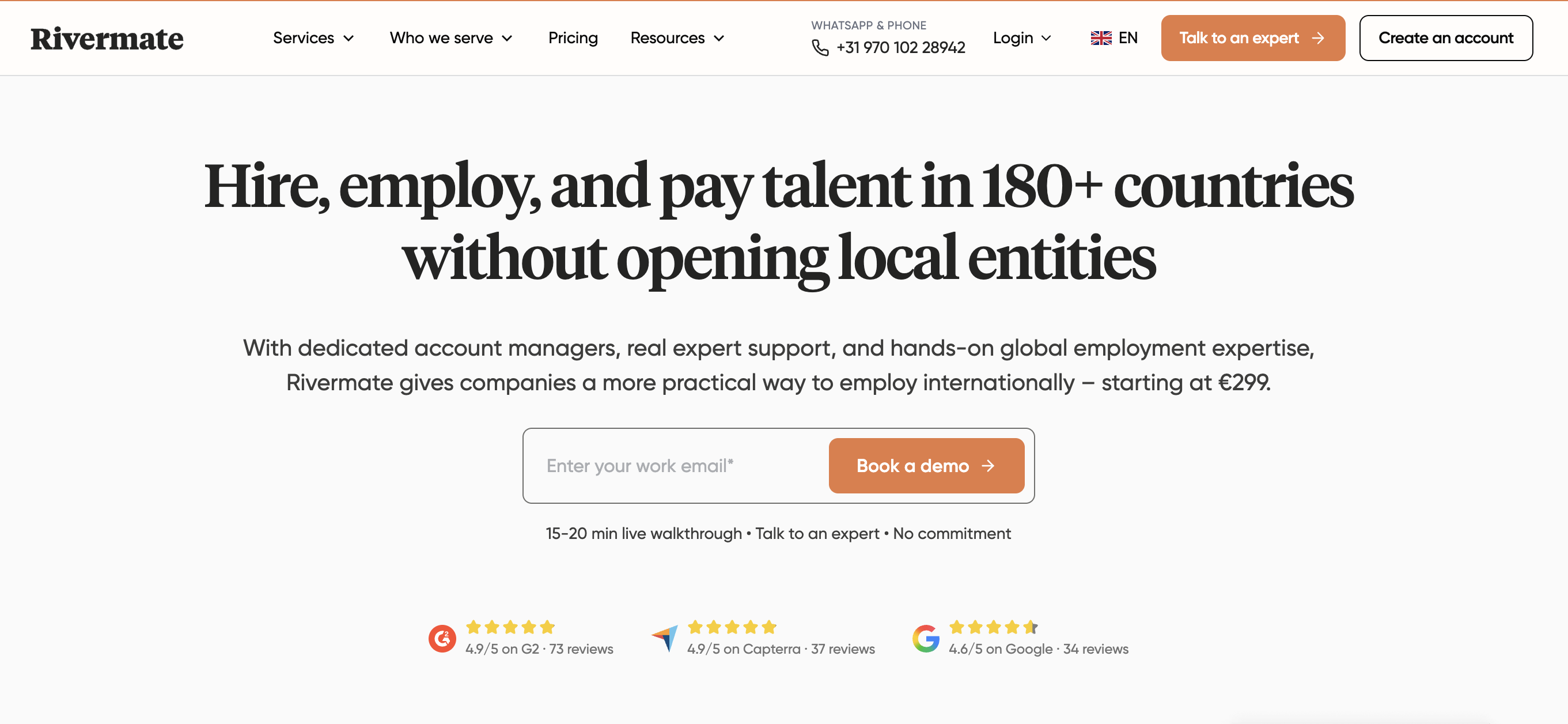
Rivermate offers six core service lines. Its EOR services start at $348 (EUR 299) per employee per month and cover 180+ countries. Contractor of Record is priced at $149 per contractor per month. Global Payroll runs across 120+ currencies. Benefits Administration uses a benchmarking approach to local market norms. Recruitment Services and Employee Relocation are available as add-ons.
In April 2026, Rivermate was absorbed into the Hightekers group alongside Eos Global Expansion and Serviap Global. The combined structure now operates 38 wholly owned legal entities. That shift materially changes the earlier criticism that Rivermate relied heavily on in-country partners: a larger owned-entity footprint reduces the compliance consistency risk that came with a pure partner model, though some markets still depend on third-party arrangements.
The typical Rivermate buyer is a founder or early-stage Operations lead at a company with 5 to 200 employees, hiring across multiple countries at once. These buyers prioritize pricing flexibility, fast onboarding, and a dedicated support contact over deep enterprise reporting. Teams fitting that profile can also review EOR for startups options to compare how providers serve that segment, or read a broader primer on how does EOR work before going deeper into Rivermate's specifics.
How We Analyzed Rivermate Reviews
This analysis draws on verified reviews from G2 (2026), Capterra, Gartner Peer Insights (2026), and Trustpilot, where Rivermate holds a 3.2/5 score. Analyst commentary from employsome.com, peoplemanagingpeople.com, and hrstacks.com provided additional context, alongside community signals from Reddit and Quora threads where buyers discuss real-world EOR experiences.
Each platform adds a distinct signal. G2 captures employer-side depth from HR leads and operations managers. Capterra skews toward SMB buyers. Gartner attracts enterprise-adjacent decision-makers. Trustpilot reflects broader sentiment, including employee-side voices on benefits and onboarding.
Reviewer profiles were segmented into three groups: employer-side respondents (SME founders, operations managers, HR leads), employee-side contributors reporting on onboarding and benefits delivery, and finance administrators flagging payroll reporting gaps. Reviews were further grouped by company size and market complexity to surface patterns relevant to early-stage teams versus growing mid-market organizations.
How Rivermate Scores Across Key Dimensions
Rivermate is evaluated across four dimensions: Coverage and Owned-Entity Footprint, Platform and Reporting, Pricing Transparency, and Customer Support. Scores are editorial assessments anchored to aggregated review signals, not vendor-supplied ratings.
Each dimension is weighted by how frequently it appears as a decision factor in verified buyer reviews. The post-April 2026 consolidation context in the best employer of record market affects how coverage claims should be read, particularly where Rivermate relies on third-party partners rather than owned entities in key markets.
Coverage and Owned-Entity Footprint
Rivermate covers 180+ countries and, following the April 2026 consolidation of the Hightekers group with Eos Global Expansion and Serviap Global, now operates 38 wholly owned entities. That merger materially expanded the directly owned footprint. Outside those 38 markets, Rivermate still relies on a partner model.
The consolidation is a genuine improvement. In owned-entity markets, Rivermate carries direct compliance accountability rather than delegating it to a third party. In partner-served markets, service consistency still varies by local partner. Buyers should ask Rivermate to confirm which specific countries fall under owned entities versus partner coverage before signing.
Platform, Reporting, and Integrations
Rivermate's employer of record software draws consistent criticism on G2 and Gartner for basic reporting. Finance administrators flag limited customization for multi-country payroll and compliance reports, which creates a visibility gap for teams managing headcount across several markets.
On integrations, Rivermate trails Deel and Remote. Its native HRIS and payroll connector count is lower, meaning mid-market buyers with established HR tech stacks often face manual workarounds. Verify specific integration compatibility with Rivermate before committing to a contract.
Pricing Transparency: Headline vs Real-World Cost
Rivermate's published employer of record cost starts at $348 (EUR 299) per employee per month, but independent review analysis puts the real-world range at $617–$669 (EUR 530 to 575) in markets with higher country complexity. Country-complexity add-ons, statutory benefit costs, and local compliance requirements drive that gap. There are no setup or offboarding fees, so $348 (EUR 299) is a floor, not a forecast.
Contractor management starts at $149 per contractor per month. Rivermate bills month to month with no long-term contract, which remains a genuine differentiator for cost-conscious SMB buyers even when real-world EOR costs run higher than the headline.
Customer Support and Account Management
Rivermate's dedicated point-of-contact model draws consistent praise on G2 and Capterra. Reviewers cite fast response times for standard compliance queries and local labor law knowledge as the clearest differentiators in day-to-day support.
The picture is less consistent for advanced or complex queries. G2 reviewers note occasional delays when issues fall outside standard EOR scope. Trustpilot's 3.2 out of 5 score reflects a broader user population, likely weighted toward employee-side experience, and signals that the support model performs best for employer-facing, routine compliance questions rather than edge cases.
What Users Consistently Praise About Rivermate
The most consistent praise across G2 reviewers in consumer services and financial services centers on Rivermate's dedicated support contact model. Reviewers cite fast, knowledgeable responses to local compliance questions and a human-first approach that stands apart from more automated employer of record platforms. That positioning traces directly to the company's founding: Lucas Botzen launched Rivermate in 2020 after experiencing the friction of remote hiring during the COVID-19 period, and the support philosophy reflects that origin.
Onboarding and payroll reliability are the second cluster of strengths. G2 and Gartner reviewers across construction, logistics, and consumer goods describe the self-serve onboarding flow as intuitive enough for new hires to complete without significant HR intervention. Payroll across 120-plus currencies is rated consistent and accurate, and month-to-month billing with no setup or offboarding fees gives scaling teams meaningful financial flexibility.
Gartner reviewers also single out benefits benchmarking as a differentiator. Rather than defaulting to statutory minimums, Rivermate proactively guides clients toward regionally competitive and culturally relevant packages, a retention-focused approach that reviewers in markets with strong benefit expectations find genuinely useful.
Where Rivermate Falls Short: Recurring Complaints
The most substantive recurring complaint comes from Finance administrators on G2 and Gartner: Rivermate's reporting tools offer limited customization, making it difficult to build multi-country payroll budget views or compliance filing summaries. For teams managing fewer than ten active markets, this is a minor inconvenience. Past that threshold, reviewers describe it as a daily bottleneck.
Employee-side reviewers on Gartner flag a separate issue with health insurance coverage. Limits are lower than what employees held under prior arrangements, and Rivermate does not recognize prior employment tenure when workers transition onto Rivermate contracts. In markets where statutory benefit expectations are high, this gap creates a measurable retention risk that HR teams need to plan around before onboarding.
The hybrid partner model introduces a third concern. Rivermate has consolidated to 38 owned entities, which reduces but does not eliminate reliance on third-party partners in some countries. Service quality varies where partners are involved, and that variation shows up in Rivermate's Trustpilot score of 3.2 out of 5, which sits noticeably below its G2 and Capterra ratings. Buyers who check multiple review platforms will find this gap independently. The primary Trustpilot complaint themes are support delays and benefits shortfalls, consistent with the issues noted above.
How Rivermate Reviews Differ by Company Type
Rivermate satisfaction is strongly correlated with company size, reporting requirements, and whether the buyer prioritizes pricing flexibility or compliance depth. Three buyer profiles show where the platform performs well and where friction emerges.
Early-Stage and SMB Teams Hiring Internationally
Founders and early-stage operations leads rate Rivermate highest among all buyer segments. Month-to-month pricing removes financial commitment risk, and there are no setup or offboarding fees to absorb.
Self-serve onboarding means a small HR team can get a new hire under contract without specialist intervention. A dedicated support contact fills the compliance knowledge gap that most seed-stage companies cannot afford to hire in-house.
For teams exploring EOR for startups for the first time, this combination of low financial commitment and on-demand compliance guidance is a practical starting point. Teams that need a broader SMB-focused option can also review EOR for small business providers before deciding.
Growing Mid-Market Teams Scaling Across Markets
Rivermate's reporting works adequately for a small international team, but Finance leads managing payroll budgets, compliance filings, and headcount forecasting across 10 or more active markets find it a recurring bottleneck. Teams at this scale typically need structured multi-country payroll visibility that Rivermate's current platform does not deliver. Integration gaps with existing HRIS stacks compound the problem, adding manual reconciliation work that grows with every new market added. For a closer look at what mid-market teams should expect from an EOR, see EOR for mid-market companies.
Teams with Complex Benefits or Compliance Needs
For teams operating in markets where employees expect strong statutory benefits, Rivermate's health insurance limits create a real retention risk. The platform's hybrid partner model means compliance quality is not uniformly owned by Rivermate across all markets: in partner-served countries, the standard of local compliance depends on the third-party provider rather than Rivermate directly.
Rivermate's post-consolidation footprint of 38 owned entities improves this picture but does not resolve it for every market. Buyers with complex benefits or compliance requirements should ask Rivermate specifically which markets are covered by owned entities and which rely on partners before signing.
What Real Users Say About Rivermate
Here are 3 additional verified user-review quotes for Rivermate, sourced from G2 and Capterra:
"The ease and clarity of onboarding process are amazing." — Dan S., Executive Leader at Infracore, G2 Verified Current User, Aug. 21, 2026.
"Rivermate makes it easy to comply locally and handle payroll administratively in different countries." — G2 Verified Current User, Aug. 21, 2026.
"Very good work employment setup, expense handling and time management options." — Mohamed H., Lead Data Engineer, Capterra Verified User, Feb. 5, 2026.
When Is Rivermate a Strong Choice?
Rivermate works best for SMB and early-stage teams making their first international hire, typically with 5 to 50 employees who need a straightforward path to compliant employment abroad.
Buyers who prioritize pricing flexibility over reporting depth will find Rivermate's month-to-month structure with no long-term lock-in a practical fit. The model suits teams that want to test a market before committing to a local entity.
Compliance consistency is strongest in Rivermate's 38 owned-entity markets, where the company controls the employment relationship directly rather than routing through third-party partners. Teams concentrating hiring in those markets get more predictable outcomes.
If your team is at an earlier stage and weighing EOR options more broadly, the EOR for small business guide covers what to look for before choosing a provider. For a wider view of the market, see the best employer of record comparison.
When Does Rivermate Start to Fall Short?
Rivermate works well for small teams hiring in its 38 owned-entity markets, but four specific conditions tend to push buyers toward alternatives.
Finance teams that need on-demand, multi-country payroll reports often find Rivermate's reporting too basic to satisfy month-end close requirements. When benefits consistency across markets becomes a retention or compliance priority, the variability in Rivermate's partner-model countries creates real risk. Teams hiring primarily outside those 38 owned entities face indirect compliance accountability, since Rivermate relies on third-party partners in those markets rather than its own legal infrastructure. Finally, companies running established HRIS stacks that require native integrations Rivermate does not support hit a practical ceiling as headcount grows.
How Gloroots Compares to Rivermate
Buyers evaluating Rivermate typically compare it against Gloroots on four dimensions: owned-entity footprint, reporting depth, native integrations, and benefits consistency. Rivermate's April 2026 consolidation brought its owned-entity count to 38, but the reporting and integration gaps remain.
| Dimension | Rivermate | Gloroots |
|---|---|---|
| Pricing model | $348 (EUR 299) headline; $617–$669 (EUR 530–575) real-world all-in per employee per month | From $199 per employee per month, with payroll, compliance, document collection and ongoing support included; additional services are approved separately |
| Owned-entity footprint | 38 owned entities post-April 2026 consolidation; partner model in remaining markets | 150+ countries supported for compliant employment and contractor operations |
| Reporting capabilities | Basic dashboards; limited custom multi-country reporting | Centralized workforce visibility with multi-country payroll, workforce-cost and compliance reporting; unified payroll data can be used for analytics and compliance reporting |
| Native integrations | Limited native HRIS integrations | Workday, SAP SuccessFactors, Oracle, BambooHR and ERP systems via secure APIs; SSO and SCIM are also supported |
| Benefits coverage consistency | Variable by market; dependent on partner network outside owned entities | Country-specific statutory benefits plus locally compliant employee benefits, including health insurance; benefits can be tailored to global workforce needs and vary by market |
| Contract terms | Month-to-month | No long-term lock-in by default; monthly billing and services can be adjusted based on hiring needs |
Rivermate suits SMB buyers who prioritize pricing flexibility and direct human support within its owned-entity markets. Gloroots fits mid-market and growth-stage teams that need reporting depth, broader integration support, and consistent benefits across all hiring markets. Explore Gloroots EOR services or review pricing to compare directly.


Rivermate vs Gloroots: Choosing the Right Fit
The decision comes down to your company size, markets, and reporting requirements, not which platform is objectively better. Choose Rivermate if you are an SMB or early-stage team hiring in its owned-entity markets, value pricing flexibility, and do not need deep custom reporting. Choose Gloroots if you are scaling at mid-market pace, need consistent benefits across diverse markets, require broader native integrations, or rely on detailed payroll reporting for Finance teams.

Final Verdict on Rivermate in 2026
Rivermate is a solid choice for SMB and early-stage teams making their first international hires, particularly across its 38 owned-entity markets following the April 2026 consolidation. The human-centric support model and pricing flexibility are genuine differentiators that smaller teams will notice in practice. Real-world costs of $617–$669 (EUR 530 to 575) per employee per month diverge meaningfully from the $348 (EUR 299) headline, and the reporting gap and limited native integrations become harder to absorb as headcount grows.
Teams that have identified those limitations as disqualifying, specifically Finance teams needing reporting depth, mid-market teams requiring integration breadth, or companies hiring outside Rivermate's owned-entity footprint, should evaluate Gloroots as an alternative. Buyers still comparing options across the full market can start with the best employer of record guide.

Frequently Asked Questions About Rivermate Reviews
Is Rivermate worth it based on user reviews?
For SMB and early-stage teams hiring internationally for the first time, Rivermate is worth it. Reviews on G2 and Capterra are strong, with users consistently citing responsive support, reliable payroll, and pricing flexibility as the main reasons they stay.
For mid-market teams, the answer is more qualified. As headcount and country complexity grow, gaps in reporting depth and integration breadth reduce the value. Rivermate's Trustpilot score of 3.2/5 reflects a broader user population that includes employees, not just HR buyers, and that context matters when reading the aggregate number.
What does Rivermate actually cost beyond the $348 (EUR 299) headline?
$348 (EUR 299) is the floor, not the forecast. In markets with higher statutory benefit requirements, local compliance overhead, or multi-jurisdiction payroll, independent review analysis puts real-world costs at $617–$669 (EUR 530 to 575) per employee per month. Country-complexity add-ons are the primary driver of that gap. Contractor management starts at $149 per month and is less exposed to those add-ons. For a broader look at how EOR pricing works across providers, see our guide to employer of record cost.
What do users dislike most about Rivermate?
Three complaints appear most consistently across review platforms. Finance teams cite basic reporting and analytics as the most common limitation, noting that the platform gives limited visibility into payroll data. On the employee side, health insurance coverage falls below previous provider standards in several markets. Compliance-focused teams flag service consistency variation in countries where Rivermate relies on local partners rather than owned entities. Rivermate's Trustpilot score of 3.2 out of 5 reflects these issues at a broader population level and aligns with the pattern seen across G2 and Capterra reviews.
Is Rivermate suitable for scaling mid-market teams?
Rivermate works well for teams scaling from 5 to roughly 50 employees across a manageable number of markets. Within that range, the platform handles payroll and compliance without significant friction.
Beyond that threshold, Finance and HR teams consistently flag three friction points: limited custom reporting, integration gaps that require manual workarounds, and pricing complexity that grows harder to forecast at scale. Teams hiring across 10 or more active markets should assess whether Rivermate's platform depth matches their operational requirements before committing. For a broader view of options built for this stage, see EOR for mid-market companies or compare providers in our Best Deel Alternatives for EOR in 2026 roundup.
Why do teams switch from Rivermate to Gloroots?
The most common trigger is Finance reporting depth. When teams need custom, on-demand payroll reports across multiple cost centers, Rivermate's standard reporting often falls short of what Finance controllers require.
A second trigger is benefits consistency. As headcount grows across markets, teams notice variation in benefits coverage quality between Rivermate's 38 owned-entity markets and the markets served through local partners. For compliance-sensitive or retention-focused teams, that inconsistency becomes a material risk.
Hiring outside Rivermate's 38 owned-entity footprint is a third factor. Partner-model variability in those markets introduces compliance uncertainty that some teams are not willing to accept. Integration breadth is a secondary trigger for mid-market teams with established HRIS stacks that expect native connectors rather than manual exports.
Gloroots covers 150+ countries, starts EOR pricing at $199 per employee per month with flat itemized fees, and provides 24/7 human support with in-region compliance specialists. For teams whose needs have outgrown their current setup, the fit question is whether those specifics match their operational requirements, not a judgment on Rivermate's overall quality.