




- This guide compares eight EOR providers in the USA across pricing, compliance depth, onboarding speed, and support model.
- Pricing ranges from $199 to $699 or more per employee per month, so understanding what each fee includes is essential.
- Multistate compliance depth, especially for California and New York, is a key differentiator among the providers reviewed.
- Flat-rate pricing models offer more predictable cost forecasting than percentage-of-salary billing as headcount and salaries grow.
Whether you are a US company expanding payroll across multiple states or a foreign company hiring your first US employee, an Employer of Record removes the entity requirement and manages compliance on your behalf.
Prices listed in this article were last verified in September 2026. Confirm current rates directly with each provider before making a purchasing decision.
To build this guide, eight providers were evaluated against a defined rubric covering pricing transparency, country coverage, onboarding speed, platform capability, and US compliance depth. The methodology section below explains the full criteria.
Our Top 8 Picks: USA EOR Comparison 2026
The table below compares all eight providers across seven criteria. Use it to shortlist two or three options before reading the detailed profiles. Safeguard Global replaces Papaya Global and Velocity Global in this updated roster.
| Provider | Pricing per month | Country coverage | Onboarding speed | Platform experience | Customer support | Scalability |
|---|---|---|---|---|---|---|
| Gloroots | $199/employee/month | 150+ countries | 3 to 5 working days | Centralized workforce dashboard covering hiring, payroll, compliance, benefits and workforce visibility | 24/7 human support with dedicated account management | SMB to enterprise; built for multi-country programs |
| Deel | $599/employee/month; country-specific statutory costs are additional | 130+ EOR countries; broader global hiring footprint is larger | Automated onboarding; country-dependent | Unified platform for EOR, payroll, contractors, HR, benefits, compliance and integrations | 24/7 HR, legal and tax expertise | SMB to enterprise; strong fit for fast-scaling distributed teams |
| Safeguard Global | From ~$599/employee/month; premium markets/country complexity can increase cost | 187 countries | 1 to 2 weeks in most countries; country-dependent | Global workforce platform covering EOR, payroll, HR and compliance | Dedicated account management plus regional and in-country specialists | Mid-market to enterprise |
| Globalization Partners | From ~$599/employee/month; custom quote available; country-specific pricing | 180+ countries | 2 to 7 days in published country comparisons; country-dependent | G-P Meridian platform covering hiring, onboarding, payroll, benefits and compliance | Dedicated Customer Success Manager and in-country expertise | Mid-market to enterprise |
| Remote | $699/employee/month standard; annual or contract arrangements may offer different pricing | 90+ EOR countries | Dedicated onboarding specialist; country-dependent | Owned-entity EOR platform with payroll, benefits, compliance, IP protection and workforce management | In-house local experts and dedicated specialist support | SMB to enterprise; particularly strong for companies prioritizing owned entities and IP |
| OysterHR | Not publicly listed in researched sources | 180+ countries | Not publicly listed in researched sources | Not publicly listed in researched sources | Not publicly listed in researched sources | Not publicly listed in researched sources |
| Multiplier | $499/monthly; $459 annually for Core; approximately 11% of countries have adjusted pricing | 150+ countries | Country-dependent | Multi-country EOR and payroll platform with employment, payroll, benefits, compliance and workforce management | Human-first support and local expertise | SMB to enterprise; supports companies from first hire to large distributed teams |
| Rippling | Custom EOR pricing; country-specific | 80 EOR countries | Not publicly listed as a universal timeframe | Unified HR, IT, payroll and finance platform | In-app and customer support; depth varies by plan | SMB to enterprise; particularly strong for automation-heavy HR and IT environments |
Top 8 Best EOR Platforms in USA
These eight providers were selected from a field of more than 30 EOR platforms evaluated across six axes: multistate payroll coverage, owned versus partner entity model, ACA compliance depth, onboarding speed, pricing transparency, and support model.
Each shortlisted provider met a minimum threshold on at least four of the six axes. The profiles below give you the detail needed to match each platform to your specific US hiring requirements.
Gloroots
Gloroots runs compliant, entity-free employment across 150+ countries, including all 50 US states. The platform covers Global EOR, Global Payroll, Compliance and Employment Governance, and Benefits and Statutory Coverage under one centralized workforce dashboard. US employment is managed through Gloroots' partner network rather than wholly owned US entities.
Onboarding SLA: 3 to 5 business days for verified hires. Pricing starts at $199 per employee per month with full cost visibility before onboarding and no percentage-of-salary billing. The platform also supports multistate payroll processing, ACA administration, and 401(k) handling across US states.
Human-led account support with retained business context is available 24/7. A dedicated account manager maintains continuity across payroll cycles, compliance filings, and benefits administration, reducing the need for repeated context-setting on each interaction.
Strengths:
-
Predictable, country-specific pricing at $199 per employee per month with no hidden FX fees or percentage-of-salary charges gives Finance teams reliable cost forecasting across US payroll cycles.
-
Centralized workforce visibility covers hiring, payroll, compliance, and benefits in one dashboard, reducing vendor sprawl for companies managing mixed contractor and full-time employee workforces.
-
24/7 human-led account support with retained business context means teams receive consistent guidance without restarting context on every interaction.
Limitations:
-
Gloroots manages US employment through a partner network rather than wholly owned US entities, which may be a consideration for buyers who require a fully owned-entity model.
-
Public sources reviewed did not document additional provider-specific limitations beyond entity model structure.
Best for:
Startups and scaleups that need cost-effective, compliant employment across US states without opening a local entity, and that value predictable flat-rate pricing with human-led account support.
Deel
Deel is a global EOR platform operating in 150+ countries through wholly owned legal entities. It covers EOR, global payroll, contractor management, and immigration support on a single platform. Ranked #1 on G2 for Employer of Record, Global Employment, and Multi-Country Payroll, Deel is trusted by 40,000+ companies worldwide.
EOR services start at $599 per employee per month. Contractor management is available from $49 per contractor per month, and Contractor of Record from $325 per contractor per month. The $599 EOR fee does not include salary, employer taxes, social contributions, statutory benefits, equipment, or immigration costs.
The platform includes AI automation across contracts, payroll, and tax filings, along with 100+ integrations, immigration and visa support, and unified management of both employees and contractors.
Strengths:
-
Operates through wholly owned legal entities in 150+ countries rather than third-party partner networks, supporting faster onboarding and consistent compliance standards across jurisdictions.
-
Ranked #1 on G2 for Employer of Record, Global Employment, and Multi-Country Payroll, with 40,000+ companies using the platform.
-
Covers EOR, global payroll, contractor management, and immigration on one platform, reducing vendor complexity for companies managing mixed workforce types.
Limitations:
-
The EOR service fee of $599 per employee per month does not include salary, employer taxes, social contributions, statutory benefits, equipment, or immigration costs, which can make total employment costs significantly higher than the headline rate suggests.
Best for:
Large-scale global operations and companies that need a single platform from their first international hire through enterprise-level expansion.
Safeguard Global
Safeguard Global has operated as an EOR provider for 18+ years and covers 187+ countries and territories. The platform supports hiring, onboarding, payroll, and employee management without requiring a local entity. It was recognized as a market leader in the 2025 NelsonHall EOR Services NEAT Report.
The company positions itself around a technology-plus-human model. In-country experts provide guidance on local labor laws, compliance, payroll requirements, and workforce management across the full employment lifecycle. Starting price is $699 per employee per month.
Coverage spans 187+ countries, with onboarding typically completed in one to two weeks in most countries. US-specific timelines are subject to verification.
Strengths:
-
In-country compliance experts provide personalized guidance on local labor laws, payroll nuances, and workforce management throughout the employment lifecycle, rather than relying solely on platform-driven workflows.
-
Recognized as a market leader in the 2025 NelsonHall EOR Services NEAT Report, with 18+ years of operating history as an EOR provider.
Limitations:
-
Starting price of $699 per employee per month is higher than several competitors in the market, which may affect cost planning for companies with larger headcounts or tighter budgets.
Best for:
Companies that value personalized, human-led compliance guidance and a strategic workforce support partner with deep in-country expertise.
Globalization Partners
Globalization Partners (G-P) is a global employment platform covering 180+ countries. It offers EOR, contractor management, and global payroll through the G-P Meridian platform, which covers hiring, onboarding, payroll, benefits, and compliance in a single interface.
G-P differentiates through G-P Gia, an AI-powered compliance intelligence tool available to all users. The platform is built for mid-market and enterprise companies that need broad geographic coverage with established employment processes and dedicated customer success management.
Pricing is not publicly disclosed. Companies seeking a firm per-employee monthly rate before engaging G-P will need to request a custom quote.
Strengths:
-
G-P Gia provides agentic AI for global HR compliance at scale, giving HR and legal teams on-demand compliance intelligence across 180+ countries.
-
Dedicated Customer Success Manager support combined with in-country expertise gives enterprise buyers a named point of contact throughout the employment lifecycle.
Limitations:
-
Pricing is not publicly listed in researched sources, which makes upfront cost comparison difficult for buyers evaluating multiple providers simultaneously.
Best for:
Enterprise and mid-market companies that need broad geographic coverage, established EOR processes, and AI-assisted compliance intelligence across 180+ countries.
Remote
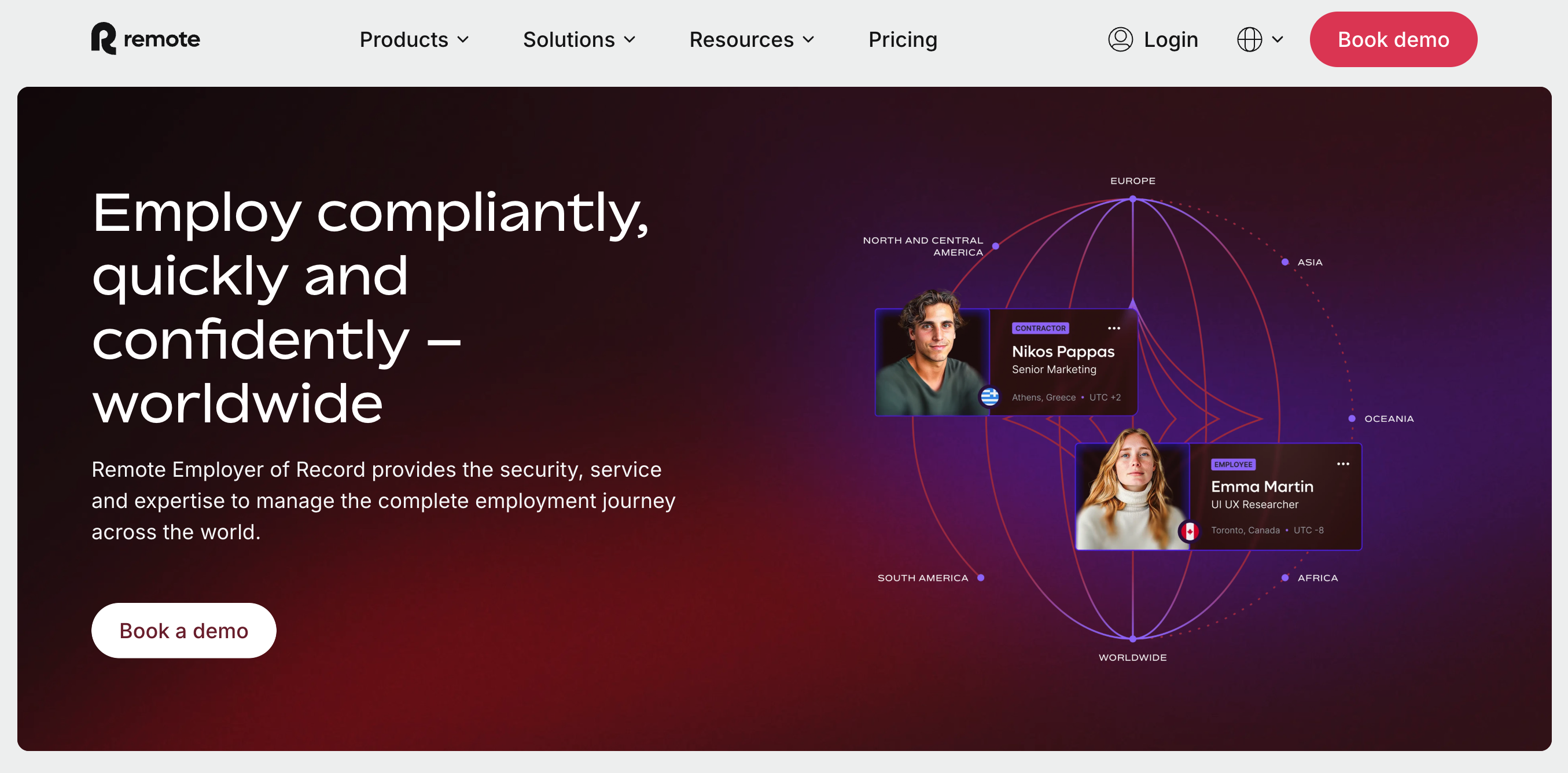
Remote is an EOR provider focused on distributed and remote-first teams, covering 90+ countries with standardized employment experiences and platform-driven workflows. The platform covers payroll, benefits, compliance, IP protection, and workforce management through owned legal entities.
Remote's owned-entity model is its primary differentiator. Rather than relying on third-party partner networks, Remote operates through its own in-country entities, which supports consistent compliance standards and IP protection for companies hiring internationally.
Remote is suited to SMB and enterprise buyers that prioritize entity ownership as a compliance and risk-management criterion. Onboarding is supported by a dedicated onboarding specialist, with timelines varying by country.
Strengths:
-
Owned in-country entities rather than partner networks support consistent compliance standards and reduce third-party risk for companies hiring across multiple countries.
-
IP protection is built into the employment model, making Remote a practical option for technology companies concerned about intellectual property exposure when hiring internationally.
Limitations:
-
Country coverage at 90+ countries is narrower than several competing EOR providers, which may limit options for companies with hiring needs in less common markets.
Best for:
Compliance-first buyers that prioritize owned-entity EOR operations and IP protection when building distributed teams across 90+ countries.
OysterHR
OysterHR is a remote-first EOR provider supporting employment in 180+ countries. The platform pays teams in 140+ local currencies and stores employment contracts and documentation in a centralized system.
OysterHR offers hiring tools, a contractor versus full-time analysis tool, an employment cost calculator, and localized benefits plans. The platform works with directly owned entities and reputable partners to maintain compliance with local employment laws.
For US operations, OysterHR manages federal and state employment obligations through a combination of direct entity and local partner arrangements. OysterHR does not publicly confirm the specific U.S. legal entity model or whether all U.S. hires are employed through an Oyster-owned entity.
Strengths:
-
Reduces legal and compliance risks through employment practices liability coverage and country-specific legal guidance designed to protect employers from potential lawsuits.
-
Supports 180+ countries and pays in 140+ local currencies, giving companies broad geographic reach without managing separate payroll vendors per country.
-
Centralizes employment contracts, documentation, hiring tools, and localized benefits plans in one platform.
Limitations:
G2 reviewers report delays and long waiting times.
Best for:
Companies scaling global remote teams that need broad country coverage, localized benefits, and employment practices liability protection.
Multiplier
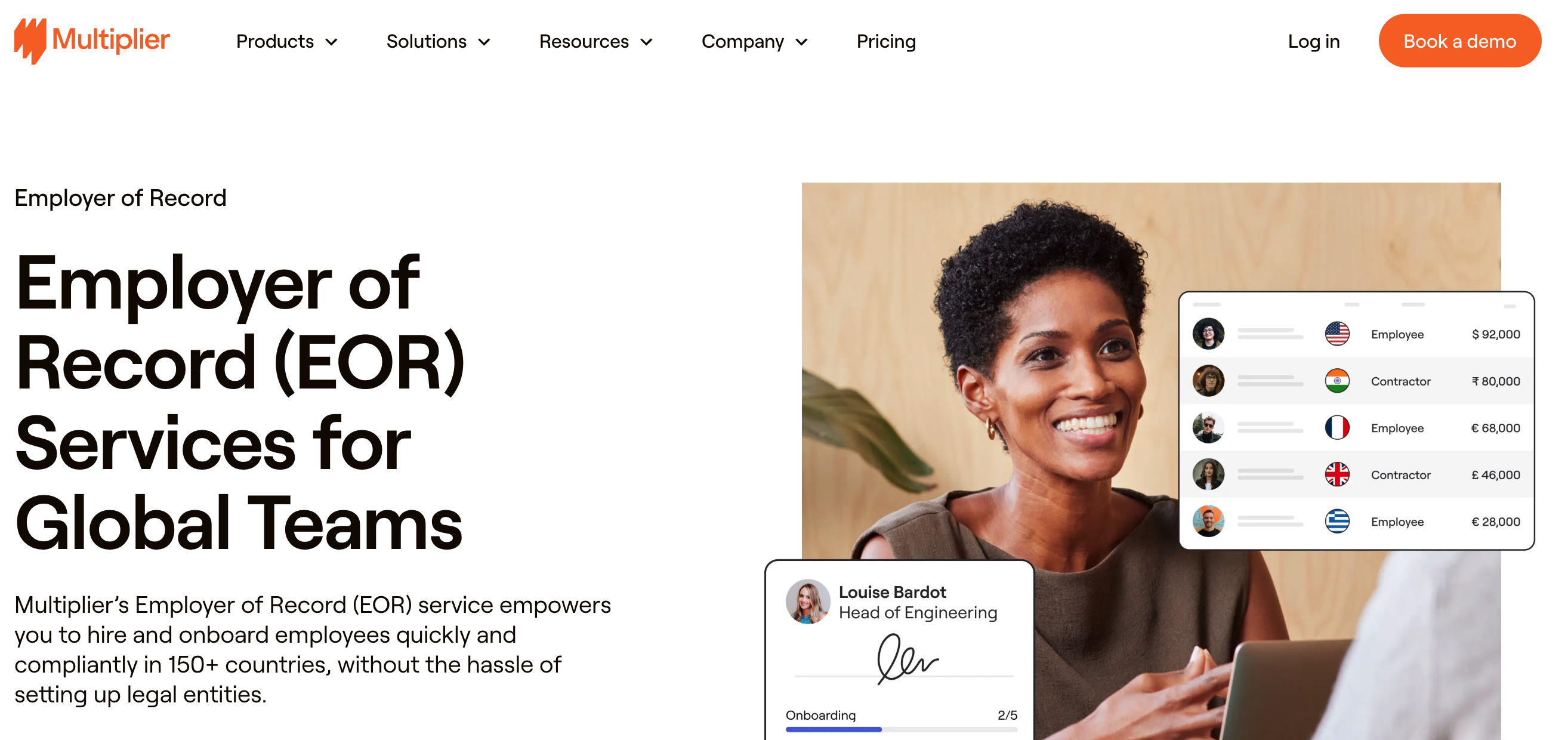
Multiplier is an EOR provider covering 150+ countries, positioned for cost-conscious growth companies that need simplified onboarding and an accessible platform. Starting price is approximately $400 per employee per month, making it one of the lower entry points among major EOR providers.
The platform covers employment, payroll, benefits, compliance, and workforce management across its supported countries. Multiplier offers human-first support and local expertise to help companies manage employment obligations without opening local entities.
Multiplier states it becomes the legal employer through its own entities, not a third‑party partner network, including in the US.
Strengths:
-
Priced at approximately $400 per employee per month, Multiplier offers a lower entry cost than several comparable EOR providers in the market.
-
Covers 150+ countries with a multi-country EOR and payroll platform that includes employment, benefits, compliance, and workforce management in one place.
-
Human-first support model with local expertise gives teams access to guidance on employment obligations without relying solely on automated workflows.
Limitations:
-
Public sources reviewed did not document a provider-specific limitation for Multiplier beyond pricing variability across approximately 11% of supported countries.
Best for:
Cost-conscious growth companies that need simplified global onboarding and an accessible EOR platform across 150+ countries.
Rippling
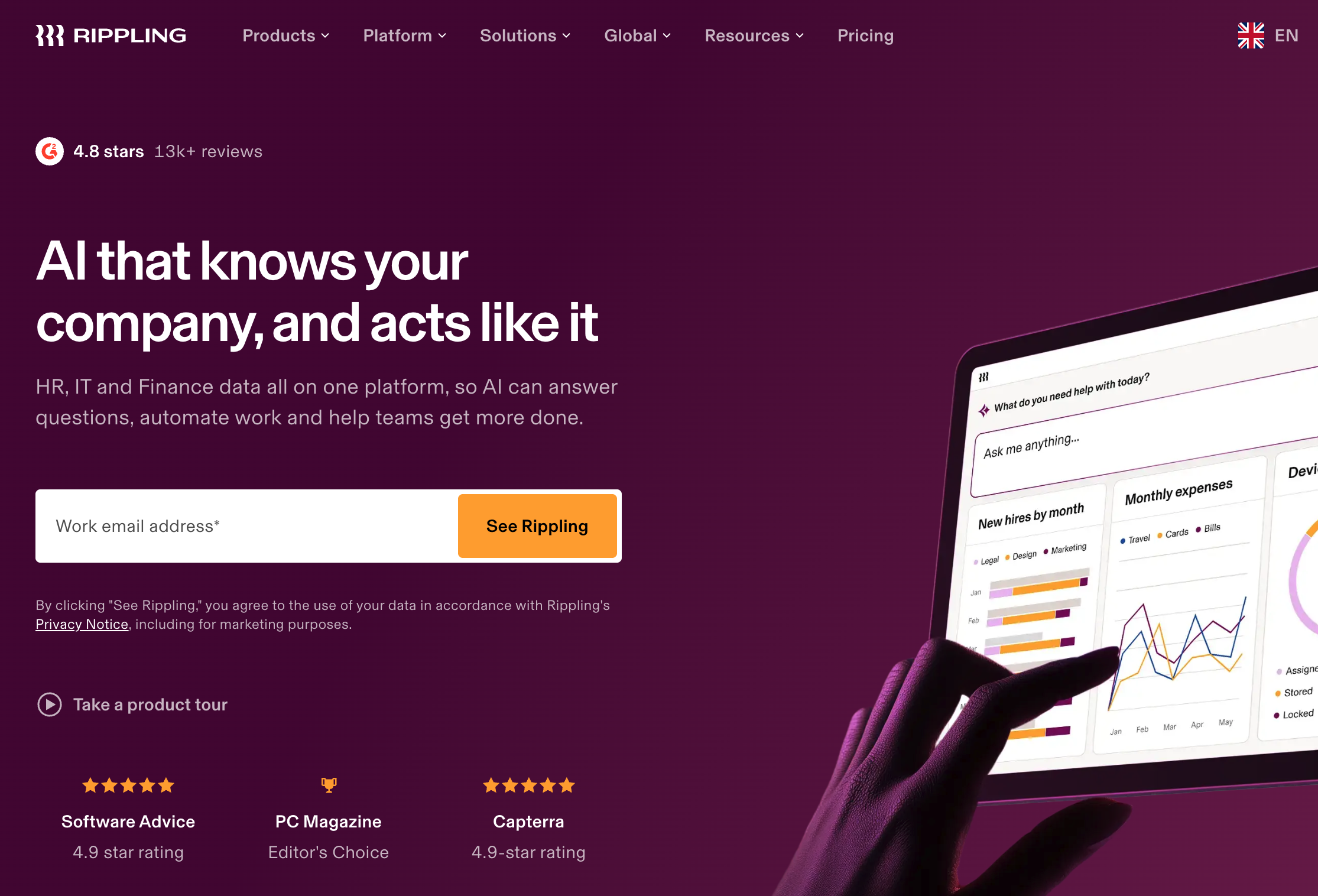
Rippling is a workforce management platform that unifies HR, IT, and Finance alongside EOR services in 150+ countries. Companies use Rippling to manage payroll, benefits, compliance, and device management from a single system, reducing the number of separate tools required to run a distributed workforce.
Rippling's automation-first model is its defining characteristic. The platform is rated 4.8 out of 5 on G2 and is built for companies that want to automate repetitive HR and IT workflows rather than manage them manually. EOR pricing is custom and requires a direct quote from Rippling.
Strengths:
-
Unified HR, IT, and Finance platform allows companies to manage payroll, device provisioning, and compliance reporting without switching between separate systems.
-
Automation-first design reduces manual work across onboarding, offboarding, and recurring HR tasks, supported by a 4.8 out of 5 G2 rating.
Limitations:
-
EOR country coverage at 80 countries is lower than several competitors in this comparison, which may limit options for companies with broad multi-region hiring plans.
Best for:
Companies seeking a unified HR, IT, and Finance management platform alongside EOR services, particularly those prioritizing workflow automation.
What Are the Key Services of an EOR in USA?
A US EOR delivers six core service areas: multistate payroll processing and tax filing, ACA-compliant benefits administration, employment contract drafting, FMLA and state paid leave compliance management, workers' compensation and unemployment insurance administration, and ongoing federal and state regulatory compliance.
US-specific complexity makes these services especially critical. Multistate payroll obligations, ACA employer mandates, and state-run paid leave programs in California, New York, Washington, and New Jersey each carry distinct filing requirements, contribution rates, and eligibility rules that change independently of federal law. An EOR tracks and executes these obligations across every state where your employees work.
Employment Contracts and Local Compliance
Employment contracts in the USA must align with both federal law and the specific requirements of each employee's state. A single template does not satisfy multistate hiring.
California's AB5 law creates significant misclassification risk. Any contract involving independent contractors in California must be drafted with AB5's ABC test in mind, or the worker may be reclassified as an employee, triggering back taxes, benefits obligations, and penalties.
New York imposes mandatory disclosure requirements that must appear in employment agreements, including wage notice obligations under the Wage Theft Prevention Act. Contracts must be updated whenever state laws change. This is an ongoing obligation, not a one-time drafting task. An EOR monitors state-level legislative changes and revises contract language accordingly.
Payroll and Tax Administration
US payroll carries fixed federal obligations alongside variable state costs. Employers pay FICA at 7.65% of each employee's wages, covering Social Security at 6.2% and Medicare at 1.45%.
FUTA applies to the first $7,000 of each employee's annual wages. At the standard 6% rate, before any state credit, that equals a maximum federal cost of $420 per employee per year. State Unemployment Insurance (SUI) rates vary by state and by each employer's experience rating, so actual costs differ across jurisdictions.
State income tax withholding adds another variable. Texas, Florida, and several other states impose no state income tax, which reduces withholding complexity and lowers the administrative burden for payroll teams operating in those states. An EOR calculates and remits all of these obligations accurately across every state where employees work.
Benefits Administration
The EOR is the legal employer of record, which means ACA compliance obligations fall on the EOR, not the client company. This distinction matters: the EOR must satisfy the employer mandate for any workforce that meets the 50 full-time equivalent threshold.
Beyond ACA, the EOR manages ERISA compliance for 401(k) plans, including enrollment, contribution processing, and required plan reporting. Failure to meet ERISA obligations carries significant penalties.
Several states impose benefits requirements beyond federal law. California requires State Disability Insurance (SDI) contributions. New York mandates Disability Benefits Law (DBL) coverage. A qualified EOR tracks these state-specific layers and administers them alongside federal obligations.
Employee Onboarding
EOR onboarding covers employment agreement execution, benefits enrollment, payroll setup, and state tax registration for the employee. The EOR also manages I-9 verification and E-Verify obligations as the legal employer.
For straightforward hires, onboarding typically completes in 3 to 5 business days. Roles requiring background checks or hires in states with additional disclosure requirements take longer.
California and New York add steps to the process. California requires specific wage and hour notices and CFRA disclosures. New York mandates written wage notices under the Wage Theft Prevention Act. Both states extend the standard timeline. Companies hiring in these states should build additional lead time into their workforce planning.
Ongoing HR Support
Ongoing HR support from a US EOR covers the employment obligations that continue after a worker is onboarded. This includes leave management, FMLA tracking, and administration of state-run paid leave programs in California, New York, Washington, New Jersey, Massachusetts, Connecticut, Oregon, and Colorado.
Each of these state programs carries its own contribution rates, which change periodically. A qualified EOR monitors rate updates and adjusts payroll deductions accordingly, removing that tracking burden from your internal team.
Workers' compensation claims and unemployment insurance responses also fall within ongoing HR support. The EOR manages claim documentation and state agency correspondence on your behalf.
Support model structure varies by provider. Some offer a dedicated account manager who retains context about your workforce. Others route requests through a shared helpdesk. For companies managing performance issues or disciplinary processes, access to employment law guidance through the EOR's support team reduces the risk of procedural errors that can create legal exposure.
Employee Offboarding
Employee offboarding through a US EOR covers final paycheck compliance, COBRA notification, unemployment insurance filing, and equipment retrieval coordination. State law governs final paycheck timing, and the rules differ significantly by jurisdiction.
California requires the final paycheck to be issued immediately upon termination. New York requires payment by the next regular payday. The EOR tracks these deadlines by state and executes accordingly, reducing the risk of wage claim liability.
For larger workforce reductions, the federal WARN Act requires 60 days' advance notice when a company with 100 or more employees conducts a qualifying layoff or plant closing. The EOR advises on WARN Act applicability and supports the required notification process.
The EOR also manages separation agreements and state-specific termination documentation. This includes preparing the correct forms for each state, ensuring that releases and final pay statements meet local requirements before the employment relationship closes.
How to Hire Through an EOR in USA
Hiring through a US EOR follows two phases: Selection and Setup, then Onboarding and Compliance. Each phase has defined steps that apply whether you are a domestic company expanding across states or a foreign company hiring your first US employee.
The process is consistent across both scenarios. The EOR becomes the legal employer, manages state-specific filings, and keeps your workforce compliant from day one.
Selection and Setup
Start by defining your hiring need: the state or states of employment, whether you need employees or contractors, and your headcount. This determines which EOR capabilities matter most.
Next, evaluate providers against criteria including entity model, multistate coverage, ACA compliance depth, pricing structure, and support quality. Once you select a provider, sign a Master Services Agreement and Statement of Work, and confirm the state-specific compliance scope covered under the engagement.
The EOR then registers as the employer of record in each relevant state if it is not already registered. Setup time varies by state. Some states require new employer registration that adds one to two weeks before the first payroll can run.
Onboarding and Compliance
A US EOR follows a defined onboarding sequence to bring each employee into compliant employment. The steps below apply to standard hires across most states.
-
The employee receives and signs a state-specific employment agreement.
-
Benefits enrollment covers health insurance, 401(k), and any state-mandated benefits applicable to the employee's location.
-
I-9 verification and E-Verify completion confirm work authorization.
-
Payroll setup is configured and the first payroll run is confirmed.
-
The EOR files state new-hire reporting as required by each state.
California and New York require additional disclosure documents at onboarding. Companies hiring in those states should confirm that their EOR tracks current disclosure requirements for each jurisdiction.
Standard hires complete onboarding in 3 to 5 business days. Hires in states with more complex requirements, such as California, may take up to two weeks.
What Are the Benefits of Using an EOR in USA?
Using an EOR in the USA removes the need to open a legal entity while keeping employment fully compliant across federal and state law. The sections below cover six core benefits companies gain when they run US employment through an EOR.
The USA presents a layered compliance environment that few companies can manage internally. Federal obligations under the FLSA and ACA combine with state-level requirements in California, New York, Washington, and other regulated states, making the federal-state compliance burden one of the primary reasons companies choose an EOR over direct entity setup.
Faster Market Entry
An EOR removes the need to register a state entity, pay registered agent fees, or wait through payroll setup delays before your first US hire starts work.
Hiring through an EOR can begin in 3 to 5 business days. Forming an LLC or C-Corp takes 1 to 2 weeks in Delaware and 4 to 6 weeks in California. The EOR holds the US Employer Identification Number, so foreign companies can employ US workers immediately without obtaining their own EIN or opening a US entity.
That speed advantage applies across all 50 states. Your team can activate a hire in a new state without triggering entity registration requirements in that jurisdiction.
Reduced Compliance Risk
An EOR assumes legal employer liability for compliance with the Fair Labor Standards Act, the Affordable Care Act, the Family and Medical Leave Act, and applicable state laws. That liability transfer reduces your exposure across federal and state requirements.
Worker classification is one of the most consequential risks in US employment. California AB5 tightened the test for independent contractor status, and misclassification under that law carries significant penalties. An EOR ensures workers are engaged as W-2 employees rather than 1099 contractors where the role requires it.
State law changes continuously. Minimum wage increases, new paid leave programs, and updated contribution rates take effect on different schedules across states. An EOR tracks those changes and applies them automatically to your payroll and benefits administration.
Simplified Payroll Administration
An EOR consolidates multistate payroll into a single vendor relationship, replacing the fragmented setup that in-house teams otherwise manage across dozens of state registrations.
The EOR calculates and remits FICA contributions, FUTA and SUTA payments, and state income tax withholdings for every state where employees work. Filing deadlines and rate changes are tracked by the EOR, not your internal team.
For foreign companies paying US employees, multi-currency payroll removes the need to manage currency conversion and cross-border payment logistics separately. In-house payroll requires separate state registrations, varying filing calendars, and constant monitoring of rate updates across jurisdictions. An EOR absorbs all of that into one managed relationship.
Access to Local Benefits
An EOR provides access to ACA-compliant health insurance, 401(k) plans, and state-mandated benefits without requiring your company to negotiate directly with insurers or benefits administrators.
Small companies with fewer than 50 full-time equivalent employees gain access to group health plans through the EOR's pooled purchasing power. This gives smaller teams benefit options that would otherwise be unavailable or prohibitively expensive to arrange independently.
State-specific obligations are also covered. California State Disability Insurance (SDI), New York Disability Benefits Law (DBL) and Paid Family Leave (PFL), and Washington Labor and Industries (L&I) contributions are all administered by the EOR. Competitive benefits packages help attract US talent without adding internal benefits management overhead.
Lower Entity Setup Costs
Forming a US LLC costs between $500 and $2,000 or more in state filing fees alone. Add a registered agent at $100 to $300 per year, a payroll system at $50 to $200 per month, and ongoing HR and legal overhead, and the total cost of maintaining a US entity grows quickly.
An EOR replaces these fragmented costs with a single per-employee monthly fee. For companies with one to five US employees, that trade-off almost always favors the EOR. There is no entity to register, no registered agent to retain, and no separate payroll vendor to manage.
Gloroots charges $199 per employee per month with no percentage-of-salary billing, giving Finance teams a predictable figure to plan against. For more detail on how employer of record cost compares to entity formation, see the linked breakdown.
More Flexible Workforce Scaling
An EOR lets companies add or remove US employees without restructuring a legal entity. Hiring in a new state does not require a separate entity registration because the EOR already holds the employment infrastructure across all 50 states.
This model supports project-based and seasonal hiring without committing to permanent employment infrastructure. When a project ends, the engagement closes without triggering entity dissolution or state deregistration processes.
When headcount in a single state reaches roughly 10 to 15 full-time employees, transitioning to a owned entity often becomes cost-effective. Until that threshold, the EOR model keeps overhead low and workforce decisions reversible. EOR for startups and EOR for mid-market companies covers how each growth stage maps to the right employment structure.
How to Find the Right EOR for USA
Selecting a US EOR requires evaluating five criteria: local compliance expertise, payroll infrastructure, benefits administration, platform capability, and pricing transparency. Use this checklist to assess each provider before shortlisting.
US EOR selection differs from other markets because compliance operates at two levels simultaneously. Federal law sets the baseline, but state-level requirements in places like California and New York add significant complexity that not every provider manages with equal depth.
Local Compliance Expertise
Local compliance expertise in the US context means the EOR can manage multistate payroll, ACA administration, FMLA tracking, state paid leave programs, and workers' compensation across every state where you hire.
Ask whether the provider employs in-house legal and compliance staff or relies on third-party advisors. In-house teams respond faster to regulatory changes and carry direct accountability for filing accuracy.
Use California and New York as your compliance depth test. Both states impose layered obligations that expose gaps in a provider's operational capability. Confirm that the EOR tracks and implements state law changes proactively, not reactively after a filing deadline has passed.
Clear Service Scope
Before signing with any US EOR, confirm exactly what the monthly fee covers. Ask whether benefits administration is included or billed as an add-on. Confirm that workers' compensation and unemployment insurance are part of the standard package, not optional extras.
The entity model matters too. EORs that rely on partner networks rather than owned entities may have coverage gaps in certain US states. Request a written service level agreement that specifies onboarding timelines, payroll accuracy standards, and support response times.
Some providers exclude immigration support and background check coordination from their standard scope. Clarify these boundaries in writing before committing to a contract.
Support Model
Ticket-only support and dedicated account management are not equivalent. A shared inbox routes queries to whoever is available, with no retained context about your workforce. A named account manager carries that context and can act faster when a compliance question requires a same-day answer.
US compliance questions often cannot wait. Termination timing, leave eligibility, and wage-hour decisions in states like California and New York can carry legal consequences if delayed. Confirm whether your EOR assigns a named contact or routes all queries to a shared queue.
For companies outside the US that are hiring US employees, time-zone coverage is a practical requirement. Ask whether the provider offers 24/7 availability and whether that coverage is human-led or automated. Gloroots provides 24/7 human support with dedicated account management and retained business context.
Technology and Reporting
A qualified US EOR platform must provide real-time payroll visibility, a compliance status dashboard, document management, and reporting with state-by-state breakdowns for finance teams managing multistate payroll.
Confirm whether the platform integrates with your existing HRIS tools such as Workday, BambooHR, or SAP SuccessFactors, and with accounting systems such as QuickBooks or Xero. Disconnected systems create reconciliation delays and increase manual error risk across payroll cycles.
Enterprise environments require SSO, SCIM provisioning, and role-based access controls. These are not optional features for companies managing sensitive employment data across multiple US states. Verify that each provider supports them before shortlisting.
Scalability for Your Hiring Plans
Confirm that the EOR supports hiring across all 50 US states without additional setup fees per state. Some providers charge state-specific surcharges for high-complexity states such as California and New York, which increases total cost as headcount grows.
Ask whether the provider supports a transition from EOR to your own US legal entity. Most companies reach this threshold at 10 to 15 full-time employees, at which point the cost of maintaining an EOR often exceeds the cost of entity setup and direct employment.
Pricing model also affects long-term scalability. A flat monthly fee per employee keeps costs predictable as salaries increase. A percentage-of-salary model raises your EOR cost automatically when you promote employees or hire at higher compensation bands, which can make employer of record cost difficult to forecast at scale.
Why Gloroots Is a Strong EOR Partner in USA
Gloroots starts at $199 per employee per month, making it one of the most cost-accessible EOR options for companies hiring across US states. Pricing is country-specific, with full cost visibility provided before onboarding begins. No percentage-of-salary billing applies.
The platform covers four service pillars: Global EOR, Global Payroll, Compliance & Employment Governance, and Benefits & Statutory Coverage. These pillars run together on a centralized workforce dashboard, giving HR and Finance teams visibility across hiring, payroll, compliance, and benefits in one place.
Human-led account support is built into the model. Account teams retain business context across engagements, so companies do not repeat background information each time they contact support. US onboarding completes in 3 to 5 business days for verified hires.
For companies with hiring needs beyond the US, Gloroots supports compliant full-time employment across 150+ countries. This makes it a practical option for startups and scaleups managing both US and international headcount without opening local entities in each market.
Gloroots is suited to startups and scaleups that need compliant US hiring without entity setup, predictable costs, and centralized workforce governance. To see pricing or request a demo, visit Gloroots EOR services or review Gloroots pricing. Options are also available for EOR for small business and EOR for enterprises.
FAQs About the Best EOR in USA
How does an EOR work in USA?
An Employer of Record becomes the legal employer of your US-based workers. The EOR holds its own Employer Identification Number (EIN), runs payroll, withholds federal and state taxes, files W-2s, and administers benefits and workers' compensation. Your company directs the day-to-day work.
No US legal entity is required on your side. The EOR assumes full employment liability under federal law, including the Fair Labor Standards Act and the Affordable Care Act, and manages state-level obligations across every jurisdiction where your employees work. For a detailed breakdown of the full process, see how does EOR work.
What does an EOR cost in USA?
EOR fees in the USA typically range from $199 to $1,000 or more per employee per month, depending on the provider and services included. That fee covers the employment layer: payroll processing, compliance management, and benefits administration.
The fee does not cover salary, employer payroll taxes (FICA at 7.65%), FUTA, state unemployment insurance (SUI), or benefits premiums. For an employee earning $80,000 per year, the monthly salary cost is approximately $6,667. Add roughly $510 in employer FICA contributions, state SUI, and the EOR service fee on top of that figure.
Gloroots starts at $199 per employee per month with no percentage-of-salary billing. Verify current prices directly with each provider before committing. For a full breakdown, see employer of record cost.
When should a company use an EOR in USA?
An EOR makes sense when a company needs to hire its first US employee without a registered US entity, or when it wants to expand into a new state without completing that state's registration process.
Companies testing the US market before committing to entity formation also benefit from an EOR. Foreign-headquartered companies can use a US EOR to employ US-based talent without opening a domestic legal entity.
An EOR is cost-effective for teams of 1 to 10 employees. Above 10 to 15 full-time employees concentrated in one state, entity formation may become more economical. Companies converting misclassified contractors to employees should also consider an EOR to manage the transition compliantly.
Can an EOR hire both local and foreign employees in USA?
Yes. A US EOR can employ both US citizens and foreign nationals who are authorized to work in the United States. The EOR manages I-9 verification for all employees regardless of nationality.
An EOR does not sponsor visas. Immigration support is a separate service that some EOR providers offer alongside their standard employment services. Companies requiring visa sponsorship should confirm whether their chosen provider offers this as a distinct offering.
Foreign-headquartered companies can use a US EOR to hire US-based employees without establishing a US legal entity. This makes the EOR model a practical option for international businesses building a US workforce before committing to domestic entity formation.
How do I choose the right EOR in USA?
Five criteria separate a reliable US EOR from one that creates compliance gaps. First, confirm whether the provider operates through owned legal entities or third-party partner networks, since owned entities deliver more consistent compliance standards. Second, assess multistate compliance depth, particularly for California and New York, where state-specific obligations require active tracking and filing. Third, require transparent pricing before signing, including all statutory costs, so Finance can forecast accurately. Fourth, evaluate the support model: dedicated account management with retained context outperforms ticket-only systems for US employment issues. Fifth, confirm the provider supports scalability and offers a clear exit path if you later establish your own US entity. See the selection criteria section above for full guidance on each factor.