




- Malta's tight labor market (2.7% unemployment, 81.6% employment rate) and iGaming and fintech hiring demand make EOR services a practical route to compliant employment without registering a local entity.
- Pricing across the eight providers ranges from $199 to $599 per employee per month, but quoted fees exclude employer social security contributions, 13th salary obligations, and onboarding or offboarding fees, so buyers must request an itemized breakdown before contracting.
- Malta-specific compliance obligations include monthly FS5 payroll tax filings, Jobsplus employee registration, social security contributions at 10% for both employer and employee, and a 13th salary payment, all of which a qualified EOR should handle as standard service.
- Whether a provider delivers Malta employment through an owned local entity or a third-party partner network determines who holds legal employer liability before the Industrial Tribunal, making this a critical due diligence question before signing.
- Non-EU nationals require a Single Permit before employment can begin in Malta, which extends onboarding timelines beyond the standard one to five business days and requires the EOR to act as the sponsoring employer.
Malta recorded 6.8% GDP growth in 2024 and an unemployment rate of 2.7% in Q3 2025, with 337,234 employed persons and an 81.6% employment rate (NSO Malta; IMF). These figures reflect a tight labor market where international companies increasingly turn to Employer of Record services to hire compliantly without opening a local entity.
Malta offers a distinct set of hiring advantages: English is an official language, the country operates on EUR, it sits within the EU single market, and it runs on Central European Time. The iGaming and fintech sectors are the primary drivers of international hiring demand, attracting companies that need fast, compliant access to Maltese talent.
This guide compares eight EOR providers active in Malta. The scoring methodology used to rank providers is disclosed in the comparison section below.
Our Top 8 Picks: Malta EOR Comparison 2026
Providers were evaluated across six axes: pricing transparency, country coverage, onboarding speed, platform experience, customer support quality, and scalability from SMB to enterprise. The table below reflects evidence gathered from public sources, provider documentation, and third-party review platforms as of September 2026.
| Provider | Pricing per month | Country coverage | Onboarding speed | Platform experience | Customer support | Scalability |
|---|---|---|---|---|---|---|
| Gloroots | From $199/employee/month | 150+ countries | 3–5 working days; country-dependent | Centralized workforce dashboard covering hiring, payroll, compliance, benefits and workforce visibility | 24/7 human support with dedicated account management | SMB to enterprise; built for multi-country programs |
| Borderless AI | From $579/employee/month | 170+ countries | 24–48 hours in supported markets; country-dependent | AI-powered EOR/workforce platform covering onboarding, payroll, compliance and employee management | 24/7 support with local payroll/HR expertise | SMB to enterprise; designed for rapid international hiring |
| G-P | From $599/employee/month | 180+ countries | 2–7 days; country-dependent | G-P global employment platform covering hiring, onboarding, payroll, compliance and workforce management | Dedicated customer success support and global/local expertise | Mid-market to enterprise; designed for global workforce expansion |
| Multiplier | $499/monthly; $459/month annually for Core; higher-tier plans available | 150+ countries | Up to 24 hours; country-dependent | Multi-country EOR/payroll platform with employment, payroll, benefits, compliance and workforce management | 24/7 dedicated customer support and local experts | SMB to enterprise; supports companies from first hire to large distributed teams |
| Deel | $599/employee/month; statutory costs additional | 150+ countries | Country-dependent; as fast as 1–2 days in some markets | Unified platform for EOR, payroll, contractors, HR, benefits, compliance and integrations | 24/7 HR, legal and tax expertise | SMB to enterprise; strong fit for fast-scaling distributed teams |
| Teamed | $599/employee/month flat; zero FX markup | 187+ countries | 24 hours to first hire claimed; actual timing country-dependent | Global employment platform covering EOR, contractors, payroll, benefits and compliance | Dedicated specialist on every account | SMB to enterprise; supports companies from initial hires through larger global teams |
| RemoFirst | From $199/employee/month; no hidden fees; contractor payments from $25/month | 185+ countries | Country-dependent; days rather than weeks | Centralized EOR platform covering payroll, tax, benefits, visa support and compliance | Dedicated account manager + 24/7 customer service and local expertise | Startups to enterprise |
| Atlas | Custom pricing; quote-based | 160+ countries | As little as 2 weeks; country-dependent | Direct-EOR platform covering onboarding, payroll, compliance, benefits, immigration and workforce management | Dedicated account manager and in-house compliance experts | SMB to enterprise; particularly suited to companies scaling across multiple countries |

Top 8 Best EOR Platforms in Malta
The eight providers below were evaluated across six axes: Malta compliance depth, pricing transparency, support model, onboarding speed, entity vs. partner model, and platform usability. Each axis score informed the final ranking order.
Each entry flags whether the provider delivers Malta employment through an owned local entity or a partner network. This distinction matters because it determines who holds legal employer accountability and who can represent the employment relationship before Malta's Industrial Tribunal.
Gloroots
Gloroots is a global employment platform that supports compliant full-time employment across 150+ countries, including Malta. It delivers Malta employment through its Global Employer of Record service, combining employment contract management, payroll processing, statutory compliance filings, and benefits administration in one centralized platform.
Gloroots uses predictable, country-specific pricing with full cost visibility before onboarding and no percentage-of-salary pricing. The published rate starts from $199 per employee per month. That fee covers the EOR service layer. Employer social security pass-through costs, 13th-month salary obligations, and any onboarding or offboarding fees are statutory or transactional items separate from the monthly platform fee; buyers should confirm the full cost schedule directly with Gloroots before contracting.
For Malta specifically, Gloroots manages FS5 monthly payroll tax filings, Jobsplus employee registration, and employer and employee social security contributions in line with Maltese statutory requirements. Human-led account support with retained business context is included across all plans, and onboarding runs in three to five working days.
Strengths:
-
Predictable, country-specific pricing with no percentage-of-salary model and full cost visibility before onboarding begins, reducing budget uncertainty for Finance teams.
-
Centralized workforce dashboard covering hiring, payroll, compliance, benefits, and workforce visibility across 150+ countries, reducing dependency on fragmented vendors.
-
24/7 human support with dedicated account management and retained business context, providing consistent guidance as headcount scales.
Limitations:
-
Gloroots is a newer entrant to the EOR market, with a more limited public track record compared to longer-established global providers.
Best for:
Growth-stage and scaling companies that need compliant, entity-free employment in Malta with predictable pricing and centralized multi-country governance.


Borderless AI
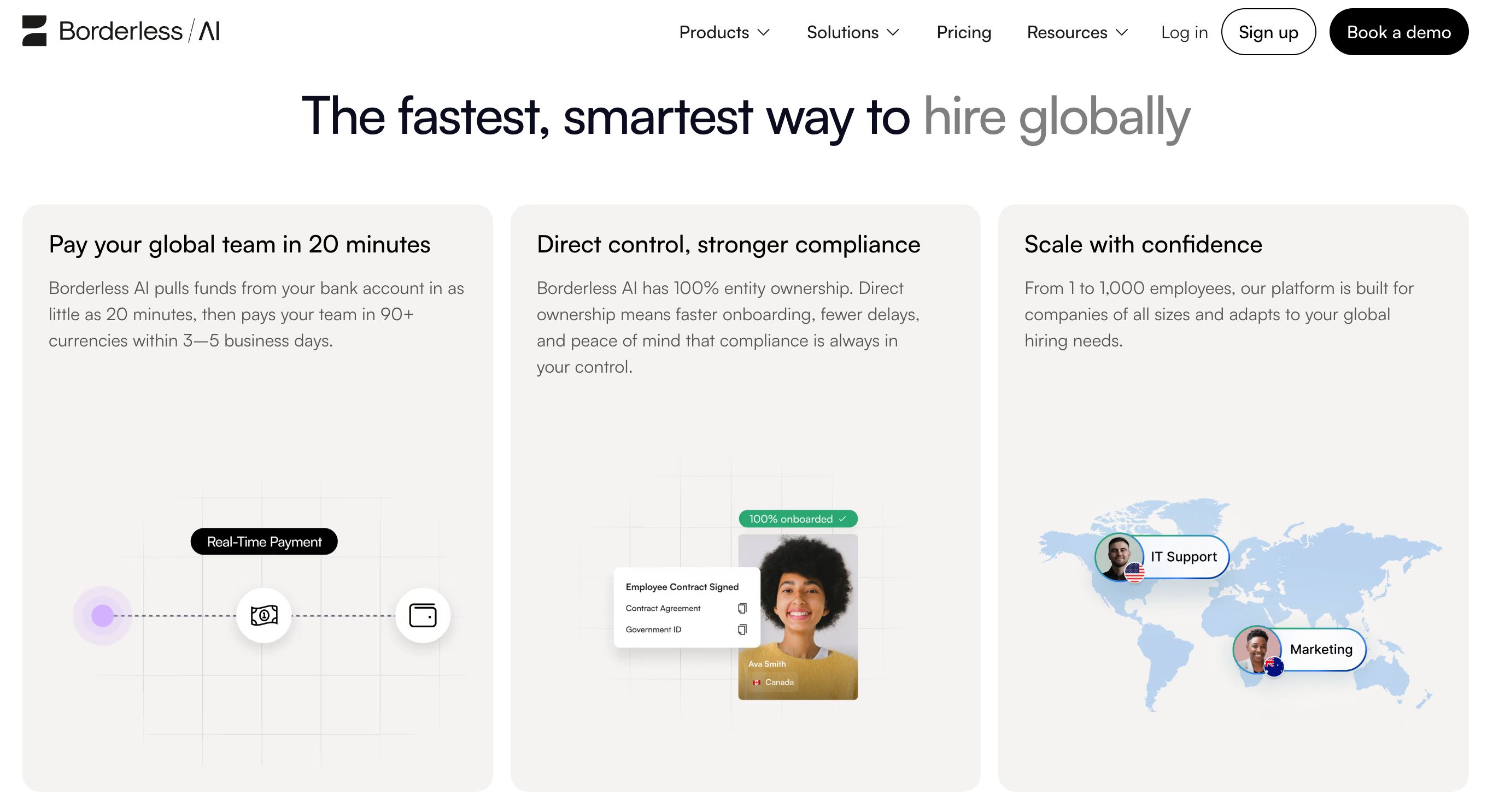
Borderless AI is an AI-native global EOR platform covering 170+ countries, including Malta. It operates via owned local entities and offers automated payroll in 80+ currencies alongside contractor management. Starting price is $579 per employee per month.
In Malta, Borderless AI handles Maltese social security contributions, maternity leave entitlements, and monthly FS5 compliance filings. Onboarding a Malta-based employee takes one to two days. The platform includes an HRGPT AI assistant, AI-driven contract generation, an employee self-service app, and a unified dashboard. Support is available 24/7 with a dedicated customer success manager and local HR experts, with multilingual coverage.
Strengths:
-
AI-driven contract generation and a built-in HRGPT AI assistant reduce manual drafting time and compliance risk on employment documents.
-
Rated 4.9 out of 5 on G2; 24/7 customer success with a dedicated CSM and local HR experts provides consistent, multilingual support.
-
Handles Malta-specific obligations including FS5 monthly filings, social security contributions, and statutory maternity leave within its standard service.
Limitations:
-
At $579 per employee per month, Borderless AI sits at the higher end of the Malta EOR pricing range compared to entry-level providers starting from $199.
Best for:
Companies that want an AI-native EOR platform with fast Malta onboarding, automated payroll, and hands-on 24/7 support, and are comfortable with a premium price point.
Multiplier
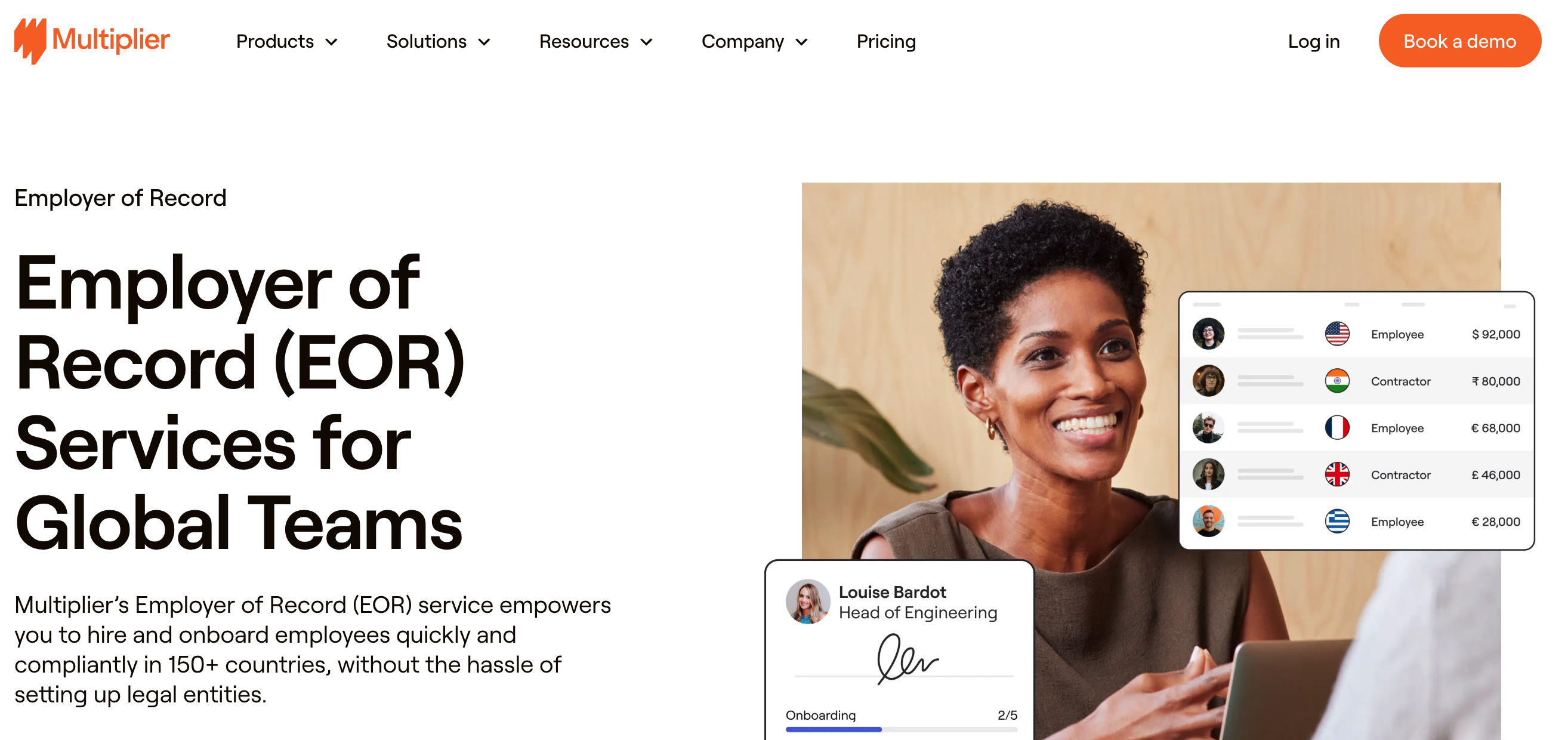
Multiplier is a global EOR platform founded in 2020, covering 150+ countries including Malta. It offers integrated payroll, compliance workflows, benefits administration, immigration support, and contractor management from a single platform. Pricing starts from $407 (350 euros) per employee per month, though the fee varies by country and the research packet notes a separate figure of $499 per month for the Core plan. Buyers should confirm the applicable Malta rate directly with Multiplier.
The platform is rated 4.7 out of 5 on G2. Multiplier supports companies building distributed teams across multiple markets, with clear platform-led workflows covering employment contracts, payroll processing, and HR administration.
Strengths:
-
Integrated contracts, payroll, compliance, and HR administration in one platform with clear, platform-led onboarding workflows.
-
Covers 150+ countries with strong EU market depth, making it practical for companies hiring across multiple European markets alongside Malta.
Limitations:
-
Malta-specific compliance feature detail, including FS5 filing and Jobsplus registration coverage, is not confirmed in public sources reviewed and requires direct verification with Multiplier.
-
Public sources reviewed show two different starting prices for Malta: $407 (350 euros) per month and $499 per month. Buyers should confirm the applicable rate before committing.
Best for:
Scale-ups building distributed teams across multiple markets including Malta that want an integrated, platform-led EOR with strong EU coverage and a competitive price point.
Deel
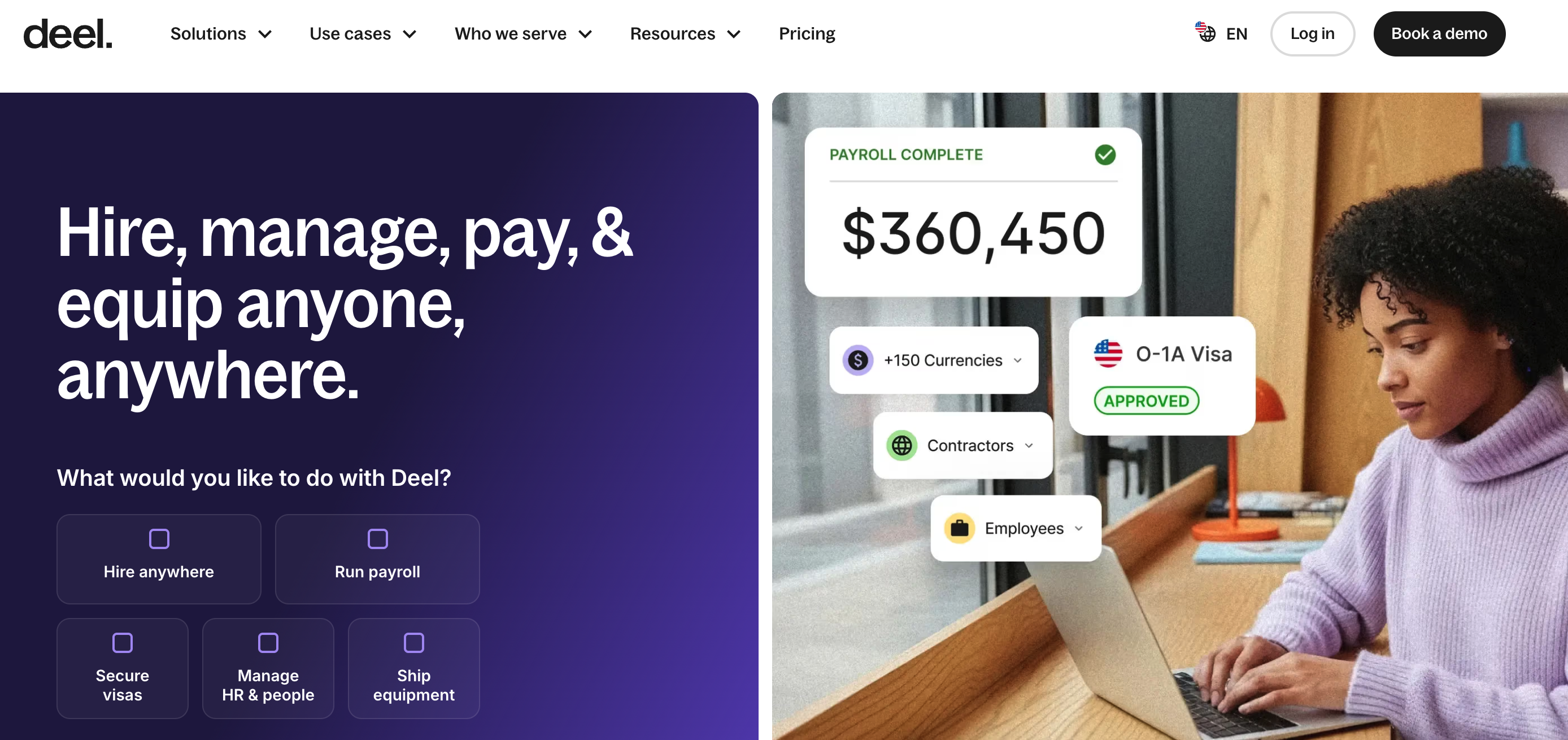
Deel is a global EOR and contractor management platform covering 150+ countries, including Malta. It suits companies managing both full-time employees and international contractors from a single platform. Pricing is listed at $599 per employee per month, with statutory costs additional.
Deel delivers Malta employment through its global network. Its entity model for Malta specifically is not publicly documented in researched sources. Malta-specific compliance handling, including FS5 filings, Jobsplus registration, and social security contributions, is not confirmed in the sources reviewed. Companies should confirm these details directly with Deel before onboarding.
The platform takes an automation-first approach, giving HR teams direct control over employment workflows. Deel provides 24/7 access to HR, legal, and tax expertise. Onboarding speed is automated but remains country-dependent. Immigration support, including Single Permit assistance for non-EU hires in Malta, is not confirmed in researched sources.
Strengths:
-
Deeper self-serve dashboard compared to most competitors, with automation-first workflows that reduce manual coordination for HR teams managing distributed headcount.
-
Combined contractor and full-time EOR management within one platform reduces vendor fragmentation for companies running mixed workforce models across multiple countries.
-
24/7 access to HR, legal, and tax expertise supports employment operations across time zones without requiring enterprise-tier escalation.
Limitations:
-
At $599 per employee per month, Deel sits at the higher end of the Malta EOR pricing range. Termination-related fees, onboarding and offboarding fees, 13th salary treatment, and FX margin are not publicly documented in researched sources and require direct confirmation.
-
Malta-specific compliance detail, including FS5 filing procedures, Jobsplus registration, and entity model disclosure, is not publicly confirmed in researched sources.
Best for:
Companies managing both full-time employees and contractors across multiple countries that prioritize a self-serve platform with broad global coverage over localized Malta-specific support depth.
Teamed
Teamed covers 187+ countries with 57 owned entities and serves Malta through a vetted local partner backed by DLA Piper as global counsel. It can onboard a Maltese hire within 24 hours. Pricing is listed at $599 per employee per month flat, with statutory costs and benefits varying by country.
Teamed scores at the top of evaluated providers on pricing transparency, Malta coverage, service model, and entity transition path modeling. It is rated 4.8 on G2 for service. Real HR and legal experts are included on every plan, with no enterprise tier required to access them. Teamed absorbs FX at zero markup on its fee.
Teamed models the exact month a client's own entity becomes more cost-effective than EOR, giving finance teams a clear transition timeline. Malta-specific compliance handling, including FS5 filings, Jobsplus registration, and social security contributions, is not separately confirmed in researched sources beyond general coverage claims. Single Permit support for non-EU hires in Malta is not confirmed in researched sources.
Strengths:
-
Zero FX markup on fees and real HR and legal experts on every plan, with no enterprise tier required, reduce both cost uncertainty and support friction for growing teams.
-
Entity transition path modeling calculates the exact month a client's own Malta entity becomes cheaper than EOR, giving finance and operations teams a concrete decision point rather than a general estimate.
-
Rated 4.8 on G2 for service and scores top on pricing transparency, Malta coverage, service model, and entity transition path among eight providers evaluated in the Teamed comparison.
Limitations:
-
Teamed concedes the platform and self-serve axes to competitors. Companies that prioritize a deep self-serve dashboard over expert-led support will find Deel or Remote better suited to that preference.
-
Malta-specific compliance detail, including FS5 filing procedures, Jobsplus registration, and Single Permit immigration support for non-EU hires, is not separately confirmed in researched sources and requires direct confirmation from Teamed.
Best for:
Fast-growing companies hiring in Malta alongside several other markets that want a real person on complex cases and one partner covering the full path from first contractor through to their own legal entity.
Atlas

Atlas HXM is a global Employer of Record and human capital management platform that provides EOR services without requiring companies to establish local entities. It combines global employment, payroll, benefits and compliance management through its own platform. Atlas currently states coverage across 160+ countries and positions its solution for companies managing international workforces.
Atlas pricing is custom/quote-based, although its current materials advertise a starting price of $399 per employee per month for a specific promotional offering. This should not be treated as a universal fixed price across all countries.
Atlas combines EOR with broader HCM capabilities, including centralized payroll and benefits management and compliance support. Its model is designed to simplify international hiring and ongoing workforce administration without requiring the client to establish local entities.
Strengths:
-
160+ country coverage gives companies a broad platform for multi-country hiring.
-
Combines EOR with broader HCM capabilities, including payroll, benefits and workforce management.
-
Provides a centralized platform designed to manage international employees while avoiding the need for local entity establishment.
-
Current promotional pricing starts at $399 per employee/month, providing a lower advertised starting point than several enterprise-focused EOR providers.
Limitations:
-
The $399/month figure is promotional and not a confirmed universal Malta price, so country-specific pricing should be confirmed directly with Atlas.
-
Atlas does not publicly provide enough country-level detail to independently confirm Malta-specific procedures such as FS5 filings, Jobsplus registration or Single Permit support.
-
Detailed onboarding timelines vary by country; a universal country-level SLA is not established in the available source.
Best for:
Mid-market and enterprise companies that want an EOR combined
with broader HCM capabilities and centralized management of payroll, benefits
and international workforce operations across multiple countries.
G-P
G-P (Globalization Partners) is a global Employer of Record provider that enables companies to hire and manage employees in 180+ countries without establishing local entities. Its platform supports the employment lifecycle from onboarding through payroll, benefits and compliance.
G-P's current EOR pricing starts at $599 per employee per month. G-P states that its $599 platform fee is a flat rate across its 180+ countries; employee compensation, statutory taxes and country-specific compliance costs are additional.
G-P provides locally compliant employment contracts, automated onboarding, payroll processing, benefits administration, compliance workflows and reporting through its Global Employment Platform. It also combines AI-powered workflows with human HR, legal and compliance expertise.
Strengths:
-
180+ country coverage without requiring the client to establish local entities.
-
Transparent $599/month platform fee across 180+ countries, rather than a percentage-of-payroll model. Country-specific statutory taxes and employment costs remain additional.
-
Strong compliance infrastructure, including locally compliant contracts, payroll, benefits administration and tax filings.
-
Combines AI-powered self-service workflows with human HR, legal and compliance expertise, making it suitable for companies managing complex international employment requirements.
Limitations:
-
The $599 fee is only the platform fee; salary, statutory taxes and country-specific employment/compliance costs are additional.
-
G-P is positioned more toward mid-market and enterprise global employment programs, so it may be less attractive for companies looking purely for the lowest-cost EOR option.
-
Actual onboarding timing remains country-dependent, so a universal 24-hour or 48-hour SLA should not be assumed.
Best for:
Mid-market and enterprise companies that need broad 180+
country coverage, transparent EOR pricing, strong compliance infrastructure
and a combination of self-service technology with human HR/legal support.
RemoFirst
RemoFirst is a global Employer of Record operating in 185+ countries, including Malta, with pricing starting at $199 per employee per month. The platform is built for startups and SMBs that need affordable, compliant employment without significant upfront investment. RemoFirst covers payroll processing, statutory compliance, in-house health insurance, and employment contracts from a single interface.
In Malta, RemoFirst manages employment under the Employment and Industrial Relations Act, handling monthly FS5 filings, Jobsplus registration, and social security contributions as part of its standard service. The $199 per month fee covers core EOR services; 13th salary obligations, employer social security contributions, onboarding or offboarding fees, and any benefits markup are statutory or variable costs confirmed separately at quote stage.
Strengths:
-
Entry-level pricing at $199 per employee per month makes RemoFirst one of the more affordable options for Malta employment, with no minimum contract requirement giving companies flexibility to adjust headcount.
-
In-house health insurance is available directly through the platform, removing the need for a separate third-party insurance vendor for Malta-based employees.
-
A beginner-friendly platform interface reduces onboarding friction for HR teams managing international employment without dedicated global employment resources.
Limitations:
-
Reliance on third-party partners in some markets can introduce inconsistency in compliance execution and support quality, and it is not publicly confirmed whether Malta is served via an owned entity or a partner.
-
Customer support is available on weekdays only, which may create gaps for companies requiring around-the-clock employment assistance.
Best for:
Startups and SMBs that need affordable, compliant employment in Malta and prioritize low entry-level pricing over enterprise-grade automation or 24/7 support coverage.
What Are the Key Services of an EOR in Malta?
An EOR in Malta acts as the legal employer under the Employment and Industrial Relations Act, taking on full statutory responsibility for employment obligations on behalf of the client company. This structure allows international businesses to employ workers in Malta without registering a local entity.
Core EOR services in Malta cover payroll processing, employment contract drafting, statutory tax filings, and benefits administration. Malta-specific compliance obligations, including monthly FS5 filings, Jobsplus registration, social security contributions, and the mandatory 13th salary, are embedded across these service areas rather than treated as optional add-ons.
EOR providers also manage employment lifecycle events such as onboarding, contract amendments, and offboarding, while maintaining alignment with EU employment directives that apply to all Maltese employers.
Employment Contracts and Local Compliance
Maltese employment law requires a written contract for every employee. The contract must comply with the Employment and Industrial Relations Act (EIRA), which governs minimum terms, working conditions, and employee protections across all sectors.
Probation periods are capped at six months for standard roles. For managerial or technical positions, the statutory maximum extends to one year. Any probation clause beyond these limits is unenforceable under Maltese law.
Malta has a union density and collective bargaining agreement (CBA) coverage rate of approximately 42%. Where a CBA applies to a role or sector, its terms take precedence over statutory minimums. An EOR operating in Malta must identify the applicable CBA and apply its conditions to the employment contract.
Fixed-term contracts are permitted under Maltese law but are subject to restrictions on successive renewals. Repeated fixed-term arrangements without objective justification can be treated as indefinite employment. An EOR must assess contract type at the point of hire to avoid misclassification risk.
Payroll and Tax Administration
Malta operates a monthly payroll cycle. Employers must file the FS5 form with the Maltese tax authority by the end of the month following each payroll run. An EOR handles this filing on behalf of the employing entity, keeping the client company compliant without requiring local tax registration.
Income tax in Malta is applied on a progressive scale, with rates reaching up to 35% at higher income bands. Both employer and employee social security contributions are set at 10% of gross salary, with the employer contribution subject to a statutory cap. For 2026, the employer Class 1 contribution is capped at €55.93 per week for employees born from 1 January 1962 onwards (Category D).
An EOR identifies the correct basis for 13th-month salary payments in Malta and ensures the payment is calculated and disbursed accurately.
Benefits Administration
Malta law sets clear statutory minimums that every employer must meet. Employees are entitled to 24 days of paid annual leave, 14 public holidays, 18 weeks of maternity leave, 10.6 weeks of paternity leave, and 8.7 weeks of parental leave.
Beyond statutory minimums, market-competitive employment in Malta typically includes supplementary private health insurance and pension contributions. Collective bargaining agreements in certain sectors may require benefits above the statutory floor, and an EOR administers both layers.
Malta also recognises a 13th-month salary as a material employment cost. Companies should factor this into total employment cost projections before committing to headcount. An EOR manages the calculation, timing, and payment of this obligation alongside monthly payroll.
Employee Onboarding
Onboarding a Malta-based employee involves several mandatory government registration steps. The EOR registers as the employing entity with Jobsplus, Malta's national employment authority, enrolls the employee in the social security system, and executes a compliant employment contract before the first working day.
For non-EU nationals, a Single Permit is required before employment can begin. The EOR acts as the sponsoring employer, managing the permit application and coordinating with Maltese authorities throughout the process.
Onboarding timelines vary across providers. Borderless AI completes onboarding in Malta in 1 to 2 days. Gloroots targets 3 to 5 working days, depending on document readiness and country-specific requirements. The EOR handles all Jobsplus filings and government registration steps, removing that administrative burden from the client's HR team.
Ongoing HR Support
An EOR in Malta manages recurring compliance obligations on your behalf throughout the employment relationship. These include monthly FS5 payroll tax filings, annual income tax reconciliation, and social security reporting to the Department of Social Security.
Malta operates sector-specific collective bargaining agreements (CBAs). An EOR must monitor CBA updates in relevant industries and apply any changes to affected employees' pay and conditions promptly.
If an employment dispute arises, the EOR acts as the legal employer before the Industrial Tribunal. This is why the entity model matters: an owned-entity EOR carries direct legal accountability, while a partner-network model may introduce an additional layer of coordination.
Support availability varies across providers. Gloroots provides 24/7 human support with retained account context. Some providers limit support to weekday business hours, which can create gaps for time-sensitive compliance matters.
Employee Offboarding
Malta does not provide statutory severance pay in most standard termination scenarios. Notice period requirements apply and vary by length of service, with an average notice period of approximately 7.3 weeks across tenure bands. Minimum notice under Article 36 EIRA: more than 1 month up to 6 months: 1 week; more than 6 months up to 2 years: 2 weeks; more than 2 years up to 4 years: 4 weeks; more than 4 years up to 7 years: 8 weeks; more than 7 years: an additional 1 week per subsequent year or part thereof up to a maximum of 12 weeks (more than 10 years: 12 weeks).
Upon termination, the EOR must deregister the employee with Jobsplus, Malta's employment authority. Failure to complete this step creates ongoing administrative and compliance exposure.
Wrongful termination claims are heard at the Industrial Tribunal. Because the EOR is the legal employer of record, it bears this legal risk directly. Buyers should confirm how each provider manages Tribunal representation before signing.
Offboarding and termination fees vary by provider. Confirm upfront whether your EOR charges a separate fee for employment exits, as this affects total cost of workforce management.
How to Hire Through an EOR in Malta
Hiring through an EOR in Malta does not require establishing a Maltese legal entity. The EOR becomes the legal employer under Maltese law, including for Industrial Tribunal purposes, taking on full statutory responsibility for the employment relationship. For non-EU nationals, a Single Permit must be obtained before employment begins, as Maltese law prohibits work without this authorization in place.
The EOR manages employment contracts, payroll, social security contributions, and statutory filings on behalf of the client company. The client retains day-to-day direction of the worker's tasks while the EOR handles all legal and administrative obligations. For a detailed explanation of how this model operates, see how does EOR work.
Selection and Setup
Before signing with any EOR for Malta, confirm the following seven points in writing:
-
Does the provider operate through an owned Maltese entity or a third-party partner, and who bears legal employer liability?
-
Who represents the employer at the Industrial Tribunal if a dispute arises?
-
Are termination fees disclosed upfront, including any fixed exit costs?
-
Is the 13th salary included in the quoted monthly fee or billed separately?
-
Does the provider support Single Permit applications for non-EU hires?
-
What is the provider's process for monthly FS5 filings with the Maltese tax authority?
-
What is the confirmed onboarding timeline from signed contract to first payroll run?
Contract setup in Malta typically takes one to three weeks from agreement to first payroll, depending on the provider's entity structure and the employee's nationality. Non-EU hires requiring a Single Permit will extend this timeline.
Before signing, request an itemized fee breakdown covering the base EOR fee, statutory employer contributions, 13th salary treatment, and any per-transaction charges. A quoted monthly figure without this breakdown makes total employment cost difficult to verify and budget accurately.
Onboarding and Compliance
Onboarding a full-time employee in Malta requires completing several government registration steps before the employee begins work. The EOR handles all filings on behalf of the client company.
Required steps include registering the employee with Jobsplus (Malta's national employment authority), enrolling them in the social security system, setting up monthly FS5 tax deduction filings with the Commissioner for Revenue, and executing an employment contract that complies with the Employment and Industrial Relations Act.
For EU nationals, onboarding typically takes one to five business days. For non-EU nationals, the Single Permit must be obtained before employment begins. The EOR may act as the sponsoring employer for this permit, and the process extends the onboarding timeline beyond the standard range.
What Are the Benefits of Using an EOR in Malta?
Using an EOR in Malta lets a company employ full-time workers without registering a local legal entity, removing the cost and time of entity setup. The EOR manages payroll, statutory filings, employment contracts, and benefits administration directly.
Malta's status as an EU member state means employment contracts and statutory protections align with EU directives, giving companies a familiar compliance framework. English is an official language, which reduces friction in contract execution, employee communication, and government filings compared to many other EU EOR markets.
Additional benefits include faster time-to-hire, reduced exposure to Maltese labor law penalties, and centralized governance across multiple countries when the same EOR platform covers other markets in the same program.
Faster Market Entry
Setting up a legal entity in Malta requires registering with the Malta Business Registry, appointing a local director, maintaining a registered office, and completing Companies House filings. That process typically takes weeks or months before a single employee can be hired.
An EOR removes those requirements entirely. Onboarding through an EOR in Malta can begin within 1 to 5 business days, giving companies direct access to local talent without the administrative overhead of entity formation.
This speed advantage is especially significant in Malta's iGaming and fintech sectors, where licensing timelines are fixed and delays in staffing directly affect operational readiness. Companies competing for regulated market positions cannot afford to wait months for entity approval before building their teams.
Reduced Compliance Risk
Malta's employment compliance obligations are specific and recurring. Employers must submit monthly FS5 payroll tax filings, register employees with Jobsplus, calculate social security contributions accurately, and honor collective bargaining agreement terms in unionized sectors, which cover approximately 42% of the Maltese workforce.
An EOR assumes the legal employer role and bears direct responsibility for meeting these obligations. That includes managing Industrial Tribunal exposure: when employment disputes arise, the EOR carries employer liability, reducing the client company's direct legal risk in contested cases.
Malta operates within the EU employment framework, and an EOR ensures alignment with applicable EU directives on working time, equal treatment, and employee information rights. Companies without local legal resources benefit from having a single accountable party managing both Maltese statutory requirements and EU-level obligations.
Simplified Payroll Administration
Malta payroll runs on a monthly cycle with mandatory FS5 filings submitted to the Inland Revenue Department each month. Income tax is progressive, reaching up to 35% for higher earners. Both employer and employee contribute 10% each to social security, and most employment contracts include a 13th-month salary provision.
Managing these obligations internally requires local payroll software, a qualified accountant, and ongoing compliance monitoring. An EOR consolidates all of these into a single monthly fee, removing the need for separate local infrastructure.
For Malta-based employees paid in euros, EOR providers with multi-currency payroll capability can process payments in EUR directly, reducing conversion costs and simplifying payslip administration for both employer and employee.
Access to Local Benefits
Malta law mandates 24 days of annual leave, 14 public holidays, 18 weeks of maternity leave, 10.6 weeks of paternity leave, and 8.7 weeks of parental leave. These entitlements apply to all employees regardless of employer nationality.
Beyond statutory minimums, private health insurance and pension contributions are standard market additions in Malta, particularly in the fintech, gaming, and professional services sectors where competition for talent is high.
An EOR administers both statutory and supplementary benefits on behalf of the client company. Enrollment, contributions, and compliance reporting are managed centrally, reducing the HR overhead that would otherwise fall on the client's internal team.
Lower Entity Setup Costs
Registering a company in Malta through the Malta Financial Services Authority typically costs between $1,745 (€1,500) and $3,489 (€3,000) in fees alone, with setup timelines running four to eight weeks. A registered office, local director requirements, and ongoing compliance obligations add further cost before a single employee is paid.
At low headcount, an EOR is typically cheaper than maintaining a local entity. Monthly EOR fees replace one-time registration costs, annual filing fees, and local director retainers. As headcount grows, the per-employee cost of an entity may become competitive, but that threshold is rarely reached in the first year of market entry.
Some EOR providers offer entity setup support when a company is ready to transition from entity-free employment to a locally registered structure. This reduces the operational gap between EOR and owned-entity employment. For more on how employer of record cost compares to entity setup, see the linked guide.
More Flexible Workforce Scaling
Malta operates a standard 40-hour workweek with monthly payroll cycles, both of which are straightforward to manage through an EOR. Most EOR providers impose no minimum contract requirements, so companies can add or remove employees without long-term entity commitments.
Malta's iGaming and technology sectors rely heavily on project-based and seasonal hiring. Operators regularly scale teams up for product launches and back down after peak periods. An EOR supports this pattern without requiring a permanent employment infrastructure in Malta.
For EOR for startups and EOR for small business, this flexibility is especially relevant. Early-stage companies entering Malta can hire one or two employees, test the market, and scale without committing to entity registration costs or fixed local overhead.

How to Find the Right EOR for Malta
Choosing an EOR for Malta requires more than comparing headline prices. Buyers should evaluate compliance depth, support quality, and how each provider structures its local employment operations.
The owned-entity versus partner-network question is the single most important due diligence item for Malta EOR buyers. A provider operating through a local owned entity carries direct legal accountability; one using a partner network introduces a third party into the employment chain.
Malta-specific due diligence is especially important because no provider has publicly confirmed a Malta-owned legal entity. Buyers should ask each provider in writing whether they employ Maltese workers through an owned entity or a local partner before signing any agreement.
-
Confirm whether the provider holds a registered Maltese legal entity or operates through a third-party partner.
-
Verify that the provider handles monthly FS5 filings, Jobsplus registration, and social security contributions.
-
Check that employment contracts reflect applicable collective bargaining agreements and the statutory 13th salary obligation.
-
Assess the provider's experience with EU employment directives applicable in Malta and their track record on Industrial Tribunal matters.
-
Request itemized pricing that separates the EOR fee from statutory employer costs to avoid unexpected charges.
Local Compliance Expertise
A Malta EOR must handle the full statutory filing cycle, not just payroll. Confirm that the provider manages monthly FS5 submissions to the Inland Revenue, Jobsplus registration for new hires, and accurate social security contributions for both employer and employee.
Collective bargaining agreement obligations and the statutory 13th salary payment are mandatory in many Maltese employment relationships. A provider that cannot demonstrate experience with these obligations creates direct legal exposure for the client company.
EU directive alignment is a further indicator of compliance depth. The provider should demonstrate that its employment contracts and practices reflect EU employment directives as transposed into Maltese law. Experience representing an employer at Malta's Industrial Tribunal is a strong signal that the provider can manage contested employment situations, not only routine administration.
Clear Service Scope
Before signing with any Malta EOR provider, request an itemized fee breakdown that separates the platform fee from statutory pass-throughs. In Malta, the 13th salary and employer social security contributions add materially to total employment cost, so understanding what is included versus billed separately is essential.
Ask each provider whether the monthly fee covers or excludes: the 13th salary obligation, employer social security pass-through, onboarding and offboarding fees, termination fees, foreign exchange margin on salary payments, and benefits administration markup.
Providers that publish country-specific, itemized pricing reduce the risk of cost surprises after contracts are signed. Gloroots uses predictable, country-specific pricing with full cost visibility before onboarding and no percentage-of-salary pricing, which simplifies budget planning for Malta employment.
Support Model
Support quality varies significantly across Malta EOR providers. Since English is one of Malta's official languages, all providers reviewed offer English-language support. The more relevant question is availability: whether support runs 24/7 or only during Central European Time business hours.
Providers differ on three dimensions: 24/7 human support versus weekday-only availability versus ticket-based systems. Borderless AI and Gloroots both offer 24/7 support with dedicated account management. RemoFirst provides weekday-only support. Konnekt Payroll offers dedicated consultants with a 24 to 48 hour turnaround on requests.
For companies with complex Malta employment situations, dedicated account management matters more than a shared support pool. A dedicated contact retains business context across payroll cycles, compliance filings, and employment changes, reducing the need to re-explain situations on each contact.
Technology and Reporting
A capable EOR platform for Malta must support EUR payroll processing, automated monthly FS5 income tax filings, and social security contribution reporting to the Maltese authorities. Platforms that handle these filings automatically reduce manual effort and lower the risk of compliance errors.
If your hiring plans extend beyond Malta, a multi-country dashboard lets you manage all employment from one place, avoiding fragmented vendor arrangements across EU markets. Gloroots provides centralized workforce visibility covering hiring, payroll, compliance, and benefits in one platform.
Employee self-service matters too. Mobile-friendly portals let Malta-based employees access payslips, contracts, and leave records without HR intervention, reducing administrative overhead for lean teams.
Scalability for Your Hiring Plans
EOR works well for early-stage Malta hiring, but costs shift as headcount grows. At higher employee counts, establishing a Maltese legal entity may become more cost-competitive than ongoing EOR fees. Ask providers whether they can model the approximate breakeven point for your specific salary mix.
If Malta is one of several EU markets in your hiring plan, choose a provider with strong EU coverage. Fragmented vendor arrangements across multiple countries add coordination overhead and increase compliance risk. Gloroots covers 150+ countries, supporting multi-country programs from a single platform.
Some providers also offer entity transition support, helping you plan the move from EOR to a local entity when the numbers justify it. Confirm whether this modeling is available before committing to a provider.

Why Gloroots Is a Strong EOR Partner in Malta
Gloroots runs compliant, entity-free employment across 150+ countries, including Malta. The platform covers Global EOR, Global Payroll, Compliance and Employment Governance, and Benefits and Statutory Coverage from a single centralized system.
For companies hiring in Malta, Gloroots manages employment contracts, statutory payroll filings, social security contributions, and benefits administration. Onboarding a Malta-based employee typically takes 3 to 5 working days, giving teams a predictable activation timeline without entity setup delays.
Pricing starts from $199 per employee per month with full cost visibility before onboarding. Gloroots uses predictable, country-specific pricing with no percentage-of-salary fees and no hidden charges. See Gloroots pricing for country-specific rates.
-
Centralized workforce dashboard covering hiring, payroll, compliance, benefits, and workforce visibility across all active countries.
-
24/7 human support with dedicated account management, giving global teams consistent guidance across time zones when managing Malta employees.
-
Transparent, itemized pricing with no unexpected add-on charges, supporting Finance and Operations teams that require predictable employment costs.
Gloroots provides human-led account support with retained business context, meaning the team managing your Malta employment understands your workforce structure over time. For companies evaluating Malta EOR options, Gloroots EOR services is a practical starting point for assessing fit, pricing, and compliance scope.
FAQs About the Best EOR in Malta
How does an EOR work in Malta?
An EOR in Malta registers as the legal employer with Jobsplus, Malta's employment authority, and executes employment contracts under the Employment and Industrial Relations Act. The EOR files the monthly FS5 return, manages employer and employee social security contributions, and administers statutory benefits on behalf of the client company.
The EOR also represents the employer at Malta's Industrial Tribunal in employment disputes, handling formal proceedings without requiring the client company to appear directly. The client company retains full day-to-day management of the employee's work, including task assignment, performance oversight, and operational direction. For a fuller explanation of the model, see how does EOR work.
What does an EOR cost in Malta?
EOR fees across the eight providers in this comparison range from approximately $115 (€99) per employee per month at the entry level to $699 per employee per month at the premium end. Mid-range options sit between $199 and $599 per month depending on the provider and service scope.
The EOR fee is only part of the total employer cost. For a Malta employee earning $3,881 (€3,337) per month (close to the national average wage), the employer also pays social security contributions at 10% of gross salary, adding roughly $388 (€334) per month. A 13th-month salary provision adds a further one-twelfth of annual gross pay, approximately $323 (€278) per month. Combined, the total employer cost for that employee reaches around $4,593 (€3,949) per month before the EOR fee.
Two providers in this comparison, Konnekt Payroll and INS Global, do not publish standard pricing and require direct engagement for a quote. Before committing to any provider, confirm exactly which services are included in the monthly fee and which, such as benefits administration, offboarding, or legal support, are billed separately. For a broader view of employer of record cost, see our dedicated guide.
When should a company use an EOR in Malta?
An EOR in Malta works well when a company wants to test the Maltese market before committing to a local entity, or when it needs to employ one or a few Malta-based staff without the overhead of incorporation.
iGaming and fintech companies frequently use EOR for fast market entry, as do non-EU companies that lack existing EU entity infrastructure. At low headcount, EOR is typically more cost-effective than entity setup. As headcount grows, a Malta entity may become competitive on cost, so companies should model the breakeven point before committing either way.
EOR is not suitable for companies that must hold a Malta-specific license, such as an Malta Gaming Authority gaming license, in their own name. That license requires a locally registered legal entity, not an EOR arrangement.
Can an EOR hire both local and foreign employees in Malta?
Yes. An EOR in Malta can employ Maltese nationals, EU and EEA nationals (who require no work permit), and non-EU nationals.
Non-EU nationals require a Single Permit under Subsidiary Legislation 217.17. This is a combined employment authorization and residence permit. The EOR typically acts as the sponsoring employer for the application. Processing timelines vary and buyers should confirm the expected duration with their chosen provider before signing.
Not all EOR providers support Single Permit applications in Malta. Confirm this capability explicitly before contracting, as gaps in immigration support can delay or block non-EU hires.
How do I choose the right EOR in Malta?
Start with the due diligence checklist covered in the provider selection section above. Then apply Malta-specific filters.
Confirm whether the provider operates an owned entity in Malta or uses a partner network. Partner-network models can affect Industrial Tribunal representation quality. Ask explicitly whether FS5 monthly tax filings and Jobsplus registration are included in scope, not billed separately.
Pricing transparency matters more in Malta than in many markets. The mandatory 13th-month salary and employer social security contributions add materially to total employment cost. Require a full cost breakdown before signing. For non-EU hires, confirm Single Permit support is included.