




- No EOR provider on this list owns a confirmed directly licensed Kuwaiti legal entity; all Kuwait coverage operates through partner networks, so buyers should confirm in writing which entity holds PAM work permit sponsorship and PIFSS filing responsibility before signing.
- Pricing across the eight providers ranges from $199 to $699 per employee per month, with Gloroots offering the lowest published entry point and Safeguard Global and Remote among the highest.
- Kuwait imposes no personal income tax, but employers must manage PIFSS contributions at 10.5% of salary for Kuwaiti national hires, end-of-service gratuity accrual, and PAM work permit sponsorship for expatriate employees, all of which a compliant EOR handles as standard obligations.
- Expatriate onboarding in Kuwait typically takes 10 to 15 business days due to mandatory PAM work permit and PACI civil ID registration steps, making provider onboarding speed a material factor when evaluating options for time-sensitive hires.
- Companies that need a focused employment service should note that platforms such as Rippling and Deel bundle HR, IT, and payroll modules into their EOR pricing, which may result in paying for features not required for Kuwait-only or limited-country hiring programs.
Last reviewed: September 2026
This guide is published by Gloroots. Gloroots is included in this comparison as one of the providers reviewed. Rankings and evaluations are based on objective criteria only. No provider has paid for placement or preferential positioning in this list.
This page evaluates eight EOR providers operating in Kuwait across compliance capability, pricing structure, country coverage, and support model. See the scoring methodology section below for the full criteria used to rank each provider.
Over 70% of Kuwaiti companies anticipate moderate to high growth by 2026, and an 89% skills gap is accelerating demand for foreign talent across IT, engineering, finance, and healthcare sectors. An EOR services provider lets companies employ workers in Kuwait without opening a local legal entity.
Our Top 8 Picks: Kuwait EOR Comparison 2026
The table below compares eight EOR providers on the factors most relevant to hiring in Kuwait. Use the columns to shortlist providers by price, coverage, and support model before reading the detailed profiles further down the page.
| Provider | Pricing per month | Country coverage | Onboarding speed | Platform experience | Customer support | Scalability |
|---|---|---|---|---|---|---|
| Gloroots | From $199 per employee/month | 150+ countries | 3–5 working days; country-dependent | Centralized platform with workforce visibility, hiring, payroll and compliance management | 24/7 human support with dedicated specialists | Built for startups, SMBs and enterprises scaling globally |
| Deel | From $599 per employee/month | 130+ countries for EOR | Country-dependent; as little as 5 days in some markets | Unified platform covering EOR, contractors, HR, IT, payroll, benefits and compliance | 24/7 support with in-house HR, legal and tax expertise | Serves 35,000+ businesses; strong fit for companies scaling across multiple countries |
| Safeguard Global | From $699 per employee/month | 187+ countries | 1–2 weeks in most countries | Technology combined with in-country HR, payroll and compliance expertise | Human-led support with in-country compliance experts | Strong fit for multinational and enterprise organizations, particularly regulated industries |
| Remote | From $699 per employee/month | 90+ countries for EOR | Country-dependent; dedicated onboarding specialist | Platform-driven EOR, payroll, benefits and compliance workflows with direct entity infrastructure | Dedicated onboarding specialists and in-house local experts | Suited to distributed teams requiring direct entity ownership and scalable global employment |
| Rippling | From $499 per employee/month | 80+ countries for EOR | Country-dependent | Unified HR, IT, Finance and payroll platform with integrated EOR workflows | In-house support; support model varies by product and plan | Strong fit for companies consolidating HR, IT, payroll and workforce management |
| Multiplier | From $400 per employee/month | 150+ countries | As fast as 24 hours; country-dependent | Global employment platform covering EOR, payroll, benefits, compliance and onboarding | Dedicated support and account management | Suitable for startups, SMBs and enterprises scaling internationally |
| Pebl | From $399 per employee/month | 185+ countries | As fast as 24–48 hours; country-dependent | Global employment platform covering EOR, payroll, benefits, immigration, compliance and workforce management | 24/7 concierge-level support with in-country experts | Suited to SMBs through enterprise companies expanding into complex and emerging markets |
| Oyster | $699 per employee/month | 120+ countries for EOR | As fast as 48 hours in supported markets | EOR platform with automated contracts, payroll, expenses, time-off and compliance workflows | End-to-end support from local experts and country-specific onboarding specialists | Suited to remote-first and globally distributed companies scaling internationally |
See the best employer of record methodology section for the full scoring criteria used to evaluate each provider.

Top 8 Best EOR Platforms in Kuwait
These eight providers were selected based on Kuwait-specific compliance coverage, pricing transparency, entity model, and verified customer feedback. Each was evaluated against the requirements of Kuwait Labor Law No. 6/2010 and the practical needs of companies hiring without a local entity.
Providers range from GCC specialists with direct licensed entities to global platforms covering 150 or more countries. That range reflects the different hiring profiles companies bring to Kuwait: some need regional depth, others need multi-country scale on a single platform.
Each provider profile below covers entity model, pricing, strengths, limitations, and available customer review data where directly supported by evidence.
Gloroots
Gloroots is a global hiring and employment platform that supports compliant full-time employment across 150 or more countries, including Kuwait, without requiring companies to open a local legal entity. The platform combines Global EOR, Global Payroll, Compliance and Employment Governance, and Benefits and Statutory Coverage in a single employment operating layer.
Gloroots uses predictable, country-specific pricing with full cost visibility before onboarding. Pricing does not use a percentage-of-salary model. Centralized workforce visibility and human-led account support with retained business context are standard across engagements. Gloroots acts as the legal employer in Kuwait and handles the employment contract, work permits, WPS payroll, PIFSS and Kuwaitization compliance; specific entity ownership or local partner details are not publicly disclosed. Onboarding in Kuwait typically takes 3–5 working days, depending on documentation and compliance requirements.
G2 rating 4.9/5 from 25 reviews (retrieved September 2, 2026). G2 review: 5/5 by Ankita D., SDR at a Mid‑Market company (51–1000 employees), dated November 3, 2025.
Strengths:
-
Predictable, country-specific pricing with full cost visibility before onboarding and no percentage-of-salary fees, supporting accurate payroll cost forecasting for finance teams.
-
Centralized workforce visibility across headcount, payroll costs, and compliance documentation, giving HR and finance teams a single governance layer across international markets.
-
Human-led account support with retained business context, reducing the need for teams to re-explain their workforce structure on every interaction.
Limitations:
-
Public sources reviewed did not document a provider-specific limitation for Gloroots in Kuwait beyond its status as a newer platform relative to some established competitors.
Best for:
Companies that require predictable fixed pricing, centralized compliance governance, and human-led account support when employing workers in Kuwait and across 150 or more countries.


Deel
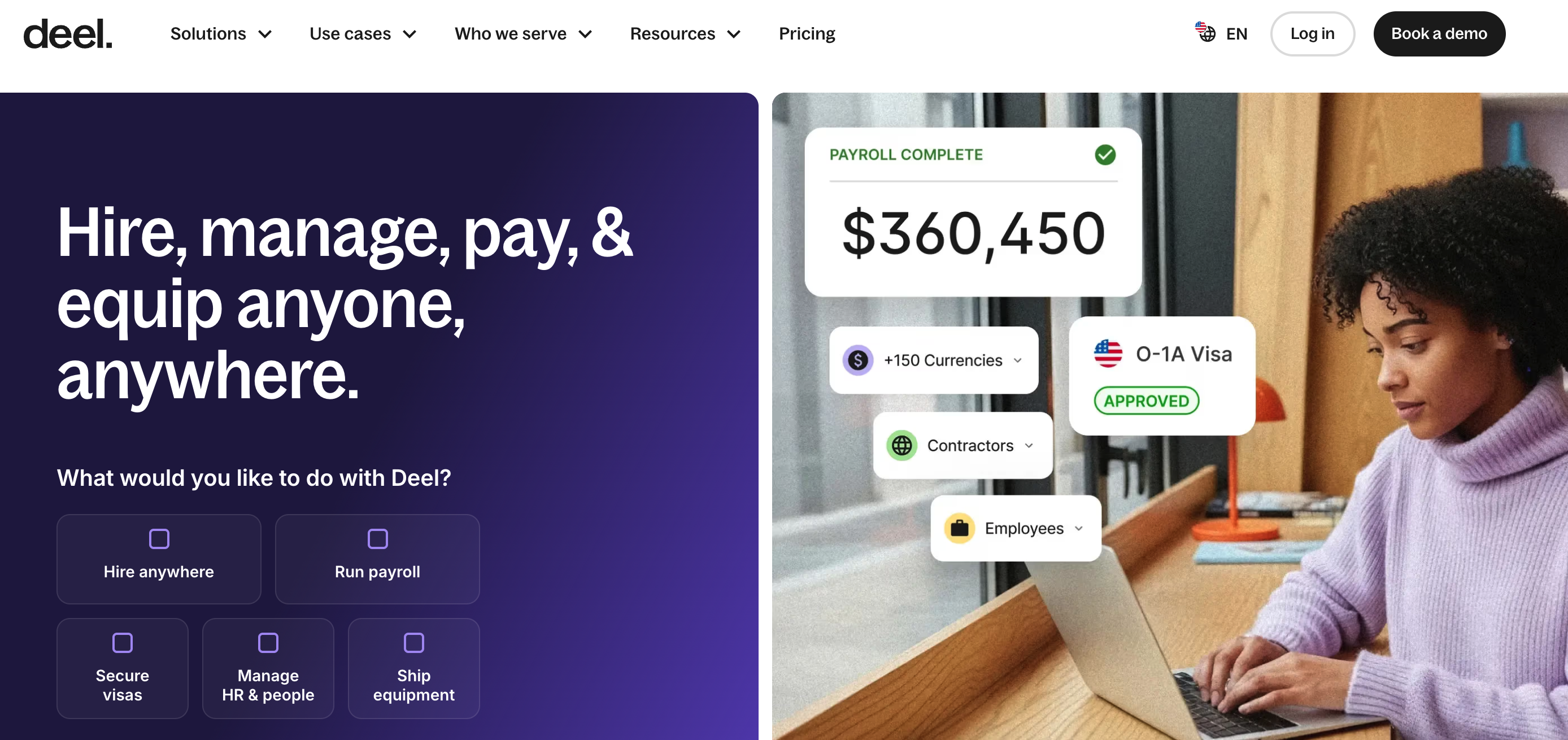
Deel is a global EOR and workforce platform serving 35,000+ businesses across 150+ countries, starting at $599 per employee per month. It covers Kuwait through its partner network and manages payroll, compliance, and benefits from a unified platform with 24/7 support availability.
Deel holds current ISO 27001 and SOC 2 security certifications and operates one of the deeper product suites among EOR providers, combining HR, IT device management, contractor management, and payroll modules in a single interface. Kuwait coverage operates through a partner model, which is standard across the market given that no provider on the comparison list owns a confirmed Kuwaiti legal entity.
Strengths:
-
Automation-first platform with current ISO 27001 and SOC 2 certifications, covering 150+ countries including Kuwait through a partner-supported network.
-
Unified dashboard manages both full-time employees and contractors globally, with granular service packages configurable by hiring volume and compliance complexity.
-
24/7 support availability ensures payroll, compliance, and onboarding queries are addressed across all time zones where Deel operates.
Limitations:
-
Platform breadth can exceed EOR requirements: companies hiring in specific regions often pay for IT lifecycle management, recruiting modules, and workforce analytics they will not use. The $599 per month price reflects the full platform, not the employment service alone.
-
Deel operates a generalist support model that covers availability well but can miss country-level legal nuance during onboarding, payroll disputes, or offboarding in markets such as Kuwait.
Best for:
Companies that need broad international hiring coverage across 150+ countries on a unified platform with self-service tools and comprehensive compliance management.
Safeguard Global

Safeguard Global is a global EOR covering 187+ countries and territories, including Kuwait, through in-country compliance experts and full employee lifecycle support. Starting price is $699 per employee per month. The provider has operated as an EOR for over 18 years and was named a market leader in the 2025 NelsonHall EOR Services NEAT Report.
Safeguard Global combines technology with a human-centered support model, providing personalized guidance on local labor laws, payroll nuances, and compliance requirements throughout the employment lifecycle. Its coverage includes payroll processing, benefits administration, and HR administration across all operating markets.
The provider is positioned for enterprise and multinational companies in regulated industries, with scalable support structures designed for organizations managing complex, multi-country workforce programs.
Strengths:
-
In-country compliance experts provide human-led guidance on local labor laws, payroll nuances, and workforce management throughout the full employment lifecycle across 187+ countries.
-
Named a market leader in the 2025 NelsonHall EOR Services NEAT Report, with over 18 years of operating history as an EOR provider.
-
Scalable support model with a proven track record serving enterprise and multinational companies across regulated industries globally.
Limitations:
-
Starting price of $699 per employee per month is among the higher entry points in the market, which may not suit smaller teams or companies with limited international hiring volume.
-
Public sources reviewed did not document a Kuwait-specific coverage gap, but buyers should confirm entity model details directly with Safeguard Global for Kuwait engagements.
Best for:
Companies that require personalized, human-led compliance guidance and scalable EOR support across 187+ countries, particularly enterprise and multinational organizations in regulated industries.
Remote
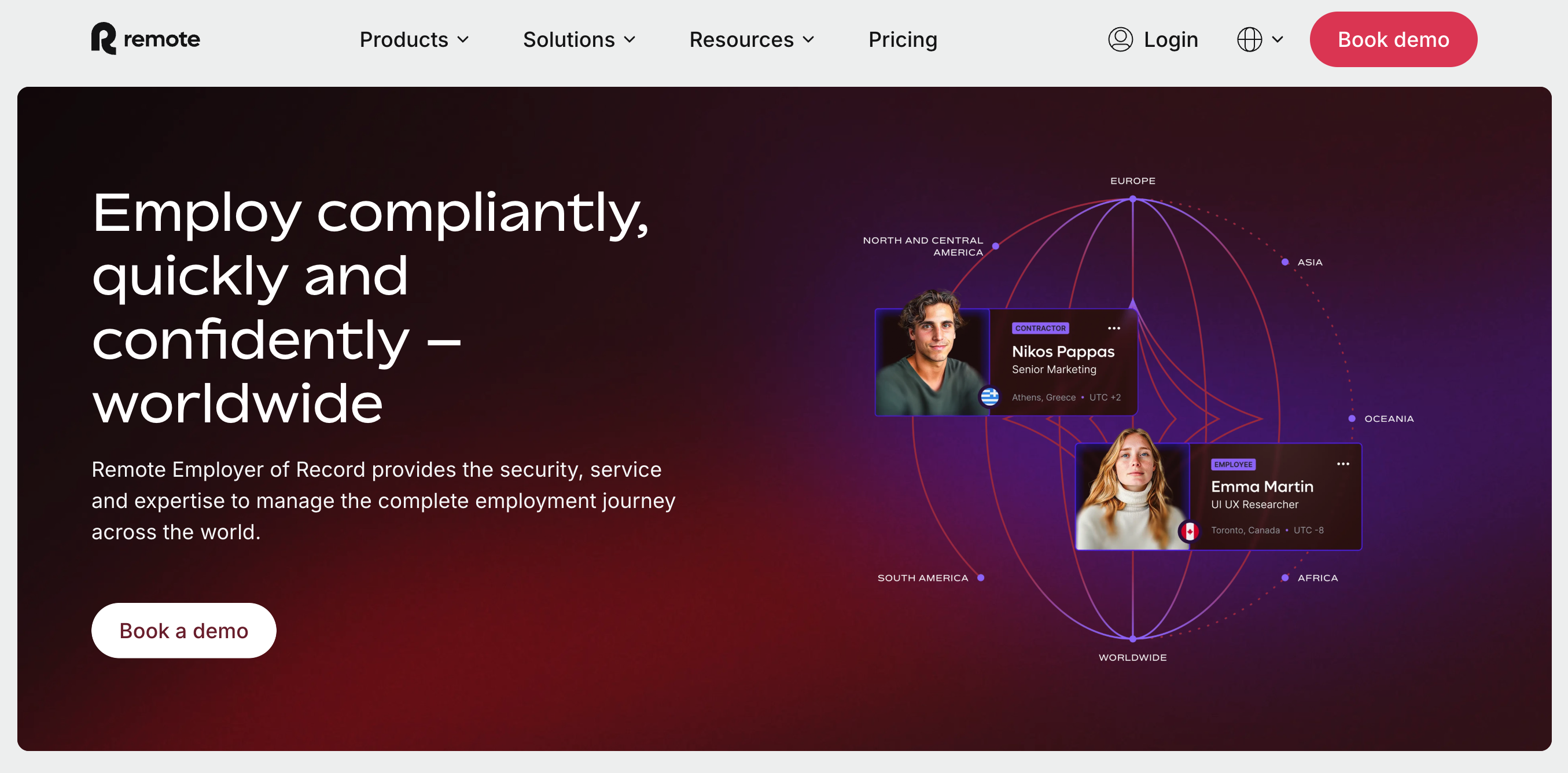
Remote is a global EOR provider covering 185+ countries, with owned legal entities in 80+ countries. Kuwait coverage is delivered through its partner network, as no provider on the comparison list has confirmed a directly owned Kuwaiti entity. Starting price is $699 per employee per month.
Remote operates a platform-driven employment model built around standardized workflows, IP protection policies, and entity transparency. It holds current security certifications and is noted for its focus on distributed teams that require consistent employment conditions across multiple countries.
Onboarding speed for Kuwait is not documented in researched sources. The platform suits companies that prioritize a uniform employment experience and want clear visibility into the legal entity structure behind each hire.
Strengths:
-
Owned legal entities in 80+ countries support entity transparency, which is a priority for IP-sensitive companies hiring across distributed locations.
-
Platform-driven workflows deliver a standardized employment experience, reducing variation in how employees are onboarded and managed across countries.
-
Current security certifications support compliance requirements for companies operating in regulated industries.
Limitations:
-
Kuwait is not confirmed as an owned-entity country. Coverage likely operates through a partner, which may reduce consistency compared to providers with direct GCC entities.
-
A standardized platform model may offer less flexibility for GCC-specific compliance nuances, including Kuwait Labor Law No. 6/2010 requirements around end-of-service gratuity and PIFSS contributions.
Best for:
Distributed teams and IP-sensitive companies that want a standardized employment experience with clear visibility into the legal entity structure behind each hire.
Rippling

Rippling is an all-in-one HR, IT, and Finance platform with an EOR module covering 80+ countries. Kuwait coverage is included within this footprint, though Rippling operates through a unified platform model rather than a dedicated GCC entity structure. Pricing is estimated at $450 per employee per month, with some sources citing $599 or above depending on configuration.
The platform connects HR, payroll, IT device management, and benefits administration in a single system. Setup time across supported countries is approximately three days, making it one of the faster onboarding options among providers reviewed. Rippling holds current security certifications alongside Deel, Remote, and G-P.
Rippling is rated 4.8 out of 5 from 10,708 reviews, reflecting strong user satisfaction across its combined HR and IT platform. It is best suited for companies that want to consolidate workforce tools rather than buyers seeking a standalone EOR service.
Strengths:
-
Unified platform connecting HR, payroll, IT management, and benefits across 80+ countries reduces the need for separate workforce management tools.
-
Approximately three-day setup time supports faster market entry for companies adding Kuwait-based employees to an existing global workforce.
-
Rated 4.8 out of 5 from 10,708 reviews, indicating consistent user satisfaction across the combined HR, IT, and payroll platform.
Limitations:
-
Rippling is built as an all-in-one platform, meaning EOR buyers pay for HR, IT, and Finance modules they may not need. This can make it a higher-cost option for companies seeking a focused employment service only.
-
Public sources reviewed did not document a Rippling-specific limitation for Kuwait compliance nuances or GCC entity coverage.
Best for:
Companies consolidating HR, IT, and payroll on one platform that also need EOR coverage across 80+ countries, including Kuwait.
Multiplier
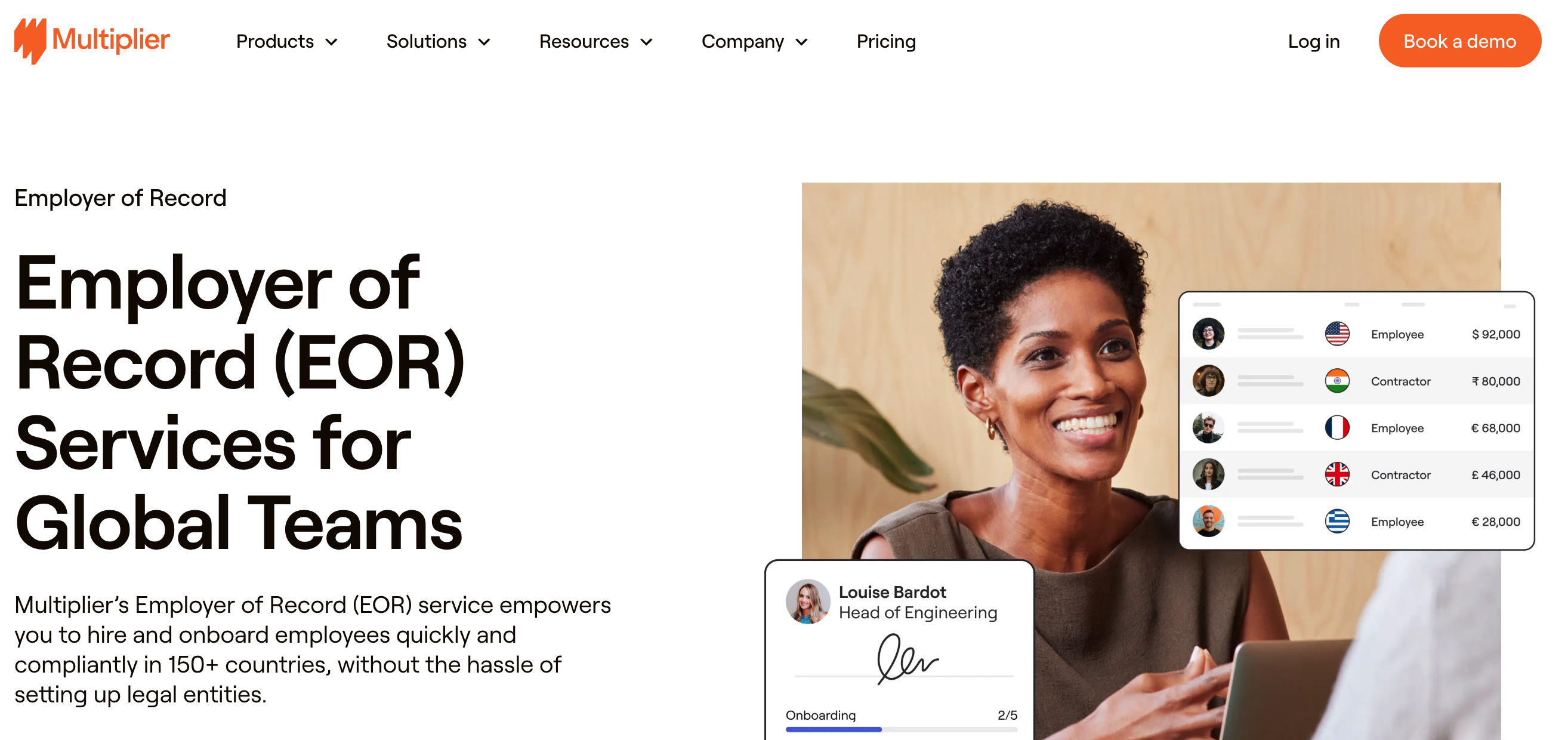
Multiplier is a global EOR covering 150+ countries through owned legal entities, with no third-party partner dependency in the employment chain. Starting price is $400 per employee per month.
Multiplier was named an EOR Industry Leader by IEC Group in 2026, based on infrastructure depth, compliance accuracy, and support model. Onboarding a new employee takes 72 hours or less in most countries once documents are submitted.
For Kuwait, Multiplier operates through its owned-entity network. Buyers should confirm Kuwait-specific entity status directly with Multiplier, as no public source reviewed confirms a separately licensed Kuwaiti entity distinct from its broader owned-entity infrastructure.
Strengths:
-
Named an EOR Industry Leader by IEC Group in 2026, based on infrastructure depth, compliance accuracy, and support model.
-
Operates through owned legal entities in 150+ countries with no third-party partner dependency in the employment chain.
-
Onboarding takes 72 hours or less in most countries once documents are submitted, supporting fast market entry.
Limitations:
-
Public sources reviewed did not document a provider-specific limitation for Multiplier in the Kuwait market.
Best for:
Cost-conscious companies seeking simplified onboarding and an accessible EOR platform across 150+ countries.
Pebl
Pebl covers 185+ countries with flexible EOR solutions focused on emerging market expansion and complex compliance regions. Starting price is $599 per employee per month.
Pebl holds current security certifications including ISO 27001 and SOC 2 Type II. For Kuwait, Pebl operates through a mix of owned entities and local partners. No provider on the researched comparison list owns a confirmed Kuwaiti legal entity, and Pebl is no exception.
Buyers prioritizing direct entity coverage in Kuwait should confirm Pebl's local partner arrangement and assess whether a partner-supported model meets their compliance requirements for the market.
Strengths:
-
Holds current security certifications including ISO 27001 and SOC 2 Type II, supporting data security and compliance assurance for enterprise buyers.
-
Covers 185+ countries with flexible EOR solutions, making it suited to companies expanding into complex or emerging compliance regions.
Limitations:
-
Kuwait coverage operates through a mix of owned entities and local partners rather than a confirmed directly licensed Kuwaiti entity, which may affect compliance consistency for buyers requiring direct entity coverage.
Best for:
Companies expanding into emerging markets and complex compliance regions that require broad country coverage and certified data security standards.
Oyster
Oyster is a global EOR covering 180+ countries, including Kuwait, through its partner network. The platform is B Corp certified and positions itself around ethical employment practices and fast onboarding for distributed teams.
Kuwait coverage operates through a partner model rather than a directly owned local entity. Oyster advertises onboarding as fast as 48 hours globally, though Kuwait-specific timelines are not publicly disclosed.
G2 rating 4.4/5 from 1,466 reviews (retrieved September 2, 2026). Capterra, 5.0/5, August 31, 2023, CEO.
Strengths:
-
Covers 180+ countries, giving companies a single EOR platform for both Gulf and non-Gulf hiring programs without switching providers.
-
B Corp certification signals a commitment to employment standards that some buyers, particularly those with ESG reporting obligations, treat as a differentiating factor.
-
Platform onboarding is designed for speed, with self-service workflows that reduce administrative back-and-forth during employee setup.
Limitations:
-
Kuwait coverage operates through a partner model. Buyers who require a directly owned local entity for compliance assurance will need to verify Oyster's in-country arrangement before committing.
-
Oyster’s country page lists Kuwait with Global Contractors available and notes that EOR in this country might require more time and/or a minimum number of hires.
Best for:
Distributed teams that want a B Corp certified EOR with broad country coverage and platform-driven onboarding workflows across both Gulf and global hiring programs.
What Are the Key Services of an EOR in Kuwait?
An EOR in Kuwait delivers a defined set of employment services that sit between the hiring company and the employee. These services cover the full employment lifecycle, from contract drafting through to offboarding, and are built around the obligations set out in Kuwait Labor Law No. 6/2010.
Kuwait-specific statutory requirements run through every service category. Public Institution for Social Security (PIFSS) contributions, end-of-service gratuity calculations, and Public Authority for Manpower (PAM) work permit processing are not add-ons. They are embedded obligations that a compliant EOR manages as part of standard service delivery.
The subsections below cover how each core service category applies under Kuwait Labor Law No. 6/2010, including the statutory thresholds, contribution rates, and filing obligations that affect every employer operating in the country.
Employment Contracts and Local Compliance
Kuwait Labor Law No. 6/2010 governs all employment relationships in the country. Contracts must be written in Arabic or in a bilingual Arabic-English format to meet Ministry of Social Affairs and Labor (MoSAL) requirements.
Contract requirements differ depending on the employee's nationality. Kuwaiti nationals are subject to specific protections and entitlements under the Labor Law, while expatriate employees operate under separate terms, particularly regarding residency sponsorship and work permit conditions.
An EOR acts as the legal employer of record in Kuwait. It drafts, holds, and manages employment contracts on behalf of the client company, ensuring every agreement meets MoSAL standards before the employee starts work.
Payroll and Tax Administration
Kuwait has no personal income tax. This removes one layer of payroll complexity for employers and simplifies net salary calculations for both Kuwaiti and expatriate employees.
Employers must contribute to the Public Institution for Social Security (PIFSS) at a rate of 10.5% of salary for Kuwaiti national employees. Expatriate employees are generally exempt from PIFSS contributions, though the EOR confirms the applicable rules for each hire at onboarding.
End-of-service gratuity accrues as part of ongoing payroll administration. An EOR calculates and tracks this liability throughout the employment period, ensuring the correct amount is paid when an employee exits.
Payroll is processed in Kuwaiti Dinar (KWD) through multi-currency payroll infrastructure. The EOR files PIFSS contributions directly with the relevant authority on behalf of the client company, removing that administrative obligation from the hiring business.
Benefits Administration
Kuwait Labor Law No. 6/2010 sets the statutory floor for employee benefits. Workers are entitled to 30 days of paid annual leave per year and 10 weeks of maternity leave.
End-of-service gratuity is a distinct statutory obligation, separate from any voluntary benefits package. It accrues based on length of service and must be paid on termination or resignation.
Beyond statutory minimums, the Kuwait market expects supplementary benefits. Private health insurance and housing allowances are commonly offered and can be administered through an EOR as part of a competitive total compensation package.
An EOR separates statutory minimums from market-competitive benefits, giving HR teams a clear view of mandatory obligations versus discretionary spend. Gloroots covers statutory benefits under its Benefits and Statutory Coverage service, with full cost visibility before onboarding begins.
Employee Onboarding
Onboarding in Kuwait follows different paths depending on the employee's nationality. Kuwaiti nationals do not require a work permit, so onboarding moves directly to contract execution and payroll setup.
Expatriate employees require a Public Authority for Manpower (PAM) work permit before they can legally begin employment. The EOR acts as the sponsoring employer for both the work permit and the residency visa, taking on full legal responsibility under Kuwait immigration rules.
After PAM approval, the employee completes civil ID registration with the Public Authority for Civil Information (PACI). The EOR manages each step in this sequence, from document collection through to first payroll.
Typical onboarding timelines for expatriate hires in Kuwait run Typically 10–15 business days from agreement to start date and appearance on the first payroll cycle.. Gloroots manages the full onboarding sequence, including PAM coordination and PACI registration, under its Employment Lifecycle Management service.
Ongoing HR Support
Employing staff in Kuwait requires continuous compliance management beyond initial onboarding. Key obligations include monthly PIFSS contribution filings, periodic MoSAL reporting, and tracking updates to Kuwait Labor Law No. 6/2010 as amendments are issued.
Kuwait's Kuwaitization policy sets nationalization quotas for private sector employers. An EOR monitors your headcount composition and flags quota thresholds, helping you remain compliant or document any applicable exemptions without managing that process internally.
Gloroots provides human-led account support with retained business context, meaning the team handling your account understands your workforce structure and can respond to Kuwait-specific queries without requiring you to re-explain your situation each time.
Employee Offboarding
Kuwait Labor Law No. 6/2010 governs termination procedures for all private sector employees. Notice period obligations vary by contract type and tenure. Three months for monthly paid employees and one month for other workers (Article 44, Law No. 6/2010).
End-of-service gratuity is payable on termination. The calculation formula and the distinction between employer-initiated termination and voluntary resignation affect the final gratuity amount owed. For monthly paid employees: 15 days’ wages per year for the first five years and one month’s wages per year thereafter, capped at 18 months; on resignation the entitlement is 50% for 3–5 years’ service, two-thirds for 5–10 years, and full after 10 years.
Kuwait law also permits summary dismissal on specific statutory grounds. An EOR manages the full termination process, including final payroll, gratuity calculation, and required documentation. Confirm with your provider whether termination support is included in the base plan or priced as an add-on.
How to Hire Through an EOR in Kuwait
Hiring through an EOR in Kuwait follows a defined process that differs from most other markets because of the Public Authority for Manpower (PAM) work permit sponsorship requirement.
The EOR becomes the legal employer and the sponsoring entity for work permit purposes under Kuwaiti immigration rules. This means the EOR holds the visa and residency sponsorship obligations for each foreign national hired through the arrangement.
The two subsections below cover the selection and setup phase, then the ongoing employment and offboarding phase, in detail.
Selection and Setup
Before signing with any EOR for Kuwait, confirm in writing whether coverage is delivered through an owned local entity or a third-party partner. This single question affects who holds PAM sponsorship, who files Public Institution for Social Security (PIFSS) contributions, and who is liable if a compliance issue arises.
Ask each provider to clarify the following in writing:
Entity model: owned Kuwaiti entity or partner network
-
PAM sponsorship holder: which legal entity sponsors work permits
-
PIFSS filing responsibility: who submits and funds social security contributions
-
End-of-service gratuity calculation method: how the provider computes and reserves the statutory gratuity
-
Termination handling: which party manages the legal process and bears associated costs
-
Foreign exchange markup policy: whether payroll conversion carries a spread and at what rate
Setup timelines vary by provider, but most require the client to supply the employee's passport copy, job title and compensation details, start date, and a signed engagement agreement before onboarding begins. Confirm the exact document list with your chosen provider before committing to a start date.
Onboarding and Compliance
Hiring in Kuwait requires completing several government-mandated steps before an employee can begin work. The process differs depending on whether the hire is a Kuwaiti national or an expatriate worker.
For expatriate employees, the EOR manages the full sponsorship chain. This includes applying for a work permit through the Public Authority for Manpower (PAM), securing a residency visa under the EOR's legal sponsorship, and registering the employee with the Public Authority for Civil Information (PACI) to obtain a civil ID. Employment contracts must be executed in Arabic or in a bilingual Arabic-English format to satisfy Kuwait Labor Law No. 6/2010 requirements.
For Kuwaiti national employees, the EOR handles registration with the Public Institution for Social Security (PIFSS), which covers mandatory social insurance contributions on behalf of the employer.
-
PAM work permit application: typically 2 to 4 weeks depending on documentation completeness
-
Residency visa processing: typically 1 to 3 weeks after work permit approval
-
PACI civil ID registration: typically 1 to 2 weeks after visa issuance
-
Employment contract execution in Arabic or bilingual format: completed before or at the point of onboarding
-
PIFSS registration for Kuwaiti nationals: completed at the point of employment commencement
What Are the Benefits of Using an EOR in Kuwait?
Using an EOR in Kuwait reduces the administrative and legal burden of employing workers under a regulatory framework that is specific to the Gulf region. Kuwait imposes no personal income tax on employees, but employers carry significant obligations: PAM work permit sponsorship, PIFSS contributions for Kuwaiti national hires, and compliance with Kuwait Labor Law No. 6/2010 across contracts, benefits, and termination procedures.
Foreign companies without a local entity cannot directly sponsor workers or execute compliant employment contracts in Kuwait. An EOR acts as the legal employer, absorbing those obligations and allowing the client company to direct the work without carrying the legal exposure.
The subsections below cover the specific benefits that EOR services deliver in the Kuwait context, from compliance management and payroll accuracy to faster market entry and cost control.
Faster Market Entry
Setting up a legal entity in Kuwait requires minimum capital deposits, registration with the Ministry of Commerce and Industry, and licensing through the Ministry of Social Affairs and Labour. That process typically takes several months before a single hire can be made.
An EOR removes that requirement entirely. Companies can employ workers in Kuwait within days, not months, using the EOR's existing legal infrastructure.
This matters for teams evaluating entity setup as a longer-term option. An EOR enables hiring to begin while entity decisions are still under review, so business operations are not delayed by administrative timelines.
Reduced Compliance Risk
Kuwait Labor Law No. 6/2010 sets out employer obligations across payroll, benefits, and workforce administration. Errors in any of these areas carry real consequences, including fines and work permit cancellation.
Common compliance failures include incorrect Public Institution for Social Security (PIFSS) contribution calculations, Public Authority for Manpower (PAM) work permit violations, Ministry of Social Affairs and Labour reporting failures, and miscalculated end-of-service gratuity payments.
An EOR assumes legal employer status in Kuwait, which transfers compliance liability from the client company to the EOR. The client retains day-to-day management of the worker while the EOR carries responsibility for statutory filings, contributions, and labor law adherence.
Simplified Payroll Administration
Kuwait payroll carries specific statutory obligations that require precise administration. Employers must contribute 10.5% of salary to the Public Institution for Social Security (PIFSS) for Kuwaiti national employees, and end-of-service gratuity accrues throughout each employment relationship.
Kuwait has no personal income tax, which removes one layer of payroll complexity. PIFSS contribution filings and gratuity accruals remain mandatory obligations regardless, and errors in either carry legal and financial consequences.
An EOR manages PIFSS filings, gratuity accruals, and salary payments in Kuwaiti dinars on behalf of the client. Payroll runs on the correct cycle, contributions are filed on time, and gratuity balances are tracked accurately across the workforce.
Access to Local Benefits
Kuwait law sets minimum statutory entitlements for all employees. Workers are entitled to 30 days of annual leave per year, 10 weeks of maternity leave, and end-of-service gratuity calculated on length of service under Kuwait Labor Law No. 6/2010.
Market practice in Kuwait extends beyond statutory minimums. Private health insurance, housing allowances, and transportation allowances are standard supplementary benefits that employers offer to attract and retain talent, particularly among expatriate workers who make up a significant share of the workforce.
-
Statutory benefits: 30 days annual leave, 10 weeks maternity leave, end-of-service gratuity
-
Supplementary benefits: private health insurance, housing allowance, transportation allowance
An EOR administers both statutory and supplementary benefits, keeping the employment package compliant with Kuwait law and competitive in the local market. Where benefit entitlements differ between Kuwaiti nationals and expatriate employees, the EOR applies the correct rules for each category.
Lower Entity Setup Costs
Establishing a legal entity in Kuwait requires Ministry of Social Affairs and Labour licensing, legal registration fees, and in some structures a minimum capital deposit. The process typically takes several months and carries significant upfront costs before a single employee is hired.
EOR fees are operational expenses billed per employee per month. Entity setup costs are capital investments with fixed overhead regardless of headcount. For companies hiring a small number of employees in Kuwait, EOR services remain the lower-cost option until headcount reaches a scale where entity overhead is distributed across enough employees to reduce the per-person cost below ongoing EOR fees.
For most companies entering Kuwait with fewer than 15 to 20 employees, an EOR avoids the capital outlay of entity formation while keeping employment costs predictable and auditable from day one. See employer of record cost for a detailed breakdown of how EOR fees compare to entity setup at different headcount levels.
More Flexible Workforce Scaling
Kuwait's oil and gas and construction sectors regularly require short-term project hires alongside permanent staff. An EOR supports both hiring types without the fixed overhead of a local entity, so companies can add or reduce headcount as project timelines change.
Scaling through an EOR also simplifies Kuwaitization quota management. Because the EOR acts as the legal employer, companies can adjust workforce composition during growth phases without triggering the full administrative burden of quota recalculation tied to a registered local entity.
For startups and growing teams, this flexibility is particularly valuable. EOR for startups covers how entity-free employment supports rapid scaling without locking capital into local registration costs.

How to Find the Right EOR for Kuwait
Kuwait-specific due diligence is the right starting point for any EOR evaluation. The employment framework in Kuwait involves distinct obligations: the entity versus partner model, Public Authority for Manpower (PAM) sponsorship requirements, and Public Institution for Social Security (PIFSS) contribution handling.
Providers that manage these obligations through a directly licensed local entity carry a different risk profile than those operating through a third-party partner network. Understanding which model a provider uses in Kuwait determines how accountability is distributed across your employment arrangement.
The criteria below cover the compliance, operational, and commercial factors that matter most for Kuwait hiring. Use them as a structured framework when evaluating any EOR shortlist.
Local Compliance Expertise
Kuwait Labor Law No. 6/2010 contains specific provisions on end-of-service gratuity calculation, working hours, and termination procedures that require local expertise to interpret correctly. Errors in gratuity calculation or Ministry of Social Affairs and Labor (MoSAL) reporting carry direct legal exposure.
When evaluating a provider, confirm whether they hold in-country Kuwait compliance staff or rely on a local partner. Ask how they track and apply updates to Kuwait labor law, and how quickly those updates reach your employment contracts and payroll runs.
Key compliance indicators to verify include: PIFSS filing accuracy and contribution schedules, PAM work permit management and renewal timelines, MoSAL reporting obligations, and end-of-service gratuity calculation methodology. A provider that cannot answer these questions with specifics is likely operating through a generalist partner with limited Kuwait depth.
Clear Service Scope
Service scope varies significantly between EOR providers operating in Kuwait. Before signing, confirm whether the provider includes Public Authority for Manpower (PAM) work permit management as part of the base service or charges it separately.
End-of-service gratuity calculation is a statutory obligation under Kuwait Labor Law No. 6/2010. Ask whether this is included in the base price or treated as a billable add-on. Termination support, including contested termination handling, should also be confirmed in writing.
Some providers charge separately for visa sponsorship management in GCC markets. Get the full service scope confirmed in a written agreement before signing any contract.
Support Model
Support quality in Kuwait depends on more than availability. Arabic-speaking support staff and GCC time zone coverage are practical requirements for day-to-day employment operations in the region.
Kuwait's PAM work permit process may require in-person or in-country representation. Confirm whether the EOR provides in-country staff for these processes or relies on a remote team operating from outside Kuwait.
Ask specifically whether support for PAM and Public Authority for Civil Information (PACI) processes is handled by local staff or managed remotely. Remote-only support can create delays when government processes require physical presence or local coordination.
Technology and Reporting
A capable EOR platform for Kuwait must handle more than payroll processing. It needs to support Kuwaiti dinar payroll, track PIFSS contribution reporting, calculate end-of-service gratuity accurately, and generate documentation aligned with Ministry of Social Affairs and Labour requirements.
Finance and HR teams managing Kuwait headcount benefit from a centralized dashboard that provides real-time visibility across payroll costs, compliance filings, and employee records. Without that visibility, reconciling monthly payroll against statutory obligations becomes a manual, error-prone process.
Before selecting a provider, ask whether the platform generates Kuwait-specific compliance reports as standard outputs. Gloroots provides centralized workforce visibility and reporting as part of its employment platform, covering payroll and compliance documentation for Kuwait-based employees.
Scalability for Your Hiring Plans
Kuwait's Kuwaitization quota requirements become more complex as your headcount grows. Each additional hire affects your ratio of Kuwaiti to expatriate workers, which means workforce planning and EOR selection are directly connected to your compliance exposure at scale.
Most companies reach a break-even point where establishing a local entity becomes cheaper than ongoing EOR fees. For Kuwait, that threshold typically depends on headcount volume, sector, and the cost of local entity maintenance. An EOR provider should be able to advise on that transition point rather than avoid the conversation.
For companies planning GCC-wide hiring programs, GCC-specialist providers may offer better regional scalability than global-only platforms. If your hiring plans extend beyond Kuwait into Saudi Arabia, the UAE, or other Gulf markets, evaluate whether your EOR can support that expansion without requiring separate provider relationships. Gloroots supports EOR for enterprises scaling across multiple countries from a single employment platform.

Why Gloroots Is a Strong EOR Partner in Kuwait
Hiring in Kuwait carries specific compliance obligations that require precise execution. PIFSS employer contributions, end-of-service gratuity calculations, and work permit support through the Public Authority for Manpower each add layers of cost and administrative complexity that generic EOR platforms often underestimate.
Gloroots manages these obligations directly. Its service model covers Global Employer of Record (EOR), Global Payroll, Compliance and Employment Governance, and Benefits and Statutory Coverage, applied to Kuwait's statutory requirements from day one of employment.
Pricing and Cost Transparency is a core part of the Gloroots model. Before onboarding begins, clients receive full cost visibility covering PIFSS contributions and gratuity accrual, so finance teams can forecast total employment costs without surprises. Gloroots uses predictable, country-specific pricing with no percentage-of-salary fees. See Gloroots pricing for current rates.
Gloroots also provides Human Support and Account Ownership, meaning clients work with a dedicated account team that retains context across the employment lifecycle. For companies managing GCC compliance nuances, this continuity reduces the risk of errors during onboarding, payroll runs, and offboarding. Learn more about Gloroots EOR services and how they apply to Kuwait.
FAQs About the Best EOR in Kuwait
The questions below cover the most common topics buyers raise when evaluating EOR providers for Kuwait. They address compliance obligations under Kuwait Labor Law No. 6/2010, cost structures including PIFSS contributions and end-of-service gratuity, and the mechanics of hiring without a local legal entity.
Each answer draws on the provider comparisons and compliance detail covered in this guide. If a question about your specific situation is not addressed here, the Gloroots account team can provide direct guidance before you commit to an employment arrangement.
How does an EOR work in Kuwait?
An EOR becomes the legal employer of your Kuwait-based staff under Kuwait Labor Law No. 6/2010. The EOR registers as the work permit sponsor through the Public Authority for Manpower (PAM) and manages all Ministry of Social Affairs and Labor (MoSAL) compliance obligations on your behalf.
The EOR drafts Arabic or bilingual employment contracts, processes payroll, and remits employer contributions to the Public Institution for Social Security (PIFSS). Your company retains full day-to-day management of the employee's work and output.
This structure lets companies employ staff in Kuwait without establishing a local legal entity, while the EOR holds all statutory employer obligations under Kuwaiti law.
What does an EOR cost in Kuwait?
EOR fees for Kuwait typically range from $199 to $699 per employee per month, depending on the provider and service tier. See the comparison table above for a side-by-side breakdown of provider pricing.
Total employer cost in Kuwait includes the base salary, the employer PIFSS contribution of 10.5% for Kuwaiti nationals, end-of-service gratuity accrual, and the EOR service fee. Kuwait has no personal income tax, which simplifies the employee cost structure compared to many other markets.
To estimate your full employment cost, use a Kuwait employer of record cost calculator or request a direct quote from the providers listed in this guide.
When should a company use an EOR in Kuwait?
An EOR in Kuwait is most practical when a company needs to hire one to five employees without committing to local entity setup. The complexity of PAM work permit sponsorship and PIFSS obligations makes entity-free employment a cost-effective starting point for most international teams.
Common use cases include hiring expatriate workers who require PAM work permit sponsorship, testing the Kuwait market before a full entity commitment, and managing GCC-wide hiring through a single provider. An EOR for small business teams is particularly well suited to this entry stage.
When headcount grows beyond the entity setup break-even point, establishing a local entity may become more cost-effective than continuing with an EOR arrangement.
Can an EOR hire both local and foreign employees in Kuwait?
Yes. An EOR in Kuwait can employ both Kuwaiti nationals and expatriate workers, though the compliance requirements differ between the two groups.
Kuwaiti nationals require PIFSS registration, with an employer contribution rate of 10.5%, but do not require a work permit. Expatriate employees require a PAM work permit and PACI civil ID registration. PIFSS contribution rates for expatriate employees differ from those applied to Kuwaiti nationals. Expatriate employees are excluded from PIFSS; employer PIFSS contributions apply only to Kuwaiti nationals.
Hiring Kuwaiti nationals can also help companies meet sector-specific Kuwaitization quota requirements. Employment contracts for Kuwaiti nationals must be in Arabic. A qualified EOR manages both tracks within a single compliant employment structure.
How do I choose the right EOR in Kuwait?
Before signing with any provider, ask these Kuwait-specific questions in writing and require documented answers.
-
Does your Kuwait coverage operate through an owned entity or a local partner network?
-
Who holds the PAM work permit sponsorship for my employees?
-
Is PIFSS filing included in the base price, or billed separately?
-
How is end-of-service gratuity calculated and paid under Kuwait Labor Law?
Is termination support included, and what does it cover?
-
What is your foreign exchange markup policy on salary payments?
Written answers to these questions reveal how a provider actually operates in Kuwait, not just what their website states. For a broader evaluation framework, refer to the selection criteria section above.