




- Chile's April 2026 workweek reduction to 42 hours is an active compliance trigger: any EOR you select must have already updated Chilean employment contract templates to reflect this change before your first hire.
- Chilean payroll carries statutory obligations beyond standard salary, including mandatory annual profit-sharing, pension fund contributions through the AFP system, workplace accident insurance, and unemployment insurance; confirm that each provider handles all of these as part of its standard fee rather than as add-ons.
- Own-entity versus partner-network status in Chile directly affects compliance assurance and IP protection; Remote and Safeguard Global operate through their own legal entities in Chile, while several other providers in this comparison have not publicly confirmed their model.
- Foreign exchange markup on Chilean peso payroll is a material cost factor when EOR fees are billed in US dollars; Multiplier states it uses the mid-market rate, Oyster invoices at the mid-market rate on the day of invoice, and several other providers in this comparison have not publicly documented their policy.
- Article 161 severance obligations, which require 30 calendar days of the last salary per year of service plus a properly executed settlement agreement filed with the labor authority, must be confirmed as included in any provider's standard Chile offboarding service before you sign.
Chile's April 2026 workweek reform reduces the standard working week to 42 hours, creating an immediate compliance trigger for any company employing workers under the Chilean Labor Code. Companies that miss this change face back-pay exposure and Dirección del Trabajo penalties.
Chile also requires employers to manage legal profit-sharing obligations and mandatory pension fund contributions through the AFP system. These statutory layers sit on top of standard payroll, and miscalculating either creates material legal risk. An Employer of Record absorbs both obligations on your behalf.
This guide compares eight EOR providers on Chile-specific statutory compliance, not just global feature lists. Each section covers how providers handle Chilean employment contracts, pension contributions, profit-sharing rules, and the April 2026 workweek change.
Our Top 8 Picks: Chile EOR Comparison 2026
The eight providers below were evaluated on Chile-specific criteria: how they handle the April 2026 workweek reform, legal profit-sharing obligations, AFP pension contributions, Spanish-language contract capability, and pricing transparency. See the full best employer of record comparison for a broader global view.
| Provider | Pricing per month | Country coverage | Onboarding speed | Platform experience | Customer support | Scalability |
|---|---|---|---|---|---|---|
| Gloroots | From $199/employee/month | 150+ countries | 3–5 working days; country-dependent | Centralized workforce dashboard covering hiring, payroll, compliance, benefits and workforce visibility | 24/7 human support with dedicated account management | SMB to enterprise; built for multi-country programs |
| Teamed | $599/employee/month flat; statutory costs and benefits vary by country | 187+ countries | 24 hours to first hire claimed; actual timing remains country-dependent | EOR platform covering employment, payroll, tax, benefits, compliance and IP | Dedicated country specialist on every account | SMB to enterprise |
| Deel | $599/employee/month; country-specific statutory costs are additional | 130+ EOR countries; broader global hiring footprint is larger | Automated onboarding; country-dependent | Unified platform for EOR, payroll, contractors, HR, benefits, compliance and integrations | 24/7 HR, legal and tax expertise | SMB to enterprise; strong fit for fast-scaling distributed teams |
| Remote | $699/employee/month standard; annual/contract arrangements may offer different pricing | 90+ EOR countries | Dedicated onboarding specialist; country-dependent | Owned-entity EOR platform with payroll, benefits, compliance, IP protection and workforce management | In-house local experts and dedicated specialist support | SMB to enterprise; particularly strong for companies prioritizing owned entities/IP |
| Pebl | From ~$599/employee/month; promotional/country-specific pricing may differ | 185+ countries | Not publicly listed in researched sources | Global EOR platform covering employment, payroll, benefits, compliance and immigration | Dedicated support and global HR specialists | SMB to enterprise |
| Multiplier | $499/monthly / $459 annually for Core; ~11% of countries have adjusted pricing | 150+ countries | Country-dependent | Multi-country EOR/payroll platform with employment, payroll, benefits, compliance and workforce management | Human-first support and local expertise | SMB to enterprise; supports companies from first hire to large distributed teams |
| Oyster | $699/employee/month; country-specific statutory/benefit costs apply | 120+ EOR countries | Country-dependent; onboarding/offboarding specialists | Remote-first platform covering hiring, onboarding, payroll, benefits, expenses and compliance | Local experts + onboarding/offboarding specialists | Startups to enterprise |
| Safeguard Global | From ~$599/employee/month; premium markets/country complexity can increase cost | 187 countries | 1–2 weeks in most countries; country-dependent | Global workforce platform covering EOR, payroll, HR and compliance | Dedicated account management + regional/in-country specialists | Mid-market to enterprise |

Top 8 Best EOR Platforms in Chile
These eight platforms were evaluated across six axes: pricing transparency, Chile compliance depth covering pension fund contributions, mandatory annual bonus calculations, and Article 161 severance obligations, service model, platform depth, own-entity status, and scalability.
Chile's statutory complexity was a primary evaluation criterion. The 42-hour workweek reform effective April 2026, the mandatory annual bonus requirement, and Article 161 severance rules each create compliance obligations that vary significantly in how well EOR providers handle them.
Gloroots
Gloroots is a global employment platform that supports compliant full-time employment across 150+ countries, including Chile. It combines Global Employer of Record, Global Payroll, Compliance and Employment Governance, and Benefits and Statutory Coverage into a single operating layer, giving HR and finance teams centralized visibility over headcount, payroll status, and compliance obligations.
Gloroots uses predictable, country-specific pricing with full cost visibility before onboarding and no percentage-of-salary pricing. For Chile, this means employers receive a fixed monthly fee per employee rather than a variable charge tied to salary levels. The platform supports contractor-to-employee conversion in Chile, and employment contracts are updated to reflect the 42-hour workweek limit effective April 2026. Gloroots' Chile EOR handles payroll with AFP pension, SIS disability and survivor, Law 16.744 workplace accident (Mutual), and Unemployment Insurance (AFC) contributions as standard. For details on gratification calculation inclusion, own-entity versus partner-network operations, and FX markup policy on CLP payroll billed in USD, contact Gloroots directly. (gloroots.com)
Human-led account support with retained business context is included across plans. A centralized workforce dashboard covers hiring, payroll, compliance, benefits, and workforce visibility for companies managing Chile employment alongside other international markets.
Strengths:
-
Predictable, country-specific pricing with no percentage-of-salary markup gives finance teams accurate cost forecasts before the first Chilean hire is onboarded.
-
Centralized workforce dashboard covers payroll, compliance, benefits, and headcount visibility across Chile and other markets from one platform, reducing vendor fragmentation.
-
Human-led account support with retained business context is included as standard, providing continuity across the employment lifecycle rather than rotating support queues.
Limitations:
-
Public sources reviewed did not document a provider-specific limitation for Gloroots in Chile beyond the absence of Chile-specific case studies or regional review data in researched sources.
Best for:
Companies scaling across multiple countries that want predictable per-employee pricing, centralized employment governance, and human-led account support without opening a local entity in Chile.


Teamed
Teamed charges a flat $599 per employee per month with zero foreign exchange markup on the fee, covering 187 countries including Chile. Every plan includes real HR and legal experts, and billing arrives as one itemized invoice with no hidden line items.
Teamed handles the full range of Chilean employment obligations: pension fund contributions, the statutory profit-sharing requirement under Chilean law, Article 161 termination procedures, and severance calculations based on years of service. This depth of local employment knowledge is built into the standard service, not sold as an add-on.
Teamed also supports companies planning to open their own Chilean simplified stock corporation, providing a structured path from first hire through entity setup. This makes it a practical single partner for companies that expect to graduate from EOR to direct employment in Chile.
Strengths:
-
Scores highest on four of six Chile-focused evaluation axes: service model, employment intelligence, path to own entity, and ties for best on pricing transparency and Chilean coverage.
-
Real HR and legal experts are included on every plan, and billing arrives as one clean itemized invoice covering all employment costs.
-
Flat $599 per employee per month fee with zero foreign exchange markup, covering 187 countries with no percentage-of-salary pricing.
Limitations:
-
Trails Deel and Rippling on self-serve platform depth and security certifications, which may matter to teams that prefer to manage Chilean hiring without advisor involvement.
Best for:
Rapidly growing companies hiring in Chile that want real HR and legal experts on call and one partner from first Chilean hire through to their own entity.
Deel
Deel is a global employment platform covering 130 or more countries, including Chile, at $599 per employee per month. Its primary differentiator is a deep self-serve dashboard that lets teams manage Chilean hiring, payroll, and compliance without relying on a dedicated internal HR specialist.
Deel covers the core Chilean employment compliance requirements: pension fund contributions, the statutory profit-sharing obligation, and Article 161 termination procedures. These are handled within the platform rather than through an advisory service model, which suits teams that prefer direct platform control over their employment workflows.
Deel's unified platform covers employer of record, payroll, contractor management, HR, benefits, compliance, and integrations in one system. For companies running Chile hiring alongside other international markets, this breadth reduces the need for multiple vendors.
Strengths:
-
Deeper self-serve dashboard than advisory-led competitors, giving teams direct platform control over Chilean hiring, payroll, and compliance without requiring a dedicated HR specialist.
-
Unified platform covering employer of record, payroll, contractors, HR, benefits, compliance, and integrations supports multi-country programs from a single system.
-
Handles Chilean pension fund contributions, statutory profit-sharing, and Article 161 termination procedures within the platform workflow.
Limitations:
-
Less suited to buyers who want advisory-led support with dedicated HR and legal experts included as standard, where providers such as Teamed score higher on service model depth.
Best for:
Teams running Chile hiring without a dedicated internal HR specialist who need a deep self-serve platform to manage employment, payroll, and compliance directly.
Remote
Remote is a global EOR platform operating across 90+ countries, including Chile, built on an owned-entity model rather than a partner network. Starting price is $699 per employee per month. Remote absorbs employment risk directly through its own legal entities, which strengthens compliance assurance for companies where IP protection and employment liability are primary concerns.
Remote ties for the top position on pricing transparency in the Chile EOR rubric, alongside Teamed. Its owned-entity structure means Chilean employment contracts, pension fund contributions, legal profit-sharing obligations, and Article 161 termination procedures are managed by Remote's own in-country legal presence rather than a third-party intermediary. Onboarding is handled by a dedicated specialist, with timing dependent on the country.
Remote's platform covers payroll, benefits, compliance, and workforce management. The FX markup policy for Chilean peso payroll is not publicly documented in the sources reviewed for this comparison. Companies should confirm CLP payroll FX handling directly with Remote before committing.
Strengths:
-
Owned-entity model in 90+ countries removes reliance on third-party partners, which reduces compliance risk for companies prioritizing IP protection and employment liability control in Chile.
-
Ties for the top score on pricing transparency in the Chile EOR rubric, offering $699 per employee per month with publicly stated pricing.
-
Dedicated onboarding specialist assigned per account, supporting structured employment setup for Chilean hires.
Limitations:
-
FX markup policy for Chilean peso payroll is not publicly documented in the sources reviewed; companies should confirm this directly with Remote.
-
Country coverage at 90+ countries is narrower than several competitors in this comparison, which may limit suitability for companies running large multi-region programs beyond Chile.
Best for:
Companies prioritizing IP protection and owned-entity compliance assurance when employing workers in Chile.
Pebl
Pebl, formerly known as Velocity Global, is a global EOR platform covering 185+ countries, including Chile. Pricing starts from approximately $599 per employee per month, though promotional or country-specific rates may differ. The platform covers employment, payroll, benefits, compliance, and immigration management.
Pebl's Chile-specific compliance coverage, including pension fund contribution handling, legal profit-sharing obligations, Article 161 severance procedures, and unemployment insurance, is not confirmed in the public sources reviewed for this comparison. Companies should verify Chile-specific statutory handling directly with Pebl before proceeding. Whether Pebl operates through its own legal entity or a partner network in Chile is also not documented in the sources reviewed.
The FX markup policy for Chilean peso payroll is not publicly documented in the sources reviewed. Onboarding speed is not listed as a universal timeframe on Pebl's public materials. Dedicated support and global HR specialists are listed as available, but account structure details are not confirmed in the sources reviewed.
Strengths:
-
Coverage across 185+ countries gives companies a broad platform for managing Chile employment alongside other international markets from a single provider.
-
Platform scope covers employment, payroll, benefits, compliance, and immigration, reducing the need for multiple vendors across an international workforce program.
Limitations:
-
Chile-specific compliance details, including pension fund contributions, legal profit-sharing, Article 161 severance, and unemployment insurance handling, are not confirmed in the public sources reviewed; direct verification with Pebl is required.
-
Own-entity versus partner-network status in Chile, FX markup policy for Chilean peso payroll, and onboarding speed are not publicly documented in the sources reviewed.
Best for:
Companies seeking broad multi-country EOR coverage across 185+ countries who can verify Chile-specific compliance and statutory handling directly with the provider.
Multiplier
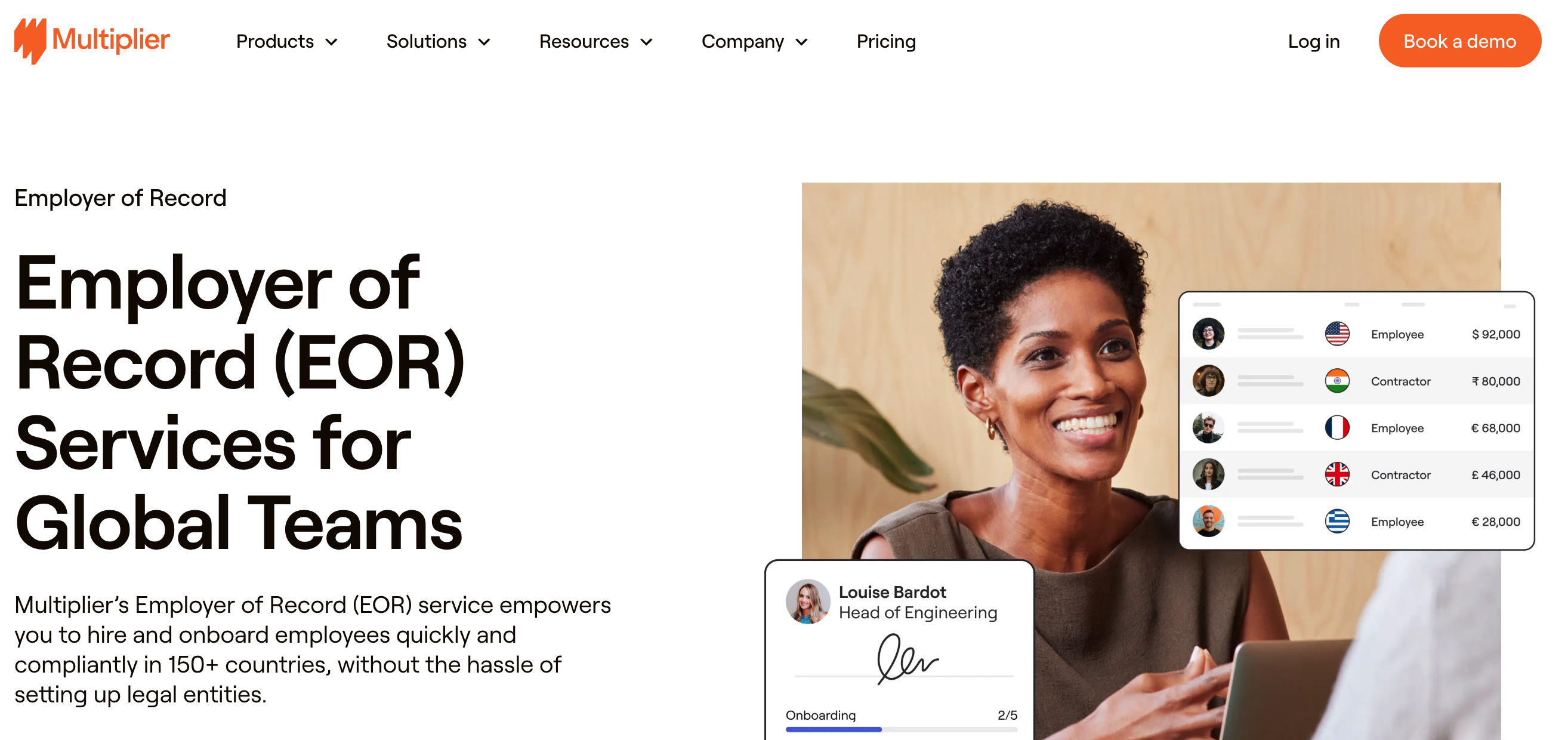
Multiplier is a global EOR platform covering 150+ countries, including Chile, suited for companies managing Chile as part of a broader Latin American expansion. It supports compliant employment contracts, payroll execution, benefits administration, immigration support, and contractor management from one platform.
Multiplier handles localized onboarding and compliant payroll execution for Chilean hires within its 150+ country network. Starting price is from $400 per employee per month, making it a cost-accessible option for scale-ups building distributed teams across LATAM. Multiplier states it is the legal employer of record in Chile through its own local entity rather than a third-party partner. Multiplier states the FX rate on its platform is the current mid‑market rate. Multiplier's Chile guide confirms handling of gratificación legal, AFP and health withholdings, AFC unemployment insurance, and Article 161 severance calculations.
Strengths:
-
Fast onboarding with clear platform-led workflows covering contracts, payroll, compliance, and HR administration in one integrated system.
-
LATAM compliance coverage supports companies managing Chile employment alongside other Latin American markets from a single provider.
-
Starting price from $400 per employee per month positions Multiplier as a cost-accessible option relative to providers priced at $599 or above.
Limitations:
-
Public sources reviewed did not document a provider-specific limitation for Multiplier's Chile services beyond the absence of confirmed Chile-specific compliance detail for AFP, gratificacion legal, and Article 161 termination handling.
Best for:
Companies managing Chile as part of a broader LATAM expansion that want a platform-led EOR with integrated payroll, benefits, and compliance across multiple Latin American markets.
Oyster
Oyster is a remote-first global employment platform covering 120+ EOR countries, including Chile, suited for startups to enterprise teams hiring internationally without a local entity. Its platform covers hiring, onboarding, payroll, benefits, expenses, and compliance from one system.
Oyster provides local experts and onboarding and offboarding specialists to support employment lifecycle management for Chilean hires. USD 699 per employee per month. Oyster invoices the total cost of employment using the mid‑market FX rate on the day of the invoice, with Team Members paid in local currency. Oyster supports contractor‑to‑employee conversions and can hire in Chile through its platform. G2 rating: 4.4/5 (1,464 reviews).
Strengths:
-
Local experts and dedicated onboarding and offboarding specialists support compliant employment lifecycle management for Chilean hires.
-
Remote-first platform covers hiring, onboarding, payroll, benefits, expenses, and compliance in one system, reducing vendor fragmentation for distributed teams.
Limitations:
-
Starting price for Chile is not publicly listed in researched sources, making direct cost comparison with providers such as Teamed or Deel more difficult for buyers evaluating Chile-specific budgets.
Best for:
Startups and growing companies hiring in Chile that want a remote-first platform with dedicated onboarding specialists and local compliance expertise across a broad international footprint.
SafeGuard global
Safeguard Global is a global workforce platform covering 187 countries, including Chile. It targets mid-market and enterprise companies that need dedicated account management alongside regional compliance specialists. Onboarding typically takes one to two weeks in most countries.
The platform covers employer of record, payroll, HR administration, and compliance management. Pricing starts from approximately $599 per employee per month, with costs varying by country complexity. Chile-specific statutory obligations, including pension fund contributions, legal profit-sharing, Article 161 severance, and unemployment insurance, fall within the scope of services Safeguard Global manages for employers. Own entity via Global PEO Services Limitada in Chile. Safeguard Global does not publicly disclose a specific FX markup for Chile payroll; Chile-specific FX markup should be confirmed directly with Safeguard Global.
Strengths:
-
Covers 187 countries with dedicated account management and regional in-country specialists, supporting mid-market and enterprise teams managing complex multi-country programs.
-
Onboarding completes in one to two weeks in most countries, giving companies a defined timeline for Chile employment setup.
Limitations:
-
Public sources reviewed did not document a provider-specific limitation for Safeguard Global's Chile services beyond the absence of verified own-entity status and FX markup policy details.
Best for:
Mid-market and enterprise companies that require dedicated account management and regional compliance specialists across a broad multi-country footprint that includes Chile.
What Are the Key Services of an EOR in Chile?
An EOR in Chile manages more than basic payroll and contracts. Chile's Labor Code layers several statutory obligations on top of standard employment administration, making each service category more operationally demanding than in many other markets.
Employers must handle pension fund contributions routed to individual worker accounts, a mandatory legal profit-sharing calculation applied to annual net income, Article 161 severance payments tied to years of service, and unemployment insurance contributions split between employer and employee. The 2024 working-hour reform, which reduced the standard week to 42 hours, adds a further compliance layer to scheduling and overtime calculations.
The sections below cover each core EOR service in Chile-specific detail, including how statutory rules apply, what employers are responsible for, and where compliance risk concentrates.
Employment Contracts and Local Compliance
Chile's Labor Code requires all employment contracts to be written in Spanish and registered with the Dirección del Trabajo. Contracts must reflect the phased reduction in the standard workweek: 44 hours effective April 2024, 42 hours effective April 2026, and 40 hours effective 2028.
Indefinite contracts are the default under Chilean law and carry stronger termination protections than fixed-term agreements. Fixed-term contracts are permitted but subject to strict renewal limits; exceeding those limits converts the arrangement into an indefinite contract by operation of law.
Chilean law does not establish a statutory probation period. Any trial arrangement must be explicitly agreed in writing and remain consistent with Labor Code protections from day one.
Companies operating in manufacturing or mining should assess collective bargaining agreement exposure before onboarding workers, as sector-level agreements can impose terms beyond the statutory floor.
Payroll and Tax Administration
Chilean payroll involves several mandatory statutory contributions that an EOR manages on the employer's behalf each month.
-
Annual profit-sharing bonus: Employers must pay a mandatory annual bonus calculated as either 25% of net company profits distributed proportionally, or 4.75% of each employee's gross annual earnings paid in monthly installments. An EOR calculates both figures and applies whichever method the employer selects, ensuring the obligation is met correctly.
-
Pension fund contributions: Employers register workers with an approved pension fund administrator and process the mandatory monthly pension contribution on each payroll cycle.
-
Pension insurance: A separate employer-side pension insurance contribution is processed monthly alongside the standard pension fund payment.
-
Workplace accident insurance: Employers contribute to the mandatory accident and occupational disease insurance scheme governed by Law 16,744. Rates vary by industry risk classification.
-
Unemployment insurance: Law 19,728 requires an employer-side contribution to the unemployment insurance fund on each payroll cycle. The EOR calculates and remits this amount monthly.
When payroll is processed in Chilean pesos but the EOR fee is billed in US dollars, foreign exchange handling becomes a material cost factor. Buyers should confirm with each provider how the CLP-to-USD conversion rate is set and whether any markup applies to that conversion.
Benefits Administration
Chile operates a dual public-private health insurance system. At onboarding, each employee elects either Fonasa, the public fund, or an Isapre, a private insurer. The EOR manages enrollment paperwork, collects the statutory 7% health contribution from the employee's gross salary, and remits it to the elected fund each month.
Annual leave entitlement is 15 working days after one year of continuous service, as set by the Labor Code. The EOR tracks accrual, schedules leave, and ensures unused entitlement is paid out correctly on termination.
Statutory sick leave and maternity leave are funded through the employee's health fund, not the employer directly. The EOR coordinates medical certificates and fund claims so payroll continuity is maintained. Paternity leave of five days is employer-funded and processed through monthly payroll.
In Chile's tech and engineering sectors, supplementary benefits commonly include a private health top-up above the statutory 7% contribution and a monthly meal allowance. A capable EOR administers both alongside statutory obligations from a single benefits ledger.
Employee Onboarding
Compliant onboarding in Chile requires several parallel registration steps. The EOR files the employment contract with the Direccion del Trabajo, Chile's labor authority, within the statutory window after the hire date. All contracts must be executed in Spanish; bilingual versions are permitted but the Spanish text governs.
Each new employee must be registered with an AFP, the private pension fund administrator they select. The EOR collects the employee's AFP choice, completes the enrollment, and begins deducting the mandatory pension contribution from the first payroll run. Health insurance election, Fonasa or Isapre, is completed at the same time.
A typical Chile onboarding timeline runs three to five working days from signed offer to compliant first day, covering contract execution, Direccion del Trabajo filing, AFP registration, and health fund enrollment in sequence.
Contractor-to-employee conversion is a common onboarding trigger in Chile, particularly in tech. The EOR terminates the contractor arrangement, issues a compliant employment contract, and completes all statutory registrations before the employee's first payroll date.
Ongoing HR Support
Chile's Labor Code is actively changing. The phased workweek reform reduces standard hours from 45 to 42 in April 2026 and to 40 hours in 2028. A qualified EOR tracks each milestone and updates employment contracts and payroll configurations before each deadline takes effect.
Ongoing compliance support also covers Direccion del Trabajo inspection response, giving employers a structured process when labor authority inquiries arise. For employees in manufacturing and mining, collective bargaining agreement monitoring is a separate requirement that a capable EOR manages as part of its standard service.
-
Spanish-language HR support is a Chile-specific operational requirement, not an optional add-on.
-
Annual profit-sharing reconciliation under the legal gratification rules requires a dedicated annual calculation and payment process.
-
Direccion del Trabajo inspection response support reduces employer exposure during formal labor authority reviews.
Employee Offboarding
Terminating a Chilean employee under Article 161 of the Labor Code, which covers economic and operational grounds, triggers a severance payment of 30 calendar days of the last salary per year of service. A 30-day statutory notice period applies, with a pay-in-lieu option capped at 90 Unidades de Fomento.
The EOR is responsible for notifying the Direccion del Trabajo of the termination and for drafting and executing the settlement agreement, known as a finiquito, which legally closes the employment relationship. Without a properly executed finiquito, the termination remains legally incomplete under Chilean law.
-
Severance reserves or insurance mechanisms managed by the EOR limit the employer's direct termination liability exposure.
-
The EOR manages wrongful dismissal risk by ensuring termination grounds align with the permitted categories under the Chilean Labor Code before any notice is issued.
How to Hire Through an EOR in Chile?
Hiring through an EOR in Chile follows a structured process, but Chile's statutory requirements make provider selection more consequential than in simpler markets. AFP pension registration, gratificación legal profit-sharing obligations, and the 2024 reduction to a 42-hour working week each add compliance layers that a poorly equipped provider can mishandle.
Many companies enter Chile by converting an existing contractor to a full-time employee. An EOR manages that transition, drafting a compliant Spanish-language employment contract, registering the worker with the AFP system, and taking over payroll and statutory benefit obligations from day one. To learn more about how the model works, see how does EOR work.
Selection and Setup
Before signing with a Chile EOR, ask each provider these questions directly:
-
Do you employ through your own legal entity in Chile or through a local partner?
-
How do you calculate and pay gratificación legal: the 25% of annual earnings cap or the 30% of net profits method?
-
What is your AFP registration process and typical timeline for a new hire?
-
Have you updated employment contract templates to reflect the 42-hour working week reform?
Do you issue employment contracts in Spanish as standard?
-
How do you manage Article 161 terminations, including severance calculation and Dirección del Trabajo notification?
-
What is your foreign exchange markup policy on CLP payroll disbursements?
Setup timelines from contract signing to first hire typically run one to three weeks in Chile, depending on AFP registration queues and document verification. FX markup policy matters: a provider absorbing currency conversion costs at zero markup reduces your total employment cost in CLP-denominated payroll runs.
Onboarding and Compliance
An EOR in Chile registers each new hire with the AFP pension system, a process that typically takes three to five business days from contract execution. The EOR also manages the health insurance election, giving employees the choice between the public Fonasa scheme and a private Isapre plan.
Employment contracts are drafted in Spanish and executed in compliance with the Chilean Labor Code before the employee's first working day. The EOR then files the required registration confirmation with the Direccion del Trabajo.
Payroll is configured to reflect the 42-hour standard workweek introduced under the 2023 labor reform, with hours tracked and reported correctly from day one. If a worker was previously engaged as a contractor, the EOR manages the conversion to full employment status, including back-calculation of any statutory entitlements accrued during the prior engagement.
What Are the Benefits of Using an EOR in Chile?
Using an EOR in Chile removes the need to incorporate a local Sociedad por Acciones before making your first hire. That alone eliminates weeks of entity setup, notarization costs, and ongoing corporate governance obligations.
Chile's Labor Code adds layers of statutory complexity that amplify every standard EOR benefit. Mandatory profit-sharing under the legal gratification rule, pension contributions to AFP funds, Article 161 severance calculations, and the 2023 shift to a 42-hour workweek each require precise, ongoing administration. An EOR absorbs that obligation directly.
-
Payroll accuracy: CLP payroll is calculated and filed each month with correct AFP deductions, health contributions, and statutory withholdings.
-
Contract compliance: Spanish-language employment contracts meet Labor Code requirements without internal legal drafting.
-
Termination management: Article 161 severance and years-of-service indemnification are calculated and executed correctly.
-
Cost predictability: Fixed monthly EOR fees replace variable entity maintenance and local legal costs.
Faster Market Entry
Setting up a SpA in Chile requires notarization, registration with the Internal Revenue Service (SII), and enrollment with the Labor Directorate (Direccion del Trabajo). That process typically takes weeks to months before a single employee can be paid compliantly.
An EOR removes that dependency. Companies can place workers on compliant Chilean employment contracts within days, not months, because the EOR already holds the legal employer infrastructure in-country.
Chile's 42-hour workweek reform and mandatory profit-sharing obligations (gratificacion legal) are managed by the EOR from day one. Finance and HR teams do not need to interpret the Labor Code before the first hire starts work.
Reduced Compliance Risk
Chile's Labor Code creates several specific liability points for foreign employers. Miscalculating mandatory profit-sharing (gratificacion legal), filing incorrect pension fund (AFP) contributions, or drafting a termination notice that does not meet Article 161 requirements can each trigger Labor Directorate inspections or employee claims.
An EOR carries direct legal employer liability for these obligations. Severance calculations under Article 161, annual leave accrual, and the 42-hour workweek compliance are handled by the EOR's in-country team, not delegated to the client's HR department.
Contractors converted to full-time employees in Chile face misclassification exposure if the transition is not documented correctly. An EOR manages that conversion under a compliant employment contract, reducing the risk of a reclassification dispute with the Labor Directorate.
Simplified Payroll Administration
Chilean payroll involves multiple concurrent obligations that must be calculated and remitted each month. These include pension fund contributions (AFP), disability and survivor insurance (SIS), workplace accident insurance under Law 16,744, unemployment insurance, and the legal profit-sharing distribution applied monthly rather than annually.
CLP salary processing also requires accurate foreign exchange conversion for companies paying from abroad, adding another layer of calculation risk. Errors in any single contribution can trigger penalties from the Dirección del Trabajo or the relevant regulatory body.
An EOR consolidates all statutory contributions into a single monthly invoice. Your finance team receives one itemized charge covering every mandatory deduction, rather than managing separate remittances across multiple Chilean agencies.
Access to Local Benefits
Chilean law mandates a defined set of employee benefits. These include health coverage through either the public Fonasa system or a private Isapre plan, AFP pension contributions, unemployment insurance, 15 working days of annual leave, and maternity and paternity leave entitlements under the Labor Code.
At onboarding, the employee must elect between Fonasa and an Isapre provider. An EOR manages this election process, collects the required documentation, and routes contributions to the correct institution from the first payroll cycle.
In Chile's tech and engineering sectors, employers commonly supplement statutory benefits with private health top-ups, meal allowances, and additional leave. An EOR can administer these supplementary benefits alongside mandatory obligations, keeping all benefit records in one place.
Lower Entity Setup Costs
Forming a SpA in Chile involves legal fees, notarization, and registration costs that typically range from several thousand dollars before a single employee is paid. Ongoing entity maintenance adds further expense: local accounting, annual tax filings, and Direccion del Trabajo reporting obligations.
An EOR replaces those fixed costs with a predictable monthly fee per employee. For companies with a small Chile headcount, that trade-off is straightforward. The break-even point, where entity formation becomes more cost-effective than an EOR, generally falls somewhere between eight and fifteen employees depending on sector complexity and local advisory fees.
For companies testing the Chilean market or managing fewer than ten hires, EOR pricing keeps costs variable and avoids the capital commitment of a permanent legal structure. To understand how employer of record cost compares to entity setup at different headcount levels, the linked guide covers the full breakdown.
More Flexible Workforce Scaling
Chile's labor market spans tech, manufacturing, and mining, and each sector carries its own hiring rhythms. An EOR lets companies hire across all three without meeting sector-specific entity requirements for each.
When headcount needs to contract, the EOR absorbs the Article 161 severance liability as the legal employer. The foreign company avoids direct exposure to indemnification-per-year-of-service obligations, which can be substantial for longer-tenured employees.
Contractor-to-employee conversion is a practical scaling tool in Chile, where misclassification risk is real. An EOR provides a structured path to convert contractors onto compliant employment contracts without forming a local entity. Companies building distributed teams in Chile can use EOR for startups as a foundation before committing to permanent infrastructure.

How to Find the Right EOR for Chile?
Chile's Labor Code is more prescriptive than most markets in Latin America. Statutory profit-sharing calculations, pension fund registration, severance rules, and accident insurance obligations each carry specific procedural requirements. A provider that handles generic global payroll may not have the depth to execute these correctly.
The evaluation rubric used in the provider comparison above scores each provider across six axes: local compliance expertise, service model, employment intelligence, pricing transparency, platform experience, and path to entity establishment. Use those same axes when assessing any provider not covered here.
Local Compliance Expertise
Chile-specific compliance depth is the most consequential factor in provider selection. Verify that any provider can handle legal profit-sharing calculation methods, pension fund contribution registration, Article 161 severance management, unemployment insurance under Law 19.728, workplace accident insurance under Law 16.744, and employment contracts updated for the 42-hour workweek.
Own-entity operations in Chile are a stronger compliance signal than a partner-network model. A provider running payroll through a local legal entity it owns and controls has direct accountability for filings and registrations. A partner-network provider adds a layer of dependency that can slow resolution when issues arise.
Ask each provider about their experience registering employers and employees with the Direccion del Trabajo, Chile's labor authority. Registration errors at that stage create downstream payroll and termination risk.
Clear Service Scope
A clear service scope defines exactly which Chilean statutory obligations are covered in the flat fee and which are billed separately. Ask every provider whether pension fund contributions, workplace accident insurance under Law 16.744, unemployment insurance, and the mandatory profit-sharing bonus are included or invoiced as add-ons.
Finiquito drafting and Article 161 severance calculations are two Chile-specific deliverables that some providers exclude from standard plans. Confirm in writing whether these are covered before signing.
Foreign exchange policy is a scope transparency factor. Providers that absorb FX at zero markup, as Teamed does, deliver more predictable total costs than those applying a percentage markup on Chilean peso payroll. Spanish-language contract drafting is a baseline requirement under the Chilean Labor Code and should be confirmed as included, not optional.
Support Model
Spanish-language HR support is a baseline requirement for Chile hiring. Employment contracts, payroll queries, and Direccion del Trabajo correspondence are conducted in Spanish, so a provider without Spanish-speaking specialists creates operational risk.
Dedicated country specialists outperform generalist support models when a Direccion del Trabajo inspection occurs. Response time matters: a provider that cannot produce documentation or legal guidance within hours of an inspection notice exposes the client company to fines and reputational damage.
Advisory-led models, such as Teamed's dedicated country specialist approach, suit buyers who need legal and HR guidance on call. Self-serve platform models, such as Deel's, suit operations teams that prefer to manage Chilean hiring workflows independently with less reliance on provider-side advisors. Gloroots provides human-led account support with retained business context, giving HR and operations teams a consistent point of contact across the employment lifecycle.
Technology and Reporting
A Chile EOR platform must do more than process payroll. It needs to track AFP pension contributions, calculate legal profit-sharing obligations under Chilean law, enforce the 42-hour workweek, and produce CLP payroll reports that satisfy Dirección del Trabajo requirements.
Teams without a dedicated HR specialist benefit from self-serve platforms that surface compliance status and payroll data without requiring a support ticket. Deel and Rippling offer deeper self-serve dashboards for this use case. Advisory-led providers like Teamed trade platform depth for direct access to HR and legal specialists.
Security certifications such as SOC 2 and ISO 27001 are a practical filter when evaluating employer of record software for Chile. Gloroots provides centralized workforce visibility covering hiring, payroll, compliance, and benefits from one dashboard, with human-led account support that retains business context across your Chile program.
Scalability for Your Hiring Plans
Chile's manufacturing and mining sectors operate under collective bargaining agreements that add complexity as headcount grows. An EOR that can manage CBA-covered employees and convert contractors to full-time staff at scale reduces operational risk during rapid expansion.
Most providers in this comparison also cover broader Latin America, which matters if Chile is the first market in a regional program. Multi-country LATAM coverage from a single provider reduces vendor fragmentation as you add Argentina, Colombia, or Peru.
At a certain headcount, forming a Chilean SpA becomes more cost-effective than paying per-employee EOR fees. A provider that supports entity formation gives you a clear transition path. Gloroots is built for EOR for mid-market companies scaling across multiple countries, with pricing and governance structures that support that transition without switching platforms.

Why Gloroots Is a Strong EOR Partner in Chile
Several EOR providers cover Chile, but few combine transparent pricing with a unified employment platform built for multi-country programs. Gloroots EOR services give companies a single system to manage Chilean payroll, employment contracts, statutory benefits, and compliance obligations without opening a local entity.
Gloroots charges $199 per employee per month for Chile, with full cost visibility before onboarding and no percentage-of-salary pricing. Gloroots pricing is country-specific and predictable, which supports accurate employment cost forecasting for finance and HR teams.
The platform covers pension contribution management, health and social security filings, statutory benefit administration, and Spanish-language employment contracts aligned with Chilean Labor Code requirements. Compliance and Employment Governance runs through a centralized dashboard, giving operations teams real-time visibility across headcount, payroll status, and filing obligations.
-
Unified platform covering payroll, compliance, benefits, and employment contracts for Chile from one system, removing the need for multiple vendors.
-
Predictable, country-specific pricing at $199 per employee per month with no hidden fees and full cost disclosure before onboarding begins.
-
Human-led account support with retained business context, supporting consistent compliance execution across Chilean Labor Code obligations.
Companies already managing employees in other markets can add Chile to the same platform without switching providers or rebuilding workflows. Gloroots supports contractor-to-employee transitions in Chile Gloroots supports seamless contractor-to-employee conversion via its EOR platform in 150+ countries.. Contact Gloroots to run compliant employment in Chile under a single, governed platform.
FAQs About the Best EOR in Chile
How does an EOR work in Chile?
An EOR in Chile acts as the legal employer for your workers, registering with the Direccion del Trabajo and executing Spanish-language employment contracts under the Chilean Labor Code.
The EOR manages monthly CLP payroll, calculates and remits pension fund contributions (AFP cotizaciones), administers the statutory profit-sharing obligation (gratificacion legal), and handles social insurance filings including the occupational accident levy under Law 16,744.
This arrangement differs from contractor engagement. Under an EOR, workers are full employees with statutory rights, not independent contractors. The EOR carries the legal employer liability, so your company can hire in Chile without registering a local entity.
What does an EOR cost in Chile?
EOR fees for Chile range from $199 to $699 per employee per month across the providers reviewed in this guide. The fee covers the EOR service itself, not the statutory costs your company must also fund.
Statutory costs, including AFP pension contributions, the unemployment insurance fund (cesantia), the occupational accident levy, and gratificacion legal, are additional to the EOR fee unless a provider explicitly states otherwise. Always confirm what is included before signing.
Pricing models vary. Flat-fee structures give predictable monthly costs regardless of salary level. Percentage-of-salary models scale with compensation, which can increase total spend significantly for higher-paid Chilean hires. Foreign exchange markup is a further cost to check: some providers absorb FX at zero markup, while others apply a spread that raises the effective price. For a full breakdown of how employer of record cost components compare, see Gloroots' detailed cost guide.
When should a company use an EOR in Chile?
An EOR in Chile is the right choice when a company wants to test the Chilean market before committing to a Sociedad por Acciones (SpA) formation, or when it needs to employ one to five workers without the overhead of a local entity.
Companies converting contractors to employees to avoid misclassification risk under the Chilean Labor Code, or scaling quickly in tech or manufacturing, are also strong candidates for EOR. Once headcount grows and long-term market presence is confirmed, forming a SpA typically becomes more cost-effective than continuing with an EOR.
Can an EOR hire both local and foreign employees in Chile?
Yes. An EOR in Chile can employ both Chilean nationals and foreign workers. For foreign employees, the EOR supports work visa and residency permit processes, helping companies manage immigration requirements under Chilean law.
Chilean nationals are enrolled in the mandatory pension fund system (AFP) from day one of employment. Foreign employees may be subject to different AFP rules depending on their residency status and applicable bilateral agreements. A qualified EOR tracks these distinctions and applies the correct contribution rules for each worker category.
How do I choose the right EOR in Chile?
Use the selection criteria covered earlier in this guide as your primary filter. Start by confirming whether the provider operates through its own Chilean entity or a local partner, since that distinction affects contract enforceability and response times.
From there, verify these Chile-specific capabilities: correct legal profit-sharing calculation, pension fund registration handling, compliance with the 42-hour workweek reform, Spanish-language employment contracts, Article 161 severance management, and a clear foreign exchange markup policy. Providers that address all six reduce your compliance exposure materially.