




- South Korea's 52-hour maximum workweek and mandatory severance accrual from day one are firm statutory requirements that any EOR you select must enforce through contract terms and payroll processes, not optional add-ons.
- National Pension Service contribution rates are rising from 4.5% to 6.5% by 2033, so evaluate whether your EOR models this escalation schedule into multi-year cost projections before you sign.
- Whether a provider operates through a direct owned entity in South Korea or relies on a partner network determines who holds compliance accountability for payroll filings, statutory registrations, and employment contracts under the Labor Standards Act.
- Pricing across the providers reviewed ranges from $199 to $645 per employee per month, and several providers do not publish rates publicly, making direct quote requests necessary before finalizing any South Korea EOR budget.
- Foreign national hires require work authorization, typically an E-7 visa for specialist roles, before employment can legally begin, so confirm visa sponsorship capability with any EOR before contracting.
South Korea added 193,000 jobs in 2025, with shortages in AI, cybersecurity, and healthcare driving international hiring. Companies entering the market without a local entity use an Employer of Record to run compliant employment from day one.
Key statutory facts for employers: Capital Seoul, population approximately 52 million, currency Korean Won (KRW), GDP per capita approximately $44,000 USD, payroll cycle monthly, corporate tax 22%, employer social security approximately 11.06%, individual income tax progressive up to 45%, minimum wage $7 (KRW 10,030) per hour ($1,572 (KRW 2,156,880) per month as of January 2026).
South Korea's 52-hour workweek cap is a firm compliance requirement that international employers must build into employment contracts and scheduling policies from the point of hire. On the cost side, National Pension Service contribution rates are rising from 4.5% to 6.5% by 2033, a phased increase that affects long-term employment cost planning for any company hiring in the market today.
Our Top 8 Picks: South Korea EOR Comparison 2026
The table below evaluates each provider across six operational dimensions: pricing, country coverage, onboarding speed, platform experience, customer support, and scalability.
| Provider | Pricing per month | Country coverage | Onboarding speed | Platform experience | Customer support | Scalability |
|---|---|---|---|---|---|---|
| Gloroots | From $199 per employee/month | 150+ countries | 3–5 business days; country-dependent | Centralized workforce platform with onboarding, payroll and compliance management | 24/7 human support with dedicated specialists | Built for startups, SMBs, scaleups and enterprises |
| Remote | From $699 per employee/month; $599 annual | 90+ countries for EOR | Country-dependent; dedicated onboarding support | EOR platform with payroll, benefits, compliance and owned-entity infrastructure | Dedicated onboarding specialists and local experts | Owned-entity model suited to distributed teams requiring direct compliance accountability |
| Deel | From $599 per employee/month | 130+ countries for EOR | Country-dependent; as fast as 5 days in some markets | Broad workforce platform covering EOR, contractors, HR, IT, payroll and compliance | 24/7 global support | Suited to distributed companies managing contractors and employees at scale |
| Multiplier | From $400 per employee/month | 150+ countries | As fast as 24 hours; country-dependent | Automation-focused global employment platform covering EOR, payroll, benefits and compliance | Dedicated support and account management | Suited to startups, SMBs and enterprises scaling internationally |
| Globalization Partners (G-P) | Custom pricing | 180+ countries | Country-dependent | G-P Meridian platform covering global hiring, onboarding, payroll and compliance | Dedicated Customer Success Manager plus global support | Strong fit for mid-market and enterprise organizations |
| Atlas HXM | From $599 per employee/month | 160+ countries | Typically 7–15 business days; country-dependent | Direct EOR model with global employment, payroll, benefits and compliance management | Dedicated support and local HR/compliance expertise | Direct-entity infrastructure suited to companies seeking centralized global employment management |
| Teamed | From $599 per employee/month | 30+ countries | Country-dependent | EOR platform with employment, payroll, compliance and HR management | Dedicated human HR and legal support | Best suited to rapidly growing companies and teams expanding internationally |
| Pebl | From $399 per employee/month | 185+ countries | As fast as 24–48 hours; country-dependent | Global employment platform covering EOR, payroll, benefits, immigration and compliance | 24/7 concierge-level support with in-country experts | Suited to SMBs through enterprise companies expanding into emerging and complex markets |

Top 8 Best EOR Platforms in South Korea
Each provider below is evaluated across six axes: compliance depth, onboarding speed, pricing transparency, platform capability, support model, and security certifications. These axes reflect the practical decisions companies face when hiring in South Korea without a local entity.
Every profile also states whether the provider operates through a direct legal entity in South Korea or relies on a partner network. That distinction affects compliance accountability, payroll execution speed, and the chain of responsibility for statutory filings under the Labor Standards Act.
Gloroots
Gloroots is a global hiring and employment platform covering 140+ countries, including South Korea. It operates as a Global Employer of Record, running compliant payroll in KRW, managing statutory deductions for the National Pension Service, National Health Insurance Service, and Employment Insurance, and handling severance accruals from the first day of employment. Gloroots says it holds its own Korean entity and employs directly in South Korea.
Gloroots uses predictable, country-specific pricing with full cost visibility before onboarding. Fees are fixed monthly amounts independent of employee salary, which gives Finance teams reliable cost forecasting for South Korean headcount. The platform accounts for the phased NPS contribution rate increase from 4.5% to 6.5% scheduled through 2033, so pricing reflects the actual statutory trajectory rather than a static snapshot. States no FX markup on disbursements and provides line‑item payroll cost breakdowns based on live market rates. Gloroots' security framework is aligned with SOC 2, ISO 27001, and GDPR requirements. Gloroots' EOR handles visa sponsorship for foreign hires in South Korea, including E‑7 skilled worker cases. Gloroots' South Korea documentation states that the 52-hour weekly cap is monitored as an ongoing obligation.
Gloroots provides human-led account support with retained business context, meaning the same account team carries institutional knowledge of each client's South Korean workforce over time. Centralized workforce visibility gives HR and Operations teams a single view of employment status, payroll records, and compliance filings across all active South Korean employees.
Strengths:
-
Fixed monthly pricing independent of employee salary removes variable billing risk and supports accurate cost forecasting for South Korean hires across different compensation levels.
-
Full statutory management covering NPS, NHIS, Employment Insurance, and severance accruals from day one reduces compliance gaps for companies without in-house Korean labor law expertise.
-
Human-led account support with retained business context gives HR and Operations teams consistent compliance guidance across the full employment lifecycle in South Korea.
Limitations:
-
Limited South Korea-specific customer reviews make it harder for buyers to benchmark Gloroots' Korea-specific EOR performance against established providers. G2 currently has 25 Gloroots reviews overall, but none are South Korea-specific.
Best for:
Gloroots is suited for startups and scaleups entering South Korea for tech talent acquisition who need predictable fixed pricing, full statutory compliance management, and human-led account support without opening a local entity.


Teamed
Teamed is a global EOR provider with a focus on service model quality and supporting companies on a path toward direct entity ownership in target markets. Teamed publishes a public scoring rubric for South Korea EOR providers, which positions it as a transparent evaluator of the market it also competes in.
Teamed owns a South Korean entity and employs Korean staff directly through it. EOR service fee starts at $599 per employee per month. Teamed does not hold ISO 27001 or SOC 2 Type II certifications.
Teamed's South Korea service model is noted for compliance depth and onboarding capability, though specific statutory contribution handling details for NPS, NHIS, and employment insurance are not documented in the sources reviewed for this guide.
Strengths:
-
Publishes a public scoring rubric for South Korea EOR providers, offering buyers a transparent framework for evaluating the market.
-
Positioned around service model quality and supporting companies planning a future transition to direct entity ownership in South Korea.
Limitations:
-
Public sources reviewed did not document provider-specific pricing, security certifications, or visa sponsorship details for South Korea operations, limiting direct comparison on those dimensions.
Best for:
Companies evaluating South Korea EOR options that want a provider with a transparent, published evaluation framework and a service model oriented toward long-term entity planning.
Atlas HXM
Atlas HXM operates as a direct EOR with legal entities in 160+ countries, covering South Korea through an owned entity rather than a partner network. This structure gives Atlas HXM direct compliance accountability for KRW payroll, statutory filings, and employment contracts in the South Korean market.
Atlas HXM holds ISO 27001, 27017, and 27018 security certifications. Atlas HXM is noted for premium benefits administration in South Korea, covering statutory obligations alongside supplementary benefits packages for full-time employees.
Atlas HXM provides visa sponsorship and work-permit support for foreign nationals employed through its South Korea EOR. Pricing for Atlas HXM South Korea EOR services is noted at $599 per employee per month in existing content, though buyers should verify the current rate directly with Atlas HXM before contracting.
Strengths:
-
Direct owned entity in South Korea eliminates partner network dependencies, giving companies a single point of compliance accountability for payroll, filings, and employment contracts.
-
ISO 27001, 27017, and 27018 security certifications support data security requirements for companies in regulated industries hiring in South Korea.
-
Premium benefits administration covers statutory South Korea obligations alongside supplementary benefits, supporting competitive employment packages for local hires.
Limitations:
-
Pricing at $599 per employee per month places Atlas HXM at the higher end of the South Korea EOR market, which may limit accessibility for early-stage companies or small hiring volumes.
-
Referenced clients report Atlas should shorten onboarding and payroll cycles, improve query turnaround and flexibility, and its predictive/prescriptive analytics are limited.
Best for:
Organizations that require direct entity ownership, verified security certifications, and premium benefits administration for South Korea employment at an enterprise or mid-market scale.
Remote
Remote is a compliance-focused employer of record operating through owned legal entities in 70+ countries for EOR services, including South Korea. The platform is suited for organizations that prioritize direct compliance accountability, intellectual property protection, and consistent employee experience when hiring Korean-based technical talent.
Remote manages KRW payroll, statutory contributions covering National Pension Service, National Health Insurance Service, and Employment Insurance, and employment contracts through Remote South Korea LLC, its owned South Korea entity. This direct entity model removes reliance on third-party partner networks for statutory filings and payroll execution.
Remote's IP Guard feature protects intellectual property for companies hiring software engineers, AI specialists, and cybersecurity professionals in South Korea under full-time employment contracts. Remote is ISO/IEC 27001 certified and SOC 2 Type 2 compliant.
Strengths:
-
Owned South Korea entity provides direct compliance accountability for KRW payroll, statutory filings, and employment contracts without partner network dependencies.
-
IP Guard feature protects intellectual property for companies hiring technical talent in South Korea's AI, cybersecurity, and IT sectors under full-time employment.
-
Flat-rate pricing at $599 to $645 per employee per month applies without percentage-of-salary billing, giving Finance teams predictable cost inputs for South Korean headcount.
Limitations:
-
Pricing at $599 to $645 per employee per month places Remote at the higher end of the South Korea EOR market, which may limit accessibility for early-stage companies or those managing multiple hires simultaneously.
-
EOR coverage limited to 70+ countries may restrict companies that need to manage South Korean employees on the same platform used for markets outside Remote's current entity footprint.
Best for:
Remote is best for mid-size and enterprise organizations hiring technical talent in South Korea that require direct entity compliance accountability and intellectual property protection under full-time employment contracts.
Multiplier
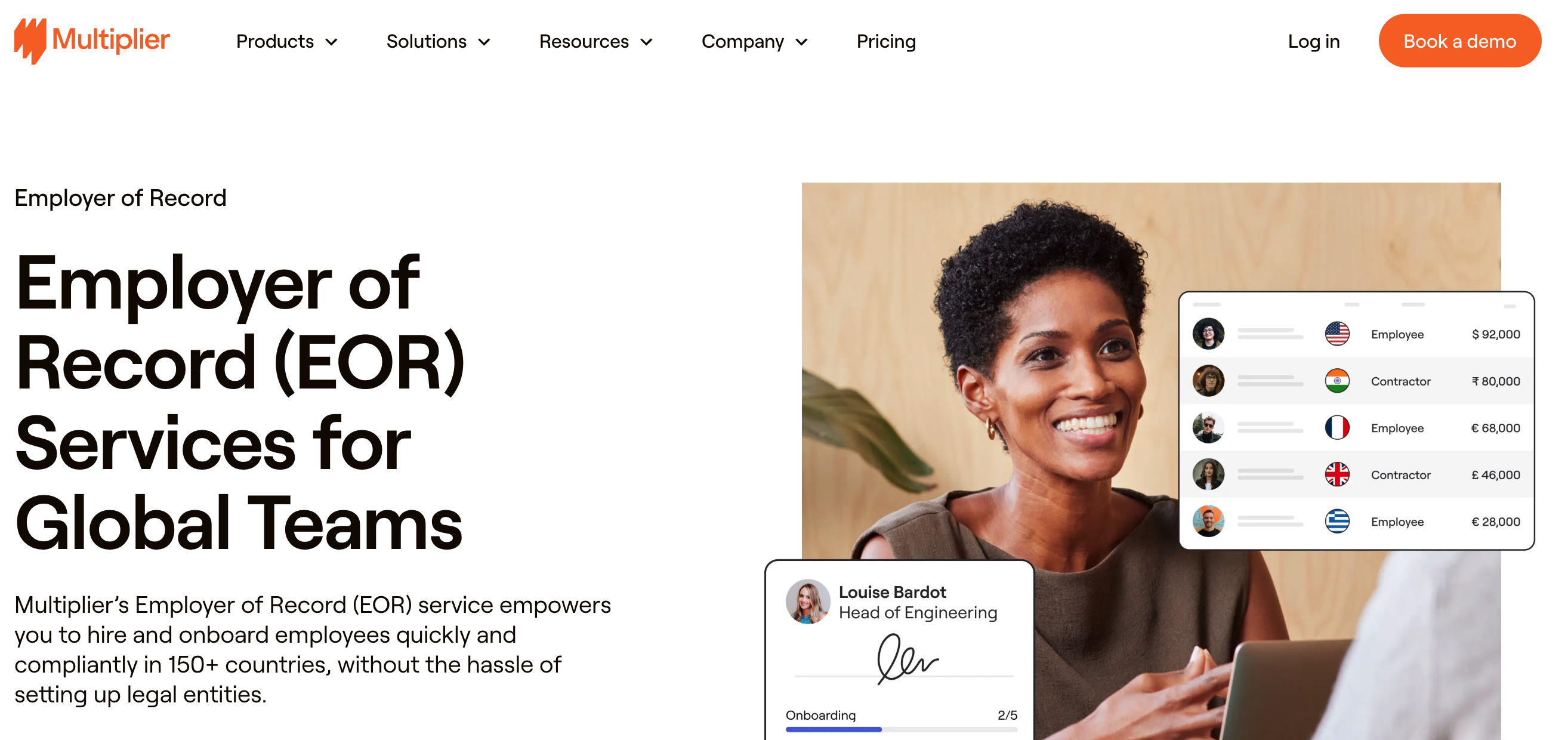
Multiplier is a global employer of record platform known for rapid onboarding and automation capabilities across international markets, including South Korea. The platform is suited for companies that need fast employment activation and automated compliance workflows when entering the Korean market without a local entity. Multiplier employs through its own South Korea entity rather than a local partner.
In South Korea, Multiplier manages KRW payroll, statutory contributions, and employment contracts through its platform. The automation layer covers payroll calculations and compliance filings, reducing manual HR intervention for teams managing Korean hires remotely. Onboarding in as few as three to five business days in supported markets. Employer of Record pricing starts at $459 per employee per month on annual contracts. Multiplier supports South Korea employment compliance, but public sources do not explicitly confirm automated tracking, alerts, or enforcement of South Korea's 52-hour weekly workweek limit.
160+ countries SOC 2 Type I and II and ISO 27001:2022 certified. Multiplier’s EOR handles South Korea visa sponsorship and renewals, including E‑7 and D‑8 categories.
Strengths:
-
Rapid onboarding capability reduces time-to-productivity for South Korea hires, making Multiplier suited for companies that need fast employment activation in the Korean market.
-
Automation capabilities cover payroll calculations and compliance filings, reducing manual workload for HR teams managing South Korean employees from a remote headquarters.
Limitations:
-
Public sources reviewed did not document a provider-specific limitation for Multiplier's South Korea operations beyond the absence of publicly confirmed pricing, entity model, and certification details.
Best for:
Multiplier is best for growth-stage companies and distributed teams that prioritize fast onboarding and automated compliance workflows when hiring full-time employees in South Korea without a local entity.
Globalization Partners
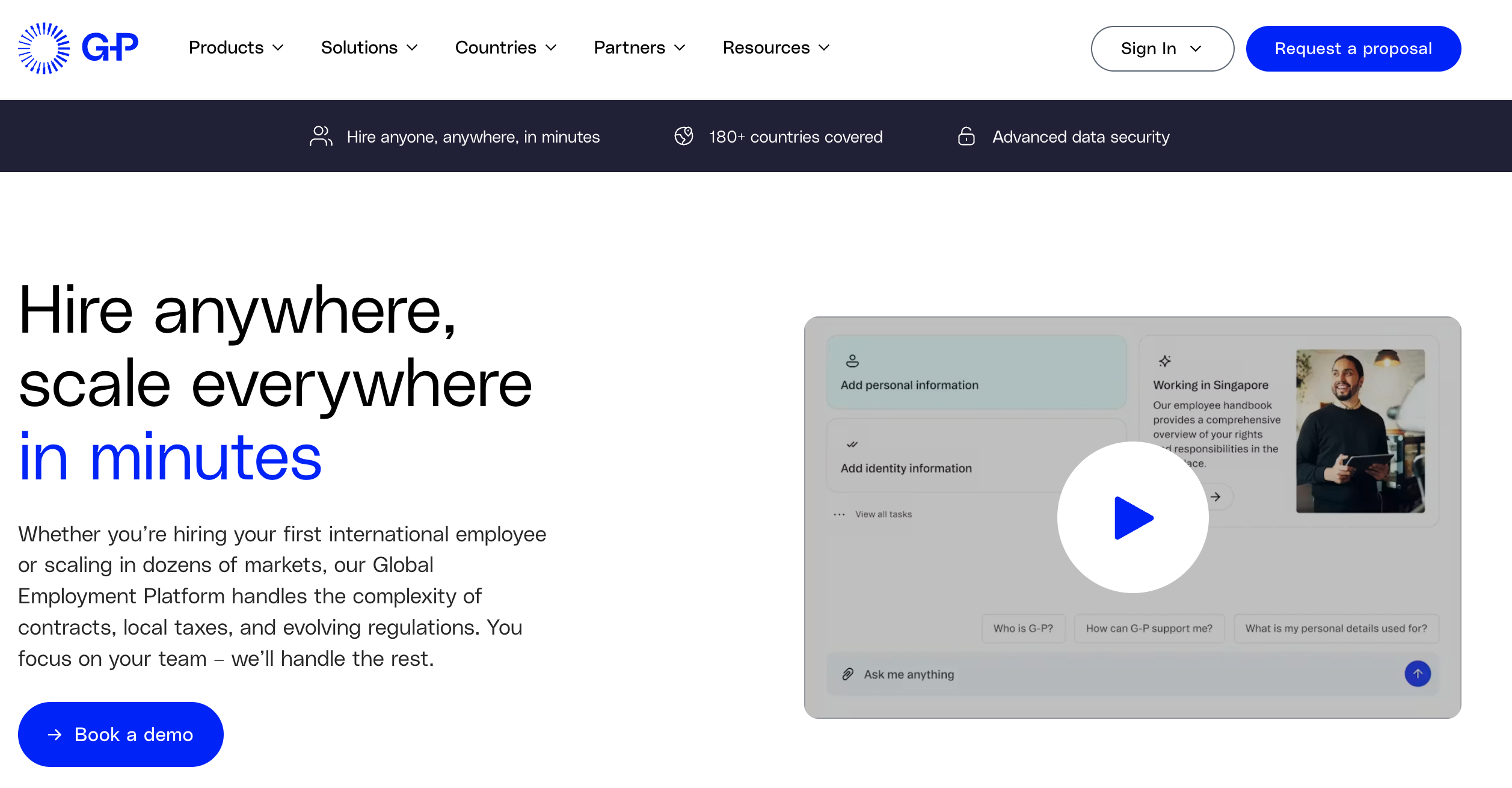
Globalization Partners is an enterprise-focused EOR with a global footprint, positioned for organizations that require established compliance infrastructure and a recognized brand name behind their international employment operations. The platform covers a broad range of countries and is frequently cited for reliability in enterprise hiring contexts.
In South Korea, Globalization Partners manages statutory employment obligations including payroll processing, social insurance contributions, and employment contracts aligned to the Labor Standards Act. The provider is noted for its compliance infrastructure and support model suited to larger organizations with structured procurement and legal review requirements.
Strengths:
-
Enterprise reliability: Globalization Partners is consistently cited as a provider suited to enterprise organizations that require structured compliance accountability and a recognized EOR brand for internal stakeholder approval.
-
Global reach: The provider covers a wide range of countries, allowing enterprise teams to manage South Korea employment within the same platform used for other international workforce operations.
Limitations:
-
Pricing is not publicly listed in researched sources, which makes upfront cost comparison difficult for companies evaluating South Korea EOR options against fixed-budget requirements.
Best for:
Enterprise organizations that need a globally recognized EOR with established compliance infrastructure for South Korea employment and multi-country workforce operations.
Deel
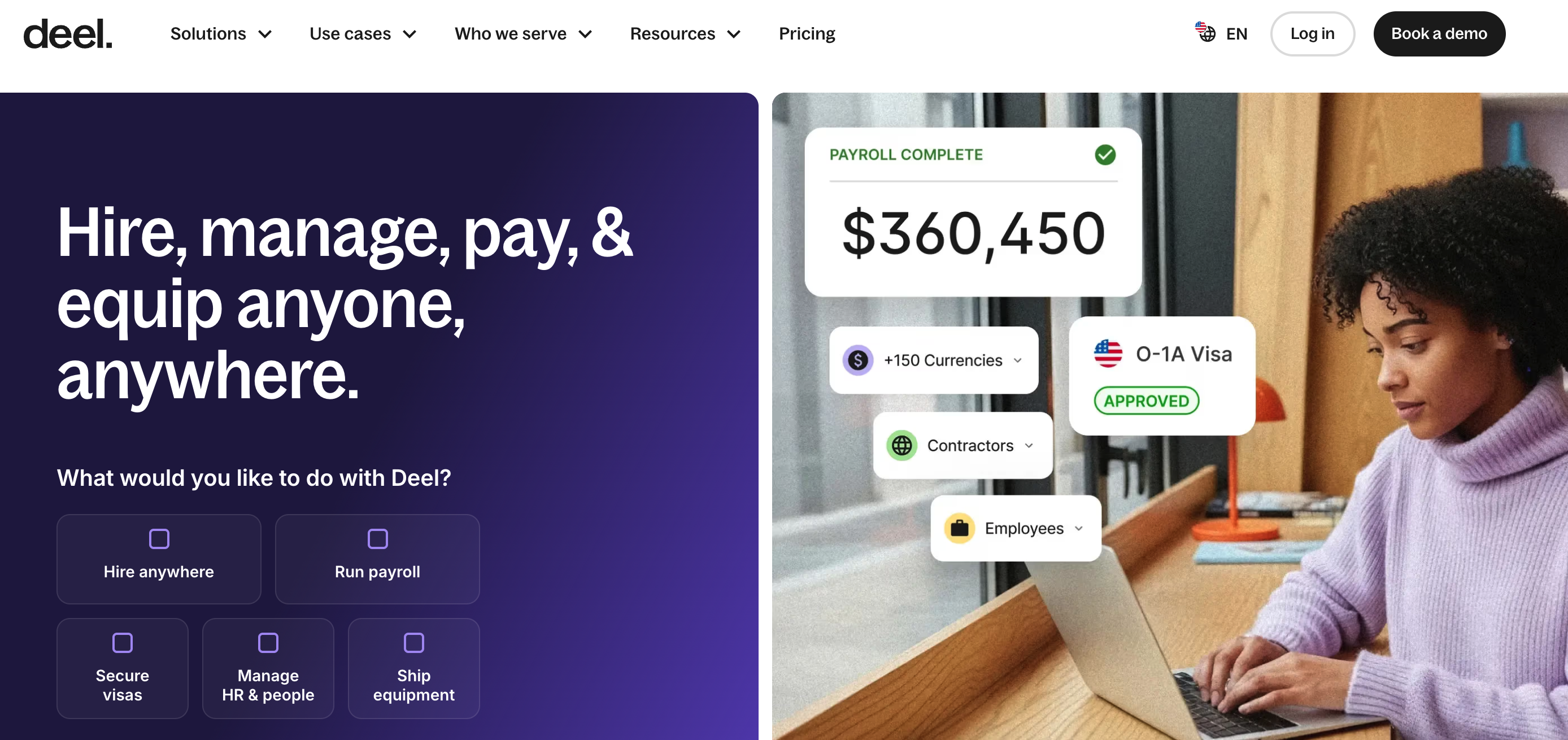
Deel is a platform-focused EOR covering 150+ countries, suited for tech companies and distributed teams that need contractor management, HRIS integrations, and full-time employment support in South Korea. The platform holds a 4.6 rating on G2 and carries SOC 2 Type II certification. ISO 27001 status for Deel has not been confirmed in researched sources.
In South Korea, Deel manages payroll in KRW and handles statutory contributions including National Pension Service, National Health Insurance Service, and Employment Insurance obligations. Deel's platform integrates with a wide range of HRIS and finance tools, giving operations and finance teams centralized visibility across their international workforce. Deel uses FX forwards to lock in exchange rates at the time of payment for invoices, providing predictable settlement amounts.
Strengths:
-
Contractor and full-time employment support on a single platform allows companies to manage both engagement types in South Korea without switching tools or providers.
-
HRIS integrations with a broad range of finance and HR systems give operations teams centralized workforce data across South Korea and other international markets.
-
SOC 2 Type II certification provides a verified security baseline for companies with data governance requirements when evaluating EOR platforms for South Korean employment.
Limitations:
-
Pricing at $599 per employee per month places Deel at the higher end of the South Korea EOR market, which may limit accessibility for early-stage companies or those hiring a single employee.
-
Deel accrues statutory severance for EOR employees in South Korea and reviews the accrual annually to meet local legal requirements.
Best for:
Tech companies and distributed teams that need contractor management, HRIS integrations, and full-time EOR support in South Korea on a single platform.
Pebl
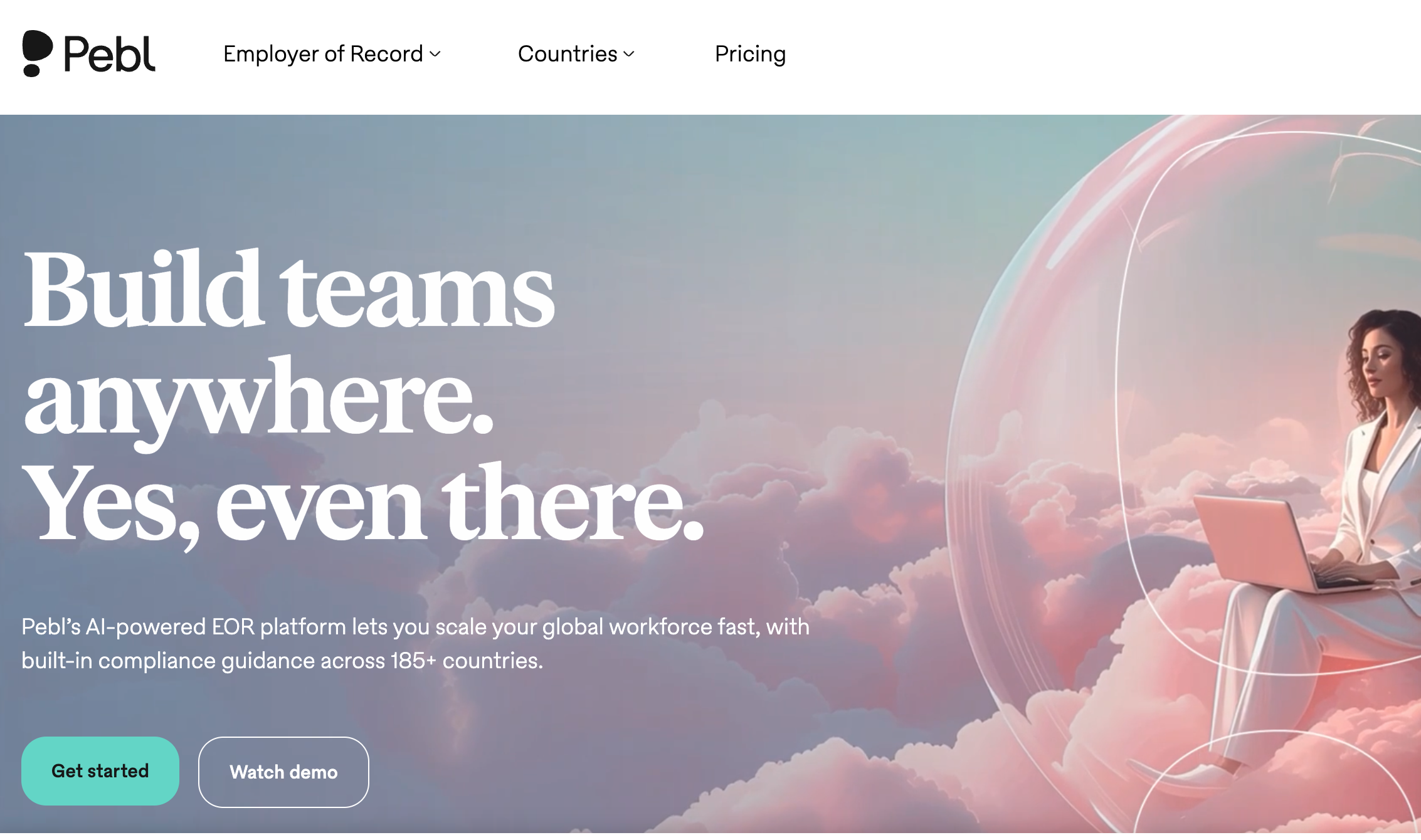
Pebl is an EOR provider added to this comparison during the provider roster review. Pebl supports South Korea as part of its global EOR coverage, combining owned entities with local partners, though South Korea-specific ownership is not publicly confirmed.
Runs KRW payroll, manages the four mandatory social-insurance contributions, and says onboarding can start in minutes. Public sources reviewed did not document Pebl's South Korea-specific service capabilities, pricing, or security certifications at the time of research.
Strengths:
-
Pebl supports South Korea as part of its global EOR coverage. Its South Korea EOR service covers hiring, onboarding, payroll, taxes, immigration and benefits, and provides the four employer social-insurance contributions.
-
Pebl supports South Korea as part of its global EOR coverage, offering hiring, onboarding, payroll, taxes, immigration and benefits services.
Limitations:
-
Public sources reviewed did not document a provider-specific limitation.
Best for:
Pebl supports South Korea as part of its global EOR coverage, combining owned entities with local partners to deliver hiring, onboarding, payroll, taxes, immigration, and benefits services.
What Are the Key Services of an EOR in South Korea?
An EOR in South Korea manages a statutory framework that is more demanding than most other APAC markets. The Labor Standards Act, four mandatory social insurance schemes, and the 52-hour weekly working hour cap each create distinct compliance obligations that an EOR must execute accurately on behalf of the client company.
Core EOR services in South Korea cover payroll processing in KRW, statutory contribution filings for the National Pension Service, National Health Insurance Service, Employment Insurance, and Industrial Accident Compensation Insurance, employment contract drafting aligned to the Labor Standards Act, and severance accrual management from the first day of employment.
EOR providers must also manage any applicable collective bargaining agreement terms alongside statutory minimums, since unionized workplaces in South Korea can carry additional obligations that sit above the baseline set by national law.
Employment Contracts and Local Compliance
South Korea's Labor Standards Act sets firm boundaries that every employment contract must reflect. The 52-hour workweek cap limits employees to 40 standard hours plus a maximum of 12 hours of overtime per week. An EOR must enforce this cap in every contract it issues on behalf of a client company.
Probation periods are permitted under the LSA and typically run up to three months. Contract terms must specify the probation duration, applicable conditions, and any variation in notice or termination rights during that period.
Fixed-term contracts carry a two-year ceiling under the Act on Protection of Fixed-Term and Part-Time Workers. Once an employee reaches two years of continuous fixed-term employment, the employer must convert the contract to indefinite-term employment. An EOR tracks this threshold and manages the conversion to keep the client compliant.
In unionized sectors, collective bargaining agreement terms may exceed statutory minimums. Where a CBA applies, its provisions govern over the LSA floor, and the EOR must apply whichever standard is more favorable to the employee.
Payroll and Tax Administration
South Korea runs a monthly payroll cycle. As of January 2026, the statutory minimum wage is $7 (KRW 10,030) per hour, equivalent to $1,572 (KRW 2,156,880) per month. An EOR must verify that every employee's base pay meets or exceeds this floor before each payroll run.
Employer social insurance contributions cover four programs. The National Pension Service rate currently sits at 4.5% of gross salary, rising incrementally to 6.5% by 2033. National Health Insurance Service contributions are approximately 3.545%, Employment Insurance is approximately 0.9%, and Industrial Accident Compensation Insurance rates vary by industry. An EOR must model the NPS escalation schedule forward to give clients accurate multi-year cost projections.
Each January, employees complete a year-end tax settlement process that reconciles income tax withheld across the prior year against actual tax liability. The EOR manages this process on behalf of employees, collecting supporting documentation, calculating adjustments, and filing the settlement with the National Tax Service. Refunds or additional withholdings are processed through the February payroll cycle.
Benefits Administration
South Korea's statutory benefits framework is set by the Labor Standards Act and the Employment Insurance Act. An EOR administers both the legal minimums and any supplemental benefits agreed in the employment contract.
Maternity leave runs for 90 days under the Labor Standards Act, with pay covered through Employment Insurance for qualifying employees. Paternity leave is 10 days, paid under the Act on Equal Employment and Work-Family Balance Support. Each parent may take up to one year of parental leave, with pay structured through Employment Insurance.
Annual leave entitlement starts at 15 days after one year of continuous employment and increases with tenure. Severance pay is calculated at 30 days of average wage per year of continuous employment. An EOR must begin accruing severance from the employee's first day to meet this obligation accurately.
Employee Onboarding
Onboarding a South Korean employee through an EOR begins with executing an employment contract in Korean or in a bilingual Korean-English format. The EOR then registers the employee with all four social insurance schemes: National Pension Service, National Health Insurance Service, Employment Insurance, and Industrial Accident Compensation Insurance. Each registration must be completed within the statutory filing window after the hire date.
For Korean nationals, the full onboarding process typically takes two to five business days. Foreign nationals require additional steps, including work visa verification and alien registration card confirmation, which extend the timeline depending on visa processing times.
The EOR carries responsibility for meeting every statutory deadline across all four insurance registrations. Companies hiring in South Korea without a local entity rely on the EOR to execute these steps accurately from day one.
Ongoing HR Support
South Korea's 52-hour maximum workweek is a statutory obligation, not a guideline. An EOR must track weekly hours for each employee and flag violations before they become legal exposure for the client company.
Annual leave accrual and tracking run under the Labor Standards Act. The EOR manages entitlement calculations, carry-over rules, and payout obligations throughout the employment lifecycle.
NPS contribution rates are scheduled to increase annually from 2026 through 2033. The EOR must apply each rate change accurately at the point of payroll processing, without requiring the client to monitor the adjustment schedule.
-
Regulatory monitoring covers annual minimum wage adjustments, NPS rate escalations, and Labor Standards Act updates as they take effect.
-
Korean-language employee communications and HR documentation support are required for compliant day-to-day workforce operations in South Korea.
Employee Offboarding
South Korea's Labor Standards Act requires justifiable cause for employer-initiated dismissal. Without documented grounds, a terminated employee can file a claim with the Labor Relations Commission, which holds authority to order reinstatement. The EOR carries this compliance risk on behalf of the client.
Severance is calculated at 30 days of average wages per year of continuous employment and must be paid within 14 days of the termination date. The EOR manages the calculation, payment execution, and documentation required under the LSA.
Employers must provide approximately 30 days of advance notice for employer-initiated termination. The EOR coordinates the notice period, final KRW payroll settlement, and return of company property within that window.
-
Social insurance deregistration across all four schemes, National Pension Service, National Health Insurance Service, Employment Insurance, and Industrial Accident Compensation Insurance, must be completed upon termination.
-
Final payroll settlement is processed in KRW and reconciled against any outstanding leave balances or statutory deductions before the employment record is closed.
How to Hire Through an EOR in South Korea
Hiring through an EOR in South Korea involves two distinct phases: a commercial agreement phase and a statutory compliance phase. Both must be completed before a hire can be activated on local payroll.
In the commercial phase, the client company signs a Master Services Agreement and a Statement of Work scoped to South Korea. The EOR then collects employee data and configures payroll in KRW, including National Pension Service, National Health Insurance Service, and Employment Insurance deductions.
Hiring foreign nationals adds a third layer. The EOR or the client must secure the appropriate work authorization, typically an E-7 visa for specialist roles, before the employee can legally begin work in South Korea. Confirm visa sponsorship capability with any EOR before signing.
Selection and Setup
Selecting the right EOR for South Korea requires evaluating several country-specific factors before signing any agreement.
Key criteria to assess include whether the provider operates a direct legal entity in South Korea or relies on a partner network, how it monitors the statutory 52-hour maximum workweek, how it handles NPS contribution rate escalations running from 2026 through 2033, and what foreign exchange markup policy applies to KRW payroll disbursements.
Ask these questions before signing:
-
Does the provider hold a direct entity in South Korea or use a third-party partner network?
-
How is severance accrued, and what documentation is provided as evidence?
-
How are NPS and NHIS filings confirmed to the client each pay cycle?
-
What controls monitor the 52-hour weekly cap for each employee?
-
What is the FX markup applied to KRW payroll, and is it disclosed in the contract?
Can the provider sponsor E-7 visas for foreign national hires?
What security certifications does the provider hold?
Once a provider is selected, setup follows three steps: MSA execution, a South Korea-specific Statement of Work, and employee data collection. Onboarding begins only after all three are complete.
Onboarding and Compliance
South Korea EOR onboarding follows a defined statutory sequence that the EOR manages on behalf of the client company from the date of employment contract execution.
-
Execute the employment contract. A bilingual Korean-English contract is recommended to meet Labor Standards Act requirements and reduce legal exposure for foreign employers.
-
Register the employee with all four social insurance programs: National Pension Service (NPS), National Health Insurance Service (NHIS), Employment Insurance (EI), and Industrial Accident Compensation Insurance (IACI), within statutory deadlines.
-
Set up payroll in Korean Won (KRW) with correct statutory deduction configurations applied before the first payroll run.
-
Run the first payroll cycle with accurate NPS, NHIS, EI, and IACI deductions confirmed.
-
Activate ongoing 52-hour workweek monitoring to maintain continuous compliance with South Korea's working-hours regulations.
For foreign national hires, add work visa verification and alien registration card confirmation before contract execution. The EOR assumes full employer-of-record liability from the date the employment contract is signed.
What Are the Benefits of Using an EOR in South Korea?
Using an EOR in South Korea reduces the compliance burden that comes with one of the more complex statutory benefit frameworks in the Asia-Pacific region. Companies avoid the cost and time of local entity setup while the EOR manages all four mandatory social insurance programs from day one.
South Korea's benefit obligations cover National Pension Service, National Health Insurance, Employment Insurance, and Industrial Accident Compensation Insurance. Each carries specific contribution rates, registration deadlines, and filing requirements that change as regulations are updated.
NPS contribution rates are scheduled to increase in phases from 2026 through 2033. An EOR absorbs that rate escalation into its compliance operations, giving Finance teams predictable cost forecasting across the full period rather than requiring internal teams to track and implement each adjustment manually.
For companies hiring in AI, cybersecurity, and healthcare, where South Korea added 193,000 jobs in 2025, EOR removes the entity overhead that would otherwise delay market entry and talent activation.
Faster Market Entry
Setting up a legal entity in South Korea requires Ministry of Justice registration, tax office registration, and separate social insurance registrations with the National Pension Service, National Health Insurance Service, and Employment Insurance system. Each step adds weeks to months before a single hire can be made compliantly.
An EOR activates employment in two to five days. Companies hiring AI or cybersecurity specialists in South Korea can bring talent on board immediately, without waiting for entity approvals or building local compliance infrastructure from scratch.
For teams competing for technical talent in a market where shortages are acute, that speed difference is a direct operational advantage.
Reduced Compliance Risk
South Korea's Labor Standards Act carries criminal penalties for violations, not just civil fines. Breaches of the 52-hour maximum workweek, incorrect National Pension Service or National Health Insurance Service contribution rates, and failure to accrue severance from day one all expose companies to serious legal liability.
Misclassifying full-time employees as independent contractors compounds that risk further. Korean labor authorities treat misclassification as a substantive violation, and enforcement has increased alongside the growth of cross-border hiring.
An EOR manages contribution rates, severance accruals, and contract classification from the point of hire. NPS contribution rates are scheduled to increase through 2033, requiring proactive cost modeling that a qualified EOR handles automatically rather than leaving it to the client's finance team.
Simplified Payroll Administration
South Korea runs a monthly payroll cycle with four mandatory social insurance deductions: National Pension Service, National Health Insurance Service, Employment Insurance, and Industrial Accident Compensation Insurance. Each deduction carries its own contribution rate, filing deadline, and regulatory update schedule.
NPS contribution rates are subject to phased annual changes through 2033. An EOR reconfigures payroll automatically when rates change, removing the compliance burden from internal Finance teams.
Payroll is processed in Korean Won. An EOR converts client billing currency to KRW for each payroll run. Transparent foreign exchange policies matter here: companies should confirm how their EOR calculates and discloses the conversion rate applied to each payment cycle.
South Korea also requires a year-end tax settlement, a mandatory annual reconciliation of employee income tax. An EOR manages this process end-to-end, filing on behalf of each employee and adjusting withholding as required by the tax authority.
Access to Local Benefits
An EOR in South Korea administers the full set of statutory benefits required under Korean labor law. These include National Pension Service contributions, National Health Insurance Service coverage, Employment Insurance, and Industrial Accident Compensation Insurance.
Employees are also entitled to annual leave of 15 to 25 days depending on tenure, maternity and paternity leave, parental leave, and severance pay equal to 30 days of average wages for each year of continuous employment.
Beyond statutory requirements, EOR providers can administer supplemental benefits common in the South Korean employment market, including private health insurance, meal allowances, and transportation allowances. These additions matter for companies competing for technical talent.
South Korea's AI and cybersecurity labor market is tight. Offering a competitive benefits package, both statutory and supplemental, is a practical factor in attracting and retaining qualified engineers and specialists in these fields.
Lower Entity Setup Costs
Establishing a legal entity in South Korea requires incorporation fees, registered capital, and ongoing Korean-language compliance management covering tax filings, accounting, and labor law reporting. These fixed costs accumulate before a single employee is paid.
EOR fees in South Korea typically run $199 to $599 per employee per month. Entity setup and annual compliance overhead can exceed that total for small headcounts, making EOR the more cost-effective path until a company reaches a threshold where fixed entity costs are distributed across a larger workforce.
For most companies, entity setup becomes cost-competitive only at sustained headcounts of 15 or more full-time employees in South Korea. Below that threshold, EOR fees are lower than the combined cost of incorporation, registered capital, and ongoing Korean-language compliance management.
More Flexible Workforce Scaling
An EOR lets companies add or reduce headcount in South Korea without carrying the fixed overhead of a registered legal entity. There are no dormancy costs, no statutory audit obligations tied to entity status, and no Korean-language compliance infrastructure to maintain during slow periods.
EOR is particularly suited to project-based hiring or pilot programs in South Korea, where a company needs to test the market before committing to entity setup. A company can activate one or two hires, assess the market, and scale or exit without restructuring a legal entity.
One structural limit applies to long-tenure hires. South Korea caps fixed-term employment contracts at two years. After that point, the employment relationship must convert to an indefinite-term contract. An EOR manages that conversion, including updated contract terms and any changes to statutory benefit obligations, so the employing company does not carry that compliance risk directly.

How to Find the Right EOR for South Korea
South Korea's employment framework is more demanding than most markets. The 52-hour workweek cap, four mandatory social insurance schemes, severance accrual from day one, and the phased NPS contribution rate increases running through 2033 all create compliance obligations that a poorly matched EOR will mishandle.
Provider selection here carries more consequence than in simpler markets. A gap in statutory filing accuracy or contract structure can expose a company to penalties under the Labor Standards Act or trigger disputes over dismissal rights.
The first question to ask any provider is whether it operates through a direct legal entity in South Korea or relies on a partner network. Direct entity ownership is the clearest indicator of compliance accountability. It determines who holds legal employer responsibility when a filing deadline or severance calculation is contested.
Local Compliance Expertise
South Korea-specific compliance depth is not self-reported. Ask providers for concrete evidence: NPS, NHIS, and Employment Insurance registration confirmations, payroll tax filing records, and documented handling of fixed-term contract conversion rules under the Act on the Protection of Fixed-Term and Part-Time Workers.
Providers should also demonstrate working knowledge of Labor Standards Act Article 23, which requires justifiable cause for dismissal, and the 52-hour workweek cap enforcement obligations that apply to companies above the relevant headcount thresholds. Understanding the NPS contribution rate escalation schedule through 2033 is a further indicator of current compliance readiness.
Direct entity ownership in South Korea is the strongest structural indicator of compliance depth. A provider operating through a partner network may lack direct accountability for statutory filings, leaving the client company exposed if a contribution or contract obligation is missed.
Clear Service Scope
South Korea's employment framework requires an EOR to cover four statutory social insurance schemes: National Pension Service, National Health Insurance Service, Employment Insurance, and Workers' Compensation Insurance. Confirm that any provider you evaluate manages all four, not a subset.
Two additional obligations require explicit confirmation. First, ask whether the provider handles year-end tax settlement, the annual income reconciliation process required under Korean tax law. Second, confirm that severance accrual and payment are managed from day one, as the Labor Standards Act mandates a 30-day average wage payment after one year of continuous employment.
Scope gaps are common in two areas: visa sponsorship for foreign nationals and collective bargaining agreement management. Some providers exclude both. Confirm coverage in writing before signing. Also clarify the foreign exchange policy: ask whether the KRW payroll conversion markup is included in the monthly service fee or billed as a separate line item.
Support Model
South Korea's labor law is detailed and changes regularly. The National Pension Service contribution rate is scheduled to increase in phases from 2026 through 2033. A provider without in-country compliance expertise will struggle to keep statutory filings accurate as those changes take effect.
Ask three questions before selecting a provider. First, is Korean-language support available for employees who need help with payroll queries or contract terms? Second, is there a dedicated account manager with documented South Korea compliance experience, not a general support queue? Third, what is the response time commitment for statutory filing questions?
Self-service platforms can work for straightforward hiring, but they are rarely sufficient for companies entering South Korea for the first time without in-house Korean labor law knowledge. Dedicated human support reduces the risk of missed filings and incorrect contribution calculations. Confirm whether the provider has in-country HR or legal staff based in South Korea, as local presence directly affects the quality of compliance guidance your team receives.
Technology and Reporting
A capable EOR platform for South Korea must produce itemized KRW payroll reports that break down each statutory deduction: National Pension Service, National Health Insurance Service, Employment Insurance, and Workers' Compensation. Finance teams managing South Korean employment costs rely on these breakdowns to reconcile monthly invoices and forecast headcount spend accurately.
A 52-hour workweek tracking dashboard is a practical requirement under South Korea's Labor Standards Act. Without it, HR teams must track hours manually, which creates compliance exposure for companies scaling beyond a handful of hires.
Providers should also issue NPS contribution rate change alerts. South Korea's phased NPS rate increases run from 2026 through 2033, and payroll systems that do not update automatically create filing errors. Year-end tax settlement reporting is a further requirement specific to Korean payroll operations.
Security certifications, specifically ISO 27001 and SOC 2 Type II, are the baseline trust indicators for enterprise buyers and government contractors evaluating EOR platforms for South Korean operations.
Scalability for Your Hiring Plans
Scalability in South Korea means more than adding headcount. It means maintaining compliance quality in KRW payroll as volume grows, without introducing gaps in statutory filings or severance accrual accuracy.
Ask whether a provider has managed growth from one or two hires to twenty or more in South Korea without compliance failures. Providers that rely on partner networks rather than owned local infrastructure are more likely to show inconsistencies at scale.
If South Korea is part of a broader APAC expansion, confirm whether the platform supports multi-country management from a single dashboard. Managing Korean, Japanese, and Singaporean employees across separate systems adds administrative overhead and reduces governance visibility.
The EOR-to-entity transition point is also worth clarifying early. At a certain headcount, establishing a Korean legal entity becomes more cost-effective than continuing with an EOR. A provider that supports or facilitates that transition, rather than creating friction around it, is a stronger long-term partner. Gloroots offers EOR for enterprises with centralized workforce visibility designed to support this kind of structured growth.

Why Gloroots Is a Strong EOR Partner in South Korea
Gloroots EOR services cover 150+ countries, giving companies a single employment operating layer for South Korea and every other market they enter. The platform combines Global Employer of Record, Global Payroll, Compliance and Employment Governance, and Benefits and Statutory Coverage under one contract.
In South Korea, Gloroots runs payroll in KRW, monitors the 52-hour maximum workweek, handles NPS contribution rate escalations as they phase in through 2033, and manages severance accruals from day one. Employment contracts are localized to the Labor Standards Act, reducing legal exposure for companies without in-house Korean compliance expertise.
Pricing follows a predictable, country-specific model with full cost visibility before onboarding. Gloroots charges a fixed monthly fee independent of employee salary, so Finance teams can forecast South Korea employment costs without variable billing risk. See Gloroots pricing for current rates.
-
NPS, NHIS, Employment Insurance, and Industrial Accident Compensation Insurance contributions managed end-to-end from hire activation.
-
Severance accrual tracking aligned to South Korea's mandatory 30-day average wage obligation after one year of continuous employment.
-
Centralized workforce visibility with human-led account support and retained business context across the employment lifecycle.
-
Localized employment contracts and cultural HR support for Korean workforce operations.
Companies ready to employ in South Korea without opening a local entity can book a demo or start free to see how Gloroots manages local labor law, statutory contributions, and benefits end-to-end.
FAQs About the Best EOR in South Korea
The questions below address the most common topics buyers raise when evaluating EOR providers for South Korea. They cover compliance obligations under the Labor Standards Act, statutory contribution structures, severance rules, and how to compare providers on pricing and service model before making a final decision.
How does an EOR work in South Korea?
An EOR becomes the legal employer under Korean law, assuming full compliance liability under the Labor Standards Act while the client company retains day-to-day management of the employee's work.
The EOR registers the employee with the four statutory schemes: National Pension Service, National Health Insurance Service, Employment Insurance, and Industrial Accident Compensation Insurance. It runs payroll in KRW, withholds and remits all contributions, and accrues severance from the employee's first day of employment.
This structure lets companies employ workers in South Korea without establishing a local legal entity, with the EOR holding direct accountability for filings, contracts, and statutory obligations throughout the employment lifecycle. For a broader overview, see how does EOR work.
What does an EOR cost in South Korea?
EOR fees in South Korea typically range from $199 to $599 or more per employee per month, depending on the provider and scope of services included.
The EOR fee is only part of the total cost of employment. Employers also pay statutory contributions on top of the base salary: National Pension Service at 4.5%, National Health Insurance Service at approximately 3.545%, Employment Insurance at approximately 0.9%, and Industrial Accident Compensation Insurance at a variable rate set by industry. Severance accrual adds the equivalent of roughly one month's average wage per year of continuous employment.
NPS contribution rates are scheduled to increase from 2026 through 2033, which will raise total employment costs progressively over that period. Buyers should also ask providers about foreign exchange markup on KRW payroll conversion, as this is a common hidden cost that does not appear in the headline fee. For a detailed breakdown of EOR pricing factors, see employer of record cost.
When should a company use an EOR in South Korea?
An EOR is the right structure when a company needs to employ workers in South Korea without committing to local entity setup. Common triggers include market entry with one to ten employees, rapid hiring of AI or cybersecurity talent, and testing the South Korean market before a long-term investment decision.
Using a contractor arrangement for full-time roles carries misclassification risk under the Labor Standards Act. An EOR removes that risk by establishing a compliant employment relationship from day one.
Most companies transition from EOR to a local entity once headcount reaches ten to fifteen employees, or when monthly EOR fees exceed the overhead cost of maintaining a registered entity in South Korea.
Can an EOR hire both local and foreign employees in South Korea?
Yes, but the process differs by nationality. Korean nationals can be hired through an EOR without quota restrictions, and onboarding follows standard statutory timelines for NPS, NHIS, and employment insurance enrollment.
Foreign nationals are subject to South Korea's foreign employee quota system. Not all EOR providers can sponsor foreign nationals, so confirming visa sponsorship capability before selecting a provider is essential.
The primary work visa for foreign professionals is the E-7 (Specially Designated Activities) visa. Foreign national onboarding takes longer than Korean national onboarding due to E-7 processing timelines and the requirement to obtain an alien registration card after arrival.
How do I choose the right EOR in South Korea?
Start by confirming whether the provider operates a direct legal entity in South Korea or relies on a partner network. Direct entities carry clearer compliance accountability for NPS, NHIS, and EI filings.
From there, evaluate these eight criteria:
Visa sponsorship capability for foreign national hires
52-hour workweek monitoring and enforcement controls
NPS contribution rate escalation handling through 2033
Foreign exchange markup policy on KRW payroll
-
Security certifications relevant to your data governance requirements
Korean-language employee support availability
Severance accrual methodology from day one of employment
Request statutory filing evidence, specifically NPS and NHIS registration confirmations, as part of due diligence before signing. See the selection criteria section above for detailed guidance on each factor.