




- Israel EOR compliance requires accurate handling of National Insurance contributions, mandatory pension enrollment from day one, and Section 14 severance fund structuring; providers that treat these as add-ons rather than core service components create direct financial and legal exposure for the hiring company.
- Pricing across the eight providers in this comparison ranges from $199 per employee per month (Gloroots) to $599 per employee per month (Teamed, Deel, Remote), with Safeguard Global and Playroll requiring direct inquiry for confirmed Israel-specific pricing.
- Entity ownership model matters for contract authority and onboarding speed; Deel and Remote publicly disclose owned Israeli legal entities, while other providers should be asked to confirm whether they operate through a direct entity or a local partner.
- Onboarding speed varies from one to three business days (Deel, Multiplier) to one to two weeks for full statutory registration completion, and the Israel-specific sequence of National Insurance registration, pension enrollment, and contract execution must be completed before the first payroll run.
- Support model and Israel-specific compliance depth differ significantly across providers; Teamed includes real HR and legal experts on every plan, Papaya Global assigns Designated Country Experts, and Gloroots provides human-led account support with retained business context, while several providers did not publicly confirm Israel-specific coverage for all statutory obligations.
Tel Aviv ranks fourth in global startup ecosystem rankings, hosts more than 180 multinational R&D centers, and produces a STEM graduate share of 23%, making Israel one of the most active hiring markets for international companies. Demand for local engineering, product, and research talent is high, and competition for that talent is direct.
Hiring in Israel carries specific statutory obligations. Employers must register and contribute to Bituach Leumi (National Insurance), enroll employees in mandatory pension from day one, and structure severance in line with Section 14 of the Severance Pay Law 1963. Each obligation carries financial and legal exposure if handled incorrectly, which makes EOR provider selection a consequential decision rather than a commodity choice.
This guide covers eight EOR providers active in Israel. Each profile is assessed against a consistent rubric covering compliance capability, pricing transparency, entity model, onboarding speed, platform experience, and support quality. Use it as a structured decision tool, not a ranked list.
Our Top 8 Picks: Israel EOR Comparison 2026
The table below evaluates eight EOR providers on six axes relevant to Israel hiring: pricing per month, country coverage, onboarding speed, platform experience, customer support, and scalability.
| Provider | Pricing per month | Country coverage | Onboarding speed | Platform experience | Customer support | Scalability |
|---|---|---|---|---|---|---|
| Gloroots | From $199 per employee/month | 150+ countries | 3–5 working days; country and documentation dependent | Centralized dashboard with workforce visibility, payroll and compliance management | 24/7 human support with dedicated account management | Built for scaling distributed teams across multiple countries |
| Teamed | From $599 per employee/month; ILS FX absorbed at zero markup | 30+ countries; coverage varies by service | Not publicly listed as a fixed timeframe | Platform-led EOR solution covering payroll, HR and compliance; less self-service depth than leading platform-first providers | Real HR and legal experts included on every plan | Supports EOR, contractors and entity management through one platform |
| Papaya Global | From $499 per employee/month | 180+ countries | Onboarding can begin within weeks; country and implementation dependent | Global workforce/payments platform with automated payroll, real-time dashboards, payments, compliance and analytics | 24/7 support with in-country Country Experts | Designed for multinational and enterprise workforces; deposit may be required |
| Deel | From $599 per employee/month | 130+ countries for EOR | Typically a few business days; country-dependent | All-in-one global employment platform with automated workflows for EOR, contractors, payroll, HR and compliance | 24/7 multichannel support | Built for global employment at startup through enterprise scale |
| Remote | From $699 per employee/month; annual billing from $599 | 90+ countries for EOR | Country-dependent; dedicated onboarding support | Global HR platform covering EOR, payroll, benefits, compliance, contractor management and IP protection | Dedicated onboarding and support teams; security and IP protection features | Owned-entity infrastructure designed for global employment |
| Multiplier | From $400 per employee/month | 150+ countries | As fast as 24 hours; country-dependent | Accessible global employment platform with simplified onboarding, EOR, payroll, benefits and compliance | 24/7 support with dedicated account management | Strong HRIS integrations and support for global and regional expansion |
| Safeguard Global | From $499 per employee/month | 170+ countries; coverage varies by service | Country-dependent; no universal public EOR timeframe | Global employment technology combined with managed payroll, EOR and in-country compliance expertise | In-country HR, payroll, legal and compliance experts | Suited to mid-market and enterprise organizations with complex global workforces |
| Playroll | Custom pricing | 180+ countries | Country-dependent; no fixed universal public timeframe | Global employment platform covering EOR, payroll, benefits, compliance, contractor management and workforce administration | Dedicated support with local HR and compliance expertise | Built for companies scaling international employment across multiple countries |

Top 8 Best EOR Platforms in Israel
Each provider in this list was evaluated against axes built around Israel's employment rules: Bituach Leumi accuracy, Section 14 severance handling, ILS payroll execution, pricing transparency, entity ownership model, support model, and path to own entity. Entity ownership is disclosed for each provider where sources confirm it. G2 ratings are included where available from researched sources.
Gloroots

Gloroots is a global employment platform that supports compliant full-time employment across 150+ countries. In Israel, Gloroots acts as the legal employer, enabling companies to employ workers, run payroll in Israeli Shekel, and manage statutory obligations without establishing a local legal entity. Whether the Israeli employing entity is directly owned by Gloroots or operated through a local partner is not publicly confirmed.
Gloroots combines Global EOR, Global Payroll, Compliance and Employment Governance, and Benefits and Statutory Coverage into one operating layer. Pricing is fixed and country-specific, with full cost visibility provided before onboarding begins and no percentage-of-salary fees. EOR onboarding typically completes within one to five business days once documentation is in order.
For Israel specifically, Gloroots manages Bituach Leumi contributions, mandatory pension enrollment, Section 14 severance fund structuring, and recuperation pay obligations as part of its statutory coverage. Human-led account support with retained business context reduces the time teams spend re-briefing the provider at each interaction.
Strengths:
-
Fixed, country-specific pricing at $199 per employee per month with no hidden costs and full cost visibility before onboarding, supporting accurate forecasting for Finance and HR teams.
-
Statutory coverage for Israel includes Bituach Leumi, mandatory pension enrollment, Section 14 severance structuring, and recuperation pay, managed by in-house compliance teams.
-
Centralized workforce visibility across all countries from one dashboard, combined with human-led account support and retained business context on every engagement.
Best for:
Companies scaling distributed teams across multiple countries that need predictable, fixed-cost employment in Israel with centralized compliance governance and human-led account support.


Teamed
Teamed is an expert-led employer of record built for tech-sector hiring in Israel. Every plan includes real HR and legal experts, not a ticketing queue, covering the full range of Israeli statutory obligations from Bituach Leumi contributions to mandatory pension and Section 14 severance arrangements.
Teamed charges a flat fee of $599 per employee per month and absorbs ILS/USD conversion at zero markup, removing currency risk from payroll cost forecasting. It covers Bituach Leumi, mandatory pension, Section 14 severance, and Keren Hishtalmut as standard inclusions.
Teamed also supports the full path from first Israeli contractor through EOR employment to incorporation of a company's own Israeli legal entity, running all three modes on one system. It scored at the top of four out of six axes in an Israel-specific EOR rubric covering Bituach Leumi, mandatory pension, Section 14 severance, Keren Hishtalmut, and ILS/USD foreign exchange handling.
Strengths:
-
Leads on service model and employment intelligence: real HR and legal experts are included on every plan, not reserved for premium tiers.
-
Covers all core Israeli statutory obligations including Bituach Leumi, mandatory pension, Section 14 severance, and Keren Hishtalmut, with ILS/USD conversion absorbed at zero markup.
-
Supports the full progression from contractor to EOR to own Israeli legal entity on a single system, reducing provider switching as a company scales.
Limitations:
-
Trails competitors on platform self-serve capability and security certifications; Rippling and Deel lead on platform experience, and other providers hold stronger security certification coverage.
Best for:
Rapidly growing tech companies hiring in Israel that need real HR and legal experts on call for Section 14 and Keren Hishtalmut decisions, and one partner from first Israeli contractor through to their own Israeli legal entity.
Papaya Global
Papaya Global is a Tel Aviv-headquartered employer of record and global payroll platform covering 160 or more countries. Its home-turf location in Israel gives it direct operational proximity to Israeli employment law, and it employs Designated Country Experts sourced from top-tier accounting firms and licensed CPAs to manage payroll, financial, legal, and compliance obligations for each market it serves.
The platform consolidates EOR workers, payroll, contractors, and payments into one automated system with real-time dashboards and AI-native compliance monitoring. Support is available around the clock via WhatsApp and a client portal. Papaya Global also provides global immigration and equity management support as part of its service scope.
Papaya Global's starting price for Israel EOR is $499 per employee per month. The provider guarantees local compliance or accepts liability for any shortfall, which is a defined contractual commitment rather than a general positioning claim.
Strengths:
-
Designated Country Experts from top-tier accounting firms and CPAs manage payroll, legal, and compliance obligations, with Papaya Global accepting liability if local compliance is not met.
-
Tel Aviv headquarters gives direct operational proximity to Israeli employment law and regulatory updates, supporting home-turf compliance depth.
Limitations:
-
Designed for onboarding multiple EOR employees at once; companies making a single hire in Israel may find the model less suited to their scale. A deposit is also required to begin service.
Best for:
Enterprise teams running payroll across multiple countries that want AI-native compliance monitoring, real-time workforce analytics, and a provider with direct operational roots in Israel.
Deel
Deel is a global employment platform offering EOR services in Israel at $599 per employee per month. It covers 150+ countries and supports contractor-to-employee conversion with locally relevant benefits packages and multiple payment currencies.
Deel leads on platform usability in Israel comparisons, alongside Rippling. Its onboarding workflows are designed to reduce time-to-hire when entering new markets. Israel-specific compliance coverage includes payroll processing, tax withholding, and employment contract management aligned with Israeli labour law. Deel states it operates its own wholly owned Israeli entity in Tel Aviv. 4.8 out of 5 based on 14,696 G2 reviews. Deel’s Israel guide says the EOR registers with Bituach Leumi, enrolls staff in mandatory pension funds, and includes Section 14 compensation terms in contracts.
Setting up a local entity in Israel carries significant upfront costs in legal, tax, and payroll infrastructure. Deel's EOR model removes that overhead, allowing companies to employ workers in Israel without incorporation.
Strengths:
-
Leads on platform usability in Israel comparisons, with fast 1 to 3 day onboarding activation across 150+ countries and structured contractor-to-employee conversion workflows.
-
Publicly discloses a starting price of $599 per employee per month, enabling direct cost comparison against other providers in this list.
-
Covers Israel EOR with payroll processing, tax withholding, employment contracts, and locally relevant benefits packages as integrated service components.
Limitations:
-
Premium pricing at $599 per employee per month sits at the higher end of this comparison, and add-on costs for compliance handling, benefits, and support tiers were not confirmed from official Deel pricing pages.
-
Heavily digital processes and limited custom benefits options may not suit companies with non-standard employment arrangements or traditional operational preferences.
Best for:
Fast onboarding and contractor-first global hiring, particularly for businesses that prioritise platform usability and quick implementation when entering Israel.
Remote
Remote offers EOR services in Israel through a dedicated country page covering payroll administration, benefits management, and employment compliance. It operates an owned-entity model, meaning it employs workers directly through its own legal entities rather than through third-party partners. Remote states it owns its own legal entity in Israel and does not rely on third parties.
Remote is noted for strong IP protection through its Remote IP Guard feature and GDPR-grade security standards. In Israel comparisons, Remote contests the pricing transparency column alongside Teamed. Pricing starts at $599 per employee per month (annual) or $699 on monthly billing. Remote handles National Insurance (Bituach Leumi), mandatory pension contributions, and statutory severance-related obligations as part of its local payroll and compliance in Israel. It holds a 4.5 out of 5 rating based on 3,887 G2 reviews.
The owned-entity structure means Remote assumes direct employment liability in each country it operates, which reduces reliance on local partner networks and supports consistent compliance standards across markets.
Strengths:
-
Owned-entity compliance model reduces reliance on third-party partners and supports direct employment liability in each country, including Israel.
-
Remote IP Guard provides structured intellectual property protection for companies employing technical and product staff in Israel.
-
Contests pricing transparency in Israel comparisons, indicating active investment in cost clarity for buyers evaluating Israel EOR options.
Limitations:
-
The official starting price for Israel EOR was not publicly confirmed from Remote's official sources at the time of this research. Contact Remote directly for current pricing.
Best for:
Companies prioritising an owned-entity compliance structure and IP protection when employing technical staff in Israel without a local legal entity.
Multiplier
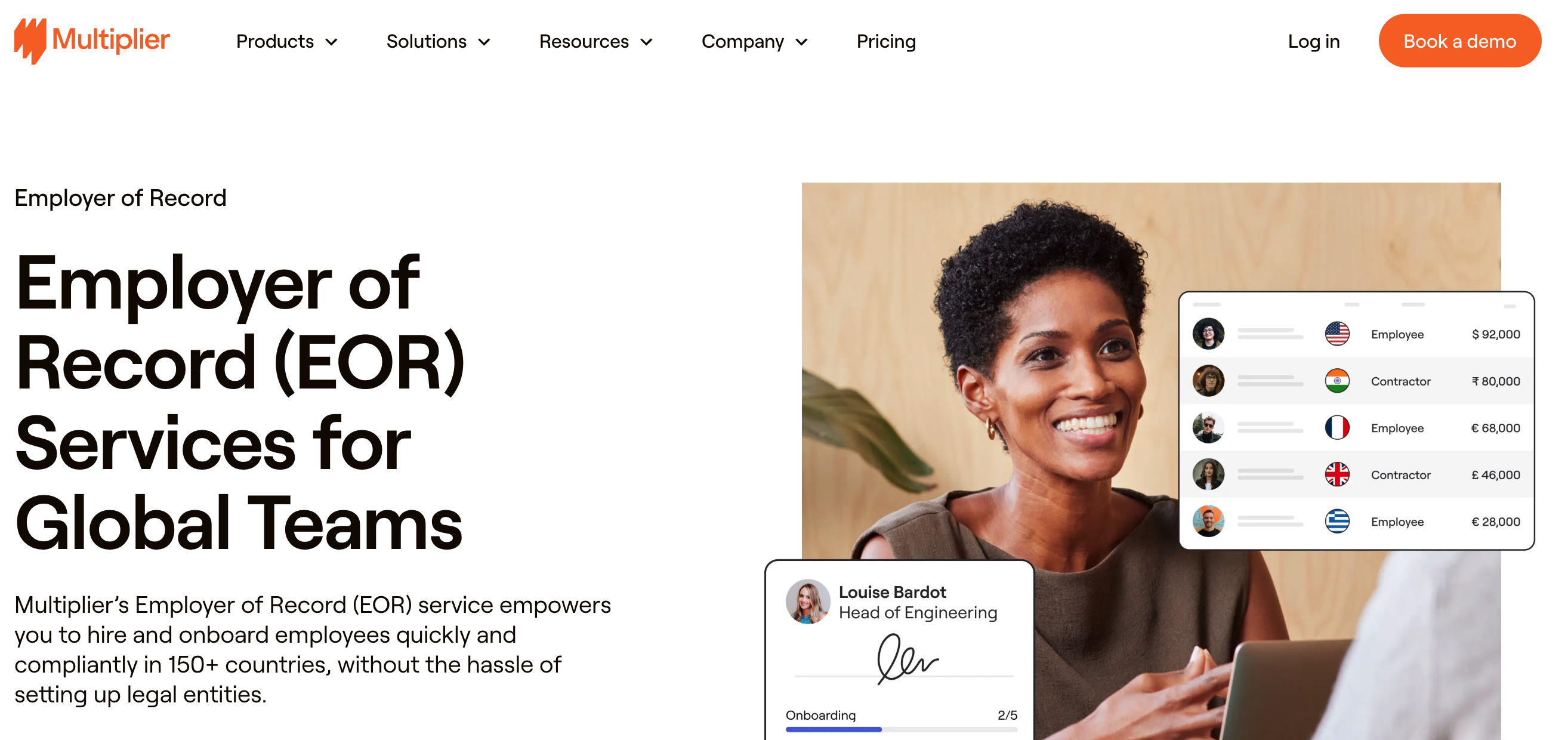
Multiplier is a global EOR platform covering 150+ countries, including Israel. It provides end-to-end employment services covering contract drafting, payroll, benefits administration, and compliance management. Starting price is $400 per employee per month, making it one of the lower flat-rate options among providers in this comparison.
Multiplier operates on a transparent flat-rate pricing model with no percentage-of-salary fees. Onboarding speed is cited at one to three business days. Whether Multiplier's Israel service explicitly covers Bituach Leumi contributions, Section 14 severance arrangements, and Keren Hishtalmut is Multiplier states it handles Bituach Leumi contributions and Pitzuim (Section 14) severance deposits in Israel and explains Keren Hishtalmut as a common employer–employee study fund..
Strengths:
-
Transparent flat-rate pricing at $400 per employee per month supports predictable cost forecasting for Finance and HR teams.
-
One to three day onboarding speed reduces time-to-hire when entering the Israeli market.
-
End-to-end service covering contract drafting, payroll, benefits, and compliance management from one platform.
Limitations:
-
Public sources reviewed did not document Israel-specific compliance depth for Bituach Leumi, Section 14 severance, or Keren Hishtalmut; buyers should confirm coverage directly with Multiplier before committing.
Best for:
Cost-conscious companies expanding globally or into APAC markets that need a flat-rate EOR with strong HRIS integrations and fast onboarding.
Safeguard Global

Safeguard Global is a global employment services provider with 18+ years of EOR experience and coverage across 187+ countries, including Israel. It operates a dedicated Israel employment law page and positions its service around adherence to local labour regulations. The 2025 NelsonHall EOR Services NEAT Report ranked Safeguard Global as a market leader.
Starting price is not publicly confirmed from official Safeguard Global sources for Israel specifically. One third-party comparison table cites $699 per employee per month, and a separate independent ranking platform lists an average of $460 per month; neither figure has been verified from Safeguard Global's own pricing pages. Buyers should request current Israel-specific pricing directly from the provider. Safeguard Global publicly confirms Israel-specific payroll and EOR compliance, including Israeli tax and social-contribution processing and compliance with Israeli labor regulations, but official sources do not explicitly confirm coverage for Bituach Leumi, Section 14 severance arrangements, or Keren Hishtalmut by name.
Strengths:
-
18+ years as an EOR provider with a technology and human-centered approach, including in-country compliance experts across 187+ countries.
-
Ranked as a market leader in the 2025 NelsonHall EOR Services NEAT Report, indicating recognized standing in enterprise compliance governance.
-
Dedicated Israel employment law page reflects active engagement with the local regulatory environment.
Limitations:
-
Starting price for Israel EOR is not publicly confirmed from official Safeguard Global sources, making direct cost comparison difficult without a direct inquiry.
-
Public sources reviewed did not document Israel-specific service depth for Bituach Leumi, Section 14 severance, or Keren Hishtalmut beyond general compliance positioning.
Best for:
Organizations with heightened regulatory requirements that need an experienced, compliance-first EOR with in-country experts and a long operational track record.
Playroll
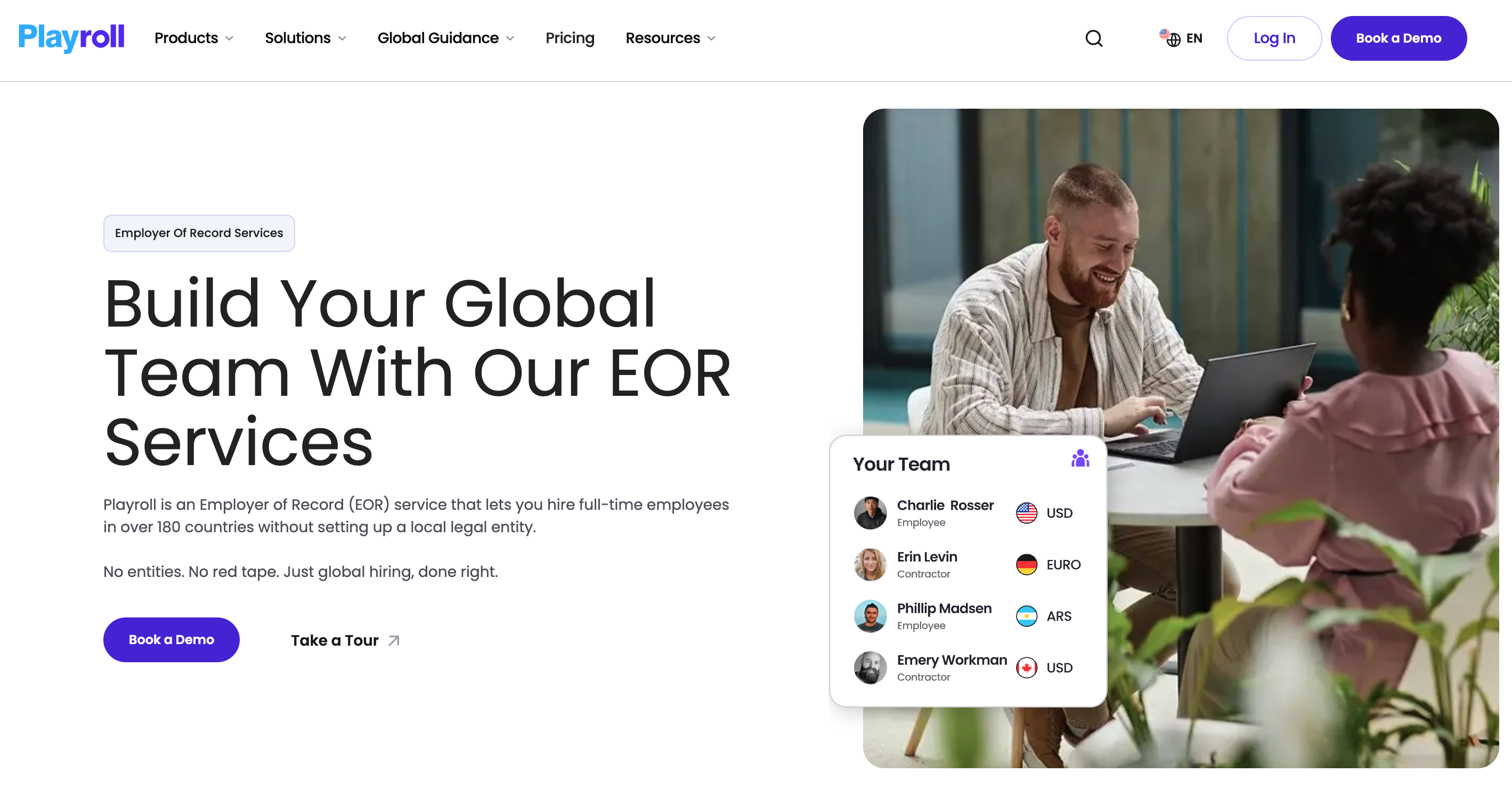
Playroll is listed among the top EOR providers in Israel, with a noted focus on severance compliance and statutory benefits management. Its key advantage in the Israeli market is documented expertise in the Severance Pay Law 1963, which governs employer obligations when employment ends.
Playroll supports statutory leave management and benefits coverage for Israeli employees. Pricing is custom and must be confirmed directly with the provider. A G2 rating of 4.7/5 is cited in third-party gap analysis for Playroll, though the review count supporting that figure was not confirmed in the sources reviewed for this guide.
Strengths:
-
Documented expertise in Israel's Severance Pay Law 1963, covering employer obligations on termination and statutory severance calculations.
-
Statutory benefits coverage and leave management for Israeli employees, addressing obligations under Israeli employment law.
Limitations:
-
Public sources reviewed did not document a provider-specific limitation beyond the absence of publicly listed pricing, which requires direct engagement with Playroll to confirm.
Best for:
Companies hiring in Israel that prioritise severance compliance and statutory benefits management, particularly where Severance Pay Law 1963 obligations are a primary concern.
What Are the Key Services of an EOR in Israel?
EOR services in Israel carry statutory obligations that go beyond the scope of a generic global employment arrangement. Israeli law imposes specific employer duties that a provider must handle correctly for employment to be compliant.
Three areas carry the most consequence for companies hiring in Israel. First, the National Insurance Institute (Bituach Leumi) requires employer and employee contributions that must be calculated and remitted accurately each month. Second, mandatory pension enrollment applies from the employee's first day, with defined contribution rates set by law. Third, Section 14 of the Severance Pay Law 1963 governs how severance is funded and paid, and incorrect handling creates direct financial liability for the employing entity.
An EOR in Israel manages payroll execution, employment contracts, statutory benefits enrollment, tax withholding, and compliance reporting. Providers with verified Israel-specific capability handle all three of the above obligations as part of their core service, not as add-ons.
Employment Contracts and Local Compliance
Israeli law requires a written employment contract for every employee. Employers must also provide written notice of employment terms within 30 days of the start date.
Contracts must specify salary in Israeli Shekel. Notice periods for termination are set at 30 days in writing. Where a collective bargaining agreement applies, its sector-specific terms govern alongside the statutory baseline.
Misclassification risk in Israel is assessed by labor courts against the substance of the working relationship, not the contract label. An EOR ensures contracts meet the standards Israeli labor courts apply, reducing exposure to reclassification claims from day one of employment.
Payroll and Tax Administration
Payroll in Israel must be executed in Israeli Shekel and filed by the 15th of each month. Employers withhold income tax at source on each payroll run.
National Insurance contributions follow a two-bracket structure. Employers pay 4.51% on salary up to the lower bracket threshold and 7.6% on salary above it.
Pension contributions add a further 6.5% employer contribution, plus an 8.33% severance component paid into the employee's pension fund under Section 14 arrangements. The statutory minimum wage is $2,155 (NIS 6,443.85) per month, effective 1 April 2026. An EOR manages each of these obligations, filing on time and ensuring payroll accuracy across every pay cycle.
Benefits Administration
Israeli employment law requires employers to administer four distinct benefit streams for every full-time employee. An EOR manages each stream accurately and on schedule.
-
Mandatory pension: Employers contribute 6.5% of salary. Employees contribute at the statutory rate. Enrollment must occur within three months of hire, though day-one enrollment is recommended practice.
-
Annual recuperation pay (Dmei Havraa): A statutory obligation paid annually. The amount varies by sector and applicable Extension Order.
-
Training fund (Keren Hishtalmut): Employers contribute approximately 7.5% and employees approximately 2.5% of salary. Funds become tax-free savings after six years and are standard in the Israeli tech sector.
-
Section 14 severance fund: Employers contribute 8.33% of monthly salary into an employee-owned fund, replacing traditional severance liability.
A qualified EOR handles enrollment, contribution calculations, and remittance across all four streams, reducing the compliance risk that comes with managing each obligation independently.
Employee Onboarding
Onboarding a new employee in Israel involves several statutory steps that must be completed in a defined sequence. An EOR manages each step from the point of offer acceptance.
-
National Insurance registration: The EOR registers the new employee with the National Insurance Institute (Bituach Leumi) at the start of employment.
-
Pension enrollment: Enrollment is initiated within the statutory three-month window, with day-one enrollment as standard practice.
-
Employment contract: Contracts are executed in Hebrew or bilingual format to meet Israeli documentation requirements.
-
Employee documentation: Required personal and tax documents are collected in line with Israeli law.
-
Invention assignment agreement: For tech-sector roles, an invention assignment agreement is executed to address obligations under Israeli privacy and IP law.
A typical EOR-managed onboarding in Israel takes one to two weeks from signed offer to active employment, covering all statutory registrations and contract execution within that window.
Ongoing HR Support
An EOR in Israel manages Bituach Leumi filings across both salary brackets on a monthly cycle, with submissions due by the 15th of each month. Payroll compliance monitoring runs continuously to catch errors before they reach employees or regulators.
Overtime pay follows the Hours of Work and Rest Law: the first two overtime hours are paid at 125% of the base rate, and each hour beyond that is paid at 150%. Night shift differentials and weekly rest day compliance, including the Shabbat rest requirement, are tracked and applied each pay cycle.
Annual recuperation pay, known in English as vacation recuperation allowance, is processed each year according to statutory entitlement. Keren Hishtalmut contributions, the statutory study fund, are calculated and remitted on an ongoing basis for eligible employees. HR query handling for Israeli employees is managed through the account support function, keeping response times consistent and context retained across interactions.
Employee Offboarding
Terminating an employee in Israel requires 30 days of written notice. The notice period applies whether the termination is employer-initiated or the employee resigns, though the consequences for severance differ significantly between the two scenarios.
For employer-initiated terminations, the Section 14 severance fund is released to the employee at offboarding. This fund, built through monthly contributions during employment, satisfies the statutory severance obligation under Israeli law. Resignations do not automatically trigger the same release, and the distinction must be documented clearly to avoid wrongful dismissal claims before Israeli labour courts.
Final payroll calculations include all accrued vacation pay. If the employee is entitled to annual recuperation pay and the termination falls mid-year, a prorated amount is calculated and included in the final payment. Termination documentation must meet Israeli labour court standards, covering notice, grounds, and final payment records, to protect the employing entity from post-termination disputes.
How to Hire Through an EOR in Israel
Hiring through an EOR in Israel follows two distinct phases: selection and setup, then onboarding and compliance execution.
Israel-specific steps differ from generic EOR onboarding. Bituach Leumi registration, Section 14 severance structuring, and pension enrollment timing each require action from day one of employment, not after the employee starts work.
The numbered steps below cover both phases in sequence.
Selection and Setup
-
Confirm the EOR owns or partners with an Israeli legal entity. Direct ownership is preferred for contract authority and faster onboarding.
-
Verify the provider can register with Bituach Leumi and manage contributions across both salary brackets correctly.
-
Confirm Section 14 severance structuring is available from day one of employment, not added later.
-
Review the ILS payroll execution timeline and confirm the provider meets the monthly filing cutoff on the 15th of each month.
-
Confirm pension enrollment is offered from day one. The statutory enrollment window is three months, but earlier enrollment reduces compliance risk.
-
Validate the provider's foreign exchange policy if salaries are denominated in USD but paid in ILS.
-
Review contract terms, service level agreements, and the support model before signing.
Onboarding and Compliance
Hiring in Israel follows a defined sequence of statutory steps. Each step carries a filing or registration obligation, and missing one creates compliance exposure from the first payroll run. Understanding how does EOR work helps clarify which obligations the EOR assumes on your behalf.
-
Execute a bilingual or Hebrew employment contract before the employee's start date.
-
Register the employee with the National Insurance Institute (Bituach Leumi) prior to the first day of work.
-
Enroll the employee in the mandatory pension scheme, as required under Israeli pension law.
-
Set up Section 14 severance fund contributions from the first payroll run.
-
Initiate a continuing education fund (Keren Hishtalmut) contribution arrangement where applicable, which is standard practice in the Israeli technology sector.
-
Confirm the first payroll run in Israeli Shekel with correct statutory deductions applied.
-
Validate the monthly filing schedule: the first filing is due by the 15th of the following month.
For technology-sector roles, an invention assignment agreement should be executed at onboarding to protect intellectual property rights under Israeli law.
What Are the Benefits of Using an EOR in Israel?
Using an EOR in Israel reduces the compliance burden that comes with the country's layered statutory obligations. Israel's employment framework includes National Insurance Institute registration, mandatory pension enrollment, Section 14 severance fund contributions, and continuing education fund arrangements, making it more complex than many other jurisdictions.
Six specific benefits apply when hiring through an EOR in Israel:
-
Entity-free employment: Hire full-time employees in Israel without incorporating a local legal entity, removing the time and cost of company registration.
-
Statutory compliance from day one: The EOR manages National Insurance Institute registration, pension enrollment, and Section 14 contributions from the first payroll run.
-
Payroll execution in Israeli Shekel: Employees are paid in local currency with correct statutory deductions applied each month.
-
Continuing education fund administration: EOR providers with Israel expertise manage continuing education fund contributions, which are standard in the technology sector and expected by candidates.
-
Predictable cost structure: Fixed-fee EOR pricing gives Finance teams accurate cost forecasts before the first hire is made.
-
Reduced legal exposure: The EOR assumes employer-of-record liability, covering employment contract compliance, termination obligations, and statutory benefit requirements under Israeli law.
Faster Market Entry
An EOR lets companies hire in Israel within days. Establishing a local entity (a private limited company under Israeli law) takes months and costs over $39,586 (NIS 118,380) in legal, tax, and payroll setup fees.
Removing entity incorporation from the critical path matters when speed is a business requirement. Israel has 151,354 open positions across its tech sector, and competition for qualified candidates moves quickly.
An EOR removes that delay entirely. Companies can place a compliant employment contract, run payroll in Israeli Shekel, and meet statutory obligations from day one, without waiting for incorporation to complete.
Reduced Compliance Risk
Israeli labor courts regularly reclassify contractors as employees. When that happens, the company faces retroactive social insurance contributions, pension arrears, statutory severance, and recuperation pay liability, all calculated from the original engagement date.
An EOR engagement uses a full employment contract from the start, which removes misclassification risk before it can accumulate. The EOR manages social insurance contributions across two income brackets, structures severance arrangements correctly under Section 14 of the Severance Pay Law, and handles monthly statutory filings on schedule.
The EOR also assumes compliance liability directly. That transfers legal exposure away from the client company and onto the provider, which is a material risk reduction for Finance and Legal teams operating in Israel without a local entity.
Simplified Payroll Administration
An EOR in Israel takes full ownership of payroll execution in Israeli Shekel, including the correct calculation of National Insurance Institute (Bituach Leumi) contributions across both salary brackets. This removes a technically demanding obligation from the client's HR team.
Monthly payroll filings are submitted by the 15th of each month, as required under Israeli law. The EOR handles this deadline on the client's behalf, covering pension contributions and Section 14 severance fund remittances as part of the standard payroll cycle.
For companies paying USD-denominated salaries, the EOR manages the foreign exchange conversion into Israeli Shekel. Clients should confirm with their provider whether a markup applies to the conversion rate. The client receives a single consolidated payroll invoice, replacing the multiple statutory filings that would otherwise fall to an in-country finance team.
Access to Local Benefits
An EOR in Israel administers the full set of mandatory employer contributions: pension at 6.5% of salary, the Section 14 severance fund at 8.33%, and annual recuperation pay (known locally as Dmei Havraa). These obligations apply to all full-time employees under Israeli law.
For technology-sector hires, the EOR can also administer the continuing education fund, a tax-advantaged savings vehicle that is standard in Israeli tech employment packages and a meaningful factor in attracting local talent. Access to this benefit through an EOR removes the administrative setup that would otherwise fall to the client.
Beyond mandatory contributions, EOR providers in Israel can offer locally competitive benefits packages that meet both statutory minimums and the requirements of applicable sector Extension Orders. This coverage supports compliance and helps client companies compete for skilled Israeli employees without operating a local entity.
Lower Entity Setup Costs
Establishing a local Israeli company (a private limited company under Israeli law) costs over $39,586 (NIS 118,380) in initial legal, tax, and payroll setup fees. That figure excludes ongoing accounting, audit, and corporate secretarial costs that accumulate each year the entity remains active.
EOR services in Israel start at $199 per employee per month with no setup cost and same-week hiring capability. There are no ongoing entity maintenance fees, no local audit obligations, and no corporate secretarial requirements.
The cost advantage of an EOR over a local entity is most pronounced for companies hiring fewer than approximately 10 to 15 employees in Israel. Below that threshold, the fixed overhead of entity ownership typically exceeds the cumulative EOR fee. For a detailed breakdown of how EOR fees compare to entity costs, see the employer of record cost guide.
More Flexible Workforce Scaling
An EOR lets companies adjust Israeli headcount up or down without restructuring a local entity. That flexibility matters most when a company is testing the Israel market with one to five hires before committing to a local subsidiary.
EOR also supports contractor-to-employee conversion without entity setup, which is relevant in Israel's competitive technology talent market. Companies can convert IDF-trained engineers and developers from contractor to full-time employment status through the EOR without opening a separate legal structure.
When scale eventually justifies a local entity, some EOR providers offer a structured path to incorporation. This means the EOR relationship can serve as a bridge rather than a permanent ceiling on growth. EOR for startups covers how this scaling model works in practice for early-stage companies entering new markets.

How to Find the Right EOR for Israel
Israel's employment framework is specific enough that generic EOR capability is insufficient. Providers must demonstrate operational depth in Israeli statutory obligations, not just country coverage.
Five criteria separate providers that can execute compliantly in Israel from those that cannot. Each criterion maps to a concrete compliance obligation under Israeli law. The subsections below work as a due-diligence checklist you can apply to any provider on your shortlist.
Local Compliance Expertise
Israel's social insurance system applies two contribution rates depending on salary bracket: 4.51% and 7.6%. A provider must calculate and remit both accurately each month.
Severance under the Severance Pay Law must be structured from day one of employment, typically through a Section 14 arrangement that routes contributions into a pension fund in lieu of direct severance liability. Providers that set this up late create retroactive exposure.
Additional obligations include: recovery pay (Dmei Havraa) administered per the applicable sector Extension Order, and a study fund (Keren Hishtalmut) where the employer contributes a percentage of salary into a tax-advantaged savings vehicle. Payroll must be filed by the 15th of each month. Confirm whether the provider's Israeli compliance team operates in-house or through a local partner, as this affects accountability and response time.
Clear Service Scope
A clear service scope tells you exactly what the monthly EOR fee covers before you sign. In Israel, this matters because several obligations, including Keren Hishtalmut administration, Dmei Havraa processing, and termination support, are sometimes bundled and sometimes billed separately depending on the provider.
Confirm whether ILS payroll execution is included in the base fee or invoiced as an add-on. Ask whether FX conversion is applied at zero markup or whether the provider applies a spread on USD-to-ILS conversions, which can add meaningful cost on tech-sector salaries.
Pricing structure also affects forecasting. Fixed per-employee fees give Finance teams a predictable monthly cost. Percentage-of-salary models scale with compensation and can become expensive as senior hires join. Gloroots uses predictable, country-specific pricing with full cost visibility before onboarding and no percentage-of-salary pricing. Confirm whether setup fees, deposit requirements, or minimum employee counts apply before committing.
Support Model
The support model determines how quickly compliance problems get resolved. In Israel, filing errors with the National Insurance Institute or incorrect termination notice handling can carry legal consequences, so response time on compliance queries matters.
Check whether the provider assigns a dedicated account manager with Israel-specific knowledge or routes queries through a general support queue. A named point of contact retained across the engagement reduces the time spent re-briefing the provider each time a question arises. Gloroots provides human-led account support with retained business context, which supports continuity on ongoing compliance matters.
For employee-facing queries, confirm whether Hebrew-language support is available. Ask whether HR and legal expert access is included on every plan or reserved for premium tiers. Providers that gate expert access behind higher-cost plans may leave standard-plan clients without guidance at critical moments, such as during a Section 14 severance arrangement or a Keren Hishtalmut eligibility question.
Technology and Reporting
A capable EOR platform gives Finance and HR teams direct visibility into Israeli Shekel payroll costs and statutory deductions without waiting for account manager updates.
Look for real-time dashboards that display ILS payroll costs, Bituach Leumi contributions, and mandatory pension deductions as they are processed each cycle. Compliance alerts tied to Israeli regulatory changes, such as minimum wage updates or revised Bituach Leumi rates, should be issued automatically rather than reactively.
Payroll data must be exportable in formats Finance and HR teams can use directly. For companies hiring in Israel alongside other markets, multi-country visibility from one dashboard reduces reporting overhead. Assess whether the platform supports self-serve actions or requires account manager intervention for routine tasks.
Scalability for Your Hiring Plans
An EOR should support your hiring from a single employee through to 50 or more without changing its pricing model or service structure mid-engagement.
At roughly 10 to 15 employees in Israel, establishing a local private company may become cost-competitive with ongoing EOR fees. A provider that supports that transition, rather than treating it as a reason to end the relationship, reduces operational disruption. Teamed, for example, explicitly supports the path from first contractor through to a locally registered entity.
Israel's technology sector adds specific requirements: Keren Hishtalmut contributions, equity compensation, and USD-denominated salary structures are common. The EOR must handle these alongside standard roles. Providers that run contractor, EOR for enterprises, and own-entity models on one platform give growing companies a single operational layer as headcount scales.

Why Gloroots Is a Strong EOR Partner in Israel
Companies hiring in Israel need an employment partner that handles statutory complexity without variable pricing surprises. Gloroots EOR services cover compliant full-time employment across 150+ countries, including Israel, with fixed country-specific pricing and full cost visibility before onboarding begins.
Gloroots executes payroll in Israeli Shekel with accurate statutory deductions, including Bituach Leumi contributions, mandatory pension, and Section 14 severance structuring. These obligations are managed in-house, not delegated to third-party subcontractors.
The platform combines four integrated capabilities: Global Employer of Record, Global Payroll, Compliance and Employment Governance, and Benefits and Statutory Coverage. Each capability operates under a single account structure, so Finance and HR teams maintain centralized visibility across headcount, payroll costs, and compliance status.
Pricing is fixed per country with no percentage-of-salary component. See Gloroots pricing for current rates. This structure lets teams forecast employment costs accurately before a hire is confirmed, which matters when building business cases for Israel headcount.
Dedicated account managers retain business context across the engagement. Teams do not re-brief the provider at each interaction. This is particularly useful for EOR for mid-market companies managing distributed workforces across multiple countries simultaneously.
Gloroots is built for scaling companies that need compliant employment in Israel with predictable costs and centralized governance. Book a demo to see fixed pricing and centralized compliance for your Israel hiring plans.
FAQs About the Best EOR in Israel
The five questions below address the most common buyer questions about EOR services in Israel. Each answer includes Israel-specific statutory figures and compliance details rather than generic EOR explanations.
Topics covered include Bituach Leumi contribution rates, mandatory pension thresholds, Section 14 severance structuring, notice period requirements under Israeli labour law, and how fixed-price EOR models compare to percentage-of-salary pricing for Israel headcount.
How does an EOR work in Israel?
An Employer of Record in Israel acts as the legal employer on behalf of the client company. The EOR holds the employment contract, assumes statutory liability, and registers the employee with the National Insurance Institute (Bituach Leumi).
The client company directs the employee's day-to-day work. The EOR manages all employment obligations, including pension enrollment, Section 14 severance fund contributions, and monthly payroll filing by the 15th of each month, with salary paid in Israeli Shekel.
The client receives a single monthly invoice covering all employment costs: the EOR fee plus statutory employer contributions. This structure removes the need to establish a local legal entity before hiring. For a broader explanation of how this model operates, see how does EOR work.
What does an EOR cost in Israel?
EOR pricing in Israel ranges from approximately $199 per employee per month (Gloroots) to $599 per employee per month (Deel, Teamed). Papaya Global sits at $499 per employee per month and Multiplier at $400 per employee per month.
The total employment cost includes the EOR fee plus mandatory employer contributions: National Insurance Institute contributions of 4.51% to 7.60%, pension at 6.5%, Section 14 severance fund at 8.33%, recreation pay (Dmei Havraa), and a continuing education fund (Keren Hishtalmut) where applicable. These statutory costs apply on top of any provider fee.
Fixed-fee pricing is preferable to percentage-of-salary models for companies hiring on higher Israeli technology-sector salaries, where cost predictability matters. For a full breakdown of how EOR fees are structured globally, see employer of record cost.
When should a company use an EOR in Israel?
An EOR in Israel is the practical choice when a company needs to hire between one and fifteen employees before entity setup costs are justified. Incorporating a local company (Chevra Baam) takes months and carries ongoing administrative overhead that rarely makes sense at low headcount.
Speed is a second driver. An EOR enables compliant employment within days, compared to the months required to establish a local entity. When a hire is time-sensitive, an EOR removes the incorporation bottleneck entirely.
Companies also use an EOR to convert contractors to employees. Converting under an EOR eliminates misclassification risk without requiring a local entity. It is also the standard approach for testing the Israel market before committing to a permanent subsidiary.
-
Hire one to fifteen employees before entity setup cost is amortized
-
Activate employment within days when speed to hire is critical
-
Convert contractors to employees to remove misclassification exposure
-
Test the Israel market before committing to a local subsidiary
-
Transition to a Chevra Baam when headcount exceeds approximately ten to fifteen employees and entity costs become justified
Can an EOR hire both local and foreign employees in Israel?
Yes. An EOR in Israel can employ Israeli nationals and foreign nationals who hold valid authorization to work in the country. The employment contract and statutory obligations under Israeli labor law apply equally to both groups.
For non-Israeli nationals, work permit and visa support may be required before employment can begin. Whether an EOR provider covers immigration support or treats it as out of scope varies by provider. Confirm this directly with any provider on your shortlist before signing.
Israel's tech sector draws significant foreign talent, and some EOR providers with Israel-specific expertise can advise on relevant work authorization categories for that segment. Verify the scope of immigration support with each provider, as this is not a standard inclusion across all EOR contracts.
How do I choose the right EOR in Israel?
Start by confirming whether the EOR owns a direct Israeli legal entity or operates through a local partner. Direct entity ownership reduces compliance risk and gives you a single point of accountability.
Verify that the provider handles National Insurance contributions accurately across both salary brackets, structures severance fund arrangements from day one, and administers the continuing education fund for eligible employees. These are non-negotiable obligations under Israeli law.
-
Ask for the monthly payroll filing cutoff and the provider's documented process when a deadline is missed.
-
Confirm whether pricing is a fixed flat fee or a percentage of salary. Fixed pricing gives Finance teams predictable cost forecasting.
-
Clarify the support model: who handles compliance queries, what the response time commitment is, and whether you get a retained account contact or a rotating helpdesk.