







- Bolivia's mandatory ROE registration via the OVT platform is a sequential prerequisite for social security enrollment and Registry of Commerce registration, meaning a foreign company cannot legally employ workers there without a local entity or an EOR that holds this registration on its behalf.
- Bolivia's statutory minimum wage is updated by annual decree—sometimes with a retroactive effective date—so any EOR you select must demonstrate a documented process for monitoring and applying these updates to avoid underpayment penalties and back-pay obligations.
- EOR services cover legally employed workers only; independent contractor payments are a separate service that not all providers support for Bolivia, and misclassification risk assessment should be confirmed before engaging any worker as a contractor.
- No Bolivia-specific pricing or onboarding timelines were independently confirmed for most providers reviewed; buyers should request itemized, Bolivia-specific quotes and ask each provider to clarify whether statutory employer contributions are included or billed as pass-throughs.
- Provider selection should be evaluated across compliance depth, pricing transparency, and platform integration fit together—prioritizing any single dimension, such as lowest per-seat cost, risks choosing a provider that cannot meet Bolivia's sequential registration requirements from day one.
Hiring in Bolivia without a local legal entity means choosing an employer of record (EOR): a third-party company that employs workers on your behalf, handles payroll, files statutory contributions, and keeps the engagement compliant with Bolivian labor law. For a founder running a 10 to 50 person company, the decision is less about finding a perfect platform and more about finding one that covers Bolivia reliably, prices predictably, and moves fast enough to keep a candidate from walking.
This guide compares eight EOR providers that serve Bolivia across five practical dimensions: pricing, country coverage, onboarding speed, platform experience, and support quality. The goal is to give founders enough structured information to build a short list and make a confident decision without becoming an expert in Bolivian employment law first.
Hiring in Bolivia without a local legal entity means choosing an employer of record (EOR): a third-party company that employs workers on your behalf, handles payroll, files statutory contributions, and keeps the engagement compliant with Bolivian labor law. For a founder running a 10 to 50 person company, the decision is less about finding a perfect platform and more about finding one that covers Bolivia reliably, prices predictably, and moves fast enough to keep a candidate from walking.
This guide compares eight EOR providers that serve Bolivia across five practical dimensions: pricing, country coverage, onboarding speed, platform experience, and support quality. The goal is to give founders enough structured information to build a short list and make a confident decision without becoming an expert in Bolivian employment law first.
Top 8 EOR Providers for Bolivia: At-a-Glance Comparison
No single EOR is the right fit for every company hiring in Bolivia. The right choice depends on your headcount, compliance requirements, and budget. Use the table below to triage which providers are worth a closer look, then read the full provider profiles for the context behind each rating. For a broader view of how these providers compare globally, see this EOR provider comparison.
| Provider | Pricing per month | Country Coverage | Onboarding Speed | Platform Experience | Customer Support | Scalability |
|---|---|---|---|---|---|---|
| Gloroots | From $199/employee/month | 150+ countries; EOR available in Bolivia | 3–5 working days generally | Centralized dashboard for hiring, onboarding, payroll, compliance, benefits, expenses, and workforce visibility | 24/7 human support with dedicated specialists | SMB to enterprise; supports companies scaling across 150+ countries |
| Deel | $599/employee/month for EOR | 130+ EOR countries; Bolivia specifically supported | As little as 5 days for Bolivia | G2 rating 4.8/5; unified global workforce platform covering EOR, contractors, payroll, HR, benefits, compliance, and integrations | 24/7 customer support with HR, legal, and tax expertise | SMB to enterprise; serves 40,000+ customers and 1.5M+ workers globally |
| Remote | $699/employee/month monthly; $599/month with annual billing | 90+ EOR countries; Bolivia specifically supported through Remote's own entity | Not publicly listed as a fixed Bolivia timeline | G2 rating 4.5/5; digital-first platform covering EOR, payroll, benefits, compliance, contractors, and workforce management | 24/7 support with local HR, legal, and finance specialists | SMB to enterprise; designed for distributed teams and standardized global hiring |
| Oyster HR | $699/employee/month; annual billing available | 130+ EOR countries; Bolivia specifically supported | As fast as 48 hours; Bolivia may require additional time depending on circumstances | G2 rating 4.4/5; remote-first platform for hiring, onboarding, payroll, benefits, compliance, and workforce management | Global HR experts; dedicated account management and support resources available on Scale | Startups to enterprise; supports international teams through standardized global employment workflows |
| Pebl | From $199/employee/month; country-specific quote may apply | 185+ countries; Bolivia specifically supported | Onboarding in minutes advertised; no fixed Bolivia-specific SLA publicly listed | G2 rating 4.6/5; AI-powered, human-led Global Work Platform with centralized HR, payroll, compliance, benefits, and workforce management | Human support with dedicated onboarding specialists and responsive support team | Startups to enterprise; supports hiring, payroll, and workforce management across 185+ countries |
| Multiplier | From $400/employee/month | 150+ countries; Bolivia EOR specifically supported | Not publicly listed as a fixed Bolivia-specific timeline | G2 rating 4.7/5; centralized platform for EOR, payroll, benefits, compliance, expenses, and global workforce management | Dedicated customer success/account support; human assistance for employment and payroll issues | SMB to enterprise; designed for multi-country hiring and global workforce expansion |
| Papaya Global | From $499/employee/month | 180+ countries; Bolivia EOR specifically supported | Fast onboarding; provider currently advertises getting started in weeks | G2 rating 4.5/5; AI-first Workforce OS integrating EOR, payroll, payments, compliance, reporting, and workforce data | 24/7 support with in-country experts and dedicated support resources | Primarily enterprise-oriented; designed to manage large multi-country workforces and payroll operations at scale |
| Rippling | Custom EOR pricing; no verified public Bolivia-specific price | 80 EOR countries globally; Bolivia-specific EOR coverage is not publicly confirmed in Rippling's country list | Not publicly listed for Bolivia | G2 rating 4.8/5; integrated HR, IT, payroll, finance, and workforce platform with EOR functionality | Customer support and in-app assistance; support model varies by plan/customer | SMB to enterprise; particularly suited to companies combining HR, IT, payroll, and finance on one platform |
EOR providers vary in their pricing models and country coverage, so direct comparison across these dimensions is a necessary first step before committing to a vendor. When evaluating any provider, assess compliance capabilities, pricing structure, and geographic coverage together rather than treating any single factor as decisive.

Top 8 EOR Providers for Bolivia: Full Profiles
EOR providers vary significantly in pricing models, country coverage, and compliance depth. For Bolivia specifically, buyers should assess each provider across four dimensions: compliance capabilities, onboarding speed, pricing structure, and local expertise. The profiles below follow a consistent format so founders can compare options without having to read between the lines.
Bolivia presents specific employment obligations including pension contributions, social security filings, and statutory benefits that not every global EOR handles with the same depth. Before committing to a provider, confirm Bolivia-specific onboarding timelines, all-in pricing, and how the provider manages local statutory requirements.
The eight providers below represent a cross-section of the market. Each profile covers strengths, limitations, and fit so a founder can identify which provider to contact first rather than running a full RFP process.
Once you have reviewed the profiles, request a Bolivia-specific quote from your shortlisted provider. You can start that process by reviewing Gloroots EOR services to confirm pricing and onboarding timelines before moving forward.
Gloroots: best for centralized employment governance across multiple markets
Gloroots operates as a Global Employer of Record across 150+ countries, including Bolivia. Its model is built around centralized employment governance rather than country-by-country point solutions, which means companies managing headcount in multiple markets run employment through a single operating layer instead of coordinating separate local vendors.
Strengths:
-
Centralized compliance and payroll governance across all active markets, including Bolivia
-
Predictable, country-specific pricing with a focus on cost transparency
-
Human-led account ownership rather than purely self-serve workflows
-
Benefits and Statutory Coverage management, including Bolivia's pension and social security obligations
-
Employment Lifecycle Management covering the full arc from contract to offboarding
Fit:
-
Companies managing headcount across multiple countries that want a single employment operating layer rather than separate local vendors
-
Founders who need predictable pricing and centralized compliance visibility without building local entity infrastructure


Deel: best for companies that prioritize contractor-to-employee conversion
Deel is a widely used global EOR and contractor payment platform with broad country coverage. Companies that already manage contractors in Bolivia and want a path to formal employment will find the platform's unified approach useful, since both engagement types live in one place.
Strengths:
-
Contractor and employee management run within a single platform, reducing tool sprawl for teams managing mixed workforces
Self-serve onboarding flow reduces back-and-forth during setup
Limitations:
-
Pricing can increase as add-ons are selected, which matters for founders tracking runway closely
Fit:
Deel suits companies that manage a mix of contractors and employees across multiple countries and want a single platform to govern both. EOR providers vary in pricing models and country coverage, making direct comparison a necessary step before committing.
Remote: best for companies that require transparent flat-fee pricing
Remote positions itself on pricing transparency and owned-entity infrastructure in select markets. For founders who have been caught off guard by variable fees before, the flat-fee model reduces the risk of a payroll bill that looks different from the quote.
Strengths:
-
Flat-fee pricing structure supports predictable, per-seat cost planning
-
IP protection features are built into the standard contract framework
Limitations:
-
Countries served through a partner model rather than an owned entity may carry different SLA guarantees, which affects how quickly employment can be executed
Fit:
Remote works well for companies that prioritize cost predictability and want to avoid hidden-cost risk. Buyers should assess compliance capabilities, pricing structure, and geographic coverage together before selecting a provider, since no single dimension tells the full story.
Oyster HR: best for distributed-first teams hiring across emerging markets
Oyster HR targets distributed teams and positions its platform around local compliance support in emerging markets. For a founder hiring a first employee in Bolivia, the appeal is a guided onboarding experience and benefits localization that reduces the research burden on the hiring team.
Strengths:
-
Guided onboarding experience designed to reduce compliance errors on first-time hires
Benefits localization support across emerging markets
Limitations:
-
Higher headcount hiring may require a plan upgrade, which affects cost predictability
-
EOR providers vary in pricing models and country coverage, so direct verification with Oyster HR is a required step before committing
Fit:
Small distributed teams making their first hire in Bolivia who prioritize a structured onboarding experience and local benefits guidance over the lowest per-seat cost.
pebl: best for enterprises requiring high-touch compliance support
Pebl positions on compliance depth and dedicated account management, making it a candidate for teams where Bolivia hiring involves complex or regulated employment scenarios. Understanding how EOR services work is useful context before evaluating whether Pebl's support model fits the scale and complexity of a given engagement.
Strengths:
-
Dedicated account management provides a consistent compliance contact rather than a shared support queue
-
Strong compliance track record in Latin America, relevant for buyers assessing multiple dimensions including compliance capabilities and geographic coverage
Limitations:
-
Pricing is not publicly listed. Contact Pebl directly for a Bolivia-specific quote.
-
Typically higher cost than self-serve platforms, which affects runway efficiency for smaller teams
-
Less suited to single-hire scenarios where the compliance overhead does not justify the cost structure
Fit:
Mid-market or enterprise teams hiring multiple employees in Bolivia where complex compliance requirements make dedicated support and a strong Latin America track record the deciding factors.
Multiplier: best for companies that need Bolivia-specific payroll compliance
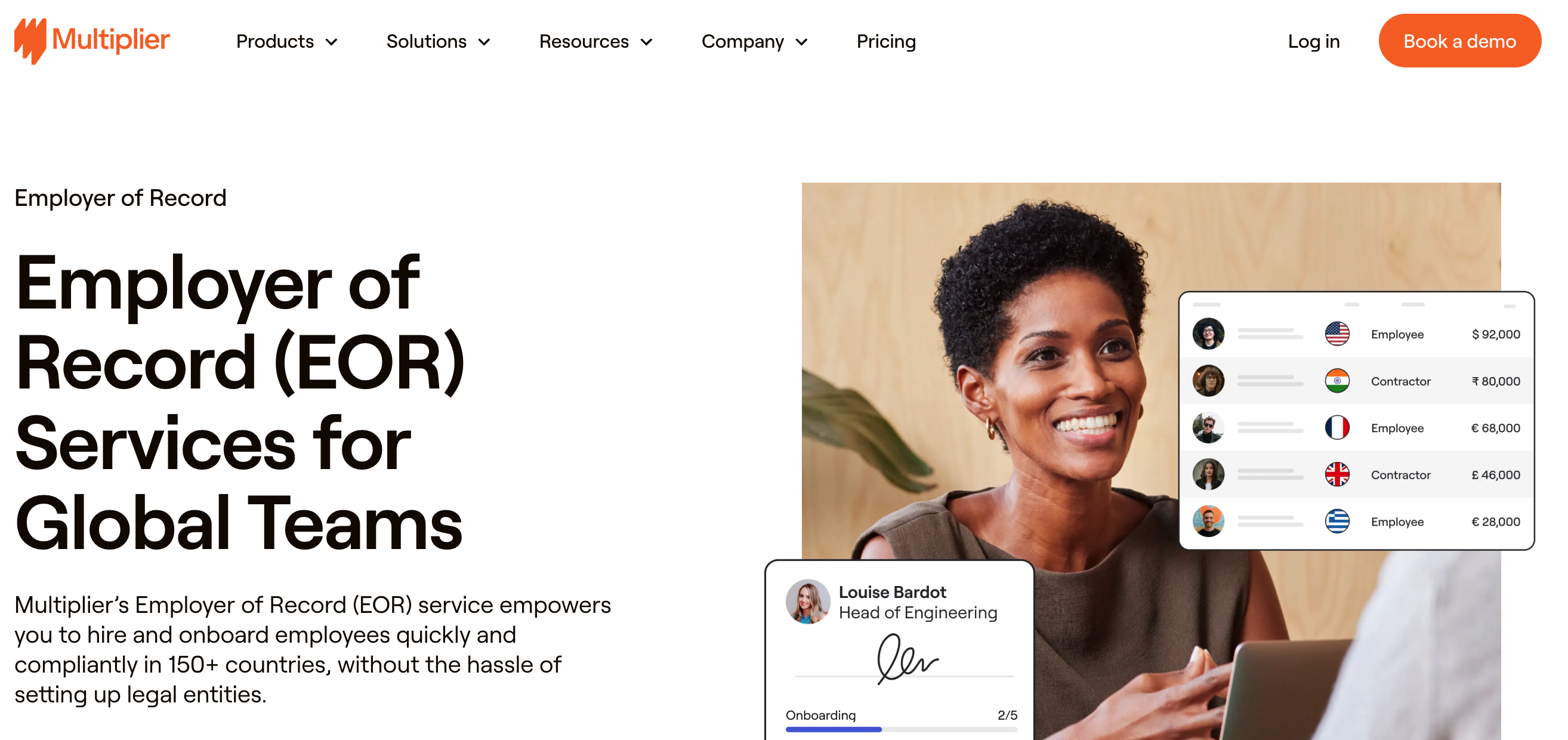
Multiplier publishes Bolivia-specific hiring documentation covering the Registro Obligatorio de Empleadores (ROE) registration process, the OVT platform required to complete it, the 2026 minimum wage update, and defined payroll contribution rates under Bolivia's pension system. That level of documented local compliance knowledge is a meaningful signal for companies that need a provider already familiar with Bolivia's regulatory requirements rather than one learning alongside them. For context on how payroll costs factor into total employment spend, see employer of record cost.
Strengths:
-
Documented Bolivia compliance coverage including ROE/OVT registration requirements and pension contribution rates
-
Published guidance on the 2026 minimum wage update with its retroactive effective date
-
Competitive pricing relative to other providers in the market, though direct comparison requires individual quotes
Companies that want a provider with demonstrated, published Bolivia compliance documentation and need confidence that statutory obligations such as ROE registration and pension contributions are handled correctly from day one.
Papaya Global: best for companies integrating EOR with existing HRIS
Papaya Global positions its platform around payroll automation and connectivity with existing HR information systems (HRIS) and enterprise resource planning (ERP) tools. For companies that already run an HR platform and want EOR services to feed into it rather than sit alongside it, that integration layer is the primary differentiator. Bolivia coverage and pricing require direct validation, as EOR providers vary significantly on both dimensions.
Strengths:
-
Strong HRIS and ERP integration capabilities for companies with an existing HR tech stack
-
Workforce visibility and reporting features that consolidate headcount data across countries
Limitations:
-
Platform depth may exceed what a company needs for a single Bolivia hire, adding unnecessary complexity to a straightforward engagement
Fit:
Mid-market companies that need Bolivia EOR services to connect directly with an existing HR platform and want consolidated workforce reporting across multiple countries rather than a standalone employment solution.
Rippling: best for companies that want EOR embedded in a full HR platform

Rippling positions its EOR capability as one module within a broader platform that also covers HR, IT, and payroll. Companies already running Rippling for domestic operations can extend that system to cover international hires rather than adding a separate vendor. EOR for startups often works best when the employment layer connects directly to existing HR workflows, which is the core premise of Rippling's model.
Strengths:
-
Unified platform covering HR, payroll, device management, and app provisioning in one system
-
Reduces vendor count for companies that already manage domestic headcount in Rippling
Limitations:
-
Modular pricing means each added capability increases total cost, which can make the all-in price harder to predict
-
EOR is a secondary product within a platform built primarily around HR software, so compliance depth in smaller markets may vary
Fit:
Companies already using Rippling for HR that want to extend employment coverage to Bolivia without switching platforms. Less suited to teams that need a dedicated EOR with deep in-country compliance support as their primary requirement.
What EOR Services Cover in Bolivia
An Employer of Record (EOR) in Bolivia acts as the legal employer on paper, taking on the statutory obligations that would otherwise require a registered local entity. The client company directs the work; the EOR owns the employment relationship under Bolivian law. See Bolivia-specific pricing to understand what these obligations translate to in practice.
Using an EOR is a recognized method for companies to employ workers in Bolivia without incorporating locally. In practice, that means the EOR handles the following obligations on the client's behalf:
-
Registro Obligatorio de Empleadores (ROE): Every employer in Bolivia must register through the OVT platform. The ROE is a prerequisite for social security registration and enrollment in the Registry of Commerce. Non-compliance carries sanctions. An EOR obtains and maintains this registration so the client does not need to.
-
Minimum wage compliance: Bolivia's statutory minimum wage is updated by annual decree. The most recent update was issued in 2026 with a retroactive effective date. An EOR tracks each update and applies it to payroll to avoid underpayment penalties.
-
Pension and social security contributions: Bolivia mandates defined contribution percentages from both the employee and the employer under its pensions system. An EOR calculates, withholds, and remits these on schedule.
-
Employment contracts and statutory filings: The EOR issues compliant employment contracts under Bolivian labor law and manages ongoing statutory filings and benefits administration.
One boundary applies regardless of provider. The EOR does not define the role, set compensation above statutory minimums, or manage day-to-day work direction. Those responsibilities stay with the client company. Gloroots offers Global Employer of Record (EOR) services that cover these employment obligations across multiple countries, including the registrations, payroll, and contributions described above.
How to Hire in Bolivia Through an EOR: Step-by-Step
-
Select and contract an EOR provider with confirmed Bolivia coverage. Verify that the provider holds or can obtain the Registro Obligatorio de Empleadores (ROE) registration via Bolivia's OVT platform. This registration is a legal prerequisite for employing workers in Bolivia and for completing downstream registrations such as social security enrollment.
-
Define the employment terms. Agree on the role, compensation at or above Bolivia's current statutory minimum wage, benefits, and contract type. Share these details with the EOR before any contract is drafted.
-
EOR completes employer registration. The EOR obtains or confirms its ROE via the OVT platform and registers the employee with Bolivia's social security authority. Non-compliance with ROE requirements carries regulatory sanctions, so confirm this step is complete before proceeding.
-
EOR issues a locally compliant employment contract. The contract must be in Spanish and must incorporate all mandatory statutory terms under Bolivian labor law. The EOR prepares and issues this document.
-
Employee completes onboarding documentation. The EOR collects required identity and tax information from the employee. The speed of this step depends on how quickly complete documentation is supplied.
-
EOR runs the first payroll. The EOR applies the current minimum wage decree, the defined pension contribution rates for both employee and employer, and any applicable statutory bonuses or benefits. The result is a compliant payslip and accurate remittance to Bolivian authorities.
Onboarding timelines vary by provider and by the completeness of documentation supplied. Confirm expected timelines directly with each provider before committing to a start date.
Why Companies Use an EOR to Hire in Bolivia
Setting up a legal entity in Bolivia requires capital, time, and ongoing administrative overhead. For a company hiring one to five employees, that investment rarely makes sense. An Employer of Record (EOR) removes the entity requirement entirely, letting a company employ workers in Bolivia under the EOR's local legal structure while retaining day-to-day management of the employee's work.
Entity-free employment:
An EOR acts as the legal employer in Bolivia on the client company's behalf. The client company does not need to incorporate locally, register with the Registry of Commerce, or maintain a local legal presence. This is a recognized method for employing workers in Bolivia without a local entity.
Compliance coverage:
Bolivia's labor framework includes mandatory ROE registration via the OVT platform, annual minimum wage decrees with retroactive effective dates, and defined pension contribution rates for both employees and employers. Non-compliance with ROE requirements carries regulatory sanctions. An EOR tracks these obligations and applies updates automatically, so the client does not need to monitor Bolivian regulatory changes independently.
Payroll accuracy and predictability:
The EOR calculates gross-to-net pay, withholds employee pension contributions, remits employer contributions, and issues payslips in line with Bolivian requirements. The client receives a predictable monthly cost rather than managing variable compliance calculations in-house.
Reduced misclassification risk:
Engaging a Bolivia-based worker as an independent contractor when the relationship meets the legal criteria for employment creates financial and legal exposure. An EOR converts that arrangement into a compliant employment structure, removing the misclassification risk from the client's books.
For a founder who has identified a strong Bolivia-based candidate, these four factors translate to one practical outcome: the company can move from offer to signed contract without first building local legal infrastructure. Gloroots positions its services around centralized employment governance, giving clients a single layer to manage employment obligations across countries rather than handling each jurisdiction separately.

How to Choose the Right EOR for Bolivia
The right EOR for Bolivia depends on three variables: compliance depth, pricing structure, and how well the provider fits the company's existing HR infrastructure. Evaluating providers across all three before signing reduces the risk of a costly switch later.
Prioritize compliance depth when Bolivia is a new or high-risk market
Bolivia's employer registration requirements are sequential and mandatory. The Registro Obligatorio de Empleadores (ROE), processed through the OVT platform, must be in place before social security enrollment and Registry of Commerce registration can proceed. Non-compliance carries sanctions. Ask each provider to confirm their ROE and OVT registration capability, explain how they track annual minimum wage decree updates, and describe their process for remitting pension contributions on schedule. A provider that cannot answer these questions specifically is not ready to employ workers in Bolivia.
Prioritize pricing transparency when headcount is small or budget is constrained
EOR providers vary in how they structure fees. Some quote a flat per-employee monthly rate; others bill Bolivia statutory employer costs as pass-throughs on top of the base fee. Both models are common, and neither is inherently better, but the total cost can differ significantly depending on which approach a provider uses. Request an itemized Bolivia quote and confirm whether statutory contributions are included or billed separately before comparing providers.
Prioritize platform and integration fit when existing HR systems are already in place
If the company already runs payroll or HR in another system, verify whether the EOR's platform connects to those tools. Confirm that workforce visibility reporting meets governance requirements. A provider with strong Bolivia compliance credentials but no integration path creates manual overhead that compounds as headcount grows.
A practical next step: compile a shortlist of two or three providers from the comparison table above, request Bolivia-specific pricing and onboarding timelines from each, and validate compliance credentials before signing. Companies ready to get a Bolivia-specific quote can explore Gloroots Global EOR services.

Frequently Asked Questions: EOR in Bolivia
Is Bolivia a difficult country to hire in without a local entity?
Hiring in Bolivia without a local entity requires completing several sequential registrations: ROE enrollment via the OVT platform, social security registration, and compliance with annual minimum wage decrees. A foreign company cannot complete these registrations independently without a legal presence in Bolivia. An EOR acts as the legal employer, handles each registration step, and keeps the employment relationship compliant from day one.
What is the ROE and why does an EOR need to obtain it on your behalf?
The Registro Obligatorio de Empleadores (ROE) is a mandatory employer registration processed through Bolivia's OVT platform. It is a prerequisite for social security registration and Registry of Commerce enrollment, and non-compliance carries sanctions. Because the ROE must be held by the legal employer, an EOR obtains and maintains it on behalf of the client company, removing that obligation entirely from the client.
How long does it take to onboard an employee in Bolivia via EOR?
Onboarding timelines vary by provider and depend on how quickly the client and employee supply complete documentation. ROE registration and social security enrollment are sequential steps, so delays in either affect the overall timeline. Rather than relying on a generic estimate, request a Bolivia-specific onboarding timeline from each shortlisted provider before making a decision.
What are the mandatory employer contributions in Bolivia?
Bolivia mandates defined employer and employee contribution percentages under its pensions system, with additional social security obligations on top. Rates are set by decree and subject to change. Verify current figures with the EOR or directly from official Bolivian labor authority sources before any payroll run. An EOR calculates, withholds, and remits these contributions on the client's behalf.
Can an EOR in Bolivia also manage contractor payments?
EOR services cover legally employed workers, not independent contractors. Some providers offer contractor payment or management modules as a separate service. Confirm with each provider whether Bolivia contractor payments are supported and whether they offer misclassification risk assessment before engaging a worker as a contractor rather than an employee.
What happens if an EOR fails to comply with Bolivia's annual minimum wage decree?
Bolivia's minimum wage is updated by annual decree, sometimes with a retroactive effective date. If an EOR does not apply the updated rate from the effective date, the employer of record faces underpayment penalties and back-pay obligations. Ask each provider how they monitor and apply minimum wage decree updates and what their remediation process is when a payroll run is affected.