







- Malaysia's Employment Act 1955 caps weekly hours at 45 and sets overtime at up to 3 times the hourly rate for public holiday work; a compliant EOR must apply these rules accurately on every payroll cycle.
- From October 2025, non-citizen employees are subject to mandatory EPF contributions of 2% from the employer and 2% from the employee, a change that requires payroll reconfiguration before the next pay run; verify how each provider has implemented this before onboarding foreign nationals.
- Total employer statutory costs in Malaysia reach approximately 15 to 20% on top of gross salary when EPF, SOCSO, EIS, and HRDF are combined, so accurate cost modeling before hiring is essential.
- Sabah and Sarawak operate under separate Labour Ordinances rather than the Employment Act 1955, meaning employment contracts and leave entitlements for employees in those states must reference the correct ordinance.
- Provider pricing ranges from $199 to $699 per employee per month across the eight providers reviewed, and onboarding speed ranges from same-day claims to up to seven days, making both factors worth confirming directly with each provider for Malaysia-specific hires.
This guide is published by Gloroots, which is one of the providers reviewed below. Gloroots is evaluated on the same criteria as all other providers listed.
Malaysia is one of Southeast Asia's most active hiring markets. GDP growth held above 4% in 2025 and the unemployment rate sits at 3.0% as of June 2026, according to the Department of Statistics Malaysia. Approved foreign investment reached $51.4 billion ($51,193,948,682 (RM 207.1 billion)), signaling sustained demand for skilled talent.
Employment law adds real complexity. The Employment Act 1955 governs Peninsular Malaysia and Labuan; Sabah and Sarawak operate under separate Labour Ordinances. The Act caps weekly hours at 45 under amendments effective January 2023. The minimum wage is $420 (MYR 1,700 per month) for employers with five or more staff. From October 2025, non-Malaysian employees face mandatory EPF contributions of 2% from the employer and 2% from the employee, a change that requires immediate payroll reconfiguration.
A best employer of record partner handles these obligations so your team can hire in Malaysia without setting up a local entity. This guide covers 8 providers evaluated on compliance depth, payroll accuracy, and execution speed.
Our Top 8 Picks: Malaysia EOR Comparison 2026
The eight providers below were evaluated on pricing transparency, entity ownership in Malaysia, onboarding speed, platform quality, support model, and scalability. Pricing is shown in USD. MYR equivalents are calculated by the application against a verified source rate and are not estimated here. For employer of record software platform comparisons, see the detailed profiles below the table.
| Provider | Pricing per month | Country coverage | Onboarding speed | Platform experience | Customer support | Scalability |
|---|---|---|---|---|---|---|
| Gloroots | $199/employee/month | 150+ countries | 3–5 working days | Centralized workforce dashboard covering hiring, payroll, compliance, benefits and workforce visibility | 24/7 human support with dedicated account management | SMB to enterprise; built for multi-country programs |
| Teamed | $599/employee/month flat; statutory costs and benefits vary by country | 187+ countries | 24 hours to first hire claimed; actual timing remains country-dependent | EOR platform covering employment, payroll, tax, benefits, compliance and IP | Dedicated country specialist on every account | SMB to enterprise |
| Deel | $599/employee/month; country-specific statutory costs are additional | 130+ EOR countries | Automated onboarding; country-dependent | Unified platform for EOR, payroll, contractors, HR, benefits, compliance and integrations | 24/7 HR, legal and tax expertise | SMB to enterprise; strong fit for fast-scaling distributed teams |
| Multiplier | $499/monthly; $459 annually for Core; approximately 11% of countries have adjusted pricing | 160+ countries | Country-dependent | Multi-country EOR/payroll platform with employment, payroll, benefits, compliance and workforce management | Human-first support and local expertise | SMB to enterprise; supports companies from first hire to large distributed teams |
| Remote | $699/employee/month standard; $599 when billed annually | 90+ EOR countries | Dedicated onboarding specialist; country-dependent | Owned-entity EOR platform with payroll, benefits, compliance, IP protection and workforce management | In-house local experts and dedicated specialist support | SMB to enterprise; particularly strong for companies prioritizing owned entities and IP |
| Safeguard Global | Contact for pricing | 187 countries | Country-dependent; no universal public 1–2 week SLA verified | Global workforce platform covering EOR, payroll, HR and compliance | 400+ in-country/regional experts | Mid-market to enterprise |
| Oyster HR | $699/employee/month; country-specific statutory and benefit costs apply | 120+ EOR countries | Country-dependent; onboarding and offboarding specialists assigned | Remote-first platform covering hiring, onboarding, payroll, benefits, expenses and compliance | Local experts plus onboarding and offboarding specialists | Startups to enterprise |
| G-P | From $599/employee/month flat | 180+ countries | Onboarding can be completed in minutes; country-dependent | G-P Meridian platform covering hiring, onboarding, payroll, benefits and compliance | Dedicated support and in-country expertise | Mid-market to enterprise |

Top 8 Best EOR Platforms in Malaysia
This guide evaluates eight EOR providers on six axes: service model and entity ownership, pricing transparency, onboarding speed, platform quality, support model, and scalability. High performance on entity ownership means the provider operates through a directly owned Malaysian entity rather than a third-party partner network. High performance on pricing transparency means fixed, country-specific fees with full cost visibility before onboarding. Fast onboarding means three working days or fewer. Strong platform quality means a centralized dashboard covering payroll, compliance, and workforce visibility. A strong support model means human-led, round-the-clock account access. High scalability means the provider serves companies from first hire through enterprise headcount.
Gloroots is the publisher of this guide and is evaluated on the same six-axis rubric as every other provider listed.
Gloroots
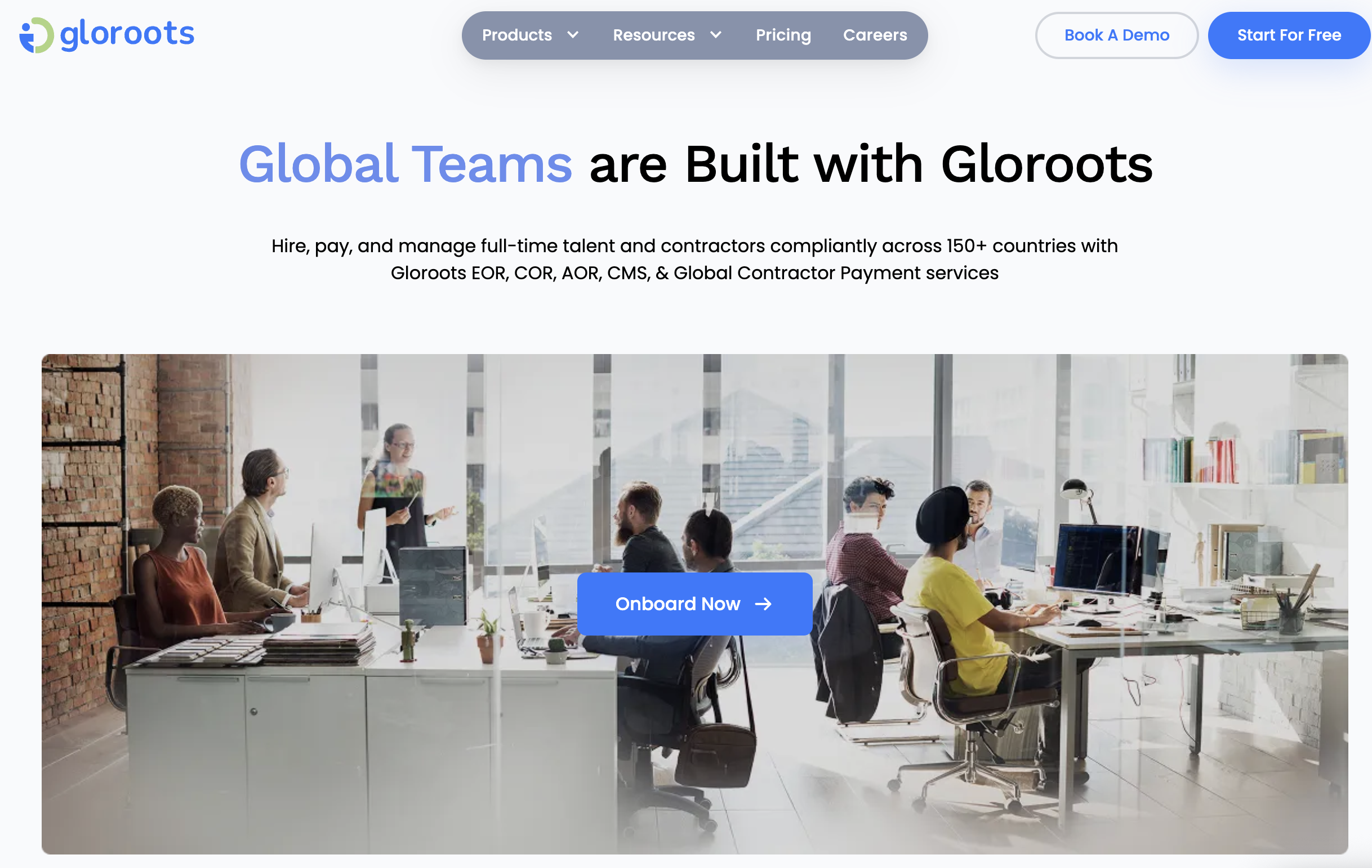
Gloroots runs entity-free employment in Malaysia as part of its Global Employer of Record service covering 150+ countries. It combines Global EOR, Global Payroll, Compliance and Employment Governance, and Benefits and Statutory Coverage into a single operating layer. Employment contracts are drafted under the Employment Act 1955 and all statutory filings run through Gloroots without requiring companies to register a local entity.
Payroll executes in MYR with EPF employer contributions at 13% for employees earning $1,236 (MYR 5,000) or below and 12% for employees earning above $1,236 (MYR 5,000). SOCSO, EIS, and PCB deductions are filed with the relevant Malaysian authorities. For non-citizen employees, Gloroots applies the mandatory EPF contribution rate of 2% employer and 2% employee effective October 2025. Gloroots includes visa sponsorship support in its EOR service.
Gloroots uses predictable, country-specific pricing with full cost visibility before onboarding and no percentage-of-salary pricing. The platform provides centralized workforce visibility and human-led account support with retained business context. Onboarding runs three to five working days. G2 rating 4.9 out of 5 from 25 reviews.
Strengths:
-
Full statutory compliance across EPF, SOCSO, EIS, PCB, and HRDF filings, with itemized payslips meeting LHDN expectations, supported by Gloroots brand documentation.
-
Predictable, country-specific pricing with full cost visibility before onboarding and no percentage-of-salary pricing, per approved Gloroots brand facts.
-
Centralized workforce dashboard covering hiring, payroll, compliance, benefits, and workforce visibility, with 24/7 human support and retained account context.
Limitations:
-
Public sources reviewed did not document a provider-specific limitation.
Best for:
Companies entering Malaysia that require accurate statutory execution, Employment Pass support, and centralized workforce visibility without setting up a local entity.


Teamed
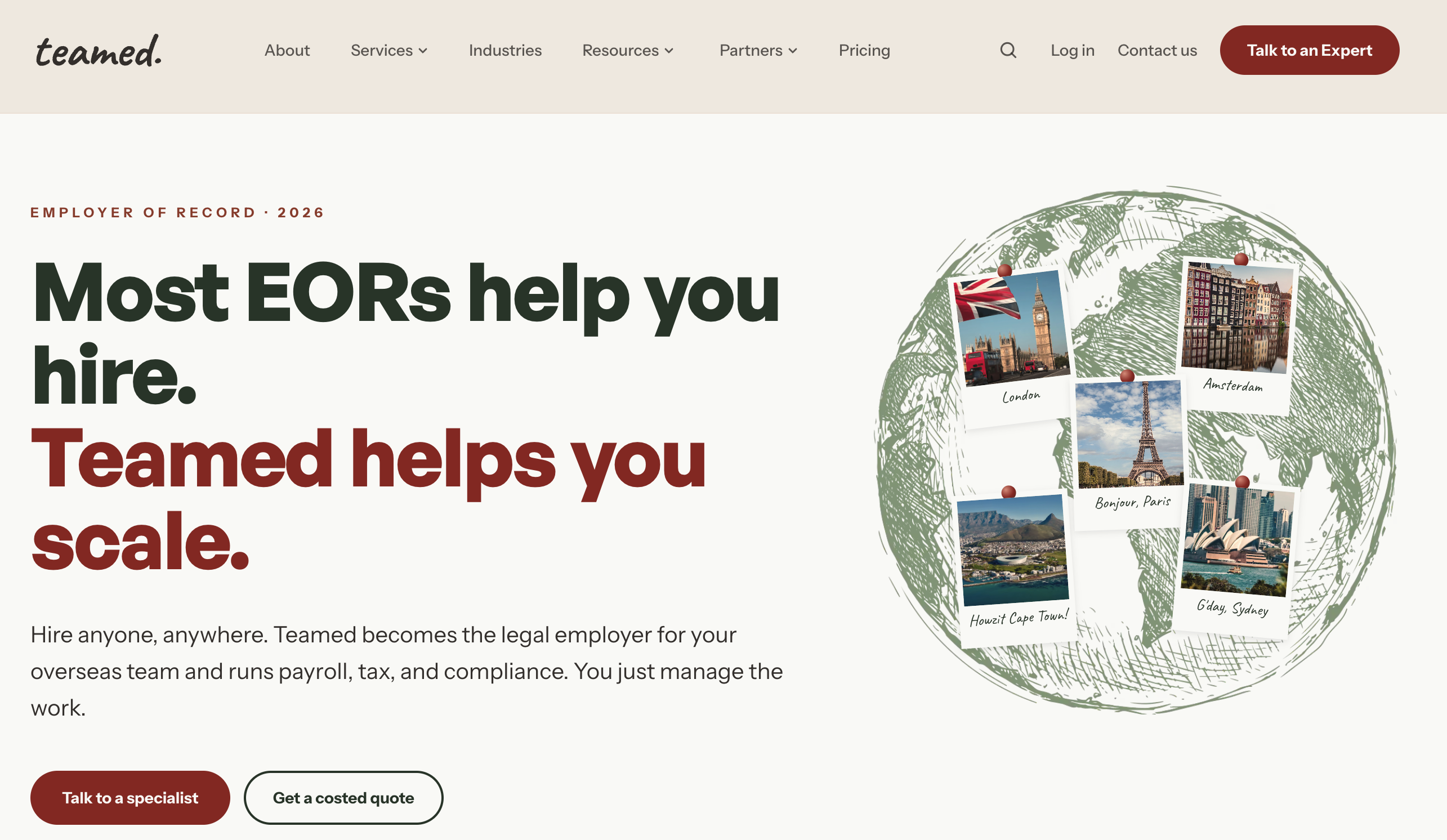
Teamed operates across 108 verified countries including Malaysia, with EOR services starting at $599 per employee per month. The platform processes payroll in 50-plus currencies and applies zero foreign exchange markup on MYR salary conversions, so the amount invoiced reflects the actual statutory cost without a currency spread added on top.
Teamed covers the full Malaysian statutory stack: EPF contributions at 13% employer rate for employees earning $1,236 (MYR 5,000) or below and 12% for those above, SOCSO, EIS, HRD Corp levy, PCB deductions filed with LHDN, and employment contracts drafted under the Employment Act 1955 including the post-2022 amendments. Employment Pass categories for foreign hires are supported. Same-day onboarding is claimed, though actual timing remains country-dependent.
A distinctive feature is Teamed's path-to-entity planning tool, which models the exact month a client's own Sdn. Bhd. becomes more cost-effective than continuing on EOR. Real HR and legal experts are included on every plan, not reserved for enterprise-tier clients. Teamed states it delivers Malaysian employment through a mix of owned entities and vetted local partners, backed by DLA Piper as global counsel. G2 lists Teamed at 4.6 out of 5 based on 57 reviews.
Strengths:
-
Real HR and legal experts are included on every plan without an enterprise-tier requirement, and same-day onboarding is available for Malaysia subject to country-specific conditions.
-
Zero FX markup on MYR salary conversions means invoiced costs reflect actual statutory amounts with no currency spread applied by the provider.
-
Path-to-entity planning models the exact month a client's own Sdn. Bhd. beats EOR cost, giving companies a clear transition point rather than an open-ended EOR dependency.
Limitations:
-
Teamed was founded in 2018, giving it a shorter operational track record than more established EOR providers, which may give larger enterprises reason to pause before committing.
-
Contractor management pricing is not publicly disclosed, which limits cost comparison for companies running mixed workforces of employees and contractors.
Best for:
Rapidly growing companies hiring in Malaysia that want real Malaysian employment-law expertise and one partner from first contractor through to their own Sdn. Bhd.
Deel
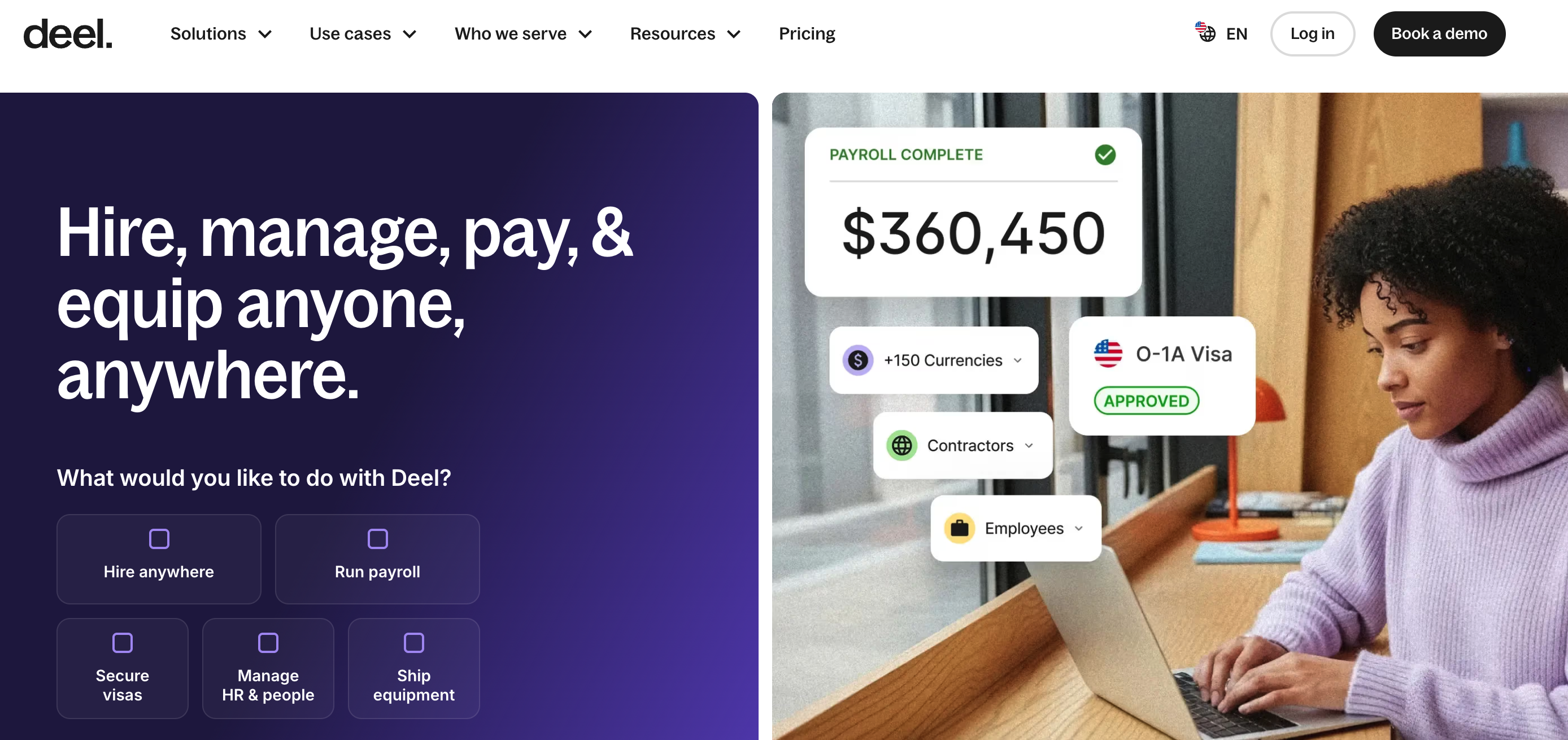
Deel owns its Malaysian entity, which means EOR employment contracts, payroll runs, and statutory filings operate through a single accountable legal structure rather than a third-party partner network. The platform covers 150-plus countries and handles EPF, SOCSO, EIS, HRDF, and PCB filings for Malaysian employees, with payroll data stored on Malaysian servers in compliance with the Personal Data Protection Act.
EPF employer contribution rates in Malaysia depend on employee salary level. For Malaysian citizens earning $1,236 (MYR 5,000) or below, the employer rate is 13%. For those earning above $1,236 (MYR 5,000), the employer rate is 12%. From October 2025, non-citizen employees are subject to mandatory EPF contributions of 2% from the employer and 2% from the employee. Deel confirms it handles EPF compliance in Malaysia and manages this updated obligation for foreign workers from Q4 2025 onward.
Deel's real-time compliance hub issues law change alerts, which means payroll configurations update in response to regulatory changes rather than requiring manual intervention from the client. Using Deel's owned Malaysian entity avoids the cost and time of setting up a local Sdn. Bhd., which can exceed $33,959 (MYR 137,378) and take four or more weeks. Pricing sits between $692 (RM 2,800) and $1,335 (RM 5,400) per employee per month, with onboarding typically completed in one to three days.
Strengths:
-
Deel holds the highest user satisfaction score and largest market presence among EOR products on G2, with a rating of 4.8 out of 5 from 14,696 reviews accessed August 28, 2026.
-
A real-time compliance hub issues law change alerts, so payroll configurations reflect current statutory rates including the October 2025 non-citizen EPF update without requiring manual client action.
-
Using Deel's owned Malaysian entity avoids entity setup costs that can exceed $33,959 (MYR 137,378) and a setup period of four or more weeks, allowing companies to hire in Malaysia without registering a local Sdn. Bhd.
Limitations:
-
Public sources reviewed did not document a provider-specific limitation on Malaysia statutory depth relative to specialist regional providers.
Best for:
SMB to enterprise teams that manage both contractors and full-time employees and want fast onboarding, owned-entity compliance, and broad multi-country coverage beyond Malaysia.
Multiplier
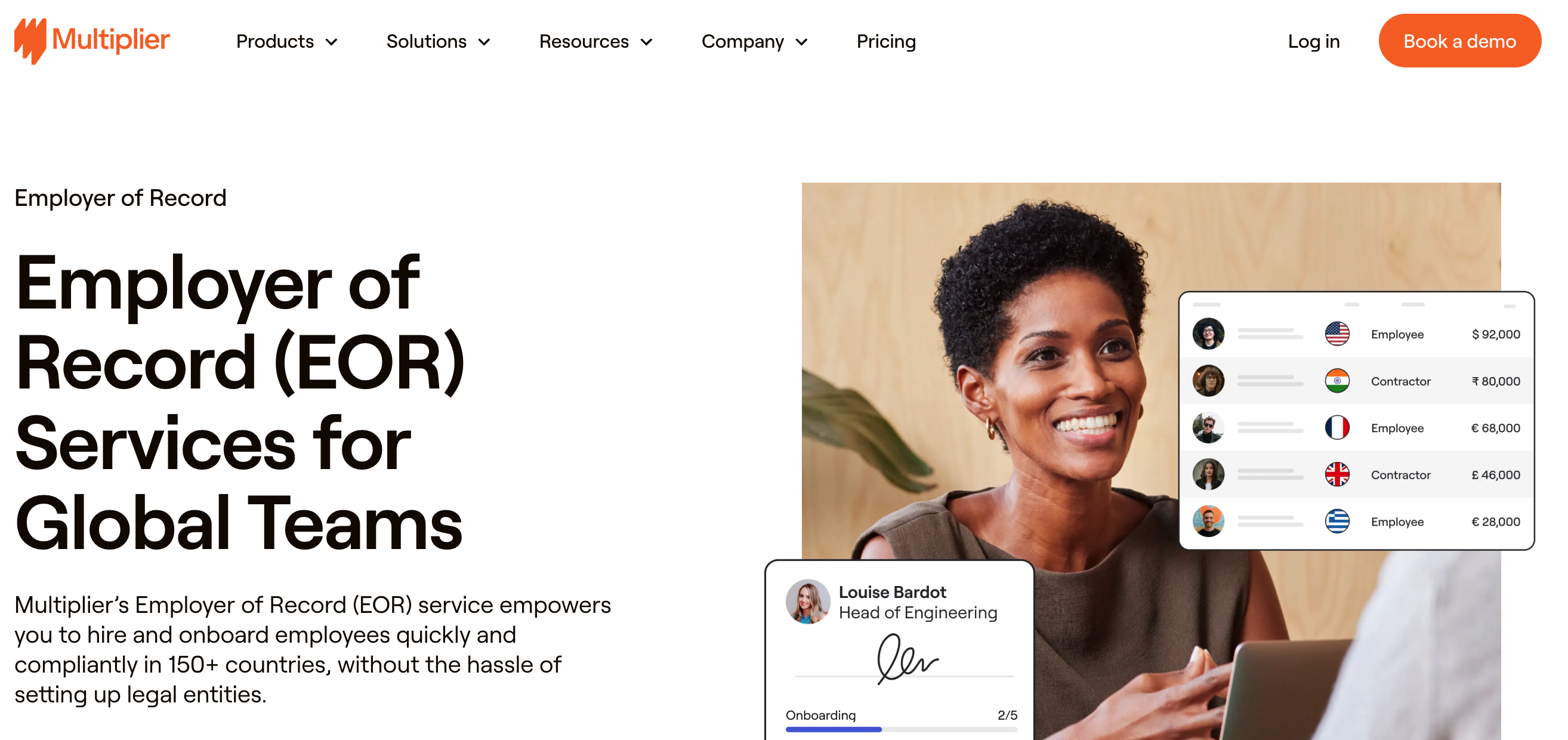
Multiplier is a global EOR platform covering 150+ countries, including Malaysia. It manages compliant employment contracts, payroll processing, and statutory obligations without requiring companies to register a local Sdn. Bhd. entity. Pricing starts from $400 per employee per month.
For Malaysia, Multiplier covers EPF, SOCSO, and EIS contributions, along with PCB monthly deductions filed with LHDN. HRDF contributions apply to qualifying employers in specified sectors; confirm directly with Multiplier whether HRDF remittance is included in its standard Malaysia service scope. For non-citizen employees, the October 2025 EPF rule requires 2% employer and 2% employee contributions. Confirm with Multiplier how this rate is configured on the platform before implementation. Employment Pass support scope should also be confirmed directly with Multiplier, as public sources reviewed do not specify whether it is included or available as an add-on.
Multiplier supports companies from their first hire through to larger distributed teams, covering SMB to enterprise scale. Customer support is described as human-first with local expertise. Onboarding speed for Malaysian hires is cited at one to two days. The platform integrates contracts, payroll, compliance, and HR administration in a single workflow.
Strengths:
-
Fast onboarding with clear platform-led workflows; contracts, payroll, compliance, and HR administration run in one integrated platform.
-
Compliant payroll execution in Malaysia covering EPF, SOCSO, and EIS without requiring a local entity, at a starting price of $400 per employee per month.
Limitations:
-
Public sources reviewed do not confirm how the October 2025 mandatory 2% EPF contributions for non-citizen employees are configured on the platform; verify directly with Multiplier before implementation.
-
Employment Pass support scope and HRDF remittance inclusion are not documented in public sources reviewed; confirm both directly with Multiplier.
Best for:
Cost-conscious companies running APAC-first expansion strategies that want competitive per-employee pricing and fast onboarding across multiple regional markets, including Malaysia.
Remote
Remote operates through owned legal entities in the markets it covers, including Remote Malaysia Sdn. as listed in its Terms of Service. This structure means employment contracts, payroll, and statutory filings run through a single accountable entity rather than a third-party partner network. Pricing starts from $699 per employee per month.
For Malaysian citizen employees earning $1,236 (MYR 5,000) or below per month, the employer EPF contribution rate is 13%. For those earning above $1,236 (MYR 5,000), the employer rate is 12%. Employee contribution remains 11% in both cases. Remote covers SOCSO, EIS, and PCB monthly deductions filed with LHDN as part of its Malaysia statutory stack. For HRDF, public sources reviewed do not confirm whether Remote includes HRD Corp levy remittance in its standard Malaysia service scope; confirm directly with Remote before implementation. Employment Pass support for foreign nationals is available through Remote's Malaysia service.
For non-citizen employees, the October 2025 EPF rule requires 2% employer and 2% employee contributions. Public sources reviewed do not confirm Remote's specific implementation approach for this rate change; verify directly with Remote before processing non-citizen payroll. Remote supports SMB to enterprise scale, with particular strength for companies that prioritise owned-entity legal structure. Customer support is described as in-house local experts with dedicated specialist support. Onboarding typically completes in two to four days.
Strengths:
-
Owned-entity model through Remote Malaysia Sdn. reduces sub-contractor risk; full EPF (with citizen salary-band rate distinction), SOCSO, EIS, and PCB compliance coverage for Malaysia.
-
Employment Pass support for foreign nationals is available, and the platform covers payroll, benefits, compliance, and IP protection in a single owned-entity structure.
Limitations:
-
Onboarding runs two to four days rather than same-day or next-day, which may not suit companies with urgent hiring timelines.
-
Public sources reviewed do not confirm Remote's handling of the October 2025 non-citizen EPF 2%/2% rate or HRDF remittance inclusion; both require direct verification with Remote before implementation.
Best for:
Mid-market to enterprise teams that prioritise owned-entity legal structure and want structured statutory compliance, including Employment Pass support, over the fastest possible onboarding speed.
Safeguard Global

Safeguard Global is a global EOR provider with more than 18 years of experience and coverage across 187 countries and territories. It offers payroll, benefits, HR administration, and full employee lifecycle support without requiring a local entity. Starting price is $699 per employee per month.
Safeguard Global is recognized as a market leader in the 2025 NelsonHall EOR Services NEAT Report. Its model pairs a global workforce platform with in-country compliance experts who provide guidance on local labor laws, payroll nuances, and workforce management throughout the employment lifecycle. For Malaysia, the entity model and specific statutory coverage details including EPF, SOCSO, EIS, PCB, and HRDF handling are Safeguard Global operates in Malaysia via its owned Safeguard Global Malaysia Sdn. Bhd., and its Malaysia country guides confirm EPF, SOCSO, and EIS benefits and require PCB withholding; HRD Corp confirms levy obligations for eligible employers; EPF confirms 2% employee and 2% employer contributions for non-citizens effective with October 2025 wages..
G2 score and review count are G2 rating 4.3 out of 5 from 110 reviews.
Strengths:
-
In-country experts provide personalized guidance on local labor laws, compliance, payroll nuances, and workforce management throughout the employment lifecycle. Safeguard Global is recognized as a market leader in the 2025 NelsonHall EOR Services NEAT Report.
-
Coverage across 187 countries and territories with more than 18 years of EOR experience, giving multinational companies a proven track record across regulated industries.
Limitations:
-
Public sources reviewed did not document a provider-specific limitation for Malaysia statutory depth or Employment Pass execution.
Best for:
Companies that value personalized, human-led compliance guidance and a strategic global employment partner with a long track record across regulated industries.
Oyster HR
Oyster HR is a global EOR platform supporting 180 countries and paying teams in 140 local currencies. It covers Malaysia as part of its service footprint and targets companies from startups to enterprise scale. Starting price is $699 per employee per month.
For Malaysia, Oyster handles EPF registration and payroll processing. EPF employer contribution rates differ by salary band: employers contribute 13% for Malaysian citizen employees earning $1,236 (MYR 5,000) or below per month, and 12% for those earning above $1,236 (MYR 5,000). Employee contribution is 11% in both bands. SOCSO and EIS deductions are included in Malaysia payroll processing. PCB income tax is withheld at source and filed with LHDN. From October 2025, non-citizen employees are subject to mandatory EPF contributions of 2% employer and 2% employee.
Oyster operates through a combination of directly owned entities and reputable partner networks to maintain compliance with local employment laws. Scalability runs from startups to enterprise teams.
Strengths:
-
Oyster works with directly owned entities and reputable partners to maintain compliance with local employment laws. The platform includes employment practices liability coverage and country-specific legal guidance.
-
Platform experience is described as user-friendly for both HR teams and employees, with localized benefits plans paid in local currency and centralized contract storage.
Limitations:
-
Customer support is listed as business hours only, which may constrain companies operating across time zones that need out-of-hours payroll or compliance assistance.
Best for:
SMB and mid-market teams that prioritize a clean, employee-friendly platform experience and are hiring in Malaysia without complex immigration or statutory edge cases.
G-P
G-P (formerly Globalization Partners) is an enterprise-focused EOR platform covering 180+ countries, including Malaysia. It operates through the G-P Meridian platform, which covers hiring, onboarding, payroll, benefits, and compliance. Pricing starts from approximately $599 per employee per month, with country-specific quotes available on request.
G-P supports compliant employment in Malaysia under the Employment Act 1955. Statutory coverage includes EPF, SOCSO, EIS, and PCB filings with LHDN. For non-citizen employees, the October 2025 EPF rule requires 2% employer and 2% employee contributions. Employment Pass support scope and HRDF remittance handling for qualifying Malaysian employers should be confirmed directly with G-P before onboarding. Onboarding speed is cited at 2 to 7 days in published country comparisons, though actual timing is country-dependent.
Strengths:
-
G-P Meridian platform covers hiring, onboarding, payroll, benefits, and compliance in one interface, with a dedicated Customer Success Manager and in-country expertise on each account.
-
180+ country coverage supports multi-market expansion programs, making G-P a practical option for enterprise teams running parallel hiring across several jurisdictions.
Limitations:
-
Pricing is not fully transparent on the public website; country-specific quotes are required, which adds a step for teams comparing costs across multiple EOR providers.
Best for:
Mid-market to enterprise teams running multi-country hiring programs that require a dedicated Customer Success Manager and a single platform covering employment, payroll, and compliance across 180+ countries.
What Are the Key Services of an EOR in Malaysia?
An EOR in Malaysia handles the full employment lifecycle under the Employment Act 1955, including the January 2023 amendments that changed working hours, paternity leave, and termination rules. From October 2025, EPF contributions apply to non-citizen employees, adding a statutory obligation that every compliant EOR must configure accurately before each payroll run.
Overtime compliance is a core service area. The Employment Act caps overtime at 104 hours per month, and premium rates apply for hours worked beyond the standard 45-hour week. An EOR must calculate and remit these amounts correctly on each payroll cycle.
East Malaysia adds a jurisdictional layer. Sabah and Sarawak operate under separate Labour Ordinances rather than the Employment Act 1955. Companies hiring in those states should confirm with their EOR which ordinance governs each employment contract before onboarding begins.
Core EOR service areas in Malaysia include:
-
Employment contracts drafted under the applicable ordinance, with correct working-hours, leave, and termination terms
-
Payroll processing in MYR with accurate EPF, SOCSO, EIS, and PCB deductions filed with the relevant authorities
-
HRDF levy remittance for qualifying employers with 10 or more Malaysian employees in covered sectors
-
Benefits administration covering statutory minimums and supplementary plans
-
Employment Pass and work authorisation support for foreign nationals
-
Overtime calculation and remittance at statutory premium rates, within the 104-hour monthly cap
Employment Contracts and Local Compliance
A compliant EOR drafts employment contracts under the Employment Act 1955 and applies the January 2023 amendments accurately. Maximum weekly hours are 45. Fathers are entitled to 7 days of paid paternity leave.
Overtime is capped at 104 hours per month. Weekday overtime is paid at 1.5 times the hourly rate. Work on a rest day is paid at 2 times the rate, and work on a public holiday is paid at 3 times the rate, per the Employment Act 1955 as amended January 2023.
Termination notice periods vary by length of service under the Employment Act 1955: 4 weeks for service under 2 years, 6 weeks for 2 to 5 years, and 8 weeks for service exceeding 5 years.
Employees based in Sabah or Sarawak are governed by the applicable Labour Ordinance for those states, not the Employment Act 1955. Contracts for those employees must reference the correct ordinance.
Payroll and Tax Administration
EPF employer contribution rates differ by salary level. For Malaysian citizens earning $1,236 (MYR 5,000) or less per month, the employer contributes 13%. For those earning above $1,236 (MYR 5,000), the employer contributes 12%. Employee contribution is 11% in both cases.
From October 2025, non-citizen employees are subject to mandatory EPF contributions of 2% from the employer and 2% from the employee. SOCSO is 1.75% employer and 0.5% employee. EIS is 0.2% from each side. HRDF applies at 1% of monthly wages for qualifying employers with 10 or more Malaysian employees in specified sectors, remitted to HRD Corp.
Total employer statutory costs add up to approximately 15 to 20% on top of gross salary: EPF (12 to 13%) plus SOCSO (1.75%) plus EIS (0.2%) plus HRDF (1% where applicable).
At a gross salary of $1,236 (MYR 5,000) per month, the employer EPF contribution is $161 (MYR 650) (13%), SOCSO is $22 (MYR 87.50) (1.75%), EIS is $2 (MYR 10) (0.2%), and HRDF is $12 (MYR 50) (1% where applicable). Total employer statutory cost reaches approximately $197 (MYR 797.50) per month on top of the $1,236 (MYR 5,000) gross salary.
Benefits Administration
Malaysia's Employment Act 1955, as amended in January 2023, sets minimum statutory leave entitlements for all covered employees.
-
Annual leave: 8 days for employees with fewer than 2 years of service; 12 days for 2 to 5 years; 16 days for more than 5 years.
-
Sick leave: 14 days for fewer than 2 years of service; 18 days for 2 to 5 years; 22 days for more than 5 years.
-
Maternity leave: 98 days paid, following the post-2022 amendment.
-
Paternity leave: 7 days paid, effective January 2023.
-
Public holidays: 11 paid days drawn from 15 gazetted national holidays.
Supplemental benefits including private medical, dental, and optical coverage are standard market practice in Malaysia. EOR providers typically offer access to group plans that meet local hiring expectations.
Employers hiring in Sabah and Sarawak should confirm applicable entitlements directly. Those states operate under separate Labour Ordinances, and leave entitlements may differ from the peninsular Employment Act 1955 schedule.
Employee Onboarding
A compliant EOR in Malaysia runs onboarding through four core steps: employment contract signing, statutory registration covering EPF, SOCSO, EIS, and PCB, payroll setup, and benefits enrollment.
For Malaysian residents, onboarding typically completes within 1 to 5 days depending on the provider and employee type. Timelines vary by platform and the completeness of documents submitted at the start of the process.
Foreign nationals require an Employment Pass before they can begin work. Applications are processed through the Expatriate Committee or the MyXpats Centre. Most Employment Pass categories carry a minimum salary threshold of $1,236 (MYR 5,000) per month, and quota restrictions apply. Processing times for Employment Pass applications extend the overall onboarding timeline beyond the standard 1 to 5 day range for local hires.
Ongoing HR Support
An EOR in Malaysia runs payroll each month and files statutory contributions on schedule. This covers EPF, SOCSO, EIS, and PCB remittances to LHDN, plus the HRDF levy for qualifying employers with 10 or more Malaysian employees in covered sectors.
Annual obligations include EA form preparation and submission. Law changes require immediate action. When EPF contribution rules for non-citizen employees changed in October 2025, compliant EORs reconfigured payroll before the next pay run.
Support models vary across providers. Some offer 24/7 access with a dedicated account manager who retains context across your account. Others operate on business hours with a shared support queue. For teams managing payroll across time zones, the support model is a practical factor to confirm before signing.
Employee Offboarding
Offboarding under the Employment Act 1955 requires written notice. Notice periods vary by length of service: one to four weeks for employees with under two years of service, and up to eight weeks for those with five or more years.
Final salary must be paid within the statutory deadline. EPF, SOCSO, EIS, and PCB deductions apply to the final payroll run and must be filed accurately with the relevant authorities.
For mass layoffs, the employer must notify the Department of Labour (JTKSM) before retrenchment proceeds. For foreign national employees, the Employment Pass must be cancelled with the Immigration Department of Malaysia following termination. Personal data handled during offboarding is subject to the Personal Data Protection Act 2010, which requires that employee data is managed and disposed of in accordance with its provisions.
How to Hire Through an EOR in Malaysia
Hiring through an EOR in Malaysia follows two phases: Selection and Setup, then Onboarding and Compliance. Understanding how does EOR work before you begin helps set accurate expectations for timelines and obligations.
The process applies to both local Malaysian hires and foreign nationals. Foreign national hires require additional Employment Pass steps, which adds time and documentation to the standard workflow.
For hires based in East Malaysia, confirm jurisdiction early. Sabah and Sarawak operate under separate labour ordinances from Peninsular Malaysia, and your EOR must account for those differences before drafting contracts or running payroll.
Selection and Setup
Selecting the right EOR for Malaysia starts with a structured evaluation. Key criteria include whether the provider operates through an owned Malaysian entity or a partner network, the depth of EPF, SOCSO, EIS, and PCB compliance, Employment Pass support scope, and how the provider handles the October 2025 mandatory non-citizen EPF contributions of 2% employer and 2% employee.
Also assess onboarding SLA, support model, contract exit terms, and security certifications before signing.
On setup speed, an EOR is typically operational within one to five business days. Registering a local Sdn. Bhd. entity takes four or more weeks and costs between $1,236 (MYR 5,000 and MYR 15,000) in setup fees, before accounting for ongoing compliance overhead. The EOR route avoids those costs entirely. A full cost comparison between EOR and Sdn. Bhd. entity registration is covered in the benefits section.
Onboarding and Compliance
A compliant EOR in Malaysia executes onboarding in a defined sequence. The process begins with contract execution under the Employment Act 1955, followed by statutory registrations covering EPF, SOCSO, EIS, and PCB (monthly tax deductions filed with LHDN). Payroll is then configured and benefits enrollment completed before the first pay run.
For foreign nationals requiring work authorisation, the Employment Pass path runs through the Expatriate Committee or MyXpats Centre. Applicants must meet a minimum monthly salary of $1,236 (MYR 5,000). The EOR confirms quota availability before submission and manages the processing timeline on the employer's behalf.
From October 2025, non-citizen employees are subject to mandatory EPF contributions at 2% employer and 2% employee. Payroll must be configured at these rates from day one for eligible hires. Companies hiring in Sabah or Sarawak should confirm which Labour Ordinance applies before contract execution, as those states operate under separate legislation from Peninsular Malaysia.
What Are the Benefits of Using an EOR in Malaysia?
Using an EOR in Malaysia removes the need to register a local entity before hiring. That decision has direct cost and time implications that affect how quickly a company can place its first employee.
Setting up a private limited company (Sdn. Bhd.) in Malaysia typically costs between $1,236 (MYR 5,000 and MYR 15,000) in registration and professional fees, with setup taking one to three weeks. An EOR requires no entity registration, reduces setup time to one to five days, and carries minimal upfront cost. Entity setup costs can exceed $33,959 (MYR 137,378) when legal, compliance, and administrative expenses are included. For most companies, the EOR model becomes less cost-efficient than a local entity at around five to eight employees, at which point the ongoing per-employee fee exceeds the amortised cost of running a Sdn. Bhd.
The six benefit areas below cover what an EOR delivers across the employment lifecycle in Malaysia, from statutory compliance to workforce visibility, and explain why each matters for companies that are not yet ready to commit to a local entity.
Faster Market Entry
An EOR can onboard a Malaysian employee in one to five days. Registering a Sdn. Bhd. entity takes one to three weeks, and compliance setup adds further time after that.
An EOR also allows hiring to begin while entity registration is still in progress. Companies that need to secure a candidate before a local entity is ready can use an EOR to issue a compliant contract and run payroll immediately.
Malaysia's talent market is competitive. With unemployment at 3.0% as of June 2026, skilled candidates receive multiple offers. The gap between offer and signed contract matters. A faster offer-to-hire process reduces the risk of losing a candidate to a competitor.
Reduced Compliance Risk
Malaysia's statutory obligations carry real penalty exposure. EPF contribution rates vary by salary band and citizenship. From October 2025, non-Malaysian employees face mandatory EPF contributions of 2% from the employer and 2% from the employee, requiring immediate payroll reconfiguration.
The Employment Act 1955 amendments effective January 2023 changed working hours, paternity leave, and termination rules. Overtime rates and weekly hour caps apply under those amendments. Employers operating in Sabah and Sarawak face separate jurisdictional rules that differ from Peninsular Malaysia.
Misclassifying a contractor as an employee, or the reverse, creates direct legal exposure. An EOR removes that risk by establishing a compliant employment relationship from day one. Employee data handling also falls under Malaysia's Personal Data Protection Act, and a qualified EOR manages those obligations as part of its standard employment governance.
Simplified Payroll Administration
Malaysian payroll involves multiple statutory deductions that must be calculated accurately each month. Employers remit EPF at 13% (or 12% for salaries above $1,236 (MYR 5,000)), SOCSO at 1.75%, EIS at 0.2%, PCB income tax withholding to LHDN, and HRDF at 1% for qualifying employers. Rates vary by salary band and citizenship status.
For an employee earning $1,236 (MYR 5,000) per month gross, the employer statutory cost breakdown is approximately: EPF $148 (MYR 600) (12%), SOCSO $22 (MYR 87.50) (1.75%), EIS $2 (MYR 10) (0.2%), and HRDF $12 (MYR 50) (1%), totalling roughly $185 (MYR 747.50) per month on top of gross salary. Total employer statutory costs typically add 15 to 20% above gross salary.
An EOR also prepares the annual EA form and meets monthly PCB filing deadlines with LHDN. Managing these obligations in-house requires dedicated payroll expertise. An EOR handles every filing, deduction, and remittance as part of its standard service.
Access to Local Benefits
Malaysian law sets a statutory baseline for all employees. Annual leave entitlement starts at 8 days for employees with fewer than 2 years of service, rises to 12 days for 2 to 5 years, and reaches 16 days for more than 5 years. Sick leave follows the same service bands at 14, 18, and 22 days respectively.
Maternity leave stands at 98 days. Paternity leave is 7 days paid, effective January 2023 under the Employment Act amendment. Employees are also entitled to 11 paid public holidays per year.
Beyond the statutory floor, an EOR gives employees access to group medical, dental, and optical plans that most individual employers cannot qualify for independently due to minimum headcount thresholds. Competitive benefits matter in Malaysia's tight labor market, where attracting and retaining skilled talent requires more than the legal minimum. An EOR consolidates benefits administration so employers can offer a complete package from day one.
Lower Entity Setup Costs
Setting up a Sdn. Bhd. in Malaysia carries direct costs of $1,236 (MYR 5,000) to $3,708 (MYR 15,000) in registration and filing fees alone. When legal, accounting, and operational setup are included, total entity setup costs can exceed $33,959 (MYR 137,378), based on figures cited by Deel in its Malaysia EOR guide. That figure excludes ongoing compliance costs such as annual audit fees, company secretary retainers, and annual filing obligations with the Companies Commission of Malaysia.
An EOR eliminates the need to appoint a local director or maintain a registered office address, both of which are statutory requirements for a Sdn. Bhd. For most companies, EOR remains more cost-effective than entity ownership below five to eight employees in Malaysia. Above that threshold, a break-even analysis comparing EOR fees against entity running costs is worth running before committing to either structure.
More Flexible Workforce Scaling
An EOR lets companies scale headcount in Malaysia without triggering entity restructuring obligations. For reductions that meet the threshold for mass layoffs, employers with a local entity must notify the Department of Labour Peninsular Malaysia (JTKSM) under the Employment Act 1955. An EOR contract sits outside that structure, so workforce adjustments do not require the same regulatory notification process.
EOR arrangements also support mixed workforces of full-time employees and contractors, which suits project-based hiring common in Malaysia's technology and professional services sectors. When a project ends, the workforce can be reduced without the administrative burden of entity-level restructuring.
Exit flexibility is a practical advantage. Terminating an EOR contract typically requires 30 to 90 days notice. Winding down a Sdn. Bhd. can take several months and involves regulatory filings, creditor notifications, and tax clearance. Companies that want to test the Malaysian market before committing to a permanent entity benefit from that difference. For EOR for startups, this flexibility is often the deciding factor.

How to Find the Right EOR for Malaysia
Choosing an EOR for Malaysia requires evaluating five criteria: local compliance expertise, entity model and sub-contractor risk, onboarding speed and Employment Pass support, platform and payroll accuracy, and contract exit terms.
Before signing with any provider, ask these due-diligence questions: Does the provider own its Malaysian entity or use a partner network? How does the platform handle the October 2025 mandatory EPF contributions for non-citizen employees? What is the onboarding SLA for Malaysian hires? Is Employment Pass support included in the base fee or priced as an add-on? What are the contract exit terms and notice periods? What security certifications does the platform hold?
The five criteria below apply equally to companies entering Malaysia for the first time and to teams switching from an existing EOR provider.
Local Compliance Expertise
A qualified EOR must cover the full Malaysian statutory stack: EPF rate bands by salary and citizenship, SOCSO, EIS, PCB monthly deductions filed with LHDN, HRDF contributions for qualifying employers, and Employment Act 1955 obligations including the January 2023 amendments on weekly hours, paternity leave, and termination rules.
From October 2025, non-citizen employees are subject to mandatory EPF contributions of 2% from the employer and 2% from the employee. Confirm that any provider you evaluate has already reconfigured payroll to apply this rate accurately.
-
Does the provider own its Malaysian entity or use a partner network? An owned entity reduces sub-contractor risk and keeps statutory accountability with one party.
-
For East Malaysia hires in Sabah or Sarawak, confirm which Labour Ordinance the provider applies, as separate ordinances govern employment conditions in those states.
Clear Service Scope
Before signing with any EOR in Malaysia, confirm exactly which statutory obligations are included in the base fee. Ask whether Employment Pass support is included or priced as an add-on. Confirm whether HRDF remittance to HRD Corp is covered or billed separately. Ask whether EA form preparation and year-end filing with LHDN are part of the standard service. For companies hiring in Sabah or Sarawak, confirm whether those hires fall under the same service scope as Peninsular Malaysia hires.
Pricing structure matters as much as scope. A fixed per-employee fee gives predictable costs as salaries rise. A percentage-of-salary model increases your EOR cost automatically when you give employees a raise. Gloroots uses predictable, country-specific pricing with full cost visibility before onboarding and no percentage-of-salary pricing.
Review contract exit terms before committing. Confirm the notice period required to terminate the EOR agreement, typically 30 to 90 days, and verify that data portability provisions allow you to retrieve employee records cleanly if you transition to a different provider or set up your own entity.
Support Model
Malaysia operates at UTC+8. For companies running payroll queries against EPF, SOCSO, or PCB deadlines, support availability during Malaysian business hours is a baseline requirement. A provider that routes queries through a shared ticket queue may not resolve statutory questions before a filing deadline passes.
Check whether the provider assigns a dedicated account manager or routes all requests through a general support queue. A dedicated contact who retains context on your account reduces the time spent re-explaining your workforce structure on every call. Gloroots provides human-led account support with retained business context, which is relevant when payroll queries arise close to statutory deadlines.
Support hours matter for companies operating across multiple time zones. A provider offering 24/7 coverage gives teams in North America or Europe a practical window to raise Malaysia payroll issues outside local business hours. Language support is also relevant: employee-facing communications in both Bahasa Malaysia and English reduce friction for local hires and improve compliance with employment documentation standards under the Employment Act 1955.
Technology and Reporting
A capable EOR platform gives you real-time payroll visibility in MYR and tracks statutory filing status for EPF, SOCSO, EIS, PCB, and HRDF contributions. Without that visibility, payroll errors surface only after LHDN or EPF flags a discrepancy.
EA form generation and year-end tax reconciliation should run inside the platform, not through a manual request to your account team. Law change alerts matter too. The October 2025 EPF rule for non-citizen employees required immediate payroll reconfiguration; providers that flagged this in advance gave clients time to act.
Ask each provider whether employee data stored on the platform meets Personal Data Protection Act (PDPA) requirements. Confirm integration capability with your existing HRIS or finance systems. Security certifications such as SOC 2 or ISO 27001 indicate that the provider has submitted its controls to independent audit.
Scalability for Your Hiring Plans
Your EOR pricing model should hold from your first Malaysian hire to your fiftieth. Some providers adjust fees or service tiers as headcount grows, which creates budget uncertainty at the point when you can least afford it.
If your workforce includes both employees and contractors, confirm the provider manages both from a single platform. Switching vendors mid-growth adds administrative overhead and compliance risk.
Plan for the transition to your own Sdn. Bhd. entity before you need it. EOR is cost-effective at low headcount, but a locally registered entity typically becomes more economical once payroll reaches a certain scale. Some providers model the exact month that crossover occurs, which turns entity planning from guesswork into a scheduled decision. If APAC expansion beyond Malaysia is part of your roadmap, verify that your provider covers your target markets before you commit. For companies planning to grow a distributed team across the region, EOR for mid-market companies covers how that transition is typically structured.

Why Gloroots Is a Strong EOR Partner in Malaysia
Gloroots supports compliant full-time employment across 150+ countries, including Malaysia, through its Global Employer of Record service. Companies hire without setting up a local entity.
The platform combines Global EOR, Global Payroll, Compliance and Employment Governance, and Benefits and Statutory Coverage in one place. For Malaysia, this means EPF, SOCSO, EIS, PCB, HRDF, and EA form filings are handled as part of the standard service. The October 2025 non-citizen EPF change, requiring 2% employer and 2% employee contributions, is covered within Gloroots compliance governance.
Pricing is country-specific and predictable. You see the full MYR cost before onboarding begins, with no percentage-of-salary pricing. There are no mid-cycle surprises when statutory rates change.
Account support is human-led, with retained business context across every payroll cycle. Your team does not re-explain Malaysia statutory changes each month. The account team carries that context forward.
For companies hiring foreign nationals, Gloroots supports Employment Pass processes in Malaysia. This makes it a practical option for teams that include both local and international hires under one employment structure.
Centralized workforce visibility means HR, Finance, and Legal teams track headcount, payroll, and compliance status from a single dashboard. To learn more about how Gloroots runs employment in Malaysia, visit Gloroots EOR services or review Gloroots pricing. Book a demo or speak with the Gloroots team to discuss your Malaysia hiring plan.
FAQs About the Best EOR in Malaysia
How does an EOR work in Malaysia?
An EOR becomes the legal employer of record in Malaysia, taking on all statutory obligations while your company retains day-to-day work direction over the employee. The EOR drafts employment contracts under the Employment Act 1955, runs payroll with accurate EPF, SOCSO, EIS, and PCB deductions, and files returns with LHDN and EPF on your behalf.
This model eliminates the need to register a local Sdn. Bhd. entity before hiring. The EOR also absorbs regulatory changes as they occur. The October 2025 EPF rule requiring 2% employer and 2% employee contributions from non-Malaysian workers is one example of a statutory obligation the EOR reconfigures and remits without requiring action from the client company. For a deeper look at how the model operates, see how does EOR work.
What does an EOR cost in Malaysia?
EOR pricing in Malaysia typically ranges from $596 to $745 per employee per month based on the providers reviewed in this guide. Pricing models vary: some providers charge a fixed per-employee fee, while others price as a percentage of salary.
The EOR fee is only part of the total employer cost. Statutory contributions add approximately 15 to 20 percent on top of gross salary. The main components are EPF at 12 to 13% employer contribution, SOCSO at 1.75%, EIS at 0.2%, and HRDF at 1% where applicable.
Fixed per-employee pricing, as used by Gloroots, gives finance teams a predictable monthly figure regardless of salary level. Percentage-of-salary models increase in cost as salaries rise, which can make budgeting less reliable for growing teams. For a full breakdown of how EOR fees are structured, see employer of record cost.
When should a company use an EOR in Malaysia?
An EOR is appropriate when hiring one to seven employees in Malaysia without a local entity, when testing the Malaysian market before committing to a private limited company registration, or when needing to place staff within one to five days rather than waiting one to three weeks for entity setup.
Foreign nationals requiring Employment Pass support and companies without local HR expertise to manage Employment Act 1955 compliance are also strong candidates for EOR. At five to eight or more employees, registering a local entity may become more cost-effective than ongoing EOR fees.
Can an EOR hire both local and foreign employees in Malaysia?
Yes. An EOR can employ both Malaysian citizens and foreign nationals. For foreign nationals, the EOR manages the Employment Pass application through the Expatriate Committee and the MyXpats Centre. The minimum salary threshold for an Employment Pass is $1,236 (MYR 5,000) per month for most categories, and quota restrictions apply.
From October 2025, non-citizen employees are mandatory EPF contributors at 2% employer and 2% employee. Not all EOR providers offer Employment Pass sponsorship, so confirm the scope of immigration support before selecting a provider.
How do I choose the right EOR in Malaysia?
Start with six questions before signing any EOR contract. Does the provider own its Malaysian entity or use a partner network? How does the platform handle the October 2025 mandatory EPF contributions of 2% employer and 2% employee for non-citizen staff? What is the onboarding SLA in writing? Is Employment Pass support included in the base fee or priced as an add-on? What are the contract exit terms, typically 30 to 90 days? What security certifications does the platform hold?
For detailed evaluation criteria, refer to the selection criteria section earlier in this guide. If you are hiring in Sabah or Sarawak, confirm the provider covers East Malaysia under the applicable Labour Ordinance, which differs from the Employment Act 1955 that governs Peninsular Malaysia.