




- Total employer cost in Colombia runs approximately 45 to 55 percent above base salary once mandatory contributions are included, covering health, pension, occupational risk insurance, parafiscal contributions, service bonus, and severance fund deposits, so buyers should request a full statutory cost breakdown from any EOR before committing.
- Employers with fewer than ten employees may qualify for an exemption from parafiscal contributions to SENA, ICBF, and the family compensation fund under Law 1429 of 2010, which can meaningfully reduce total payroll cost for small teams.
- The entity model an EOR uses in Colombia, whether a wholly-owned local entity or a local partner network, affects direct legal employment accountability and compliance ownership, making this a critical question to confirm before signing a master services agreement.
- EOR onboarding in Colombia typically takes three to ten business days from signed contract to first payroll run, compared to 16 to 28 weeks required to incorporate a local entity, making EOR the faster path for companies that need to activate Colombian headcount quickly.
- Pricing across the eight providers reviewed ranges from $199 to $699 per employee per month, and foreign exchange policies vary significantly, with some providers applying mid-market rates and others applying a fixed or marked-up rate, so buyers funding invoices in USD while paying employees in Colombian pesos should confirm the FX policy before signing.
Colombia has become one of Latin America's most active markets for distributed hiring. This guide evaluated more than a dozen EOR providers operating in Colombia before narrowing the list to eight, assessed across six axes: compliance ownership, pricing transparency, onboarding speed, platform experience, customer support model, and scalability.
All salary and statutory cost figures in this guide use the 2026 SMMLV (monthly minimum legal wage) as the reference wage. Employers should note that total employer cost in Colombia runs approximately 45 to 55 percent above base salary once mandatory contributions are included. The sections below cover that cost burden in detail, including health, pension, occupational risk insurance, parafiscal contributions, prima de servicios, and severance fund deposits.
Our Top 8 Picks: Colombia EOR Comparison 2026
More than a dozen providers were evaluated before the list was narrowed to eight based on Colombia market coverage, Labor Code compliance capabilities, and pricing transparency. The table below gives you a cost baseline, geographic reach, onboarding speed, platform quality, support model, and scalability indicator for each provider. Use it as a starting filter before reading the detailed profiles below.
| Provider | Pricing per month | Country coverage | Onboarding speed | Platform experience | Customer support | Scalability |
|---|---|---|---|---|---|---|
| Gloroots | From $199/employee/month | 150+ countries | 3-5 working days | Centralized workforce dashboard covering hiring, payroll, compliance, benefits and workforce visibility | 24/7 human support with dedicated account management | SMB to enterprise; built for multi-country programs |
| Teamed | $599/employee/month flat; statutory costs and benefits vary by country | 187+ countries | 24 hours to first hire claimed; actual timing remains country-dependent | EOR platform covering employment, payroll, tax, benefits, compliance and IP | Dedicated country specialist on every account | SMB to enterprise |
| Deel | $599/employee/month; country-specific statutory costs are additional | 130+ EOR countries; broader global hiring footprint is larger | Automated onboarding; country-dependent | Unified platform for EOR, payroll, contractors, HR, benefits, compliance and integrations | 24/7 HR, legal and tax expertise | SMB to enterprise; strong fit for fast-scaling distributed teams |
| Remote | $699/employee/month standard; annual/contract arrangements may offer different pricing | 90+ EOR countries | Dedicated onboarding specialist; country-dependent | Owned-entity EOR platform with payroll, benefits, compliance, IP protection and workforce management | In-house local experts and dedicated specialist support | SMB to enterprise; particularly strong for companies prioritizing owned entities/IP |
| G-P (Globalization Partners) | From ~$599/employee/month / custom quote; country-specific pricing | 180+ countries | 2-7 days in published country comparisons; country-dependent | G-P Meridian platform covering hiring, onboarding, payroll, benefits and compliance | Dedicated Customer Success Manager and in-country expertise | Mid-market to enterprise |
| Rippling | Custom EOR pricing; country-specific | 80 EOR countries | Not publicly listed as a universal timeframe | Unified HR + IT + payroll + finance platform | In-app/customer support; depth varies by plan | SMB to enterprise; particularly strong for automation-heavy HR/IT environments |
| RemoFirst | From $199/employee/month; explicitly varies by country | 185+ countries | Days, not weeks; country-dependent | Centralized EOR platform covering payroll, tax, benefits, visa support and compliance | Dedicated account manager + in-country experts; 24/7 support | Startups to enterprise |
| Safeguard Global | From ~$599/employee/month; premium markets/country complexity can increase cost | 187 countries | 1-2 weeks in most countries; country-dependent | Global workforce platform covering EOR, payroll, HR and compliance | Dedicated account management + regional/in-country specialists | Mid-market to enterprise |

Top 8 Best EOR Platforms in Colombia
The eight providers below were selected from a broader field of more than twenty EOR platforms reviewed for Colombia market coverage. Final selection applied six evaluation axes: pricing transparency, compliance ownership model, platform depth, support tier, entity-path guidance, and security certifications held.
Each profile states the provider's entity model for Colombia, whether owned entity or local partner, and discloses the foreign exchange policy applied to payroll and contractor payments. Profiles are ordered with Gloroots first, followed by seven additional providers ranked by Colombia-specific compliance capability and pricing clarity.
Gloroots
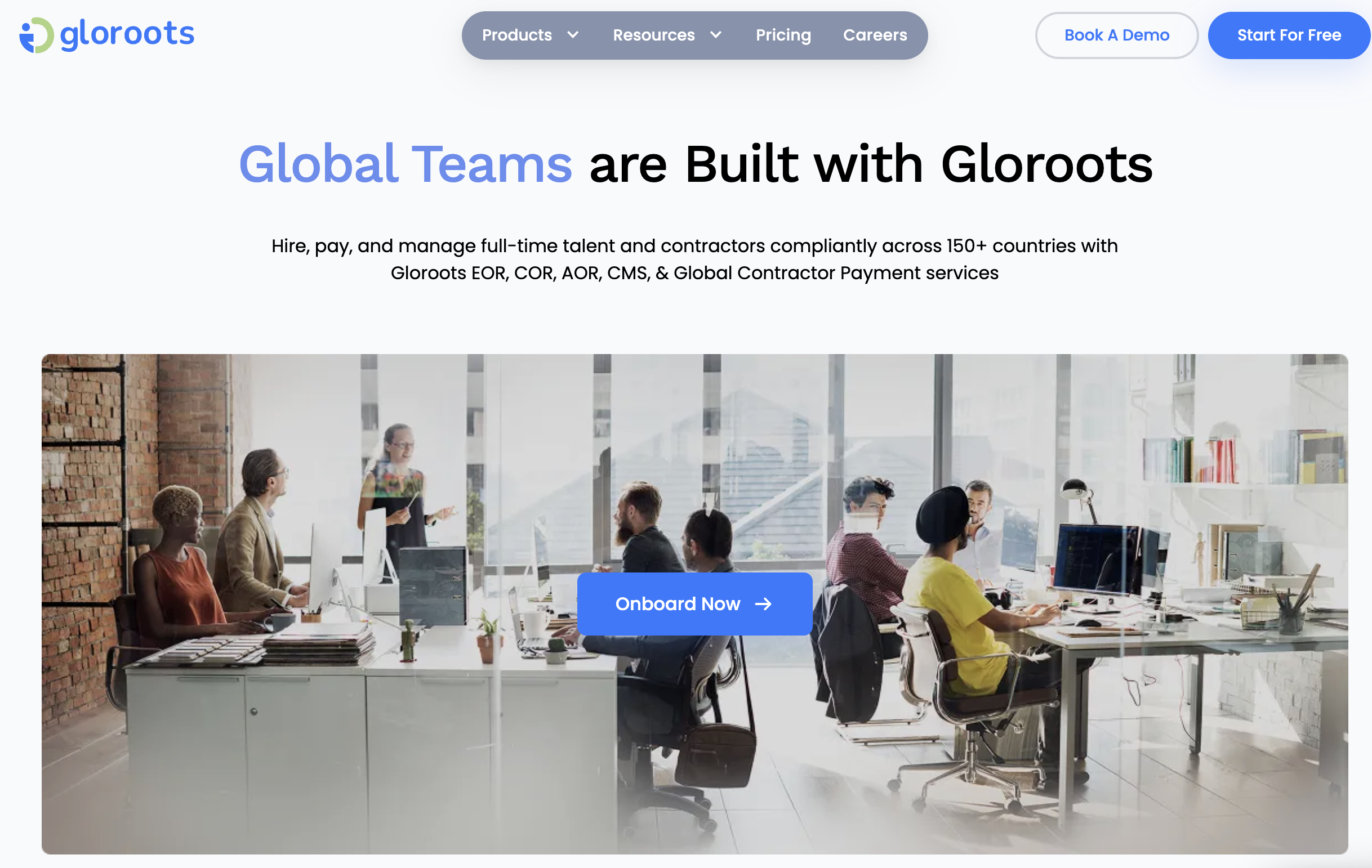
Gloroots is a global employment platform that supports compliant full-time employment across 150+ countries, including Colombia. It combines Global Employer of Record (EOR), Global Payroll, Compliance and Employment Governance, and Benefits and Statutory Coverage into one platform. Gloroots operates in Colombia through a local partner model. Gloroots states it uses an owned-entity model in Colombia, not a partner network.
Gloroots holds ISO 27001 certification and SOC 2 Type II attestation. Gloroots states it uses ISO 27001 and SOC 2 Type II standards for data security (retrieved September 8, 2026). The platform uses predictable, country-specific pricing with no percentage-of-salary fees and full cost visibility before onboarding begins. Gloroots charges $199 per employee per month for Colombia EOR services and applies mid-market exchange rates with no hidden FX markup for international payments.
Colombia's parafiscal contribution rules include an exemption for eligible employees earning individually less than 10 SMMLV, which reduces or eliminates SENA, ICBF, and family compensation fund obligations. Colombian Tax Statute Article 114-1 provides this exemption from SENA, ICBF, and employer health contributions for qualifying employers in respect of employees earning individually less than 10 SMMLV. The platform's G2 rating is 4.9 out of 5 based on 21 G2 reviews (retrieved September 8, 2026).
Strengths:
-
Full statutory cost coverage in Colombia, including parafiscal contributions, occupational risk insurance, prima de servicios, and cesantias fund deposits, managed through one platform with centralized workforce visibility.
-
Predictable, country-specific pricing at $199 per employee per month with no percentage-of-salary fees and mid-market FX rates applied to international payments, giving finance teams a fixed cost baseline before onboarding.
-
Human-led account support with retained business context across the employment lifecycle, reducing coordination overhead for HR and finance teams managing Colombian headcount.
Limitations:
-
Gloroots is a newer platform than several established competitors, which may require additional due diligence for buyers with complex multi-country compliance programs.
-
G2 reviews identify limited HRMS integration and limited regional customization as recurring drawbacks. Reviewers also mention some initial onboarding issues, although these appear to have improved over time.
Best for:
Companies that want all statutory obligations in Colombia, including parafiscal contributions, occupational risk insurance, and mandatory benefits, managed through a single platform with predictable pricing and human-led account ownership.


Teamed
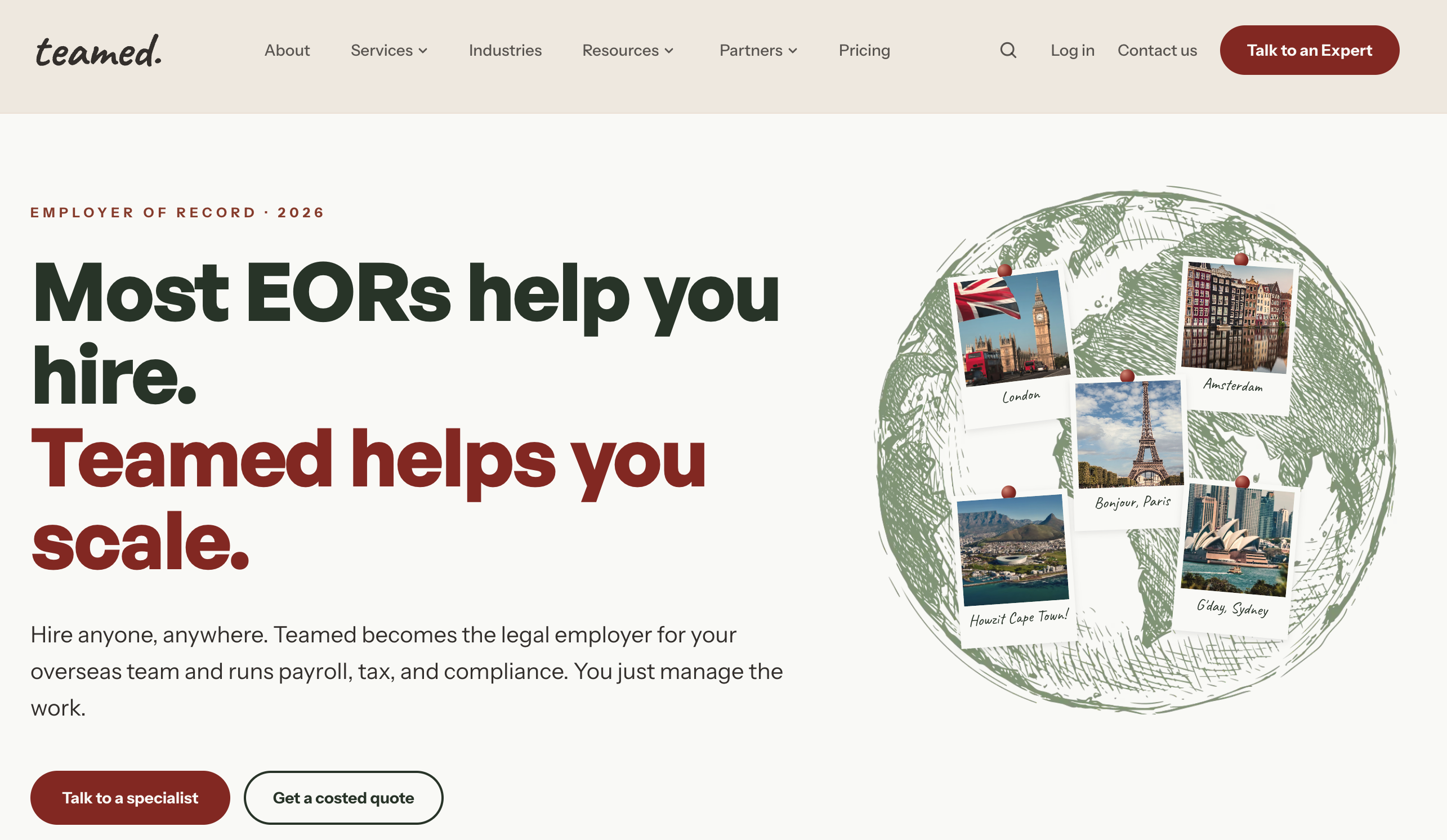
Teamed is a global EOR provider operating across 187+ countries. In Colombia, it scores at the top of four of six Colombia-focused rubric axes, leading outright on service model, employment intelligence, and path to a client's own SAS entity. Pricing is a flat $599 per employee per month, with foreign exchange absorbed at zero markup.
Teamed includes real HR and legal experts on every plan, not locked behind an enterprise tier. The platform covers parafiscal contributions, prima de servicios, cesantias, and occupational risk insurance (ARL). It also models the exact month at which a client's own SAS entity becomes more cost-effective than continuing with EOR. Total employer cost in Colombia runs approximately 45 to 55 percent above base salary, and Teamed pre-calculates each statutory obligation within that range.
On security certifications, Teamed trails providers that hold ISO 27001 and SOC 2 Type II accreditation. No analyst recognition specific to Teamed was identified in researched sources.
Strengths:
-
Scores at the top of four of six Colombia-focused rubric axes, leading on service model, employment intelligence, and path to a client's own SAS entity.
-
Every plan includes real HR and legal experts; the platform models the exact month a client's own SAS entity beats EOR cost, supporting long-term entity planning.
Limitations:
-
Trails certified providers on security: ISO 27001 and SOC 2 Type II certifications are not confirmed in researched sources. Also trails Deel and Rippling on platform depth and self-serve dashboard capability.
Best for:
Rapidly growing companies hiring in Colombia that want HR and legal experts on call for parafiscal, prima de servicios, and cesantias compliance, and one partner from first Colombian hire through to their own SAS entity.
Deel
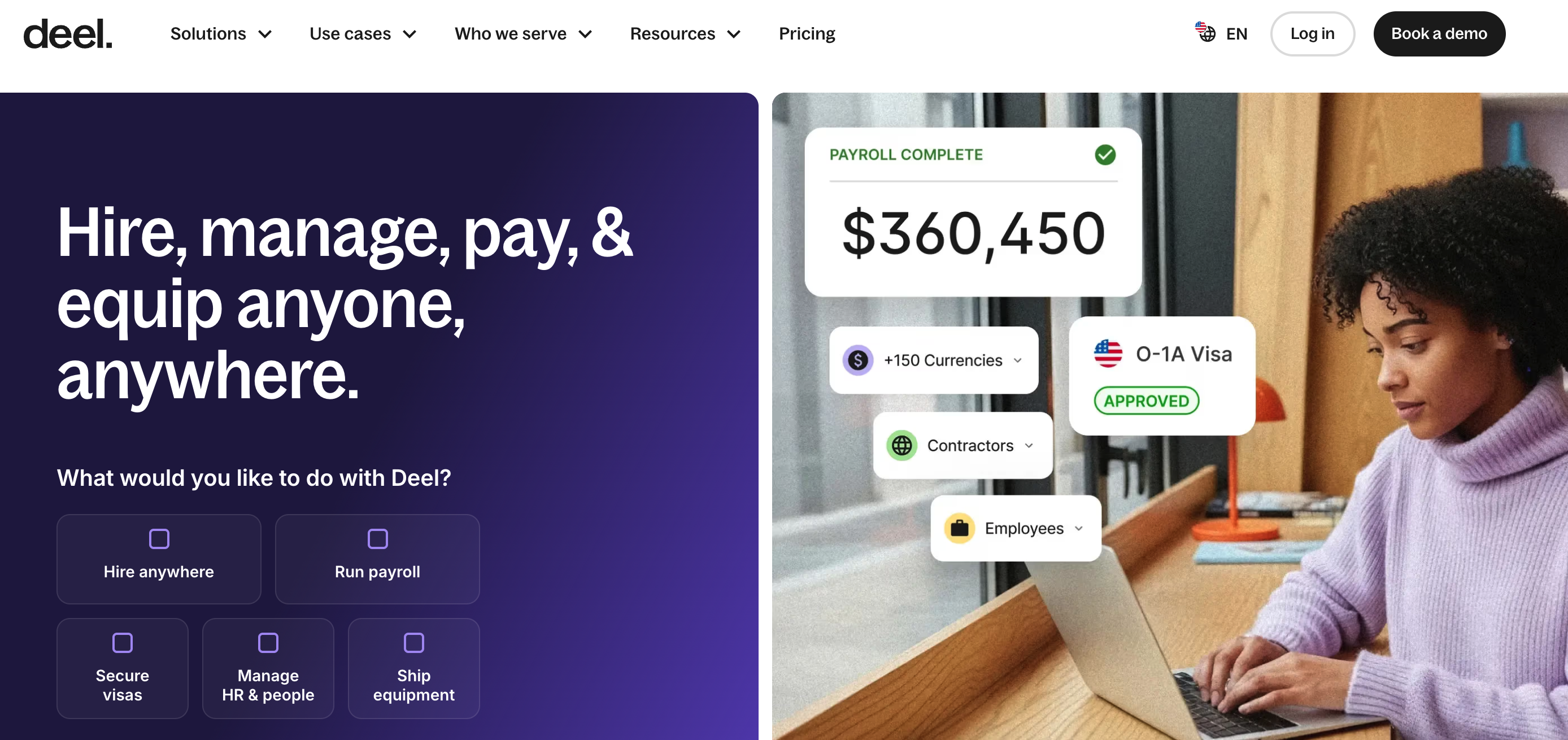
Deel operates in Colombia through a wholly-owned local entity, which means it employs Colombian workers directly without relying on a third-party partner. It onboards employees in under five working days, compared to 16 to 28 weeks required for entity incorporation. The platform covers employment contracts under the Colombian Labor Code, PILA social security submissions, parafiscal contributions, income tax withholding, prima de servicios, cesantias, and occupational risk insurance (ARL).
Deel holds ISO 27001 and SOC 2 Type II certifications. It was recognized as a Leader in Everest Group's 2025 Employer of Record (EOR) Solutions PEAK Matrix Assessment and received an independent vendor assessment from NelsonHall in July 2025. The platform provides a Compliance Hub with real-time compliance alerts and AI-powered cost forecasting. Colombian payroll is invoiced in a single USD invoice, which removes the need for clients to manage foreign exchange conversion directly. Currency conversion is applied only when invoice funding currency differs from payroll currency, with competitive exchange rates and minimal fees per Deel's published terms.
Pricing is $599 per employee per month. Customer support operates on a tiered model with 24/7 availability covering HR, legal, and tax expertise.
Strengths:
-
Wholly-owned Colombian entity supports direct legal employment; onboards in under five working days versus 16 to 28 weeks for entity incorporation.
-
Real-time compliance alerts via Compliance Hub, AI-powered cost forecasting, and a single USD invoice mechanism reduce FX coordination overhead for finance teams.
-
Leads on platform depth and self-serve dashboard per Colombia-focused rubric; holds ISO 27001 and SOC 2 Type II certifications.
Limitations:
-
Tiered support model details and specific response-time commitments for Colombia accounts are not documented in researched sources, which limits visibility into service-level expectations.
Best for:
Companies that need compliant Colombian employment activated quickly under the Labor Code, with a platform that scales across multiple countries and carries enterprise-grade security certifications.
RemoFirst
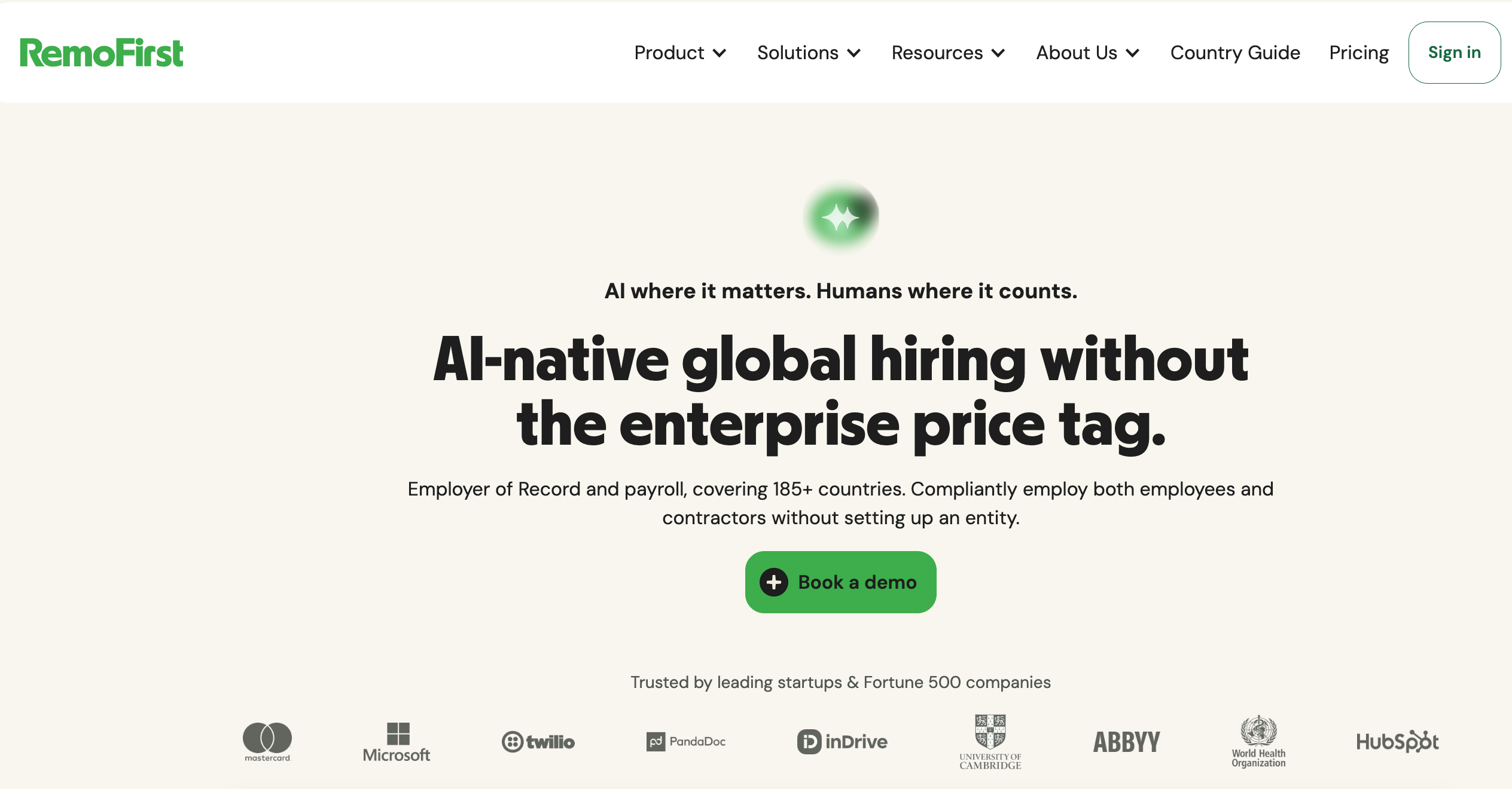
RemoFirst is a global employer of record covering 185+ countries, including Colombia. It operates through a local-partner model rather than a wholly-owned entity in Colombia, relying on established in-country partners to execute payroll and compliance obligations.
RemoFirst manages Colombian employee onboarding, payroll in Colombian pesos, and statutory benefits including health insurance, social security, and paid leave. It also supports visa and immigration assistance and equipment shipping for Colombia-based hires. Statutory services covered include social security contributions filed through PILA, parafiscal contributions (SENA, ICBF, and family compensation fund), prima de servicios paid in two annual installments, and cesantias fund deposits. EOR services start at $199 per employee per month. Contractor management is available from $25 per contractor per month. RemoFirst states it uses mid‑market rates for currency conversion on invoices, i.e., the midpoint between buy and sell prices. 4.5 out of 5 based on 403 G2 reviews (retrieved September 8, 2026) RemoFirst states it is SOC 2 Type II certified and ISO 27001 certified.
Strengths:
-
Predictable pricing with no hidden fees; a dedicated account manager is included on every account with 24/7 customer support.
-
Broad service scope for Colombia-based hires, covering payroll in Colombian pesos, statutory benefits, visa and immigration support, and equipment shipping from one platform.
Limitations:
-
RemoFirst does not operate its own legal entity in Colombia. It relies on long-standing local partners for payroll execution and compliance, which introduces an additional layer between the client and direct employment accountability.
Best for:
Startups and small businesses seeking budget-friendly EOR coverage in Colombia with predictable per-employee pricing and a dedicated account manager included.
Remote
Remote is a global employer of record that operates through an owned-entity model in Colombia, providing direct legal employment without reliance on third-party local partners. Pricing starts at $699 per employee per month, with contractor management available at $29 per contractor per month.
Remote manages Colombian Labor Code compliance, PILA social security submissions, and statutory benefits including prima de servicios, cesantias, and mandatory bonuses. It supports contractor management alongside full-time employment, giving companies flexibility when managing mixed workforces in Colombia. The platform integrates with Workday, Zapier, and Xero, and pricing transparency is rated on par with comparable providers in Colombia-focused evaluations. Remote applies a fixed monthly Remote FX Rate when billing and payroll currencies differ. This rate is set by Remote rather than tracking the mid-market rate, which means the effective conversion cost may be higher than a mid-market benchmark. Buyers funding invoices in USD while paying Colombian employees in COP should request the current Remote FX Rate before committing. Remote is ISO/IEC 27001 certified and SOC 2 Type II compliant. Its Trust Center provides the current ISO 27001 certificate and SOC 2 Type II report for customers. 4.5 out of 5 based on 3,887 G2 reviews (retrieved September 8, 2026) Remote reports Leader placements in G2's Summer 2026 Employer of Record reports, including Mid‑Market Grid.
Strengths:
-
Owned-entity model in Colombia supports direct employment compliance execution without reliance on a third-party local partner, reducing intermediary risk.
-
Wide integration support including Workday, Zapier, and Xero, with pricing transparency rated on par with comparable Colombia EOR providers.
Limitations:
-
Public review sources report slow support responses, onboarding timelines longer than expected, and occasional payroll inconsistencies for some accounts.
Best for:
Larger companies with the budget to match seeking an owned-entity EOR in Colombia with extensive integration options and statutory benefit coverage.
Rippling

Rippling is a unified HR, IT, payroll, and finance platform that extends employer of record coverage across 80 countries, including Colombia. It is built for companies that want to manage Colombian hires through a self-serve dashboard rather than relying on a dedicated HR specialist for day-to-day tasks.
Rippling handles Colombian payroll and statutory filings through its platform. Colombia-specific statutory services include PILA contributions covering health, pension, and occupational risk (ARL), parafiscal contributions to SENA, ICBF, and Caja de Compensacion Familiar, prima de servicios paid in two annual installments, and cesantias fund deposits.
Rippling's pricing for Colombia EOR is custom and not publicly listed in researched sources. Its G2 rating and review count are 4.8 out of 5 stars based on 12,372 reviews on G2 (retrieved September 8, 2026). Security certifications held by Rippling are SOC 2 Type II, SOC 1, ISO 27001, ISO 27018, and ISO 42001.
Strengths:
-
Deeper self-serve dashboard and platform automation than most EOR providers, making it a strong fit for HR and operations teams that want to manage Colombian hiring independently without a dedicated specialist.
-
Unified HR, IT, payroll, and finance tooling in one platform, reducing the number of systems a company needs to run Colombian employment alongside global workforce management.
Limitations:
-
EOR country coverage is limited to 80 countries, which is narrower than several competing providers on this list and may constrain multi-country programs that extend beyond Rippling's supported markets.
Best for:
Companies that want a self-serve dashboard with deep platform and automation capabilities for managing Colombian hires independently.
Safeguard Global

Safeguard Global is a global employment platform founded in 2008 and covering 187 countries and territories, including Colombia. It combines technology with in-country human experts to manage payroll, benefits, HR administration, and end-to-end workforce compliance. It is recognized as a market leader in the 2025 NelsonHall EOR Services NEAT Report.
Colombia-specific statutory services managed by Safeguard Global include PILA submissions; parafiscal contributions to SENA, ICBF, and CCF; prima de servicios in June and December; annual cesantías deposits with 12% interest; and employer-funded ARL coverage. The entity model used to employ workers in Colombia is owned local entity via Global CS Colombia S.A.S.
Safeguard Global's starting price is $699 per employee per month.
Strengths:
-
Positioned as a market leader in the 2025 NelsonHall EOR Services NEAT Report, with 18 or more years of EOR experience across regulated industries, providing a documented compliance track record for enterprise and mid-market buyers.
-
Dedicated account management combined with regional and in-country specialists gives Colombia-based employment programs access to human-led guidance at each stage of the employment lifecycle.
Limitations:
-
Starting price of $699 per employee per month sits at the higher end of the providers on this list, which may make Safeguard Global less suitable for startups or small teams with limited EOR budgets.
Best for:
Companies that value personalized, human-led guidance and a long compliance track record, including enterprise and mid-market organizations building or expanding Colombian headcount.
Globalization Partners
Globalization Partners (G-P) is an established employer of record covering 180+ countries, including Colombia. The platform operates through the G-P Meridian suite, which covers hiring, onboarding, payroll, benefits, and compliance from a single interface. A dedicated Customer Success Manager is assigned to each account.
In Colombia, G-P manages the statutory obligations defined by the Colombian Labor Code and the PILA integrated social security system. Covered services include PILA submissions for health, pension, and occupational risk contributions; parafiscal contributions to SENA, ICBF, and the family compensation fund; occupational risk insurance (ARL) enrollment; prima de servicios paid in two annual installments; and cesantias fund deposits with the required annual interest payment. Payroll is executed in Colombian pesos. Employment is executed via G-P's local Colombian entity, GLOBALIZATION PARTNERS COLOMBIA S A S (NIT 901076771). G2 rating 4.4/5 based on 988 reviews (retrieved September 8, 2026). ISO 27001 certified and SOC 2 (Type II attested) for the G‑P Platform (retrieved September 8, 2026). Everest Group Employer of Record (EoR) Solutions PEAK Matrix Assessment 2025 (Highest Leader and Star Performer) and NelsonHall Global EOR NEAT 2024 (Leader).
Strengths:
-
Rated level with Teamed on Colombian coverage and compliance depth across a Colombia-focused six-axis rubric, covering PILA, parafiscales, prima de servicios, cesantias, and ARL.
-
G-P Meridian provides a unified platform for hiring, onboarding, payroll, benefits, and compliance, with a dedicated Customer Success Manager on every account.
Limitations:
-
Pricing is not publicly listed in researched sources, which makes upfront cost comparison harder without requesting a custom quote.
Best for:
Mid-market to enterprise companies that want broad geographic coverage across 180+ countries alongside dedicated account management and a unified compliance platform for Colombian hires.
What Are the Key Services of an EOR in Colombia?
Two frameworks define what an EOR must execute in Colombia. The Colombian Labor Code sets contract terms, termination rules, mandatory bonuses, and statutory leave. PILA, the integrated social security contribution system, governs monthly remittances covering health, pension, and occupational risk insurance.
Together, these frameworks produce a defined set of compliance obligations that every EOR operating in Colombia must cover on behalf of the employer. The sections below describe each obligation in detail, including the statutory rates, deadlines, and administrative steps involved.
One obligation varies by employer headcount. Parafiscal contributions to SENA, ICBF, and the family compensation fund apply to employers above a defined salary threshold. The service section covering parafiscales explains the applicable threshold and how it affects total employer cost in Colombia.
Employment Contracts and Local Compliance
Colombian law recognizes two primary contract types: indefinite-term and fixed-term. Indefinite-term contracts have no set end date and are the default form of employment under the Labor Code. Fixed-term contracts must specify a duration and can be renewed, but repeated renewals may convert them to indefinite-term arrangements.
Probationary periods differ by contract type. For indefinite-term contracts, the maximum probationary period is two months. For fixed-term contracts, the probationary period cannot exceed one-fifth of the agreed contract term.
Termination rules change after probation ends. During probation, either party may end the contract without cause. After probation, the employer must pay severance and, in most cases, provide statutory notice or compensation in lieu. An EOR drafts contracts that meet Colombian Labor Code requirements, covering these distinctions from day one.
Payroll and Tax Administration
Total employer cost in Colombia runs approximately 45 to 55 percent above an employee's base salary. That burden is built from several mandatory line items: health contributions at 8.5%, pension at 12%, occupational risk insurance (ARL) at a rate that varies by job category, parafiscal contributions covering SENA at 2%, ICBF at 3%, and the family compensation fund at 4%, plus prima de servicios and cesantias. All calculations are anchored to the 2026 statutory minimum monthly wage (SMMLV).
Employers with fewer than ten employees may be exempt from SENA, ICBF, and family compensation fund contributions under Law 1429 of 2010, which introduced parafiscal relief for small employers meeting the statutory headcount threshold.
A separate arrangement applies to higher-earning employees. Workers earning ten or more times the SMMLV may agree to an integral salary structure, which bundles statutory benefits into a higher base wage. This changes how parafiscal contributions and benefit calculations are applied and requires explicit agreement in the employment contract.
Benefits Administration
Colombian law mandates several statutory benefits that employers must administer correctly. The prima de servicios is paid in two installments per year: one by June 30 and one by December 20. Cesantias must be deposited into the employee's chosen fund by February 14 each year, and cesantias interest is paid at 12% annually by January 31.
Employees are entitled to 15 business days of paid vacation per year. Mandatory bonuses are also required under the Labor Code.
The transportation subsidy (auxilio de transporte) is mandatory for employees earning up to two times the monthly minimum wage (SMMLV). The 2026 amount is $64 (COP 200,000) per month and is included in the cesantias calculation base. An EOR manages enrollment in supplemental health and life insurance where applicable.
Employee Onboarding
EOR onboarding in Colombia follows a defined sequence. On day one, the employment contract is signed under the Colombian Labor Code. The EOR then submits the employee to PILA within the required registration window, enrolls the employee in the occupational risk insurer (ARL), and registers them with the applicable family compensation fund (Caja de Compensacion Familiar).
The first payroll run follows once all registrations are confirmed. End-to-end, from signed contract to first payroll run, the typical timeline is three to ten business days, though statutory registration windows can affect the exact date.
Onboarding speed varies by provider. The comparison table above shows published timelines for each of the eight providers covered in this guide.
Ongoing HR Support
Ongoing HR support in Colombia covers MinTrabajo reporting, annual DIAN filings, and periodic PILA reconciliation. An EOR manages each obligation on the statutory schedule so employers avoid late-filing penalties.
The EOR monitors Colombian Labor Code amendments and updates employment terms when legislation changes. This includes tracking parafiscales exemption thresholds as headcount grows, since crossing certain employee counts affects contribution obligations.
Worker misclassification risk is a standing compliance concern in Colombia. The EOR tracks contractor-versus-employee classification across the workforce and advises on reclassification triggers before a misclassification finding creates liability.
Employee Offboarding
Colombian law distinguishes between just-cause and without-cause dismissal. Without-cause termination triggers a statutory indemnity: for employees earning up to 10 times the monthly minimum wage, the formula is 30 days of salary for the first year of service plus 20 days per additional year. For employees earning above that threshold, the formula is 20 days per year of service.
The EOR calculates and executes the full final settlement. This covers outstanding severance fund balances, severance interest at 12% annually, pro-rata service bonus, and accrued vacation pay.
Where applicable, the EOR also manages stability protection obligations, including cases where an employee holds protected employment status under Colombian law.
How to Hire Through an EOR in Colombia
Hiring through an EOR in Colombia follows two phases: selection and setup, then onboarding and compliance execution. The EOR becomes the legal employer of record, manages all statutory filings, and pays the employee in Colombian pesos on your behalf.
This approach removes the need to incorporate a local entity. A Colombian SAS incorporation takes 16 to 28 weeks and carries ongoing compliance overhead once established. Whether an EOR or a local SAS entity is more cost-effective at a given headcount is covered in the benefits section, including a breakeven analysis to support that decision.
Selection and Setup
Begin by defining the role and compensation in Colombian pesos, anchored to the 2026 minimum monthly legal wage (SMMLV). A clear compensation figure lets the EOR calculate total employer cost accurately before onboarding begins.
Once compensation is set, select an EOR provider and sign a master services agreement. At this stage, confirm the entity model the provider uses: an owned Colombian entity or a local partner network. Compliance ownership differs between the two, and that distinction affects your legal exposure.
Confirm the foreign exchange policy before signing. Providers apply different approaches, including mid-market rates, fixed rates, or a markup on conversion. For enterprise buyers, verify security certifications such as ISO 27001 and SOC 2 Type II at this stage.
After the agreement is signed, provide employee details so the EOR can draft a Colombian Labor Code-compliant employment contract. Onboarding begins once the contract is executed.
Onboarding and Compliance
An EOR in Colombia follows a defined sequence from contract execution to first payroll run. The steps below reflect the standard timeline under Colombian law.
-
Contract execution: The EOR issues a Colombian Labor Code-compliant employment contract. Probationary periods may be structured for up to two months under Article 78 of the Labor Code, with options to shorten based on role type.
-
PILA registration: The EOR registers the employee in the integrated social security system, covering health, pension, and occupational risk contributions.
-
ARL enrollment: The EOR classifies the employee by job risk category and enrolls them with the appropriate occupational risk insurer.
-
Caja de Compensacion Familiar registration: The EOR registers the employee with a family compensation fund and confirms parafiscal contribution applicability based on employer headcount at the time of hire.
-
First payroll run: The EOR executes payroll in Colombian pesos, remitting all statutory contributions and withholding income tax in line with DIAN requirements.
The EOR also maintains worker classification documentation throughout the engagement, reducing misclassification exposure under Colombian labor and tax law.
What Are the Benefits of Using an EOR in Colombia?
Using an EOR in Colombia reduces the time and legal exposure involved in employing workers without a registered local entity. Companies can place a Colombian employee on a compliant contract within days rather than the 16 to 28 weeks typically required to incorporate a local subsidiary.
The core benefits span four areas: speed to hire, compliance risk reduction, cost predictability, and workforce flexibility. An EOR manages PILA filings, parafiscal contributions, ARL enrollment, and statutory benefit administration on the employer's behalf, which removes the need for in-country legal and payroll infrastructure.
Cost predictability is a practical advantage for finance teams. A fixed monthly EOR fee covers statutory obligations and removes the variable overhead of running a local entity. For companies evaluating whether an EOR or a local SAS entity is more cost-effective at a given headcount, that breakeven analysis is covered in the Lower Entity Setup Costs section below.
Faster Market Entry
Incorporating a Sociedad por Acciones Simplificada (SAS) in Colombia takes 16 to 28 weeks. An EOR can place a compliant employee in days, not months.
Colombia's tech talent market is moving quickly. With tech hiring expectations at 29% in Q1 2026, the window to secure qualified candidates is narrow. A company that waits for entity incorporation risks losing candidates to competitors who can extend offers immediately.
Through an EOR, PILA registration covering health, pension, and occupational risk, along with ARL enrollment, can be completed within the first payroll cycle. The employee is on payroll, covered, and productive before a local entity would even clear its first regulatory filing.
Reduced Compliance Risk
Colombian labor law applies a three-part test to determine whether a worker is an employee: subordination, personal service, and remuneration. A contractor who meets all three criteria is legally an employee, regardless of how the contract is labeled.
Misclassification carries real financial consequences. Employers found to have misclassified workers owe back social security contributions, parafiscal payments, and statutory benefits, plus applicable fines. The exposure compounds the longer the misclassification continues.
An EOR assumes compliance ownership on behalf of the client company. It manages Labor Code contracts, PILA filings, and parafiscal contributions from day one. It also monitors the parafiscales exemption threshold: companies with fewer than 10 employees are exempt from SENA, ICBF, and family compensation fund contributions, but that exemption disappears as headcount grows. An EOR tracks that threshold and adjusts filings accordingly, so the client does not face a retroactive liability.
Simplified Payroll Administration
Colombian payroll carries a total employer cost burden of roughly 45 to 55 percent above base salary. That burden includes PILA submissions covering health, pension, and occupational risk, plus parafiscal contributions to SENA, ICBF, and the family compensation fund, income tax withholding, and statutory payments such as prima de servicios and cesantias calculations.
An EOR absorbs every one of those obligations. It calculates, files, and remits each component on the statutory schedule, removing the need for an in-country payroll team or specialist accountant.
For companies funded in foreign currency, payroll in Colombian pesos introduces FX exposure. A qualified EOR operates with a disclosed foreign exchange policy, giving finance teams a predictable cost basis each pay cycle rather than variable conversion outcomes.
Access to Local Benefits
Colombian law requires employers to administer a defined set of statutory benefits. An EOR manages all of them: prima de servicios paid in two annual installments, cesantias deposited by the February 14 deadline, cesantias interest at 12 percent annually, mandatory transportation subsidies, paid vacation, health and pension enrollment through PILA, and occupational risk insurance classification and registration.
Beyond statutory minimums, an EOR can offer supplemental benefits such as private health coverage and group life insurance. These additions improve offer competitiveness in a market where tech talent has multiple options.
For employees earning ten or more times the monthly minimum wage, the salario integral structure applies and changes how statutory benefits are calculated. A capable EOR supports this contract type and applies the correct benefit methodology from the start of employment.
Lower Entity Setup Costs
Incorporating a Colombian SAS (Sociedad por Acciones Simplificada) typically takes 16 to 28 weeks and requires legal fees, notary costs, and ongoing compliance overhead covering accounting, legal counsel, and mandatory MinTrabajo filings. Once operational, a local entity also carries recurring costs for payroll administration, statutory reporting, and tax compliance that apply regardless of headcount.
An EOR removes those fixed costs entirely. You pay a per-employee monthly fee and the EOR manages all statutory obligations. For most companies, EOR remains more cost-effective than a local entity up to approximately 5 to 15 employees in Colombia, depending on salary levels and the complexity of benefits required.
Above that threshold, the fixed cost of a SAS can be distributed across a larger headcount, which may reduce the per-employee cost below EOR fees. A provider such as Gloroots models this breakeven point before onboarding begins, giving finance teams a clear number to plan against. See employer of record cost for a detailed breakdown.
More Flexible Workforce Scaling
An EOR lets you add or reduce Colombian headcount without triggering entity registration, director appointment, or ongoing statutory reporting obligations. Each new hire is activated under the EOR's existing legal structure, so compliance obligations do not multiply as your team grows.
One threshold matters as headcount increases: Colombian law exempts employers with fewer than 10 employees from parafiscal contributions to SENA, ICBF, and the family compensation fund. Once you cross that threshold, those contributions apply. An EOR tracks this transition and adjusts payroll calculations automatically, so the cost change is reflected accurately without manual intervention from your HR or finance team.
EOR also supports both fixed-term and indefinite-term contracts under the Colombian Labor Code. As workforce needs shift, you can switch contract types without renegotiating an entity-level employment framework. When headcount eventually justifies a local SAS, the EOR-to-entity transition path is available. EOR for startups and EOR for small business cover how this scaling model works in practice.

How to Find the Right EOR for Colombia
This guide evaluates each provider across six axes: pricing transparency, compliance ownership model (direct entity versus partner network), platform depth, support tier, entity-path guidance, and security certifications.
Colombia's statutory framework adds complexity that generic EOR platforms often underestimate. Parafiscal contributions, cesantias fund deposits, occupational risk insurance classification, and the salario integral threshold all require in-country expertise, not just software automation. Local compliance depth is therefore the primary filter in this guide, applied before pricing or platform features.
Providers that operate through a wholly owned Colombian entity carry direct legal accountability. Those that rely on partner networks share that accountability across parties, which can slow resolution when a filing dispute or classification question arises.
Local Compliance Expertise
Colombia's payroll obligations extend well beyond a base salary calculation. Parafiscal contributions cover SENA at 2%, ICBF at 3%, and the family compensation fund at 4% of payroll, with an exemption threshold that applies to qualifying small employers. Cesantias must be deposited into a designated severance fund by February 14 each year, with interest accruing at 12% annually. Occupational risk insurance rates vary by job category and require correct ARL classification at onboarding. Prima de servicios is paid in two installments per year. PILA submissions consolidate health, pension, and occupational risk contributions into a single monthly filing. DIAN filings govern income tax withholding.
Providers with a direct Colombian entity hold in-country legal accountability for each of these obligations. Partner-network providers distribute that accountability, which can complicate resolution when a filing error or worker classification dispute arises. Misclassification risk management is a reliable indicator of genuine compliance expertise: ask each provider how it handles contractor-to-employee reclassification under Colombian Labor Code rules.
Clear Service Scope
Before signing with any EOR in Colombia, confirm exactly which statutory obligations are included in the monthly fee and which are billed separately. Key items to verify include parafiscal contributions (SENA, ICBF, and family compensation fund), occupational risk insurance (ARL), prima de servicios, cesantias, and transportation subsidy administration.
Ask whether the provider supports salario integral contract structures, which consolidate statutory benefits into a higher base salary and carry different contribution rules. Confirm whether contractor-to-employee conversion is in scope, since many Colombian hiring programs begin with contractors before transitioning to formal employment.
Pricing structure also affects total cost predictability. A flat monthly fee per employee gives finance teams a fixed baseline. A percentage-of-salary model scales with compensation and can produce materially different costs as salaries rise. Gloroots uses predictable, country-specific pricing with no percentage-of-salary fees and full cost visibility before onboarding begins.
Support Model
Confirm the support tier before committing to a provider. The three common models are a dedicated account manager, a shared support queue, and in-app-only assistance. Each carries a different response time and a different level of retained business context.
Colombia-specific compliance questions require access to HR and legal experts, not general platform support. Calculating termination indemnity under the Colombian Labor Code, verifying parafiscal exemption eligibility, and structuring a salario integral contract all require country-specific knowledge that a generic support queue may not provide reliably.
Ask for documented response time commitments for payroll queries and compliance questions before signing. The support model also affects switching cost: if the provider relationship deteriorates, a dedicated account manager with retained context is harder to replace than an in-app ticket system. Gloroots provides human-led account support with account managers who retain business context across the employment lifecycle.
Technology and Reporting
Evaluate any Colombia EOR on the depth of its payroll reporting before signing. Confirm the platform produces COP payroll reports, tracks PILA submission status, and shows parafiscales remittance records for each pay cycle.
Buyers should also verify that cesantias deposit confirmations are available in the platform and that workforce cost dashboards break down total employer cost by statutory line item. Visibility into these figures supports accurate budget forecasting as Colombian headcount grows.
Enterprise buyers handling Colombian employee data under Ley 1581 de 2012 should treat ISO 27001 and SOC 2 Type II certifications as a due-diligence requirement, not a differentiator. Confirm which certifications a provider holds before sharing employee data.
On foreign exchange, ask each provider whether it applies a mid-market rate, a fixed rate, or a markup. The answer affects the real cost of paying Colombian employees from a foreign currency account.
Scalability for Your Hiring Plans
Scalability in Colombia means more than adding headcount. As employee numbers grow, parafiscales thresholds shift and administrative complexity increases. Confirm that your EOR provider can manage those changes without requiring manual intervention from your team.
If your hiring plan extends beyond Colombia, ask whether the provider covers Mexico, Brazil, Argentina, and Chile under a single program. Providers with direct entities in Colombia and broader LATAM coverage offer stronger multi-country program consolidation than those relying on local partners in each market.
Two resources worth reviewing before committing: EOR for enterprises and EOR for mid-market companies. Both cover how Gloroots structures employment programs as headcount scales.
Finally, confirm whether the provider offers entity formation support in Colombia. When headcount reaches the point where a local Sociedad por Acciones Simplificada becomes more cost-effective than an EOR fee, a provider that can support that transition reduces the operational cost of switching.

Why Gloroots Is a Strong EOR Partner in Colombia
Gloroots supports compliant full-time employment across 150+ countries, including Colombia, through its Global Employer of Record (EOR) service. Pricing starts at $199 per employee per month with full cost visibility before onboarding begins.
The platform manages every statutory obligation required under Colombian law. This includes monthly PILA submissions covering health, pension, and occupational risk contributions, plus parafiscal contributions: SENA at 2%, ICBF at 3%, and Caja de Compensacion Familiar at 4% of payroll. Gloroots also handles occupational risk insurance (ARL) enrollment, prima de servicios paid in two annual installments, cesantias fund deposits by the February 14 statutory deadline, and cesantias interest at 12% annually. DIAN tax filings and MinTrabajo reporting are executed on the required statutory schedule.
There is no percentage-of-salary pricing. Gloroots uses predictable, country-specific pricing so finance teams can confirm the full cost of employment before a contract is signed.
For international payments, Gloroots applies mid-market exchange rates with no hidden FX markup. Account support is human-led, with account managers who retain business context across the employment lifecycle rather than routing queries through generic support queues.
Companies operating across multiple markets benefit from centralized workforce visibility covering every active employment market in one platform. This makes Gloroots a practical fit for multi-country programs where payroll, compliance, and headcount data need to sit in one place.
Gloroots is a strong fit for companies seeking all-in-one compliance with full statutory cost coverage in Colombia, managed through a single platform with predictable pricing and human-led account ownership. Review Gloroots EOR services or compare Gloroots pricing before your next hire.
FAQs About the Best EOR in Colombia
How does an EOR work in Colombia?
An employer of record becomes the legal employer of your Colombian workers on paper. The EOR signs Labor Code-compliant employment contracts, submits monthly PILA contributions covering health, pension, and occupational risk, remits parafiscal contributions to SENA, ICBF, and the family compensation fund, administers prima de servicios and cesantias, and manages termination obligations under Colombian law.
Your company retains full day-to-day direction of the employee's work. The EOR handles the legal and statutory layer. This structure removes the need to incorporate a local SAS entity before your first Colombian hire.
What does an EOR cost in Colombia?
Platform fees across providers in this guide range from $199 to $699 per employee per month. That fee covers the EOR service itself. It does not cover statutory employer contributions.
In Colombia, mandatory contributions add roughly 45 to 55 percent above base salary. These include health and pension contributions, occupational risk insurance (ARL), parafiscal contributions to SENA, ICBF, and the family compensation fund, prima de servicios, and cesantias. Employers with fewer than ten employees are generally exempt from parafiscal contributions, which reduces that burden.
Foreign exchange policy also affects total cost. Providers differ on whether they apply mid-market rates, a fixed internal rate, or a markup. Companies funding payroll in a currency other than Colombian pesos should confirm the FX approach before signing. For a broader breakdown, see employer of record cost.
When should a company use an EOR in Colombia?
An EOR in Colombia is appropriate when a company is hiring fewer employees than the headcount threshold at which forming a local SAS entity becomes more cost-effective. Based on EOR fee structures starting at $199 to $599 per employee per month, that breakeven point typically falls between five and ten employees, depending on the provider selected.
EOR is also the right structure when entering Colombia for the first time, when a hire must be activated within days rather than the 16 to 28 weeks required for SAS incorporation, or when the company lacks in-house Colombian HR or legal expertise to manage PILA filings, parafiscales, and Labor Code obligations directly.
Can an EOR hire both local and foreign employees in Colombia?
Yes. An EOR can employ Colombian nationals and foreign nationals who hold valid work authorization in Colombia. Both categories are covered under the same Colombian Labor Code employment structure.
Foreign nationals must obtain a valid Colombian work visa before EOR employment can begin. The standard visa category for this purpose is the Visa M (Trabajador), which authorizes paid employment with a specific employer. Some EOR providers offer immigration support as an add-on service to assist with this process.
Contractor engagement is a separate arrangement and carries misclassification risk. If a worker meets the tests for employee classification under Colombian law, treating that person as an independent contractor exposes the company to back-payment of statutory benefits, social security contributions, and potential penalties.
How do I choose the right EOR in Colombia?
Five criteria apply across any EOR selection: local compliance expertise, clear service scope, support model, technology and reporting quality, and scalability as headcount grows.
Two Colombia-specific filters sharpen that list. First, confirm whether the provider operates an owned entity in Colombia or relies on a local partner. Owned-entity providers carry direct compliance accountability; partner-model providers introduce a third party into the employment chain. Second, confirm the provider's foreign exchange policy for Colombian peso payroll. A fixed or zero-markup FX rate gives finance teams predictable monthly costs; a variable spread does not.
Use the comparison table at the top of this page to review all eight providers across pricing, coverage, onboarding speed, platform experience, support, and scalability before making a final decision.