



International recruitment agencies help businesses find, screen, and place candidates across borders, navigating hiring norms, compliance requirements, and local labor laws in each market. The global recruiting market reached USD 642.28 billion in 2025, growing at 7.56% annually through 2030.
The 8 best international recruitment agencies for global hiring in 2026:
- Gloroots: best for hiring and EOR in one platform, covering 150+ countries with owned compliance, payroll, and a built-in path from sourcing to legal employment
- Randstad: best for enterprise-scale expansion across 39 countries with integrated payroll and 90-day replacement guarantees
- Korn Ferry: best for executive and senior leadership (VP+), using retained search and proprietary assessment frameworks
- Avomind: best for international companies and high-growth businesses building teams across multiple markets.
- Lupa: best for remote-first tech hiring with fast technical vetting and 3 to 6 week timelines
- OnHires: best for early-stage startup hiring with 1 to 2 week shortlists and success-fee pricing
- Hudson: best for mid-market leadership in APAC with both contingency and retained models
- NPAworldwide: best for budget-conscious SMBs using a 500+ firm global network at 15 to 20% contingency fees
Key decision criteria:
- Match agency strength to hire impact: enterprise expansion needs integrated EOR compliance, while tech startups benefit from fast-vetting specialists
- Global branding does not equal local expertise: validate agencies have actual recruiters and closed placements in your target country, not just referral agreements
- Evaluate total cost of ownership including time-to-hire, replacement guarantees, and compliance costs, not just placement fee percentages
- Run a pilot hire with contingency pricing to validate execution quality before committing to multi-role contracts or RPO agreements
If you're scaling internationally, you already understand the compliance maze. What you don't have is clarity on which agencies actually deliver versus those that just forward LinkedIn profiles and invoice you.
This guide evaluates international recruitment agencies on what matters:
• Time to revenue-ready hire
• Replacement guarantees
• Compliance ownership
• Accountability
We've prioritized regional depth and role specialization because global branding rarely translates to local hiring expertise. No generic advice, just the framework you need to de-risk global hiring and move faster.
Quick Comparison: Top 8 International Recruitment Agencies [2026]
Top 8 International Recruitment Agencies (2026)
Each agency below has been evaluated on regional depth, role specialization, compliance ownership, and hiring speed.
1. Gloroots - Hiring + EOR in one platform
Gloroots is a global hiring and employment platform that combines recruitment advisory, owned EOR, payroll, and compliance infrastructure across 150+ countries. It removes the vendor handoff between finding a candidate and legally employing enabling companies to hire, onboard, and pay internationally without setting up a local entity.
Best for
Companies hiring internationally without setting up entities
Regions covered
150+ countries
Specialization
IC to leadership roles across tech, GTM, operations, and finance
Gloroots combines recruitment advisory with owned EOR and payroll infrastructure. Companies can bring their own candidates, hire via Gloroots' recruitment team, or work with external agencies while Gloroots acts as the legal employer. Understanding what an employer of record does end-to-end is key to seeing how Gloroots differs from agencies that introduce a third-party EOR rather than owning employment themselves.
Strengths
• Single vendor for recruitment + EOR + payroll + compliance
• Fast international hiring without entity setup
• Clear compliance ownership (Gloroots is legal employer)
• Ideal for pilot hires and scaling across multiple countries
Limitations
• Not positioned as a retained executive search firm
• Less suited for ultra-niche C-suite searches where retained firms dominate
Ideal for
Startups to mid-market companies expanding globally or testing new markets. Companies looking for employer of record software that unifies hiring, payroll, and compliance in one platform.
Pricing



2. Randstad
Randstad is the world's largest talent company by revenue, operating physical branch networks across 39 countries with integrated staffing, EOR, and payroll capabilities for enterprise organizations managing multi-geography hiring at volume.
Best for
Enterprise-scale hiring across multiple geographies
Randstad operates as both staffing agency and EOR provider. They source through local branch networks, vet via behavioral assessments, and can employ hires through their legal entities one of the few agencies owning the full hiring-to-payroll chain.
Strengths
• Largest global footprint with deep local bench
• Integrated EOR/payroll removes compliance risk
• Proven Fortune 500 track record
• 90-day replacement guarantees (standard)
Limitations
• Premium pricing: 20–30% of first-year salary for senior hires
• Slower for startup-speed hiring
• Less specialized in niche tech or early-stage roles
Pricing
15–30% of annual salary or fixed monthly retainer for volume hiring. EOR services billed separately.
Ideal for
Mid-market to enterprise (500+ employees or multi-country expansion)
3. Korn Ferry

Korn Ferry is a global organizational consulting and retained executive search firm, recognized for VP+ and C-suite placements across revenue-critical functions, with proprietary assessment frameworks used by Fortune 500 companies for high-stakes leadership hires.
Best for
Executive search and senior revenue leadership (VP+)
Retained search (1/3 fee upfront, regardless of placement). Uses proprietary assessment frameworks focusing on cultural fit and long-term leadership impact.
Strengths
• Best for executive and sales leadership
• Deep market intelligence and compensation benchmarking
• High candidate quality and retention
• Strong post-placement advisory
Limitations
• Expensive (30–40% of total compensation)
• Slow timeline (8–12 weeks)
• Not built for high-volume or IC-level hiring
• Advisory on compliance only
Pricing
Retained fee (30–40% of first-year comp, split into thirds)
Ideal for
Mid-market to enterprise for revenue-critical leadership
4. Avomind
Avomind is an international recruitment agency that helps high-growth companies hire commercial, strategy, analytics, technology, and leadership talent across Europe, APAC, the Americas, and other international markets. Its recruitment approach combines global reach with local market knowledge and a personalized, hands-on search process.
Best for
International companies and high-growth businesses building teams across multiple markets.
Avomind supports companies throughout the recruitment process, from defining role requirements and mapping the relevant talent market to candidate sourcing, assessment, interview coordination, and offer management. Its international network is particularly valuable for businesses entering new markets or looking for candidates who may not be actively applying through traditional job platforms.
Strengths
- Strong international reach across Europe, APAC, and the Americas.
- Specialized in commercial, strategy, analytics, technology, and leadership roles.
- Access to passive and hard-to-reach candidates.
- Personalized recruitment process tailored to each company and market.
- Suitable for both individual strategic hires and international team expansion.
Limitations
- Does not directly provide EOR, payroll, or legal employment services.
- Less suitable for temporary staffing or large-scale, high-volume recruitment.
Pricing
Contact us for more details.
Ideal for
Startups, scale-ups, and established international companies seeking specialized or business-critical talent across multiple countries.
5. Lupa
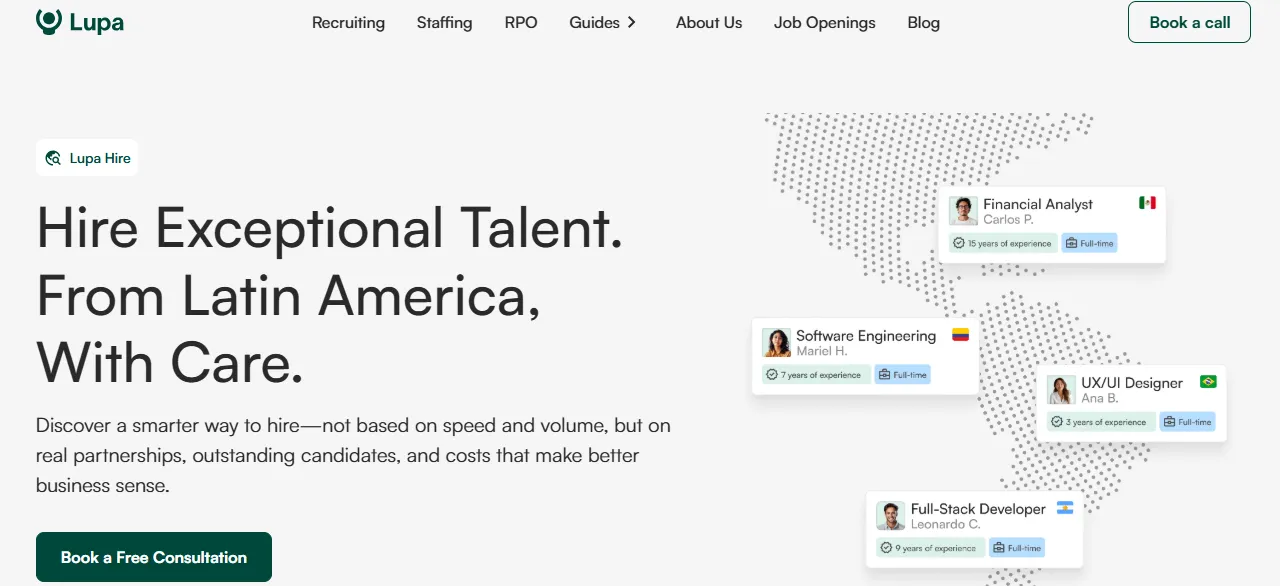
Lupa is a remote talent marketplace with an integrated vetting layer, built for companies that need pre-screened engineers, product managers, and designers from global talent pools with faster time-to-shortlist than traditional recruitment firms and no retainer required.
Best for
Remote-first tech hiring (engineers, PMs, designers)
Remote talent marketplace with a vetting layer. Pre-screened candidates for technical skills and remote readiness. Offers contractor management but not EOR services. Companies hiring contractors through Lupa should evaluate the employer of record for independent contractors model to ensure proper classification and compliance.
Strengths
• Fast (2–4 weeks to shortlist)
• Strong technical vetting (coding tests, portfolios)
• Transparent pricing
• Flexible engagement (contract-to-hire, full-time)
Limitations
• No compliance or payroll infrastructure
• Limited support for non-tech roles
• Basic post-placement onboarding
Pricing
Success fee (15–20% of annual salary) or flat fee
6. OnHires
OnHires is a startup-focused recruitment agency that delivers vetted technical and product candidates within 1–2 weeks, using cultural fit and mission-alignment screening designed for fast-moving seed to Series B companies building their first international teams.
Best for
Early-stage startups hiring technical and product roles
Speed and cultural fit for startups. Provides 3–5 vetted candidates within 1–2 weeks. Advisory on international employment law but no EOR. For APAC-focused hiring, companies will need separate EOR coverage see EOR in Singapore and hiring employees in Singapore for local compliance requirements.
Strengths
• Fastest time-to-shortlist
• Startup-friendly pricing and process
• Strong cultural fit assessment
• Flexible hire types
Limitations
• Shallow bench for senior/executive roles
• No compliance or payroll ownership
• Limited geographic depth outside core markets
Pricing
Success fee (15–25% of first-year salary)
Ideal for
Seed to Series B startups
7. Hudson

Hudson is a mid-market executive search and assessment firm with particularly strong depth across APAC including Australia and Singapore offering retained and contingency search for Director-to-VP functional leadership roles that larger global firms often underserve.
Best for
Mid-market leadership (Director to VP level)
Both contingency and retained search. Assessment-driven hiring using behavioral interviews and psychometric testing. Strong APAC expertise often overlooked by US firms.
Strengths
• Deep APAC market knowledge
• Flexible pricing models
• Strong assessment frameworks
• Good for functional leadership
Limitations
• Less specialized in sales or tech leadership
• Compliance advisory only
• Slower than startup-focused agencies
Pricing
Contingency (20–25%) or retained (25–33%)
Ideal for
Mid-market companies expanding into APAC
8. NPAworldwide

NPAworldwide is a global recruitment network connecting 500+ independent local firms across 40+ countries, designed for SMBs and growth-stage companies that need cross-border placement capability without the overhead pricing of enterprise agencies.
Best for
Budget-conscious SMBs hiring individual contributors
Recruitment network, not single agency. Local firms share candidate pools for cross-border placements. Reduces overhead but increases service quality variance.
Strengths
• Lower fees than enterprise agencies
• Flexible and entrepreneur-friendly
• Good for Tier 2/3 markets
• Fast for straightforward roles
Limitations
• Inconsistent quality across network
• Minimal compliance or post-placement support
• Not built for complex or senior hires
• No EOR or payroll services
Pricing
Contingency (15–20% of first-year salary)
Ideal for
SMBs and growth-stage companies (50–500 employees)
The 'best' agency depends on the complexity and revenue impact of the role. Executive hires justify Korn Ferry's retained model. High-volume tech hiring benefits from Lupa or OnHires' speed. Enterprise expansion demands Randstad's infrastructure.

Which Agency Matches Your Hiring Need?
1. Enterprise expansion across multiple markets:
Randstad operates 4,600+ branches across 39 countries with an integrated payroll and compliance infrastructure. Revenue: USD 29 billion annually.
Gloroots is better suited when expansion starts with smaller teams (1–10 hires per country) and speed matters, combining recruitment with owned EOR and payroll to avoid entity setup. Understanding the full employer of record cost including the compliance overhead of managing a separate EOR alongside a recruitment agency helps you make the right call here.
2. Sales and GTM leadership:
For early GTM teams or regional sales leaders where speed and compliant local employment matter more than retained search, Gloroots supports hiring while acting as the legal employer.
Korn Ferry specializes in executive search with a dedicated revenue role practice, strong across North America, EMEA, and APAC for Director+ placements.
3. Tech and engineering roles:
Lupa and OnHires both rank among 2025's top-rated agencies for cross-border tech hiring with faster timelines than traditional firms. Both invest in deep technical vetting coding tests, portfolio reviews, and remote-readiness screening so engineering teams interview fewer, better candidates.
4. Executive and C-suite positions:
Hudson and Korn Ferry offer retained search models with robust assessment frameworks for VP+ hires.
5. Budget-conscious mid-market companies:
NPAworldwide uses a network model that reduces overhead, best for individual contributors or mid-level roles in Tier 2 markets. Gloroots also fits here when combining cost-efficient recruitment advisory with owned EOR infrastructure.
How to Evaluate Agencies: CEO Checklist
"Global branding tells you nothing about whether an agency can actually close a role in Berlin or Bangalore. Country-level expertise recruiters who've placed the same role, in the same city, in the past year is what separates a usable shortlist from a wasted quarter."
- Head of Talent, scaling B2B SaaS company
1. Country-Level Expertise, Not Just "Global Coverage"
Ask: Do you have legal entities, recruiters, and employment counsel in the country I'm hiring in, or do you subcontract?
Red flag: "We'll figure it out" or "we partner with local firms."
Green flag: Recent placements, time-to-hire data, employment law nuances specific to your market.
2. Role and Industry Specialization
Ask: How many hires have you closed in this role, in this geography, in the past year? Validate compensation benchmarks, candidate sources, and hiring velocity for similar roles.
3. Candidate Vetting Depth
Ask: What does your screening process look like before a candidate reaches me?
Minimum standard: skills assessment, behavioral interview, reference checks, compensation alignment.
Red flag: 10 intro calls with unscreened candidates.
Green flag: 3–5 shortlisted candidates with detailed briefs.
4. Compliance Ownership
Ask: If we hire through you and face a misclassification audit, who is liable?
• Agency is a legal employer (EOR model): They own compliance
• Agency introduces EOR partner: You manage two vendors
• Agency provides 'advisory': You own all risk
Validate who drafts contracts, processes payroll, handles statutory benefits, and is named the employer in government filings. Understanding the pros and cons of employer of record helps you evaluate which model best fits your risk tolerance and hiring volume.
5. Replacement Guarantees
Ask: What's your replacement guarantee, and what triggers it?
Standard: 90 days, free replacement if hire quits or is terminated for performance.
Red flags: No guarantee, applies only if hire quits, pro-rated credit.
Green flag: 90–180 day guarantee, full replacement, applies to termination or resignation.
6. Time-to-Hire Benchmarks
Ask: What's your average time-to-hire for this role in this country? Realistic benchmarks: IC roles (4–6 weeks), technical roles (6–8 weeks), management (6–10 weeks), executive (8–16 weeks).
International Recruitment vs EOR Platforms
When recruitment wins: Specialized or senior roles with low talent density. Speed without ongoing employment overhead. Replacement guarantees and vetting rigor matter.
When it doesn't: High-volume hiring (10+ per country). Need a full employment infrastructure. Testing a new market with flexibility. Aggressive misclassification enforcement countries (Germany, France, India).
The EOR vs contractor decision is closely linked to which engagement model your agency supports get this wrong and you compound compliance risk as headcount scales. The benefits of EOR are most pronounced when combining recruitment with employment infrastructure rather than running them through separate vendors.
Facing challenges of hiring international employees?
Gloroots removes vendor handoff with recruitment advisory + EOR + payroll + compliance in one platform.
What CEOs Actually Pay for International Recruitment Agencies?
Pricing varies widely by model, role seniority, and geography. Below are the common pricing structures, what drives cost, and how to avoid overpaying.
Common Pricing Models
What Drives Cost
• Role seniority and scarcity: VP+ roles command 30–40% fees. High-volume roles might be 15–20%.
• Geography: Tier 1 cities cost more than Tier 2/3 not because agency rates differ, but salary bands are higher.
• Market competition: If multiple companies are hiring the same role in the same city, agencies command higher fees.
• Urgency: Need someone in 2 weeks versus 8? Expect a premium or upfront retainer.
How to Avoid Overpaying
• Negotiate guarantee length, not just fee percentage
• Ask for volume discounts if hiring multiple roles
• Clarify what's included (sourcing only vs. full coordination)
• Compare total cost of ownership: agency fee + EOR + payroll + compliance
• Use contingency for first hire with a new agency
For companies hiring across countries, combining recruitment advisory with EOR infrastructure (like Gloroots) eliminates vendor handoff and often results in lower total costs. See a full breakdown of employer of record cost to understand the full picture before committing to a pricing model.
Common Mistakes When Choosing Recruiters
1. Optimizing for cost over outcomes
- Choosing the lowest fee (15% vs. 25%) without asking what's included.
- The 15% agency sends unvetted profiles.
- You spend 40 hours interviewing unqualified candidates. Three months later, you're still hiring.
Fix: Evaluate placement fee + time-to-hire + replacement guarantee + compliance ownership as total cost.
2. Trusting "global" without validating local presence
- Believing brands claiming "150+ countries" without validating actual recruiters in your target market.
- You're paying enterprise fees for a subcontracted, untested relationship.
Fix: Ask for anonymized placement data in your specific country from past 12 months.
3. Ignoring post-placement support
- Treating recruitment as transactional.
- Hire accepts offer, then ghosts during onboarding or quits after 60 days.
- Agency already got paid.
Fix: Ask what happens after the candidate accepts the offer. Good agencies schedule onboarding check-ins and facilitate the first 90 days.
4. Not aligning recruiter incentives with revenue roles
- Using the same evaluation for the customer support hire and the VP of Sales hire.
- VP Sales directly impacts revenue, costs $500K+ in comp if they fail.
Fix: For revenue-critical roles, negotiate extended guarantees (180 days) and ask agencies to share historical performance data.
How to Choose the Right Recruitment Agency?
Use this 5-step framework to shortlist, validate, and scale with the right partner.
Step 1: Define hiring goal
Document role specifics, geography, urgency, and budget.
Be specific: "Hiring VP Sales in Germany to launch EMEA expansion, budget $180K–$220K total comp, must be in-market by Q2."
Step 2: Shortlist by region and role
Build a shortlist of 3–5 agencies by asking how many [role] hires they've closed in [country] in the past 12 months.
Validate: typical time-to-hire and whether they have local recruiters or subcontractors.
Step 3: Validate process and guarantees
Dig into the replacement guarantee length and conditions. Clarify compliance ownership (who drafts contracts, processes payroll).
Understand: the vetting process and post-placement support.
Step 4: Run pilot hire
Start with one mid-level or senior IC role, contingency fee structure.
Evaluate: speed, quality, process transparency, and post-hire support.
Step 5: Scale with confidence
Share hiring roadmap. Provide feedback loops.
Negotiate: ongoing rates after 3+ hires. Consolidate to 1–2 agencies with multi-country capability + 1 EOR platform.
Gloroots vs. Top Recruitment Agencies: Side-by-Side Comparison
How Gloroots Supports International Recruitment?
Companies scaling globally fastest don't optimize for the cheapest or fastest recruitment. They build employment infrastructure that scales.
Hiring 1–5 people internationally? A recruitment agency with deep regional expertise outperforms DIY sourcing.
Scaling to 10+ hires across countries? You need more than candidate pipelines. Combine recruitment with EOR services, consolidated payroll, and compliance management.
Gloroots eliminates handoff risk between sourcing and employment. Whether you bring candidates from your pipeline, use our recruitment advisory, or hire through an external agency, we employ them compliantly across 100+ countries without setting up local entities.
Planning international expansion? Explore Gloroots' EOR services or read our guide on best countries to hire remote workers to inform your strategy.

Frequently Asked Questions
1. How long does international hiring usually take?
Timeline varies by role: IC roles take 4–6 weeks, technical roles 6–8 weeks, management 8–12 weeks, C-suite 12–16 weeks. Work permits add 2–8 weeks, depending on country and visa category.
2. Do agencies handle contracts and labor laws?
Most provide advisory only. Some partner with EORs (you manage two vendors). Few like Randstad or Gloroots act as legal employer, owning compliance end-to-end. Always ask: "Are you the legal employer, or are you introducing us to a third-party EOR?"
3. What roles are hardest to hire internationally?
Senior sales/GTM leadership, highly specialized technical roles (AI/ML engineers), regulated roles requiring local licensing, and positions needing security clearances or work authorization restrictions.
4. Are placement guarantees standard?
Yes, but terms vary. Standard is a 90-day replacement if the hire quits or is terminated. Watch for guarantees applying only to resignation, pro-rated refunds, or administrative loopholes.
5. Can agencies help with onboarding?
Most don't. Premium agencies stay involved through the first 90 days with offer negotiation, pre-start coordination, and 30/60/90-day pulse checks to surface issues early.
6. What is an international recruitment agency, and how does it differ from a local staffing firm?
An international recruitment agency sources, vets, and places candidates across borders, navigating labor law variance, visa requirements, and multi-jurisdiction compliance areas that domestic staffing firms don't cover. They differ from remote hiring platforms by delivering vetted shortlists, process management, and replacement guarantees. Most agencies own sourcing and placement, but not compliance or payroll that's where an EOR platform like Gloroots fills the gap.
7. How do international recruitment agencies differ from EOR platforms?
Recruitment agencies find the person; EOR platforms legally employ them. Most agencies partner with EORs but don't own employment infrastructure, meaning you manage two vendors with separate contracts and compliance accountability. Gloroots combines both recruitment advisory plus owned EOR and payroll, eliminating that handoff risk. See a full comparison of the benefits of EOR to understand what employment infrastructure adds beyond what agencies provide.
8. What should I look for in an international recruitment agency for tech hiring?
For tech hiring, prioritize agencies with structured technical vetting, coding assessments, portfolio reviews, and remote-readiness screening, not just CV screening. Lupa and OnHires are strong for speed and vetting depth at the IC and mid-level range. For senior engineering leadership across APAC markets, including Singapore, validate whether the agency has placed the same role in your target city within the past 12 months. Companies hiring in Singapore should also understand local compliance requirements for employing staff in Singapore alongside their recruitment strategy.

Ready to hire Globally ?
Gloroots help you hire employees, manage contractors, run global payroll, and stay compliant across 150+ countries seamlessly.