




- EORs and staffing agencies solve different problems, EORs manage legal employment and compliance, while staffing agencies focus on sourcing and placing talent.
- Compliance risk is the biggest differentiator, EORs absorb employment liability, while staffing agencies leave compliance responsibilities with the hiring company.
- Costs vary by hiring model, EORs are more cost-efficient for full-time global roles, while staffing agencies work better for short-term or high-volume local hiring.
- Choosing the right model depends on scope and duration, Use an EOR for global, long-term employees; use a staffing agency for fast, temporary, or domestic staffing needs.
When HR leaders evaluate hiring models for the first time, EOR and staffing agency often land in the same mental bucket. Both involve third parties, both promise to simplify hiring, both charge a fee. But conflating the two is where strategic misalignment begins.
An Employer of Record (EOR) becomes the legal employer of your workforce, managing payroll, compliance, benefits, and taxes on your behalf. A staffing agency sources and places talent but typically leaves employment responsibility with you, along with the associated legal risk.
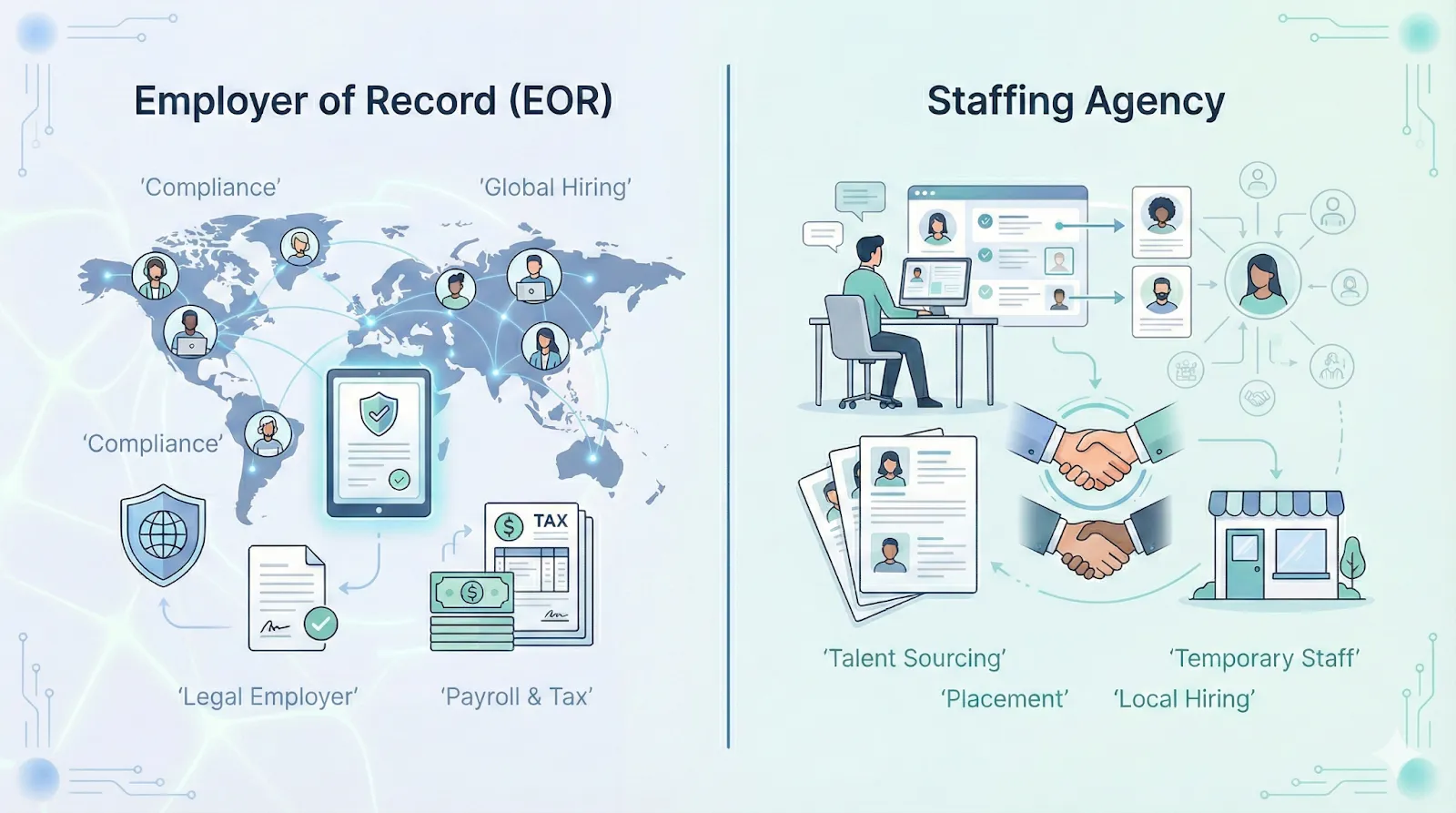
The distinction determines who carries compliance liability, who ensures cross-border statutory adherence, and whether your hiring model can scale globally.
According to recent market data, the global EOR platform market reached $5.6 billion in 2025, reflecting how enterprises are shifting employment infrastructure to specialized platforms rather than patchwork vendor arrangements.
What Is an Employer of Record (EOR)?
An Employer of Record is a third-party organization that becomes the legal employer of your workforce in jurisdictions where you don't have a legal entity.
The EOR holds
- the employment contract
- processes payroll in local currency
- withholds and remits taxes
- administers benefits
- ensures compliance with labor laws, statutory filings, and termination procedures.
You still manage your team’s daily work setting goals, assigning tasks, and guiding performance while the EOR takes care of everything tied to employment. They handle compliant contracts, statutory benefits, and payroll calculations like PF, ESIC, gratuity, or pension contributions based on local laws.
This model is purpose-built for global and remote full-time hiring. An EOR removes the 4-8 month entity formation process and the ongoing compliance overhead of maintaining local HR, legal, and accounting functions in every market.
The EOR isn't a recruiter. It's employment infrastructure, designed to let you hire compliantly in countries where you don't exist as a legal employer.
What Is a Staffing Agency?
A staffing agency is a recruitment vendor that sources, screens, and places candidates into roles at your company.
The agency manages the talent pipeline:
- posting job descriptions
- conducting initial interviews
- coordinating placements
But the employment relationship typically remains with you or follows a co-employment structure depending on contract terms.
The agency may handle payroll for those placements, but you remain responsible for workplace compliance, worker classification, and ensuring the role meets independent contractor or employee definitions under local law.
Staffing agencies excel at speed and volume. Filling short-term gaps, scaling teams for project-based work, or providing flexible labor during demand spikes. But they operate within regional markets, rarely extend to true global hiring, and don't absorb the legal employer role that cross-border compliance requires.
If the question is: "how do we find 10 customer support agents in Austin by next month?"
A staffing agency solves it.
If the question is: "how do we employ a full-time engineer in Singapore without a local entity?"
The staffing agency has no mechanism to answer.
What Are the Key Differences Between an EOR and a Staffing Agency?
The belief that EORs and staffing agencies are interchangeable stems from surface-level similarity. Both involve third parties in the hiring process. But the models solve fundamentally different problems. Here's the breakdown across every dimension that matters for global HR strategy:
The real distinction:
- An EOR transfers legal employment risk off your balance sheet.
- A staffing agency helps you find people but leaves you holding the compliance exposure: misclassification liability, payroll tax errors, termination disputes. Unless explicitly structured otherwise.
Research shows that staffing agencies typically charge 25-40% markups on hourly wages, while EORs cost 10-15% monthly. A difference that compounds when hiring long-term, full-time employees where the staffing model wasn't designed to operate.
Cost Analysis: EOR vs. Staffing Agency
Cost comparisons only make sense when you're solving the same problem. But since many companies mistakenly treat these as alternatives, here's how the economics break down:
EOR Pricing Model:
- Monthly service fee: 10-15% of gross salary
- Payroll and benefits: Pass-through at cost (taxes, social contributions, health insurance, statutory benefits)
- Transparent FX handling: Local currency payouts with disclosed exchange rates
- No placement fees: You're paying for employment infrastructure, not recruitment markup
For a $100,000 annual salary employee, expect $10,000-$15,000 in annual EOR fees, plus actual payroll taxes and benefits that would exist regardless of model.
Staffing Agency Pricing Model:
- Markup model (temp/contract): 25-40% above worker wages
- Placement fee model (permanent hire): 15-25% of first-year salary as one-time fee
- No compliance coverage: You still own employment risk and must handle benefits, taxes, and labor law adherence
For that same $100,000 employee placed via staffing agency markup, your cost could reach $150,000 annually. Compare that to $110,000-$115,000 via EOR.
The EOR route includes full compliance coverage; the staffing route does not.
Hidden Costs:
Staffing agency: Misclassification penalties if worker should be employee, not contractor. Internal HR/legal time managing compliance gaps. Benefits administration if agency doesn't provide.
EOR: Potentially higher per-employee cost for very short-term roles (under 6 months). Less control over benefits customization in some markets.
The cost question is actually a risk-adjusted return calculation.
Which model gives you compliant employment at predictable cost, and which leaves residual liability that isn't priced into the invoice?
When Should You Use an Employer of Record?
An EOR is the correct infrastructure when you're building full-time, long-term employment relationships in markets where you lack legal presence. Specifically:
1. You're hiring globally without local entities
- Expanding into APAC, LATAM, or EMEA but entity formation would take 6+ months and cost $50,000-$200,000 per country?
- An EOR enables compliant hiring in days instead of quarters.
2. You need to transfer compliance risk off your balance sheet
- Misclassification audits, payroll tax errors, wrongful termination disputes, benefits non-compliance.
- The EOR absorbs these as the legal employer. In high-regulation markets like Germany, France, or India, this risk transfer is the entire value proposition.
3. You're building distributed teams with remote employees
- If your engineering team spans Bangalore, Berlin, and Buenos Aires, managing three separate payroll systems, tax jurisdictions, and labor codes internally is operationally unsustainable.
- The EOR consolidates it into one platform.
4. You're establishing a Global Capability Center (GCC) in India
- Many enterprises use an EOR as a bridge.
- Hiring and paying Indian talent compliantly via EOR services while the subsidiary incorporation and PF/ESIC registration process completes, then transitioning employees onto the local entity once operational.
5. You want to test a market before committing infrastructure
- Hiring 3-5 employees via EOR to validate product-market fit or customer demand lets you move fast without the irreversible commitment of entity formation.
The EOR model assumes permanence and compliance are more valuable than recruitment speed, which is true for most full-time, strategic hires.
When Should You Use a Staffing Agency?
A staffing agency is the right call when your problem is talent sourcing velocity, not employment infrastructure. Specifically:
1. You need temporary or contract workers for defined projects
- Seasonal demand spikes, 3-month product launches, interim coverage during parental leave.
- Staffing agencies specialize in flexible labor that matches your variable workload without long-term employment commitments.
2. You're hiring domestically in markets where you already have an entity
- You have a US subsidiary and need 10 customer service reps in Texas?
- A local staffing agency can source, screen, and place candidates faster than building an internal recruiting function.
3. Speed matters more than long-term cost efficiency
- You need bodies in seats by next week and you're willing to pay the 25-40% markup for that velocity?
- Staffing agencies deliver. The premium buys you time.
4. You want to evaluate talent before permanent employment
- Some companies use temp-to-perm staffing as a trial period.
- Place someone via agency for 90 days, convert to direct hire if performance validates. The agency typically charges a conversion fee, but you've de-risked the permanent hire decision.
5. You lack internal recruiting bandwidth
- Early-stage startups without dedicated TA teams often outsource volume hiring to agencies rather than building recruiting infrastructure prematurely.
The staffing model assumes speed and flexibility outweigh cost and compliance transfer, which is true for short-term, tactical hiring needs.
How Do You Choose the Right Model: EOR or Staffing Agency?
The choice isn't subjective. It's a function of employment duration, geographic scope, and who should absorb compliance risk. Ask these questions:
- Is this a full-time, long-term role or a temporary/contract placement?
- Full-time? EOR.
- Temporary? Staffing agency.
- Are you hiring in a country where you don't have a legal entity?
- No entity? EOR.
- Entity exists? Either works, but staffing is faster for temp roles.
- Who should be the legal employer and bear compliance liability?
- Want risk off your books? EOR.
- Comfortable owning employment relationship? Staffing agency (but verify contract terms).
- What's more expensive: compliance failure or service fees?
- High-regulation markets (India, Germany, Brazil)? EOR.
- Lower-risk, domestic hiring? Staffing may pencil.
- Do you need recruiting support or employment infrastructure?
- Need sourcing help? Staffing.
- Need payroll, benefits, and legal employer coverage? EOR.
The framework should clarify:
EOR and staffing agencies aren't alternatives. They're answers to different questions. One solves "how do we find talent fast?" The other solves "how do we employ talent legally where we don't exist?"
Treating them as interchangeable is the root cause of most global hiring missteps.
Why Gloroots Is the Right EOR Partner for Your Business?
Choosing the right EOR partner is critical, especially when your hiring strategy spans multiple countries and compliance environments. Gloroots is built to solve the challenges global teams face not just with payroll, but with the deeper operational gaps most EORs overlook.
Gloroots stands out for its India specialization and GCC support, making it the ideal partner for companies building engineering, operations, or support teams in India. From PF, ESIC, and gratuity management to statutory audits and localized payroll, Gloroots delivers the depth of compliance that generic global EORs can’t match.
For companies setting up a local entity, Gloroots offers hybrid onboarding, allowing you to hire through EOR now and smoothly transition employees to your subsidiary later no disruption, no rebuild.
Finance teams benefit from audit-ready reports, GL mapping, and transparent invoices, eliminating end-of-month reconciliation headaches. And with our platform + managed service model, you get intuitive dashboards along with dedicated Customer Success Managers who understand your hiring roadmap, compliance posture, and escalation needs.
Whether you’re converting long-term contractors to full-time employees or scaling from 10 to 250 hires, Gloroots delivers speed, accuracy, and compliance without shortcuts.
It’s employment infrastructure built for growth. Explore Gloroots EOR solutions →
FAQs on EOR vs Staffing Agency
1. What is the main difference between an EOR and a staffing agency?
An EOR becomes the legal employer, holding contracts and managing payroll, benefits, and compliance. A staffing agency sources candidates but leaves employment responsibility and legal risk with you.
2. Can a staffing agency hire globally?
Most staffing agencies operate regionally. They lack the compliance infrastructure to act as legal employer across 100+ countries. For cross-border hiring without local entities, you need an EOR.
3. Does an EOR also handle recruitment?
Some EORs offer recruiting support, but it's not the core function. An EOR's primary value is employment infrastructure: legal compliance, payroll, benefits, contracts. Pair an EOR with a staffing agency if you need both sourcing and compliant employment.
4. Which option is more cost-effective?
For full-time, long-term employees, EORs typically cost less: 10-15% monthly fees versus staffing agencies' 25-40% markups. For temporary roles under 6 months, staffing agencies may be cheaper despite higher markups.
5. Can I work with both an EOR and a staffing agency together?
Yes. Use the staffing agency to source candidates, then employ them via EOR for payroll, compliance, and benefits. This hybrid approach works well for global hiring, giving you recruiting velocity and employment infrastructure without forcing a tradeoff.