






- Global workforce management software unifies hiring, payroll, and compliance across multiple countries from one platform.
- Top contenders in 2026 include Gloroots, Deel, Remote, Rippling, and Workday for scalable global team management.
- The right platform balances automation, compliance ownership, and multi-currency payroll for international growth.
- Gloroots stands out with full compliance liability, transparent pricing, and support across 140+ countries.
Spreadsheets stop being effective once a company starts hiring in multiple countries. Manual tracking quickly leads to missed tax filings, duplicate payroll entries, and compliance issues that can take days to resolve.
While the global workforce management software market is dominated by Oracle, SAP, Workday, UKG, and ADP, which together account for nearly half of the market, market share does not guarantee the right fit for your team.
The best platform is not necessarily the one with the most features. It is the one your team can use efficiently and consistently as you scale across countries.
This guide explains what qualifies as true global workforce management software, compares leading platforms including Gloroots, and provides practical guidance on selecting a solution that minimizes cost and operational complexity.
What Is Global Workforce Management Software?
Global workforce management software manages hiring, payroll, compliance, and administration for employees and contractors across multiple countries through a single platform.
It is more than international payroll or a basic HR information system. It provides the infrastructure to onboard employees in different countries, process accurate payments, file taxes on time, and monitor performance without relying on multiple vendors.
Many companies confuse this category with other HR technologies:
- HRIS platforms store employee data and support basic HR workflows but rarely handle multi-country payroll or compliance.
- Payroll software processes salaries but does not manage employment contracts, benefits, or statutory filings across jurisdictions.
- Employer of Record (EOR) platforms act as legal employers in countries where a company has no entity. They handle payroll and compliance while the company manages daily operations.
A global workforce management platform combines these capabilities into one system. It manages hiring, contracts, payroll, compliance, and reporting under a unified structure.
True global workforce management software includes four essential functions:
- Hiring and onboarding employees across countries.
- Payroll and payments in local currencies with full tax compliance.
- Compliance and contracts aligned with local labor laws.
- Workforce data and reporting that provide real-time insight into headcount, costs, and compliance status.
The Best Global Workforce Management Software – Quick Comparison
Before diving into detailed profiles, here's a scannable comparison of the leading global workforce management platforms based on decisive factors:
Ready to consolidate your global workforce operations? Book a demo with Gloroots to see how compliance-first workforce infrastructure works in practice.
Best Global Workforce Management Software Platforms
1. Gloroots
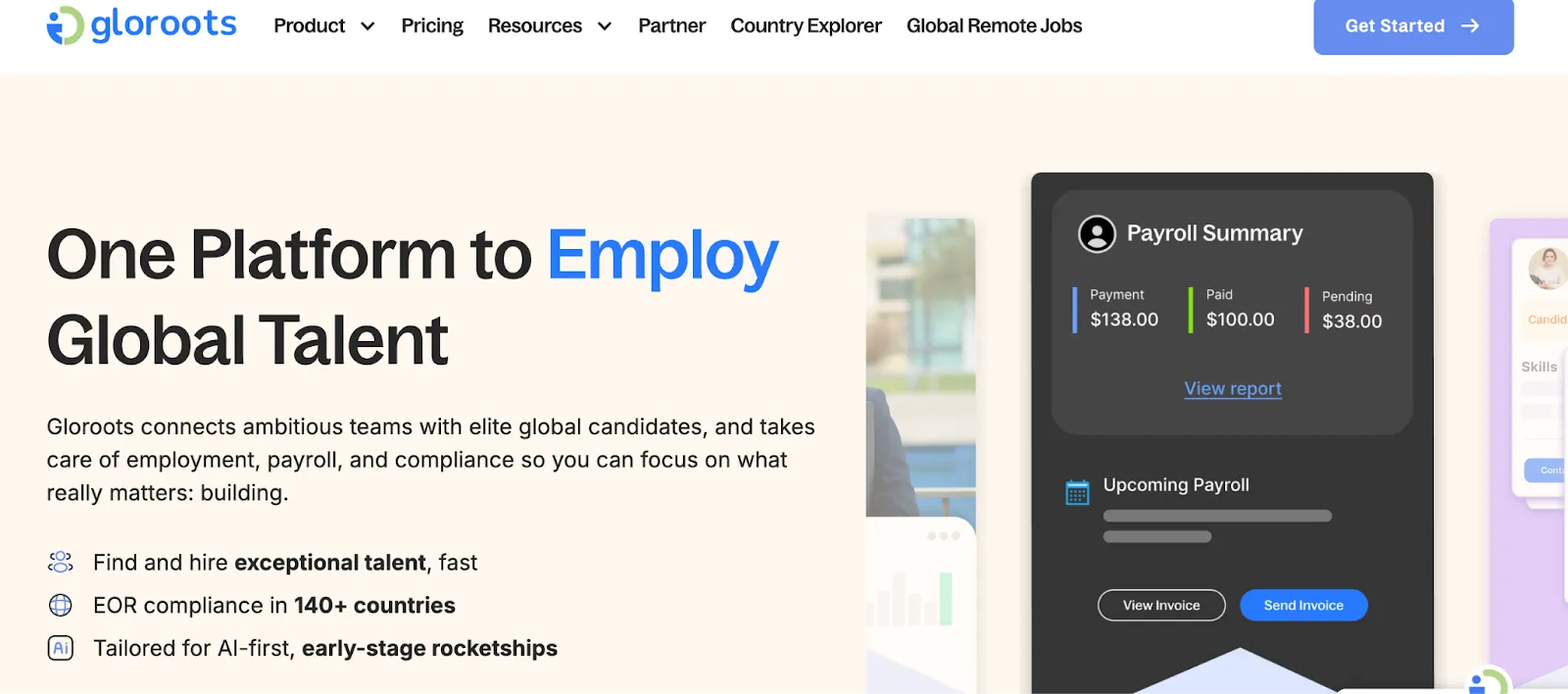
Gloroots helps companies hire and manage teams across multiple countries without needing local entities. It simplifies international payroll, contractor management, and compliance, so businesses can expand globally without getting bogged down in administrative work.
The platform acts as a legal Employer of Record, taking responsibility for labor law compliance, benefits, and payroll in over 140 countries. This means companies can focus on running their teams while Gloroots handles the legal and operational complexities.
By centralizing workforce management, Gloroots gives full visibility into employee costs, contracts, and compliance status. It supports both full-time employees and contractors, making it easier to scale teams quickly and reliably across borders.
Key Features
1.Integrated EOR and Payroll
Combines contracts, payroll, taxes, and compliance within a single system, removing the need for multiple vendors or manual coordination.
2. Global Expertise
The platform provides specialized support for companies building or scaling teams across 140+ countries. This includes assistance with local payroll, social security contributions, statutory benefits, work permit compliance, compensation benchmarking, and HR advisory.
3.Contractor-to-Employee Conversion
Allows easy conversion of contractors into full-time employees in line with local employment laws and compliance requirements.
4.Transparent Billing
Offers clear, country-specific cost breakdowns for salaries, taxes, and deductions, improving visibility and cost forecasting for finance teams.
5.Platform with Support
Combines a self-service dashboard for onboarding, contracts, and payroll with dedicated Customer Success Managers who provide ongoing guidance and support.
Pros
- Takes full compliance ownership as the legal Employer of Record
- Offers fixed, transparent pricing with no hidden charges
- Strong India and GCC expertise for regional expansion
- Delivers audit-ready payroll and compliance reports
- Handles contractor-to-employee conversions cleanly
Cons
- Slightly narrower coverage in select niche markets compared to 180+ country providers
Pricing
- Contractors: Starting at $29/month per contractor
- Full-time employees: Starting at $399/month per employee
For detailed pricing across different engagement types and geographies, visit the Gloroots pricing page. The platform also offers volume discounts for teams scaling beyond 10+ international hires.
"Now that Gloroots handles all contracts, I am no longer worried about compliance when onboarding a new contractor"
- Julio Arias
- Co-founder, Sketchnote
Best For
- Startups and SMBs hiring international employees without entities
- Mid-market companies building or scaling GCCs in India
- Finance and HR teams seeking transparent pricing and audit-ready payroll reports
-
Companies converting contractor-heavy workforces to compliant employment
models
- Book a demo-BAnner
2. RemoFirst
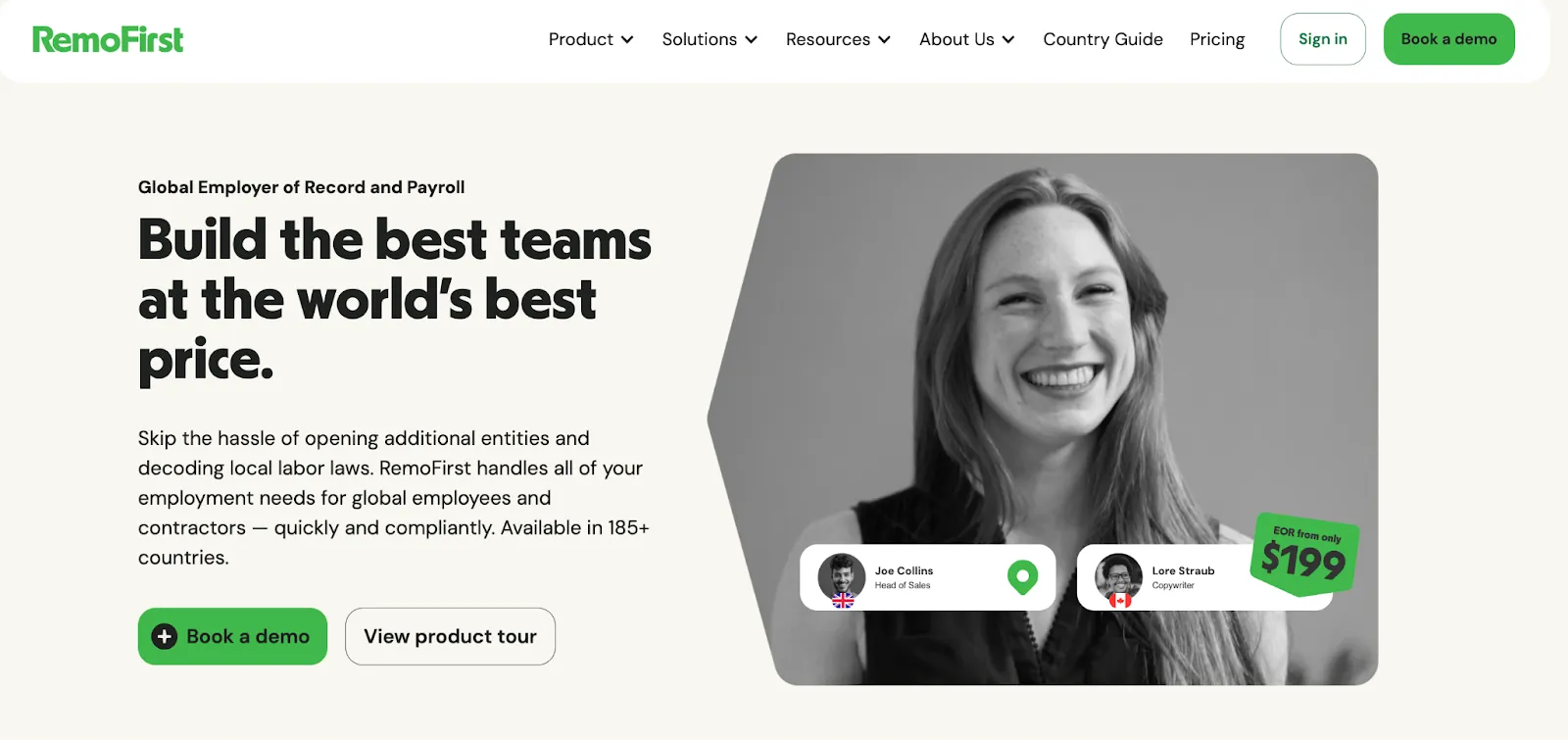
RemoFirst helps companies hire and manage employees globally with a focus on speed and wide country coverage. It supports operations in more than 180 countries and is designed for businesses that need to onboard and pay distributed teams quickly.
The platform provides Employer of Record (EOR) services that simplify hiring and payroll across markets, allowing companies to expand without setting up local entities.
Its main strength lies in fast implementation and efficient global payroll management for growing international teams.
Key Features
1.Global EOR Coverage
Supports hiring and workforce management in more than 180 countries, enabling companies to expand internationally without creating local entities.
2.Localized Payroll Processing
Processes salaries in local currencies with built-in tax deductions, statutory contributions, and compliance oversight for each region.
3.Contractor Management
Simplifies the onboarding and payment of international contractors through one integrated system that ensures accuracy and timely payouts.
4.Immigration Support
Provides assistance with work permits and visa applications in selected countries, helping companies manage global mobility efficiently.
5.Fast Onboarding
Offers quick setup and activation so businesses can begin hiring, paying, and managing international teams in a short timeframe.
Pros
- Extensive country coverage
- Fast onboarding timelines
- Competitive pricing for EOR services
Cons
- Limited direct employment options compared to hybrid models
- Support quality varies by region
- Integration capabilities less robust than larger platforms
Best For
Companies prioritizing speed and coverage breadth over deep functionality in specific markets.
3. Deel
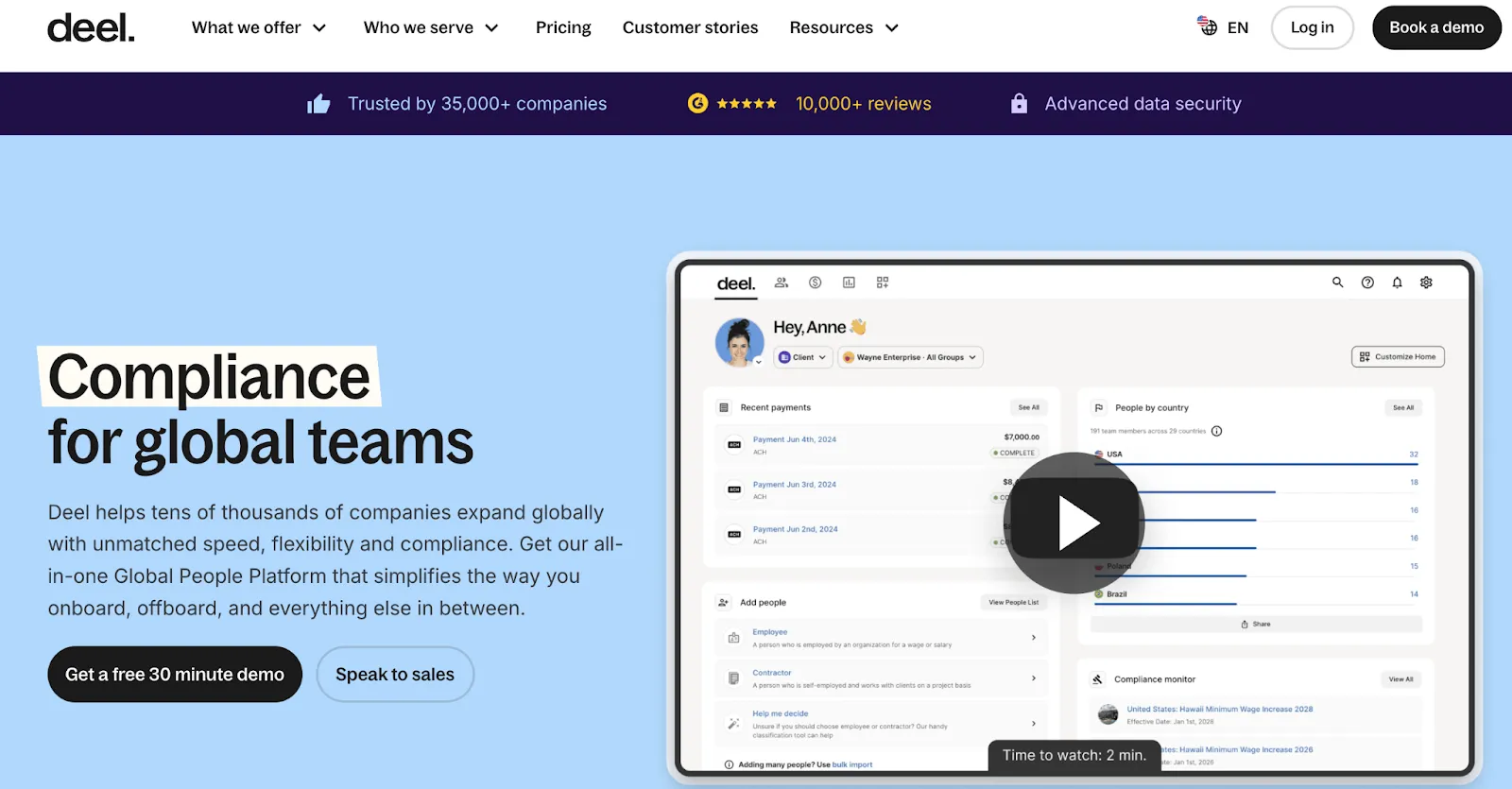
Deel provides a platform for global hiring, payroll, and compliance that supports employees, contractors, and Employer of Record (EOR) arrangements. It is designed for companies that manage a mix of workforce types and need flexibility in how they hire and pay across countries.
The platform simplifies international operations by combining contract management, payroll processing, and compliance tools under one system. Deel is well-suited for businesses balancing full-time employees and contractors across multiple regions.
Key Features
1.Global Coverage
Supports hiring and payroll in more than 130 countries, allowing companies to manage both employees and contractors within one consistent framework.
2.Unified Workforce Management
Brings full-time employees and contractors together on a single platform, providing better visibility into contracts, payments, and compliance records.
3.Compliance Tools
Includes built-in features for managing local labor laws, tax requirements, and statutory benefits, helping companies stay compliant across all operating regions.
4.Immigration Support
Assists with visa applications, relocation, and work authorization processes to help businesses move and retain international talent smoothly.
5.Equipment Management
Enables companies to manage, ship, and track laptops and other equipment for remote employees through trusted logistics partners.
Pros
- Strong contractor payment infrastructure
- Extensive integration options
- Comprehensive compliance library
Cons
- Complexity increases with scale
- Support response times can lag during growth periods
- Pricing structure changes frequently
Best For
Companies managing both contractors and employees globally with emphasis on contractor payments.
4. Remote
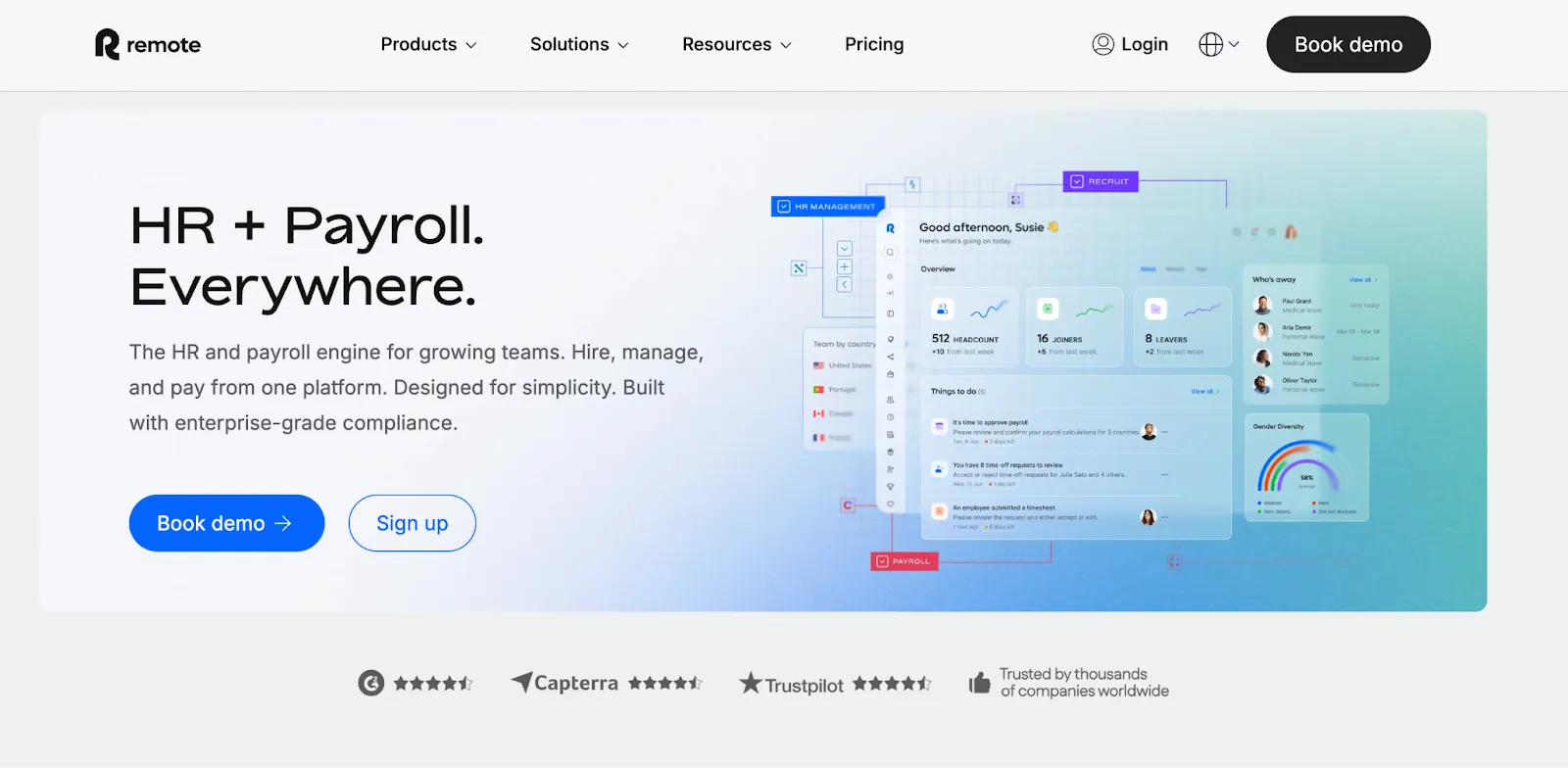
Remote offers a platform for global employment that provides both Employer of Record (EOR) and direct hiring options across more than 100 countries. It is built for remote-first companies that prioritize flexibility and a strong employee experience when managing distributed teams.
The platform combines payroll, benefits, and compliance management under one system. Remote is ideal for businesses that want to streamline hiring and create a consistent experience for employees working across different regions.
Key Features
1.EOR and Direct Employment Support
Offers both Employer of Record (EOR) and direct employment options, allowing companies to hire globally while maintaining flexibility in how teams are managed.
2.Global Payroll Software
Processes payroll across more than 100 countries with automated tax deductions, local compliance checks, and payments in multiple currencies.
3.Benefits Administration
Manages employee benefits such as health insurance, pensions, and local statutory entitlements to ensure a consistent experience worldwide.
4.Compliance Management
Monitors and updates employment contracts, labor law changes, and country-specific requirements to keep global operations fully compliant.
5.Time-Off Tracking
Tracks employee leave and time-off policies across markets, ensuring local laws and company guidelines are followed accurately.
Pros
- Strong benefits packages in key markets
- Clean user interface
- Good employee self-service capabilities
Cons
- Country coverage smaller than competitors
- Higher pricing in some markets
- Limited contractor management features
Best For
Remote-first companies prioritizing employee experience and benefits in core markets over maximum country coverage.
5. Rippling
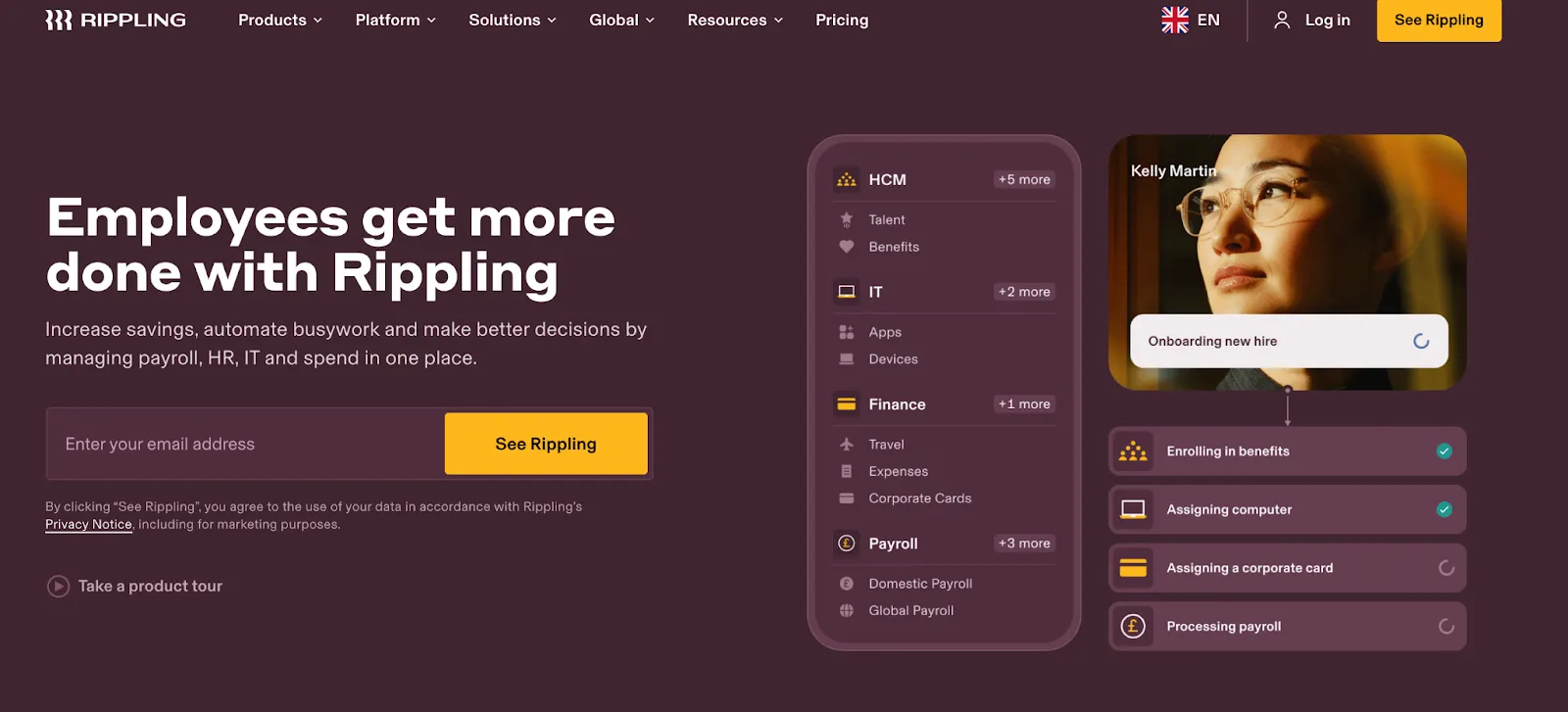
Rippling combines HR, payroll, and IT management in a single global platform designed for companies operating through their own legal entities. It enables businesses to manage employee data, devices, and applications alongside workforce operations in one place.
The platform supports global payroll, compliance, and automation workflows that connect HR and IT functions. Rippling is best suited for companies seeking to centralize operations while maintaining control over their international entities.
Key Features
1.Unified HR, IT, and Payroll Administration
Combines human resources, payroll, and IT management in one system, giving companies a single source of truth for employee data and operations.
2.Automated Device Provisioning and App Access
Automatically assigns and manages employee devices and software access, ensuring secure and efficient onboarding for global teams.
3.Global Payroll with EOR Capabilities
Supports payroll processing across multiple countries with Employer of Record (EOR) functionality available in select markets.
4.Custom Workflow Automation
Allows companies to build automated workflows that reduce manual work and improve accuracy across HR and IT processes.
5.Extensive Third-Party Integrations
Integrates with a wide range of business tools and platforms, enabling smooth data sharing between HR, finance, and IT systems.
Pros
- Strong automation capabilities
- Comprehensive app ecosystem
- Unified employee data model across HR and IT
Cons
- Requires local entities for most countries
- Limited EOR functionality
- Implementation complexity for global teams
Best For
Companies with existing international entities looking to consolidate HR, payroll, and IT management under one system.
Supporting Workforce Management Tools (Not Full Platforms)
These tools complement global workforce platforms but do not manage compliance, payroll, or legal employment responsibilities.
They form part of a company’s HR tech stack rather than serving as full workforce management solutions.
1. Slack – Best for Communication
Enables real-time messaging and asynchronous collaboration across time zones with searchable message history.
- Why global teams use it: Reduces email overload and organizes communication through channels for teams and projects.
- Key limitation: Designed solely for communication; does not support payroll, compliance, or workforce management.
2. QuickBooks – Best for Accounting
Tracks expenses, manages invoices, and supports basic bookkeeping for workforce-related costs.
- Why global teams use it: Offers a familiar accounting interface that integrates easily with banks and expense tools.
- Key limitation: Not suitable for multi-country payroll or tax compliance. Requires a separate workforce management platform.
3. Toggl Track – Best for Time Tracking
Tracks billable hours, project time, and productivity across distributed teams.
- Why global teams use it: Offers simple time tracking with project-based reporting and client billing integration.
- Key limitation: Limited to time tracking; does not cover payroll, compliance, or HR management.
4. Greenhouse – Best for Recruiting
Manages candidate pipelines, interviews, and hiring workflows for global recruitment.
- Why global teams use it: Provides structured interview processes and strong candidate experience tools.
- Key limitation: Recruitment ends once offers are accepted; does not include onboarding, payroll, or compliance features.
5. JumpCloud – Best for Device and Identity Security
Manages device access, single sign-on, and security policies for remote employees worldwide.
- Why global teams use it: Centralizes identity and device management across operating systems and locations.
- Key limitation: Focused on IT security only; does not handle HR, payroll, or compliance.
6. Zapier – Best for Automation
It connects different applications and automates workflows to sync data between systems.
- Why global teams use it: Provides no-code automation that reduces manual data entry across tools.
- Key limitation: Serves only as an integration tool and does not replace workforce platforms. May break when APIs change.
Why Should You Compare Global Workforce Management Software?
Choosing a workforce management platform is about finding the right fit for your operational needs. Companies actively compare providers for several key reasons:

1.Compliance accountability
Some providers act as the legal employer, taking full responsibility for taxes, contracts, and labor law compliance. Others only process payroll based on client-provided data. Understanding who carries legal liability is essential when evaluating Employer of Record (EOR) models and their true costs.
2.Geographic coverage vs. depth
A provider may claim coverage in over 180 countries, but that does not guarantee local teams or legal entities in key markets. The depth of in-country expertise and compliance presence matters more than the number of countries listed.
3.Reporting and transparency
When payroll is managed across multiple vendors, cost tracking often becomes unclear. The best platforms provide detailed, line-item billing that helps finance teams forecast expenses accurately and maintain audit-ready documentation.
4.Pricing structure
Workforce management software pricing can vary by employee, country, or region. Some include hidden currency conversion fees or annual minimums. Review EOR software options that prioritize transparent pricing.
5.Scalability
Platforms designed for smaller teams often struggle as headcount grows. Choosing a scalable provider ensures smooth expansion without costly system migrations or workflow disruptions.
Understanding these tradeoffs helps you select a provider that matches your growth, compliance, and visibility needs for strategic workforce planning.
How to Choose the Right Global Workforce Management Software?
Use this practical framework to evaluate global workforce management providers based on what really matters.
1. Country Coverage vs. Local Expertise
Check if the provider has local teams or owned entities in your key markets. Ask if they act as the legal employer or rely on partners. This shows who is responsible for compliance.
2. Compliance and Risk Responsibility
Find out who is accountable for tax filings or employee misclassification. EOR providers handle legal liability, payroll-only services leave the risk with you. Choose a model that matches your risk tolerance.
3. Workforce Data Integration
The platform should share data automatically with HR, accounting, and reporting tools. Look at API quality, not just the number of integrations. Ask how errors are handled if data doesn’t sync.
4. Reporting, Analytics, and Audit Readiness
Finance teams need detailed labor cost visibility by country. Pick platforms that offer multi-currency reporting, GL-ready exports, and audit-ready documents without manual work.
5. Pricing Transparency and Scalability
Get country-specific pricing and understand what is included. Check for extra fees on filings, benefits, or compliance updates. Model costs for different team sizes to see if pricing scales predictably.
Common Mistakes to Avoid When Choosing Workforce Management Tools
1.Choosing HR tools without payroll ownership
Platforms that track employee data but don’t process payroll leave you managing multiple vendors for contracts, payments, taxes, and compliance. This increases errors and administrative burden.
2.Relying on too many integrations
Each integration adds risk if APIs change or vendors remove features. Fewer, deeper integrations are better than many shallow ones. Companies with 10+ integrations often spend more time fixing problems than gaining efficiency.
3.Ignoring future expansion countries
A platform that works for your current five countries may not cover new markets. This can force costly migrations later. Evaluate providers based on your growth plans for the next 1–2 years.
4.Selecting tools built only for one region
US-focused platforms may lack depth in APAC or EMEA compliance. Asia-focused tools might struggle with European or Latin American labor rules. Choose a provider that has expertise in your priority markets.
5.Assuming implementation is quick
Platform migrations take months, not weeks. Account for data migration, testing, training, and running parallel systems. Rushing can lead to payroll errors, compliance issues, and employee frustration.
Why Choose Gloroots for Global Workforce Management?
Gloroots was built to address a challenge many global workforce platforms overlook companies that need both compliance certainty and operational visibility.
As the legal Employer of Record, Gloroots assumes statutory compliance responsibility, so finance and HR teams do not have to navigate complex tax codes or labor law updates on their own.
Key Benefits:
- Full Compliance Ownership – In-house legal and country-specific expertise across 100+ markets.
- Reduced Misclassification Risk – Direct employment relationships lower audit exposure and legal liability.
- Transparent, Detailed Billing – Line-item invoices show salaries, taxes, and deductions for accurate budgeting.
- Audit-Ready Reporting – GL-ready exports, multi-currency reporting, and payroll documentation included every cycle.
- Contractor-to-Employee Conversion – Easily transition freelancers to full-time employees in compliance with local laws.
- Platform + Managed Service – Self-service dashboard plus dedicated Customer Success Managers for guidance and support.
Whether hiring your first international employee or consolidating multiple regional vendors, Gloroots scales efficiently from 10 to 250+ employees without requiring platform changes or operational rework.
Ready to see how compliance-first workforce infrastructure works in practice?
Explore Gloroots' global workforce solutions or book a demo to discuss your specific markets and growth plans.
FAQ’s
1.What is global workforce management software?
It is a platform that handles hiring, payroll, compliance, and administration for international teams. It manages employment contracts, tax compliance, benefits, and workforce reporting across multiple countries, all from a single system.
2.What's the difference between workforce management software and an Employer of Record (EOR)?
Workforce management software provides tools to manage global teams but usually leaves legal liability with your company. An EOR acts as the legal employer in each country, taking full responsibility for taxes, compliance, and labor law obligations.
3.Can one provider manage all my international employees?
It depends on your footprint. Providers usually handle 3–15 countries well. Larger companies often use multiple providers to cover all regions. The goal is to balance convenience with strong local compliance.
4.Why does pricing transparency matter?
Hidden fees can quickly add up. Some vendors charge extra for filings, benefits, or currency conversions. Clear, itemized pricing helps you plan costs accurately and avoid surprises as your team grows.