







- Sri Lanka EOR pricing benchmarks between $300 and $500 USD per employee per month, with providers like Gloroots and Horizon EOR publishing LKR-denominated ranges; always confirm the provider's foreign exchange markup policy in writing before signing to avoid undisclosed cost increases.
- Owned-entity providers such as Remote reduce intermediary risk by employing workers through their own legal entities in Sri Lanka, while partner-network providers like Safeguard Global and Teamed add a coordination layer to compliance decisions.
- Core statutory obligations every EOR must manage in Sri Lanka include EPF contributions (12% employer, 8% employee), ETF contributions (3% employer), PAYE withholding, gratuity accrual under the Termination of Employment Act, and payroll adjustments for 26 annual public holidays.
- Using an EOR allows companies to hire in Sri Lanka within one to three days compared to four to six months required for local entity incorporation, with employment liability sitting with the EOR rather than the hiring company.
- Employer-initiated terminations in certain categories require prior approval from the Commissioner of Labour, and severance obligations average approximately 10.8 weeks of salary, making compliant offboarding management a critical EOR service to verify before selecting a provider.
Sri Lanka is a market worth watching. With a population of approximately 22.16 million, a capital in Sri Jayawardenepura Kotte, and Colombo as its commercial center, the country has spent the past two years rebuilding after its 2022 economic crisis. GDP per capita stands at roughly $4,000 USD in 2025, the corporate tax rate is 24%, and the official languages are Sinhala, Tamil, and English. That English proficiency, combined with a skilled workforce in IT, BPO, and finance, makes Sri Lanka an attractive hiring destination for international companies.
Regulatory change has been a constant since the crisis. Any EOR operating here must respond quickly to shifts in labor law, tax policy, and statutory contribution rules. Provider responsiveness to those changes is a core selection factor on this page.
This guide covers eight best employer of record providers for Sri Lanka in 2026, ranked using transparent criteria: pricing structure, entity ownership, platform capability, compliance depth, and verified customer ratings where available.
Our Top 8 Picks: Sri Lanka EOR Comparison 2026
The eight providers below were selected based on four criteria: verified Sri Lanka coverage, pricing transparency (benchmarked against the $300 to $500 USD per employee per month market range), disclosure of owned-entity versus local-partner operating models, and published ratings on G2, Capterra, or Trustpilot where scores could be confirmed. Providers without a verified rating in researched sources are noted accordingly.
| Provider | Pricing per month | Country coverage | Onboarding speed | Platform experience | Customer support | Scalability |
|---|---|---|---|---|---|---|
| Gloroots | From $199/employee/month | 150+ countries including Sri Lanka | 1–3 days | User-friendly centralized platform with payroll, compliance, onboarding, and workforce visibility | 24/7 human support with dedicated specialists | SMB to Enterprise; supports companies scaling across 150+ countries |
| Safeguard Global | Not publicly listed in researched sources | Global, including Sri Lanka | 5–7 days | Global workforce platform covering EOR, payroll, HR, and compliance management | Dedicated support and account management | Enterprise; suited to complex multinational workforce operations |
| Teamed | From $400/employee/month | 150+ countries | Fast, hours to days; country-dependent | Modern global EOR platform covering employment, payroll, compliance, and workforce management | Dedicated Customer Success Manager on every plan | SMB to Enterprise; supports international workforce expansion |
| Multiplier | From $275/employee/month | 150+ countries including Sri Lanka | Most new hires fully onboarded within 48 hours; country-dependent | Centralized global employment platform covering EOR, payroll, benefits, compliance, expenses, and workforce management | 24/7 support with dedicated managers and local experts | SMB to Enterprise; supports global workforce expansion |
| Deel | $599/employee/month for EOR | 130+ EOR countries; 150+ countries for broader global hiring | Automated onboarding; country-dependent | Self-serve global workforce platform covering EOR, contractors, payroll, HR, benefits, compliance, visas, and integrations | 24/7 support with HR, legal, and tax expertise | SMB to Enterprise; supports geographically distributed teams at scale |
| Remote | $699/employee/month | 90+ EOR countries | Dedicated onboarding specialist; no fixed universal timeline publicly listed | Digital-first EOR platform covering payroll, benefits, compliance, contractors, and workforce management | 24/7 specialist support with local HR, legal, and finance expertise | SMB to Enterprise; suited to distributed teams scaling internationally |
| Pebl | Custom pricing / quote-based | 150+ countries | Not publicly listed as a fixed Sri Lanka-specific timeframe | Global EOR platform covering onboarding, payroll, benefits, compliance, contracts, and workforce management | Dedicated customer support and global HR specialists | SMB to Enterprise; designed for companies scaling international teams |
| Horizon EOR | LKR 70,000–130,000 | Sri Lanka-focused | 2–4 days | Modern local EOR and payroll platform focused on Sri Lankan employment and compliance | Responsive local support | SMB to Enterprise |

Top 8 Best EOR Platforms in Sri Lanka
The eight providers below cover the full range of EOR options available to companies hiring in Sri Lanka. Each profile notes whether the provider operates through an owned entity or a local partner in Sri Lanka, includes USD pricing where publicly available, and identifies the employment model best suited to each use case.
Gloroots
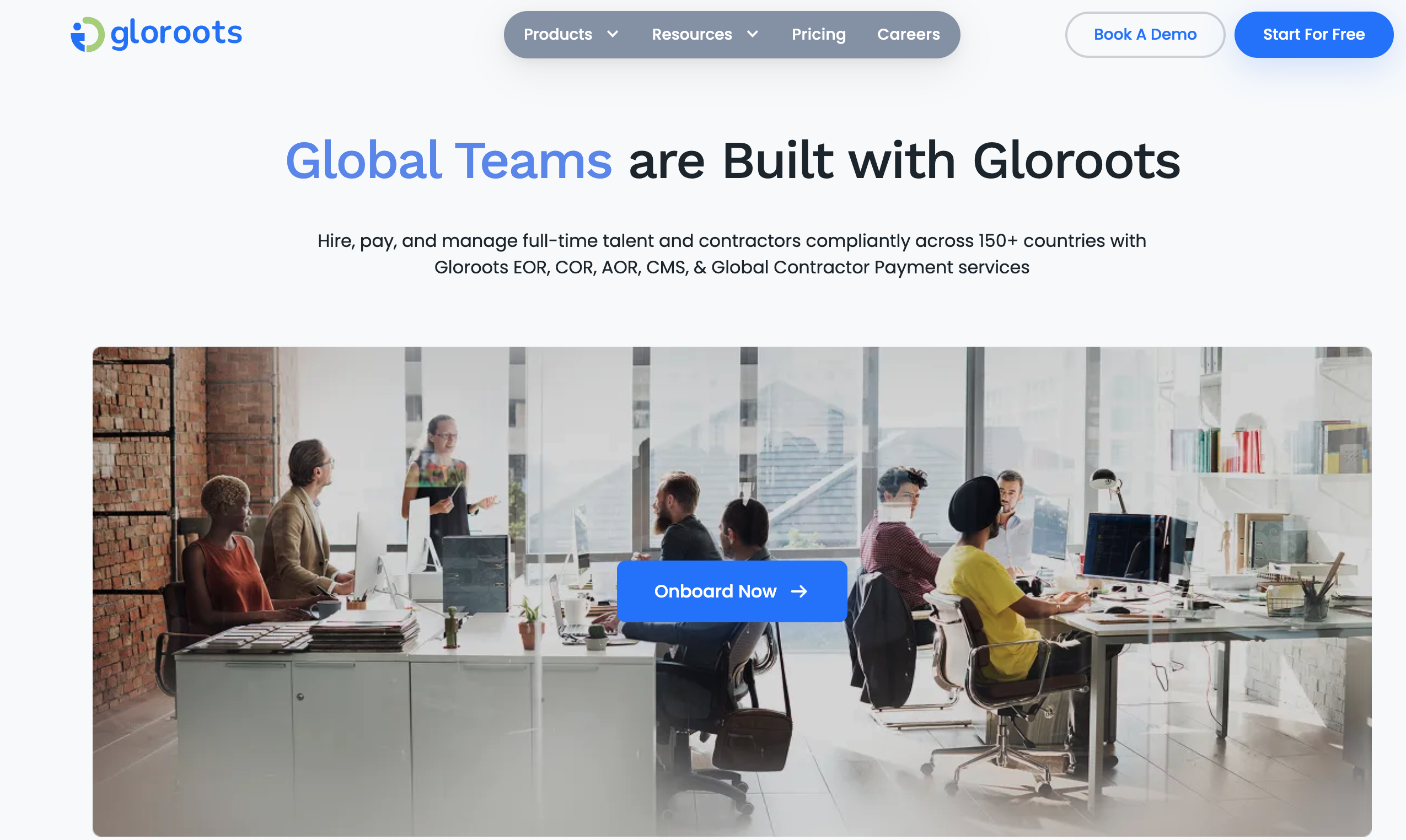
Gloroots supports compliant full-time employment across 150+ countries, including Sri Lanka, through its Global Employer of Record service. The platform combines Global EOR, Global Payroll, Compliance and Employment Governance, and Benefits and Statutory Coverage into a single employment operating layer.
Pricing follows a predictable, country-specific model with full cost visibility before onboarding. Gloroots does not use percentage-of-salary pricing. The USD benchmark for EOR services in Sri Lanka is $199 per employee per month.
Gloroots operates through EOR services that cover local execution with centralized governance.
Strengths:
-
Predictable, country-specific pricing with full cost visibility before onboarding and no percentage-of-salary fees, reducing budget uncertainty for finance teams.
-
Centralized workforce visibility paired with human-led account support that retains business context across the employment lifecycle.
-
Single platform covering Global EOR, Global Payroll, Compliance and Employment Governance, and Benefits and Statutory Coverage across 150+ countries.
Best for:
Companies that require predictable employment costs, centralized workforce governance, and human-led account ownership when hiring full-time employees in Sri Lanka without establishing a local entity.


Safeguard Global

Safeguard Global offers EOR services in Sri Lanka, enabling companies to hire full-time employees without establishing a local entity. The platform manages payroll, onboarding, and statutory compliance on behalf of the client company.
Safeguard Global operates through a partner network in Sri Lanka rather than an owned local entity. Pricing is not publicly listed in researched sources, though the comparison table in this article reflects LKR 90,000–170,000 per month based on available market data.
On the compliance side, Safeguard Global covers the core Sri Lanka statutory requirements:
-
EPF contributions (12% employer, 8% employee) and ETF contributions (3% employer)
PAYE tax withholding and Inland Revenue Department filings
Gratuity calculations under the Termination of Employment Act
Support is delivered through a dedicated account management model, which suits enterprise clients who prefer a single point of contact over a self-serve platform. Onboarding timelines run longer than APAC-specialist providers, typically five to seven days.
Strengths:
-
Covers core Sri Lanka statutory obligations including EPF, ETF, PAYE, and gratuity.
-
Dedicated account management model provides consistent enterprise-grade support.
Limitations:
-
Operates through local partners in Sri Lanka rather than an owned entity, which can add a layer of coordination to compliance decisions.
Best for: Enterprise teams that need managed EOR services in Sri Lanka with dedicated account support and can accommodate a five-to-seven-day onboarding window.
Teamed
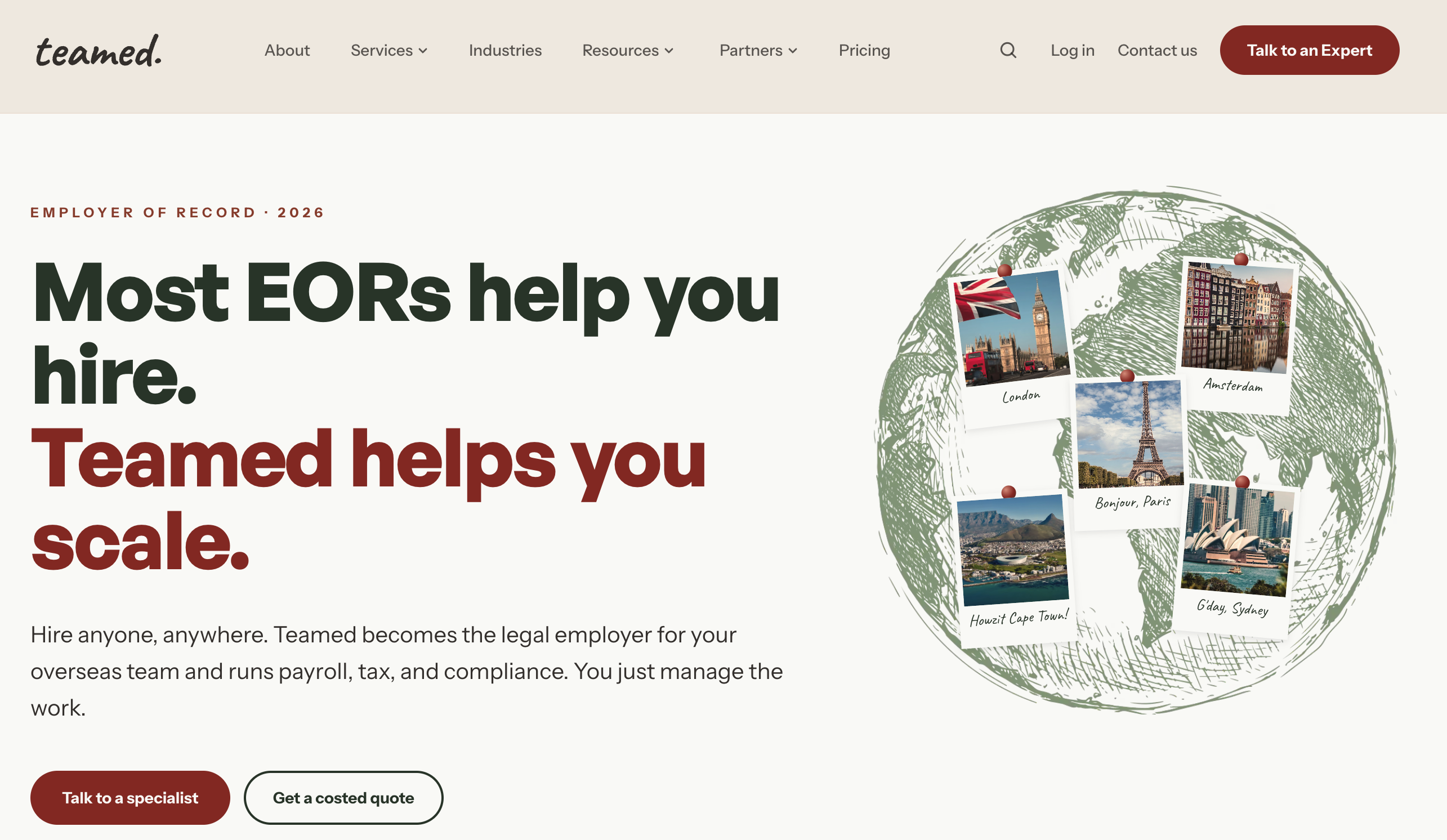
Teamed positions itself as an advisory-led EOR provider covering Sri Lanka. Its model combines employment administration with structured guidance on provider selection, using a six-axis scoring framework to give buyers transparency on how EOR vendors compare across pricing, compliance, support, and other dimensions.
Teamed operates in Sri Lanka through a local partner arrangement rather than an owned entity. Pricing is not publicly listed in researched sources.
Key Sri Lanka compliance capabilities covered by Teamed include:
EPF and ETF statutory contributions
PAYE tax withholding and Inland Revenue filings
Employment contracts aligned with Sri Lankan labor law
The advisory model means clients receive guidance on structuring employment arrangements, not just execution of payroll and filings. Onboarding speed and platform experience details are not publicly documented in researched sources.
Strengths:
-
Six-axis scoring framework gives buyers a structured, transparent basis for comparing EOR providers in Sri Lanka, reducing selection risk.
-
Advisory-led model provides employment structuring guidance alongside standard EOR execution.
Limitations:
-
Pricing and onboarding timelines are not publicly documented, which makes direct cost comparisons harder before an initial consultation.
Best for: Companies that want structured advisory support when selecting and onboarding an EOR in Sri Lanka, particularly those evaluating multiple providers before committing.
Multiplier
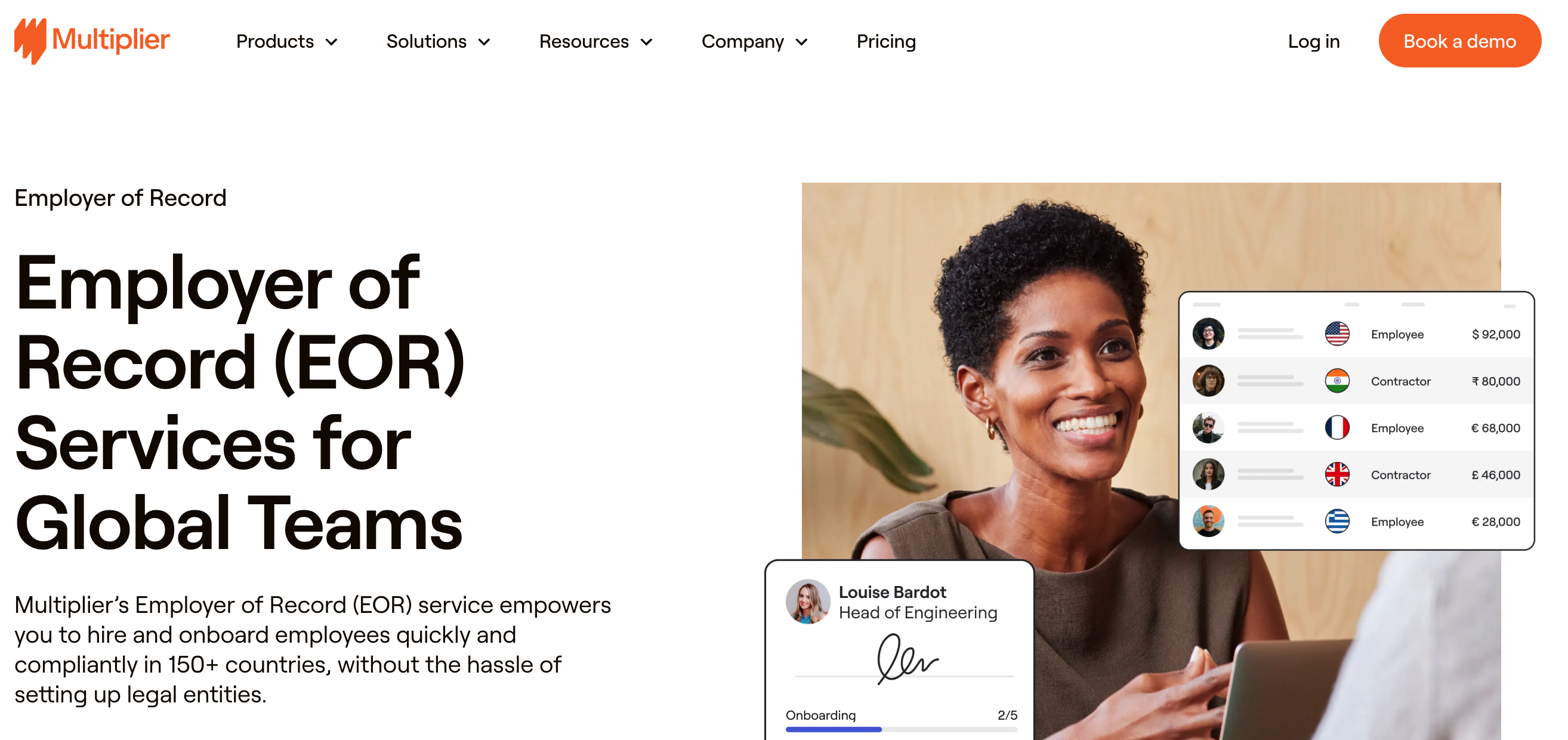
Multiplier is an APAC-focused EOR platform that supports hiring in Sri Lanka and across 150+ countries. The platform is positioned for companies that want fast onboarding with structured payroll compliance across the Asia-Pacific region.
Multiplier manages EPF and ETF contributions, PAYE withholding, and gratuity calculations under Sri Lankan labor law. Payroll is processed in LKR with statutory deductions applied at source, covering the 12% employer EPF contribution, 8% employee EPF, and 3% employer ETF.
Onboarding in Sri Lanka typically completes within one to two days, making Multiplier one of the faster options for companies that need to place workers quickly without establishing a local entity.
Pricing is listed in the comparison table above at LKR 70,000 to 130,000 per month. The support model is described as responsive, with account management available to handle compliance queries and payroll adjustments.
Strengths:
-
Strong APAC coverage with Sri Lanka included, supported by structured EPF/ETF and PAYE compliance workflows.
-
Fast onboarding speed of one to two days, suited to companies with urgent hiring timelines in Sri Lanka.
Limitations:
-
Public sources reviewed did not document a provider-specific limitation for Multiplier in Sri Lanka beyond general APAC platform positioning.
Best for: Companies scaling across APAC that need fast, compliant Sri Lanka hiring with EPF/ETF and PAYE managed through a single platform.
Deel
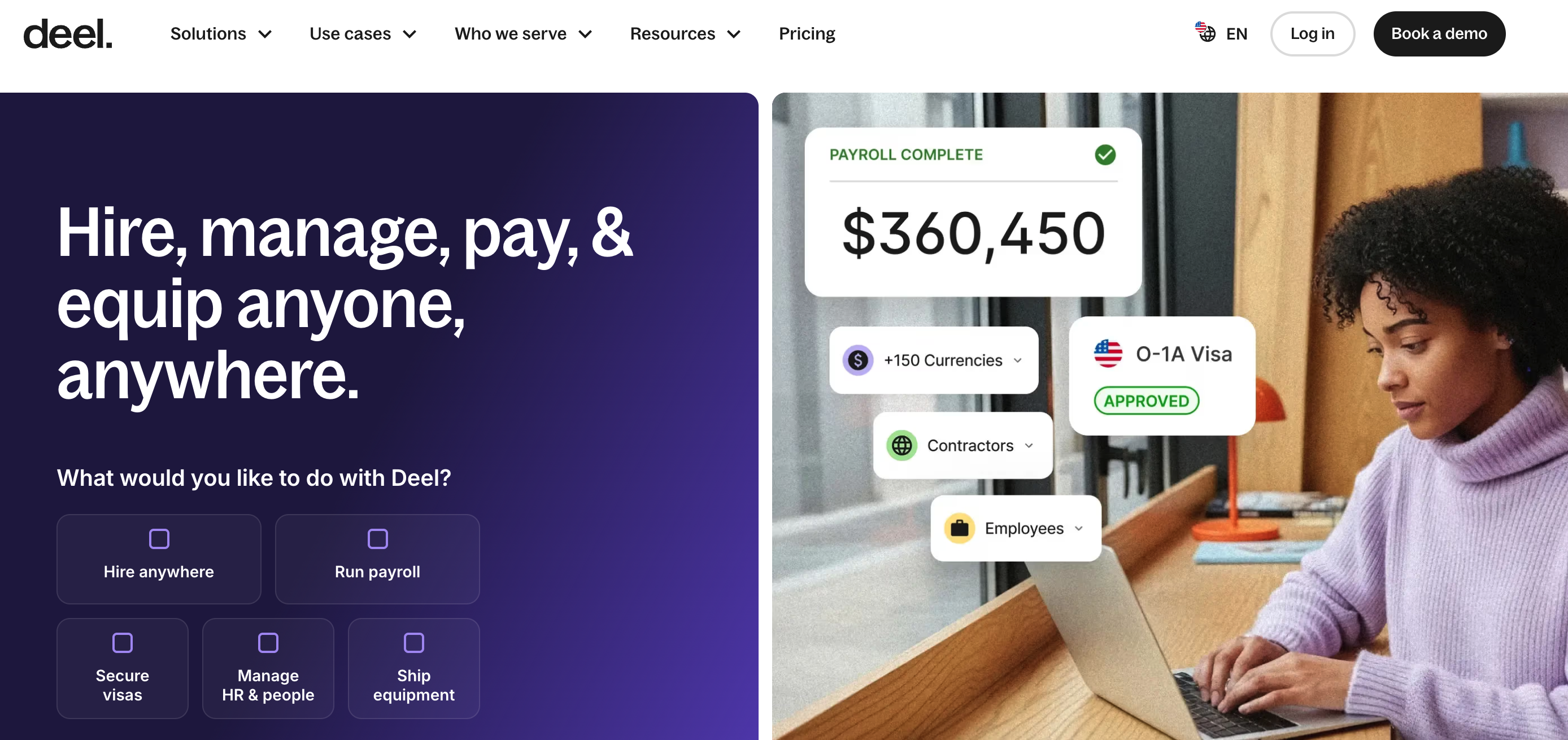
Deel is a global EOR provider covering Sri Lanka within its 150+ country network. The platform is built for companies that want a self-serve hiring experience with broad international coverage managed through a single interface.
In Sri Lanka, Deel handles EPF and ETF contributions, PAYE tax withholding, and gratuity accrual in line with the Termination of Employment Act. Employment contracts are structured to comply with the Shop and Office Employees Act and applicable Wages Boards Ordinances.
Deel's platform is noted for a modern user interface with 24/5 customer support. Onboarding in Sri Lanka can complete within one to three days, which suits companies moving quickly from offer acceptance to active employment.
Strengths:
-
Wide country coverage across 150+ countries, allowing Sri Lanka hiring to sit within a broader global workforce program without switching platforms.
-
Handles core Sri Lanka statutory obligations including EPF/ETF contributions, PAYE withholding, and gratuity calculations through a single employment layer.
Limitations:
-
Public sources reviewed did not document a provider-specific limitation for Deel's Sri Lanka EOR operations beyond general platform-level observations.
Best for: Companies with existing global headcount across multiple regions that want to add Sri Lanka employment within a unified platform without managing separate compliance workflows.
Remote
Remote operates an all-owned-entity model, meaning it employs workers through its own legal entities rather than third-party partners. For Sri Lanka, this structure reduces intermediary risk and gives companies a single accountable employer on record.
Remote handles EPF and ETF contributions, PAYE withholding, and gratuity calculations under the Termination of Employment Act. Employment contracts are drafted to comply with the Shop and Office Employees Act.
The platform is self-serve by design. HR teams can onboard employees, run payroll, and track compliance through a single dashboard without requiring account manager involvement for routine tasks. Onboarding in Sri Lanka typically completes within two to five days.
-
Owned-entity employment in Sri Lanka with no local partner dependency
EPF, ETF, and PAYE compliance managed within the platform
Gratuity accrual and statutory leave tracking included
-
Self-serve interface suited to teams managing multiple countries simultaneously
Pricing is published in USD. $599 to $699 per employee per month. Support is available through the platform, with async and live options depending on the plan tier.
Best for: Companies that want a self-serve EOR platform backed by owned legal entities and prefer to manage Sri Lanka employment without dedicated account management.
Pebl
Pebl positions itself as an EOR provider focused on emerging markets, including Sri Lanka. Its model is designed for companies hiring in regions where local compliance complexity is high and in-house expertise is limited.
For Sri Lanka, Pebl covers statutory payroll obligations including EPF and ETF contributions, PAYE withholding, and employment contracts aligned with local labor law.
Onboarding timelines and platform capabilities are not fully documented in publicly reviewed sources. The support model is described as advisory-led, with account managers providing compliance guidance rather than a purely self-serve interface.
Emerging-market EOR positioning with Sri Lanka coverage
Statutory compliance support including EPF, ETF, and PAYE
Advisory-led support model for compliance-heavy markets
Pricing is from $399 per employee per month. Public sources reviewed did not document a provider-specific limitation beyond the gaps noted above.
Best for: Companies entering Sri Lanka and other emerging markets that prefer an advisory-led EOR model over a self-serve platform.
Horizon EOR
Horizon EOR operates as a Sri Lanka-focused provider that combines employment administration with local recruitment capabilities. Companies that need to source and employ talent through a single provider find this integration useful, particularly when entering the market without existing hiring relationships.
Pricing runs from LKR 70,000 to LKR 130,000 per employee per month. Horizons operates its own Sri Lanka subsidiary as the Employer of Record rather than using a local-partner arrangement.
Strengths:
-
Integrated recruitment and EOR services allow companies to source, screen, and employ candidates through one provider rather than coordinating separate vendors.
-
Local account management with Sri Lankan market knowledge supports payroll processing, EPF and ETF contributions, and labor law compliance.
Limitations:
-
Recruitment services may carry additional fees beyond the base EOR monthly rate, which affects total cost predictability for companies hiring at volume.
Best for:
Companies entering Sri Lanka without an established talent pipeline that need integrated recruitment support alongside compliant employment and payroll administration.
What Are the Key Services of an EOR in Sri Lanka?
An EOR in Sri Lanka manages payroll, statutory contributions, tax filings, employment contracts, and benefits administration on behalf of the hiring company. This removes the need for a local entity while keeping the employment relationship fully compliant with Sri Lankan labor law.
Sri Lanka observes 26 public holidays annually, each of which creates specific payroll-tracking obligations. EOR providers calculate holiday pay, track working days accurately, and file the correct statutory amounts with the Inland Revenue Department and the EPF and ETF boards each month.
Contractor misclassification is a common trigger for EOR adoption. When a company engages workers as independent contractors but the working arrangement resembles full-time employment under the Shop and Office Employees Act, the company faces liability for unpaid EPF and ETF contributions, PAYE tax, and gratuity. An EOR converts that risk into a governed employment relationship from the start.
Employment Contracts and Local Compliance
A formal employment contract is the first line of defense against misclassification risk in Sri Lanka. The Shop and Office Employees Act and the Industrial Disputes Act both impose significant liability on companies that treat employees as independent contractors without proper documentation.
EOR providers issue contracts in Sinhala, Tamil, or English depending on the employee's location and role requirements. Where a Wages Board covers the relevant sector, contracts must specify the applicable minimum wage set by that Board, not just the national floor.
Gloroots issues locally compliant employment contracts as part of its Compliance and Employment Governance service, covering statutory minimums, leave entitlements, and termination provisions under Sri Lankan labor law.
Payroll and Tax Administration
Sri Lanka's national minimum wage stands at LKR 30,000 per month as of January 2026, setting the payroll floor for all EOR-managed employees. Payroll must be processed in LKR, and PAYE tax remittances are due to the Inland Revenue Department within 30 days after the end of each month.
Since the LKR moved to a free-floating exchange rate in 2022, companies billed in USD by their EOR provider carry real foreign exchange exposure. A provider that applies a markup on the USD-to-LKR conversion can materially increase the effective cost of employment over time.
Gloroots uses predictable, country-specific pricing with full cost visibility before onboarding and no percentage-of-salary pricing, which limits unexpected FX-related cost increases for companies managing Sri Lankan payroll through its Global Payroll service.
Benefits Administration
An EOR in Sri Lanka manages both statutory and supplemental benefits, keeping employers compliant with obligations that go beyond basic payroll.
Sri Lanka observes 26 public holidays each year, including 12 Full Moon Poya Days. Each holiday requires accurate holiday-pay tracking and correct payroll treatment under the Shop & Office Employees Act.
Gratuity accrual follows a two-tier formula: half a month's salary per year of service for the first five years, then one full month's salary per year thereafter. An EOR calculates and provisions these amounts on an ongoing basis, reducing termination-period liability.
-
EPF contributions: 12% employer, 8% employee, remitted monthly to the Employees' Provident Fund
-
ETF contributions: 3% employer, remitted to the Employees' Trust Fund
-
Supplemental benefits: health insurance, meal allowances, and transport support, administered separately from statutory contributions
Gloroots manages Benefits & Statutory Coverage as a distinct service layer, tracking EPF, ETF, gratuity accruals, and public holiday pay through a centralized payroll policy.
Employee Onboarding
An EOR in Sri Lanka manages the full onboarding sequence for both local hires and foreign nationals, covering registration, documentation, and work authorization from day one.
For foreign nationals deployed to Sri Lanka, the EOR handles work permit and visa processing. Relevant categories include the Resident Guest visa and the Employment visa, each with distinct eligibility criteria and documentation requirements under the Department of Immigration and Emigration.
For all new employees, the EOR registers individuals with the relevant statutory departments:
EPF registration with the Employees' Provident Fund department
ETF registration with the Employees' Trust Fund Board
-
Employment contract execution compliant with the Shop & Office Employees Act
Gloroots runs Employment Lifecycle Management as part of its Global Employer of Record service, covering EPF/ETF registration, contract issuance, and work authorization support for foreign hires entering the Sri Lankan market.
Ongoing HR Support
Sri Lanka's regulatory environment has shifted considerably since 2022, with labor and tax authorities issuing updated guidance on EPF/ETF filings, PAYE thresholds, and employment contract requirements. A qualified EOR monitors these changes and communicates updates to clients before they affect payroll or compliance obligations.
Department of Labour inspections present a real risk for foreign employers operating without local legal expertise. An EOR maintains audit-ready documentation, including employment contracts, leave records, and statutory contribution receipts, reducing exposure during inspections.
Gloroots provides human-led account support with retained business context, so the team managing your Sri Lankan workforce understands your employment structure and can respond to regulatory changes without requiring you to brief them from scratch each time.
Employee Offboarding
Offboarding in Sri Lanka depends on how the employment ends. Resignations require the employee to serve the contractual notice period. Mutual separations are documented through a written agreement between both parties. Employer-initiated terminations in certain categories require prior approval from the Commissioner of Labour under the Termination of Employment Act.
Severance obligations average approximately 10.8 weeks of salary, calculated based on tenure and the applicable gratuity formula. Errors in these calculations can trigger labor tribunal claims.
An EOR manages the full offboarding process: issuing the correct documentation, calculating final pay and gratuity, filing required notices with the Commissioner of Labour where applicable, and closing out statutory contributions with EPF and ETF authorities. Gloroots supports Employment Lifecycle Management across all termination types, keeping the process compliant and documented.
How to Hire Through an EOR in Sri Lanka
Hiring through an EOR in Sri Lanka means the provider becomes the legal employer on record, handling payroll, statutory filings, and labor law compliance on your behalf. You direct the work; the EOR manages the employment relationship.
This approach removes the need to incorporate a private limited company or obtain Board of Investment registration, which typically takes four to six months. You can employ Sri Lankan nationals and, with the appropriate work visa in place, foreign nationals as well.
To understand the full mechanics before you begin, review how does EOR work as a foundation for the steps below.
Selection and Setup
Follow these four steps to move from role definition to a compliant employment contract in Sri Lanka.
-
Define the role and compensation package. Set the salary, benefits, and leave entitlements before approaching any provider. Confirm that your package meets Sri Lankan statutory minimums, including EPF and ETF contribution rates and applicable Wages Board thresholds.
-
Select an EOR provider. Verify whether the provider operates through an owned local entity or a third-party partner arrangement. Confirm USD or LKR pricing, and review the provider's compliance track record with the Inland Revenue Department and Department of Labour.
-
Sign the master service agreement and country addendum. The country-specific service agreement sets out employment terms, liability allocation, and the scope of statutory filings the EOR will manage on your behalf.
-
EOR registers the employee. The provider registers the employee with the EPF and ETF departments and files the required documentation with the Inland Revenue Department before the first payroll run.
If your billing currency differs from LKR, confirm the provider's foreign exchange markup policy in writing before signing. Undisclosed FX margins can add material cost to each monthly payroll cycle.
Onboarding and Compliance
Once a candidate accepts an offer, the EOR issues an employment contract compliant with the Shop and Office Employees Act or the applicable Wages Board ordinance for the relevant sector.
The employee then completes onboarding documentation, including tax file number registration with the Inland Revenue Department. The first payroll run applies EPF and ETF deductions alongside PAYE withholding.
Ongoing compliance monitoring covers:
-
Public holiday payroll adjustments in line with statutory requirements
Annual leave accrual tracking based on employee tenure
Monthly EPF, ETF, and PAYE remittance filings
For foreign nationals, work permit processing timelines vary by nationality and role type. Companies should account for this lead time before the employee's intended start date, as permits must be secured before employment begins.
What Are the Benefits of Using an EOR in Sri Lanka?
Using an EOR in Sri Lanka lets a company employ workers legally within days, without incorporating a local entity. Sri Lanka ranks 34th of 192 countries globally on employer compliance burden, which means the statutory obligations are real and consequential.
The table below compares EOR engagement with direct entity setup across five decision factors.
| Factor | EOR | Entity setup |
|---|---|---|
| Setup time | 1 to 3 days | 4 to 6 months |
| Initial cost | Monthly service fee | LKR 500,000 to 1,500,000 incorporation cost |
| Compliance burden | Managed by EOR | Managed in-house or via local advisors |
| Scalability | Adjust headcount without entity changes | Requires ongoing corporate secretarial maintenance |
| Risk allocation | Employment liability sits with EOR | Full liability retained by the company |
Gloroots supports entity-free employment across 150+ countries, including Sri Lanka, with predictable, country-specific pricing and full cost visibility before onboarding begins.
Faster Market Entry
Incorporating a private limited company in Sri Lanka typically takes four to six months and costs between LKR 500,000 and LKR 1,500,000 (approximately USD 1,600 to USD 4,900). Foreign-invested entities registering with the Board of Investment face additional approval steps that extend this timeline further.
An EOR removes that requirement entirely. Companies can place employees on compliant contracts within one to three days, with payroll, EPF/ETF contributions, and PAYE withholding handled from the first pay cycle.
This matters most when a business needs to respond quickly to a market opportunity or secure a specific candidate before a competitor does. Entity-free employment through an EOR converts a multi-month administrative process into a short onboarding window.
Reduced Compliance Risk
Sri Lanka's regulatory environment has shifted considerably since the 2022 economic crisis. Tax policy, foreign exchange rules, and labor enforcement priorities have all changed, making current compliance expertise more valuable than historical knowledge of the framework.
Employment law risk in Sri Lanka is specific and layered. Misclassifying a worker as an independent contractor rather than an employee can trigger liability under both the Shop and Office Employees Act and the Industrial Disputes Act, including back-payment of EPF and ETF contributions, gratuity, and statutory leave entitlements.
An EOR assumes the legal employer role, which transfers employment liability directly. That includes exposure to Department of Labour inspections, labor tribunal proceedings, and statutory filing obligations. The hiring company retains operational direction of the worker without carrying the legal risk of direct employment.
Simplified Payroll Administration
Running payroll in Sri Lanka requires accurate monthly calculations across EPF, ETF, and PAYE withholding, with PAYE remittances due to the Inland Revenue Department within 30 days after each month-end.
An EOR manages this recurring cycle, including filing deadlines, statutory deductions, and payslip generation, so your finance team does not carry the compliance burden directly.
Since 2022, the Sri Lankan rupee has been free-floating, which means payroll costs in USD terms can shift month to month. Depending on the provider, that foreign exchange exposure is either absorbed by the EOR or passed through to the client. Confirming this policy before signing a contract protects your budget from unexpected variance.
Access to Local Benefits
Sri Lanka mandates 26 public holidays per year, including 12 Full Moon Poya Days. Tracking these correctly across payroll cycles is a statutory requirement, and errors create liability under the Shop and Office Employees Act.
An EOR monitors the official holiday calendar and adjusts payroll accordingly, removing the administrative risk from your HR team.
Beyond statutory minimums, supplemental benefits such as health insurance and transport allowances are common in the Sri Lankan market. With an average monthly wage of LKR 48,843, benchmarking these additions against local norms helps companies attract qualified candidates without overpaying. An EOR with local market knowledge can advise on competitive benefit structures for your specific sector and headcount.
Lower Entity Setup Costs
Establishing a private limited company in Sri Lanka typically requires LKR 500,000 to 1,500,000 in setup costs, plus Board of Investment registration for foreign investors, ongoing corporate secretarial fees, and dedicated local legal and accounting staff.
An EOR removes all of that overhead. You pay a predictable monthly fee per employee and carry no entity maintenance burden.
For most companies, EOR fees remain more cost-effective than entity ownership until headcount reaches roughly 15 to 20 full-time employees in Sri Lanka. Beyond that threshold, incorporating a private limited company and absorbing the fixed compliance costs can produce a lower per-employee cost. Until then, an EOR gives you full statutory compliance without the capital outlay.
More Flexible Workforce Scaling
Entity-based employers in Sri Lanka can face approval requirements under the Termination of Employment Act when reducing headcount in certain categories. An EOR absorbs that legal employer role, so scaling down does not trigger the same procedural obligations for your business.
This matters when project timelines shift or market conditions change. You can adjust team size without the administrative and legal exposure that comes with direct entity employment.
An EOR also supports both local Sri Lankan hires and foreign nationals under a single service agreement. Whether you are building a local operations team or placing an expatriate manager, the same employment framework applies. For early-stage companies, EOR for startups provides a practical way to scale a Sri Lankan team without committing to a fixed entity structure.

How to Find the Right EOR for Sri Lanka
Selecting an EOR for Sri Lanka requires evaluating five key dimensions: local compliance expertise, technology and reporting, support quality, pricing transparency, and entity model. Each dimension affects how reliably the provider can manage your Sri Lankan workforce.
The single most important due-diligence question is whether the provider operates through an owned local entity or a local-partner arrangement. Owned-entity providers carry direct legal accountability for employment compliance. Local-partner models introduce a third party into the employment chain, which can affect response times and compliance consistency. Ask every provider in writing which model applies before signing a contract. Reviewing employer of record software options can also help you assess platform capabilities alongside entity structure.
Local Compliance Expertise
Local compliance expertise means the provider has working knowledge of the Shop and Office Employees Act, Wages Boards Ordinances, and the Termination of Employment Act. It also covers EPF and ETF registration, PAYE filing deadlines with the Inland Revenue Department, and regulatory changes introduced after 2022.
Ask providers directly how they track Sri Lanka regulatory updates and how they communicate those changes to clients. A provider that cannot describe a clear internal process for monitoring legislative changes is a compliance risk.
Owned-entity providers typically maintain deeper local compliance infrastructure than local-partner models. When a provider employs workers through its own registered entity in Sri Lanka, it has direct accountability for filings and statutory contributions, which generally produces more consistent compliance outcomes.
Clear Service Scope
A clear service scope means the provider explicitly confirms what is included in the monthly fee before you sign. At minimum, that list should cover EPF and ETF filings, PAYE submissions, gratuity accrual, leave management, and offboarding support.
Work permit processing is a common gap. Some providers include it in the base fee; others bill it separately. Confirm this in writing during the evaluation stage, not after onboarding.
Currency handling also matters. Confirm whether the provider bills in USD or LKR and at what exchange rate. An undisclosed FX markup can add meaningful cost to each monthly invoice. Providers with pricing built around Pricing & Cost Transparency give you a full cost picture before the first payroll run.
Support Model
The support model determines how quickly your team gets answers when payroll issues arise. A dedicated account manager retains context about your workforce; a shared support pool does not. Ask each provider which model applies to your account tier.
Response SLA matters in practice. Sri Lanka operates at UTC+5:30, so confirm the provider has coverage during local business hours rather than routing all queries through a distant time zone.
Sri Lanka observes 26 public holidays, including monthly Poya Days tied to the lunar calendar. Payroll queries tend to spike around these dates. Confirm that the provider maintains adequate staffing during those periods. Gloroots uses human-led account support with retained business context, which reduces the risk of repeated explanations during high-volume periods.
Technology and Reporting
A capable EOR platform gives you real-time payroll visibility, not just end-of-month reports. Look for a dashboard that confirms EPF and ETF contributions as they are processed and generates audit-ready documentation for each pay cycle.
Platform security certifications matter during due diligence. SOC 2 Type II and ISO 27001 certification signal that the provider governs data with defined controls, which is relevant when your legal or finance team reviews vendor risk.
If you are hiring across APAC alongside Sri Lanka, reporting capabilities should extend across all active countries in one view. Gloroots provides centralized workforce visibility through its Workforce Visibility and Reporting module, supporting multi-country payroll governance from a single platform.
Scalability for Your Hiring Plans
Your EOR should support growth from a single hire to 50 or more employees in Sri Lanka without service degradation or pricing surprises. Confirm that the provider's operations model, not just its technology, scales with headcount.
Ask whether the provider offers path-to-entity support. As your Sri Lankan team grows, there is a point where incorporating a local entity becomes more cost-effective than EOR fees. A provider that models this threshold for you adds long-term planning value rather than locking you into a single arrangement.
Workforce mix flexibility also matters. If you engage both full-time employees and independent contractors in Sri Lanka, a platform that manages both under one contract reduces administrative overhead. Gloroots supports EOR for enterprises scaling across multiple countries, with Global EOR and Global Payroll on one platform for a consistent employment operating layer as headcount grows.

Why Gloroots Is a Strong EOR Partner in Sri Lanka
Gloroots supports compliant full-time employment across 150+ countries, including Sri Lanka, through its entity-free employment model. Companies can employ workers in Sri Lanka without registering a local entity.
The platform combines four service pillars: Global Employer of Record (EOR), Global Payroll, Compliance & Employment Governance, and Benefits & Statutory Coverage. Each pillar operates together to cover the full employment lifecycle from contract to offboarding.
For Sri Lanka specifically, Gloroots manages:
-
EPF and ETF automated contributions (12% employer EPF, 8% employee EPF, 3% employer ETF) with monthly statutory filings
PAYE withholding and Inland Revenue Department submissions
-
Gratuity accrual calculations under the Termination of Employment Act
-
Employment contracts compliant with the Shop & Office Employees Act
Gloroots uses predictable, country-specific pricing with full cost visibility before onboarding. There is no percentage-of-salary pricing, so finance teams can plan headcount costs accurately from the start. See Gloroots pricing for country-specific rates.
Workforce Visibility & Reporting gives HR and operations teams a centralized view of their Sri Lanka headcount alongside global employees. Human-led account support retains business context across interactions, so teams do not repeat background on every query.
Dedicated account managers handle Sri Lanka labor law queries, EPF/ETF clarifications, and benefits benchmarking. Support runs 24/7 across time zones. To see how Gloroots manages Sri Lankan employment end to end, review Gloroots EOR services or book a demo to discuss your specific hiring requirements.
FAQs About the Best EOR in Sri Lanka
The questions below address the most common topics buyers raise when evaluating an EOR for Sri Lanka, covering compliance obligations, costs, onboarding timelines, and statutory requirements.
What statutory contributions does an EOR manage in Sri Lanka?
An EOR handles EPF contributions (12% employer, 8% employee), ETF contributions (3% employer), PAYE withholding, and gratuity accruals under the Termination of Employment Act. Monthly filings go to the Inland Revenue Department and the relevant statutory bodies.
How quickly can an EOR onboard an employee in Sri Lanka?
Most EOR providers complete onboarding within one to five business days, depending on document readiness and the provider's local processes. Gloroots targets one to three days for Sri Lanka.
Do I need a local entity to hire in Sri Lanka through an EOR?
No. An EOR acts as the legal employer on record, so your company can employ workers in Sri Lanka without incorporating a private limited company or obtaining Board of Investment approvals.
What employment laws govern Sri Lankan workers?
Key legislation includes the Shop & Office Employees Act, Wages Boards Ordinances, Termination of Employment Act, and Industrial Disputes Act. An EOR maintains compliance with all applicable statutes and sector-specific regulations.
How does an EOR work in Sri Lanka?
An EOR becomes the legal employer of your Sri Lankan workers on paper, while your company retains full day-to-day management of their work. No local entity is required.
The EOR registers with the Employees' Provident Fund and Employees' Trust Fund, withholds PAYE tax, and files with the Inland Revenue Department on your behalf. It also issues employment contracts compliant with the Shop and Office Employees Act.
Your team works to your direction. The EOR handles the statutory obligations. For a detailed breakdown of how this model operates across countries, see how does EOR work.
What does an EOR cost in Sri Lanka?
EOR fees in Sri Lanka typically run between $300 and $500 per employee per month. At current exchange rates, that translates to approximately LKR 60,000 to LKR 120,000 per month.
Before signing, confirm exactly what the fee covers: EPF and ETF contributions, PAYE withholding, gratuity accrual, and offboarding costs. Also ask whether a foreign exchange markup applies to LKR payments.
Some providers use percentage-of-salary pricing, which scales costs upward as salaries rise and makes budgeting harder to predict. Gloroots uses predictable, country-specific pricing with full cost visibility before onboarding and no percentage-of-salary model. For a broader view of what drives these fees, see employer of record cost.
When should a company use an EOR in Sri Lanka?
An EOR in Sri Lanka makes sense in four common situations: testing the market without committing to a local entity, hiring a small team of one to five employees, needing immediate compliance from day one, or converting contractors to employees to reduce misclassification risk under the Shop & Office Employees Act.
EOR services are typically most cost-effective below a headcount threshold where the fixed costs of running a registered entity become cheaper than monthly EOR fees. For smaller teams and early-stage market entry, an EOR for small business offers predictable costs without the administrative burden of entity setup and ongoing corporate secretarial obligations.
Can an EOR hire both local and foreign employees in Sri Lanka?
Yes. An EOR in Sri Lanka can employ both Sri Lankan nationals and foreign nationals on behalf of your company. Sri Lankan nationals are employed directly under standard labor law protections.
Foreign nationals require appropriate work authorization before employment can begin. This typically means a Resident Guest visa or an Employment visa issued by Sri Lankan immigration authorities. Some EOR providers include work permit processing support within their service scope, while others treat it as a separate engagement.
Before selecting a provider, confirm exactly which steps they manage in the work permit process and which steps remain your responsibility. Scope varies across providers and can affect how quickly a foreign hire can start work.
How do I choose the right EOR in Sri Lanka?
Start by confirming whether the provider operates through an owned local entity or relies on a local partner. This single question determines where legal liability sits and how quickly compliance issues get resolved.
Once entity status is confirmed, ask for written documentation on these four points:
-
USD pricing breakdown with all statutory costs itemized before onboarding
-
How EPF, ETF, and PAYE filings are handled and confirmed each month
-
The process for communicating Sri Lankan labor law updates to your team
-
Dedicated account support with retained context on your workforce
Providers that cannot supply written answers to these questions carry higher compliance risk for your Sri Lankan headcount.