



- Employer of Record (EOR) in Hong Kong legally employs workers on behalf of foreign companies, managing payroll, MPF mandatory provident fund contributions (5% employer matching), and local compliance without entity setup.
- Best EOR service providers in Hong Kong include Gloroots, AYP Group, Asia Pacific Recruitment, Michael Page Hong Kong, Robert Walters Hong Kong, Deel, Remote, Multiplier, Atlas HXM, and Velocity Global.
- Choosing the right EOR provider depends on factors like Employment Ordinance expertise, MPF handling (5% employer), IRD salaries tax compliance (2-17%), and APAC headquarters support.
- Hiring through an EOR in Hong Kong offers rapid APAC market entry, access to finance and tech talent pools, a business-friendly environment with 0% employer social security, and flexible scaling without Private Limited entity complexity.
Our Top 10 Picks from All Employer of Record (EOR) Companies in Hong Kong [2026 Shortlist]
What is an EOR in Hong Kong?
An Employer of Record (EOR) in Hong Kong lets companies hire employees without setting up a local legal entity. The EOR becomes the legal employer, while your company manages the employees’ day-to-day work.
The EOR handles payroll, benefits, and compliance with Hong Kong employment laws, including retirement fund contributions (MPF), salaries tax withholding (IRD), the Employment Ordinance, statutory holidays and annual leave, severance and long service payments, maternity and paternity leave, sickness allowance, notice periods, and employment visa processing through the Immigration Department.
For global teams and expanding businesses, a Hong Kong EOR makes it easy to hire, pay, and stay compliant while entering the Hong Kong market quickly and confidently.
Key Services of EORs in Hong Kong
- Payroll & MPF Management: Processing salaries in HKD, managing mandatory MPF contributions of 5% employer portion (5% employee portion, capped at HKD 1,500/month each for monthly salaries above HKD 30,000), calculating IRD salaries tax withholding (progressive rates 2-17% or 15% standard rate), and ensuring compliance with MPFA (Mandatory Provident Fund Schemes Authority) regulations.
- Employment Ordinance Compliance: Managing employment contracts compliant with the Employment Ordinance, notice period requirements (1 week for under 1 month service, up to 1 month for 2+ years), probation periods (typically 1-3 months), termination procedures, and strict employee protection laws.
- Statutory Benefits Administration: Managing minimum 12 statutory holidays, annual leave (7 days after first year, increasing to 14 days after 9 years), statutory holiday pay, rest day provisions (1 day per 7 days), maternity leave (14 weeks at 80% pay for first 10 weeks), paternity leave (5 days at 80% pay), sickness allowance, and end-of-year payment practices.
- Severance & Long Service Payments: Calculating severance pay (2/3 of monthly wages × years of service for employees with 2+ years tenure in redundancy situations), long service payment (for employees with 5+ years service not entitled to MPF or severance), and ensuring compliance with calculation caps and requirements.
- Employment Visa Support: Processing employment visa applications through the Immigration Department for expatriates (note: Hong Kong offers visa-free access for many nationalities, making hiring relatively straightforward), dependent visas, and ensuring immigration compliance.
Benefits of Using an EOR in Hong Kong
- Rapid APAC Entry: Start hiring in Hong Kong without establishing a Private Limited company, requiring minimum capital and a company secretary.
- 0% Employer Social Security: Benefit from Hong Kong's business-friendly environment with no employer social security taxes beyond MPF (5%).
- MPF Simplicity: Navigate a straightforward Mandatory Provident Fund system with 5% employer matching capped at HKD 1,500/month.
- Finance & Tech Talent: Access Hong Kong's skilled workforce in fintech, trading, banking, and technology across Central, Kowloon, and regional hubs.
- APAC Headquarters: Establish regional operations in Asia's leading financial centre with strong rule of law and an English business environment.
Top 10 Best EOR Platforms in Hong Kong
1. Gloroots (Global, with strong Hong Kong coverage)
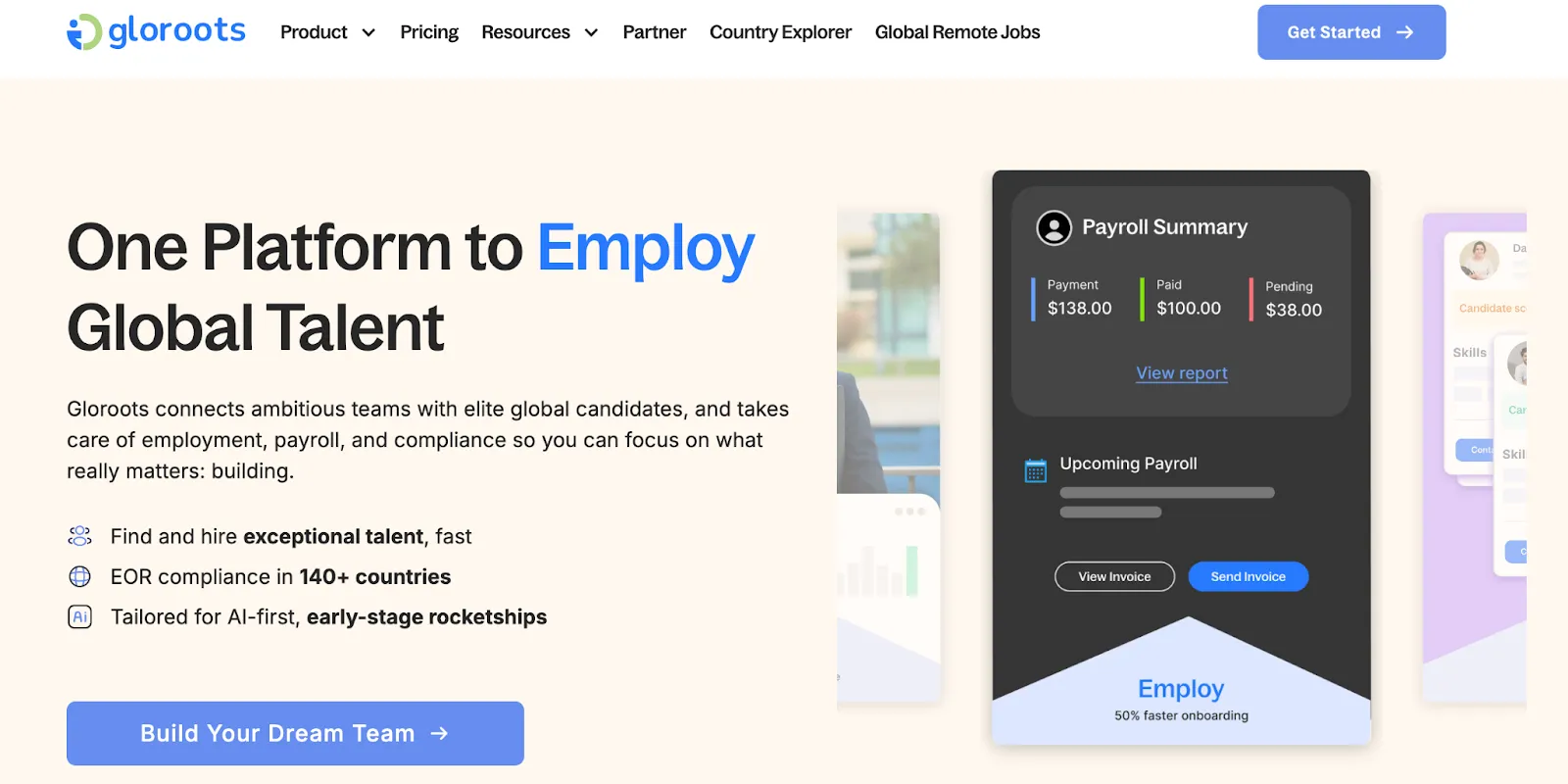
Gloroots helps companies hire and employ workers in Hong Kong without setting up a local entity. It manages payroll, MPF mandatory provident fund contributions, IRD salaries tax filings, statutory benefits, and Employment Ordinance compliance, allowing businesses to expand into the Hong Kong market without legal or regulatory risk.
Gloroots supports companies from the hiring stage through ongoing employment. The platform connects hiring, onboarding, and Employer of Record (EOR) into a single workflow, providing predictable monthly costs starting at HKD 3,200 per employee and fast onboarding in 1–2 weeks.
This makes Gloroots a reliable partner for businesses expanding into Hong Kong’s fintech, trading, and regional APAC operations.
Why Use Gloroots in Hong Kong
Gloroots combines a technology platform with in-house Hong Kong HR and payroll experts. Companies get real-time visibility into payroll, MPF contributions, IRD salaries tax, statutory leave accruals, and severance obligations, while local specialists ensure every hire meets Employment Ordinance requirements.
This approach gives startups and mid-market companies a faster and more predictable way to hire in Hong Kong compared to EORs that rely heavily on third-party partners, without establishing a local Private Limited entity.
Key Benefits and Features
- Hire in Hong Kong without an entity
Employ Hong Kong workers quickly, with Gloroots as the legal employer. - MPF automation
Mandatory 5% employer contributions managed automatically (capped at HKD 1,500/month). - Hong Kong contract localisation
Employment Ordinance templates with correct legal terms. - IRD salaries tax
PAYE withholding precision with 2–17% progressive rates or 15% standard rate. - Employment visa support
Immigration Department filing coordination for work permits and visas.
Hong Kong-Specific Services Offered
- EOR hiring and onboarding with full compliance across Hong Kong Island, Kowloon, New Territories, and regional areas.
- Payroll management with automated MPF (5% employer, capped at HKD 1,500) and IRD tax compliance.
- Employment Ordinance contract management, ensuring statutory compliance.
- Statutory benefits administration, including 12 holidays, annual leave, and maternity/paternity leave.
- Employment visa processing throughthe Immigration Department for expatriates.
Platform Experience
- Technology-driven platform with a live dashboard providing real-time visibility into payroll and compliance.
- Transparent, user-friendly interface designed to minimise complexity for companies new to Hong Kong.
- Real-time tracking of MPF obligations, statutory leave accruals, and severance calculations keeps businesses informed.
Customer Support
- 24/7 support availability for all client tiers ensures assistance across time zones and business needs.
- Responsive account managers provide strategic guidance and personalised support for complex Hong Kong compliance questions.
- Transparent communication and proactive onboarding assistance help companies understand Hong Kong's business advantages and talent markets.
Pricing & Hidden Fees
Transparent pricing starting at HKD 3,200 per employee/month, adjusted for service complexity and seniority levels. All services are clearly itemised upfront. Simple, straightforward pricing structure with no hidden charges.
Pros:
- Handles HK regulatory simplicity + speed
- Rapid APAC market entry
- Multi-country scalability
- Cost-effective platform
- Compliance dashboard excellence
Cons:
- Emerging HK presence
- MPF documentation processing
- Seniority-based extras
- Chinese platform maturing
- Limited local offices
Best For
Fintech, trading, and APAC headquarters seeking rapid Hong Kong market entry with MPF expertise (5% employer), IRD tax compliance (2-17%), and expert navigation of the Employment Ordinance without establishing a Private Limited entity.
2. AYP Group (Hong Kong EOR leader)
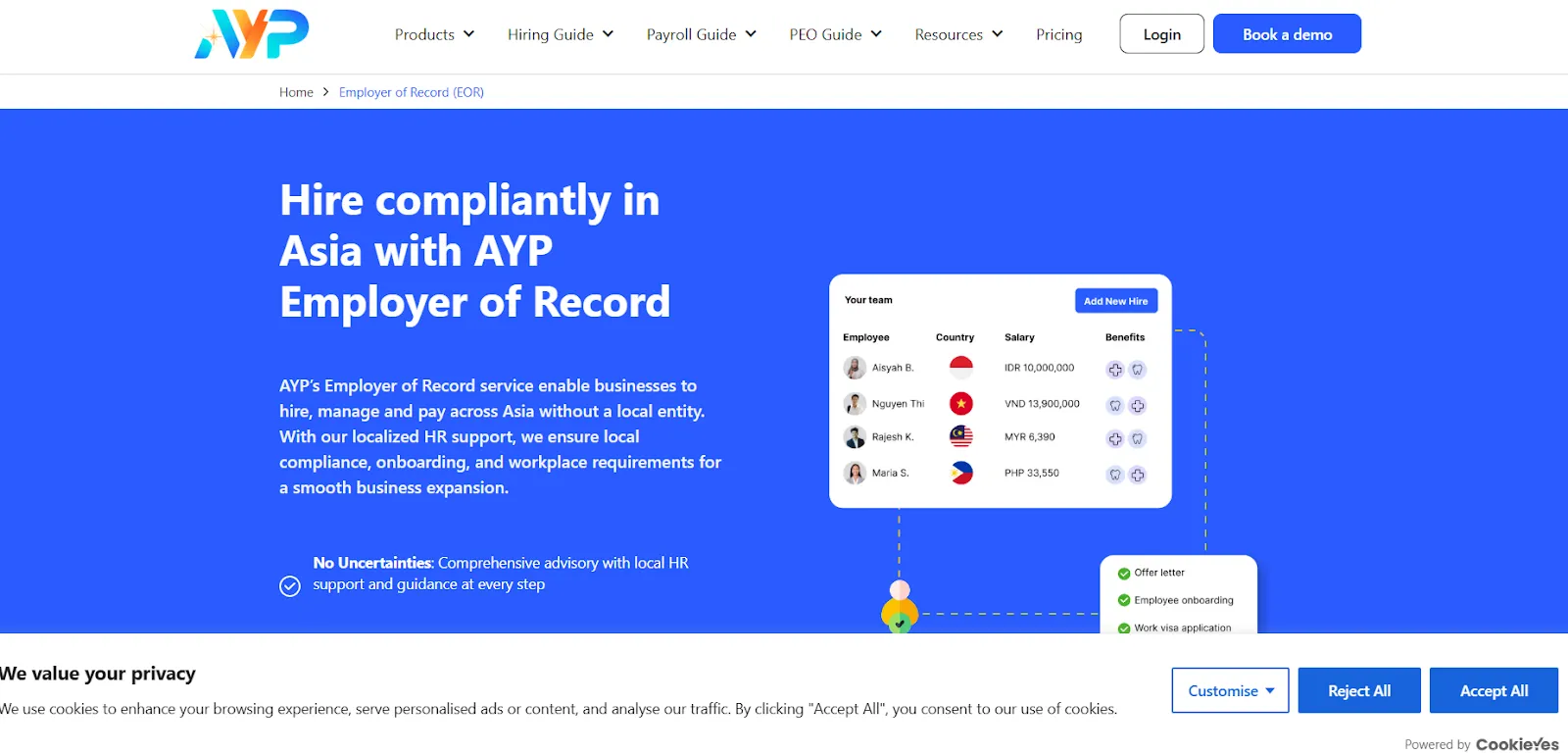
AYP Group dominates Hong Kong EOR with a zero-penalty compliance guarantee, MPF expertise, and comprehensive advisory for fintech and trading firms establishing APAC headquarters. They bring trusted Employment Ordinance mastery and ultra-fast onboarding (3-5 days) with seamless regional coordination.
The platform combines guaranteed compliance with transparent fixed pricing at HKD 2,800 per employee/month and regional APAC capabilities.
Why Use AYP Group in Hong Kong
AYP Group brings a zero-penalty compliance guarantee combined with deep HK market expertise and ultra-fast onboarding capabilities (3-5 days). Their specialisation in fintech and trading sectors provides comprehensive support for financial services expansion.
The combination of compliance guarantee with transparent pricing creates an ideal fit for companies prioritising regulatory certainty and rapid deployment in the Hong Kong financial centre.
Key Benefits and Features
- MPF precision: 5% employer contributions automated with MPFA compliance.
- Hong Kong payroll: IRD salaries tax filings with accurate withholding.
- Employment Ordinance compliance: Leave and severance calculation expertise.
- APAC advisory: Regional expansion support and coordination.
- Zero-penalty guarantee: Compliance assurance with regulatory protection.
Hong Kong-Specific Services Offered
- MPF precision management with 5% employer contribution automation.
- Hong Kong payroll processing with IRD salaries tax compliance.
- Employment Ordinance adherence for leave and severance calculations.
- APAC regional advisory supporting broader expansion strategies.
- Ultra-fast onboarding enabling 3-5 day employee activation.
Platform Experience
- APAC-focused platform designed for regional operational needs.
- Fintech and trading sector specialisation with industry expertise.
- Transparent fixed pricing structure ensuring cost predictability.
Customer Support
- Zero-penalty compliance guarantee providing regulatory certainty.
- Deep HK market expertise from experienced professionals.
- Ultra-fast onboarding capabilities for rapid deployment.
Pricing & Hidden Fees
Transparent fixed pricing starting at HKD 2,800 per employee/month. Clear fee structure with no hidden charges. Custom enterprise quotes available for larger organisations.
Pros:
- Zero-penalty compliance guarantee
- Deep HK market expertise
- Ultra-fast onboarding (3-5 days)
- Transparent fixed pricing (HKD 2,800)
- Fintech/trading specialisation
Cons:
- APAC/regional focus
- Custom enterprise quotes
- Less global platform scale
- Enterprise orientation
- Global coverage secondary
Best For
Fintech and trading companies seeking Hong Kong EOR with zero-penalty compliance guarantee, ultra-fast onboarding (3-5 days), deep market expertise, and transparent pricing (HKD 2,800/month) for APAC headquarters.
3. Asia Pacific Recruitment (HK specialist)
Asia Pacific Recruitment provides Hong Kong-focused EOR with recruitment integration, MPF administration, and compliance for finance and tech hiring in the Central district. They combine a local talent pipeline with Employment Ordinance expertise for comprehensive hiring solutions.
The platform integrates recruitment strength with EOR services at HKD 3,500 per employee/month for complete talent acquisition.
Why Use Asia Pacific Recruitment in Hong Kong
Asia Pacific Recruitment brings HK finance and tech recruitment excellence, combined with local Central operations and talent pipeline strength. Their integration of recruitment with employment services creates comprehensive solutions for companies building Hong Kong teams.
The combination of talent sourcing with compliance support createsan ideal fit for companies seeking complete hiring solutions from recruitment through employment management.
Key Benefits and Features
- Finance/tech talent pipeline: Local recruitment integrated with employment.
- HK payroll compliance: MPF and IRD processing precision.
- Contract localisation: Standard Hong Kong Employment Ordinance templates.
- Visa support: Immigration Department processing coordination.
- Central operations: Direct presence in the Hong Kong financial district.
Hong Kong-Specific Services Offered
- Finance and tech talent pipeline with recruitment integration.
- HK payroll compliance managing MPF and IRD accurately.
- Contract localisation using standard Employment Ordinance templates.
- Visa support coordinating Immigration Department processing.
- Central district operations with an established local presence.
Platform Experience
- Recruitment-integrated platform combining talent sourcing with EOR.
- Finance and tech sector focus on providing specialised capabilities.
- Local Central operations enabling direct Hong Kong presence.
Customer Support
- HK finance and tech recruitment expertise from specialists.
- Local Central operations with established relationships.
- Talent pipeline strength for competitive market hiring.
Pricing & Hidden Fees
Competitive pricing starting at HKD 3,500 per employee/month. Custom volume pricing based on team size. Transparent fee structure with clear breakdowns.
Pros:
- HK finance/tech recruitment excellence
- Local Central operations
- Talent pipeline strength
- Compliance reliability
- Competitive local pricing (HKD 3,500)
Cons:
- Recruitment-first focus
- Custom volume pricing
- Platform secondary
- HK-centric coverage
- Enterprise minimums
Best For
Finance and tech companies seeking Hong Kong talent with recruitment integration, Central district operations, local pipeline access, and comprehensive EOR services at HKD 3,500/month.
4. Michael Page Hong Kong (Professional services EOR)
Michael Page delivers established Hong Kong EOR with an extensive finance and consulting network, MPF processing, and compliance for professional hires across sectors. They specialise in senior placements with Employment Ordinance compliance and premium talent access.
The platform combines executive search capabilities with EOR services at HKD 4,200 per employee/month for senior hiring.
Why Use Michael Page Hong Kong
Michael Page brings a premium HK talent network combined with senior hire expertise and an established reputation. Their focus on executive search with employment services creates comprehensive solutions for professional services hiring.
The combination of premium talent access with compliance support creates an ideal fit for companies seeking senior professional hires with an established Hong Kong presence.
Key Benefits and Features
- Executive search + employment: Senior talent pipeline with EOR integration.
- HK payroll administration: MPF and severance handling expertise.
- Compliance consulting: Employment Ordinance advisory services.
- Local market insights: Salary benchmarking and market intelligence.
- Professional services strength: Finance, consulting, and legal sector focus.
Hong Kong-Specific Services Offered
- Executive search integrated with employment services for senior hires.
- HK payroll administration managing MPF and severance obligations.
- Compliance consulting providing Employment Ordinance advisory.
- Local market insights delivering salary benchmarking data.
- Professional services expertise across finance, consulting, and legal sectors.
Platform Experience
- Premium platform designed for executive and senior professional hiring.
- Established reputation with extensive Hong Kong network.
- Compliance and recruitment synergy for comprehensive solutions.
Customer Support
- Premium HK talent network with extensive relationships.
- Senior hire expertise from specialised professionals.
- Established reputation providing reliability and trust.
Pricing & Hidden Fees
Premium pricing starting at HKD 4,200 per employee/month, reflecting senior focus. Transparent quotes based on requirements. Clear fee structure with detailed breakdowns.
Pros:
- Premium HK talent network
- Senior hire expertise
- Established reputation
- Compliance + recruitment synergy
- Professional services strength
Cons:
- Premium pricing tier (HKD 4,200+)
- Recruitment-focused model
- Less startup agile
- Platform basic
- HK/Asia focus
Best For
Professional services companies seeking premium Hong Kong talent with executive search integration, senior hire expertise, an established network, and comprehensive EOR at HKD 4,200/month.
5. Robert Walters Hong Kong (Finance EOR specialist)
Robert Walters provides Hong Kong EOR for banking and finance with deep Central networks, MPF expertise, and rapid compliance onboarding for professional services. They specialise in contract-to-permanent conversions in the competitive Hong Kong market.
The platform combines finance sector dominance with contractor conversion expertise at HKD 4,000 per employee/month.
Why Use Robert Walters Hong Kong
Robert Walters brings finance sector dominance, combined with Central HK operations and contractor-permanent expertise. Their understanding of banking and finance requirements provides specialised support for financial services hiring.
The combination of finance specialisation with local intelligence creates an ideal fit for banking and professional services seeking Hong Kong talent with market expertise.
Key Benefits and Features
- Finance talent pipeline: Banking and contractor hiring capabilities.
- MPF/IRD compliance: Professional payroll processing with accuracy.
- Employment Ordinance contracts: Standard template documentation.
- Market intelligence: Hong Kong salary data and benchmarking.
- Contractor-permanent: Conversion expertise for the competitive market.
Hong Kong-Specific Services Offered
- Finance talent pipeline providing banking and contractor access.
- MPF and IRD compliance with professional payroll accuracy.
- Employment Ordinance contract management using standard templates.
- Market intelligence delivering HK salary benchmarking data.
- Contractor-to-permanent conversion expertise and support.
Platform Experience
- Finance-specialised platform designed for banking sector needs.
- Central HK operations providing direct financial district presence.
- Market intelligence capabilities for competitive hiring.
Customer Support
- Finance sector expertise from specialised banking professionals.
- Central operations with an established Hong Kong presence.
- Local intelligence provides market insights and data.
Pricing & Hidden Fees
Finance-focused pricing starting at HKD 4,000 per employee/month. Custom pricing based on requirements. Transparent fee structure with clear breakdowns.
Pros:
- Finance sector dominance
- Central HK operations
- Contractor-permanent expertise
- Local intelligence strength
- Compliance reliability
Cons:
- Finance specialization
- Custom pricing structure
- Platform secondary focus
- HK-centric delivery
- Enterprise orientation
Best For
Banking and finance companies seeking Hong Kong EOR with finance specialisation, Central operations, contractor conversion expertise, and market intelligence at HKD 4,000/month.
6. Deel (Global leader, HK entity)
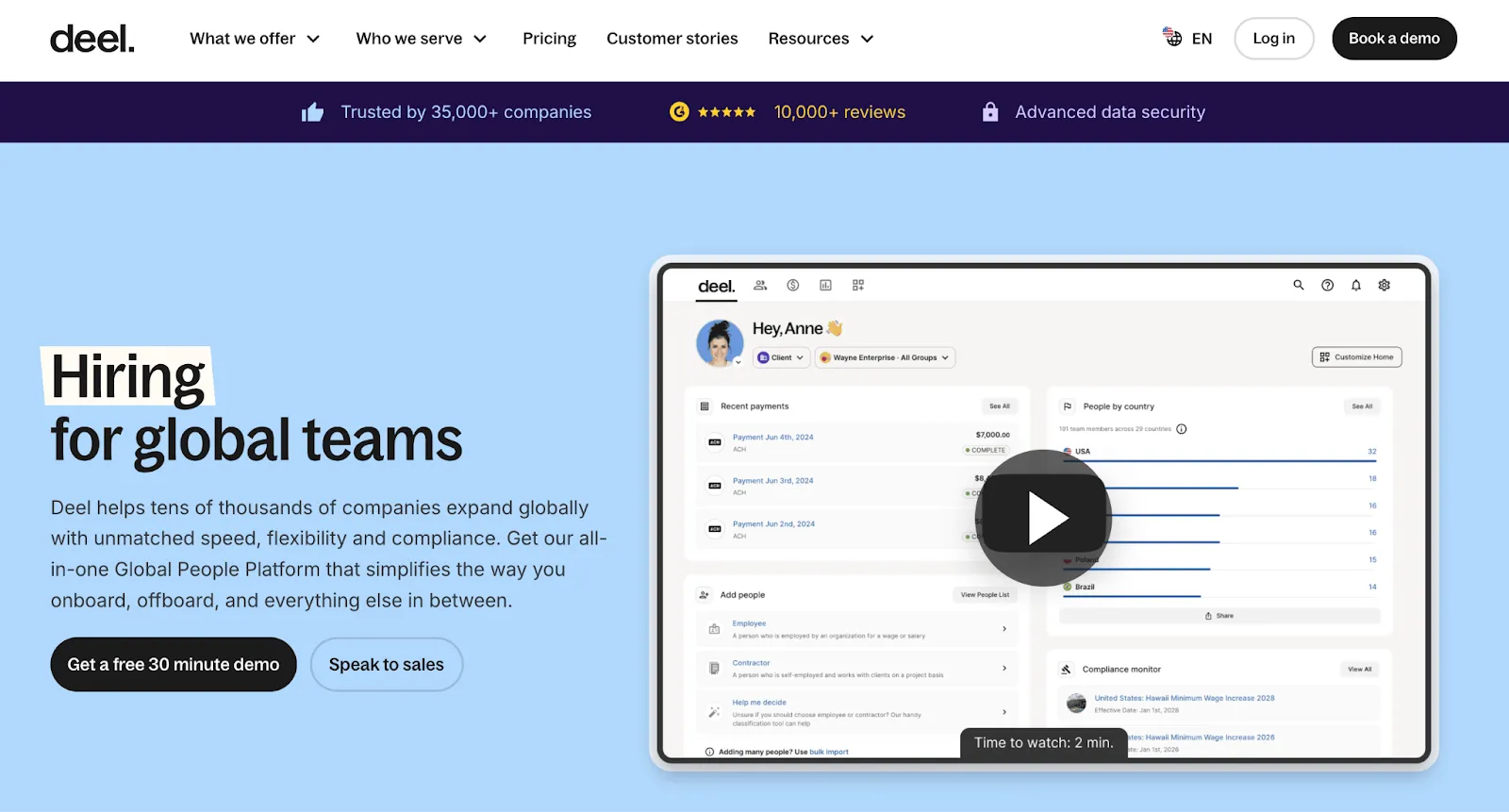
Deel offers an owned Hong Kong entity EOR with 48-hour onboarding, contractor-to-employee conversions, and a mature platform for fintech expansion at HKD 5,500 per employee/month. They represent an industry benchmark for APAC compliance excellence with cutting-edge automation.
The platform enables ultra-fast deployment with comprehensive Employment Ordinance compliance and global coordination capabilities.
Why Use Deel in Hong Kong
Deel brings industry-leading automation capabilities, combined with its owned HK entity infrastructure and 48-hour onboarding speeds. Their mature platform enables fastest market entry while maintaining Employment Ordinance compliance and MPF accuracy.
The combination of speed with global platform capabilities creates ideal fit for fintech companies prioritising rapid scaling and contractor-to-employee transitions.
Key Benefits and Features
- Automated MPF/IRD payroll: Tax integration with real-time compliance.
- Employment Ordinance contracts: Digital automation with proper legal terms.
- Global HRIS sync: Seamless enterprise integration with major platforms.
- Contractor-to-permanent: Frictionless transitions maintaining compliance.
- 48-hour onboarding: Ultra-fast employee activation capabilities.
Hong Kong-Specific Services Offered
- Automated MPF and IRD payroll with tax integration and compliance tracking.
- Employment Ordinance contract automation with digital processing.
- Global HRIS synchronization enabling seamless platform coordination.
- Contractor-to-permanent conversion supporting compliance transitions.
- Rapid onboarding processes enabling 48-hour employee setup.
Platform Experience
- Cutting-edge modern platform with powerful automation and an intuitive interface.
- Technology-driven workflows minimise manual tasks while maintaining compliance.
- Strong API integrations enabling seamless data flow and system coordination.
Customer Support
- 24/5 support availability with responsiveness to Hong Kong compliance questions.
- Global support team familiar with APAC and Hong Kong requirements.
- Proactive assistance helps companies optimise platform usage and workflows.
Pricing & Hidden Fees
Premium pricing at HKD 5,500+ per month with a clear fee breakdown. Transparent structure reflecting automation capabilities. Seniority-based services may incur additional charges.
Pros:
- Ultra-fast HK onboarding (48hr)
- Mature platform excellence
- Strong API integrations
- Contractor flexibility
- Enterprise scalability
Cons:
- Premium pricing (HKD 5,500+)
- Feature tiers exist
- Global support variability
- Enterprise complexity
- Seniority extras
Best For
Fintech companies seeking ultra-fast Hong Kong deployment (48hr) with contractor-to-permanent conversion, mature platform capabilities, and strong API integrations for APAC expansion.
7. Remote (Global enterprise EOR)
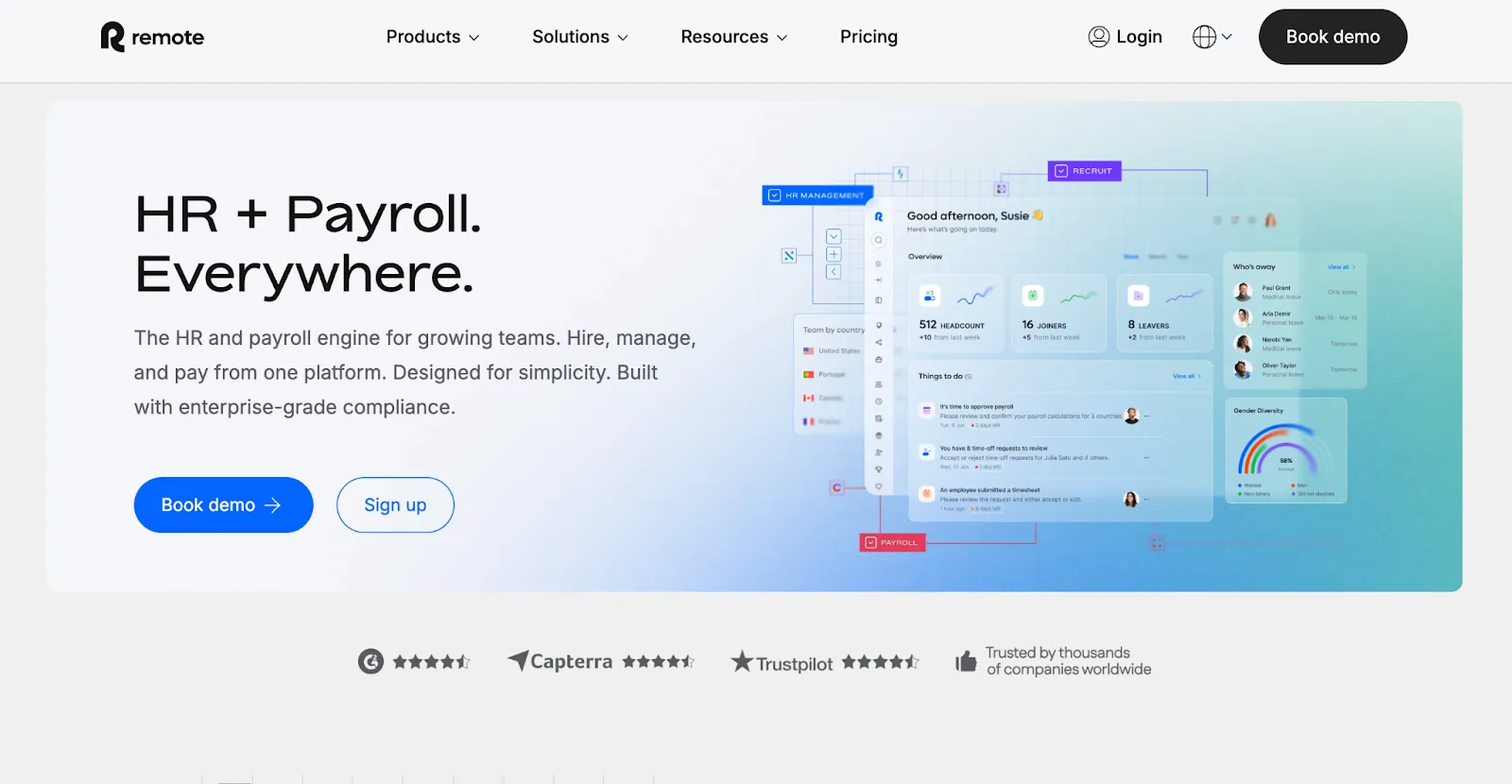
Remote delivers comprehensive Hong Kong EOR with IP protection, equity plans, and enterprise compliance for senior tech and finance hires at HKD 4,800 per employee/month. They excel in supporting APAC headquarters with owned entity operations and intellectual property safeguards.
The platform focuses on maximum legal protection and compliance assurance for companies with strict regulatory requirements.
Why Use Remote in Hong Kong
Remote brings owned legal entities combined with a strong compliance infrastructure and intellectual property protection, providing maximum legal assurance for international companies. Their focus on enterprise-grade compliance and equity management creates comprehensive solutions for senior talent acquisition.
The combination of legal entity ownership with IP protection creates an ideal fit for companies prioritising maximum compliance assurance and equity compensation capabilities.
Key Benefits and Features
- IP indemnity: Hong Kong contract protection and intellectual property safeguards.
- Equity administration: Stock option and compensation compliance management.
- MPF compliance: Mandatory contribution handling with 5% employer accuracy.
- 24/7 SLA support: Guaranteed enterprise resolution capabilities.
- Owned entity: Direct Hong Kong regulatory alignment and control.
Hong Kong-Specific Services Offered
- IP indemnity provisions protecting contracts under Hong Kong law.
- Equity plan administration for stock options and senior compensation.
- MPF compliance, ensuring mandatory contribution accuracy (5% employer).
- 24/7 SLA support providing enterprise-grade resolution capabilities.
- Owned Hong Kong entity operation,s ensuring direct regulatory compliance.
Platform Experience
- A professional platform designed with compliance and legal protection as priorities.
- Real-time compliance dashboard providing continuous visibility into obligations.
- Enterprise-grade infrastructure supporting complex organisational requirements.
Customer Support
- 24/7 support with strong Hong Kong and APAC compliance expertise.
- Compliance-focused guidance ensuring adherence to all regulatory requirements.
- Personalised account management providing strategic support and proactive oversight.
Pricing & Hidden Fees
Premium pricing at HKD 4,800+ per month reflecting enterprise capabilities. Transparent fee structure with clear cost breakdown. No hidden charges.
Pros:
- Enterprise compliance depth
- IP/equity expertise
- Proven HK operations
- Global scalability
- Support excellence
Cons:
- Higher pricing tier
- Enterprise focus
- Platform learning curve
- Less startup flexibility
- Customization fees
Best For
Tech and finance enterprises seeking maximum Hong Kong compliance with IP protection, equity administration, and comprehensive regulatory assurance for senior talent in APAC headquarters.
8. Multiplier (APAC value leader)

Multiplier provides scalable Hong Kong EOR at HKD 3,500 per employee/month with Singapore-HK compliance synergy and rapid APAC expansion support. They combine competitive mid-market pricing with strong regional platform capabilities.
The platform balances affordability with comprehensive Hong Kong compliance and APAC regional coordination.
Why Use Multiplier in Hong Kong
Multiplier brings a balanced approach combining competitive pricing with HK compliance automation and APAC regional capabilities. Their experience with Singapore and Hong Kong markets enables coordinated growth strategies with cost-effective service delivery.
The combination of value pricing with automation creates an ideal fit for mid-market companies seeking a scalable Hong Kong presence alongside broader APAC expansion.
Key Benefits and Features
- Automated Employment Ordinance compliance: Statutory leave and severance ready.
- Multi-country APAC dashboard: Regional view coordinating operations across Asia.
- Contract localisation: Hong Kong templates with Employment Ordinance terms.
- Payroll forecasting: Budget transparency and planning tools.
- Singapore-HK synergy: Coordinated APAC regional expertise and support.
Hong Kong-Specific Services Offered
- Automated Employment Ordinance compliance with statutory requirements.
- Multi-country APAC dashboard providing regional expansion coordination.
- Contract localisation using Hong Kong Employment Ordinance templates.
- Payroll forecasting tools enable budget planning and transparency.
- Regional expertise supporting Singapore-HK synergy and APAC growth.
Platform Experience
- Modern platform combining automation with Hong Kong compliance expertise.
- A cost-effective approach designed for mid-market companies and growth.
- Clear reporting and compliance tracking with analytics capabilities.
Customer Support
- Hong Kong compliance expertise supporting regulatory questions.
- Responsive team addressing APAC expansion and scaling needs.
- Mid-market focus with scalable support delivery.
Pricing & Hidden Fees
Competitive pricing starting at HKD 3,500 per month with a transparent structure. Flexible tiers accommodating different team sizes. Clear fee breakdown with volume discounts available.
Pros:
- Best value premium tier (HKD 3,500)
- APAC regional platform
- Automation excellence
- Singapore-HK synergy
- Scalable growth path
Cons:
- Volume discounts needed
- Less enterprise analytics
- Platform adaptation required
- Regional vs pure global
- Quote-based extras
Best For
Mid-market companies seeking scalable Hong Kong EOR with competitive pricing (HKD 3,500/month), APAC regional expansion support, and balanced automation for Singapore-HK coordination strategies.
9. Atlas HXM (Enterprise APAC platform)
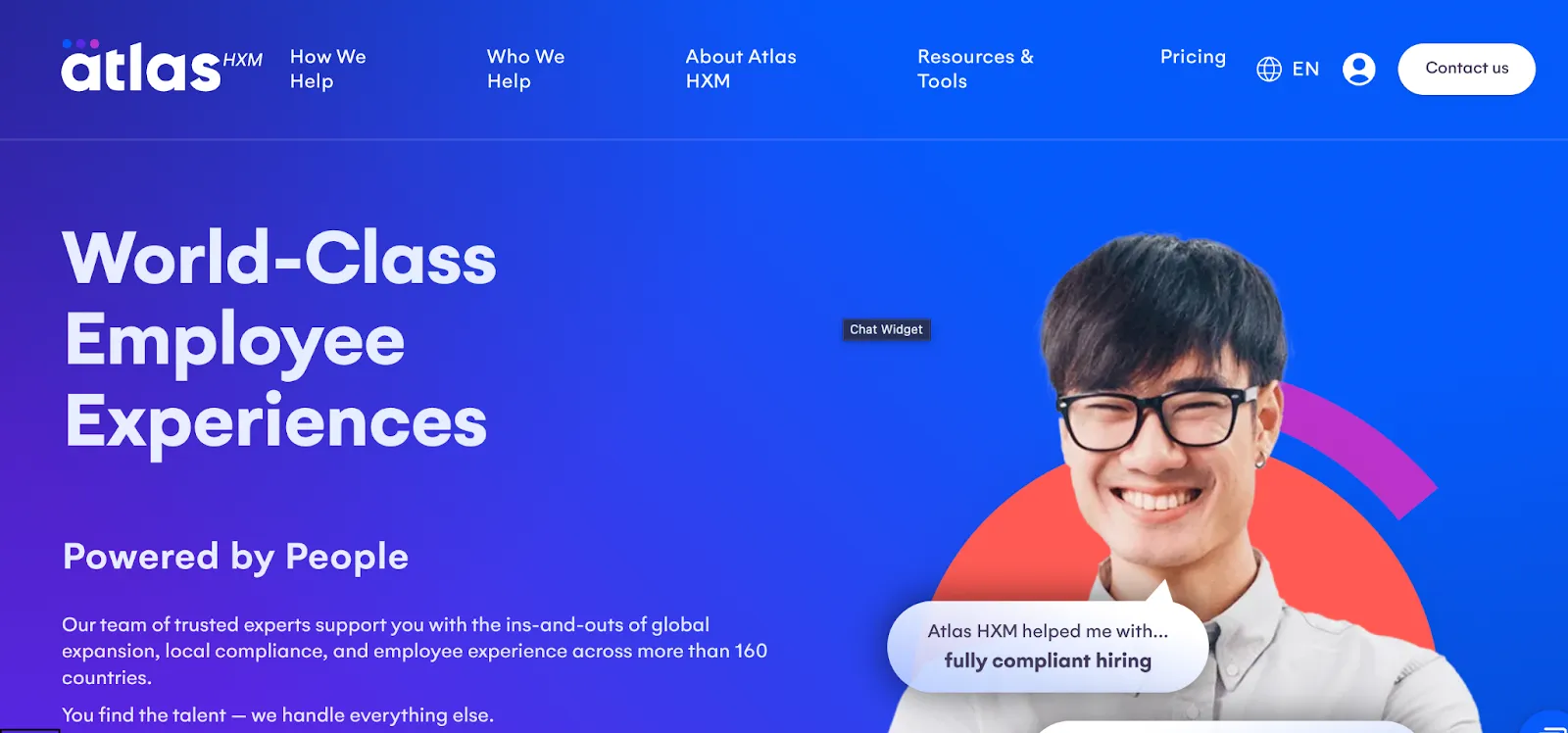
Atlas HXM delivers enterprise-grade Hong Kong EOR with direct ownership, 24/7 support, and SOC2/ISO27001 security at HKD 5,800 per employee/month. They specialize in established APAC headquarters with complex compliance needs requiring maximum security and operational assurance.
The platform combines enterprise security with direct ownership model and advanced reporting capabilities.
Why Use Atlas HXM in Hong Kong
Atlas HXM brings enterprise-grade security (SOC2/ISO27001) combined with direct ownership model and 24/7 global support. Their focus on established firms with APAC headquarters provides comprehensive infrastructure for sophisticated regional operations.
The combination of security certifications with direct ownership creates ideal fit for enterprises prioritizing compliance assurance and operational reliability.
Key Benefits and Features
- Direct HK entity ownership: No middlemen ensuring accountability and control.
- 24/7 global support: Real-time resolution across time zones.
- Enterprise security: SOC2 and ISO27001 certified infrastructure.
- Multi-country unified platform: APAC coverage with seamless coordination.
- Advanced reporting: Comprehensive analytics and compliance tracking.
Hong Kong-Specific Services Offered
- Direct HK entity ownership with no third-party intermediaries.
- 24/7 global support providing real-time Hong Kong compliance assistance.
- Enterprise security with SOC2/ISO27001 certifications and infrastructure.
- Multi-country platform integrating Hong Kong with APAC operations.
- Advanced reporting capabilities for compliance and workforce analytics.
Platform Experience
- Enterprise-grade platform with sophisticated security infrastructure.
- Direct ownership model providing accountability and control.
- Advanced analytics and reporting capabilities for complex needs.
Customer Support
- 24/7 global support with enterprise-grade service delivery.
- Direct ownership accountability for compliance and operations.
- Advanced reporting expertise for workforce optimisation.
Pricing & Hidden Fees
Custom enterprise pricing starting at HKD 5,800+ per month. Quote-based process reflecting enterprise capabilities. Transparent fee structure with detailed breakdowns.
Pros:
- Enterprise-grade security (SOC2/ISO27001)
- Direct ownership model
- 24/7 support excellence
- Global compliance leadership
- Advanced reporting
Cons:
- Custom enterprise pricing
- Enterprise minimums
- Platform complexity
- Less SMB agile
- Quote-based process
Best For
Large enterprises seeking Hong Kong EOR with enterprise security (SOC2/ISO27001), direct ownership model, 24/7 support, and advanced reporting for APAC headquarters operations.
10. Velocity Global (Flexible global EOR)

Velocity Global offers adaptable Hong Kong EOR with customised service delivery at HKD 4,200 per employee/month, rapid onboarding (2-3 days), and APAC expansion support. They specialise in flexible service models for growing firms with varying requirements.
The platform combines customizable compliance solutions with enterprise flexibility and rapid deployment.
Why Use Velocity Global in Hong Kong
Velocity Global brings flexible service models combined with custom compliance solutions and rapid market entry capabilities (2-3 days). Their adaptability to diverse organisational needs provides comprehensive support for companies with varying requirements.
The combination of flexibility with rapid deployment creates an ideal fit for growing firms seeking a customizable Hong Kong presence with scalable service delivery.
Key Benefits and Features
- Flexible HK employment arrangements: Customizable service models.
- Customised compliance advisory: Tailored regulatory guidance.
- Rapid 2-3 day onboarding: Fast market entry and deployment.
- APAC regional expansion support: Coordinated growth strategies.
- Enterprise flexibility: Scalable solutions for diverse needs.
Hong Kong-Specific Services Offered
- Flexible employment arrangements with customizable service delivery.
- Customised compliance advisory providing tailored regulatory guidance.
- Rapid onboarding enabling 2-3 day employee activation.
- APAC regional expansion support coordinating growth strategies.
- Enterprise flexibility with scalable compliance solutions.
Platform Experience
- Flexible platform designed for customizable service delivery.
- Rapid deployment capabilities with 2-3 day onboarding.
- Enterprise infrastructure supporting diverse organisational needs.
Customer Support
- Flexible service delivery, adapting to organisational requirements.
- Custom compliance expertise providing tailored solutions.
- APAC expansion support with regional coordination.
Pricing & Hidden Fees
Custom pricing starting at HKD 4,200 per employee/month. Quote-based structure reflecting service customisation. Transparent fee breakdowns with clear explanations.
Pros:
- Flexible service models
- Custom compliance solutions
- Rapid market entry (2-3 days)
- APAC expansion ready
- Enterprise flexibility
Cons:
- Custom pricing structure
- Less self-service platform
- Regional APAC emphasis
- Enterprise orientation
- Feature standardisation varies
Best For
Growing firms seeking flexible Hong Kong EOR with customizable service delivery, rapid onboarding (2-3 days), custom compliance solutions, and APAC expansion support at HKD 4,200/month.
FAQs
1. What Are the Selection Criteria and Methodology for Choosing an EOR in Hong Kong?
Top EORs are evaluated on Employment Ordinance expertise, MPF handling (5% employer, HKD 1,500 cap), IRD salaries tax compliance, statutory benefits administration, severance calculations, employment visa support, pricing transparency, onboarding speed, and scalability. Preference goes to providers with proven Hong Kong and APAC experience.
2. What Compliance Factors Should You Consider When Hiring in Hong Kong via an EOR?
Ensure your EOR manages MPF contributions (5% employer, 5% employee, capped), IRD salaries tax (2–17% progressive or 15% standard), statutory holidays (12), annual leave accrual, rest days, maternity/paternity leave, sickness allowance, notice periods, severance and long service payments, probation periods, and expatriate visa processing.
3. What Are Expert Tips for Hiring in Hong Kong Through an EOR?
Choose providers with Employment Ordinance and MPF expertise. Confirm IRD tax withholding capabilities. Verify statutory leave and severance administration. Assess employment visa processing experience. Ensure knowledge of talent markets in Central, fintech, and tech sectors.
4. How Do You Choose the Best Employer of Record (EOR) Company in Hong Kong?
Compare pricing, MPF handling, and Employment Ordinance compliance. Test responsiveness on leave accrual and severance questions. Review client feedback from fintech, finance, and tech. Verify visa processing experience and request a pilot to evaluate platform usability, MPF accuracy, and tax compliance.
5. Why Should You Choose an EOR Provider for Hiring in Hong Kong?
An EOR lets you hire without forming a Private Limited company, ensuring compliance with MPF contributions, IRD salaries tax, statutory leave, maternity/paternity leave, rest days, notice periods, severance, long service payments, and visa rules. It speeds APAC entry, gives access to skilled talent, reduces risk, eliminates setup costs, and enables flexible scaling while navigating Hong Kong’s employee protections and statutory requirements.

Ready to take the first step?
Request a demo now and learn how you can focus on building, without worrying for compliance, ever!