







- Egypt's employment framework requires Arabic-language contracts, monthly payroll tax filings with the Egyptian Tax Authority by the 15th of each month, and social insurance registration with NOSI within 15 days of hire under Social Insurance Law No. 148/2019, making local compliance capability a critical factor when selecting an EOR provider.
- Employer-side social insurance contributions are set at 26% of base salary, capped at a monthly base of $295 (EGP 15,000), and are billed separately from platform fees by every provider on this list, so the published per-employee monthly fee does not reflect total employment cost.
- Platform fees across reviewed providers range from $199 to $699 per employee per month, and whether a provider serves Egypt through a directly owned legal entity or a local partner is not publicly confirmed for several providers on this list, which is a material compliance disclosure buyers should verify before contracting.
- For companies hiring non-Egyptian nationals, work permit support through the Ministry of Manpower is a distinct onboarding requirement that adds four to eight weeks to the process, and not all EOR providers include this service within their standard scope.
- Egypt does not follow an at-will employment model, meaning termination requires documented cause and proper notice under Labour Law No. 12/2003, and EOR providers manage this risk including final payroll settlements covering all accrued but unused annual leave.
Gloroots publishes this page and is included in the comparison below. We evaluated each provider on compliance coverage, pricing transparency, and Egypt-specific employment support.
Egypt is one of Africa's largest labor markets, with a workforce exceeding 32 million people and a strategic position at the center of MENA trade and investment corridors. That scale makes it an increasingly important hiring destination for global companies.
Employment in Egypt is governed by Labour Law No. 12/2003 and the Social Insurance and Pensions Law No. 148/2019. Both laws carry direct obligations for any employer operating in the country, including payroll filings, social insurance contributions, and Arabic-language contract requirements.
This list covers both global best employer of record platforms with Egypt coverage and Egypt-specialist providers with deep local roots.
Our Top 8 Picks: Egypt EOR Comparison 2026
Providers were evaluated across six axes: pricing transparency, country coverage, onboarding speed, platform experience, customer support, and scalability. The table below lists platform fees only. Mandatory employer contributions under the National Organization for Social Insurance (NOSI) add approximately 26% of gross salary, and Egyptian Tax Authority (ETA) income tax obligations are separate and additional.
| Provider | Pricing per month | Country coverage | Onboarding speed | Platform experience | Customer support | Scalability |
|---|---|---|---|---|---|---|
| Gloroots | From $199/employee/month | 150+ countries | 3–5 working days; country-dependent | Centralized workforce dashboard covering hiring, payroll, compliance, benefits and workforce visibility | 24/7 human support with dedicated account management | SMB to enterprise; built for multi-country programs |
| Atlas HXM | From $599/employee/month; all-inclusive pricing | 160+ countries through direct legal entities | Rapid onboarding; exact global SLA not publicly stated | HXM platform covering EOR, payroll, compliance and workforce management | Dedicated account management and local HR/compliance expertise | Mid-market to enterprise; designed for multi-country employment |
| Deel | $599/employee/month; country-specific employment costs may apply | 130+ EOR countries | Automated onboarding; country-dependent | Unified platform for EOR, payroll, contractors, HR, benefits, compliance and integrations | 24/7 HR, legal and tax expertise | SMB to enterprise; strong fit for fast-scaling distributed teams |
| Remote | $699/employee/month standard | 90+ EOR countries | Dedicated onboarding specialist; country-dependent | Owned-entity EOR platform with payroll, benefits, compliance, IP protection and workforce management | In-house local experts and dedicated specialist support | SMB to enterprise; particularly strong for companies prioritizing owned entities/IP |
| Globalization Partners | From $599/employee/month; custom quote available | 180+ countries | A few days to a couple of weeks; country-dependent | G-P Global Employment Platform covering hiring, onboarding, payroll, benefits and compliance | Dedicated Customer Success Manager and in-country expertise | Mid-market to enterprise |
| RemoFirst | From $199/employee/month; varies by country | 185+ countries | As fast as 48 hours; country-dependent | Centralized EOR platform covering payroll, tax, benefits, visa support and compliance | Dedicated account manager and 24/7 support | Startups to enterprise; designed for rapid global scaling |
| Mercans | $299–$599/employee/month; market-dependent | 160+ countries | As fast as 48 hours; country-dependent | Proprietary HR Blizz platform covering EOR, payroll, compliance, tax and workforce management | Dedicated account manager and locally based specialists | SMB to enterprise; strong for multi-country payroll and complex global workforce programs |
| Borderless AI | Pricing not publicly disclosed; custom quote | 170+ countries | Country-dependent; exact global SLA not publicly disclosed | AI-powered global employment platform covering EOR, payroll, compliance, contracts and workforce management | Dedicated support and local employment expertise | SMB to enterprise; designed for globally distributed teams |

Top 8 Best EOR Platforms in Egypt
Each provider below was evaluated across six axes: Egypt entity model (direct entity versus local partner), pricing transparency, Arabic contract capability, compliance track record under Labour Law No. 12/2003 and Social Insurance Law No. 148/2019, onboarding speed, and support model.
Gloroots
Gloroots operates as a Global Employer of Record across 150+ countries, including Egypt. Gloroots employs workers through its entity model and discloses its local partner or direct entity arrangement to clients before onboarding. Employment in Egypt is governed under Labour Law No. 12/2003 and Social Insurance Law No. 148/2019, and Gloroots manages compliance with both frameworks as part of its standard service.
Gloroots combines Global EOR, Global Payroll, Compliance and Employment Governance, and Benefits and Statutory Coverage into one platform. Clients get a centralized workforce dashboard covering hiring, payroll, compliance, benefits, and workforce visibility. Pricing is country-specific and fixed per employee per month, with no percentage-of-salary model. Full cost visibility is provided before onboarding begins.
For companies expanding into Egypt, Gloroots targets an onboarding speed of 3 to 5 working days, subject to document readiness and country-specific requirements. Account support is human-led, with dedicated account managers who retain context across the employment lifecycle. This model suits teams that need predictable costs and centralized governance across multiple countries, not just Egypt.
Strengths:
-
Predictable, country-specific pricing with no percentage-of-salary model and full cost visibility before onboarding, starting from $199/employee/month.
-
Centralized workforce dashboard covering payroll, compliance, benefits, and workforce visibility across 150+ countries, with human-led account support and dedicated account management.
-
Onboarding target of 3 to 5 working days in Egypt, with compliance managed under Labour Law No. 12/2003 and Social Insurance Law No. 148/2019.
Limitations:
-
Public sources reviewed did not document a provider-specific limitation for Gloroots in Egypt beyond general notes that onboarding timelines are country-dependent and subject to document readiness.
Best for:
Companies that need entity-free employment in Egypt with predictable fixed pricing, centralized compliance governance across multiple countries, and human-led account support.


Atlas HXM
Atlas HXM operates as a 100% direct employer of record with a confirmed, direct-owned Egyptian legal entity. Its platform fee starts at $599 per employee per month. Egypt's mandatory National Organization for Social Insurance (NOSI) employer contributions, set at 26% of base salary under Social Insurance Law No. 148/2019, are billed separately and are not included in that platform fee.
Atlas HXM covers end-to-end payroll, benefits, compliance, onboarding, HR dashboards, local support, secure employee portals, and data-driven compliance insights across 160+ countries. For Egypt specifically, local experts handle compliant Arabic contracts, NOSI filings, and ongoing support aligned with Egyptian labor law.
The direct entity model means clients work under a single contract with one point of contact, removing third-party intermediary risk. Atlas HXM reports up to 90% faster employee setup and up to 85% savings on global HR rollout costs compared to entity-establishment approaches.
Strengths:
-
Direct-owned Egyptian legal entity confirmed: single contract, one point of contact, and full legal certainty with no third-party intermediary risk across 160+ countries.
-
Up to 90% faster employee setup and up to 85% savings on global HR rollout costs, with local experts managing Arabic contracts, NOSI filings, and Social Insurance Law No. 148/2019 compliance.
Limitations:
-
Contractor management is available only through external partners, not directly through Atlas HXM.
-
The HCM platform has limited use of generative AI and guided chatbots compared to some competitors.
Best for:
Atlas HXM is best for mid-market to enterprise companies that require a confirmed direct legal entity in Egypt, full compliance certainty under Social Insurance Law No. 148/2019, and a single-contract engagement without third-party intermediaries.
Deel
Deel supports hiring and paying employees or contractors in Egypt without requiring a local entity. Its platform fee is $599 per employee per month. Egypt's mandatory NOSI employer contributions of 26% under Social Insurance Law No. 148/2019 are statutory costs billed separately and are not included in that platform fee. Onboarding in Egypt typically takes about 10 days.
Deel uses a hybrid entity model: it operates direct-owned legal entities in approximately 100 countries and uses partner-led services in remaining markets. Whether Egypt is covered via a Deel-owned entity or a local partner has not been confirmed in the sources reviewed for this page. Buyers requiring entity-model certainty for Egypt should request written confirmation from Deel directly before contracting.
The platform automates onboarding, document collection, and payroll through a unified dashboard covering local labor laws, tax compliance, and benefits administration. Platform differentiators include Slack workflow automation and customizable reporting. Deel also supports multiple payment methods including bank transfers, PayPal, crypto, and the Deel Card, with real-time currency conversion.
Strengths:
-
Unified dashboard automates onboarding, document collection, payroll, tax compliance, and benefits administration, reducing manual coordination across Egypt's regulatory requirements including Social Insurance Law No. 148/2019.
-
Multiple payment methods including bank transfers, PayPal, crypto, and the Deel Card with real-time currency conversion, alongside Slack workflow automation and customizable reporting as platform differentiators.
Limitations:
-
The hybrid entity model combines direct-owned entities in approximately 100 countries with partner-led services elsewhere, which can produce variation in service consistency depending on the market.
-
Whether Egypt is served via a Deel-owned entity or a local partner is not confirmed in the sources reviewed; this is a material compliance disclosure that buyers should verify directly with Deel.
Best for:
Deel is best for SMB to enterprise teams that prioritize payroll automation, multi-method payment flexibility, and a unified compliance dashboard, and that are comfortable verifying Egypt's entity coverage model directly with the provider before contracting.
Remote
Remote is listed among the top EOR providers for hiring in Egypt, ranked for its ability to support international companies that need compliant employment without a local entity. Egypt's employment framework requires Arabic-language contracts, monthly payroll tax filings with the Egyptian Tax Authority by the 15th of each month, and social insurance registration through NOSI under Social Insurance Law No. 148/2019. Remote covers these requirements as part of its standard Egypt service.
Remote operates across 90 or more countries. Its published standard pricing is $699 per employee per month, covering the platform fee only. Egyptian employer-side social insurance contributions, which average 18.75% of gross pay under Social Insurance Law No. 148/2019, are separate statutory costs not included in that fee. Whether Remote serves Egypt through a directly owned legal entity or a local in-country partner is not publicly confirmed in researched sources. Arabic contract capability for Egypt is referenced in country-level compliance sources but is not independently verified against Remote's own published documentation.
Strengths:
-
Covers Egypt's core compliance requirements including NOSI social insurance filings and monthly ETA payroll tax declarations aligned with Labour Law No. 12/2003.
-
Operates across 90 or more countries with in-house local experts and dedicated specialist support, making it a practical option for companies hiring across multiple markets alongside Egypt.
Limitations:
-
Entity model for Egypt, whether directly owned or partner-led, is not publicly confirmed in researched sources, which limits certainty about legal accountability and service consistency.
Best for:
Remote is best for mid-market to enterprise companies that prioritise owned-entity EOR infrastructure and need to hire in Egypt as part of a broader multi-country program.
Globalization Partners
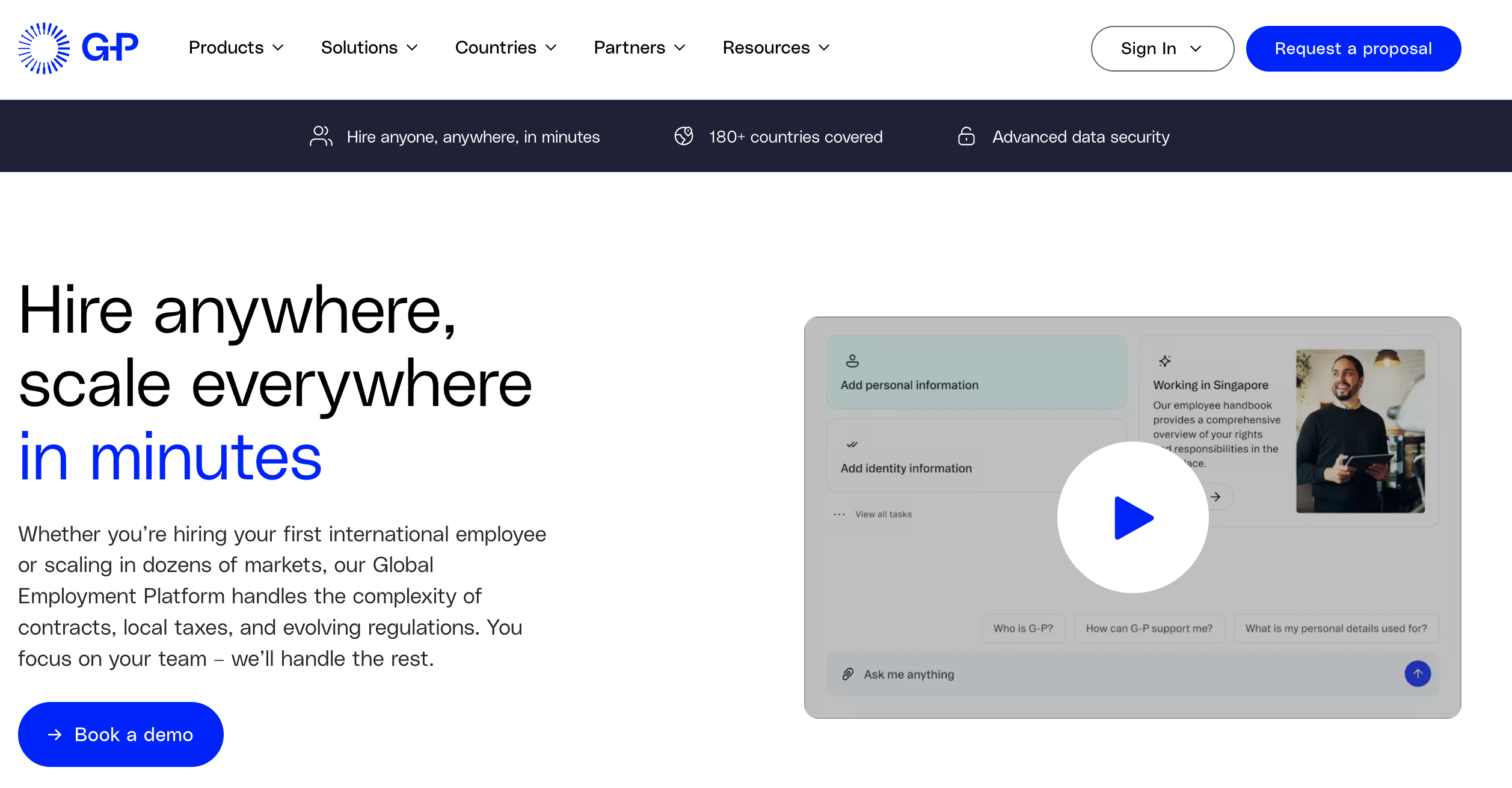
Globalization Partners, operating under the G-P brand, is ranked among the top EOR providers for companies expanding into Egypt. It covers 180 or more countries and is positioned for fast global expansion, with published onboarding timelines as short as two to seven days in country-level comparisons, though actual timelines are country-dependent. Egypt's compliance environment includes mandatory Arabic employment contracts, employer-side social insurance averaging 18.75% of gross pay under Social Insurance Law No. 148/2019, and monthly payroll filings enforced by the Egyptian Tax Authority under Labour Law No. 12/2003. G-P addresses these requirements through its Meridian platform.
G-P's published starting price is approximately $599 per employee per month, though country-specific pricing applies and custom quotes are standard for larger engagements. This fee covers the platform service; Egyptian statutory costs including NOSI social insurance contributions are separate. Whether G-P serves Egypt through a directly owned legal entity or a local partner arrangement is not publicly confirmed in researched sources. Arabic contract capability for Egypt is referenced in compliance-focused sources but is not independently verified against G-P's own published documentation.
Strengths:
-
Covers 180 or more countries with a dedicated Customer Success Manager and in-country expertise, supporting companies that need Egypt as part of a wide multi-country hiring program.
-
The G-P Meridian platform covers hiring, onboarding, payroll, benefits, and compliance in a single interface, reducing the administrative load for HR and operations teams managing cross-border headcount.
Limitations:
-
Entity model for Egypt, whether directly owned or partner-led, is not publicly confirmed in researched sources, which limits certainty about legal accountability for Egyptian employment obligations.
Best for:
Globalization Partners is best for mid-market to enterprise companies that need fast entry into Egypt alongside a broad international expansion and prefer a managed platform with dedicated account support.
Remofirst
Remofirst is ranked among the top 10 EOR providers for hiring in Egypt, positioned as a cost-effective option for startups and SMBs. The platform covers 185+ countries and offers a centralized dashboard for payroll, tax, benefits, visa support, and compliance management.
Pricing starts from $199 per employee per month, though the exact Egypt-specific rate varies by country. RemoFirst works with exclusive local partners in 185+ countries. Arabic-language employment contracts are not publicly confirmed; verify directly with RemoFirst. Egypt social-insurance compliance is supported through RemoFirst's EOR service, though specific NOSI registration handling should be confirmed directly. Egypt-specific onboarding timeline is not publicly confirmed; verify directly with RemoFirst.
Strengths:
-
Covers 185+ countries with a centralized platform handling payroll, tax, benefits, visa support, and compliance from a single dashboard.
-
Pricing starts from $199 per employee per month, making it one of the more accessible options for startups and SMBs entering Egypt without a local entity.
-
Dedicated account manager plus in-country experts and 24/7 support are included in the service model.
Limitations:
-
Public sources reviewed did not document a provider-specific limitation for Remofirst in Egypt beyond the absence of confirmed entity model disclosure and Arabic contract capability.
Best for:
Startups and SMBs seeking an affordable, multi-country EOR platform to hire in Egypt without establishing a local entity.
Mercans
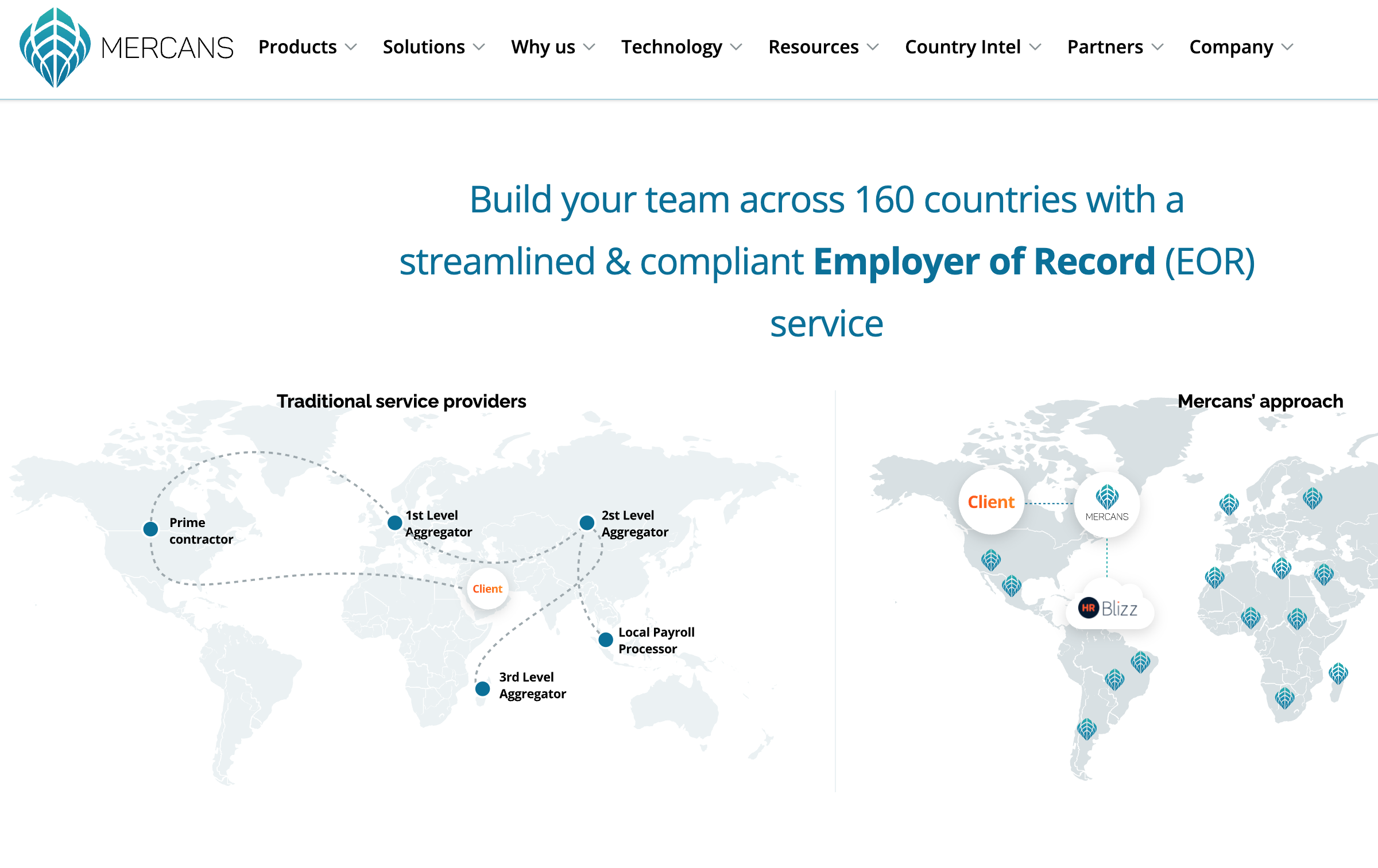
Mercans is a global payroll technology and Employer of Record provider supporting employment across 160+ countries. Its EOR model combines proprietary payroll technology with in-country teams and provides hiring, onboarding, employment contracts, payroll, benefits, compliance, and workforce management.
For Egypt, Mercans provides EOR services that allow companies to hire employees without establishing a local legal entity or subsidiary. Its Egypt-specific service covers hiring, employment contracts, onboarding, payroll, employee records, benefits, and compliance with Egyptian labour requirements. Mercans also provides payroll administration covering salary-tax withholding and social-insurance administration.
Mercans also supports immigration and global mobility in Egypt. Its Egypt EOR service includes assistance with work permits and residence authorisations for non-Egyptian nationals, as well as visa sponsorship and global mobility services.
Mercans publishes EOR pricing of approximately $299–$599 per employee per month depending on the market. Its global EOR service advertises rapid payroll processing, but no fixed Egypt-specific EOR onboarding SLA is publicly disclosed.
For Egypt specifically, Mercans does not publicly confirm that its EOR service automatically registers employees with NOSI, nor does its current Egypt EOR documentation explicitly state that employment contracts are issued in Arabic. Therefore, both NOSI registration handling and Arabic-language contract support should be verified directly with Mercans.
Strengths:
-
Confirmed Egypt EOR service without requiring the client to establish a local entity.
-
Handles hiring, employment contracts, onboarding, payroll, benefits, and compliance.
-
Provides social-insurance administration and salary-tax withholding.
-
Supports work permits, residence authorisations, and visa sponsorship for expatriate employees.
Proprietary payroll technology with in-country employees.
Global EOR coverage across 160+ countries.
Limitations:
-
Egypt-specific EOR pricing is not publicly stated; the published $299–$599 range is a global EOR pricing range.
-
A fixed Egypt-specific onboarding timeline is not publicly disclosed.
-
Public Egypt documentation does not explicitly confirm NOSI employee-registration handling.
-
Public Egypt documentation does not explicitly confirm Arabic-language employment contracts.
Best for:
Companies looking for a payroll-focused EOR with direct
in-country delivery, strong statutory payroll capabilities, and immigration
support for hiring employees in Egypt and other international markets.
Borderless AI
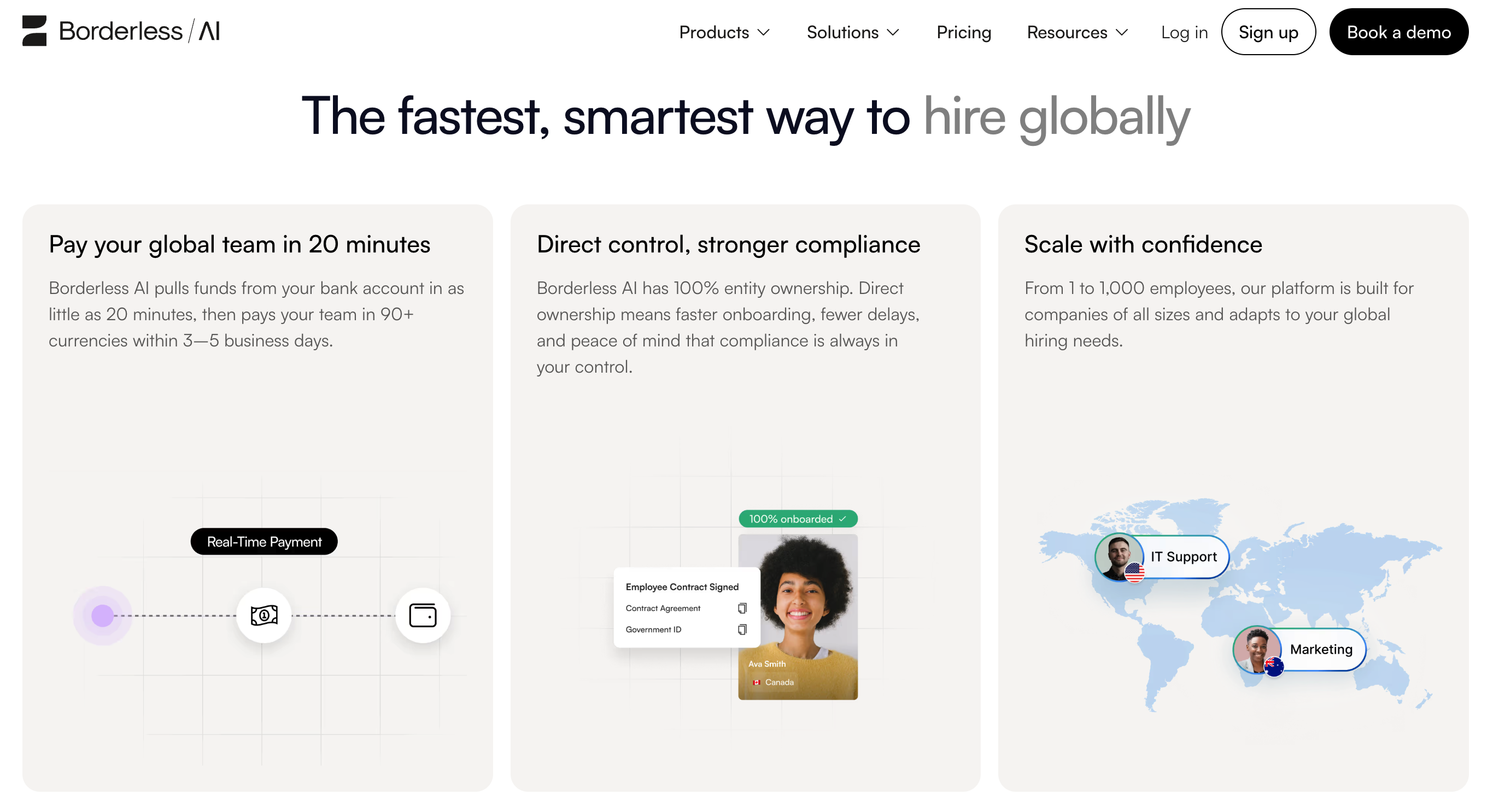
Borderless AI is an AI-powered Employer of Record and global payroll platform that enables companies to hire, onboard, manage, and pay employees without establishing foreign entities. The platform currently supports 170+ countries and handles local employment contracts, payroll, benefits, tax compliance, and country-specific employment requirements.
Borderless AI states that it owns its legal entities in every supported market rather than relying on third-party EOR vendors. Its platform provides automated contract generation, payroll and tax filings, benefits administration, compliance monitoring, and integrations with HR and finance systems.
Egypt is included among Borderless AI's supported hiring destinations. Its global platform runs payroll in local currencies and manages country-specific tax, statutory deductions, and reporting requirements. However, the public Egypt-specific material reviewed does not provide detailed confirmation of individual Egyptian requirements such as NOSI registration, Arabic contract handling, or specific Egypt payroll calculations.
Borderless AI currently publishes EOR pricing of $579 per employee per month. Its official materials state onboarding can be completed in 24–48 hours, although this is a global onboarding claim rather than a specifically guaranteed Egypt SLA.
Borderless AI provides dedicated support and states that its in-house support team provides 24/7 assistance.
Strengths:
170+ country EOR coverage.
Owned-entity model rather than third-party EOR vendors.
$579 per employee per month EOR pricing.
24–48-hour global onboarding claim.
AI-powered contract generation and compliance automation.
Payroll in local currencies with tax and statutory compliance.
24/7 support.
Limitations:
-
Egypt-specific public documentation is less detailed than the provider's general global documentation.
-
Egypt-specific NOSI registration handling is not publicly confirmed.
-
Egypt-specific Arabic employment-contract support is not publicly confirmed.
-
The 24–48-hour onboarding figure is a global claim and should not be treated as a guaranteed Egypt-specific SLA.
Best for:
Startups, scale-ups, and multinational companies that want a
technology-driven EOR with fast global onboarding, owned-entity
infrastructure, AI-assisted compliance, and centralized payroll and workforce
management.
What Are the Key Services of an EOR in Egypt?
An EOR in Egypt covers the full employment lifecycle so companies can hire without a local entity. Core services include payroll processing with progressive personal income tax withholding, NOSI social insurance contributions under Social Insurance Law No. 148/2019, Arabic-language employment contracts with English translations, and monthly filings to the Egyptian Tax Authority.
Egypt's regulatory environment adds specific complexity that makes service scope important to evaluate carefully. Dual-language contract requirements, NOSI registration deadlines of 15 days from hire, and ongoing Social Insurance Law No. 148/2019 obligations mean that gaps in an EOR's local capability carry real compliance risk.
For companies hiring non-Egyptian nationals, work permit and residency support is a distinct service category. Not all EOR providers cover this in-house, so confirming work permit handling before signing is a practical step for international teams expanding into Cairo or Alexandria.
Employment Contracts and Local Compliance
Employment in Egypt is governed by Labour Law No. 12/2003 and Social Insurance Law No. 148/2019. Both statutes set binding obligations that apply from the first day of employment.
Contracts must be written in Arabic. English translations are permitted alongside the Arabic original, but the Arabic version controls in any dispute. Three copies are required: one for the employer, one for the employee, and one filed with the relevant authority.
Every contract must specify the probation period. The standard probation period is three months. Labour Law No. 12/2003 sets a maximum of six months, and employees may not be placed on probation more than once by the same employer.
The contract type also determines termination rights and severance obligations. Fixed-term contracts expire at the agreed end date, and early termination can trigger compensation claims. Indefinite contracts carry stronger protections, including notice requirements and end-of-service indemnity calculated at one-half month salary per year of service.
Payroll and Tax Administration
Payroll in Egypt is governed by Labour Law No. 12/2003 for employment terms and Social Insurance Law No. 148/2019 for contribution obligations. Both laws impose monthly compliance deadlines that EOR providers must meet on behalf of client companies.
Social insurance contributions are calculated on base salary, capped at $295 (EGP 15,000) per month. The employer rate is 26% and the employee rate is 14%. Filings go to the National Organization for Social Insurance (NOSI) each month.
Personal income tax is withheld at progressive rates. Egypt applies a bracketed structure ranging from 0% to 25%. A dedicated section of this page sets out the full bracket table.
Egyptian law also requires employers to distribute a share of annual profits to employees. EOR providers must track this obligation and ensure distributions meet statutory thresholds. In addition, end-of-service indemnity accrues throughout employment at one-half month salary per year of service and must be reflected accurately in payroll records from the start of each employment relationship.
Benefits Administration
Egyptian law sets minimum employment entitlements that every employer must meet. Employees are entitled to 21 days of paid annual leave, 90 days of paid maternity leave, and sick leave under the Labour Law No. 12/2003 framework. Egypt observes approximately 13 public holidays per year. The standard probation period is three months. Notice periods vary by tenure, and end-of-service indemnity is calculated at one-half month salary per year of service.
Social insurance contributions are mandatory: employers contribute 26% of gross salary and employees contribute 14%, both capped at an $295 (EGP 15,000) monthly base salary. The minimum wage is set by the National Wages Council and is subject to periodic revision; EOR providers track current figures and apply them automatically.
Beyond statutory minimums, EOR providers in Egypt commonly layer voluntary benefits such as private health insurance and transportation allowances, both of which are standard in the Egyptian market. Egypt does not currently mandate statutory paternity leave under Labour Law No. 12/2003.
Employee Onboarding
Onboarding an employee in Egypt requires more than a signed contract. All employment agreements must be drafted in Arabic, with English translations provided as needed. EOR providers prepare these documents in compliance with Labour Law No. 12/2003 and complete NASI registration within the mandatory 15-day window.
For non-Egyptian employees, work permit support is a distinct onboarding requirement. The Ministry of Manpower and Migration oversees work permit approvals. The process typically involves submitting the employment contract, proof of qualifications, passport copies, and employer registration documents. Approval timelines vary but generally range from four to eight weeks depending on the applicant's nationality and role.
EOR providers differ in how they handle this process. Some manage work permits end-to-end within their service scope; others refer clients to specialist immigration firms. Confirming this scope before signing an EOR agreement avoids delays for international hires.
Ongoing HR Support
EOR providers in Egypt maintain payroll compliance on a monthly basis, including submitting ETA (Egyptian Tax Authority) declarations by the 15th of each month and updating NOSI contribution calculations when salary bases change.
Ongoing HR support also covers Arabic-language documentation for employee changes such as salary adjustments and role transitions. These updates must be recorded in Arabic to remain compliant with Labour Law No. 12/2003.
Profit-sharing obligations are monitored as a continuing employer responsibility under Egyptian law. EOR providers track these requirements alongside Social Insurance Law No. 148/2019 regulatory updates, ensuring contribution rates and reporting procedures reflect current rules without requiring clients to monitor legislative changes directly.
Employee Offboarding
Egypt does not follow an at-will employment model. Under Labour Law No. 12/2003, valid grounds for dismissal are defined by statute, and notice period requirements vary by tenure.
Wrongful termination carries financial penalties and may require resolution through the labour court system. EOR providers manage this risk on behalf of clients, including labour court representation or negotiated settlement where applicable.
Final payroll settlements must include payment of all accrued but unused annual leave. EOR providers calculate and process these amounts as part of the offboarding workflow, ensuring the exit meets statutory requirements and reduces exposure to post-termination disputes.
How to Hire Through an EOR in Egypt
Hiring through an EOR in Egypt follows a defined process, but Egypt's specific legal requirements make compliance at each step particularly important. Employment contracts must be in Arabic, and Egypt operates a non-at-will employment model, meaning termination requires documented cause and proper notice under Labour Law No. 12/2003.
The EOR becomes the legal employer on record. It registers the employee with NOSI, processes payroll with the correct social insurance contributions, withholds progressive personal income tax, and files monthly declarations with the Egyptian Tax Authority by the 15th of each month.
For non-Egyptian employees, work permit requirements add an additional process step before employment can begin. The EOR manages this application, but buyers should confirm this capability before signing a contract. To understand the full mechanics of how this model operates, see how does EOR work.
Selection and Setup
When evaluating Egypt EOR providers, apply four criteria: entity model (direct entity vs. partner network), Arabic contract capability, NOSI compliance track record, and pricing transparency (platform fee vs. all-in monthly cost).
Confirm that the provider can demonstrate compliance with Social Insurance Law No. 148/2019, which governs contribution calculations and filing obligations. Providers without a documented track record on this law carry higher compliance risk for your Egypt hires.
If you plan to hire non-Egyptian employees, confirm work permit support capability before committing. Not all EOR providers include this service, and gaps here can delay onboarding by weeks.
From provider selection to first hire onboarded in Egypt, the typical timeline runs four to six weeks. This accounts for contract review, NOSI registration within the mandatory 15-day window, work permit processing where applicable, and payroll setup.
Onboarding and Compliance
An EOR in Egypt manages the full onboarding process for both Egyptian nationals and non-Egyptian employees. For non-Egyptian hires, the EOR handles work permit applications through the Ministry of Manpower, including document preparation, approval steps, and coordination with relevant authorities. The process typically takes several weeks depending on applicant nationality and role type.
The EOR registers each employee with the Egyptian Tax Authority (ETA) and manages ongoing tax obligations on the employee's behalf. All onboarding documentation must be prepared in Arabic, as required under Egyptian employment law. Employment contracts include a standard three-month probation period, which must be specified in the written agreement.
Social insurance registration follows Social Insurance Law No. 148/2019. The EOR completes registration with the National Organization for Social Insurance (NOSI) within the mandatory 15-day window and manages monthly contribution filings throughout the employment relationship.
What Are the Benefits of Using an EOR in Egypt?
Using an EOR in Egypt reduces the compliance burden created by the country's regulatory environment. Egypt requires dual-language employment contracts, strict NOSI filing deadlines, and a non-at-will termination model under Labour Law No. 12/2003. Each of these requirements carries legal and financial risk for companies without local expertise.
An EOR absorbs that risk by acting as the legal employer. It handles NOSI contributions, ETA tax declarations, Arabic contract preparation, and end-of-service indemnity calculations. These benefits apply equally whether a company is hiring Egyptian nationals or non-Egyptian employees who require Ministry of Manpower work permits.
For companies entering Egypt without a local entity, an EOR provides a direct path to compliant employment across Cairo, Alexandria, and other regions, without the time and cost of establishing a local company. To understand how this model works in practice, see how does EOR work.
Faster Market Entry
Registering a legal entity in Egypt through GAFI (General Authority for Investment and Free Zones) typically takes several months. An EOR gets your first hire in Egypt onboarded in two to four weeks, without entity registration, capital requirements, or local directorship obligations.
This speed difference matters when you are testing a new market. An EOR lets companies hire one or two employees in Egypt, validate the opportunity, and decide whether a permanent entity makes commercial sense before committing to the full registration process.
For companies that have already decided to expand, the time saved on setup translates directly into earlier revenue and faster team productivity in Cairo, Alexandria, and other Egyptian cities.
Reduced Compliance Risk
Egypt's employment framework creates several distinct compliance risks for foreign employers. Social Insurance Law No. 148/2019 governs contribution rates and filing obligations, and errors in calculation or timing carry financial penalties.
Termination is another high-risk area. Egyptian labour law does not follow an at-will model. Employers must observe notice periods, calculate end-of-service indemnity correctly, and avoid wrongful dismissal exposure that can result in court-ordered compensation.
Employment contracts must be in Arabic. A contract drafted only in English may not be enforceable. EOR providers maintain Arabic-language contract templates that meet Labour Law No. 12/2003 requirements. They also manage profit-sharing obligations where applicable, ensuring statutory distributions are calculated and paid on time.
Simplified Payroll Administration
Egypt's payroll obligations are governed by multiple statutes, including Labour Law No. 12/2003 and Social Insurance Law No. 148/2019. Together, these laws create a layered compliance environment that requires precise monthly execution.
Income tax applies across multiple progressive brackets, with rates ranging from 0% to 25% depending on annual earnings. Employers must calculate withholding accurately for each employee and submit declarations to the Egyptian Tax Authority by the 15th of every month. Errors in bracket application carry penalty risk.
Social Insurance Law No. 148/2019 governs employer and employee contribution obligations, requiring accurate calculation and timely remittance each payroll cycle. EOR providers integrate with Egypt's e-tax portal to submit filings electronically, reducing manual processing and declaration errors.
Egyptian law also requires payslips to be generated in Arabic. EOR providers handle Arabic payslip production as part of standard payroll administration, removing a documentation burden that many international HR teams are not equipped to manage in-house.
Access to Local Benefits
EOR providers in Egypt administer both statutory and voluntary benefits on behalf of the employing company. Statutory obligations are set by Labour Law No. 12/2003 and Social Insurance Law No. 148/2019, and non-compliance carries direct legal exposure.
Minimum wage compliance is a baseline statutory requirement. EOR providers track the current national minimum wage and apply it to every employment contract, ensuring no hire falls below the legally mandated floor.
End-of-service indemnity is a further statutory entitlement. Under Labour Law No. 12/2003, employees are entitled to half a month's salary per year of service upon termination. EOR providers calculate accruals throughout the employment lifecycle and manage settlement payments accurately at exit.
Social Insurance Law No. 148/2019 governs the benefits coverage framework for social insurance, including pension and disability protections funded through employer and employee contributions. EOR providers manage registration, contribution calculations, and ongoing filings under this statute.
Beyond statutory requirements, EOR providers can source voluntary benefits for Egypt-based employees, including private health insurance and transportation allowances. These additions support competitive compensation packages without requiring the employer to build local vendor relationships independently.
Lower Entity Setup Costs
Setting up an Egyptian LLC through GAFI (General Authority for Investment and Free Zones) typically requires registration fees, minimum capital deposits, and ongoing costs for a local accounting firm, legal counsel, and an HR compliance team. These fixed costs make direct entity setup impractical for companies hiring fewer than 10 to 15 employees in Egypt.
An EOR removes all of those costs. There is no entity to register, no local counsel to retain, and no in-country HR staff required for statutory compliance. You pay a per-employee monthly fee and the EOR covers payroll, NOSI filings, and Labour Law adherence. For companies below the headcount breakeven threshold, EOR is the more cost-controlled path. See the employer of record cost guide for a detailed cost comparison.
More Flexible Workforce Scaling
An EOR lets you hire across Cairo, Alexandria, Giza, and other Egyptian regions without opening multiple local offices or registering separate payroll entities in each location. One EOR contract covers the full country.
EOR providers also support both Egyptian nationals and non-Egyptian employees. For foreign hires, the EOR manages work permit applications and residency compliance alongside standard payroll and NOSI obligations. This matters for companies building mixed-nationality teams in Egypt's growing tech and IT sectors.
Offboarding is also lower-risk under an EOR. Direct employers who mishandle termination under Labour Law No. 12/2003 face labour court exposure and end-of-service indemnity disputes. The EOR owns the employment relationship and manages compliant exits, reducing that risk. EOR for startups and EOR for mid-market companies both benefit from this flexibility as headcount changes.

How to Find the Right EOR for Egypt
Not every global EOR is equipped to handle Egypt's specific employment requirements. The criteria below were used to evaluate and rank the eight providers listed on this page, so the methodology connects directly to the rankings.
Generic EOR evaluation checklists miss what matters most in Egypt. Egypt-specific criteria, including Arabic contract capability, whether a provider operates through a direct entity or a third-party partner model, and a documented track record of NOSI compliance, carry more weight than standard global EOR benchmarks. Prioritise providers that can demonstrate these capabilities before comparing price or platform features.
Local Compliance Expertise
Egypt compliance expertise is not a generic capability. Look for providers with documented knowledge of Labour Law No. 12/2003 and Social Insurance Law No. 148/2019, the ability to draft contracts in Arabic as required by law, and a track record of accurate NASI registration within the mandatory 15-day window and timely ETA filings by the 15th of each month.
Two areas are frequently overlooked. First, profit-sharing compliance under Egyptian law requires specific calculation and reporting obligations that many global EORs handle inconsistently. Second, Egypt does not follow an at-will employment model. Termination requires adherence to defined notice periods and, in disputed cases, the labour court process. Providers with direct experience managing Egyptian termination procedures reduce the risk of costly disputes significantly.
Clear Service Scope
Service scope transparency is a practical filter when evaluating EOR providers for Egypt. Before signing, confirm whether the provider handles work permit applications for non-Egyptian employees or treats that as an out-of-scope service.
Pricing clarity matters equally. Ask whether the quoted fee includes the 26% NOSI employer contribution or bills it separately. Confirm that setup and offboarding fees are disclosed upfront, and verify whether profit-sharing compliance under Egyptian law is covered.
The provider's operating model also affects scope. A direct-entity model gives you one contract and one point of accountability. A partner-led model may introduce variation in service delivery and documentation standards.
Two additional items to verify: whether the provider generates Arabic-language payslips as a standard output, and whether it integrates with Egypt's e-tax portal for monthly ETA declarations by the 15th.
Support Model
Support quality in Egypt depends on more than response time. Bilingual Arabic and English capability is a baseline requirement, given that employment contracts, payslips, and Ministry of Manpower filings must be in Arabic.
Time zone alignment with Egypt (UTC+2 in winter, UTC+3 during daylight saving) affects how quickly a provider can resolve payroll errors or compliance queries on the day they arise. Ticket-only support models create delays that dedicated account managers avoid.
Providers with an established Ministry of Manpower relationship carry a practical advantage for termination disputes and labour court matters. That relationship reflects operational depth, not just geographic presence.
In-country support, such as a Cairo office with local HR staff, differs meaningfully from remote-only coverage. For companies entering Egypt for the first time, local presence reduces the risk of miscommunication on regulatory requirements and speeds resolution of NASI registration issues.
Technology and Reporting
A capable EOR platform must connect directly with Egypt's e-tax portal to submit monthly ETA declarations by the 15th of each month. Look for Arabic payslip generation as a standard output, not an add-on, since Egyptian employees expect payslips in Arabic.
Real-time dashboards for NOSI contribution tracking give finance teams accurate accrual data without manual reconciliation. Providers that integrate with HRIS tools such as BambooHR or Workday reduce duplicate data entry across your existing systems.
Data security and compliance with Egyptian data protection requirements are also a baseline criterion. Confirm that the provider stores and processes employee data in accordance with applicable Egyptian regulations before signing any agreement.
Scalability for Your Hiring Plans
Evaluate whether the provider can employ workers across all 27 Egyptian governorates, not just Cairo and Alexandria. Coverage should extend to both Egyptian nationals and non-Egyptian employees who hold valid work permits issued by the Ministry of Manpower.
For companies also hiring across the MENA region, multi-country scalability matters. A provider that manages Egypt alongside Saudi Arabia, the UAE, or other regional markets reduces the number of vendor relationships your team must maintain.
Two additional factors shape long-term planning. First, ask whether the provider supports an EOR-to-entity transition: specifically, whether it will hand over employment contracts and NASI registrations when you establish your own Egyptian legal entity. Second, identify the headcount breakeven threshold at which running a local entity becomes more cost-effective than continuing with an EOR services arrangement. That number informs your expansion timeline from the start.

Why Gloroots Is a Strong EOR Partner in Egypt
Editorial disclosure: Gloroots publishes this page and is included in the comparison. All provider assessments use the same criteria.
Gloroots supports compliant full-time employment across 150+ countries, making it a practical choice for companies that hire in Egypt today and plan to expand into additional markets later. Its global coverage means a single platform can govern multi-country programs without switching providers as headcount grows.
Pricing is predictable and country-specific. Gloroots does not charge a percentage of salary, so cost scales with headcount rather than with compensation levels. Full cost visibility is provided before onboarding begins, which removes the uncertainty common with percentage-based models.
Account support is human-led. Dedicated account managers retain business context across the employment lifecycle, so teams are not restarting conversations with each interaction. This contrasts with ticket-only support models where institutional knowledge is lost between contacts.
In Egypt, Gloroots covers the compliance requirements that matter most: payroll processing under Labour Law No. 12/2003, NOSI social insurance contributions under Social Insurance Law No. 148/2019, Arabic contract documentation, and monthly ETA filings. Its Compliance and Employment Governance capability manages these obligations through a centralized platform, giving HR and finance teams real-time workforce visibility without building local infrastructure.
To discuss Egypt-specific hiring requirements or see the platform in action, visit Gloroots EOR services or review Gloroots pricing before your next hire.
FAQs About the Best EOR in Egypt
How does an EOR work in Egypt?
An Employer of Record in Egypt becomes the sole legal employer of your workers. Unlike a PEO model, which requires shared liability and a local entity, an EOR takes on full legal responsibility without any entity requirement on your side.
The EOR operates under Labour Law No. 12/2003 and Social Insurance Law No. 148/2019. It registers the employee with the National Authority for Social Insurance (NASI) within the mandatory 15-day window, files monthly payroll tax declarations with the Egyptian Tax Authority (ETA) by the 15th of each month, and manages all statutory contributions and Arabic contract requirements. Your company retains day-to-day management of the worker's tasks.
What does an EOR cost in Egypt?
Platform fees for global EOR providers covering Egypt typically range from $199 to $599 per employee per month. These figures are platform fees only and do not include mandatory employer-side NASI contributions, which run at approximately 26% of capped salary under Social Insurance Law No. 148/2019.
Additional costs can include one-time setup fees and offboarding fees, which vary by provider. Egypt-specialist providers such as Tawzef and Staff Arabia generally price their services on request rather than publishing standard rates. For a full picture of employer of record cost, request itemised quotes that separate the platform fee from all statutory contributions.
When should a company use an EOR in Egypt?
An EOR in Egypt is the right choice when a company has no local legal entity and no near-term plans to establish one. Common scenarios include testing the Egyptian market before committing to entity setup, hiring one to five employees in Cairo or Alexandria, or scaling a tech or IT team quickly without building local HR infrastructure.
An EOR also works well for sending foreign nationals to Egypt who need work permits before employment can begin. However, when headcount grows large enough that the cumulative EOR fees exceed the cost of registering and running an Egyptian entity, direct entity setup may be more cost-effective. That cost breakeven point depends on salary levels, statutory contributions, and the EOR provider's monthly fee per employee.
Can an EOR hire both local and foreign employees in Egypt?
Yes. EOR providers operating in Egypt can employ both Egyptian nationals and non-Egyptian (foreign) employees on behalf of a client company. For Egyptian nationals, onboarding follows standard Labour Law No. 12/2003 procedures including NASI registration and Arabic contract requirements.
Foreign employees require a work permit approved by the Ministry of Manpower before employment can legally begin. Work permit processing in Egypt typically takes four to eight weeks, which adds time to the onboarding timeline for non-Egyptian hires. EOR providers vary in how they handle this: some manage work permit applications end-to-end, while others refer clients to specialist immigration firms. Confirm the provider's exact scope before onboarding a foreign employee.
How do I choose the right EOR in Egypt?
Five criteria matter most when selecting an EOR for Egypt. First, confirm whether the provider operates a direct legal entity in Egypt or relies on a third-party partner model, as direct entities reduce compliance risk. Second, verify that the provider can issue employment contracts in Arabic, which Egyptian law requires. Third, check the provider's track record with NOSI filings and Social Insurance Law No. 148/2019 compliance. Fourth, confirm work permit support if you plan to hire expatriates. Fifth, compare pricing structures: a flat platform fee versus an all-in rate affects total cost predictability.