




-
EORs offer unmatched speed and compliance, helping
companies hire globally in days instead of months.
-
They’re ideal for early expansion, letting teams test
markets without the cost or complexity of setting up entities.
-
But long-term use can get expensive, reduce HR control, and
create vendor dependency if teams scale in one country.
- The smartest approach is a hybrid of EOR for pilot markets and building entities where you plan long-term growth.
The global employment market moves faster than legal infrastructure can keep up.
Right now, 41% of companies use EOR services, while another 49% are planning to adopt them. Most organizations have already placed their bet or are sizing up the table.
Here's what nobody tells you upfront: EOR isn't just a hiring decision. It's a capital allocation choice disguised as HR operations.
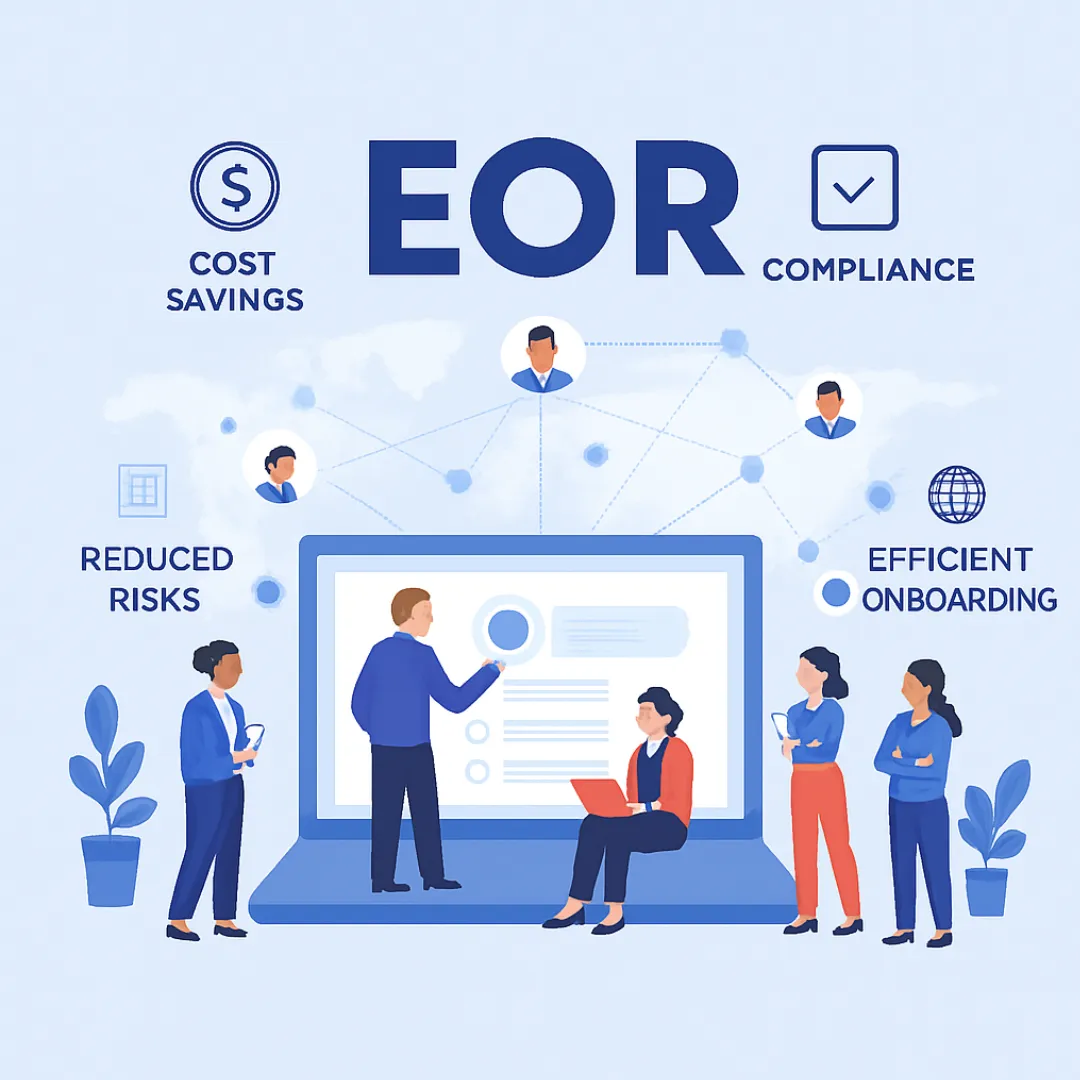
You're racing to hire globally. Do you spend six to twelve months building legal entities in target markets, or activate hiring in days through an Employer of Record? The speed argument is compelling. So is compliance coverage and operational simplicity. But EORs aren't frictionless, and they're rarely the most cost-effective long-term play.
The real question isn't whether EORs work. They clearly do. The $4.71 billion market projected for 2025 proves that. What matters is understanding
- When they work
- What you're trading for that speed
- How to avoid strategic lock-in that surfaces twelve months after your first hire.
This guide breaks down both sides. Strategic advantages. Practical limitations. The full picture, minus vendor propaganda and oversimplified comparisons.
What Is an Employer of Record (EOR)?
An Employer of Record (EOR) becomes the legal employer of your international workforce. You direct the work, manage performance, control day-to-day operations. The EOR owns the employment contract, processes payroll, withholds taxes, administers benefits, ensures statutory compliance in each jurisdiction.
Think of it as renting employment infrastructure instead of building it.The EOR manages the full employment lifecycle.
- Drafting compliant local contracts.
- Registering employees with social security systems.
- Calculating tax withholdings based on local codes.
- Managing statutory benefits like health insurance, pension contributions, and paid leave.
- Processing monthly payroll in local currency.
- Executing offboarding when roles end.
You remain the operational manager, setting objectives, assigning work, conducting reviews. The EOR carries liability for employment law compliance as the legal employer.
This differs fundamentally from a Professional Employer Organization (PEO), which co-employs and requires you to have a legal entity in-country. It also differs from staffing agencies providing temporary placements rather than enabling permanent employee relationships under your control.
EORs shine when you need to
- hire internationally without establishing a local entity.
- Testing a new market with a small team.
- Building a distributed remote workforce.
- Activating hiring in weeks rather than quarters.
The model trades margin for speed and flexibility, brilliant in certain contexts and expensive in others.
What are the Advantages of Using an Employer of Record?
1. Speed That Reshapes Strategic Timelines
- Entity formation in most countries takes four to nine months. EORs compress that to days. Companies using EORs cut global onboarding timelines by 56%.
- Sign a candidate in Germany on Monday, have them onboarded and working by Friday.
- This speed advantage compounds into faster market entry, faster revenue generation, and faster feedback loops on whether a geography actually works for your business model.
2. Compliance Coverage Across Jurisdictions
- 65% of organizations cite regulatory and compliance risk reduction as their primary reason for using EORs. Employment law varies dramatically by country, with different notice periods, termination protections, mandatory benefits, and tax structures.
- An EOR maintains country-specific legal playbooks, monitors regulatory changes, and ensures your contracts, payroll, and benefits administration align with local requirements.
3. Capital Efficiency for Early-Stage Expansion
- Entity setup carries hard costs like legal fees, registration, and accounting infrastructure, plus soft costs like finance team bandwidth and ongoing statutory filings.
- EOR lets you deploy capital toward revenue-generating activities like product development, customer acquisition, and market validation instead of legal infrastructure that only makes sense at scale.
Example: Hire three people in Singapore, five in Brazil, two in the UAE without building three separate legal entities.
4. Localized Payroll and Benefits
- Payroll complexity varies wildly by country. India requires managing Provident Fund, ESIC, and gratuity calculations. France involves complex social charges and Works Council considerations.
- An EOR runs multi-country payroll from a unified platform, handles local currency disbursements, manages FX transparently, and ensures statutory deductions align with current tax codes.
5. Operational Flexibility for Pilot Markets
- The EOR market is valued at USD 5.59 billion in 2025 and expected to reach USD 10.46 billion by 2035, growing at a CAGR of 6.8% reflecting how widely businesses use this model for market testing.
- EOR services let you test new markets without committing to a legal entity. You can validate demand and assess talent before making long-term investments. If the market works, transition to your own entity. If it doesn't, exit cleanly without unwinding corporate structures.
What are the Drawbacks of Using an Employer of Record?
Reduced Control Over HR Processes
- Since the EOR is the legal employer, they control key HR elements like contract terms, termination steps, and dispute handling. This limits your ability to customize benefits or HR policies.
- Onboarding also feels less personal because employees interact with the EOR’s system, not yours, which can weaken cultural connection, especially for early hires.
Higher Long-Term Costs Than Direct Employment
- EORs charge 8–15% of gross salary plus extra fees, which is manageable for a few hires but becomes costly as teams grow. Once you reach 10–15 employees in one country, entity setup is usually more economical.
- The real risk comes from treating EOR as a long-term solution when it’s meant for early expansion, not ongoing large-scale hiring.
Role and Industry Limitations in Certain Markets
- Some regulated professions, like legal, medical, or financial roles, cannot be hired through an EOR due to licensing rules.
- Complex compensation structures, such as custom equity plans or intricate bonus systems, are hard to manage through standardized EOR payroll, making the model restrictive for companies with tailored reward strategies.
Vendor Dependency and Switching Costs
- Once you hire many employees through an EOR, switching providers or moving to your own entity becomes operationally heavy. Contracts, payroll records, and benefits need to be migrated carefully, creating uncertainty for employees and taking 60–90 days.
- This lock-in effect is often underestimated. What starts as a quick hiring solution can become an entrenched dependency.
Limited Customization in Benefits and Employment Terms
- EORs offer competitive but standardized benefits, which makes it difficult to provide unique perks or custom leave policies without extra cost.
- Contract terms also follow conservative templates, so businesses needing flexible arrangements, tailored probation periods, or specific IP clauses may find the EOR structure too rigid.
When an EOR Makes Sense (and When Entity Setup Is Better)?
EOR Is the Right Choice When:
You're testing a new market with fewer than 10 employees. Entity formation is economically inefficient for small teams. EOR lets you validate product-market fit, assess talent quality, gauge operational complexity without committing capital to permanent infrastructure.
Speed is a competitive advantage. If your closest competitor can hire in Germany three months faster because they use an EOR while you're navigating GmbH formation, you've lost strategic ground. In talent wars, speed to offer matters.
You're building a distributed, remote-first workforce. Two employees in Portugal, three in South Africa, one in Thailand, four in Canada. Establishing entities in each country is operationally absurd. EOR provides the legal scaffolding for truly global hiring.
You need Global Capability Center (GCC) enablement in India. Gloroots specializes in
- accelerating GCC setup
- providing payroll
- PF/ESIC/gratuity handling
- statutory compliance while your entity incorporation is underway, or managing operations long-term if you prefer not to establish a local entity
Particularly valuable for companies where India is a strategic hub but legal formation timelines create hiring bottlenecks.
Entity Setup Is the Better Path When:
You're hiring 15+ employees in a single country. At this density, the recurring EOR fees outweigh entity formation costs within 18 to 24 months. You also gain full control over HR processes, benefits customization, employment terms.
Your business model requires direct employment relationships. If employer branding, equity participation, or proprietary HR practices are core to talent strategy, the mediation layer an EOR introduces creates friction that undermines those advantages.
You're entering a market for the long term with significant hiring projections. If the five-year plan involves scaling to 50+ employees in a geography, start with entity formation. The transition cost from EOR to entity mid-growth is higher than building the right foundation from day one.
Regulatory or contractual requirements mandate a local entity. Government contracts, certain regulated industries, public sector work often require employees to be on the books of an in-country legal entity. EOR simply isn't viable in these contexts.
The smartest global teams increasingly use hybrid models: EOR in experimental markets, entities in core geographies, a willingness to transition from one to the other as market maturity evolves. The question isn't binary. It's sequential and context-dependent.
Why Should You Choose Gloroots as Your EOR Partner?
Choosing an EOR isn't just about compliance coverage. It's about operational transparency, service quality, and whether the vendor can scale with your hiring ambitions. Gloroots differentiates on the dimensions that enterprise teams actually care about.
Transparent, line-item pricing with no hidden fees. Most EOR pricing models obscure costs in "platform fees," "setup charges," ambiguous benefits markups.
Gloroots provides detailed, country-level invoicing with clear GL mapping and accounting exports. Finance teams can forecast accurately and audit with confidence. You see exactly what you're paying for global payroll compliance in every jurisdiction.
Gloroots combines a powerful platform with hands-on managed support, giving you clear visibility and control over contracts, onboarding, and payroll.Plus, dedicated Customer Success Managers provide expert, country-specific guidance and resolve complex compliance issues that automation alone can’t handle.
Scalable from 10 to 250 employees across 100+ countries. Hiring your first international employee or managing distributed teams across fifteen markets,
Gloroots scales with your hiring velocity without compromising service quality or compliance rigor. Ready to see how it can support your global expansion? Talk to our team today.
Frequently Asked Questions
1. Is using an EOR safe and compliant?
Yes, when you work with a reputable provider. The EOR becomes the legal employer and handles compliance in each country. That said, you still need oversight on job classification and compensation decisions. Think of it as a partnership, not a hands-off solution.
2. Is EOR legal in all countries?
It's legal in most countries, but some places like China and certain Middle Eastern nations have restrictions or require special licensing. A good EOR will tell you upfront where the model works smoothly and where you'll need a local entity instead.
3. What does an EOR typically cost?
Expect to pay 8 to 15% of gross salary per month, plus platform and benefits fees. For a $60K salary, that's roughly $400 to $750 monthly. Costs are higher in complex markets like Germany or France. Check our guide on EOR costs and pricing models for detailed breakdowns.
4. What are the main benefits of using an EOR?
Speed (hire in days, not months), compliance coverage across jurisdictions, no entity setup costs, and flexibility to scale up or down quickly. It's ideal when you're testing new markets or building distributed teams without the overhead of local infrastructure.
5. How does Gloroots ensure compliance across different countries?
Gloroots maintains country-specific legal playbooks and monitors regulatory changes in real time. The platform automates payroll, tax filings, and benefits while compliance specialists handle edge cases. For India, we manage PF, ESIC, and gratuity with deep local expertise. Want to see how this works for your hiring plans? Get in touch with our team.