




- Every EOR operating in Switzerland must hold a SECO labour-leasing licence to legally act as the employer, so verifying this licence before signing any EOR agreement is a non-negotiable first step.
- Switzerland's 26 cantons apply independent tax rates, family-allowance levies, and public holiday schedules, meaning payroll costs and contract terms must be calculated per canton rather than at a flat national rate.
- The 13th-month salary is standard market practice across most Swiss employment agreements and adds approximately 8.3% to annual cash payroll cost, so buyers should confirm whether their EOR defaults to 12 or 13 pay periods before onboarding.
- For most companies, an EOR becomes cost-competitive with incorporating a Swiss entity up to roughly 5 to 10 employees, after which the share capital requirement, notary fees, and ongoing administrative costs of a local entity may shift the economics.
- Cross-border commuters from France, Germany, and Italy are subject to separate bilateral tax treaty rules, and an EOR must identify commuter status at onboarding and apply the correct withholding framework from the first payroll run.
Switzerland offers one of Europe's most competitive talent markets, with a GDP per capita of approximately $94,800 USD (2024), a population of 8.8 million, and a workforce concentrated in finance, life sciences, and technology. The official capital is Bern, the currency is CHF, and the country recognises four official languages: German, French, Italian, and Romansh.
Employers pay social contributions of 12 to 18 percent of gross salary, and the standard payroll cycle is monthly. The corporate tax rate ranges from 14 to 21 percent depending on the canton, and the tax year ends on 31 December. The average workweek runs 41 hours.
Switzerland treats employer of record arrangements as staff leasing, known locally as Personalverleih, which requires a SECO-issued cantonal labour-leasing licence from any provider operating in the country. A 13th-month salary payment is also standard market practice across most employment agreements.
Our Top 8 Picks: Switzerland for EOR Comparison 2026
The table below compares eight employer of record providers active in Switzerland across pricing, coverage, onboarding speed, platform experience, support, and scalability. Pricing figures are indicative and may vary with canton complexity, salary level, and service scope.
| Provider | Pricing per month | Country coverage | Onboarding speed | Platform experience | Customer support | Scalability |
|---|---|---|---|---|---|---|
| Gloroots | From $199 per employee/month | 150+ countries including Switzerland | 3–5 working days | Unified platform for hiring, onboarding, payroll, compliance and workforce management | 24/7 human support with dedicated specialists | SMB to enterprise |
| Deel | $599 per employee/month | 130+ EOR countries | Within days; Switzerland-specific SLA not publicly disclosed | Comprehensive platform covering EOR, payroll, benefits, tax and compliance | 24/7 support with HR, legal and tax expertise | SMB to enterprise |
| Remote | $699 per employee/month; $599 with annual billing | 90+ EOR countries | Country-dependent; dedicated onboarding specialist | Global HR platform covering EOR, payroll, benefits, compliance, IP protection and equity management | Dedicated onboarding specialist and global support | SMB to enterprise |
| Pebl | From $399 per employee/month | 185+ countries | As fast as 24–48 hours | AI-powered global workforce platform covering onboarding, payroll, benefits, expenses and compliance | Local experts and concierge-level support | SMB to enterprise |
| Multiplier | $499 per employee/month; $459 with annual billing | 150+ countries | As fast as 24 hours; country-dependent | Global employment platform covering contracts, payroll, benefits, expenses, leave and compliance | 24/7 support with local HR and legal experts | SMB to enterprise |
| Safeguard Global | Custom pricing | 187 countries | Country-dependent | End-to-end workforce platform covering EOR, payroll, benefits, HR administration and compliance | 400+ in-country experts with human-led support | Mid-market to enterprise |
| Papaya Global | From $499 per employee/month | 180+ countries | Onboarding in weeks | Global workforce platform covering payroll, benefits, compliance and workforce management | In-country experts and human support | Mid-market to enterprise |
| Swiss Employer of Record | Custom pricing | Switzerland specialist | Country-dependent | Switzerland-focused EOR, payroll and compliance management | Dedicated local Swiss support | SMB to enterprise |

Top 8 Best EOR Platforms in Switzerland
Every provider listed below must hold or partner with an entity that carries a SECO labour-leasing licence to legally employ workers in Switzerland. Without that licence, an EOR cannot act as the legal employer under Swiss law.
Each profile below includes a "Best For" label so you can identify the provider that fits your company size, industry, and canton coverage requirements without reading every section in full.
Gloroots
Gloroots supports compliant full-time employment across 150+ countries, including Switzerland. The platform covers Global Employer of Record (EOR), Global Payroll, Compliance and Employment Governance, and Benefits and Statutory Coverage, giving companies a single employment operating layer rather than a set of disconnected tools.
Gloroots uses predictable, country-specific pricing with full cost visibility before onboarding. There is no percentage-of-salary pricing. Standard contracts include 13th-month salary handling where required under Swiss practice, so companies are not caught by that obligation after onboarding. Gloroots states it operates in Switzerland through a Swiss‑authorised entity that satisfies the SECO labour‑leasing authorisation requirement.
The platform provides centralized workforce visibility and human-led account support. Account managers retain business context across engagements, which reduces repeated briefings and keeps compliance decisions consistent across all 26 Swiss cantons.
Strengths:
-
Predictable, country-specific pricing with no percentage-of-salary fees and full cost visibility before onboarding begins.
-
Centralized workforce visibility across all 26 Swiss cantons, covering payroll, social security contributions, and occupational pension obligations in one dashboard.
-
Human-led account support with retained business context, reducing compliance gaps when canton-specific rules or multilingual contract requirements change.
Limitations:
-
Gloroots documents no canton exclusions or minimum headcount requirements for its Switzerland EOR services.
Best for:
Life sciences, finance, and tech companies that need rapid Swiss market entry with coverage across all 26 cantons, multilingual contract support, and predictable employment costs without establishing a local entity.


Swiss Employer of Record
Swiss Employer of Record is a Switzerland-specialist EOR provider. It helps international companies hire and manage employees in Switzerland without establishing a local legal entity. The provider handles payroll, tax withholding, social insurance contributions, and employment contract management across all Swiss cantons.
The provider's focus is entirely on Switzerland. This means its compliance team works directly with Swiss authorities and applies canton-specific rules to every payroll run. Companies that need dedicated local expertise rather than a broad multi-country platform may find this focus useful. SECO maintains the official directory of authorized private employment and staff leasing companies (AVG-Verzeichnis) for licence verification. Remote’s EOR payroll explicitly includes support for 13th/14th salaries and holiday bonuses. WorkMotion states its Swiss EOR contracts are aligned with the Swiss Code of Obligations and any applicable collective labour agreements.
Strengths:
-
Switzerland-only compliance focus, with direct engagement with cantonal tax authorities and Swiss social insurance bodies across all 26 cantons.
-
Full payroll and HR administration in CHF, covering income tax withholding, social security contributions, and statutory benefit coordination.
-
Local contract management in German, French, and Italian, aligned with Swiss Code of Obligations requirements.
Limitations:
-
Coverage is limited to Switzerland. Companies that need EOR services across multiple countries will require a separate provider for non-Swiss headcount.
-
Pricing is available only on request after consultation, which makes upfront cost comparison difficult.
Best for:
Businesses wanting dedicated Switzerland-only compliance support and local payroll expertise to hire without setting up a Swiss entity.
Safeguard Global
Safeguard Global is a global workforce management provider that offers EOR services across 170 or more countries, including Switzerland. It positions itself toward mid-size and enterprise companies that need Switzerland as part of a broader multi-country employment programme rather than as a standalone engagement.
The provider manages payroll, statutory compliance, and employment contracts in each country it covers. For Switzerland, this includes social insurance contributions, canton-specific payroll calculations, and employment contract administration. Safeguard Global's Swiss SECO labour-leasing licence status is not publicly confirmed and should be verified directly with the provider. Safeguard Global notes that 13th month pay is customary in Switzerland. G2 rating 4.3/5 (retrieved September 4, 2026)
Strengths:
-
Coverage across 170 or more countries allows companies to consolidate multi-country EOR programmes, including Switzerland, under a single provider relationship.
-
Payroll and compliance infrastructure supports canton-specific Swiss payroll calculations and statutory employment obligations.
-
Suited to mid-market and enterprise organisations that require consistent employment governance across multiple jurisdictions simultaneously.
Limitations:
-
Public sources reviewed did not document a provider-specific limitation beyond the absence of Switzerland-only specialisation, which may matter to companies whose hiring is confined to Switzerland.
Best for:
Mid-to-enterprise companies that need Switzerland covered as part of a broader multi-country EOR programme rather than as a standalone Swiss engagement.
Deel
Deel is a global employment and payroll platform that supports hiring in 150+ countries, including Switzerland. It operates in Switzerland through local entities or in-country partners, enabling companies to employ Swiss workers without setting up a local legal entity.
Deel holds SOC 2 certification and aligns with Swiss data protection requirements under the revised Federal Act on Data Protection (nDSG/Swiss FADP). Employment contracts issued through Deel for Swiss workers can include IP assignment clauses, which is relevant for technology and life sciences companies protecting proprietary work. The platform is rated 4.8 out of 5 on G2 based on 5,503 reviews and 4.9 on Trustpilot Ratings pages accessed on September 4, 2026..
Deel is frequently used by companies that need to convert contractors to full-time employees quickly, reducing contractor misclassification risk in jurisdictions with strict labour rules. Its self-serve platform allows HR and legal teams to initiate onboarding, generate contracts, and run payroll without heavy implementation support.
Strengths:
-
Fast onboarding speed, with employment in Switzerland typically initiated within one to two days, suited to companies with urgent hiring timelines.
-
SOC 2 certification and nDSG/Swiss FADP alignment provide a documented compliance baseline for Swiss data protection requirements.
-
IP assignment clause availability in Swiss employment contracts supports technology and life sciences companies managing intellectual property across borders.
Limitations:
-
Deel's self-serve model may require more internal HR capacity to manage complex Swiss cantonal compliance questions compared to providers offering dedicated in-country account management.
Best for:
Companies prioritising fast onboarding, global payroll consolidation, and a self-serve platform experience when hiring in Switzerland and across multiple countries simultaneously.
Remote
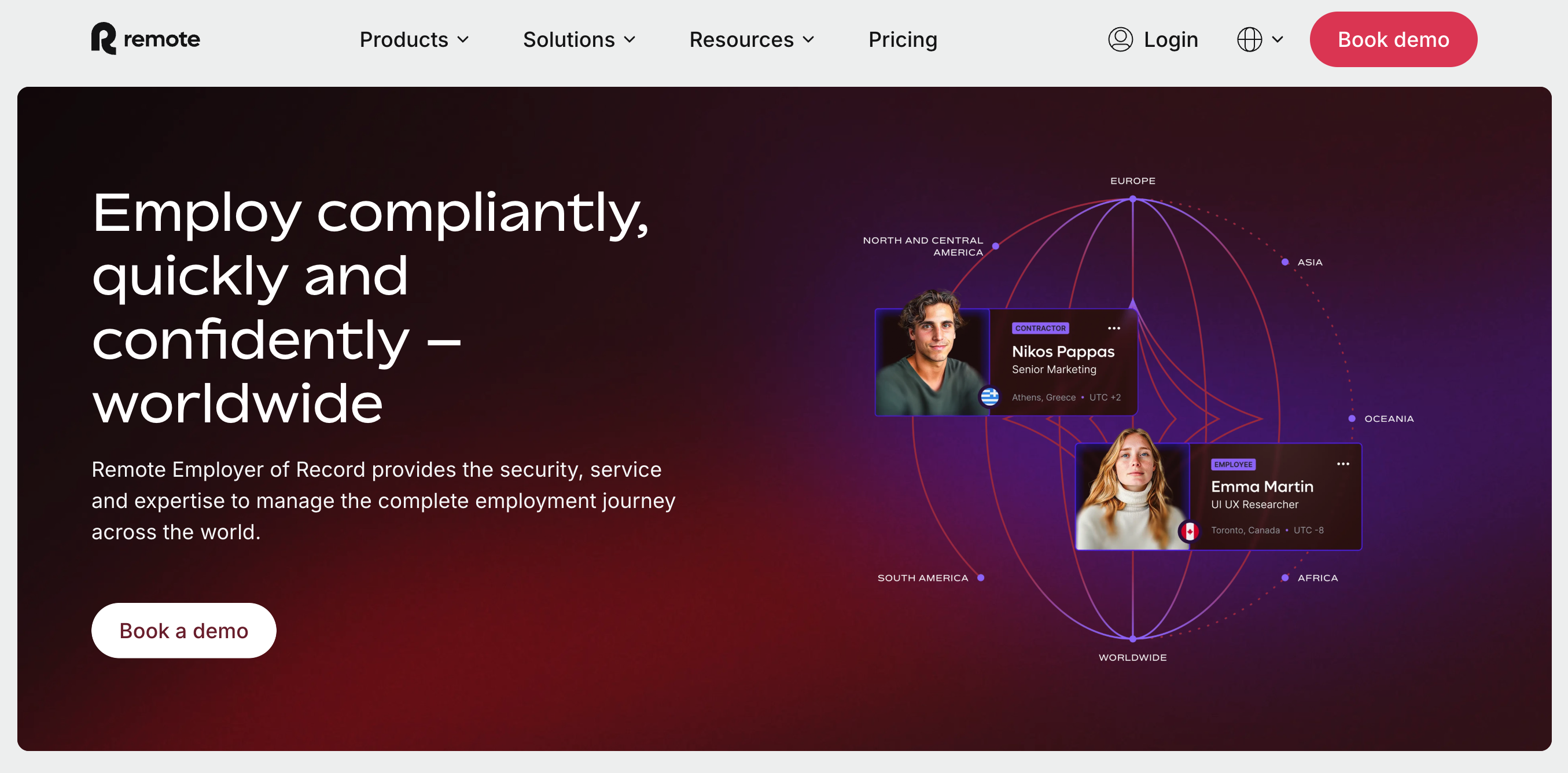
Remote is a global employment platform that operates through wholly owned legal entities in the countries where it employs workers, including Switzerland. This owned-entity model means Remote acts as the direct legal employer rather than routing employment through third-party in-country partners.
The owned-entity structure gives Remote direct control over payroll processing, statutory filings, and employment contract management in Switzerland. For companies concerned about data residency, Remote's infrastructure supports data localisation requirements, which is relevant under the revised Swiss Federal Act on Data Protection (nDSG/Swiss FADP). IP protection provisions are available within Swiss employment contracts issued through Remote, making it a considered option for companies in technology, pharma, and life sciences. G2 rating 4.5/5 (retrieved September 4, 2026)
Remote's model is positioned toward companies that place a high priority on knowing their employees are employed directly by a licensed local entity rather than through a partner network. This distinction matters in Switzerland, where labour-leasing regulations under SECO set clear requirements for who may legally act as employer.
Strengths:
-
Owned-entity model in Switzerland means Remote is the direct legal employer, removing reliance on third-party partner networks and the associated compliance handoff risk.
-
IP protection and data residency capabilities are built into the Swiss employment structure, relevant for companies in regulated or IP-sensitive industries.
-
Direct control over payroll, filings, and contracts through a single owned entity supports consistent compliance across Swiss cantonal requirements.
Limitations:
-
Remote's onboarding timeline of two to three weeks is longer than some competitors, which may not suit companies with urgent hiring needs in Switzerland.
-
Public sources reviewed did not document a provider-specific limitation on Swiss cantonal coverage or service scope beyond the onboarding timeline noted above.
Best for:
Companies prioritising IP protection, direct legal entity ownership, and data residency compliance when employing workers in Switzerland.
Multiplier
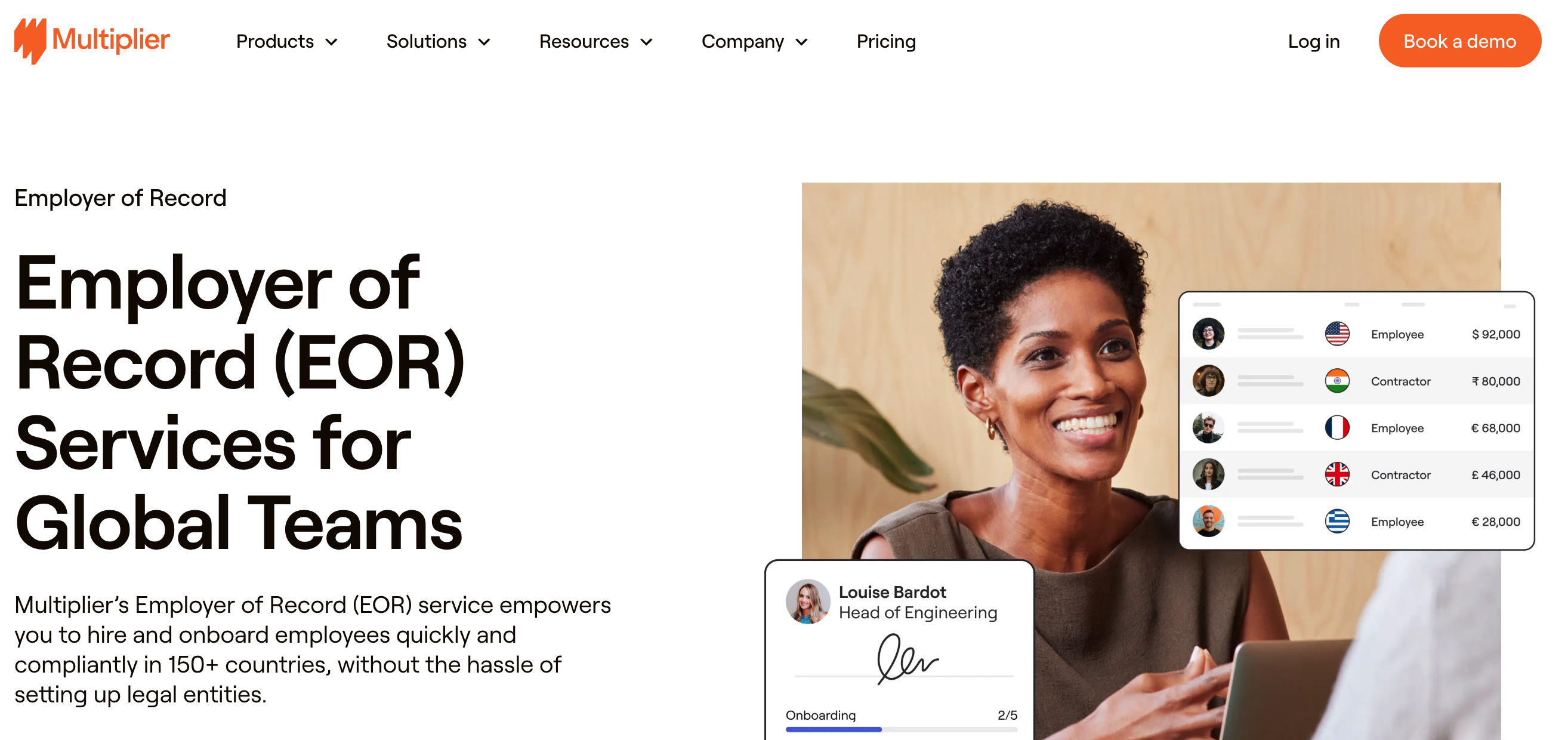
Multiplier is a global employment platform that enables companies to hire employees without establishing local entities. Its EOR service covers compliant employment contracts, payroll processing, tax and statutory filings, benefits administration, onboarding, and ongoing HR support across 150+ countries.
For companies hiring in Switzerland, Multiplier can manage local employment, payroll, statutory requirements, and benefits through its EOR service. Its current pricing starts at $499 per employee per month for monthly contracts or $459 per employee per month when billed annually. Multiplier does not publish a fixed Switzerland-specific onboarding SLA, so the timeline should be treated as country-dependent.
Strengths:
-
EOR employment without requiring the client to establish a Swiss legal entity.
-
Unified platform covering payroll, benefits, leave, expenses, and workforce data.
-
24/7 support with dedicated managers and local HR and legal expertise.
-
Transparent pricing starting at $459 per employee per month on annual contracts.
Limitations:
-
Switzerland-specific onboarding timelines are not publicly disclosed.
-
Switzerland-specific pricing may vary depending on local requirements.
Best for:
SMB-to-enterprise companies that need Switzerland included
within a broader multi-country EOR programme and want centralized employment,
payroll, and workforce management.
Pebl
Pebl is a global employer of record provider that enables companies to hire employees without establishing local entities. Its Global Work Platform supports onboarding, employee management, payroll, benefits, and compliance across its supported countries. Pebl supports international workforce expansion across 185+ countries, including Switzerland.
For Switzerland, Pebl’s EOR service manages local employment requirements, payroll, benefits, and compliance without requiring the client to establish a Swiss entity. Pebl’s global platform provides centralized workforce management for onboarding, employee administration, and payroll. Pebl generally provides custom EOR pricing rather than publishing a Switzerland-specific list price.
Strengths:
-
Enables Swiss hiring without requiring the client to establish a local entity.
-
Global platform combines onboarding, payroll, employee management, benefits, and compliance.
-
Broad international coverage supports multi-country workforce programmes.
-
Suitable for growing businesses and larger global workforce operations.
Limitations:
-
A fixed Switzerland-specific onboarding timeline is not publicly disclosed.
-
Switzerland-specific EOR pricing is not publicly listed and requires a custom quote.
-
Switzerland-specific details on the underlying employment entity and local service structure are not extensively disclosed publicly.
Best for:
Companies that want Switzerland covered as part of a broader
international EOR programme and prefer a centralized global workforce
platform.
Papaya Global
Papaya Global is a cloud-based workforce management and payroll platform that supports employment in over 160 countries, including Switzerland. The platform is built around enterprise-grade payroll consolidation, giving large organizations a single system to manage multi-country payroll runs, statutory contributions, and workforce data.
Papaya Global's analytics and reporting capabilities are a core differentiator for enterprise buyers. The platform provides workforce spend visibility, headcount reporting, and payroll audit trails across jurisdictions. For companies managing large Swiss headcounts alongside global operations, this reporting layer supports finance and HR governance requirements. Papaya states it uses licensed in‑country partners when a labour‑leasing licence is required, rather than holding every local licence directly.
Strengths:
-
Enterprise-grade workforce analytics and payroll reporting across 160+ countries, supporting finance and HR governance for large organizations.
-
Multi-country payroll consolidation in a single platform, which reduces administrative overhead for enterprises running payroll across Switzerland and other jurisdictions simultaneously.
-
Established global coverage that supports companies scaling beyond Switzerland without switching providers.
Limitations:
-
Papaya Global's pricing is positioned at the higher end of the market, with published rates starting at $863–$1,110 (CHF 700 to 900) per month per employee in Switzerland, which may not suit smaller teams or budget-constrained buyers.
-
Public sources reviewed did not document a provider-specific limitation regarding Swiss canton-level compliance depth or local HR support staffing.
Best for:
Enterprise companies that need advanced workforce analytics, consolidated global payroll reporting, and multi-country employment management across 160+ countries, including Switzerland.
What Are the Key Services of an EOR in Switzerland ?
An EOR in Switzerland manages the full employment relationship on behalf of a client company, covering payroll, statutory contributions, contracts, and insurance across all 26 cantons. Each canton applies its own tax rules and administrative requirements, so service delivery must account for those variations rather than treating Switzerland as a single uniform jurisdiction.
A foundational service layer is compliance with the Swiss State Secretariat for Economic Affairs (SECO) labour-leasing licence requirements, which governs how EORs can legally employ and second workers in Switzerland. EORs operating without this licence cannot legally place staff with client companies under Swiss law.
Core services typically include:
-
Payroll processing in CHF with canton-specific income tax withholding calculations
-
Social security contributions under the federal old-age and survivors insurance scheme, with the employer share at approximately 5.3%
-
Mandatory occupational pension administration under the federal occupational benefits act, coordinated with approved pension funds
-
Accident insurance, invalidity insurance, and unemployment insurance compliance
-
Employment contracts drafted in the applicable official language (German, French, or Italian) and compliant with the Swiss Code of Obligations
-
Collective labour agreement (CLA) compliance where a sector-specific agreement applies to the employee's role or industry
CLA obligations vary by sector and canton. An EOR must identify whether a binding collective agreement applies to each hire and apply the correct minimum wages, working hours, and notice periods accordingly. This is a service dimension that affects payroll calculations and contract terms directly.
Employment Contracts and Local Compliance
EOR providers operating in Switzerland must hold a SECO labour-leasing licence. This licence is a legal prerequisite for any EOR contract and confirms that the provider is authorised to act as the legal employer under Swiss law.
Employment contracts must also account for collective bargaining agreements (CBAs) that apply by sector. Construction, hospitality, and retail each carry their own minimum wage and benefit floors that sit above cantonal minimums. An EOR that does not apply the correct CBA exposes the client company to back-pay liability and regulatory penalties.
Switzerland's 26 cantons introduce additional contract variations. Notice periods, probation terms, and tax withholding obligations differ by canton. Contracts drafted for a Zurich hire will not automatically satisfy the requirements for a Geneva or Ticino hire. EOR providers must produce canton-specific employment agreements in the applicable official language: German, French, or Italian.
Payroll and Tax Administration
Switzerland treats the 13th-month salary as a market standard, not a statutory requirement, but most employers pay it. It adds approximately 8.3% to annual cash payroll cost. EOR providers differ on whether they default to 12 or 13 pay periods, so clients should confirm this before onboarding to avoid budget surprises.
Cantonal family-allowance levies vary significantly. Geneva charges employers approximately 2.5% of gross salary, while Zurich charges approximately 1.3%. These differences compound across a distributed Swiss workforce and must be calculated per canton, not at a national flat rate.
Occupational pension contributions under the BVG scheme are age-banded. Employees aged 55 and above attract materially higher employer contributions than younger employees, which affects total employment cost projections for senior hires.
Cross-border commuters from France, Germany, and Italy are subject to Grenzganger tax treaty rules. Each bilateral treaty applies different withholding and reporting obligations. EOR providers must identify commuter status at onboarding and apply the correct treaty framework from the first payroll run.
Benefits Administration
Swiss EOR providers manage three mandatory benefit pillars for every employee. The occupational pension scheme (BVG) requires contributions split between employer and employee, with rates increasing across four age bands: 25 to 34, 35 to 44, 45 to 54, and 55 to 65.
Unemployment insurance (ALV) contributions are mandatory for all employees and are shared equally between employer and employee. Maternity leave runs for 14 weeks at 80% of salary, funded through the income compensation scheme (EO). Paternity leave is two weeks, also coordinated through EO.
Public holidays vary by canton, ranging from 8 to 15 days per year. EOR providers account for these cantonal differences when calculating leave entitlements and payroll obligations across all 26 cantons.
Employee Onboarding
A Swiss EOR onboarding follows a structured sequence. The hiring company defines the role and salary, then selects an EOR provider. The EOR drafts an employment contract in the appropriate official language, German, French, or Italian, compliant with the Swiss Code of Obligations.
Once the contract is signed, the EOR registers the employee for social insurance covering old-age, survivors, and disability coverage. The EOR then selects and enrolls the employee in a BVG pension fund, activates mandatory accident insurance (UVG), and runs the first payroll with canton-specific withholding tax applied.
Ongoing compliance monitoring follows each payroll cycle. The full process typically takes one to three weeks, depending on the provider and canton. For non-EU and non-EFTA nationals, a work permit is required before employment begins. EOR providers can support the permit application process.
Ongoing HR Support
Switzerland's 26 cantons update their tax and employment rules independently. An EOR monitors these cantonal changes continuously and applies updates to payroll calculations, filings, and contracts without requiring action from the client company.
Collective labor agreements (known as CCT or GAV agreements) are renegotiated periodically across industries. An EOR tracks renegotiation cycles and adjusts employment terms to reflect current agreement requirements before deadlines pass.
Swiss courts apply economic dependency and integration tests when assessing worker classification. Because an EOR employs workers directly, misclassification risk is eliminated at the structural level rather than managed case by case.
Ongoing compliance also covers data protection obligations under the revised Swiss Federal Act on Data Protection, which took effect in September 2023. An EOR monitors regulatory guidance and keeps employment data practices aligned with current requirements.
Employee Offboarding
Swiss termination procedures follow the Code of Obligations. Notice periods are one month during the first year of service, two months from years two through nine, and three months from year ten onward. During probation, either party may terminate with seven days' notice.
Article 336 of the Code of Obligations prohibits abusive dismissal. Where a court finds a termination abusive, the employer may owe compensation of up to six months' salary. An EOR carries this liability on behalf of the client company and manages the termination process to reduce exposure.
Final payroll settlement includes payout of all accrued but unused vacation and a pro-rata calculation of the 13th-month salary. The EOR executes these calculations, processes the final payroll run, and closes the employment record in compliance with Swiss statutory requirements.
How to Hire Through an EOR in Switzerland
Hiring through an EOR in Switzerland requires a few foundational checks before onboarding begins. First, confirm that your chosen EOR holds a SECO labour-leasing licence, which is the federal authorisation required to legally employ workers on behalf of client companies in Switzerland.
The process differs depending on the worker's nationality. EU and EFTA nationals benefit from freedom of movement and can be employed with minimal permit requirements. Non-EU and non-EFTA nationals require a work permit, which adds time and documentation to the process.
The two subsections below cover Selection and Setup, including how an EOR compares to incorporating a Swiss entity, and Onboarding and Compliance, covering what happens once a hire is confirmed.
Selection and Setup
Choosing between an EOR and incorporating a Swiss entity depends on headcount, timeline, and cost tolerance. The table below compares the two approaches across the factors that matter most to hiring teams.
| Factor | EOR | Swiss GmbH or AG entity |
|---|---|---|
| Setup time | Days | 2 to 6 weeks |
| Initial cost | Monthly fee per employee | $24,667 (CHF 20,000) minimum share capital for GmbH, $123,333 (CHF 100,000) for AG, plus notary and legal fees |
| Ongoing cost | Predictable monthly fee | Accounting, legal, and administrative overhead |
| Complexity | Low: EOR manages compliance | High: internal or external legal and HR resources required |
| Compliance management | Handled by EOR | Managed in-house or via local advisers |
| Scalability | Add or reduce headcount without structural changes | Entity structure is fixed regardless of headcount |
| Risk | EOR carries employer liability | Company carries full employer liability |
| Best for | Testing the Swiss market or managing a small distributed team | Long-term, larger-scale Swiss operations |
When selecting an EOR provider, verify that they hold a valid SECO labour-leasing licence. This licence is the legal prerequisite for operating as an employer of record in Switzerland, and its absence creates compliance exposure for your company.
For most companies, the crossover point where a Swiss entity becomes cost-competitive with an EOR sits at roughly 5 to 10 employees. Below that threshold, the share capital requirement, notary fees, and ongoing administrative costs of a GmbH or AG typically exceed EOR fees. Above it, entity incorporation may offer better long-term economics depending on salary levels and canton.
Onboarding and Compliance
Hiring in Switzerland follows a defined sequence. The EOR drafts employment contracts in the appropriate official language, German, French, or Italian, in line with the Swiss Code of Obligations.
After contracts are signed, the EOR registers the employee with the AHV/IV/EO social insurance system, enrolls them in a BVG occupational pension fund, activates UVG accident insurance, and configures canton-specific withholding tax.
Work permit requirements depend on nationality. EU and EFTA nationals typically receive a short-term L permit or a B residence permit, with onboarding completed in one to two weeks. Non-EU and non-EFTA nationals require a quota-based B permit coordinated through SECO and the relevant cantonal migration office, which can extend the timeline pending permit approval.
What Are the Benefits of Using an EOR in Switzerland ?
An EOR gives companies accurate visibility into the true cost of hiring in Switzerland before a contract is signed. BVG contributions are age-banded, meaning employer pension costs rise with employee age. Cantonal family-allowance levies vary by region, and the 13th-month salary is a standard expectation in many Swiss employment arrangements. An EOR that understands these factors provides a complete cost-of-hire figure upfront, not after payroll runs.
An EOR also removes contractor misclassification risk. Swiss law applies economic dependency tests to determine whether a worker is genuinely self-employed. Misclassifying an employee as a contractor can trigger back-payment of social contributions and penalties. Employing workers through an EOR places them on a compliant employment contract from day one, eliminating that exposure entirely.
Faster Market Entry
An EOR lets you hire in Switzerland within days to weeks. Incorporating a Swiss GmbH takes 2 to 6 weeks, and that timeline excludes the additional setup required before your first hire can start.
Entity formation also requires a $24,667 (CHF 20,000) share capital commitment upfront. An EOR removes that obligation entirely, so capital stays available for operations rather than regulatory prerequisites.
Key Swiss hiring hubs, including Zurich, Geneva, Basel, and Bern, are accessible immediately through an EOR. You can place employees across all 26 cantons without waiting for local registrations or entity approvals.
Reduced Compliance Risk
Switzerland's 26 cantons each apply distinct tax rules. An EOR manages those variations alongside mandatory AVS, BVG, and UVG contribution calculations, and monitors collective agreement (CCT/GAV) obligations that apply by sector and region.
Contractor misclassification carries real financial exposure. Swiss courts apply economic dependency and integration tests to determine employment status. A misclassification finding triggers back-payment of AHV and BVG contributions plus associated penalties.
An EOR also manages compliance with the revised Swiss Federal Act on Data Protection (nDSG), which governs how employee data is collected, stored, and processed. Handling these obligations through a single employment partner reduces the risk of gaps across any one of these regulatory layers.
Simplified Payroll Administration
Swiss payroll is one of the most complex in Europe. Employers must calculate contributions across four separate social insurance schemes: AVS (old-age and survivors insurance), BVG (occupational pension), UVG (accident insurance), and ALV (unemployment insurance).
Each of Switzerland's 26 cantons applies its own withholding tax rates and family-allowance levies. BVG contributions are age-banded, meaning the employer's share increases as workers get older. Thirteen-month salary payments add a further calculation layer that must be reflected accurately in each payroll run.
For a gross annual salary of $59,511 (CHF 48,252), employer social contributions add approximately 15.5%, or around $771 (CHF 625) per month. An EOR consolidates every one of these obligations into a single monthly invoice, giving finance teams a predictable cost figure without managing the underlying calculations directly.
Access to Local Benefits
Swiss law mandates a specific set of employee benefits that every employer must provide. These include BVG occupational pension contributions (calculated on age-banded brackets), UVG accident insurance covering both occupational and non-occupational incidents, EO maternity and paternity insurance, and ALV unemployment insurance.
Statutory leave entitlements set a minimum of four weeks of annual leave per year, rising to five weeks for employees under age 20. Maternity leave runs for 14 weeks at 80% of salary. Paternity leave is two weeks.
Public holidays vary by canton, ranging from 8 to 15 days per year. An EOR tracks each employee's canton of residence and applies the correct holiday calendar automatically. Competitive Swiss employers also offer supplementary benefits such as additional pension contributions and health insurance top-ups. An EOR can administer these alongside statutory obligations within the same employment structure.
Lower Entity Setup Costs
Setting up a Swiss entity carries significant upfront costs. A GmbH requires a minimum share capital of $24,667 (CHF 20,000), while an AG requires $123,333 (CHF 100,000). Both structures add notary fees, legal fees, and commercial register fees on top of that.
Ongoing obligations compound the cost further. Swiss GmbH entities must appoint at least one Swiss-resident managing director, which means an additional external hire if no local candidate is available. Annual audit and accounting requirements add recurring expense.
An EOR services model replaces those costs with a predictable monthly fee, typically $493–$1,110 (CHF 400 to 900) per employee depending on the provider, with no entity formation or maintenance overhead. For companies testing the Swiss market or managing a small headcount, that cost structure is materially lower.
More Flexible Workforce Scaling
An EOR lets companies hire across all 26 Swiss cantons without separate cantonal entity registrations. Each canton applies its own tax rules and employment requirements, but the EOR handles those variations centrally.
Scaling down is equally straightforward. Reducing headcount through a Swiss entity involves redundancy procedures that add time and administrative complexity. An EOR arrangement allows rapid scale-down without that procedural burden.
Companies hiring Grenzgaenger workers, cross-border commuters from France, Germany, and Italy, can also use an EOR to manage those employment relationships without additional entity structures in border regions.
One threshold to consider: EOR pricing is typically cost-competitive up to five to ten employees. Beyond that point, establishing a Swiss entity may reduce the per-employee cost over time. The right structure depends on headcount trajectory and long-term market commitment.

How to Find the Right EOR for Switzerland ?
Start by confirming that any provider holds a valid SECO labour-leasing licence. This licence is the legal foundation for employing workers in Switzerland, and no amount of global coverage compensates for its absence.
Switzerland's 26-canton structure adds a second layer of complexity. Each canton applies its own tax rules, and many sectors operate under collective agreements (CCT/GAV) that set minimum wages, working hours, and benefits. Generic global EOR providers often lack the canton-specific depth to manage these requirements accurately. The criteria below help you assess whether a provider can handle Switzerland's compliance demands in practice, not just in principle.
Local Compliance Expertise
Verify that a provider holds a current SECO labour-leasing licence before evaluating anything else. Without it, the provider cannot legally employ workers in Switzerland.
Beyond the licence, confirm coverage across five compliance layers: the 26-canton tax system, AVS/BVG/UVG/ALV contribution accuracy, CCT/GAV collective agreement tracking by sector, and compliance with the revised Federal Act on Data Protection (nDSG).
Ask providers two direct questions: which cantons do you have direct compliance experience in, and do you track CCT/GAV agreements in my sector? Generic global EOR platforms may cover Switzerland on paper but lack the canton-level depth to manage payroll, contributions, and collective agreements without errors.
Clear Service Scope
A Switzerland EOR must cover more than basic payroll. Before signing, confirm whether the provider handles the 13th-month salary by default or only on request, and whether occupational pension (BVG) age-banding adjustments are applied automatically as employees move into higher contribution brackets.
Cross-border commuter arrangements add another layer. Grenzganger workers are subject to specific tax treaty rules between Switzerland and neighboring countries. Confirm whether the provider manages this directly or passes the complexity to you.
Work permit support for non-EU/EFTA nationals is a separate question. Not all EOR providers include permit applications in their standard scope. Ask upfront. Hidden costs to watch for include BVG age-banding adjustments for senior hires, cantonal family-allowance levies, and 13th-month salary obligations, all of which can affect total employment cost materially.
Support Model
Switzerland operates across three official language regions: German, French, and Italian. A support team that handles only English will struggle with canton-specific queries, particularly where local authorities or employees communicate in a regional language.
Time zone fit matters too. Switzerland runs on CET/CEST. If a provider's support team operates only in US hours, you will wait until the following business day for answers to urgent payroll or compliance questions. Verify whether in-hours Swiss support is available or whether the model is fully asynchronous.
Canton-specific expertise is the harder test. Tax treatment in Geneva differs from Zurich, and those differences affect withholding calculations and employee net pay. Ask whether the provider employs in-country Swiss HR or legal specialists, or whether compliance queries are handled by a remote team without direct Swiss market experience.
Technology and Reporting
A capable EOR platform for Switzerland must do more than process payroll. It needs to show canton-level tax calculations, track occupational pension contributions by age bracket, and display AVS, UVG, and ALV contribution splits in real time.
Ask providers whether their dashboard surfaces 13th-month salary accruals and generates payroll reports formatted for cantonal tax authorities. These are standard Swiss requirements, not optional features.
Switzerland's Federal Act on Data Protection (nDSG) sets strict rules on personal data handling. Ask each provider whether Swiss data residency is available and how employee data is stored and processed within the platform.
Scalability for Your Hiring Plans
Switzerland's 26 cantons each carry distinct tax and employment rules. A scalable EOR must support hiring across all cantons without requiring separate setup for each one.
Border-region hiring adds another layer. Grenzganger workers, employees who live in a neighboring country and commute into Switzerland, require specific cross-border tax treatment. Confirm that your provider handles this correctly before committing.
EOR becomes less cost-effective as headcount grows. Most companies reach that threshold between five and ten employees. At that point, incorporating a Swiss GmbH or AG often makes more financial sense. Ask providers whether they offer an entity transition pathway as an add-on service, so you are not forced to switch platforms when you are ready to incorporate.

Why Gloroots Is a Strong EOR Partner in Switzerland ?
Switzerland's 26-canton structure creates real compliance overhead. Each canton applies its own tax rules, and employment contracts must meet the Swiss Code of Obligations in the correct official language. Gloroots manages this complexity as part of its standard employment operating layer, not as an add-on.
Gloroots supports compliant full-time employment across 150+ countries. For companies hiring in Switzerland alongside other markets, this means one platform governs payroll, filings, and statutory benefits across every location without switching providers.
Pricing is predictable and country-specific. Gloroots does not use percentage-of-salary models, which can obscure total employment cost as salaries rise. Every cost is visible before onboarding begins. See Gloroots pricing for Switzerland-specific figures.
Account support is human-led, with retained business context across engagements. When a canton-specific question arises, the account team already knows your workforce structure and employment history. This matters in Switzerland, where cantonal tax queries often require context that a generic support queue cannot provide.
Gloroots combines Global Employer of Record, Global Payroll, Compliance and Employment Governance, and Benefits and Statutory Coverage into a single service. Learn more about Gloroots EOR services or contact the team for a Switzerland-specific cost estimate and a product demo.
FAQs About the Best EOR in Switzerland
The questions below address what companies most commonly ask when evaluating an employer of record for Swiss hiring. Answers reflect the Swiss Code of Obligations and current Swiss employment law.
What does an EOR in Switzerland actually do?
The EOR becomes the legal employer on record. It processes payroll in CHF, manages AVS social security contributions, administers BVG occupational pension schemes, handles accident and unemployment insurance, and ensures contracts comply with the Swiss Code of Obligations across all 26 cantons.
Do I need a Swiss legal entity to hire in Switzerland?
No. An EOR lets you employ workers in Switzerland without registering a GmbH or AG. The EOR holds the legal employment relationship while you direct the employee's work.
How does canton complexity affect payroll?
Each of Switzerland's 26 cantons applies its own income tax rates and withholding rules. A qualified EOR calculates and remits the correct cantonal deductions for each employee based on their registered canton of residence.
What is the employer's share of AVS contributions?
The employer contributes approximately 5.3% of gross salary toward AVS, with total AVS contributions running at roughly 10.6% split equally between employer and employee.
How does an EOR work in Switzerland ?
An Employer of Record in Switzerland acts as the legal employer for your workers. The EOR handles payroll, AVS, BVG, and UVG contributions, canton-specific tax withholding, and compliance with the Swiss Code of Obligations.
The EOR must hold a SECO cantonal labour-leasing licence to operate legally. Your company directs the employee's day-to-day work, while the EOR manages all statutory obligations. The EOR invoices your company a monthly fee covering gross salary, statutory contributions, and platform costs.
Onboarding typically takes one to three weeks for EU and EFTA nationals. Non-EU and non-EFTA nationals require additional time pending work permit approval. For more detail on how this model operates, see how does EOR work.
What does an EOR cost in Switzerland ?
EOR platform fees in Switzerland typically range from $493 (CHF 400) to $1,110 (CHF 900) per employee per month, depending on the provider. That fee covers the platform and service layer only.
Total employer cost of hire is higher. On top of gross salary, employers pay: employer AVS at approximately 5.3%, BVG occupational pension contributions that are age-banded at roughly 7 to 18%, UVG accident insurance at approximately 0.5 to 2%, unemployment insurance (ALV) at approximately 1.1%, and cantonal family-allowance levies at approximately 1.3 to 2.5%.
For a $59,511 (CHF 48,252) gross annual salary, total employer cost including statutory contributions and the platform fee ranges from approximately $7,893 (CHF 6,400) to $8,510 (CHF 6,900) per month, depending on provider and employee age. Switzerland also requires a 13th-month salary payment, which adds approximately 8.3% to annual cash cost. For a full breakdown of how these costs compare across providers, see employer of record cost.
When should a company use an EOR in Switzerland ?
A company should use an EOR in Switzerland when it wants to hire Swiss talent without incorporating a local GmbH or AG entity. This approach also fits companies testing the Swiss market before committing to a full entity setup.
An EOR is cost-effective when headcount stays below 5 to 10 employees in Switzerland, since entity setup costs outweigh EOR fees at that scale. It also enables hiring in weeks rather than the months typically required for entity registration. Companies with contractors at risk of misclassification under Swiss economic dependency tests can use an EOR to govern employment compliantly from the start.
Can an EOR hire both local and foreign employees in Switzerland ?
Yes. An EOR in Switzerland can employ both Swiss nationals and foreign nationals. EU and EFTA nationals work in Switzerland under freedom of movement rules, using an L or B permit with relatively straightforward cantonal registration.
Non-EU and non-EFTA nationals require a quota-based B or C work permit. Applications go through the cantonal migration office and the State Secretariat for Economic Affairs (SECO). An EOR can support the permit application process, though approval timelines vary by canton and nationality. Permit quotas for non-EU and non-EFTA nationals are limited and competitive, so companies should plan accordingly.
How do I choose the right EOR in Switzerland ?
To choose the right EOR in Switzerland, verify that the provider holds a SECO cantonal labour-leasing licence and confirm they have deep 26-canton compliance expertise, not just generic global coverage.
Check whether they handle Switzerland-specific complexities: occupational pension age-banding, 13th-month salary, collective agreement obligations, and cross-border worker tax treaties. Review independent ratings with retrieval dates, confirm their support model includes multilingual coverage in German, French, and Italian during Swiss business hours, and request a full cost-stack breakdown before signing, not just the platform fee.