




- Romania's IT sector income tax exemption reduces personal income tax to zero for qualifying software developers and IT professionals, making it a concrete cost advantage for tech companies hiring through an EOR that can administer the exemption correctly.
- Every EOR operating in Romania must complete national employment registry registration before a new hire's first working day; failure to do so creates direct financial penalties, so confirming this capability with any provider is a mandatory evaluation step.
- The entity model each provider uses for Romania, whether a directly owned legal entity or a third-party aggregator arrangement, affects compliance accountability, onboarding speed, and the number of contractual handoff layers between the employer and the worker.
- Offboarding and termination support is not always included in a standard EOR monthly fee; Romanian law sets strict notice period and documented disciplinary procedure requirements, so buyers should confirm whether termination services are bundled or billed separately before signing.
- Among the eight providers reviewed, published EOR pricing for Romania ranges from $199 to $899 per employee per month, but all-in costs can run significantly higher once employer social contributions, benefits, and any partner-model surcharges are added.
Romania has become one of Central and Eastern Europe's most active hiring destinations. EU membership gives employers a stable legal framework, and the country's 200,000-plus IT professionals make it a practical base for technology teams at competitive salary costs compared with Western Europe.
One incentive stands out for tech hiring: Romanian law exempts IT sector employees from personal income tax, reducing the total cost of employment for qualifying roles. Any employer of record operating in Romania must also handle REGES-Online registration, the national electronic labor registry that records every employment contract before a hire starts work.
This page covers eight EOR providers active in Romania. For each one, it notes whether the provider operates through a direct owned entity or relies on a third-party aggregator model, because that distinction affects compliance accountability and onboarding speed.
Our Top 8 Picks: Romania for EOR Comparison 2026
The eight providers below cover the range of entity models, price points, and use cases relevant to hiring in Romania. Pricing reflects published EOR fees per employee per month. For a broader view of the market, see our best employer of record roundup.
| Provider | Pricing per month | Country coverage | Onboarding speed | Platform experience | Customer support | Scalability |
|---|---|---|---|---|---|---|
| Gloroots | From $199 per employee/month | 150+ countries | 3–5 working days | Unified platform for hiring, onboarding, payroll, compliance, benefits and workforce management | 24/7 human support with dedicated specialists | SMB to Enterprise |
| Atlas HXM | Custom pricing | 160+ countries | Not publicly disclosed | Unified HXM platform with automated workflows, payroll, compliance and employee self-service | Responsive customer support with local/regional expertise | Mid-market to Enterprise |
| RemoFirst | From $199 per employee/month | 185+ countries | As fast as 48 hours in many cases; country-dependent | Self-service global employment platform covering onboarding, payroll, expenses and compliance | Dedicated account manager and 24/7 customer support | Startup to Enterprise |
| Multiplier | From $499 per employee/month; $459 with annual billing | 150+ countries | As fast as 24 hours; country-dependent | Global employment platform covering payroll, compliance, benefits and workforce workflows | 24/7 support | SMB to Enterprise |
| Deel | $599 per employee/month | 130+ EOR countries | As fast as 2 days; country-dependent | Comprehensive global employment platform covering EOR, payroll, compliance, onboarding and HR workflows | 24/7 support with HR, legal and tax expertise | SMB to Enterprise |
| Globalization Partners (G-P) | $599 per employee/month | 180+ countries | Country-dependent; can be completed in days | Enterprise global employment platform with G-P Gia AI-powered compliance intelligence, payroll, tax, benefits and reporting | Dedicated customer success and in-country HR/legal experts | Enterprise |
| Payoneer Workforce Management (formerly Skuad) | From $199 per employee/month | 160+ countries | Typically 5–7 business days across 110+ EOR countries | Unified platform for onboarding, payroll, compliance, benefits, workforce management and third-party integrations | Dedicated account managers, local HR specialists and legal support | SMB to Enterprise |
| Oyster HR | $699 per employee/month | 120+ EOR countries; 180+ countries overall | As fast as 48 hours | Global employment platform with automated onboarding, payroll, benefits and compliance | Local experts and dedicated support resources | SMB to Enterprise |

Top 8 Best EOR Platforms in Romania
Each provider below is evaluated on four criteria: entity model (direct versus aggregator), Romania-specific compliance capability, pricing transparency, and support quality.
Entity model matters because an aggregator places a third-party intermediary between the EOR and the Romanian employee, which adds a compliance handoff layer and can increase both cost and risk. A direct entity model removes that intermediary.
Every profile below includes a Best For label so you can match each provider to your hiring situation quickly.
Gloroots
Gloroots supports compliant full-time employment across 150+ countries, including Romania, through its Global Employer of Record service. The platform combines Global EOR, Global Payroll, Compliance and Employment Governance, and Benefits and Statutory Coverage into a single employment operating layer. Gloroots acts as the legal employer in Romania through a local entity and provides country-specific pricing charged per active employee, handling statutory filings and compliance responsibilities.
Gloroots uses predictable, country-specific pricing with full cost visibility before onboarding. There is no percentage-of-salary pricing. Clients see the complete cost of employing a Romanian worker before the first contract is signed.
Workforce visibility is centralized across all active headcount. Account support is human-led, with retained business context carried across interactions so clients do not repeat background information on each contact.
Strengths:
-
Predictable, country-specific pricing with full cost visibility before onboarding and no percentage-of-salary fees, supporting accurate budget planning for Romanian hires.
-
Centralized workforce visibility across all active headcount, paired with human-led account support that retains business context across every interaction.
-
Single platform covering Global EOR, Global Payroll, Compliance and Employment Governance, and Benefits and Statutory Coverage across 150+ countries including Romania.
Limitations:
-
Gloroots' Romania-specific entity ownership model and local office structure are not publicly disclosed and should be confirmed directly with Gloroots.
Best for:
Companies scaling international headcount that require predictable country-specific pricing, centralized workforce visibility, and human-led compliance governance across Romania and multiple other markets.


Atlas HXM

Atlas HXM operates through 100% directly owned legal entities across 160+ countries, including Romania. This structure means companies work with one contract and one point of contact, with no third-party aggregators involved in the employment relationship.
Atlas HXM offers a unified HXM platform covering payroll, onboarding, benefits, compliance, and HR analytics. Pricing starts at $599 per employee per month as a platform fee, with mandatory local contributions and taxes added separately. The platform has received industry recognition from NelsonHall, Everest Group, and the Global Payroll Association.
For companies hiring in Romania, Atlas HXM provides 24-hour local support and Romania-specific employment expertise, making it a practical option for mid-sized to large enterprises and high-growth startups that need a scalable, enterprise-grade employment solution.
Strengths:
-
100% direct entity model with wholly owned legal entities in 160+ countries eliminates third-party risk and provides a single contract and contact for all employment relationships, including Romania.
-
24-hour local support with Romania-specific expertise, backed by industry recognition from NelsonHall, Everest Group, and the Global Payroll Association.
-
Unified HXM platform covering payroll, onboarding, benefits, compliance, HR analytics, automated workflows, and a self-service dashboard across all supported countries.
Limitations:
-
Contractor management services are only available through external partners, not directly through the Atlas HXM platform.
-
The HCM platform has limited use of generative AI and guided chatbot functionality compared to some competitors.
Best for:
Best Overall EOR for enterprise and high-growth startups that need a 100% direct entity model, Romania-specific compliance expertise, and an integrated HXM platform at scale.
Remofirst
Remofirst covers 185+ countries and positions itself as a cost-accessible EOR option for startups and SMEs. EOR pricing starts at $199 per employee per month, with contractor management available at $25 per person per month and an optional free tier for limited services.
The platform assumes full legal employer responsibilities, including payroll processing, tax withholding, statutory benefits, and local compliance. Companies use a straightforward dashboard to invite hires, track documents, manage contracts, and monitor payroll. Remofirst has been ranked first overall for Romania EOR by Employsome, with a combined score of 4.36.
For European hiring, Remofirst is noted for striking a practical balance between broad country coverage and cost-effectiveness, whether a company is making its first international hire or its tenth.
Strengths:
-
Lowest published EOR rate among major providers at $199 per employee per month, with contractor management at $25 per month, making it accessible for budget-conscious startups and SMEs.
-
Ranked first overall for Romania EOR by Employsome with a combined score of 4.36, reflecting strong performance across global and Romania-specific criteria.
-
Simple, centralized dashboard for managing contracts, documents, and payroll tracking across 185+ countries, including Romania.
Limitations:
-
Public sources reviewed did not confirm whether Remofirst operates through directly owned entities or an aggregator model for Romania specifically; buyers should verify the entity structure before signing.
Best for:
Best for startups and SMEs on a budget that need broad country coverage, including Romania, at the lowest published EOR price point among major providers.
Multiplier
Multiplier is ranked second overall for Romania EOR by Employsome, with a combined score of 4.32 (Global Score 4.5, Romania EOR Score 4.2). Average pricing is approximately $605 per employee per month based on Employsome data.
Multiplier operates through an owned-entity model, which reduces third-party risk and supports consistent compliance across its coverage markets. The platform is noted for fast onboarding across Europe and strong automation capabilities within its hiring and payroll workflows.
Strengths:
-
Owned-entity model reduces third-party risk and supports consistent compliance, giving companies a single contractual relationship rather than a layered partner arrangement.
-
Ranked second overall for Romania EOR by Employsome with a combined score of 4.32, reflecting strong performance across both global and Romania-specific criteria.
-
Platform automation capabilities support fast onboarding across European markets, reducing manual steps in the employment setup process.
Limitations:
-
Public sources reviewed did not document a Romania-specific limitation for Multiplier beyond the absence of published contractor management pricing or dedicated Romania support details.
Best for:
Companies that want an owned-entity EOR model with strong platform automation and fast onboarding across Europe, particularly for mid-sized teams expanding into Romania.
Deel
Deel is a global HR and EOR platform covering 150+ countries. EOR Standard pricing starts at $599 per employee per month, with EOR Enterprise at $899 per employee per month. Contractor management starts from $49 per contractor per month.
Deel provides local employment contracts, payroll processing, tax withholding, statutory contributions, benefits administration, onboarding, HR support, and offboarding. It also offers immigration support and contractor management services across its coverage markets.
Deel holds a G2 score of 4.8 out of 5 based on 5,503 reviews. Onboarding speed for Romania is reported as fast, though exact timelines should be confirmed directly with Deel for specific hiring scenarios.
Strengths:
-
Covers 150+ countries with a broad service set including payroll, compliance, benefits, immigration support, and contractor management in a single platform.
-
G2 score of 4.8 out of 5 from 5,503 reviews reflects strong user satisfaction across a large customer base.
-
EOR Standard pricing at $599 per employee per month provides a clear published entry point for companies evaluating Romania hiring costs.
Limitations:
-
The real all-in cost runs 15 to 40 percent higher than published list prices once employer taxes, foreign exchange spread, and benefits markups are added. A salary deposit of typically one month gross salary per employee creates an upfront cash obligation before the first hire starts.
-
In partner-entity countries, a third-party aggregator sits between Deel and the worker, creating an additional compliance handoff layer and potentially higher monthly surcharges and longer onboarding timelines.
Best for:
Companies that need a single platform covering global HR, EOR, payroll, and contractor management across 150+ countries, and can absorb a higher per-employee cost in exchange for broad coverage and an established user base.
Globalization Partners
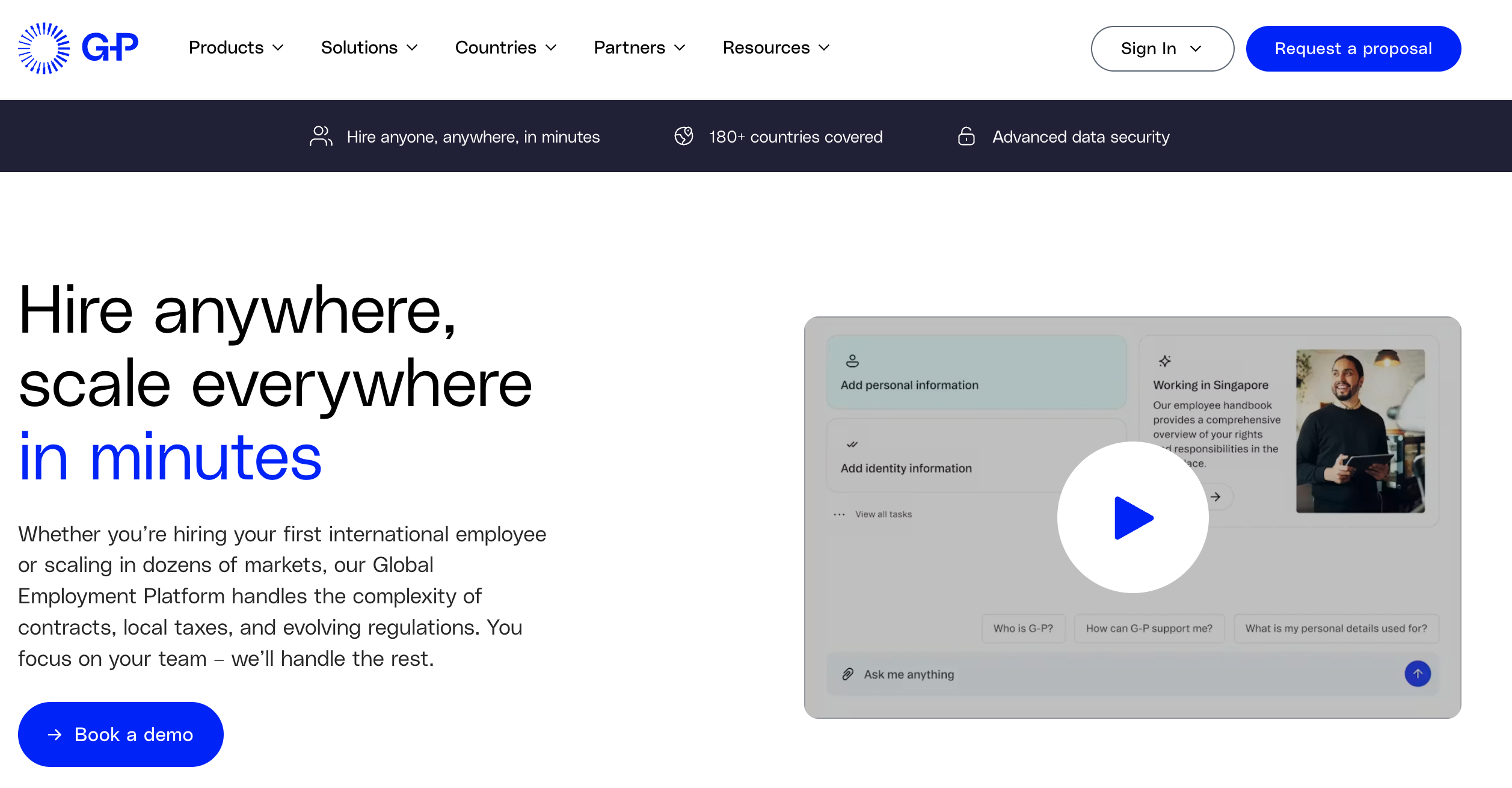
Globalization Partners (G-P) operates an EOR service across 180+ countries, including Romania, through a combination of owned entities and in-country partners. Its platform covers global hiring, team management, global mobility, and compliance assurance under a unified product suite that includes G-P EOR and G-P Contractor.
A standout feature is G-P Gia, an AI-powered compliance intelligence tool available to all users. G-P Gia provides agentic AI support for global HR compliance questions, which can reduce the manual research burden for HR and legal teams managing multi-country workforces. The platform is positioned for startups, mid-market companies, and large enterprises seeking scalable international expansion.
Starting price for G-P EOR is not publicly listed in researched sources. Romania-specific onboarding timelines and REGES-Online handling details are not documented in the sources reviewed for this page.
Strengths:
-
G-P Gia delivers AI-powered compliance intelligence at scale and is available to all platform users, not only enterprise tiers.
-
Coverage spans 180+ countries with products covering EOR, contractor management, global mobility, and compliance assurance in a single platform.
Limitations:
-
Starting price is not publicly listed in researched sources, which makes upfront cost comparison difficult for budget-conscious buyers.
Best for:
Globalization Partners is best for enterprises and high-growth companies that need scalable international expansion across 180+ countries and want AI-assisted compliance support built into their EOR platform.
Payoneer
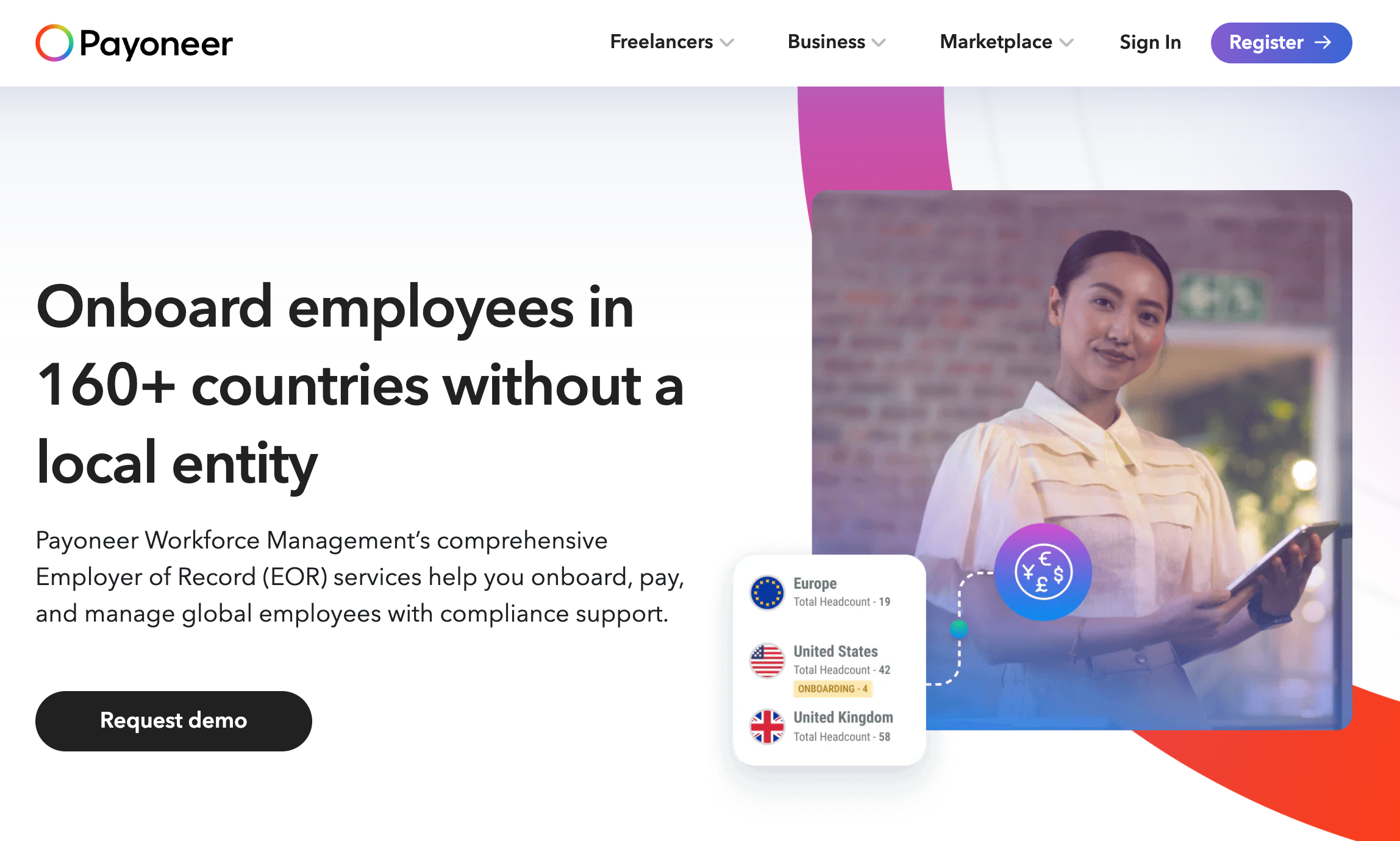
Payaneer offers EOR services in Romania starting at $249 per employee per month, discounted from a list price of $399 per month, with additional savings of up to 15% on annual billing. Services include instant onboarding, global payroll, compliance with Romanian employment laws, benefits management, work permits, timesheets, and contractor or agent-of-record management.
Payoneer states its Romania EOR handles the REGES (General Register of Employees) Online registration for employee onboarding and compliance. Skuad Remote Solutions S.R.L., its former Romanian subsidiary, was deregistered on February 13, 2025. Payoneer Workforce Management (Formerly Skuad) has a G2 rating of 4.6/5 from 202 reviews.
Strengths:
-
Payoneer publishes a Romania-specific EOR pricing page for 2026 with transparent per-employee monthly rates, giving buyers a clear cost baseline before contacting sales.
-
The platform covers instant onboarding, global payroll, benefits management, work permits, timesheets, and contractor management in a single product.
Limitations:
-
Public sources reviewed did not document a provider-specific limitation for Skuad beyond the absence of entity model confirmation for Romania.
Best for:
Payoneer is best for companies seeking flexible, tech-driven EOR onboarding in Romania with transparent published pricing and a broad service set covering payroll, benefits, and contractor management.
Oyster HR
Oyster HR is an EOR platform covering 180+ countries, with automated hiring, payroll, and benefits management. It pays teams in 140+ local currencies and stores employment contracts and documentation in a centralized system.
Oyster HR works with directly owned entities and reputable local partners to support compliance with local employment laws. It includes employment practices liability (EPL) coverage and country-specific legal guidance. served via Oyster-owned Romanian subsidiary OYSTER HR S.R.L.
handles REGES-Online registration for Romanian hires can onboard a Romanian employee within 48 hours of contract signature G2 rating 4.4/5 from 1,586 reviews Oyster employment agreements include IP protection clauses for Romania
Strengths:
-
Works with directly owned entities and reputable partners to support compliance with local employment laws; includes employment practices liability (EPL) coverage and country-specific legal guidance.
-
Offers a contractor versus full-time employee analysis tool, an employment cost calculator, and localized benefits plans to support hiring decisions.
-
Supports automated payroll and benefits management in 180+ countries, paying teams in 140+ local currencies with centralized contract and document storage.
Limitations:
-
Public sources reviewed did not document a provider-specific limitation for Oyster HR in Romania.
Best for:
Distributed and remote-first teams that need automated payroll across multiple currencies, localized benefits, and employment practices liability coverage across a broad country footprint.
What Are the Key Services of an EOR in Romania ?
An EOR in Romania takes on the legal employer role so that your company can direct the work without holding a local entity. Core services cover payroll processing in Romanian leu, income tax withholding at the flat 10% rate, and mandatory social security contributions, including the 25% pension contribution and 10% health insurance contribution filed with the National Agency for Fiscal Administration.
REGES-Online registration is a mandatory compliance function, not an optional add-on. Every EOR operating in Romania must register each new employee in the national employment register before the first working day. Confirm that any provider you evaluate handles this filing directly.
Service scope varies by provider entity model. EORs with a directly owned Romanian entity manage filings in-house. Aggregator models route compliance through a local partner, which can affect response times and accountability. Ask each provider which model applies to Romania specifically.
Offboarding and termination management is a separate consideration. Romanian Labour Code rules on notice periods and severance are strict, and not every EOR includes termination support in its standard package. Verify coverage before signing.
Employment Contracts and Local Compliance
Every employment contract in Romania must be registered in REGES-Online before the employee's first working day. Registration must be completed prior to the start date; failure to register on time exposes the employer to fines under Romanian labour law.
Beyond registration, sector-specific collective bargaining agreements (CBAs) apply in industries such as construction, IT, and retail. These CBAs can impose terms that exceed Labour Code minimums, including higher minimum wages, additional leave entitlements, or stricter notice requirements. An EOR operating in Romania must identify the applicable CBA for each hire and apply its terms correctly from day one.
Payroll and Tax Administration
Romania applies a flat 10% personal income tax rate on employment income. Software developers and qualifying IT professionals benefit from a 0% income tax exemption under Article 60 of the Romanian Fiscal Code. An EOR must correctly identify eligible roles and administer this exemption to avoid over-withholding.
Employer social contributions include 25% pension insurance (CAS) and 10% health insurance (CNAS), both calculated on gross salary. For an employee earning $2,204 (RON 10,000) gross per month, the employer's CAS contribution is $551 (RON 2,500) and CNAS is $220 (RON 1,000), bringing total employer cost to approximately $2,976 (RON 13,500) before the EOR fee. Employee net pay after 10% income tax and employee-side contributions varies by role and exemption status.
Romania sets a statutory minimum wage, which is updated periodically by government order. A higher minimum applies to employees with higher-education qualifications in roles requiring that credential. An EOR must update payroll automatically whenever the minimum wage changes to maintain compliance.
Benefits Administration
Romanian law sets statutory minimums for annual leave, sick pay, maternity and paternity leave, and public holidays. In sectors covered by collective bargaining agreements, those minimums may be higher, and a qualified EOR provider must apply the correct floor for each employee.
A reliable EOR tracks statutory changes automatically and updates benefit calculations without requiring manual intervention from the client company. This matters in Romania, where contribution rates and leave entitlements are subject to periodic legislative revision.
Supplemental private health insurance is a common market-rate benefit in Romania, particularly in the technology and professional services sectors. EOR providers that can administer private health plans alongside statutory coverage give client companies a stronger position when competing for skilled talent.
Employee Onboarding
Every new hire in Romania must be registered in REGES-Online, the national employment register, before the employee's first working day. An EOR provider is responsible for completing this registration on time and maintaining accurate records throughout the employment relationship.
Romanian law also requires that employment contracts be delivered in Romanian. EOR providers must produce compliant, Romanian-language contracts as a standard part of the onboarding workflow, not as an optional add-on.
Onboarding speed varies by provider model. Direct-entity providers, which hold their own legal entities in Romania, typically complete onboarding faster than aggregator models that route employment through third-party partners. For companies already working with Romanian contractors, the ability to convert those contractors to full-time employees through the same EOR platform reduces administrative complexity and transition risk.
Ongoing HR Support
Ongoing HR support from a Romania EOR covers more than payroll processing. A qualified provider monitors Romanian Labour Code amendments and minimum wage updates, alerting clients when changes affect employment terms or cost structures.
For employers with 50 or more employees, works council (employees' committee) consultation is a standing legal obligation. Your EOR should manage consultation procedures for organizational changes, restructuring, and collective decisions that require employee representation input.
Sector-specific employers must also track collective bargaining agreement (CBA) updates, as CBA terms can override statutory minimums on pay, leave, and working conditions. For technology companies, ongoing IP protection clause management is a distinct HR function, ensuring assignment and confidentiality provisions remain enforceable under Romanian law as contracts evolve.
Employee Offboarding
Offboarding and termination management is not always included in a standard EOR monthly fee. Buyers should confirm with each provider whether termination support is bundled or billed separately before signing a contract.
Romanian law sets clear notice period obligations: a minimum of 20 working days for employees in non-management roles, up to three months for senior or management positions, depending on tenure and contract terms. The Romanian Labour Code also requires documented disciplinary procedures for cause-based terminations, including written warnings, investigation records, and formal decision notices.
Severance pay obligations may apply depending on the reason for termination and the employee's length of service. Offboarding cost transparency is a practical selection criterion: providers that itemize termination fees upfront reduce the risk of unexpected charges at the end of an employment relationship.
How to Hire Through an EOR in Romania
Hiring through an EOR in Romania starts with one structural decision: whether to use a provider that operates through a direct legal entity in Romania or one that works through an aggregator or partner model. That choice affects compliance risk, contract ownership, and how quickly issues get resolved. Learn more about how does EOR work before committing to a model.
Once a provider is selected, the EOR registers the employment relationship through REGES-Online, Romania's mandatory electronic employment registry. This step is required by law before any employee starts work. Skipping or delaying it creates regulatory exposure with the Labour Inspectorate.
In Romania's tech sector, contractor-to-employee conversion is a common starting point. Many companies begin with a freelance or contractor arrangement and later transition the individual to full employment. An EOR handles that conversion without requiring the client company to establish a local entity.
Selection and Setup
The first selection criterion is the provider's operating model. A direct-entity provider employs workers through its own Romanian legal entity. An aggregator or partner model routes the employment relationship through a third party, which adds a compliance handoff layer and can extend onboarding timelines.
Evaluate SLA response times before signing. Look for documented commitments on payroll query resolution, contract amendment turnaround, and escalation paths. Vague support language in a contract typically means slower resolution when a Labour Code question arises.
-
Confirm that the provider handles REGES-Online registration directly. This is a mandatory pre-employment step and cannot be delegated informally.
-
For tech companies hiring Romanian developers, verify that the provider includes IP protection clauses in employment contracts. Standard EOR contracts do not always include these by default.
-
Romanian law requires employment contracts to be written in Romanian. Confirm the provider issues Romanian-language contracts as standard, not as an add-on.
-
Check whether offboarding is included in the standard package. Some providers treat termination support, Labour Inspectorate filings, and final payroll settlement as billable extras, which creates cost exposure at the end of an employment relationship.
Onboarding and Compliance
Every new hire in Romania requires REGES-Online registration, which must be completed before the employee's first working day. The EOR handles this filing, along with Romanian-language contract delivery and signing, CAS and CNAS enrollment, and the first payroll run.
If a works council applies to the hiring company, the EOR manages the required notification. Direct-entity providers typically complete onboarding faster than those relying on third-party partners, so the provider's operating model affects timeline.
Romanian law draws a clear line between B2B contractors and full-time employees. Misclassifying a worker as a contractor when the relationship meets FTE criteria under the Labour Code creates significant legal and financial exposure. An EOR eliminates this risk by employing the worker directly as a compliant full-time employee from day one.
What Are the Benefits of Using an EOR in Romania ?
Using an EOR in Romania removes the need to incorporate a local S.R.L. entity before hiring. Companies can employ workers in weeks rather than months, with the EOR acting as the legal employer and managing all statutory obligations.
Romania offers an income tax exemption for qualifying IT sector employees, reducing their personal income tax liability to zero. An EOR with Romania-specific payroll expertise can apply this exemption correctly for eligible hires, which is a concrete financial benefit for tech companies building engineering teams.
REGES-Online non-compliance carries direct financial penalties. An EOR registers each employee before their first working day, removing that exposure entirely. The EOR also manages CAS and CNAS contributions, ANAF filings, and Labour Code requirements, so companies avoid the cost and complexity of building that compliance infrastructure internally.
Faster Market Entry
Setting up a Romanian limited liability company (S.R.L.) typically takes several weeks of notarial filings, tax registration, and capital deposit procedures. An EOR lets companies employ workers in Romania in one to two weeks, without any entity formation.
Romania's EU membership simplifies cross-border employment for EU-based companies. Payroll, social security contributions, and statutory filings operate within a familiar EU regulatory framework, reducing the administrative complexity of a first hire.
The EOR also handles REGES-Online registration, the mandatory employee registry submission required by Romanian labour law. For companies new to the market, this removes a significant administrative barrier that would otherwise require local legal coordination before a single employee can start work.
Reduced Compliance Risk
Romanian labour law carries specific compliance obligations that create real financial exposure for companies managing employment directly. An EOR absorbs those obligations as the legal employer of record.
REGES-Online non-compliance carries penalties under Romanian labour inspection rules. The Romanian Labour Code also requires strict termination procedures, mandatory Romanian-language contracts, and works council consultation in applicable circumstances. Collective bargaining agreement obligations apply in sector-specific hiring and must be tracked separately from statutory minimums.
Income tax accuracy, including the IT sector exemption available to qualifying software employees, requires precise classification and filing. Misclassifying a full-time employee as a B2B contractor creates retroactive social contribution liability. An EOR eliminates that misclassification risk by employing workers directly under compliant employment contracts.
Simplified Payroll Administration
Romanian payroll carries specific obligations that require precise calculation and timely filing. An EOR automates the employer social security contribution (CAS) at 25% and the health insurance contribution (CNAS) at 10%, ensuring both are calculated correctly and submitted to ANAF on schedule.
All payroll in Romania must be processed in Romanian leu (RON). An EOR handles currency compliance as part of standard payroll execution, removing the risk of incorrect denomination or conversion errors in statutory filings.
Romania's IT sector income tax exemption adds another layer of complexity. Qualifying software employees are exempt from the 10% flat income tax, and an EOR manages eligibility verification and exemption administration within the payroll cycle.
When the national minimum wage changes, an EOR updates payroll automatically to reflect the new floor. This prevents underpayment exposure without requiring manual intervention from the hiring company.
Access to Local Benefits
Romanian law sets clear statutory minimums for employee benefits. Workers are entitled to 20 to 25 days of paid annual leave depending on tenure and employment conditions, plus 15 public holidays per year. Maternity leave runs 126 days at full pay, and paternity leave entitlements apply from the date of birth.
Meal vouchers, known locally as tichete de masa, are a standard part of Romanian compensation. The value per voucher is capped by law, and an EOR tracks the current cap and applies it correctly in each payroll cycle, keeping the benefit compliant without manual monitoring by the employer.
In sectors covered by collective bargaining agreements, minimum benefit levels may exceed statutory floors. An EOR identifies which agreements apply to a given role and manages enhanced entitlements accordingly, reducing the risk of under-provision in unionized industries.
Beyond statutory requirements, private health insurance is a common market-rate benefit in Romania, particularly in the technology sector. An EOR can administer supplemental health coverage as part of a competitive benefits package, supporting talent retention without requiring the employer to manage insurer relationships directly.
Lower Entity Setup Costs
Setting up a Romanian limited liability company (S.R.L.) requires share capital, notary fees, registration costs, and ongoing obligations including accounting, statutory audit, and a registered office address. The total first-year cost of maintaining a local entity typically runs well above the EOR fee for a small team.
An EOR removes those fixed costs entirely. Companies pay a predictable monthly fee per employee and carry no entity maintenance burden.
As a general rule, EOR is cost-effective for companies employing fewer than five to ten people in Romania. Beyond that threshold, a local entity may become more economical, depending on salary levels and service scope. For companies in early-stage Romania hiring, EOR keeps costs variable and controlled.
More Flexible Workforce Scaling
Romania's Labour Code sets strict termination procedures, including mandatory notice periods and documentation requirements. Scaling down a local team without proper process creates legal exposure. An EOR manages those procedures on your behalf, reducing risk when headcount needs to change.
EOR also lets companies employ workers across Bucharest, Cluj-Napoca, Timisoara, Iasi, and Brasov without regional entity requirements. Each city has its own talent profile, and an EOR supports hiring across all of them under a single employment contract.
Contractor-to-employee conversion is another common use case. When a contractor relationship needs to transition to full employment, an EOR executes that change without requiring a new entity or legal structure. For EOR for startups building initial Romania teams, this flexibility supports growth into broader Central and Eastern Europe markets from a single operational base.

How to Find the Right EOR for Romania
Choosing an EOR for Romania requires a structured due-diligence process. Not all providers operate the same way, and the differences matter for compliance, cost, and risk.
Start with the entity model. Providers that operate through a direct legal entity in Romania carry employer liability themselves. Aggregators pass that liability to a third-party partner, which adds a compliance handoff layer. This is the first and most critical criterion to verify before evaluating anything else.
From there, confirm that the provider can handle REGES-Online registration, which is a mandatory baseline requirement for any lawful employment in Romania. Use the checklist criteria below to complete your evaluation.
Local Compliance Expertise
REGES-Online handling is the first compliance capability to verify. Any provider that cannot register employees in Romania's General Register of Employees is not operationally ready for the market.
Beyond registration, confirm expertise in the Romanian Labour Code: termination procedures, works council consultation obligations, and mandatory Romanian-language employment contracts. For sector-specific hiring, ask whether the provider can manage collective bargaining agreement obligations that apply to your industry.
-
IT sector income tax exemption administration: verify the provider can identify eligible employees and apply the exemption correctly through payroll.
-
ANAF filing accuracy: confirm the provider has a track record of accurate and timely filings with Romania's National Agency for Fiscal Administration.
-
In-country staff: ask directly whether the provider employs Romanian HR and legal professionals in-house or relies on third-party partners for local execution.
Clear Service Scope
A Romania EOR should cover the full employment lifecycle in its standard fee. Confirm whether offboarding and termination management are included or billed separately, as some providers charge an additional fee per exit.
REGES-Online registration, Romania's mandatory employee registry system, should be part of the standard service scope. Verify this explicitly before signing. Similarly, confirm whether the provider includes explicit IP assignment clauses, which matter for tech and R&D hires.
For sector-specific roles, ask whether the provider handles collective bargaining agreement (CBA) obligations. Immigration support, including EU Blue Card processing, should be confirmed as included or excluded in writing. If you also engage contractors, check whether the provider offers agent of record (AOR) services alongside EOR.
Support Model
Support quality varies significantly across EOR providers. Request a written SLA that commits to a 24-hour response time for compliance queries before signing any contract.
Clarify whether the provider has in-country staff in Romania or operates entirely through remote teams. In-country presence typically means faster resolution of Labour Code and ANAF-related issues. Also confirm whether support runs 24/7 or only during business hours, and whether your account is assigned a dedicated manager or routed through a shared support pool.
Romanian-language support for local employee queries is a practical requirement, not a bonus. Providers operating through direct legal entities in Romania generally deliver more consistent support than those using aggregator or partner-entity models, where accountability can be split across multiple parties.
Technology and Reporting
A strong EOR platform gives your team real-time visibility into payroll runs, compliance status, and statutory filings without requiring manual follow-up.
Look for a real-time payroll and compliance dashboard as a baseline requirement. Integrations with Workday, BambooHR, and Slack separate platforms built for distributed teams from those designed for single-office use. Mobile app availability matters when managers operate across time zones.
ISO 27001 certification is the standard benchmark for data security. Confirm it before sharing employee records.
For Romania specifically, two reporting capabilities are non-negotiable. First, the platform should automate REGES-Online filings rather than require manual submission to the General Register of Employees. Second, it must generate ANAF-compliant payroll reports directly, so your finance team is not rebuilding data exports each pay cycle.
Scalability for Your Hiring Plans
Your Romania hire today may be the first of many across Central and Eastern Europe. Confirm that the provider can support expansion into Poland, Czech Republic, or Hungary from the same platform without requiring a separate contract or onboarding process.
Contractor-to-employee conversion is a practical requirement for teams that start with freelancers and move to full-time employment as the Romanian operation grows. Not every provider handles this in-platform.
Direct-entity providers typically scale more reliably than aggregator models at higher headcounts. When a third party sits between the EOR and the worker, compliance handoffs multiply as your team grows. For companies planning significant headcount, this distinction matters more than published pricing.
Ask about volume pricing and enterprise discount availability before signing. Providers that offer EOR for enterprises often structure pricing tiers that reduce per-employee cost at scale, which changes the total cost calculation for teams beyond 20 employees.

Why Gloroots Is a Strong EOR Partner in Romania
Gloroots supports compliant full-time employment across 150+ countries, including Romania. The platform combines Global Employer of Record (EOR), Global Payroll, Compliance & Employment Governance, and Benefits & Statutory Coverage in one place.
For Romania specifically, Gloroots automates payroll calculations for the 25% social security contribution (CAS) and 10% health insurance contribution (CNAS). Employment contracts are managed in Romanian, in line with Labour Code requirements. Works council consultation procedures are handled directly, and EU Blue Card assistance is available for highly skilled foreign workers. Coverage extends across all major Romanian tech hubs, including Bucharest, Cluj-Napoca, Timisoara, Iasi, and Brasov.
Pricing is country-specific and fixed before onboarding begins. There is no percentage-of-salary pricing. Clients see the full cost of employment in Romania before committing, which supports budget control across multi-country workforces. Human-led account support retains business context across the employment lifecycle, so teams are not re-explaining their situation with each interaction.
Gloroots is a practical fit for companies that need to govern employment across Romania and multiple other countries from a single platform, without sacrificing local compliance precision. Learn more about Gloroots EOR services or review Gloroots pricing before your first hire.
FAQs About the Best EOR in Romania
The questions below cover the topics companies most commonly raise when evaluating an EOR for Romania. Each answer addresses a specific compliance or operational concern rather than general EOR theory.
Topics covered in the subsections below include whether a local entity is required to hire in Romania, how to calculate total employer cost including CAS and CNAS contributions, typical onboarding timelines, the termination process under the Romanian Labour Code, REGES-Online reporting obligations, the distinction between an EOR and a PEO, and how the IT sector income tax exemption works for qualifying employees.
How does an EOR work in Romania ?
An Employer of Record in Romania becomes the legal employer of your worker. The EOR registers the employee through REGES-Online, issues a Romanian-language employment contract, and manages all mandatory contributions: 25% CAS (social security) and 10% CNAS (health insurance).
Your company retains full day-to-day management of the employee. The EOR handles the legal and administrative layer, including payroll filings with ANAF and statutory benefit administration under the Romanian Labour Code.
Two EOR models exist. A direct-entity EOR owns a Romanian legal entity and employs workers through it directly. An aggregator EOR uses a local partner, which introduces an additional compliance handoff and potential risk. Either model eliminates the need for your company to establish a Romanian S.R.L. (limited liability company) before hiring.
What does an EOR cost in Romania ?
EOR platform fees across the providers reviewed range from $199 per employee per month (Remofirst) to $899 per employee per month (Deel Enterprise). Platform fees cover employment management but do not include mandatory employer contributions.
The total employer cost in Romania adds three layers: gross salary, 25% CAS, and 10% CNAS, plus the EOR platform fee. For a worker on $2,204 (RON 10,000) gross per month, the employer pays $551 (RON 2,500) in CAS and $220 (RON 1,000) in CNAS on top of gross salary, before the platform fee is added. Income tax of 10% is withheld from the employee's gross pay, reducing net pay accordingly.
Employees in Romania's IT sector may qualify for an income tax exemption, which reduces the total cost of employment. Some providers also charge offboarding fees that are separate from the monthly platform rate. For a detailed breakdown of how employer of record cost is structured across markets, see Gloroots' cost guide.
When should a company use an EOR in Romania ?
An EOR in Romania is the right choice when a company wants to hire Romanian employees without committing to a local S.R.L. entity. This applies directly to companies testing the Romanian market before a full incorporation decision.
Romania's REGES-Online registration system and Labour Code requirements add administrative weight to every hire. An EOR absorbs that complexity, making it practical to employ staff in weeks rather than months. For companies hiring fewer than roughly ten employees, the cost of entity setup rarely justifies itself.
Romania's EU membership also makes it an attractive entry point for non-EU companies building a European workforce. An EOR provides entity-free employment that satisfies local law from day one. It is also the standard path for converting contractors to full-time employees in Romania's active tech sector, where misclassification risk is a real concern.
Can an EOR hire both local and foreign employees in Romania ?
Yes. An EOR in Romania can employ Romanian nationals and EU citizens without additional work permits. EU freedom of movement applies, so onboarding these employees follows the standard Labour Code process.
For non-EU nationals, the EU Blue Card is the primary route for highly skilled workers. A qualified EOR manages the application, tracks processing timelines, and coordinates with Romanian immigration authorities. Work permit timelines for non-EU hires are longer and should be factored into onboarding schedules from the start.
Regardless of nationality, every employee must be registered in REGES-Online, Romania's national employment registry. The EOR handles this filing for all hires, keeping the company compliant with Labour Code obligations across the full workforce.
How do I choose the right EOR in Romania ?
Start by confirming whether the provider operates through a direct legal entity in Romania or relies on a third-party aggregator. Direct-entity providers carry fewer compliance handoff risks and typically offer more predictable timelines.
Check that the provider can handle REGES-Online reporting, administer the IT sector tax exemption, and deliver employment contracts in Romanian. Confirm whether offboarding is included in the standard monthly fee or billed separately.
For companies in unionized or regulated sectors, verify that the provider can manage collective bargaining agreement obligations. Romanian-language support from in-country specialists reduces the risk of miscommunication on Labour Code requirements.
Independent review scores on platforms such as G2 and Trustpilot provide third-party validation of provider quality. See the best employer of record selection criteria section above for a detailed evaluation framework.