




- Poland's 2023 Labour Code amendments introduced codified remote work rules and new parental leave categories, making local compliance expertise a core requirement when selecting an EOR provider.
- Employer social security contributions in Poland total roughly 19.52% of gross salary, and accurate monthly filings are a legal obligation that a qualified EOR manages on your behalf.
- EOR providers vary significantly in entity structure: wholly-owned Polish entities, as operated by Deel, provide direct legal accountability, while partner-network arrangements introduce a third-party intermediary into contract execution and issue resolution.
- Pricing across the eight providers reviewed ranges from $199 to $699 per employee per month for the base EOR fee, with statutory employer costs such as social security contributions and pension fund obligations always additional to that figure.
- An EOR can activate a Polish employee in as little as 3 to 5 days, compared to the 4 to 8 weeks typically required to register a local limited liability company, making it the faster route for companies testing the Polish market before committing to a permanent entity.
Poland's 2023 Labour Code amendments tightened remote work rules and employee protections, making compliant employment harder to manage without local expertise. An employer of record removes that burden by acting as the legal employer in Poland while you direct the work.
This guide evaluates eight providers across pricing, country coverage, onboarding speed, platform experience, customer support, and scalability. Providers were assessed using publicly available evidence, dedicated Poland EOR pages, and verified pricing data.
Our Top 8 Picks: Poland EOR Comparison 2026
The table below compares eight providers across the criteria most relevant to hiring in Poland: pricing, country coverage, onboarding speed, platform experience, customer support, and scalability. Providers with wholly-owned Polish entities are noted under platform experience where evidence supports it. Pricing reflects the base EOR fee only and excludes statutory employer costs such as ZUS social security contributions and PPK pension fund obligations.
| Provider | Pricing per month | Country coverage | Onboarding speed | Platform experience | Customer support | Scalability |
|---|---|---|---|---|---|---|
| Gloroots | $199/employee/month | 150+ countries | 3-5 working days; country-dependent | Centralized workforce dashboard covering hiring, payroll, compliance, benefits and workforce visibility | 24/7 human support with dedicated account management | SMB to enterprise; built for multi-country programs |
| Deel | $599/employee/month; country-specific statutory costs are additional | 130+ EOR countries; broader global hiring footprint is larger | Automated onboarding; country-dependent | Unified platform for EOR, payroll, contractors, HR, benefits, compliance and integrations | 24/7 HR, legal and tax expertise | SMB to enterprise; strong fit for fast-scaling distributed teams |
| Remote | $699/employee/month standard; annual/contract arrangements may offer different pricing | 90+ EOR countries | Dedicated onboarding specialist; country-dependent | Owned-entity EOR platform with payroll, benefits, compliance, IP protection and workforce management | In-house local experts and dedicated specialist support | SMB to enterprise; particularly strong for companies prioritizing owned entities/IP |
| Payoneer | From $199/employee/month; varies by country | 160+ countries | 1-2 weeks / country-dependent | Global EOR platform covering contracts, onboarding, payroll, compliance, benefits and payments | 24x5 dedicated support manager and localized support | SMB to enterprise |
| G-P | From ~$599/employee/month / custom quote; country-specific pricing | 180+ countries | 2-7 days in published country comparisons; country-dependent | G-P Meridian platform covering hiring, onboarding, payroll, benefits and compliance | Dedicated Customer Success Manager and in-country expertise | Mid-market to enterprise |
| Multiplier | $499/monthly / $459 annually for Core; ~11% of countries have adjusted pricing | 150+ countries | Country-dependent | Multi-country EOR/payroll platform with employment, payroll, benefits, compliance and workforce management | Human-first support and local expertise | SMB to enterprise; supports companies from first hire to large distributed teams |
| Oyster HR | $699/employee/month; country-specific statutory/benefit costs apply | 120+ EOR countries | Country-dependent; onboarding/offboarding specialists | Remote-first platform covering hiring, onboarding, payroll, benefits, expenses and compliance | Local experts + onboarding/offboarding specialists | Startups to enterprise |
| Rippling | Custom EOR pricing; country-specific | 80 EOR countries | Not publicly listed as a universal timeframe | Unified HR + IT + payroll + finance platform | In-app/customer support; depth varies by plan | SMB to enterprise; particularly strong for automation-heavy HR/IT environments |

Top 8 Best EOR Platforms in Poland
Each provider below was assessed across six criteria applied consistently: Poland compliance depth, pricing transparency, onboarding speed, support model, platform usability, and scalability.
Providers were also evaluated for Poland-specific entity presence, distinguishing wholly-owned local entities from partner-network arrangements, since entity structure directly affects accountability and contract execution speed.
The table below summarises how each platform scores across those criteria. Individual profiles that follow explain the reasoning behind each placement in detail.
Gloroots
Gloroots supports compliant full-time employment across 150+ countries, including Poland, operating as the legal employer so companies can hire without setting up a local entity. The platform combines Global Employer of Record, Global Payroll, Compliance and Employment Governance, and Benefits and Statutory Coverage in one employment operating layer.
Gloroots uses predictable, country-specific pricing with full cost visibility before onboarding begins. There is no percentage-of-salary pricing. Companies see the exact monthly cost per employee in Poland before any contract is signed, which removes the budget uncertainty common with variable-rate models.
A centralized workforce dashboard gives HR, Finance, and Operations teams real-time visibility into payroll, compliance status, and benefits across every country in a single view. Account support is human-led, with retained business context, so teams are not re-explaining their situation on every call. Onboarding in Poland runs in 3 to 5 working days.
Strengths:
-
Predictable, country-specific pricing with no percentage-of-salary fees and full cost visibility before onboarding, reducing budget risk for Poland hires.
-
Centralized workforce dashboard covering payroll, compliance, and benefits across 150+ countries, giving HR and Finance teams unified governance without switching tools.
-
Human-led account support with retained business context, backed by 24/7 availability and dedicated account management.
Limitations:
-
Gloroots pricing starts from $199 per employee per month, with the actual Poland rate varying by country-specific statutory costs. Teams requiring a fixed published Poland-specific rate before a discovery call should confirm the exact figure directly with Gloroots.
Best for:
Companies scaling distributed teams across multiple countries that need predictable pricing, centralized workforce visibility, and compliant employment in Poland without establishing a local entity.


Deel
Deel operates a wholly-owned legal entity in Poland, registered under its own REGON and NIP numbers. This means employment contracts are signed directly under Deel's Polish entity, giving clients immediate legal standing without a local subsidiary.
Deel manages ZUS social security registration, Platnik payroll filings, PIT income tax withholding, PPK pension enrollment, and GDPR-compliant data processing for Polish employees. Pricing starts from $599 per employee per month, which excludes statutory employer costs. Onboarding is claimed to complete in under two days. Deel holds a 4.8 out of 5 rating on both G2 and Trustpilot.
For companies hiring non-EU nationals in Poland, Deel Mobility provides work permit and visa support, covering the additional compliance layer that cross-border relocations require.
Strengths:
-
Wholly-owned Polish entity registered under its own REGON and NIP numbers, enabling direct contract signing, faster issue resolution, and full accountability without a third-party intermediary.
-
Onboarding claimed in under two days, supported by a 4.8 out of 5 rating on G2 and Trustpilot across a large review base.
-
Deel Mobility covers work permit and visa support for non-EU hires relocating to Poland, addressing immigration compliance alongside standard employment.
Limitations:
-
Pricing starts from $599 per employee per month and sits at a higher point than several competitors in the Poland EOR market; statutory employer costs are additional to this fee.
Best for:
Broad global coverage with strong Poland-specific compliance and fast self-serve onboarding, particularly suited to companies hiring across multiple countries alongside Poland.
Remote
Remote operates through its own legal entities in Europe, including Poland, providing direct employment contracts without relying on third-party partners. This owned-entity model gives clients a single accountable counterpart for employment, payroll, and compliance obligations.
Remote covers employment contracts, payroll processing, statutory benefits, and compliance with Polish labor law. Pricing is listed at $750 (645 euros) per employee per month for European hires. Average onboarding takes approximately three days. Remote holds security certifications including SOC 2 and ISO standards, supporting clients with data protection requirements.
The platform is designed for self-serve global hiring, with IP protection built into its employment structure, which is relevant for technology companies placing engineers or product staff in Poland.
Strengths:
-
Owned legal entity in Poland provides direct accountability for employment contracts, payroll, and compliance without third-party intermediaries.
-
Security certifications including SOC 2 and ISO standards support data protection compliance, relevant for technology and regulated-industry clients.
-
Transparent pricing at $750 (645 euros) per employee per month for Europe, with an average onboarding speed of approximately three days.
Limitations:
-
Pricing sits at the higher end of the Poland EOR market, and publicly available documentation provides less Poland-specific compliance detail compared to providers with dedicated Poland-focused resources.
Best for:
Self-serve global hiring with owned-entity assurance and IP protection, suited to technology companies that require direct legal accountability and security certifications for their Polish workforce.
Payoneer
Payoneer Workforce Management, formerly known as Skuad, is a global EOR platform with a dedicated Poland offering. It covers payroll, compliance with the Polish Labour Code, statutory benefits, work permit support, and timesheet management across 160+ countries.
The platform lists EOR services in Poland at $299 per month, discounted from a standard rate of $449 per month. The discount is volume-dependent, so buyers should confirm the applicable rate based on their headcount before committing. Onboarding is described as fast, though timelines vary by country.
For companies hiring in Poland while also managing headcount across multiple markets, Payoneer Workforce Management offers broad country coverage alongside Poland-specific compliance infrastructure.
Strengths:
-
Competitive Poland-specific pricing at $299 per month (discounted from $449 per month), making it one of the more cost-accessible options for budget-conscious buyers.
-
Work permit support is included in the Poland service scope, covering a compliance requirement that many platforms handle separately or at additional cost.
-
Coverage across 160+ countries means companies can manage multi-country hiring programs from a single platform without switching providers as they expand.
Limitations:
-
The discounted $299 per month rate is volume-dependent. Buyers hiring smaller headcounts should verify the applicable price before assuming the advertised rate applies.
-
Public sources reviewed did not document the depth of the customer support model for Poland-based accounts, so buyers with complex compliance needs should confirm support availability directly.
Best for:
Cost-conscious companies hiring in Poland that also need multi-country EOR coverage and want work permit support included in the base service.
G-P
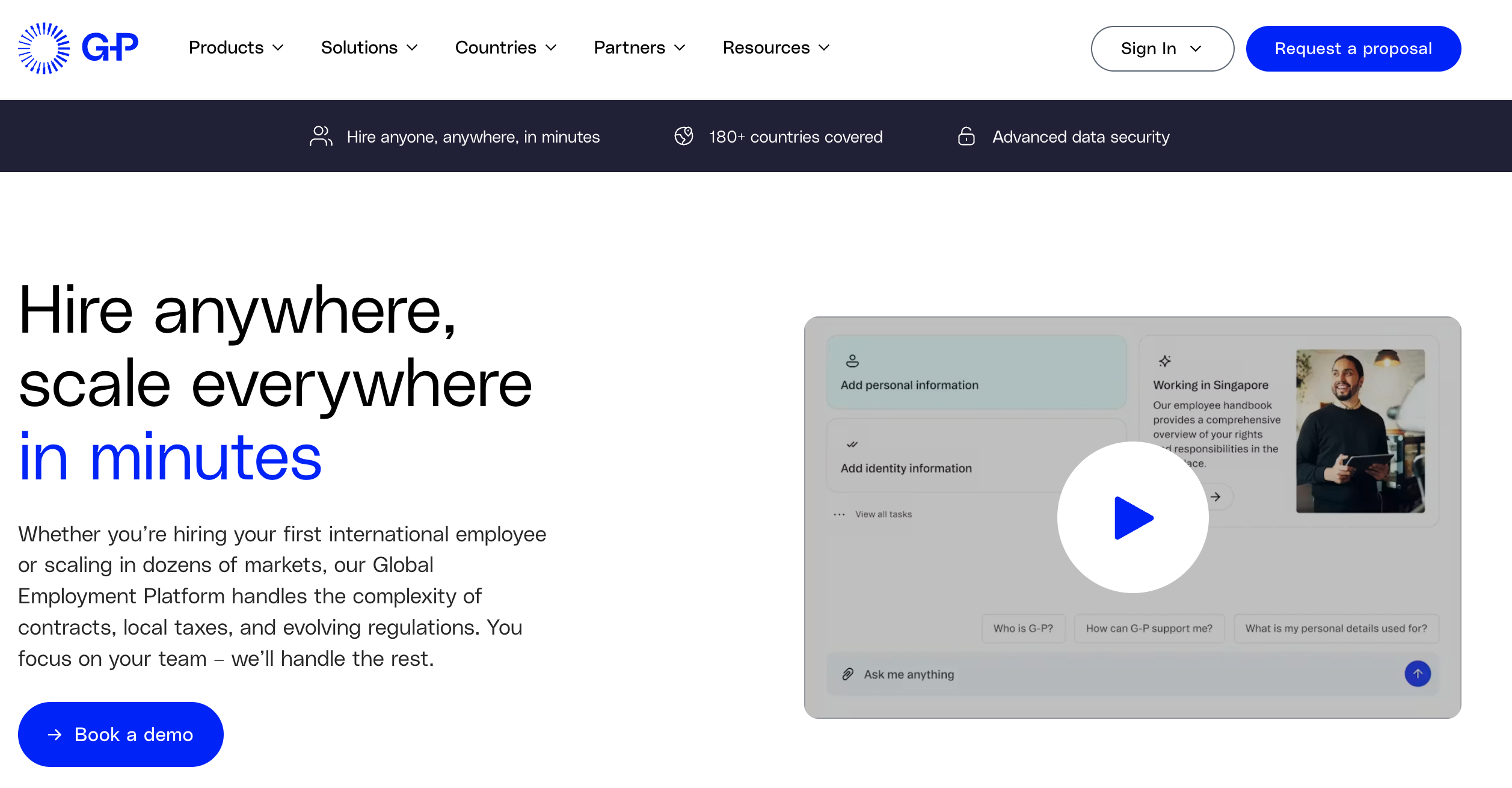
G-P, formerly Globalization Partners, is one of the earliest EOR providers and operates across 180+ countries through owned entities. It covers employment contracts, ZUS compliance, payroll, statutory benefits, and termination support for employees in Poland.
Pricing is available on a custom quote basis and is positioned toward enterprise buyers. Independent reviews place the starting rate at approximately $940 per month per employee, which is among the higher price points observed across global EOR providers. Obtaining a quote has been reported to require multiple sales interactions.
The platform runs on G-P Meridian, which covers hiring, onboarding, payroll, benefits, and compliance in a single interface. Onboarding timelines vary by country and are not published as a universal figure.
Strengths:
-
Established compliance infrastructure built through owned entities in 180+ countries, giving enterprise buyers direct accountability and in-country legal standing rather than reliance on third-party partners.
-
Dedicated Customer Success Manager and in-country expertise provide structured account support suited to complex, multi-jurisdiction employment programs.
Limitations:
-
Pricing is not publicly listed and requires a custom sales process. Independent testing found that obtaining an initial quote required three separate sales calls, and full onboarding from first contact to employee activation took more than three weeks.
-
Pricing landed among the highest observed across global EOR providers tested, which may make G-P cost-prohibitive for small and mid-sized businesses without large headcounts to justify the rate.
Best for:
Enterprise companies that require proven compliance infrastructure, owned-entity coverage across major markets, and dedicated account support for large-scale or multi-country employment programs.
Multiplier
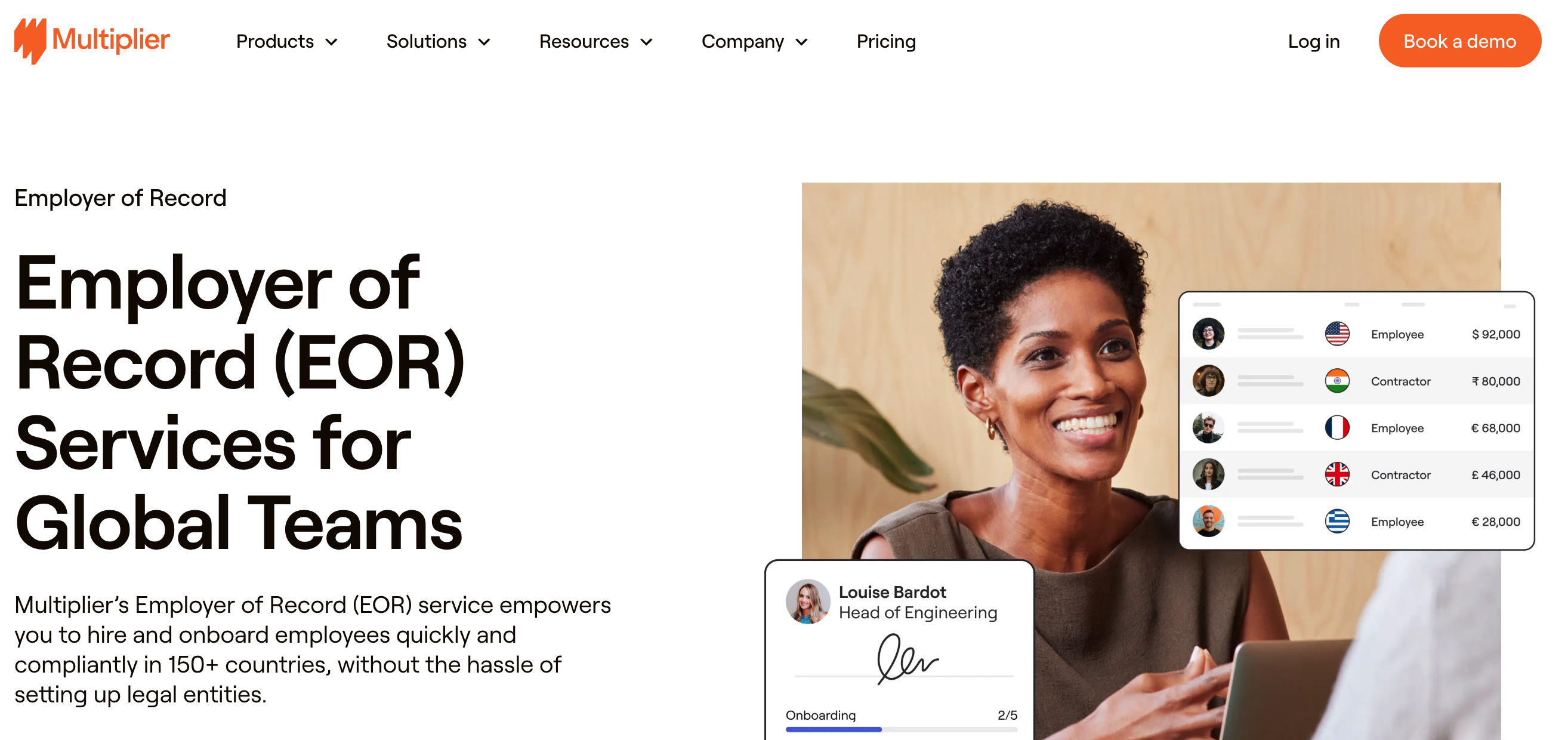
Multiplier is a global EOR provider covering 150+ countries, including Poland. It handles payroll, ZUS compliance, employment contracts, and statutory benefits for companies hiring Polish employees without a local entity.
Pricing starts from $400 per employee per month, making it one of the more cost-competitive options among global EOR platforms. Multiplier holds ISO 27001, SOC 2, and SOC 3 certifications, and claims onboarding under 24 hours, though actual timelines vary by country.
The platform suits SMB and enterprise teams scaling across Central and Eastern Europe who want broad coverage at a lower per-seat cost than providers such as Deel or Remote.
Strengths:
-
ISO 27001, SOC 2, and SOC 3 compliance certifications provide a documented security baseline for companies with data governance requirements.
-
Pricing from $400 per employee per month positions Multiplier as a cost-competitive option for teams scaling across CEE without sacrificing global coverage.
-
Responsive support and a multi-country EOR platform covering employment, payroll, benefits, and compliance in 150+ countries.
Limitations:
-
Multiplier does not publicly disclose whether it operates through its own legal entities in Europe, which may affect accountability and issue resolution speed for Poland-based hires.
Best for:
SMB to enterprise teams scaling across Central and Eastern Europe who prioritize cost-effective EOR pricing and broad country coverage over a locally owned Polish entity.
Oyster HR
Oyster HR is a global EOR platform supporting hiring in 180+ countries, including Poland. It pays teams in 140+ local currencies and covers employment contracts, payroll, statutory benefits, and visa and work permit sponsorships.
The platform is built for remote-first teams and places particular emphasis on employee benefits administration and a positive employee experience alongside standard compliance requirements. Pricing is listed at $699 per employee per month in European EOR comparisons.
Oyster HR suits companies that want automated hiring, payroll, and benefits management across a wide country footprint, with local experts and onboarding specialists supporting each hire.
Strengths:
-
Coverage across 180+ countries with multi-currency payroll in 140+ local currencies gives teams broad geographic flexibility without switching providers.
-
Strong benefits administration focus, including visa and work permit sponsorships, makes Oyster HR a practical choice for companies prioritizing employee experience alongside compliance.
Limitations:
-
Public sources reviewed did not document a provider-specific limitation for Oyster HR's Poland operations or entity structure.
Best for:
Remote-first companies prioritizing employee benefits administration, multi-currency payroll, and automated hiring workflows across a wide international footprint.
Rippling
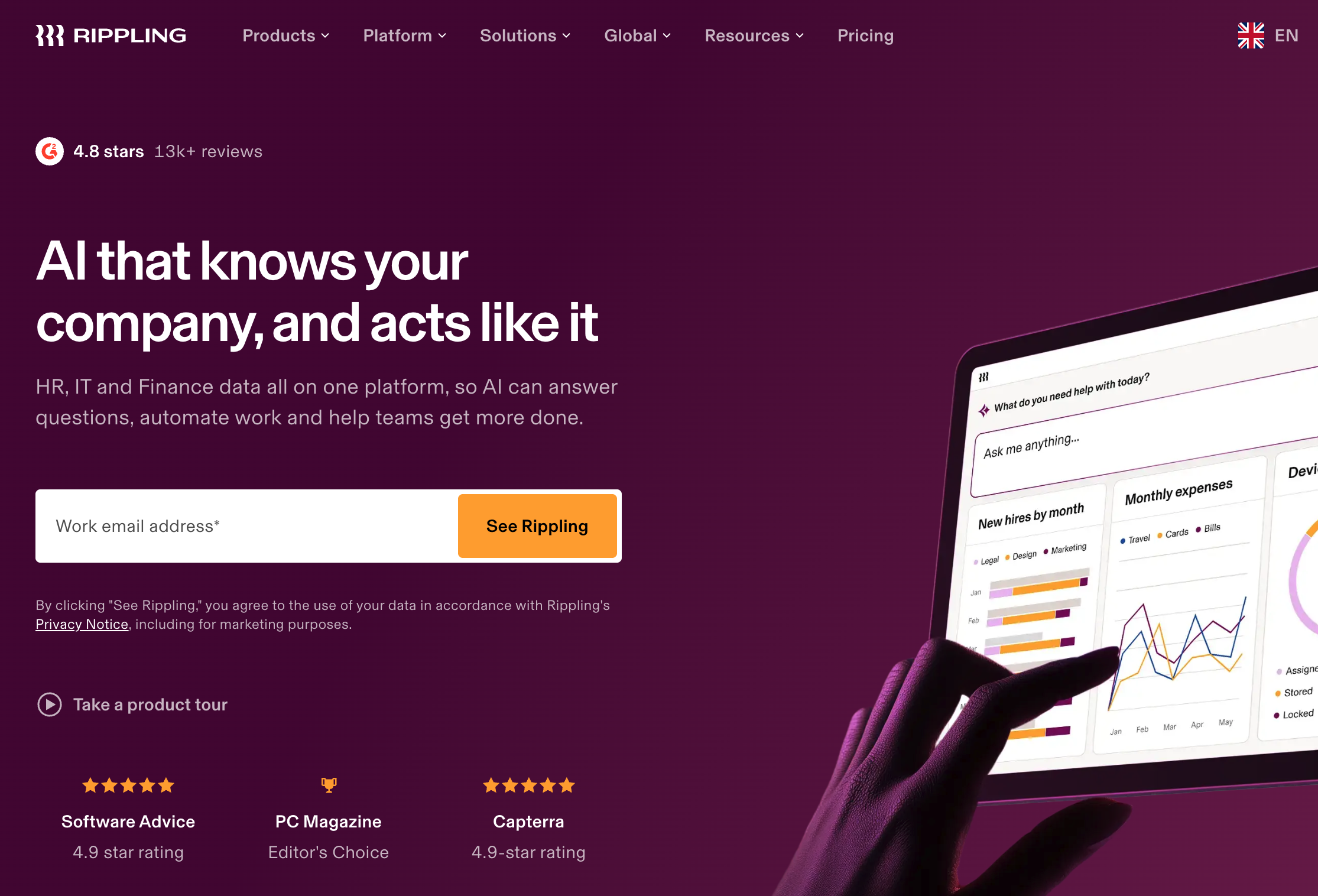
Rippling is a unified HR, IT, and finance platform that offers EOR services in 80+ countries, including Poland. It covers payroll, ZUS compliance, employment contracts, and HR automation, with all employment data flowing through a single employee record that also drives device provisioning and app access.
The platform holds a 9.3 out of 10 G2 support score across more than 13,000 reviews. Local HR advisors average a decade of in-country experience. EOR pricing is not publicly listed and requires a custom sales quote, with annual contracts as standard.
Strengths:
-
One employee record drives payroll, benefits, device provisioning, and app access across 600+ integrations. Offboarding revokes system access in the same action as termination.
-
Strong enterprise scalability with deep automation across HR, cross-border payroll compliance, and IT device administration in a single platform.
Limitations:
-
EOR pricing is not published. Every quote is custom, annual contracts are standard, and the seat count signed becomes the billing floor. Competitors such as Deel and Remote publish EOR rates openly.
-
Modular pricing requires separate licenses for payroll, benefits, and IT modules, which can increase total cost and make the full cost of ownership harder to assess upfront.
Best for:
Enterprise companies that want EOR integrated with a broader HR and IT management stack, particularly tech-forward teams with 50 to 1,000 employees requiring automation across payroll compliance and device administration.
What Are the Key Services of an EOR in Poland?
An EOR in Poland covers the full employment lifecycle under Polish law. Poland's 2023 Labour Code amendments introduced codified remote work rules and new parental leave categories, expanding the compliance scope that EOR providers must manage on behalf of client companies.
ZUS contribution management is a core differentiator for Poland EOR services. Employers owe roughly 19.52% of gross salary in social security contributions, and accurate, timely ZUS filings are a legal requirement. Beyond ZUS, a Poland EOR handles employment contracts in Polish, PIT payroll tax withholding, statutory leave administration, trade union notifications, and GDPR-compliant data processing for all employees.
Employment Contracts and Local Compliance
Polish law requires all employment contracts to be written in Polish. The Labour Code recognises three contract types: indefinite-term, fixed-term, and probationary. Each carries distinct rules on duration, renewal limits, and termination rights.
An April 2023 amendment to the Labour Code introduced a new obligation: employers must state written reasons when terminating a fixed-term contract. This change aligns fixed-term termination rules more closely with those that already applied to indefinite contracts.
Contracts must also comply with GDPR requirements for employee data collection, storage, and processing. An EOR drafts, signs, and stores compliant contracts as the legal employer, removing that administrative burden from the client company.
Payroll and Tax Administration
Payroll in Poland is processed in Polish zloty (PLN). From 2026, the statutory minimum wage is $1,294 (PLN 4,806) per month gross.
Employer contributions to the Social Insurance Institution (ZUS) cover pension (9.76%), disability (6.5%), accident insurance (approximately 1.67% on average), the Labour Fund (2.45%), and the Guaranteed Employee Benefits Fund (0.1%). Employees contribute separately toward pension (9.76%), disability (1.5%), and sickness insurance (2.45%).
Personal income tax (PIT) applies at 12% on annual income up to $32,303 (PLN 120,000) and 32% above that threshold. Employers also manage enrolment and contributions under the Employee Capital Plans (PPK) scheme and file payroll data using the Platnik software system required by ZUS.
Benefits Administration
Polish law sets two tiers of annual leave: 20 days for employees with fewer than 10 years of tenure and 26 days for those with 10 or more years. Employees also receive 13 public holidays in 2026, including New Year's Day, Easter Monday, Labour Day, Constitution Day, Assumption, All Saints' Day, Independence Day, and Christmas.
Sick leave is covered by the employer for the first 33 days of illness in a calendar year (14 days for employees aged 50 and over), at 80% of salary. After that threshold, the Social Insurance Institution (ZUS) takes over payments. Maternity leave starts at 20 weeks and can be extended, paternity leave is 2 weeks, and parental leave runs 41 weeks for a single parent or 43 weeks for two parents under the post-2023 amendment.
Beyond statutory entitlements, employers commonly offer private medical insurance through providers such as Medicover or LuxMed, meal vouchers, and sport cards such as Multisport. An EOR administers all statutory benefits and coordinates enrollment in any optional benefit programs on the employer's behalf.
Employee Onboarding
An EOR onboarding in Poland follows a defined sequence: collect employee data, draft a Polish-language employment contract, register the employee with ZUS within 7 days of the employment start date (a statutory requirement), enroll the employee in the Employee Capital Plans (PPK) scheme, and configure payroll.
The 7-day ZUS registration deadline is fixed by law and applies regardless of the EOR provider used. For remote workers, the April 2023 Labour Code amendment requires the employer to provide equipment or reimburse the employee for costs incurred working from home.
Most EOR providers support e-signature for Polish contracts, which reduces paperwork delays. Typical onboarding timelines in Poland range from 3 to 5 days to 2 weeks depending on the provider and the complexity of the hire.
Ongoing HR Support
An EOR in Poland runs monthly payroll processing and submits ZUS social insurance declarations, including DRA and RCA forms, on the required schedule. Annual PIT-11 tax certificates are prepared and filed with the Polish tax authority on behalf of each employee.
Labour Code compliance monitoring covers regulatory changes as they occur, including future amendments to employment law. In unionized workplaces, the EOR manages mandatory trade union notification obligations. Under the 2023 remote work amendment, employers must reimburse employees for work-from-home costs, and the EOR tracks and administers those obligations.
HR advisory support covers employee queries, disciplinary procedures, and performance management within Labour Code constraints. Employee records are maintained in full compliance with GDPR data processing requirements.
Employee Offboarding
Notice periods under the Polish Labour Code depend on tenure. Employees with less than six months of service receive two weeks notice. Those with six months to three years receive one month, and employees with three or more years receive three months.
For indefinite-term contracts, the employer must provide written reasons for termination. Following the 2023 Labour Code amendment, written reasons are also required for fixed-term contract terminations. In unionized workplaces, trade union consultation is required before proceeding.
Collective redundancy rules apply when a company with 20 to 99 employees dismisses 10 or more workers within 30 days, when a company with 100 to 299 employees dismisses 10 percent of its workforce, or when a company with 300 or more employees dismisses 30 or more workers.
At the point of employment end, the EOR files the ZUS deregistration form (ZWUA) within the required seven-day window, processes final pay, and pays out any accrued leave. Managing the full offboarding process reduces direct employer liability throughout.
How to Hire Through an EOR in Poland
Hiring through an EOR in Poland follows two phases: Selection and Setup, then Onboarding and Compliance. Each phase has defined steps and clear responsibilities split between the client and the EOR.
Using an EOR removes the need to register a Polish limited liability company before hiring. The EOR becomes the legal employer under Polish law, holding the employment contract, managing ZUS filings, and running payroll. The client retains full operational control over the employee's work and performance.
With a prepared EOR, the total timeline from signed agreement to active employee can be as fast as 3 to 5 days, depending on the provider and role complexity.
Selection and Setup
Start by defining the role clearly: job scope, salary, contract type (indefinite or fixed-term), and whether the position is remote or on-site. These decisions shape every compliance step that follows.
Next, select an EOR provider. Evaluate Poland-specific compliance depth, entity structure (wholly-owned versus partner network), pricing model, and support availability. Sign a Master Services Agreement and a Statement of Work with the chosen provider.
The EOR then conducts a compliance review. This confirms role classification, verifies that the proposed salary meets the Polish minimum wage ($1,294 (PLN 4,806) per month in 2026), and validates contract terms.
-
Decide at this stage whether to engage the worker as an employee or a contractor. Misclassification carries ZUS reclassification risk and should be resolved before any contract is issued.
Onboarding and Compliance
Once a candidate accepts an offer, the EOR issues a Polish-language employment contract and signs it as the legal employer. To understand the full process, see how does EOR work.
The EOR then registers the employee with ZUS within seven days using the required ZUS ZUA form. Employees are enrolled in the PPK occupational pension scheme by default, though they may opt out. If the role is remote, the EOR documents a remote work agreement as required under the April 2023 Labour Code amendment.
On the first payroll run, the EOR processes salary in PLN, withholds income tax, and remits ZUS contributions. Ongoing obligations include monthly ZUS declarations, annual PIT-11 filings, and continuous Labour Code monitoring.
For non-EU employees, a Type A or Type B work permit must be obtained before employment begins. The EOR or an immigration partner manages this process.
What Are the Benefits of Using an EOR in Poland?
Using an EOR in Poland removes the need to register a local entity, which typically takes several months and requires ongoing administrative overhead. Companies can employ workers in Poland within weeks instead.
-
Faster market entry: Start employment in Poland without waiting for entity registration to complete.
-
ZUS and tax compliance: The EOR manages social security contributions, income tax withholding, and monthly filings on your behalf.
-
Labour Code adherence: Employment contracts, notice periods, and termination procedures follow Polish law from day one.
-
Benefits administration: Statutory leave, public holidays, and sector-specific entitlements are handled by the EOR.
-
Cost control: Fixed monthly fees replace the unpredictable costs of running a local legal entity.
-
Flexible scaling: Add or reduce headcount without restructuring a Polish subsidiary.
These benefits are especially relevant for companies testing the Polish market before committing to a permanent entity. An EOR provides a compliant employment structure while that decision is still open.
Faster Market Entry
An EOR lets companies hire in Poland in as little as 3 to 5 days. Setting up a local limited liability company typically takes 4 to 8 weeks and requires completing REGON, NIP, and ZUS employer registration before a single contract can be signed.
With an EOR, those registrations are already in place. The EOR is the legal employer, so your hire can start while your competitors are still filing paperwork.
Poland's IT talent market is competitive. Warsaw, Krakow, and Wroclaw attract strong candidates who receive multiple offers. Speed of hire directly affects which companies win that talent.
Reduced Compliance Risk
An EOR assumes full legal employer liability in Poland. That covers ZUS social security contributions, income tax withholding, and adherence to the Polish Labour Code, including contract clauses, notice periods, and termination procedures.
Errors in ZUS filings carry financial penalties. Improper termination or missing contract terms can trigger Labour Code violations. The EOR tracks obligations and corrects filings before penalties apply.
Poland's April 2023 Labour Code amendments added new employer obligations, including remote work reimbursement rules and sobriety control procedures. A qualified EOR monitors these changes and updates employment practices accordingly. GDPR compliance for employee personal data is also managed within the EOR's legal framework.
Simplified Payroll Administration
An EOR processes payroll in Polish zloty, calculates and remits ZUS employer and employee contributions, withholds personal income tax, and manages PPK occupational pension enrolment on behalf of the client.
This removes the need for client teams to operate Płatnik software or submit monthly DRA and RCA declarations directly to ZUS. Annual PIT-11 certificates for employees are also prepared and filed by the EOR.
For companies with employees across multiple countries, multi-currency payroll capability keeps all payroll runs in one place. Accurate, timely filings reduce the risk of ZUS audits or employee disputes caused by payroll errors.
Access to Local Benefits
An EOR administers all statutory entitlements: 20 to 26 days of paid annual leave depending on tenure, sick leave, 13 public holidays, and maternity, paternity, and parental leave under the post-2023 structure of 41 or 43 weeks.
Beyond statutory minimums, EOR providers can coordinate optional benefits that are standard in the Polish market: private medical insurance through providers such as Medicover or LuxMed, Multisport cards, and meal vouchers. These benefits matter for attracting and retaining talent in competitive Polish tech and business hubs.
Clients gain access to locally competitive benefit packages without negotiating directly with Polish benefit providers or managing enrolment administration internally.
Lower Entity Setup Costs
Setting up a limited liability company in Poland requires a minimum share capital of $1,346 (PLN 5,000), a notarial deed, KRS registration fees, and ongoing accounting and audit obligations. These costs add up quickly, even before a single employee is paid.
An EOR removes all of these upfront and recurring expenses. There is no need for a local director or a registered office address. For companies hiring between one and ten employees in Poland, this makes EOR significantly more cost-effective than entity incorporation.
EOR monthly fees typically range from $199 to $699 per employee per month, giving finance teams a predictable cost line rather than variable entity overhead. Learn more about how these costs compare in our guide to employer of record cost.
More Flexible Workforce Scaling
An EOR lets companies scale headcount up or down without restructuring a legal entity. Most EOR contracts carry no minimum employee commitment, so companies can hire one person or fifty without locking into a fixed structure.
Exiting the Polish market is also straightforward. Terminating an EOR agreement requires only the agreed notice period. Liquidating a Polish limited liability company, by contrast, can take six to twelve months. This matters for project-based hiring, seasonal scaling, or market testing.
EOR also supports hiring across Warsaw, Krakow, Wroclaw, Poznan, and Gdansk without any regional entity requirements. EOR for startups covers how early-stage teams use this flexibility to test new markets without long-term commitment.

How to Find the Right EOR for Poland
Choosing the right best employer of record for Poland requires evaluating five criteria: local compliance expertise, entity structure, payroll accuracy, contract quality, and termination support.
Poland's compliance environment is specific and demanding. The ZUS social security system, the Polish Labour Code, and the April 2023 amendments covering remote work, parental leave, and sobriety controls all require providers with direct, in-country knowledge. Generic global coverage is not sufficient.
Entity structure also matters. A provider operating through a wholly-owned Polish entity carries direct accountability for filings and contracts. A partner-network model adds an intermediary, which can slow issue resolution and reduce transparency when problems arise.
Local Compliance Expertise
Ask whether the provider operates through a wholly-owned Polish entity or relies on a third-party partner network. A wholly-owned entity means the provider signs contracts under its own registration numbers and carries direct legal accountability.
Verify ZUS compliance track record. The provider should demonstrate accurate contribution calculations and timely filings, including the employer's 19.52% social security share and associated health insurance obligations.
-
Confirm knowledge of the April 2023 Labour Code amendments covering remote work rules, expanded parental leave, and sobriety control procedures.
-
Check experience with trade union notification requirements in unionized Polish workplaces.
-
Confirm that employment contracts are drafted in Polish as standard, not translated from English templates.
-
Verify termination procedure expertise: notice periods, the written reasons requirement, and collective redundancy rules.
Clear Service Scope
Before signing with any EOR in Poland, confirm exactly what the base fee covers. Ask whether ZUS employer contributions are included in the quoted price or passed through at cost, and whether PPK administration and work permit support are bundled or billed separately.
Offboarding and termination support are often treated as add-ons. Clarify this upfront. Hidden charges for currency conversion, compliance updates, or employee record changes can significantly raise the total cost of employment.
Compare providers on full cost transparency, not just the headline EOR fee. A lower monthly rate that excludes statutory filings or benefits coordination may cost more in practice than a higher all-in price. For a detailed breakdown of what EOR fees typically include, see the employer of record cost guide.
Support Model
Support quality varies significantly across EOR providers. Check whether the provider offers 24/7 coverage or business-hours-only access, and whether support is human-led through a dedicated account manager or primarily handled via tickets and automated chat.
For Poland specifically, ask whether the provider has Polish-speaking HR and legal specialists on staff. ZUS audit notices and employee disputes require fast, accurate responses. Confirm what response time commitments exist for urgent compliance issues.
Proactive compliance alerts matter as much as reactive support. A provider that monitors Polish Labour Code changes and notifies you before a deadline reduces your compliance risk more than one that only responds when you raise a ticket.
Technology and Reporting
A strong EOR platform gives you real-time visibility into payroll runs and ZUS contribution calculations, so you can verify costs before each pay cycle closes.
Check whether the platform integrates with HR and accounting tools your team already uses, such as BambooHR, Workday, QuickBooks, or Xero. Integrations reduce manual data entry and keep records consistent across systems.
Reporting capabilities matter for Poland specifically. Confirm the platform can generate Poland-specific payroll reports, ZUS contribution summaries, and PIT-11 data on demand.
-
Employee self-service portal: Polish employees should be able to access payslips, leave balances, and employment documents in Polish.
-
Data security certifications: Look for SOC 2 and ISO 27001 certifications, both of which support GDPR compliance obligations for employee data held in Poland.
Scalability for Your Hiring Plans
Confirm the provider can support growth from a single employee to 50 or more in Poland without a drop in service quality or response times.
If Poland is part of a broader Central and Eastern European or pan-European expansion, multi-country capability matters. A provider that covers only Poland will create friction when you add headcount in Germany, Romania, or the Czech Republic.
Ask whether the provider supports both EOR and global payroll. When you eventually set up a Polish entity, you will want a provider that can help transition employees to your own legal structure without disruption. Gloroots supports companies at that stage through its EOR for enterprises offering, which is built for multi-country programs at scale.
-
Transition support: the provider should be able to migrate employees to a client-owned entity when the time comes.
-
Pricing model scalability: check whether the per-employee cost decreases at higher headcount volumes.

Why Gloroots Is a Strong EOR Partner in Poland
Companies entering Poland need cost visibility before they commit. Gloroots uses predictable, country-specific pricing with full cost transparency before onboarding begins, and no percentage-of-salary pricing that inflates costs as salaries grow.
For teams building across Central and Eastern Europe, Gloroots supports compliant full-time employment across 150+ countries. That coverage means a single provider can run Poland alongside any other market in the same program.
Support is human-led. Account managers retain business context across engagements, so teams are not re-explaining their situation to a new contact each time. There are no ticket queues replacing direct relationships.
-
Centralized workforce dashboard covering payroll, compliance, benefits, and workforce visibility in one place
-
ZUS contribution management and Polish Labour Code-compliant employment contracts
-
Trade union notification handling and termination support for Polish employment law requirements
-
Integrated service suite: Global EOR, Global Payroll, Compliance and Employment Governance, and Benefits and Statutory Coverage
For companies entering Poland or scaling a CEE presence, Gloroots provides the employment operating layer to employ, pay, and govern workers without a local entity. Learn more about Gloroots EOR services or review Gloroots pricing before your first hire.
FAQs About the Best EOR in Poland
How does an EOR work in Poland?
An Employer of Record in Poland becomes the legal employer of your worker. You retain full operational control over the employee's day-to-day tasks and performance.
The EOR registers with ZUS, processes payroll in PLN, issues Polish-language employment contracts, and manages compliance with the Polish Labour Code. You sign a service agreement with the EOR. The EOR then signs a direct employment contract with your employee.
The employee sits on the EOR's Polish payroll. You pay the EOR a monthly fee that covers gross salary, employer-side statutory costs, and the EOR service fee. Unlike a PEO model, which requires co-employment and typically a local entity, an EOR lets you hire in Poland without establishing a Polish legal entity of your own. For a fuller explanation, see how does EOR work.
What does an EOR cost in Poland?
EOR service fees in Poland typically range from $199 to $699 per employee per month, depending on the provider and service level. That fee is separate from the employee's gross salary and statutory employer costs.
Total employer cost includes the EOR fee plus gross salary, ZUS employer contributions (approximately 19.52% of gross salary), the PPK employer pension contribution (1.5% by default), and accident insurance. For a gross salary of $2,154 (PLN 8,000) per month, the total employer cost before the EOR fee is approximately $2,638 (PLN 9,800) to $2,746 (PLN 10,200) per month.
Pricing structures vary across providers. Some include statutory costs in their quoted monthly price; others pass them through at cost on top of the service fee. Always confirm which model applies before signing. For a broader view of what drives these costs, see employer of record cost.
When should a company use an EOR in Poland?
An EOR in Poland works best when a company wants to test the Polish market without committing to a local entity. It is also the right fit for hiring between one and ten employees, filling urgent project-based roles, or managing post-acquisition integration where speed matters.
EOR becomes cost-effective when headcount stays below the break-even point for entity setup, commonly cited at ten to fifteen employees, though this varies by company size and structure. It also suits companies that lack internal Polish HR or legal expertise. An EOR is less appropriate when a company already operates a Polish entity with established payroll infrastructure.
Can an EOR hire both local and foreign employees in Poland?
Yes. An EOR in Poland can employ both Polish nationals and foreign nationals, including EU and non-EU citizens. EU nationals benefit from free movement rights and require no work permit.
For non-EU nationals, a work permit must be obtained before employment begins. Type A permits apply to standard employment; Type B permits apply to board members. Some EOR providers assist with the permit process. Ukrainian nationals holding temporary protection status in Poland may face different requirements: verify current rules for 2026 before proceeding.
Regardless of nationality, the EOR handles ZUS social security registration for all employee types, keeping the company compliant with Polish statutory obligations from day one.
How do I choose the right EOR in Poland?
Start by confirming whether the provider operates a wholly-owned Polish entity or relies on a partner network. A direct entity means faster contract execution and clearer accountability under Polish law.
Evaluate compliance depth across ZUS social security filings, Labour Code obligations, and GDPR requirements. Then review pricing transparency: confirm what the base fee covers and what employer costs are added on top.
Assess the support model. Human-led, 24/7 account access matters more in Poland than ticket-based systems when payroll deadlines or termination procedures require fast decisions. Finally, request a Poland-specific compliance checklist from each shortlisted provider and ask for references from companies that have hired in Poland through that EOR. Price alone is not a reliable selection criterion. A compliance failure costs more than a higher monthly fee.