







- Pakistan's four provinces each operate separate labor codes and social security institutions, so an EOR must demonstrate explicit compliance coverage across Punjab, Sindh, Khyber Pakhtunkhwa, and Balochistan rather than federal-level compliance alone.
- Hiring through an EOR in Pakistan takes 2 to 5 days, compared to the 4 to 6 months and PKR 500,000 to PKR 1,500,000 typically required for SECP entity registration.
- Statutory obligations beyond payroll include EOBI contributions, provincial social security enrollment, FBR income tax withholding, and Workers' Participation Fund administration for companies with 20 or more employees, all of which a qualified EOR manages on the hiring company's behalf.
- Contractor-to-employee conversion is a distinct service that requires new compliant employment contracts, retroactive statutory enrollment, and updated payroll from the conversion date, and not all EOR providers support this transition directly.
- Pricing transparency varies significantly across providers on this list, so requesting a full cost breakdown covering EOBI, provincial social security, and per-employee fees before signing is essential for accurate budget planning.
Pakistan presents a strong case for international hiring. With a population of approximately 255 million, a labor force of 85.6 million, and over 75,000 IT graduates entering the market annually, the country supports a workforce of 600,000+ IT professionals. ICT exports reached $3.81 billion in FY2025, and Pakistan ranks as the 4th largest freelance market globally.
GDP growth is projected at 3.7% for FY2026. The government has established 12 or more Special Technology Zones to attract foreign investment and support technology hiring at scale.
Setting up a legal entity in Pakistan requires SECP registration, provincial compliance across four distinct labor frameworks, and months of lead time. An EOR services provider lets companies employ workers in Pakistan without entity formation, transferring statutory obligations to a compliant local employer of record.
Our Top 8 Picks: Pakistan for EOR Comparison 2026
The table below covers eight EOR providers evaluated for Pakistan employment. Use it to compare pricing, country coverage, onboarding speed, platform experience, customer support, and scalability side by side. Detailed provider profiles follow the table.
| Provider | Pricing per month | Country coverage | Onboarding speed | Platform experience | Customer support | Scalability |
|---|---|---|---|---|---|---|
| Gloroots | From $199/employee/month | 150+ countries | 3–5 working days | Unified platform for hiring, onboarding, payroll, compliance, benefits, expenses, and workforce management | 24/7 human support with dedicated specialists | SMB to enterprise; supports global teams across 150+ countries |
| Borderless AI | From $579/employee/month | 170+ countries | 24–48 hours | AI-powered EOR and global payroll platform with automated contracts, compliance, payroll, benefits, and workforce management | 24/7 in-house support with a dedicated point of contact | Startups to mid-market and enterprise; designed to scale from 1 to 1,000 employees |
| Remote | $699/employee/month | 90+ EOR countries | Not publicly listed as a fixed timeframe; dedicated specialist assigned for onboarding | Platform-first global employment platform covering onboarding, contracts, payroll, benefits, expenses, time off, and compliance | 24/7 support from global employment specialists | SMB to enterprise; suited to distributed teams scaling internationally |
| Horizons | From $299/employee/month | 180+ countries for contractors; EOR country coverage varies | Not publicly listed as a fixed timeframe | Unified platform for global employment, contractors, payroll, benefits, and talent sourcing | Expert HR support and dedicated assistance | Startups to enterprise; combines EOR, contractor management, payroll, benefits, and in-house recruitment |
| Skuad | From $199/employee/month | 160+ countries | A few days | Unified global HR and payroll platform covering onboarding, payroll, compliance, contracts, benefits, expenses, and integrations | 24/5 dedicated support with employer and employee account managers | SMB to enterprise; supports global teams across 160+ countries |
| Safeguard Global | Custom pricing; EOR pricing reported from $699/employee/month | 187 countries | Country-dependent; fast-track onboarding available in selected countries | Global workforce platform covering EOR, onboarding, payroll, HR, benefits, time and expense management, and workforce data | Local HR support with 400+ in-country experts and account management | Mid-market to enterprise; supports global workforce management across 187 countries |
| Mercans | Custom / flat-price model | 160+ countries | Within 48 hours | HR Blitz platform for global payroll and EOR, with hiring, onboarding, payroll, benefits, compliance, and tax management | Dedicated account manager and single point of contact | SMB to enterprise; supports global payroll and EOR across 160+ countries |
| Native Teams | From €99/employee/month | 95+ countries | A few days; provider advertises 3x faster onboarding | Unified platform for EOR, payroll, payments, contractors, compliance, benefits, and workforce management | Dedicated support specialists and employee support; local expertise in 95+ countries | Startups to scaling businesses; supports companies from individual hires to multi-country teams |

Top 8 Best EOR Platforms in Pakistan for
The eight providers below were evaluated across six criteria: provincial labor law expertise, EOBI and social security handling, payroll accuracy, onboarding speed, platform experience, support quality, and pricing transparency.
Each criterion was assessed using publicly available product documentation, provider websites, and third-party research sources. No single criterion was weighted above the others. The goal is to give hiring teams a structured basis for comparison rather than a ranked score.
The profiles cover eight providers active in Pakistan as of 2025 and 2026. Each entry includes core capabilities, Pakistan-specific services, and a best-fit use case.
Gloroots
Gloroots runs compliant full-time employment across 150+ countries, including Pakistan. Its service model covers four product areas: Global Employer of Record (EOR), Global Payroll, Compliance and Employment Governance, and Benefits and Statutory Coverage.
Pricing is country-specific and fixed before onboarding begins. There are no percentage-of-salary fees and no hidden charges. Teams see the full cost of employment in Pakistan before a single contract is signed.
The platform provides centralized workforce visibility across all active employees. Account support is human-led, with retained business context carried across interactions rather than reset with each contact.
Strengths:
-
Covers Global EOR, Global Payroll, Compliance and Employment Governance, and Benefits and Statutory Coverage within a single platform, reducing the need for multiple vendors.
-
Uses predictable, country-specific pricing with full cost visibility before onboarding and no percentage-of-salary pricing, giving finance teams a reliable cost baseline.
-
Provides centralized workforce visibility and human-led account support with retained business context, supporting consistent governance across distributed teams.
Limitations:
-
Public sources reviewed did not document a provider-specific limitation.
Best for: Companies that need entity-free employment in Pakistan with predictable fixed pricing, centralized workforce governance, and human-led account ownership across a global headcount. Learn more about EOR services from Gloroots.


Borderless AI
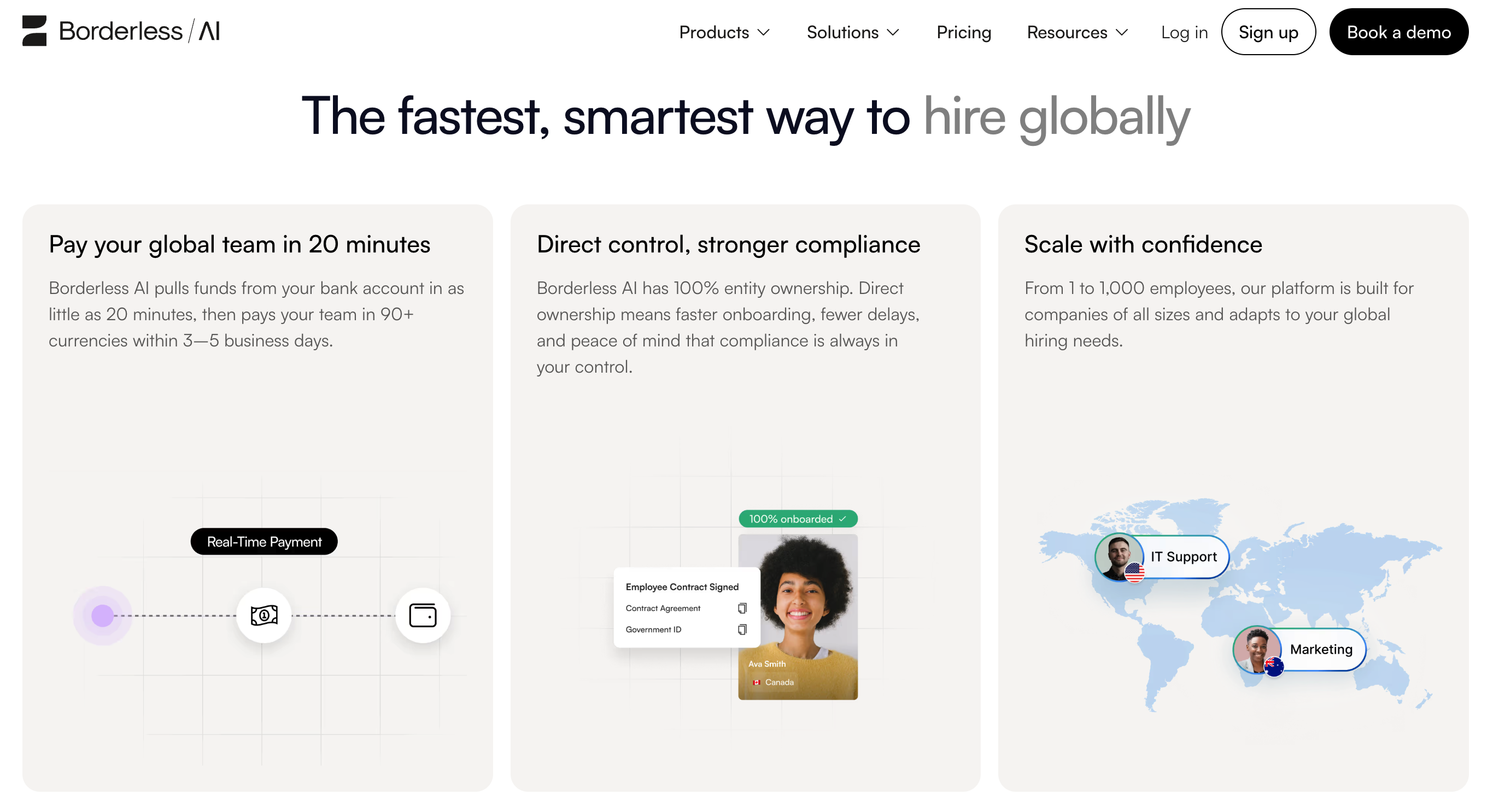
Borderless AI is an AI-powered employer of record platform that supports employment across 170+ countries, including Pakistan. The platform uses automation to reduce manual compliance work and speed up onboarding for distributed teams.
For Pakistan, Borderless AI covers statutory obligations including Employees' Old-Age Benefits Institution (EOBI) contributions, provincial social security enrollment across Punjab, Sindh, Khyber Pakhtunkhwa, and Balochistan, and Federal Board of Revenue (FBR) income tax withholding. Onboarding timelines for Pakistan-based employees are reported as fast, though exact day counts are 1–2 days.
The platform is designed for teams that prefer a technology-first experience, with AI-driven workflows handling contract generation, payroll runs, and compliance checks.
-
Strengths: AI-powered automation across 170+ countries; Pakistan statutory compliance covering EOBI, provincial social security, and FBR tax handling.
-
Limitations: Public sources reviewed did not document a provider-specific limitation.
-
Best for: Teams that want AI-driven EOR workflows and broad country coverage with Pakistan compliance built in.
Starting price: $579 per employee per month. G2 rating: 4.9/5 on G2..
Remote
Remote operates as a global employer of record, acting as the legal employer for workers in Pakistan on behalf of client companies. The platform is built around a technology-first model with self-serve onboarding and automated payroll runs.
Whether Remote uses an owned legal entity or an in-country partner to employ workers in Pakistan is Remote owns its legal entity in Pakistan. On the compliance side, Remote covers EOBI contributions, provincial social security filings, and FBR income tax withholding for Pakistan-based employees.
Onboarding speed for Pakistan is reported in the 2-4 day range based on existing page data. The platform experience is described as tech-first, with a self-serve dashboard for contracts, payroll, and compliance tracking. Customer support operates during business hours rather than around the clock, which may affect teams working across significant time zone differences.
-
Strengths: Tech-first platform with automated payroll and compliance; Pakistan statutory coverage including EOBI, provincial social security, and FBR tax handling.
-
Limitations: Business-hours support model may limit responsiveness for teams in time zones far from Remote's support centers.
-
Best for: Mid-market to enterprise companies that prefer a self-serve, technology-driven EOR platform for Pakistan employment with established compliance workflows.
Starting price: approximately $599 per month per employee (verify against current Remote pricing page). G2 rating: 4.5/5 on G2..
Horizons

Horizons is an employer of record platform that supports companies hiring in Pakistan without establishing a local entity. It manages payroll processing, statutory contributions, and employment contracts across Pakistan's federal and provincial labor frameworks.
Pakistan-specific services include EOBI contributions (employer 5%, employee 1%), provincial social security enrollment under PESSI and SESSI, and income tax withholding aligned with FBR tax slabs. Horizons handles employment contract drafting compliant with provincial labor codes and manages gratuity accruals under statutory requirements.
Onboarding timelines run approximately 3 to 5 days based on available sourced comparisons. The platform experience is described as traditional in structure, suited to teams that prefer established workflows over newer interface designs.
Support follows a personalized model, with account managers assigned to client accounts rather than a pooled support queue. This approach works well for teams that need consistent points of contact for compliance questions.
-
Strengths: Pakistan payroll and EOBI compliance support; personalized account management model; provincial social security and FBR tax handling.
-
Limitations: Platform experience is traditional rather than tech-forward, which may not suit teams expecting modern dashboard interfaces.
-
Best for: SMBs and mid-market companies hiring in Pakistan that prefer a personalized support model over a self-serve platform.
Starting price: From $249 per month. G2 rating: 4.7/5 on G2..
Payoneer
Payoneer is a unified employer of record platform covering Pakistan employment law compliance, including EOBI contributions, provincial social security enrollment, and FBR income tax withholding. It manages employment across multiple countries from one interface.
Pakistan-specific services include EOBI (employer 5%, employee 1%) and provincial social security contributions under PESSI in Punjab and SESSI in Sindh. Payoneer handles employment contract drafting aligned with provincial labor codes and manages income tax filings with the Federal Board of Revenue.
Onboarding speed and platform experience details are not documented in the sources reviewed for this comparison. Support model specifics are similarly not publicly detailed in the researched sources.
-
Strengths: Unified platform covering Pakistan employment law compliance; handles EOBI, provincial social security, and FBR tax obligations within one system.
-
Limitations: Public sources reviewed did not document a provider-specific limitation.
-
Best for: Companies seeking a single platform to manage Pakistan employment compliance alongside hiring in other countries.
-
Starting price: $199 per employee per month.
-
G2 rating: 4.6/5 on G2.
Safeguard Global
Safeguard Global is an enterprise-grade Employer of Record and PEO provider with coverage across Pakistan and a broad global footprint. The platform is built for large organizations that require structured compliance management and dedicated account ownership rather than self-serve tooling.
In Pakistan, Safeguard Global covers statutory obligations including EOBI contributions, provincial social security enrollment across Punjab, Sindh, KP, and Balochistan, and FBR income tax withholding and reporting. Payroll is processed in PKR with filings aligned to federal and provincial schedules.
Onboarding in Pakistan typically runs five to seven days. The platform experience is oriented toward enterprise workflows, with reporting and governance features suited to multi-country headcount management. Support follows a dedicated model, meaning clients are assigned account contacts rather than routed through shared queues.
-
Strengths: Enterprise-grade compliance coverage across Pakistan's four provinces; dedicated support model with assigned account contacts; structured EOBI, provincial social security, and FBR handling.
-
Limitations: Pricing starts at approximately PKR 95,000 per month per employee, which positions it above mid-market options; onboarding speed of five to seven days is slower than several competitors on this list.
-
Best for: Enterprise organizations that require dedicated account management, structured multi-provincial compliance, and a formal governance layer for Pakistani employment.
$699 per employee per month 4.3/5 on G2.
Mercans
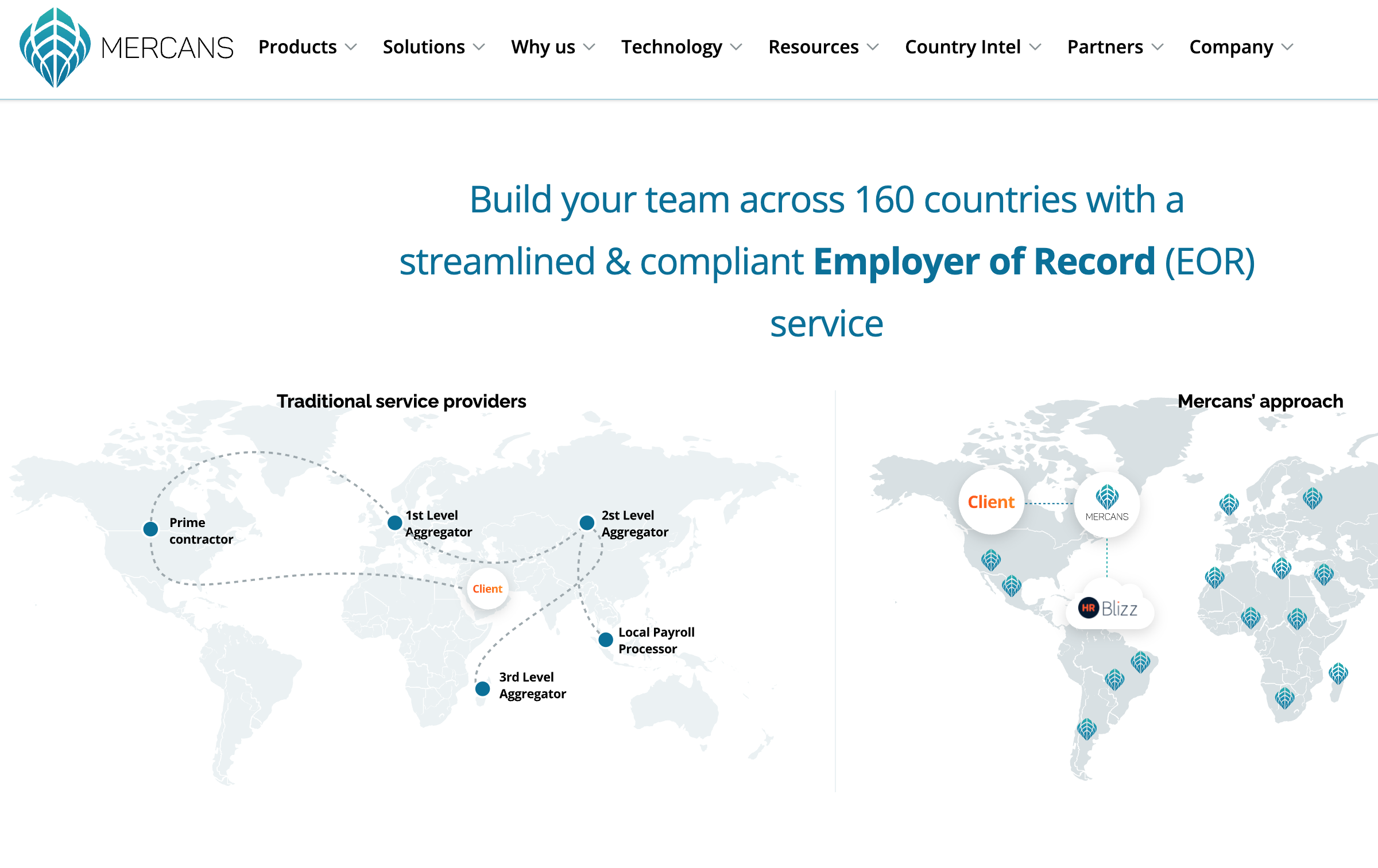
Mercans is a full-service Employer of Record with dedicated Pakistan coverage. The provider manages the complete employment lifecycle, including payroll processing, statutory filings, and multi-provincial compliance across all four of Pakistan's provinces.
Pakistan-specific compliance handled by Mercans includes EOBI contributions, provincial social security enrollment under PESSI in Punjab, SESSI in Sindh, PESCI in Khyber Pakhtunkhwa, and BESSI in Balochistan, along with FBR income tax withholding and annual reconciliation. Payroll is processed in PKR with filings submitted on the applicable federal and provincial schedules.
Mercans positions itself as a provider for organizations that want full-service employment management rather than a platform-first model. The support structure is oriented toward direct client engagement with compliance advisory included.
-
Strengths: Dedicated Pakistan coverage with explicit handling of all four provincial social security schemes (PESSI, SESSI, PESCI, BESSI); full-service model covering payroll, tax, and statutory filings end to end.
-
Limitations: Public sources reviewed did not document a provider-specific limitation.
-
Best for: Organizations that require full-service EOR management in Pakistan with explicit multi-provincial social security compliance and direct compliance advisory support.
$299 per employee per month within 48 hours. 4.8/5 on G2.
Native Teams
Native Teams is a tech-driven EOR platform that supports employment in Pakistan, covering payroll processing, EOBI contributions, and FBR income tax withholding. The platform handles provincial social security enrollment across Punjab, Sindh, KP, and Balochistan alongside standard statutory filings.
Onboarding through Native Teams typically runs 3 to 5 days. The platform is built around a self-serve interface with automated payroll workflows, making it accessible for teams that prefer a product-led experience over high-touch account management. Support is described as responsive rather than dedicated.
Pricing sits at PKR 85,000 to PKR 155,000 per employee per month based on the comparison data in this review. A verified USD starting price is not publicly listed in researched sources.
Pakistan payroll processing with EOBI and FBR tax withholding
-
Provincial social security administration across all four provinces
Tech-driven platform with automated compliance workflows
Onboarding in 3 to 5 days
Best for: SMBs and mid-market companies that want a product-led EOR experience in Pakistan with automated payroll and statutory compliance, and do not require a dedicated account manager.
What Are the Key Services of an EOR in Pakistan for?
An EOR in Pakistan covers the full employment lifecycle: payroll, statutory contributions, tax filings, provincial labor law compliance, benefits administration, and worker classification. Three service areas deserve specific attention for companies entering Pakistan.
Pakistan has one of South Asia's largest freelance workforces. An EOR can convert existing contractors to full-time employees, handling the reclassification, updated contracts, and retroactive statutory enrollment that conversion requires. Providers including Gloroots and Mercans support this transition directly.
Work permit and visa sponsorship is a distinct service category. Not all EOR providers in Pakistan offer immigration support, so companies hiring foreign nationals should confirm this capability before selecting a provider.
Workers' Participation Fund (WPF) administration is part of statutory compliance for applicable companies. An EOR calculates, withholds, and remits WPF contributions alongside EOBI, provincial social security, and FBR tax obligations, reducing the compliance burden on the hiring company.
Employment Contracts and Local Compliance
Employment contracts in Pakistan are governed by provincial legislation. The Punjab Industrial Relations Act, Sindh Industrial Relations Act, and KP Factories Act each set distinct requirements for contract terms, working hours, and termination procedures.
Contracts must specify probation periods, leave entitlements, and notice terms aligned to the applicable provincial code. Where a contractor is converted to a full-time employee, a new compliant employment agreement is required under Pakistani law, covering retroactive benefits and statutory contributions from the conversion date.
In regions with significant Urdu-speaking workforces, bilingual contracts in Urdu and English are advisable to ensure clarity and enforceability. An EOR manages contract drafting, provincial alignment, and conversion documentation across all four provinces.
Payroll and Tax Administration
Employers in Pakistan must deposit withheld income tax with the Federal Board of Revenue (FBR) by the 15th of the following month. Annual tax reconciliation filings with the FBR are also required to close each tax year.
Companies with 20 or more employees contribute 2% of annual profit to the Workers' Participation Fund (WPF). A separate 2% of profit contribution applies to the Workers' Welfare Fund (WWF) for qualifying establishments.
An EOR handles monthly tax deposits, FBR reconciliation filings, WPF calculations, and WWF contributions, reducing the risk of penalties from missed deadlines or incorrect profit-based assessments.
Benefits Administration
Pakistan separates mandatory benefits from supplementary ones, and an EOR manages both categories correctly.
Mandatory benefits include EOBI contributions, provincial social security coverage, gratuity after five years of continuous service, and annual leave entitlements. Companies with 20 or more employees must also contribute to the Workers' Participation Fund (WPF), which distributes a share of annual profits to eligible workers.
Mandatory benefits vary by province. Punjab, Sindh, Khyber Pakhtunkhwa, and Balochistan each operate separate social security institutions with distinct enrollment and contribution rules. An EOR tracks these provincial differences and files contributions to the correct institution for each employee.
Supplementary benefits commonly offered in Pakistan include group life insurance and private health coverage. These are not legally required but are standard practice for companies competing for skilled talent in sectors such as IT and business process outsourcing.
Employee Onboarding
Onboarding a new employee in Pakistan requires several country-specific steps that an EOR handles on the hiring company's behalf.
Required documentation includes verification of the employee's Computerized National Identity Card (CNIC) and registration of a National Tax Number (NTN) with the Federal Board of Revenue. The EOR also registers the employee with the Employees' Old-Age Benefits Institution (EOBI) and enrolls them in the applicable provincial social security institution based on their work location.
Via an EOR, this process typically completes in 2 to 5 days. Direct entity-based hiring in Pakistan can take several weeks when accounting for SECP registration, provincial labor department filings, and internal HR setup.
For contractors converting to full-time employees, the EOR manages the transition, including issuing a compliant employment contract, updating statutory registrations, and initiating payroll from the correct start date.
Ongoing HR Support
An EOR in Pakistan provides ongoing HR support that extends well beyond initial onboarding. This includes provincial labor law advisory covering Punjab, Sindh, KP, and Balochistan regulations as employment conditions change.
FBR compliance monitoring and annual tax reconciliation support keep employer filings current with Federal Board of Revenue requirements. Worker classification is reviewed on a continuing basis to reduce exposure to labor court disputes and provincial department penalties.
Labor court inquiry support when employee disputes arise
-
Special Technology Zone (STZ) compliance advisory for companies operating within designated technology zones
-
Multi-province HR policy harmonization to maintain consistent employment standards across provincial boundaries
Gloroots provides human-led account support with retained business context, giving HR and legal teams a consistent point of contact for ongoing compliance questions across all four provinces.
Employee Offboarding
Offboarding in Pakistan requires precise compliance with termination notice periods, which vary by province and employment category under the applicable provincial industrial relations act.
Gratuity payment obligations apply after five years of continuous employment, calculated at a minimum of one month's salary per year of service. End-of-service settlement calculations must account for outstanding leave encashment, final payroll, and any applicable bonus entitlements, with settlement timelines governed by provincial labor law.
-
Redundancy procedures must follow provincial industrial relations acts, including required consultation and notice steps
-
EOBI and provincial social security deregistration must be completed on offboarding to close contribution obligations
-
Final payroll settlement must be processed within the statutory timeline set by the relevant provincial authority
An EOR manages each of these steps, reducing the risk of post-termination claims and ensuring all statutory deregistration filings are completed accurately.
How to Hire Through an EOR in Pakistan for
Hiring through an EOR in Pakistan takes 2 to 5 days from contract signing to first payroll run. Setting up a private limited company with SECP registration takes 4 to 6 months by comparison.
If you already work with a contractor in Pakistan, most EOR providers support a contractor-to-employee conversion path. This lets you transition an existing relationship into a compliant employment arrangement without starting from scratch.
Foreign nationals working in Pakistan require valid work permits and relevant visa approvals before employment can begin. Confirm that your EOR provider can support this process if you plan to place non-Pakistani nationals in the country.
Companies operating within Special Technology Zones (STZs) may face additional regulatory considerations. Verify that your chosen provider has experience with STZ employment contexts before committing.
Selection and Setup
Evaluate each provider against a consistent set of criteria before signing a contract. The following checklist covers the factors that matter most for Pakistan employment.
-
Owned entity vs. partner model: confirm whether the provider employs workers directly in Pakistan or relies on a third-party partner network, which affects liability and response times.
-
Provincial compliance depth: verify coverage across Punjab, Sindh, KP, and Balochistan labor regulations, not just federal standards.
-
Support hours: confirm availability across your operating time zones, particularly if your team works outside Pakistan business hours.
-
Platform integration: check compatibility with your existing HR or finance systems.
-
Pricing transparency: request a full cost breakdown covering payroll, EOBI contributions, social security filings, and any per-employee fees before signing.
Ask specifically whether the provider can handle EOBI registration (employer 5%, employee 1%) and Provincial Social Security enrollment. These are mandatory statutory obligations and not all partner-model providers manage them directly.
Request Pakistan-specific compliance references or case studies from shortlisted providers. A provider that has managed multi-provincial payroll and labor filings for comparable clients will carry less execution risk. Ask whether a demo or trial period is available before full onboarding begins.
Gloroots uses predictable, country-specific pricing with full cost visibility before onboarding and no percentage-of-salary pricing, which simplifies budget planning for Pakistan headcount. Learn more about pricing or review EOR services to assess fit.
Onboarding and Compliance
An EOR in Pakistan runs a structured onboarding process that covers federal and provincial requirements before a worker's first day. Understanding how does EOR work clarifies each step in this process.
The standard onboarding checklist includes:
-
CNIC (Computerized National Identity Card) verification for all new employees
-
NTN (National Tax Number) setup with the Federal Board of Revenue
EOBI enrollment for old-age benefits contributions
-
Provincial social security registration (PESSI in Punjab, SESSI in Sindh, PESCI in KP, BESSI in Balochistan)
-
Employment contract execution compliant with the applicable provincial labor code
-
FBR employer registration for income tax withholding obligations
-
Provincial labor department notification where required by local regulation
For contractor-to-employee conversions, the EOR executes a formal transition: issuing a compliant employment contract, enrolling the worker in statutory schemes, and recalculating benefits from the conversion date. Foreign nationals requiring a work permit follow a separate authorization process before onboarding proceeds.
What Are the Benefits of Using an EOR in Pakistan for?
Using an EOR in Pakistan reduces compliance exposure across four provinces, each with its own labor code, social security institution, and filing requirements. Managing that complexity in-house requires dedicated local legal and payroll expertise that most foreign companies do not have at market entry.
Key benefits include:
-
Multi-provincial compliance coverage across Punjab, Sindh, KP, and Balochistan labor frameworks without entity formation
-
Workers' Participation Fund (WPF) administration handled by the EOR, removing a common compliance gap for foreign employers
-
Contractor-to-employee conversion support, reducing misclassification risk and the liability that comes with retroactive benefit claims
-
Rapid hiring within 2 to 5 days compared to the 4 to 6 months typically required for SECP entity registration
-
Predictable cost structure covering EOBI, provincial social security, income tax withholding, and gratuity accruals
For companies scaling across multiple markets, an EOR provides local execution with centralized governance, keeping payroll, contracts, and filings consistent without managing separate entities in each jurisdiction.
Faster Market Entry
Setting up a private limited company through SECP registration typically takes four to six months and costs between PKR 500,000 and PKR 1,500,000. An EOR removes that requirement entirely.
Companies can place workers in Pakistan within two to five days. Pakistan's large, English-speaking talent pool across IT, software development, engineering, and business process outsourcing means teams can scale quickly once the employment structure is in place.
For companies targeting technology sectors, hiring through Special Technology Zones (STZs) offers an additional accelerated path. STZ-registered employers benefit from streamlined hiring conditions designed to attract foreign investment, making EOR-backed entry into these zones a practical option for fast team builds.
Reduced Compliance Risk
Pakistan's employment framework creates several distinct liability exposures for foreign companies operating without local compliance expertise.
Provincial industrial relations acts in Punjab, Sindh, KP, and Balochistan each carry their own dispute resolution procedures. Incorrect handling of worker classification or termination can result in labor court proceedings under these acts, with back-payment obligations and mandatory conversion to employee status.
The Federal Board of Revenue (FBR) imposes penalties for incorrect income tax withholding, including surcharges on underpaid amounts. Companies with 20 or more employees must also comply with Workers' Participation Fund (WPF) obligations, and failure to meet EOBI contribution requirements carries its own penalty regime. An EOR absorbs these obligations directly, transferring the compliance burden away from the hiring company.
Simplified Payroll Administration
Pakistan's payroll cycle carries a firm federal deadline: income tax deductions must be filed with the Federal Board of Revenue by the 15th of the following month. Missing this date triggers penalties and audit exposure for the employing entity.
An EOR absorbs this obligation entirely. It calculates withholding across FBR's progressive tax slabs, submits monthly filings on time, and handles the annual tax reconciliation return without requiring any action from the client company.
Multi-province payroll adds another layer of complexity. Salary structures, social security bases, and leave encashment rules differ across Punjab, Sindh, KP, and Balochistan. An EOR standardizes payroll execution across all four provinces from a single governed process.
Workers' Participation Fund (WPF) obligations, where applicable, are also calculated and filed by the EOR, removing one more compliance variable from the client's internal workload.
Access to Local Benefits
Mandatory benefits in Pakistan span multiple institutions and vary by province. PESSI covers workers in Punjab, SESSI in Sindh, with equivalent bodies in KP and Balochistan. Each scheme provides healthcare and injury coverage funded by employer contributions of 6% of qualifying wages. An EOR manages enrollment, monthly contributions, and provincial filings across all four schemes.
Workers' Participation Fund and profit-sharing obligations, where a company meets the statutory threshold, are calculated and remitted by the EOR as part of standard payroll governance.
Beyond mandatory coverage, an EOR can offer supplementary benefits including group life insurance and private health plans. These additions help companies attract Pakistani talent in competitive sectors such as IT and business process outsourcing without building a local HR infrastructure to administer them.
Managing these benefits independently requires separate registrations, provincial filings, and ongoing reconciliation across institutions. An EOR consolidates that administration under a single employment operating layer, giving the client full visibility without the operational overhead.
Lower Entity Setup Costs
Registering a private limited company with the Securities and Exchange Commission of Pakistan (SECP) costs between PKR 500,000 and PKR 1,500,000 in setup fees alone. That figure excludes ongoing SECP compliance fees, mandatory annual audits, and the cost of retaining local accounting and legal counsel throughout the year.
An EOR replaces that expenditure with a predictable monthly fee. For context, Gloroots prices its Pakistan EOR service from PKR 80,000 to PKR 150,000 per employee per month, covering payroll, statutory contributions, and compliance filings. That total is typically lower than entity setup costs spread across even a short engagement period.
Exit costs also favor the EOR model. Winding down a registered Pakistani entity requires regulatory filings, creditor notifications, and legal fees. Ending an EOR arrangement requires no entity dissolution process, which reduces both cost and time when a company decides to exit the Pakistan market.
More Flexible Workforce Scaling
Pakistan's labor force exceeds 85.6 million people, including more than 600,000 IT professionals. That talent pool supports rapid headcount growth, but scaling across Punjab, Sindh, Khyber Pakhtunkhwa, and Balochistan without an EOR requires separate provincial registrations and compliance processes in each jurisdiction.
An EOR removes that constraint. Companies can add employees across all four provinces under a single engagement, convert contractors to full-time employees without restructuring contracts from scratch, and reduce headcount without the cost or timeline of entity wind-down. Each of those actions is available on demand.
For EOR for startups and early-stage teams, this flexibility is especially practical. Headcount decisions can follow business conditions rather than entity obligations, which keeps workforce costs aligned with actual operational needs.

How to Find the Right EOR for Pakistan for
Before selecting a provider, confirm whether your situation requires a full legal entity or entity-free employment. Most companies entering Pakistan for the first time benefit from an EOR because it removes the 4-6 month SECP registration timeline and the associated setup costs.
Once you decide on an EOR, provider selection comes down to a specific set of criteria. Pakistan's four-province labor framework means a provider operating through a partner network carries different compliance risks than one with an owned legal entity. Evaluate each candidate against the criteria below. For a broader comparison framework, see the best employer of record guide.
Local Compliance Expertise
A provider must cover all four provinces: Punjab, Sindh, Khyber Pakhtunkhwa, and Balochistan. Each province administers its own labor code, and gaps in provincial coverage create direct compliance exposure for your workforce.
Verify that the provider handles EOBI registration and monthly filings, along with the correct provincial social security institution for each employee's location: PESSI in Punjab, SESSI in Sindh, PESCI in KP, and BESSI in Balochistan. FBR employer registration and monthly income tax filing capability are non-negotiable requirements.
For scaling companies, confirm Workers' Participation Fund administration is included. Finally, ask whether the provider operates through an owned legal entity in Pakistan or relies on a local partner network. A partner-dependent model introduces an additional layer of compliance accountability that the provider may not fully control.
Clear Service Scope
A Pakistan EOR must cover the full employment lifecycle, not just payroll processing. Verify that the provider handles EOBI contributions, provincial social security enrollment (PESSI, SESSI, PESCI, BESSI), FBR income tax filing, gratuity calculations, Workers' Participation Fund compliance, and structured offboarding.
Check whether the provider supports work permit assistance for foreign nationals placed in Pakistan. Confirm whether the platform manages contractors alongside employees or restricts service to full-time employment only.
-
Contractor-to-employee conversion support reduces reclassification risk when engagement terms change.
-
Special Technology Zone (STZ) hiring support is an optional but useful capability for technology-focused teams.
Support Model
Support quality matters most when a compliance issue surfaces. Confirm that the provider covers Pakistan Standard Time (PKT, UTC+5) during business hours and offers after-hours escalation for payroll or labor authority inquiries.
Bilingual support in Urdu and English reduces friction when coordinating with local employees or provincial labor departments. A dedicated account manager who retains context about your workforce is more reliable than a shared support pool that requires repeated briefings.
-
Ask whether the provider can assist with labor court inquiries or connect you with local legal counsel when disputes arise.
-
Request documented response time SLAs for compliance-critical issues, not just general ticket resolution targets.
Technology and Reporting
A capable EOR platform does more than process payroll. It produces the documentation Pakistani regulators and auditors expect.
Look for providers that generate EOBI contribution confirmations, FBR filing receipts, and provincial social security records as standard outputs. These records support FBR inspections without requiring manual reconstruction of payroll history.
Payroll disbursement should connect directly to Pakistani banking systems so employees receive salaries on schedule across all four provinces. Real-time payroll visibility at the province level lets finance teams catch discrepancies before they become compliance issues.
API integration with existing HR systems reduces duplicate data entry and keeps headcount records consistent across platforms. Gloroots provides centralized workforce visibility with audit-ready documentation and reporting built for multi-province operations.
Scalability for Your Hiring Plans
Scaling a Pakistani workforce creates compliance obligations that grow with headcount. The right EOR handles that growth without requiring you to register additional entities in each province.
Multi-province expansion is a practical test. A provider should support hiring in Punjab, Sindh, KP, and Balochistan under a single engagement, with payroll and statutory filings handled locally in each jurisdiction.
Headcount thresholds matter too. When a company crosses the 20-employee mark, Workers' Participation Fund obligations may apply. Providers should flag that threshold proactively rather than leaving clients to discover it during an audit.
-
Contractor-to-employee conversion at scale, with compliant reclassification and updated contracts
-
Efficient offboarding processes that reduce administrative lag when headcount contracts
-
Rapid onboarding capacity to support Pakistan's growing tech sector hiring cycles
Gloroots is built for scale, supporting companies from early-stage hiring through EOR for enterprises without adding entity overhead as teams grow.

Why Gloroots Is a Strong EOR Partner in Pakistan for
Companies entering Pakistan without a local entity face a layered compliance environment: federal tax rules, four distinct provincial labor frameworks, and mandatory statutory contributions. Gloroots supports compliant full-time employment across 150+ countries, including Pakistan, through a single employment operating layer.
Gloroots combines Global Employer of Record (EOR), Global Payroll, Compliance & Employment Governance, and Benefits & Statutory Coverage into one platform. For Pakistan specifically, this means handling EOBI contributions, provincial social security enrollment, and FBR income tax withholding without requiring the hiring company to build local payroll expertise.
Pakistan's multi-provincial structure adds compliance complexity that generic EOR platforms often underestimate. Gloroots manages employment contracts calibrated to Punjab, Sindh, KP, and Balochistan labor standards, and tracks statutory filings across all four provinces from a centralized dashboard.
-
Predictable, country-specific pricing with full cost visibility before onboarding and no percentage-of-salary fees. See Gloroots pricing for details.
-
Human-led account support with retained business context, so teams are not re-explaining their workforce structure on every call.
-
Centralized workforce visibility across headcount, payroll status, and compliance filings in one place.
Gloroots is a practical fit for EOR for mid-market companies building Pakistan teams without entity setup. To review the full service scope, visit Gloroots EOR services or contact the team directly to discuss your Pakistan hiring requirements.
FAQs About the Best EOR in Pakistan for
The questions below cover the topics buyers most commonly raise when evaluating EOR providers for Pakistan. They address operational setup, cost structure, legal obligations, and how to select a provider suited to Pakistan's multi-provincial employment environment.
Topics include how EOR employment works without a local entity, what statutory contributions apply under Pakistani law, how provincial labor law differences affect contracts and payroll, what pricing models to expect, and what compliance risks arise from worker misclassification. Each answer draws on Pakistan-specific regulatory requirements and practical hiring considerations.
How does an EOR work in Pakistan for?
An EOR becomes the legal employer of your Pakistani workers on record. The client company retains day-to-day management of those workers, while the EOR handles all statutory obligations.
The EOR registers with the Federal Board of Revenue (FBR), enrolls employees in EOBI and the relevant provincial social security institution (PESSI, SESSI, PESCI, or BESSI depending on province), withholds income tax, and files required returns. Provincial labor law compliance, including working hours, leave entitlements, and termination procedures, also falls within the EOR's scope.
Onboarding typically completes in 2 to 5 days. This differs from a PEO model: an EOR is the sole legal employer, while a PEO operates under a co-employment arrangement where the client retains shared employer status. For a full breakdown of how this model operates, see how does EOR work.
What does an EOR cost in Pakistan for?
EOR fees in Pakistan typically range from $199 to $599 or more per employee per month, depending on the provider and services included. The PKR equivalent of these fees shifts with the exchange rate.
Several factors affect the final cost: the number of employees covered, the province of employment (which changes statutory contribution rates), and whether the provider bundles payroll, compliance, and benefits or charges separately. Companies with 20 or more employees may also face Workers' Participation Fund (WPF) obligations, which add to total employment costs.
Compared to establishing a local entity, which can require PKR 500,000 to PKR 1,500,000 and four to six months of setup time, EOR fees represent a lower upfront cost with faster access to compliant employment. For a detailed breakdown, see the full employer of record cost guide.
When should a company use an EOR in Pakistan for?
An EOR in Pakistan fits several specific situations. Companies testing the Pakistani market without committing to entity setup, or hiring between one and five employees, avoid the PKR 500,000 to PKR 1,500,000 cost of SECP registration by using an EOR instead.
Pakistan's large freelance and tech workforce creates frequent contractor-to-employee conversion needs. When a contractor relationship becomes ongoing and full-time, an EOR provides a compliant path to formal employment without entity formation.
-
Rapid scaling in Pakistan's IT and BPO sectors where speed matters
-
Hiring within Special Technology Zones (STZs) where local compliance rules apply
-
Managing multi-provincial compliance complexity across Punjab, Sindh, KP, and Balochistan
Can an EOR hire both local and foreign employees in Pakistan for?
Yes. An EOR can employ Pakistani nationals directly, managing payroll, EOBI contributions, provincial social security, and statutory benefits under local labor law.
Hiring foreign nationals requires additional steps. Pakistan's immigration framework, administered by the Directorate General of Immigration and Passports, requires a valid work permit and visa before a foreign employee can legally work in the country. The EOR acts as the legal employer but the work authorization process must be completed before employment begins.
Some EOR providers offer work permit sponsorship support as part of their service. This distinguishes a standard local hire from an expatriate hire, where the EOR coordinates with immigration authorities on the company's behalf. Confirm work permit support directly with your chosen provider before onboarding a foreign national through an EOR in Pakistan.
How do I choose the right EOR in Pakistan for?
Start by confirming whether the provider operates through an owned entity in Pakistan or relies on a partner network. Owned-entity models typically carry clearer accountability for compliance filings.
Evaluate provincial compliance depth. Pakistan's four provinces each maintain distinct labor regulations, so ask providers for Pakistan-specific compliance references covering Punjab, Sindh, KP, and Balochistan.
Review the support model and pricing transparency. Fixed, country-specific pricing with full cost visibility before onboarding reduces budget risk. For scaling companies, confirm how the provider handles Workers' Participation Fund obligations, as WPF compliance becomes a material consideration as headcount grows.
Use the comparison table in this article as a starting point, then request a demo to verify platform capabilities and support responsiveness before committing.