




- Eight EOR providers are compared on Indonesia-specific compliance depth, including owned local entity status, social insurance execution, holiday allowance handling, and path to local entity transition, weighted at 60% of the overall score.
- Hiring through an EOR in Indonesia eliminates the need to register a local entity, which requires minimum placed capital of $566,508 and takes 2 to 4 months, reducing time to first hire to under 5 days.
- Fixed-term contract misclassification is the highest-risk compliance error in Indonesia: using a fixed-term contract for a permanent role triggers automatic retroactive conversion from day one, including full severance entitlements and social insurance arrears.
- Social insurance contributions, income tax withholding, and the annual religious holiday allowance each carry fixed deadlines and financial penalties, making EOR provider compliance execution quality a more important selection factor than headline pricing alone.
- EOR management fees shown across providers cover only the service fee; statutory costs including social insurance contributions and the religious holiday allowance are separate and vary by employee salary and province.
Indonesia is one of Southeast Asia's most active hiring markets. With a population of approximately 287 million, a standard 40-hour workweek, monthly payroll cycles, and a corporate tax rate of 22%, the country offers significant workforce depth. GDP per capita stands at roughly $5,074 nominal. The official language is Indonesian, and the currency is the Indonesian Rupiah (IDR). Income tax under PPh 21 runs from 5% to 35% depending on annual earnings.
Hiring here without a local entity means working through an best employer of record provider that can execute BPJS registration, PPh 21 withholding, THR holiday allowances, and Manpower Law contracts on your behalf. The eight providers below were selected and ranked on six criteria: owned Indonesian PT entity status, BPJS execution quality, THR handling capability, platform and self-serve rating, path to PT PMA support, and starting EOR fee.
Our Top 8 Picks: Indonesia EOR Comparison 2026
The table below scores eight providers across seven axes. Scoring weights 60% on Indonesia-specific compliance depth (owned PT entity, BPJS execution, THR handling, path to PT PMA) and 40% on global capability (platform experience, scalability, support model).
| Provider | Pricing per month | Country coverage | Onboarding speed | Platform experience | Customer support | Scalability |
|---|---|---|---|---|---|---|
| Gloroots | $199/employee/month | 150+ countries | 3 to 5 working days; country-dependent | Centralized workforce dashboard covering hiring, payroll, compliance, benefits and workforce visibility | 24/7 human support with dedicated account management | SMB to enterprise; built for multi-country programs |
| Teamed | $599/employee/month flat; statutory costs and benefits vary by country | 187+ countries | 24 hours to first hire claimed; actual timing remains country-dependent | EOR platform covering employment, payroll, tax, benefits, compliance and IP | Dedicated country specialist on every account | SMB to enterprise |
| Deel | $599/employee/month; country-specific statutory costs are additional | 130+ EOR countries; broader global hiring footprint is larger | Automated onboarding; country-dependent | Unified platform for EOR, payroll, contractors, HR, benefits, compliance and integrations | 24/7 HR, legal and tax expertise | SMB to enterprise; strong fit for fast-scaling distributed teams |
| Remote | $699/employee/month standard; annual/contract arrangements may offer different pricing | 90+ EOR countries | Dedicated onboarding specialist; country-dependent | Owned-entity EOR platform with payroll, benefits, compliance, IP protection and workforce management | In-house local experts and dedicated specialist support | SMB to enterprise; particularly strong for companies prioritizing owned entities/IP |
| Rippling | Custom EOR pricing; country-specific | 80 EOR countries | Not publicly listed as a universal timeframe | Unified HR + IT + payroll + finance platform | In-app/customer support; depth varies by plan | SMB to enterprise; particularly strong for automation-heavy HR/IT environments |
| Multiplier | $499/monthly / $459 annually for Core; approximately 11% of countries have adjusted pricing | 150+ countries | Country-dependent | Multi-country EOR/payroll platform with employment, payroll, benefits, compliance and workforce management | Human-first support and local expertise | SMB to enterprise; supports companies from first hire to large distributed teams |
| Papaya Global | From $499/employee/month; country-specific employment costs apply | 180+ countries | Get started in weeks; country-dependent | Global payroll/workforce platform with automated contracts, payroll, benefits, payments and compliance | In-country experts and dedicated support | Mid-market to enterprise; strong for complex global payroll programs |
| Oyster | $699/employee/month; country-specific statutory/benefit costs apply | 120+ EOR countries | Country-dependent; onboarding/offboarding specialists | Remote-first platform covering hiring, onboarding, payroll, benefits, expenses and compliance | Local experts + onboarding/offboarding specialists | Startups to enterprise |

Top 8 Best EOR Platforms in Indonesia
Each provider profile below covers four dimensions: whether the provider operates through an owned Indonesian entity, the published starting price, a best-for label, and the key strengths and limitations drawn from available evidence.
The profiles are followed by a comparison table covering pricing, country coverage, onboarding speed, platform experience, customer support, and scalability across all eight providers.
All prices shown are EOR management fees only. Statutory costs, including BPJS Ketenagakerjaan, BPJS Kesehatan, and the annual religious holiday allowance (THR), are separate and vary by employee salary and province.
Gloroots
Gloroots is a global employment platform that supports compliant full-time employment across 150+ countries. Its service model combines Global Employer of Record, Global Payroll, Compliance and Employment Governance, and Benefits and Statutory Coverage under a single agreement.
Gloroots uses predictable, country-specific flat-fee pricing with full cost visibility before onboarding. There is no percentage-of-salary pricing. Clients see the complete employment cost, including statutory obligations, before a contract is signed. EOR management fees start from $199 per employee per month, with the Indonesia-specific rate starting from $400 per employee per month.
Wholly owned Indonesian PT entity .
Strengths:
-
Predictable flat-fee pricing with full cost visibility before onboarding: no percentage-of-salary model and no hidden statutory markups.
-
Centralized workforce dashboard covering hiring, payroll, compliance, benefits, and workforce visibility across 150+ countries, supported by human-led account management with retained business context.
-
24/7 human support with dedicated account management, giving clients a consistent point of contact across their entire employment program.
Limitations:
-
Gloroots is a newer brand compared to larger incumbents such as Deel and Remote, and has a smaller volume of published reviews on platforms such as G2.
-
Public sources reviewed did not document a second provider-specific limitation beyond review volume relative to established competitors.
Best for:
APAC multi-country hiring programs where compliance accountability, predictable pricing, and centralized workforce governance are the primary requirements.


Teamed
Teamed charges a flat $599 per employee per month with foreign exchange absorbed at zero markup, so the invoice is one clean figure regardless of IDR fluctuations. Real HR and legal experts are included on every plan; no enterprise tier is required to access them.
Teamed scores at the top of four of six Indonesia-focused evaluation axes among eight scored providers. It leads outright on service model and employment intelligence, and on the path to a company's own PT PMA entity. Coverage includes BPJS Ketenagakerjaan and Kesehatan contributions, THR before Eid al-Fitr, Omnibus Law terminations, and PT PMA transition planning.
Strengths:
-
Real HR and legal experts are included on every plan with no enterprise tier required to access them.
-
Leads outright on service model and employment intelligence, and on path to PT PMA transition, among eight scored providers on an Indonesia-focused rubric.
-
Covers BPJS Ketenagakerjaan and Kesehatan, THR before Eid al-Fitr, Omnibus Law terminations, and PT PMA entity transition planning for Indonesia.
Limitations:
-
Trails Rippling and Deel on platform and self-serve capability, and trails certified providers on security ratings.
Best for:
Companies hiring in Indonesia that want employment-law expertise included on every plan, covering BPJS, THR, and Omnibus Law terminations, with one partner from first hire through to PT PMA transition.
Deel
Deel operates a wholly owned entity in Jakarta, giving it direct control over compliant contracts, automated IDR payroll, and IP protection for Indonesian hires. The average onboarding time for Indonesian employees is three business days, compared to 10 to 12 weeks for setting up a local entity independently.
Indonesia-specific services include BPJS Ketenagakerjaan and Kesehatan enrollment, PPh 21 withholding, THR scheduling, province-specific minimum wage payroll, and PKWT and PKWTT contract templates. Real-time compliance alerts are available through the Deel Compliance Hub. Deel operates in 130+ countries and holds a 4.8 out of 5 rating on G2 from more than 8,000 reviews.
Strengths:
-
Wholly owned Jakarta entity supports compliant contracts, automated IDR payroll, and IP protection, with real-time compliance alerts via Deel Compliance Hub.
-
Average Indonesian employee onboarding takes three business days, versus 10 to 12 weeks for independent entity registration.
-
Covers BPJS Ketenagakerjaan and Kesehatan enrollment, PPh 21 withholding, THR scheduling, province-specific minimum wage payroll, and PKWT and PKWTT contract templates.
Limitations:
-
Entity setup is a paid add-on and is not included in the base $599 per employee per month fee.
Best for:
Companies that need to hire in Indonesia under a compliant local entity and want a single platform to manage employees and contractors across multiple regions.
Remote
Remote operates through fully owned entities in every country where it employs workers. It never outsources employment to third-party partners. That model gives clients a direct compliance chain from contract to BPJS registration to statutory filings, with no intermediary between the employer of record and the Indonesian regulator.
Remote is priced at $599 per employee per month. It holds a 4.6 out of 5 rating on G2 and supports thousands of companies worldwide. Independent reviewers rank it among the top EOR providers for compliance certainty, citing its G2 compliance score as the highest among scored EOR providers.
For Indonesia specifically, Remote's owned-entity model covers BPJS Ketenagakerjaan and Kesehatan contributions, PPh 21 withholding, THR scheduling, and province-specific minimum wage payroll.
Strengths:
-
Owned-entity model with no outsourcing: Remote employs workers through fully owned local entities in every covered country, removing third-party intermediary risk from the compliance chain.
-
Leads G2 compliance scores among EOR providers, with a 4.6 out of 5 overall G2 rating across thousands of company reviews.
Limitations:
-
At $599 per employee per month, Remote's flat fee can increase the effective hiring cost by approximately 40% on lower regional salaries in Southeast Asia compared to specialist regional providers, according to independent EOR network analysis.
Best for:
Companies that require compliance certainty through a fully owned-entity model and want a provider with documented G2 compliance leadership for Indonesian employment.
Rippling

Rippling is a unified workforce platform covering HR, payroll, and IT management. Among the eight EOR providers scored on an Indonesia-focused rubric by Teamed, Rippling and Deel share the top position on platform capability and self-serve functionality. That score reflects product surface area, integration depth, and API capability rather than Indonesia-specific compliance specialization.
Rippling's EOR pricing is custom and quote-only. It does not publish a per-employee monthly rate. Country coverage extends to 80 EOR countries.
For Indonesia-specific compliance, Rippling covers payroll processing, but its depth on BPJS Ketenagakerjaan and Kesehatan enrollment, THR scheduling, and PPh 21 withholding relative to specialist EOR providers is not confirmed in the sources reviewed. Companies with complex Indonesian compliance requirements should verify these capabilities directly with Rippling before signing.
Strengths:
-
Leads on platform and self-serve capability among eight Indonesia-focused EOR providers scored by Teamed, sharing the top position with Deel on product surface, integrations, and API depth.
-
Unified HR, payroll, and IT platform in a single system, which reduces the number of tools required for teams managing distributed workforces across multiple countries.
Limitations:
-
Indonesia-specific compliance depth, including BPJS enrollment quality, THR handling, and PPh 21 filing accuracy, is not confirmed in the sources reviewed and may trail specialist EOR providers focused on Southeast Asia.
Best for:
Companies that prioritize platform depth, self-serve workflows, and HR and IT automation over Indonesia-specific compliance specialization.
Multiplier
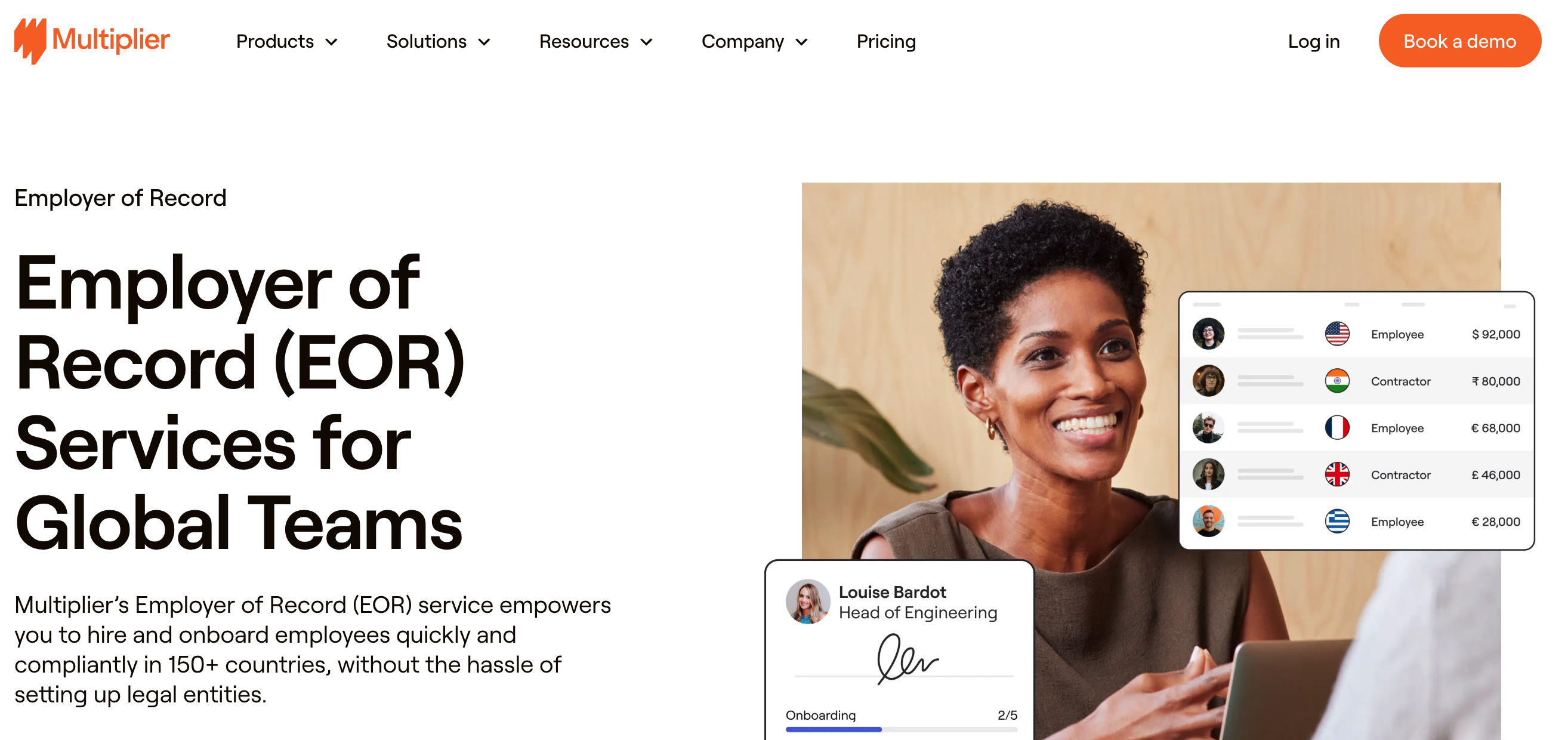
Multiplier is a global EOR platform covering 150+ countries, including Indonesia. It handles compliant employment contracts, payroll and compliance workflows, benefits administration, immigration support, and contractor management. EOR pricing starts at $400 per employee per month.
Multiplier covers Indonesia as part of its APAC footprint. The platform integrates contracts, payroll, and HR functions into a single workflow, which reduces the coordination overhead for teams hiring across multiple markets simultaneously.
Strengths:
-
Rapid onboarding with structured workflows that integrate contracts, payroll, and HR functions into a single process, suited to multi-country recruitment programs including Indonesia.
-
Coverage across 150+ countries with explicit Indonesia inclusion, supporting companies expanding distributed teams across APAC and beyond.
Limitations:
Owned Indonesian entity: PT Multiplier Technologies Indonesia.
Best for:
Multi-country teams expanding distributed headcount across APAC, including Indonesia, that want integrated payroll and compliance workflows from a single platform.
Papaya Global
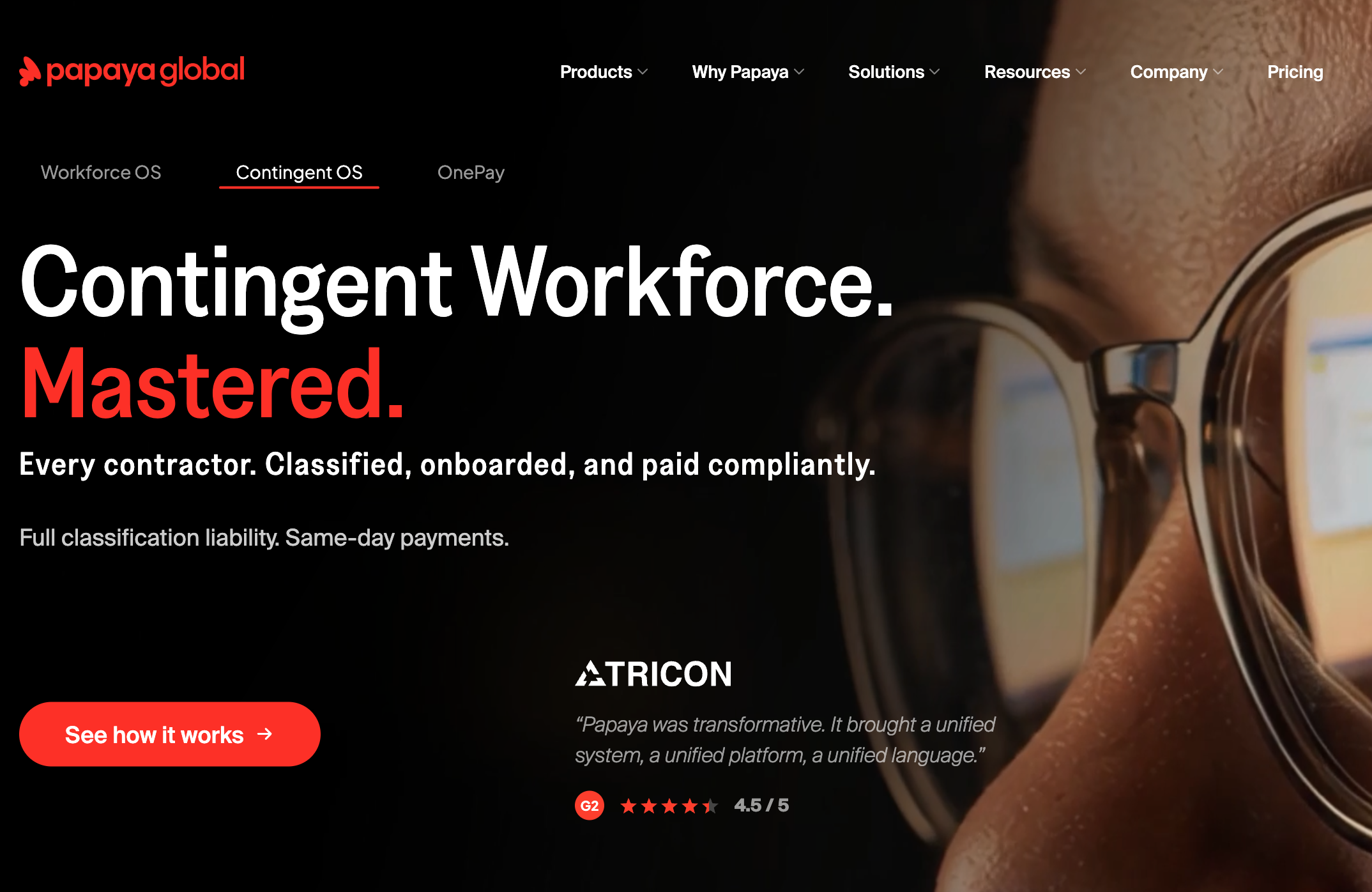
Papaya Global is a global payroll and EOR platform covering 160+ countries, with a payments network extending to 180+ countries across 130+ currencies. It acquired Azimo in 2022, giving it ownership of its cross-border payment rails. Published EOR pricing starts at $499 per employee per month, though independent analysts report negotiated quotes typically range from $650 to $770 per employee per month depending on country and tier.
The platform offers native two-way sync with Workday, SAP SuccessFactors, and NetSuite, making it a practical fit for finance and HR operations teams that already run enterprise systems. Services include EOR, managed payroll, contractor management, workforce payments, benefits, and immigration across its covered markets.
Strengths:
-
Owns its payment rails via the 2022 Azimo acquisition, so payroll and cross-border disbursement run on the same regulated infrastructure without a third-party payments intermediary.
-
Native two-way sync with Workday, SAP SuccessFactors, and NetSuite supports finance-led teams consolidating payroll data across enterprise systems.
Limitations:
-
Requires a security deposit reported at roughly two months of gross salary, plus per-country setup fees that are not publicly disclosed. Real quotes typically exceed the $499 headline rate by a significant margin.
-
Trustpilot data shows 30% one-star ratings, most citing response speed issues during active payroll cycles. Delivery quality varies across markets served by in-country partners rather than Papaya-owned entities.
Best for:
Finance-led teams consolidating payroll across 20 or more countries that need owned payment infrastructure and enterprise HRIS integrations, and are not hiring only a small number of employees abroad.
Oyster
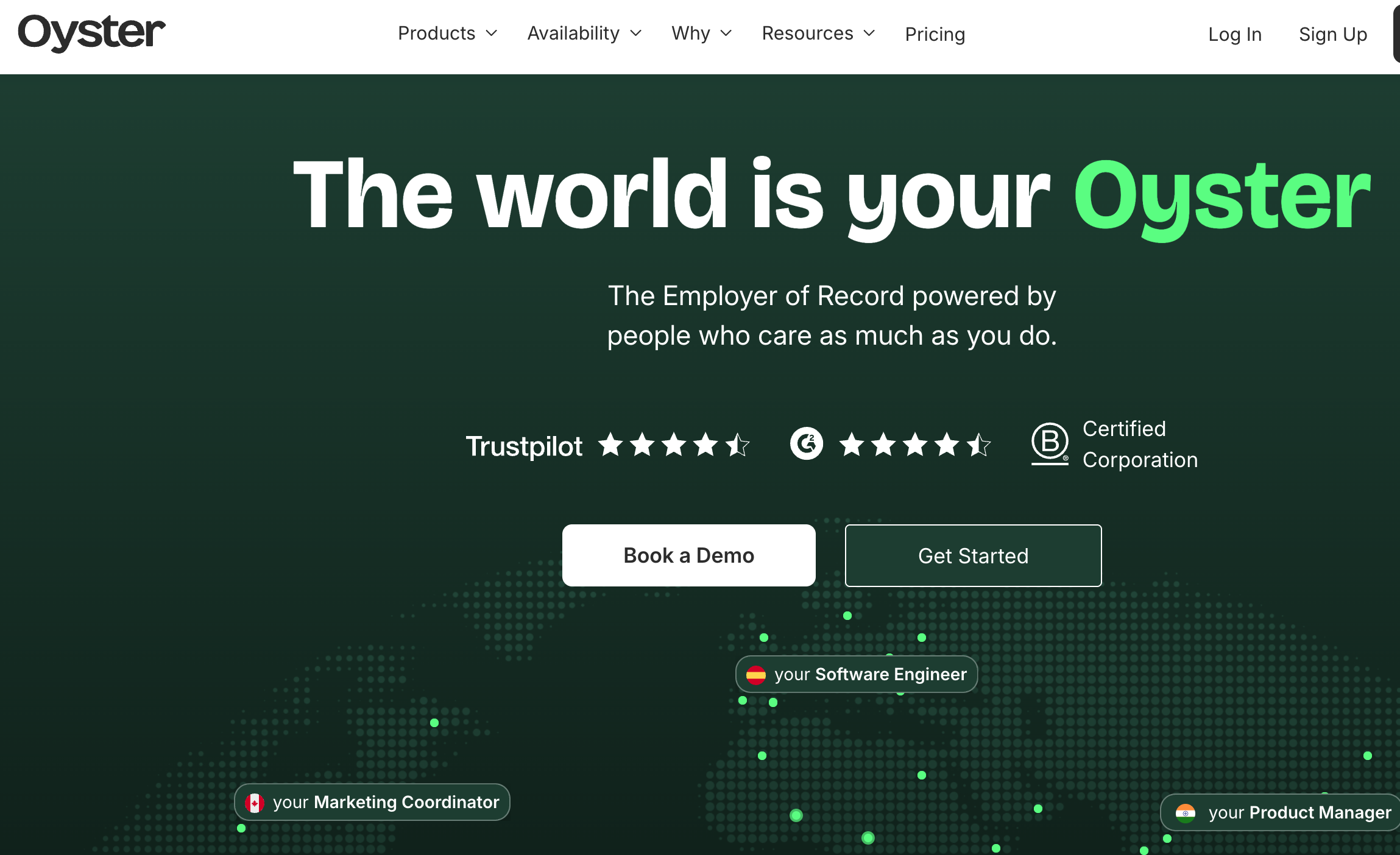
Oyster is a remote-first employment platform covering 120+ countries, including Indonesia. It handles hiring, onboarding, payroll, benefits, expenses, and compliance through a single platform built for distributed teams.
Oyster's published pricing starts at $699 per employee per month, with country-specific statutory and benefit costs applied separately. Oyster provides Indonesia-specific compliant employment, localized payroll and tax handling, and country-specific compliance guidance for employees hired in Indonesia.
Strengths:
-
Remote-first platform covering hiring, onboarding, payroll, benefits, expenses, and compliance in one place, with dedicated onboarding and offboarding specialists on every account.
-
Oyster provides Indonesia-specific compliant employment, localized payroll and tax handling, and country-specific compliance guidance for employees hired in Indonesia.
Limitations:
-
Oyster’s Help Center lists Indonesia as having no automated Global Hiring features (no virtual assistant, onboarding, automated agreements, or e‑signature).
Best for:
Best for companies needing compliant hiring in 180+ countries without entity setup, with expert, “most human” EOR support.
What Are the Key Services of an EOR in Indonesia?
An EOR in Indonesia acts as the legal employer on your behalf, managing both statutory obligations and day-to-day HR administration. Six service categories cover the full employment lifecycle.
On the statutory side, an EOR handles BPJS Ketenagakerjaan and Kesehatan enrollment, PPh 21 income tax withholding under the mandatory TER method, and THR holiday allowance payments timed to the religious calendar. These obligations carry fixed deadlines and financial penalties for late or missed filings.
The administrative layer covers compliant contract drafting (PKWT or PKWTT), payroll processing in Indonesian rupiah, benefits administration, and offboarding with severance calculated under Government Regulation 35/2021. Together, these six categories give companies full employment coverage without registering a local entity. For a broader view of how this model works, see how does EOR work.
Employment Contracts and Local Compliance
Indonesian law recognizes two employment contract types. A fixed-term contract (PKWT) applies to temporary, seasonal, or project-based roles and has a maximum total duration of five years including extensions. A permanent contract (PKWTT) applies to ongoing core roles and permits a written probation period of up to three months.
Contract type is a legal determination based on role nature, not employer preference. Misclassifying a permanent role as fixed-term triggers automatic retroactive conversion to PKWTT from day one, including full severance entitlements and BPJS arrears.
Employers must also comply with the Manpower Law as amended by the Job Creation Law (Omnibus Law). Vacancy postings must meet the non-discrimination requirements in Ministry of Manpower Circular No. M/6/HK.04/V/2025, which prohibits specifying age, gender, marital status, or appearance criteria. All open vacancies must be reported through the Karirhub portal under Perpres 57/2023 before hiring proceeds. Unresolved Karirhub violations block RPTKA processing. The annual labor report (WLKP) must be filed as a prerequisite for RPTKA processing for any foreign hire.
Payroll and Tax Administration
Payroll in Indonesia is processed in Indonesian rupiah (IDR). BPJS contributions must be remitted by the 15th of each month. PPh 21 income tax withholding uses the Average Effective Rate (TER) method, mandatory since 2024. This method replaces complex monthly progressive calculations with a standardized monthly rate tied to the employee's PTKP category.
Employers reconcile against Article 17 progressive brackets in December and must issue Form 1721-A1 by 31 March each year.
Minimum wage compliance requires applying the correct provincial rate. Indonesia has 38 provinces, each with its own UMP or UMK rate, revised annually each November. Applying a national figure without checking the applicable provincial rate is a common and costly error.
The religious holiday allowance (THR) must be paid at least seven days before the relevant religious holiday. Late payment triggers a 5% penalty on the outstanding amount. A qualified EOR tracks all provincial wage updates, manages monthly BPJS remittance, and executes THR payment on schedule.
Benefits Administration
A qualified EOR enrolls every Indonesian employee in BPJS Kesehatan (national health insurance) from day one. Coverage extends to the employee, spouse, and up to three dependent children.
BPJS Ketenagakerjaan covers four mandatory programs: JKK (work accident insurance), JKM (death insurance), JHT (old age savings), and JP (pension). Employer contributions across these programs total approximately 10.48% of salary.
One program frequently omitted from provider comparisons is JKP (job loss insurance), which carries a 0.36% employer contribution. A compliant EOR includes JKP in its statutory filings.
-
THR (religious holiday allowance) accrual tracked and paid at least seven days before the applicable holiday
-
Supplemental benefits administration where applicable to the role or employment agreement
Employee Onboarding
Indonesian onboarding through an EOR follows a defined compliance sequence. The EOR reports the open vacancy through the Karirhub portal on the SIAPkerja platform before hiring begins. This step is mandatory under Perpres 57/2023 and must be completed before any RPTKA processing for foreign workers.
If a new employee does not already hold an NPWP tax identification number, the EOR registers one as part of the onboarding workflow. For foreign hires, the EOR also confirms WLKP (mandatory labor report) compliance before proceeding, since an unresolved WLKP filing blocks RPTKA issuance.
For Indonesian nationals, the full onboarding process typically completes in under five days. Foreign worker onboarding takes longer due to permit processing timelines.
Ongoing HR Support
After onboarding, the EOR runs a fixed compliance calendar on your behalf. Monthly obligations include BPJS remittance monitoring and PPh 21 withholding remitted by the 10th of the following month.
Provincial UMK minimum wages update each November. The EOR tracks changes by region and adjusts payroll before the effective date. Annual WLKP labor report renewal is also managed as part of the standard service.
-
OSH Programme 2024 to 2029 workplace safety compliance monitoring
-
Leave balance tracking: employees accrue a minimum of 12 days paid annual leave after 12 months of service
Maternity leave administration: 3 months paid
Paternity leave administration: 2 days paid
Employee Offboarding
Offboarding obligations differ depending on contract type. Fixed-term contracts (PKWT) require end-of-contract compensation under Government Regulation 35/2021. Permanent contracts (PKWTT) trigger severance calculated on tenure under the same regulation.
The Omnibus Law sets out specific termination procedure requirements, including written notice periods and mandatory bipartite negotiation before a unilateral termination can proceed. Skipping these steps exposes the employer to reinstatement orders or additional compensation liability.
Final payroll settlement must include base salary through the last working day, compensation for unused annual leave, and any outstanding allowances. The EOR manages the settlement timeline and handles BPJS deregistration to stop contributions from the termination date.
How to Hire Through an EOR in Indonesia
Hiring through an EOR in Indonesia follows two phases: Selection and Setup, then Onboarding and Compliance. The first phase covers entity verification, vacancy reporting, and contract type selection. The second covers BPJS registration, payroll configuration, and ongoing statutory obligations.
Sequence matters under Indonesian law. Misordering steps creates retroactive liability. Late BPJS registration makes the employer liable for all healthcare costs from the original hire date. A PKWT contract used for a permanent role converts to PKWTT from day one, triggering full severance entitlements. For a full explanation of how the EOR model works, see how does EOR work.
Selection and Setup
Before any contract is signed, the employer must report the open vacancy through the Karirhub portal on the SIAPkerja platform. This is a legal requirement under Perpres 57/2023 for all employers operating in Indonesia, including foreign entities. Unresolved Karirhub violations block RPTKA processing for foreign worker permits.
Contract type selection follows vacancy reporting. Indonesian law recognizes two contract types: PKWT (fixed-term) and PKWTT (permanent). The choice is a legal determination based on the nature of the role, not employer preference. Using PKWT for an ongoing core role triggers automatic conversion to PKWTT retroactively from day one, including full severance and BPJS arrears.
Before signing with any EOR, verify three items:
-
BPJS employer registration number: confirms the EOR can actively enroll employees in social and health insurance.
-
Trade registry certificate: confirms the PT entity is legally registered in Indonesia.
-
WLKP annual labor report filing status: confirms the EOR has met its own reporting obligation, which is required before RPTKA processing can proceed.
Onboarding and Compliance
Once the contract is signed, the EOR registers the employee's tax identity. Local nationals require NPWP or NIK registration. The EOR submits this before the first payroll run.
Karirhub vacancy reporting must be confirmed complete before onboarding proceeds. Unresolved reporting blocks downstream regulatory steps, including work permit processing for foreign hires.
For foreign workers, three permits are required in sequence. First, the RPTKA manpower utilization plan is approved by the Ministry of Manpower. Second, the IMTA work permit is issued, typically within 7 to 14 working days of RPTKA approval. Third, the KITAS limited stay permit is processed through Immigration, typically taking 14 to 30 working days after IMTA issuance.
After onboarding, the EOR manages a recurring compliance calendar. BPJS contributions are remitted by the 15th of each month. PPh 21 income tax withholding is remitted by the 10th of the following month.
What Are the Benefits of Using an EOR in Indonesia?
An EOR in Indonesia covers six categories of employment obligation: statutory social insurance, income tax withholding, mandatory holiday allowances, leave entitlements, termination compliance, and foreign worker permits.
Across all six, the EOR acts as the registered employer. It handles BPJS enrollment and remittance, PPh 21 filings, THR scheduling, and Manpower Law severance calculations. Your internal HR team directs the employee's work without carrying the administrative and audit burden of Indonesian employment law.
The sections below cover each benefit category with the specific rates, deadlines, and rules that apply in 2026.
Faster Market Entry
Setting up a PT PMA takes 2 to 4 months and requires minimum placed capital of $566,508 (IDR 10 billion). An EOR requires no capital outlay and no entity registration. Time to first hire is typically under 5 days.
Karirhub vacancy reporting and WLKP compliance are managed by the EOR from day one. Your team directs the employee's work; the EOR handles every regulatory filing before the first payslip runs.
This model suits companies testing the Indonesian market with 1 to 10 employees before committing to entity registration. It also suits teams that need a hire active within a week, not a quarter. For EOR for startups and early-stage market entry, the cost and time savings over entity setup are material from the first hire.
Reduced Compliance Risk
BPJS audit exposure shifts to the EOR. PPh 21 filing liability shifts to the EOR. Manpower Law obligations, including fixed-term contract classification, religious holiday allowance, and severance calculations, are managed by an employment specialist, not your internal HR team.
The most consequential risk is fixed-term contract misclassification. Using a fixed-term contract for a permanent role triggers automatic retroactive conversion to a permanent contract from day one. That conversion carries full severance entitlements and BPJS contribution arrears from the original start date. In Supreme Court Decision No. 394 K/Pdt.Sus-PHI/2023, 200 contractors were reclassified under exactly this scenario.
A qualified EOR classifies contracts correctly at the point of hire. It monitors role nature against contract type throughout the employment period and manages any required reclassification before a dispute arises. That removes the retroactive liability before it can accumulate.
Simplified Payroll Administration
Indonesian payroll requires precise compliance across 38 provinces, each with its own UMP or UMK minimum wage floor. An EOR processes payroll in IDR and applies the correct provincial rate for each employee's work location.
PPh 21 income tax is calculated using the mandatory TER (Average Effective Rate) method and remitted to the tax authority on the correct schedule. BPJS contributions are calculated across all five programs, including the Jaminan Kehilangan Pekerjaan (employment loss insurance) program introduced under the Job Creation Law.
THR holiday allowances are accrued monthly and scheduled for payment at least seven days before the relevant religious holiday. The EOR manages the full payroll cycle, removing the need for internal Indonesian payroll expertise on your team.
Access to Local Benefits
An EOR enrolls every employee in BPJS Kesehatan (national health insurance) and BPJS Ketenagakerjaan (social security for employment) from day one. Both programs are statutory and enrollment cannot be deferred.
THR holiday allowances are administered in full: employees with 12 or more months of tenure receive one month's salary, and those with less than 12 months receive a prorated amount. The EOR calculates, schedules, and pays THR before the applicable religious holiday deadline.
-
Maternity leave: three months paid, administered in line with the Manpower Law.
-
Paternity leave: two days paid, administered at the time of birth.
-
Supplemental benefits: access to locally competitive health and insurance options through the EOR's pooled purchasing arrangements.
Lower Entity Setup Costs
Setting up a PT PMA requires a minimum investment plan of $566,508 (IDR 10 billion) (approximately $560,000–$590,000) plus ongoing annual compliance costs. An EOR eliminates that capital requirement entirely.
The break-even calculation depends on the EOR fee per seat and the provider's price point. At $400 per employee per month, the annual EOR cost for 15 employees is $72,000. At $599 per month, the same headcount costs $107,820 annually. PT PMA ongoing compliance runs roughly $6,400 per year once the entity is active, but the amortized setup cost pushes the total well above EOR fees at low headcount.
At $400 per month, the break-even threshold is typically 15 to 20 employees. At $599 per month, competitors cite a lower threshold of 8 to 10 employees. Capital opportunity cost on the $560,000 minimum investment is not included in these figures and would raise the effective PT PMA cost further. For companies below the relevant threshold, EOR is the lower-cost structure. See employer of record cost for a full breakdown.
More Flexible Workforce Scaling
An EOR lets you hire one employee or scale to 15 or more without changing your legal structure. There is no minimum headcount commitment in most EOR agreements, so you pay only for active employees.
If the Indonesian market does not perform as expected, you can exit without going through entity dissolution. Dissolving a PT PMA involves regulatory filings, creditor notifications, and a process that can take several months. An EOR relationship ends when the employment contracts end.
Multi-country expansion across APAC is also manageable under a single EOR agreement. Rather than registering separate entities in each market, one provider can cover Indonesia alongside other countries in the region, reducing administrative overhead for your HR and legal teams. For companies at an early stage, this flexibility is a core operational advantage. Learn more about EOR for startups and how entity-free employment supports growth without structural commitment.

How to Find the Right EOR for Indonesia
Choosing an EOR for Indonesia requires evaluating five criteria: local compliance expertise, entity structure, payroll execution quality, contract classification support, and ongoing reporting obligations.
Global platform features matter, but Indonesia-specific compliance depth should carry more weight for most buyers. An EOR that handles BPJS registration, THR scheduling, and PKWT classification correctly reduces your legal exposure far more than one with a polished dashboard but shallow in-country knowledge.
Local Compliance Expertise
An EOR that operates through a wholly owned Indonesian PT entity carries direct liability for BPJS registration, statutory filings, and regulatory escalation. A partner-network model introduces an intermediary between your company and the regulator, which can slow filings and reduce accountability.
BPJS registration must happen within 30 days of hire. A competent EOR registers on day one, not at the end of the window. THR must be paid at least seven days before the relevant religious holiday; proactive scheduling is a basic indicator of compliance depth.
PKWT classification is a legal determination based on role nature. An EOR should advise on contract type, not simply execute what you request. Compliance with vacancy reporting through the Karirhub portal and annual labor report filing through WLKP are further indicators of operational depth.
Before signing with any EOR, verify three items:
-
BPJS employer registration number, confirming the EOR can actively enroll your employees in social and health insurance.
-
Trade registry certificate, confirming the PT entity is legally registered in Indonesia.
-
WLKP filing status, confirming the EOR has met its own annual labor reporting obligation, which is required before work permit processing for foreign hires can proceed.
Clear Service Scope
Before signing with any EOR for Indonesia, confirm exactly what the base fee covers. Statutory costs such as BPJS Ketenagakerjaan, BPJS Kesehatan, and the annual religious holiday allowance (THR) are mandatory employer obligations. Ask whether they are included in the quoted fee or billed separately as pass-through costs.
Foreign worker permit sponsorship, including RPTKA processing and KITAS support, is often an add-on. Clarify this before onboarding any expatriate employee. PT PMA transition support is a separate service at most providers; confirm whether it is in scope or requires a separate agreement.
Pricing structure matters too. Percentage-of-salary models increase cost as salaries rise, with no added compliance value. Gloroots uses predictable, country-specific flat-fee pricing with full cost visibility before onboarding and no percentage-of-salary component.
Support Model
Ticket-based support is not adequate for Indonesian employment compliance. BPJS disputes, Ministry of Manpower inquiries, and Omnibus Law termination questions require a specialist who knows the file, not a generalist working from a queue.
Ask whether the provider assigns a dedicated account manager or routes requests through a shared inbox. Confirm whether in-country Indonesian HR and legal specialists are available on your plan, or whether support comes from a generalist global team with no local expertise.
Response time matters during Indonesian business hours and across the country's 17 national public holidays and 8 collective leave days. Escalation paths for BPJS contribution disputes or Ministry of Manpower filings should be defined in writing before you sign. Gloroots provides human-led account support with retained business context and dedicated account management across its global operations.
Technology and Reporting
A capable EOR platform tracks BPJS contributions in real time and provides remittance confirmation after each payment cycle. For PPh 21, the TER calculation method has been mandatory since 2024, and your EOR should produce a clear audit trail showing how each employee's effective rate was applied.
Provincial UMK minimum wages update every November across all 38 Indonesian provinces. Platforms that automate this update reduce the risk of underpayment penalties. Payroll reporting should be denominated in IDR with transparent foreign exchange rates applied to the EOR fee.
Integration with your existing HRIS reduces manual data entry and reconciliation errors. One trade-off worth evaluating: self-serve platforms offer greater configurability but may require your team to carry more compliance knowledge internally, while managed-service models provide expert oversight at the cost of direct platform control.
Scalability for Your Hiring Plans
If your Indonesia hiring is part of a broader APAC expansion, confirm whether the EOR covers multiple countries under a single master services agreement. Managing separate contracts per country adds administrative overhead and creates inconsistent employment governance across your workforce.
Foreign worker hires require RPTKA approval and KITAS sponsorship. Not every EOR handles both Indonesian nationals and expatriate staff. Verify this capability before signing, particularly if your team includes technical or managerial roles filled by non-Indonesian nationals.
Ask whether the EOR offers a structured path to PT PMA entity transition when your headcount reaches the break-even point, typically 15 to 20 employees. A provider that supports this transition keeps employment continuous and BPJS coverage uninterrupted during the registration period. For companies planning to scale significantly, see EOR for enterprises to understand how Gloroots supports larger workforce programs. Also confirm minimum and maximum headcount served in Indonesia, and whether the contract runs month-to-month or requires an annual commitment.

Why Gloroots Is a Strong EOR Partner in Indonesia
Several EOR providers cover Indonesia. Gloroots differentiates on compliance accountability and cost predictability, which matter most for APAC multi-country programs where payroll errors compound across markets.
Gloroots supports compliant full-time employment across 150+ countries through four integrated service lines: Global Employer of Record (EOR), Global Payroll, Compliance and Employment Governance, and Benefits and Statutory Coverage. Each service line operates under a single account structure, so your team manages Indonesian headcount alongside other APAC markets from one workforce dashboard.
For Indonesia specifically, Gloroots uses in-house Indonesian HR and payroll specialists rather than third-party partners. The platform provides real-time BPJS tracking and built-in Manpower Law expertise, giving clients direct compliance accountability from day one of employment.
Pricing follows a predictable, country-specific model with full cost visibility before onboarding. There is no percentage-of-salary pricing. The Indonesia-specific rate starts at $400 per employee per month with full BPJS and Manpower Law compliance included. You can review the full rate structure on the Gloroots pricing page before committing.
Human-led account support with retained business context means your account team carries knowledge of your Indonesian workforce structure across every interaction. That continuity reduces the risk of compliance gaps when regulations update, such as the 2024 TER method change for PPh 21 or annual UMK minimum wage revisions.
For teams running EOR for mid-market companies across APAC, Gloroots provides centralized workforce visibility covering hiring, payroll, compliance, benefits, and reporting in one place. See the full Gloroots EOR services page for a complete breakdown by service line.
FAQs About the Best EOR in Indonesia
How does an EOR work in Indonesia?
An EOR becomes the legal employer of record in Indonesia. It registers with the Ministry of Manpower, handles BPJS enrollment, withholds PPh 21 income tax, pays the annual THR religious holiday allowance, and maintains full compliance with the Manpower Law. Your company directs the employee's daily work.
Third-party employment arrangements are legal in Indonesia. No prohibition applies to the EOR model. The EOR carries the statutory obligations; your team retains operational control. Typical onboarding runs under five days, compared to two to four months for PT PMA entity registration. For a deeper look at how the model operates, see how does EOR work.
What does an EOR cost in Indonesia?
EOR management fees across the eight providers reviewed range from approximately $400 to $650 per employee per month. That fee covers employment administration but not statutory costs.
Statutory costs are additional. Employer BPJS contributions total approximately 10.48% of gross salary, plus a JKP unemployment insurance contribution of 0.36%. THR accrues at approximately 8.33% of annual salary and must be paid before the relevant religious holiday. Combined, total employer costs above gross salary run approximately 20 to 25%, including THR accrual.
Gloroots uses predictable, country-specific pricing with no percentage-of-salary markup and full cost visibility before onboarding begins. For a full breakdown of how EOR fees compare across providers and markets, see employer of record cost.
When should a company use an EOR in Indonesia?
An EOR is the rational choice in four specific situations: market testing with 1–10 employees, speed-to-hire priority, hiring local talent only, and multi-country APAC expansion under a single agreement.
When hiring only Indonesian nationals, no independent RPTKA sponsorship is required, so entity ownership adds no compliance advantage. For EOR for small business teams, the cost case is clear: below approximately 8–15 employees (depending on the EOR price point), the annual EOR management fee is typically lower than the ongoing compliance cost of running a PT PMA.
EOR also suits companies that want compliance liability shifted to a specialist. BPJS audit exposure, PPh 21 filings, and Manpower Law obligations sit with the EOR provider, not your internal HR team.
Can an EOR hire both local and foreign employees in Indonesia?
Yes. An EOR can hire Indonesian nationals directly under either a fixed-term (PKWT) or permanent (PKWTT) contract, depending on the role.
For foreign workers (TKA), the EOR must sponsor a three-step permit chain: the RPTKA manpower utilization plan, the IMTA work permit, and the KITAS temporary stay permit. Foreign workers in Indonesia are restricted to fixed-term PKWT contracts only.
Not all EOR providers actively sponsor these permits. Some only advise on the process rather than executing it. Confirm sponsorship capability before signing any EOR agreement. KITAS processing timelines vary; verify the current timeline directly with your chosen provider or the relevant Indonesian authority before committing to a hire date.
How do I choose the right EOR in Indonesia?
Evaluate each provider on five criteria: whether they operate a wholly owned Indonesian PT entity, the quality of their BPJS execution, pricing transparency (flat fee versus percentage of salary), their support model (dedicated specialist versus ticket-based), and whether they offer a structured path to PT PMA transition.
To verify claims, ask each provider for their BPJS employer registration number and their WLKP annual labor report filing status. Both are public records that confirm active compliance standing.
Use the scored comparison table earlier in this article to compare providers side by side across these dimensions before requesting a quote.