




- Georgia imposes a flat 20% income tax and a 2% employer pension contribution with no broader social security levy, making the total statutory cost burden comparatively low and predictable for companies hiring through an EOR.
- Companies without a Georgian LLC must use an EOR rather than a PEO, since a PEO requires an existing local entity for co-employment while an EOR acts as the legal employer directly.
- EOR onboarding in Georgia typically takes one to two weeks, compared to several months required to register a local LLC and complete Revenue Service enrollment.
- Providers should be evaluated on whether they operate through an owned Georgian entity, file directly with the Revenue Service, and process payroll in Georgian Lari with correct tax withholding, not just on country coverage claims.
- Georgia's visa-free regime covering 90 or more nationalities simplifies hiring foreign workers in most cases, but companies in the IT sector should confirm whether their chosen EOR understands virtual zone tax structures and territorial tax optimization.
Georgia offers a flat 20% income tax, a 15% corporate tax on distributed profits only, and a visa-free regime covering 90-plus nationalities. These conditions make it one of the more accessible markets in the Caucasus for companies hiring without a local entity. An best employer of record partner handles payroll, statutory filings, and Labor Code compliance so you can employ workers in Georgia without registering a local company.
The providers below were evaluated on pricing transparency, Georgia compliance depth, onboarding speed, support model, and scalability. An Employer of Record (EOR) is the legal employer of your workers; a Professional Employer Organization (PEO) co-employs staff and typically requires you to hold a local entity. All providers listed here operate as EORs.
Georgia at a glance: Capital Tbilisi, population approximately 3.74 million, currency Georgian Lari (GEL), official language Georgian, 40-hour workweek, monthly payroll cycle, tax due by the 15th of the following month, 15% corporate tax on distributed profits, 2% employer pension contribution, and a 20% flat employee income tax plus 2% employee pension.
Our Top 8 Picks: Georgia for EOR Comparison 2026
The table below compares eight EOR providers on the criteria most relevant to hiring in Georgia: pricing, coverage, onboarding speed, platform experience, support model, and scalability. Providers were evaluated using publicly available pricing, verified coverage data, and documented support structures. All pricing figures are in USD and exclude the statutory 2% employer pension contribution, which applies on top of any EOR service fee. For a broader view of employer of record software options, see our dedicated guide.
| Provider | Pricing per month | Country coverage | Onboarding speed | Platform experience | Customer support | Scalability |
|---|---|---|---|---|---|---|
| Gloroots | From $199 per employee/month | 150+ countries including Georgia | 3–5 business days; country-dependent | Unified platform for hiring, onboarding, payroll and compliance | 24/7 human support with dedicated specialists | SMB to Enterprise |
| Deel | $599 per employee/month | 130+ countries for EOR | As fast as 2 days; country-dependent | Unified platform covering EOR, payroll, HR, compliance and contractor management | 24/7 support with in-house HR, legal and tax experts | SMB to Enterprise |
| Multiplier | $499 per employee/month monthly; $459 annually | 150+ countries | As fast as 24 hours; country-dependent | Unified platform covering EOR, payroll, benefits, compliance and onboarding | 24/7 dedicated customer support | SMB to Enterprise |
| Globalization Partners (G-P) | Custom pricing | 180+ countries | Country-dependent | G-P Meridian platform with AI-powered compliance and workforce management | Dedicated customer support and global experts | Mid-market to Enterprise |
| Safeguard Global | Custom pricing | 187 countries | Launch in weeks; country-dependent | Enterprise workforce platform with localized compliance workflows and real-time analytics | 400+ in-house experts with multilingual support | Mid-market to Enterprise |
| Remote | $699 per employee/month | 90+ countries for EOR | Country-dependent; dedicated onboarding specialist | Platform-driven workflows for employment, payroll, benefits and compliance | Dedicated specialist and global support | Mid-market to Enterprise |
| Oyster | $699 per employee/month | 120+ countries for EOR | As fast as 48 hours | Automated hiring, payroll, benefits, expenses and compliance workflows | End-to-end support from local experts | SMB to Enterprise |
| Pebl | $399 per employee/month | 185+ countries | As fast as 48 hours | AI-powered EOR platform covering hiring, onboarding, payroll, benefits and compliance | 24/7 concierge-level support with 240+ in-country experts | SMB to Enterprise |

Top 8 Best EOR Platforms in Georgia for
The right EOR for Georgia depends on your hiring scenario. For a single hire or pilot engagement, a flat-fee global platform gives cost predictability. IT and crypto companies can use Georgia's virtual zone status to reduce tax exposure, so a provider familiar with that framework matters. Enterprises scaling beyond 50 employees need a provider with centralized governance and multi-country payroll. Teams operating in Georgian or Russian require local-language contract support.
One structural point applies to every company without a Georgian entity: a Professional Employer Organization (PEO) requires a registered Georgian LLC or branch before it can co-employ staff. An Employer of Record operates under its own Georgian legal entity, so no local registration is needed on your side. If your company has no Georgian LLC, only an EOR applies.
The eight providers below were selected and ranked based on Georgia-specific compliance coverage, pricing transparency, onboarding speed, platform capability, and the breadth of hiring scenarios each can support.
Gloroots
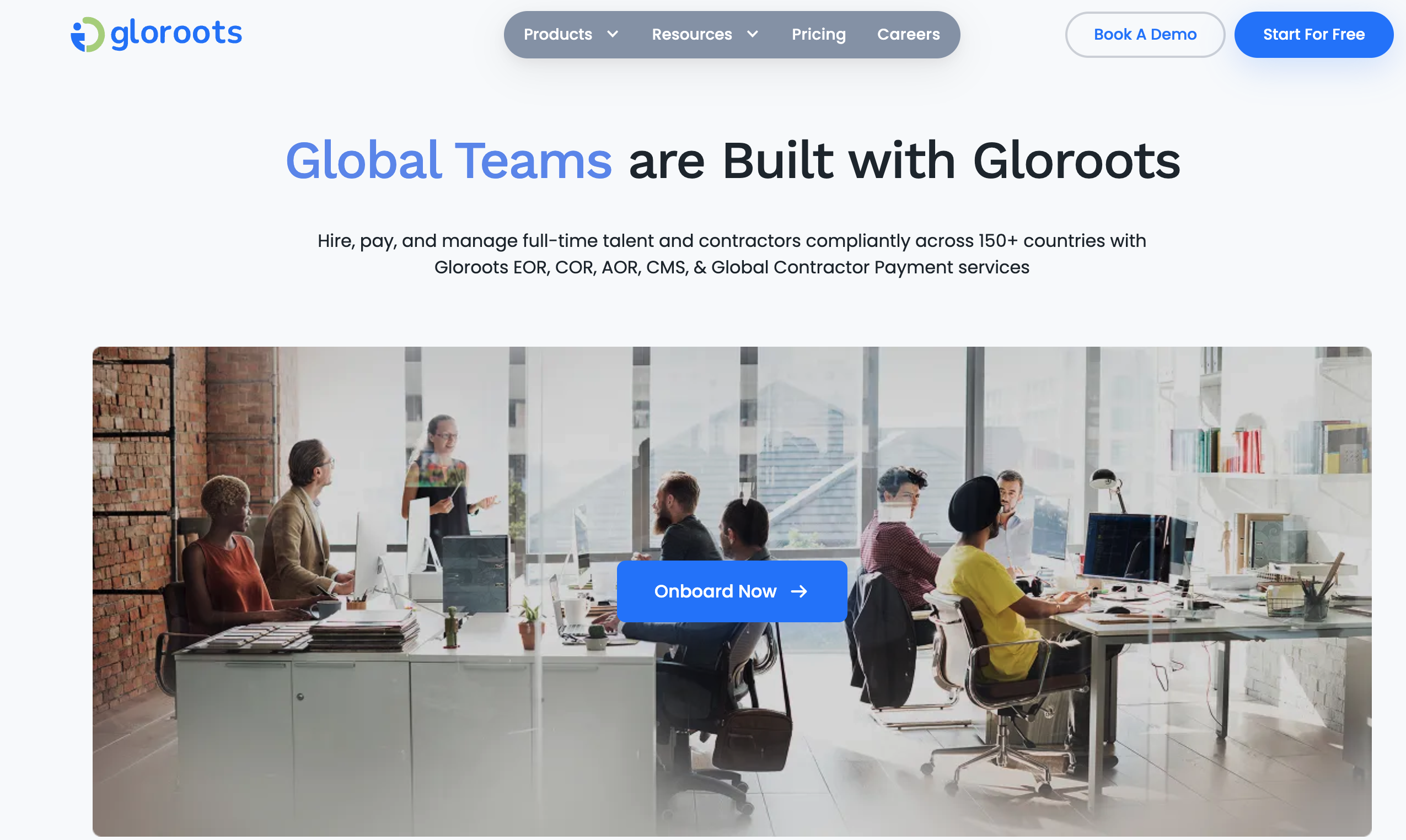
Gloroots supports compliant full-time employment across 150+ countries, including Georgia, operating as the legal employer under its own entity so client companies need no Georgian LLC or branch. The platform covers Global Employer of Record (EOR), Global Payroll, Compliance and Employment Governance, and Benefits and Statutory Coverage in a single workflow.
Pricing is predictable and country-specific, with full cost visibility provided before onboarding begins. Gloroots does not use percentage-of-salary pricing, which means monthly costs stay fixed regardless of employee compensation levels. Human-led account support with retained business context is included across all client tiers.
Georgia's pension scheme requires a 2% employer contribution, a 2% employee contribution, and up to a 2% state co-contribution. Gloroots manages these statutory deductions alongside income tax withholding and Revenue Service filings. Third-party platform ratings for Gloroots are not publicly listed in researched sources.
Strengths:
-
Predictable, country-specific pricing with no percentage-of-salary component gives finance teams a fixed monthly cost regardless of salary levels, supporting accurate budget planning.
-
Centralized workforce visibility and human-led account support with retained business context reduce the coordination overhead that grows as headcount scales across multiple countries.
-
Global coverage across 150+ countries means a company that starts with one hire in Georgia can add headcount in other markets without switching providers or rebuilding compliance workflows.
Limitations:
-
Third-party review ratings and independent benchmark scores for Gloroots are not publicly listed in researched sources.
Best for:
Companies hiring in Georgia without a local entity that need predictable flat-fee pricing, centralized compliance governance, and the option to scale into additional markets without changing providers.


Deel
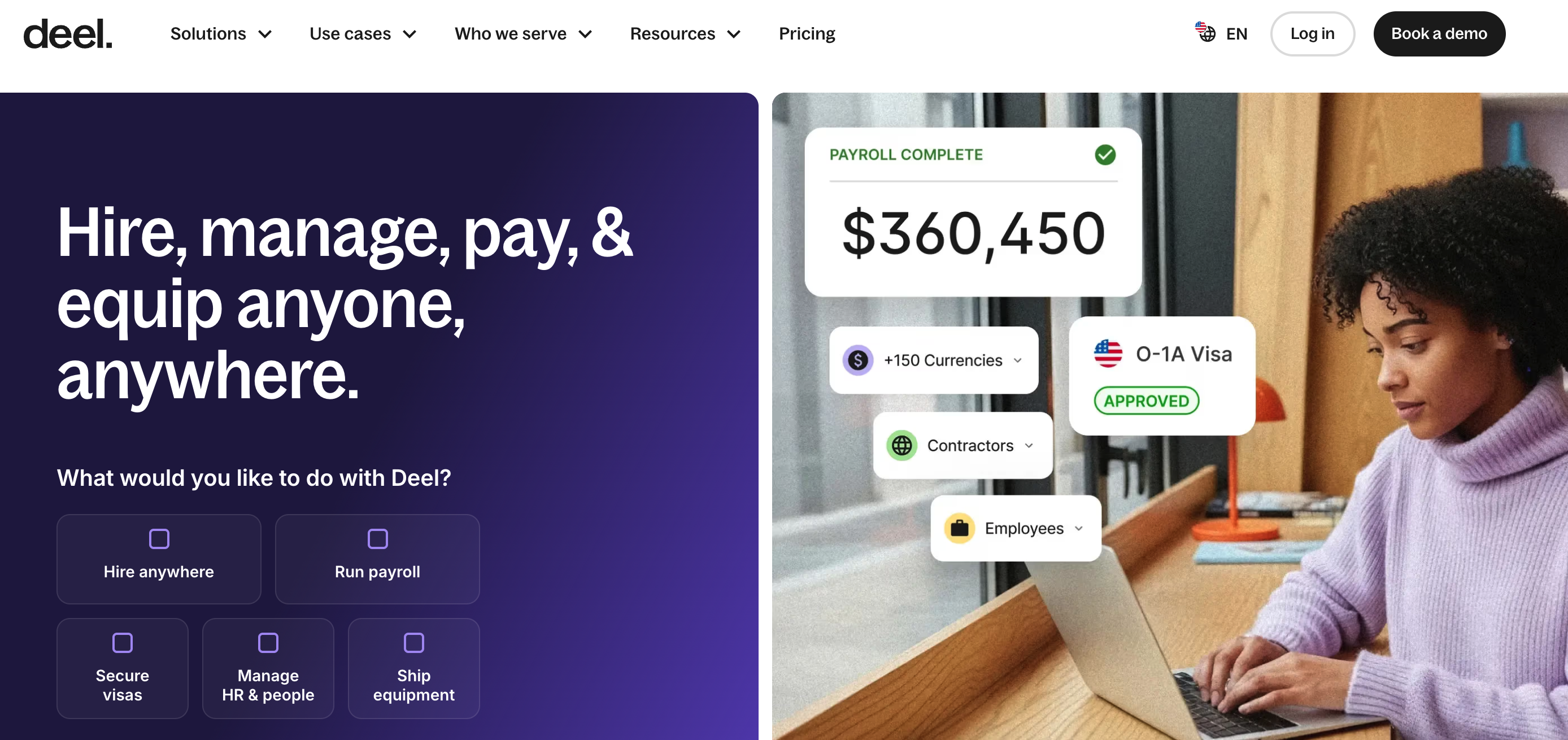
Deel covers Georgia through its global EOR platform, allowing companies to hire Georgian employees without setting up a local entity. It operates through wholly owned legal entities across 150+ countries, giving it direct control over employment processes rather than relying on third-party partner networks. This structure supports faster onboarding and consistent compliance standards across markets, including Georgia.
Deel's platform handles contracts, payroll, tax filings, and statutory benefits with AI automation built into core workflows. It also connects with 100+ HR, payroll, and finance tools, and includes immigration and visa support alongside IT asset management. Pricing starts at $599 per employee per month for EOR services.
Ranked number one on G2 for Employer of Record, Global Employment, and Multi-Country Payroll, Deel is trusted by more than 40,000 companies. Customer support runs 24 hours a day, five days a week, not around the clock, so teams in time zones outside standard business hours should factor that into their evaluation.
Strengths:
-
Operates through wholly owned legal entities rather than third-party partner networks, providing direct control over onboarding, payroll, and compliance in Georgia and 150+ other countries.
-
Ranked number one on G2 for Employer of Record, Global Employment, and Multi-Country Payroll, with more than 40,000 companies on the platform.
-
Includes AI automation across contracts, payroll, and tax filings, plus 100+ integrations with HR, payroll, and finance tools.
Limitations:
-
Customer support operates 24/5, not 24/7. Teams requiring assistance outside those hours may experience delays.
Best for:
Fast-scaling companies hiring across multiple countries that need a single platform covering EOR, payroll, contractor management, and immigration without switching providers as headcount grows.
Multiplier
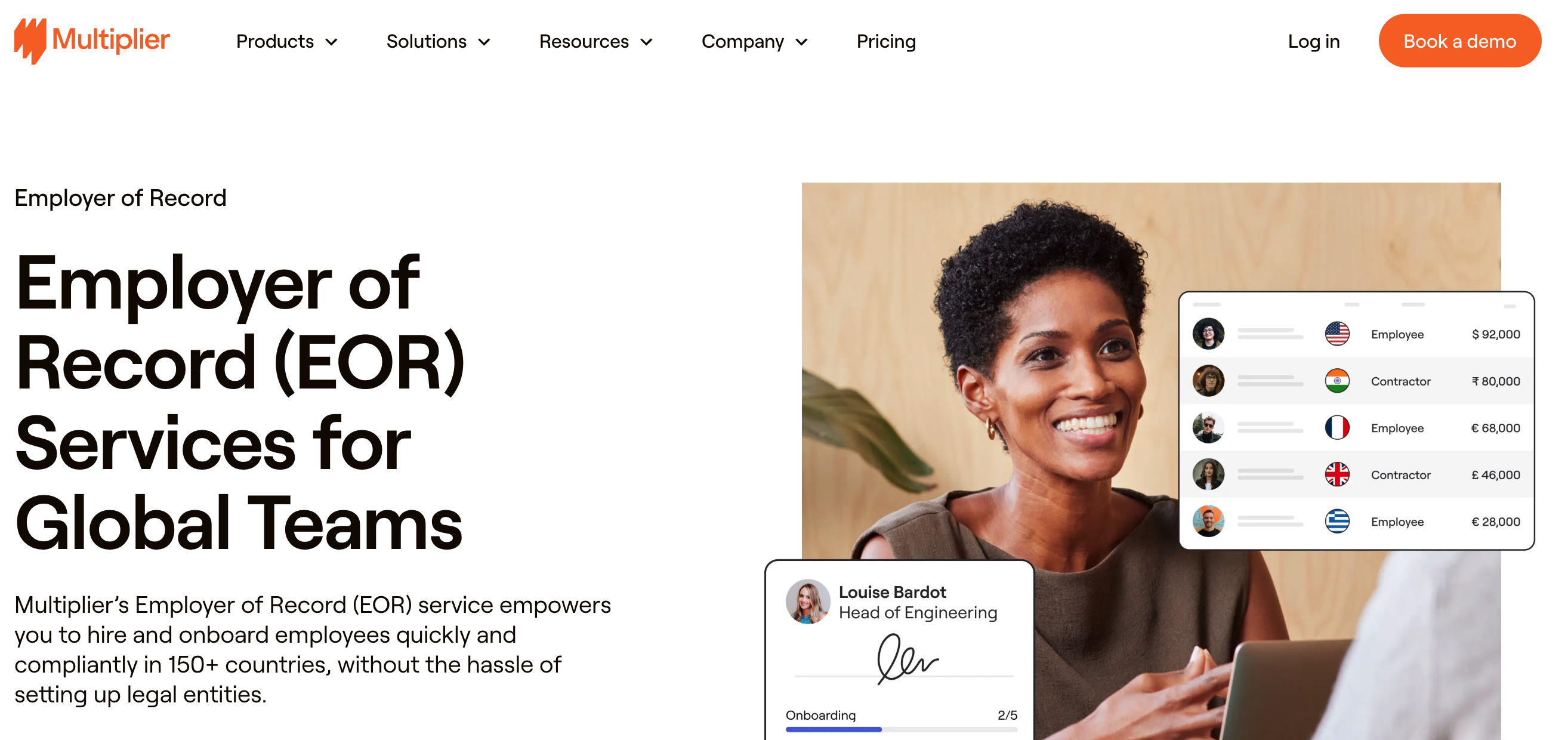
Multiplier is a global EOR provider covering 150+ countries, with a base in Sydney. It is listed as a top EOR option for Georgia, supporting compliant hiring under the Georgian Labour Code. This includes payroll processed in Georgian Lari, tax withholdings, and mandatory pension contributions.
Multiplier is noted for its accessible price point, with sources citing a starting price of approximately $400 USD per employee per month, though this figure should be confirmed directly with the provider before budgeting. The platform is described as particularly strong in the APAC region, with simplified onboarding processes suited to companies entering new markets.
Public sources reviewed describe Multiplier as APAC-strong but note that its global compliance depth may be more limited compared to larger rivals with broader owned-entity infrastructure. Whether Multiplier operates through an owned entity or a partner model in Georgia specifically is not documented in the sources reviewed.
Strengths:
-
Listed as a top EOR provider for Georgia, with documented support for Georgian Labour Code compliance, payroll in Georgian Lari, tax withholdings, and mandatory pension contributions.
-
Accessible starting price of approximately $400 USD per employee per month, making it a cost-competitive option for companies with tighter hiring budgets.
Limitations:
-
Global compliance depth is described as more limited compared to larger EOR providers. Companies hiring across many high-complexity markets may find coverage gaps.
-
Whether Multiplier uses an owned entity or a partner network in Georgia is not documented in the sources reviewed. operates via a local partner in Georgia
Best for:
Companies seeking a cost-accessible EOR for Georgia and APAC-region hiring, particularly those with straightforward compliance needs and a preference for simplified onboarding.
Globalization Partners
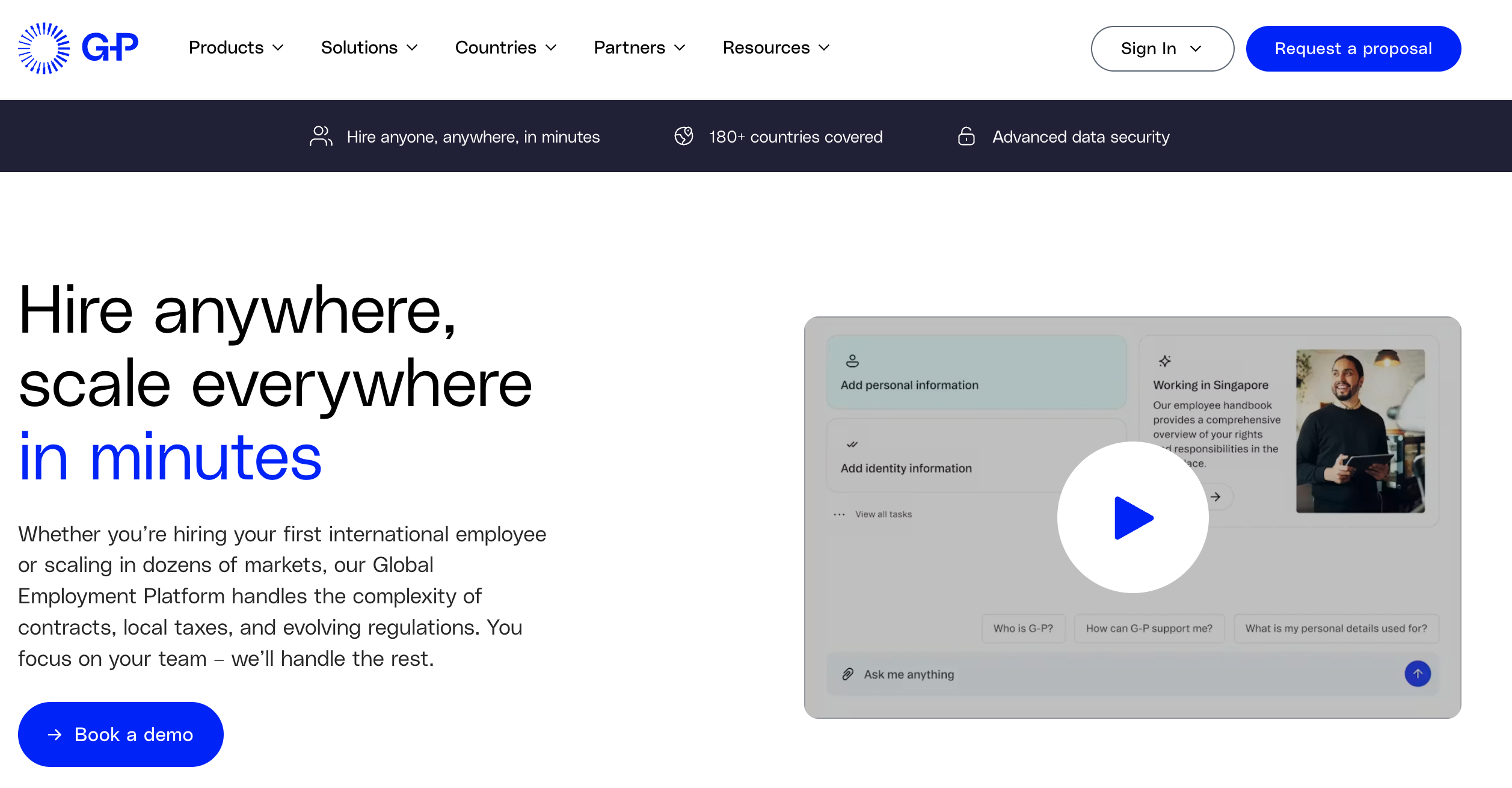
Globalization Partners (G-P) covers 180+ countries and has operated in the global EOR market for more than 13 years. The company supports compliant employment through its own infrastructure, offering EOR, contractor management, global mobility, and integrations including API and MCP Server connectivity.
G-P includes an AI-powered compliance intelligence tool called G-P Gia, which helps HR and legal teams stay current with employment law changes across markets. Georgia falls within G-P's broad geographic footprint, though country-specific service details for Georgia are not documented in the sources reviewed.
Pricing is not publicly disclosed. Companies interested in G-P's services for Georgia should contact the provider directly to request a quote tailored to their headcount and requirements.
Strengths:
-
Covers 180+ countries with more than 13 years of operating experience, providing broad geographic reach for enterprises managing multi-country workforces.
-
G-P Gia is an AI-powered compliance intelligence tool that supports HR and legal teams with employment law monitoring across markets.
-
Offers API and MCP Server integrations, supporting connectivity with existing HR, finance, and payroll systems.
Limitations:
-
Pricing is not publicly disclosed, which makes upfront cost comparison difficult without engaging the sales team directly.
Best for:
Enterprise companies that need broad multi-country EOR coverage and want AI-assisted compliance tooling across a large, geographically distributed workforce.
Safeguard Global

Safeguard Global is one of the earlier entrants in the global EOR market, with 18+ years of experience and coverage across 187+ countries. The company operates through owned local entities rather than third-party partner networks, which gives it direct control over employment processes and compliance execution.
Safeguard Global employs 400+ in-country experts who handle local employment law, payroll, and statutory obligations. This in-country expert model differs from platform-only EOR providers that rely on automated workflows without dedicated local specialists. Georgia falls within Safeguard Global's 187+ country coverage, though Georgia-specific service details are not documented in the sources reviewed.
Starting price is listed from $499 USD per employee per month in Australian market sources and from $699 USD per employee per month in general listings. Companies should contact Safeguard Global directly to confirm which pricing tier applies to Georgia engagements.
Strengths:
-
Operates through owned local entities across 187+ countries rather than third-party partners, providing greater consistency and compliance assurance across markets.
-
Employs 400+ in-country experts, offering human-led compliance support that goes beyond platform-only EOR models.
Limitations:
-
Pricing varies across market listings ($499 to $699 USD per employee per month), and Georgia-specific pricing is not confirmed in the sources reviewed.
Best for:
Compliance-focused enterprises that require owned-entity coverage and dedicated in-country expert support across a large number of countries.
Remote
Remote covers 90+ countries through owned legal entities, which means it does not rely on third-party partner networks to employ workers. This structure gives companies direct control over employment processes and consistent compliance standards across markets. Pricing starts at $699 per employee per month.
Remote emphasizes platform-driven workflows, standardizing how employment contracts, payroll runs, and statutory filings are executed across its supported countries. For Georgia, Remote supports compliant hiring without requiring companies to establish a local entity, handling payroll and employment obligations under local law.
Remote includes IP protection through its Remote IP Guard feature, which is relevant for technology companies hiring software engineers or product teams internationally.
Strengths:
-
Operates through owned legal entities across 90+ countries, providing direct employment control without reliance on third-party partners.
-
Platform-driven workflows standardize employment processes, reducing variation in how contracts, payroll, and filings are handled across countries.
-
Remote IP Guard provides intellectual property protection, which is relevant for tech companies building distributed engineering teams.
Limitations:
-
Coverage of 90+ countries is narrower than hybrid providers that combine owned entities with partner networks, which may limit options for companies hiring across a wider range of markets.
-
Public sources reviewed did not document a Georgia-specific limitation beyond general coverage scope.
Best for:
Distributed teams seeking a standardized global employment experience with consistent, platform-driven workflows across owned-entity markets.
OysterHR
OysterHR supports EOR hiring in 180+ countries with payroll processed in 140+ local currencies, including Georgian Lari. The platform works with directly owned entities and reputable partners to employ workers compliantly under local law. EOR pricing starts at $699 per employee per month.
For Georgia, OysterHR covers payroll processing, tax withholding, and statutory benefits administration under the Georgian Labour Code. It offers employment practices liability coverage and country-specific legal guidance to reduce compliance risk for companies hiring in markets where local regulations require careful management.
OysterHR primarily serves mid-market and enterprise companies building distributed teams across multiple countries. Its contractor management service is available at $29 per contractor per month after a 30-day free trial.
Strengths:
-
Offers employment practices liability coverage and country-specific legal guidance, reducing compliance risk when hiring across 180+ countries including Georgia.
-
Supports payroll in 140+ local currencies, covering Georgian Lari payroll, tax withholdings, and statutory contribution processing.
-
Works with directly owned entities and reputable partners, providing flexibility in how employment is structured across different markets.
Limitations:
-
Advertised fees exclude salary, employer social contributions, mandatory benefits, and currency conversion costs, so total costs often exceed headline rates by 20 to 50 percent or more.
-
Costs increase significantly when hiring across high-tax countries, and foreign exchange margins and benefit markups reduce budget predictability for companies managing multi-country payroll.
Best for:
Mid-market and enterprise companies with 50 or more employees building distributed teams across multiple countries, prioritizing compliance coverage and employee experience.
Pebl
Pebl (formerly Velocity Global) is a global Employer of Record platform operating across 185+ countries. It covers hiring, onboarding, payroll, taxes, immigration, and benefits without requiring clients to set up local entities. EOR pricing starts at $399 per employee per month.
For Georgia, Pebl supports EOR services with employees paid in GEL, managing statutory contributions and employment contracts in line with Georgian Labor Code requirements. The platform combines automated workflows with local compliance support.
One detail worth confirming before signing: Pebl does not publicly disclose whether its Georgia employment runs through a Pebl-owned entity or a local partner. Prospective clients should ask for that entity structure directly before committing.
Strengths:
Wide country coverage across 185+ countries, including Georgia
-
Transparent base pricing starting at $399 per employee per month
-
Covers payroll, taxes, immigration, and benefits in a single platform
-
AI-powered workflows reduce manual steps during onboarding and compliance management
Limitations:
-
Entity structure for Georgia (owned vs. partner) is not publicly confirmed; clients should verify directly
-
Pricing beyond the base rate, including benefits and immigration fees, is not fully disclosed publicly
Best for: Companies hiring across multiple countries who want broad coverage, a clear starting price, and integrated immigration support without setting up local entities.
What Are the Key Services of an EOR in Georgia for?
An EOR in Georgia covers the employment obligations that a foreign company cannot easily manage without a local entity. Every service must align with the Georgian Labor Code and Revenue Service (RS.ge) digital filing requirements.
One differentiator to evaluate carefully is pension contribution handling. Georgia operates a 2%+2%+2% mandatory pension model, where the employee, employer, and government each contribute 2% of gross salary. Providers that automate this three-way calculation and file directly with RS.ge reduce your compliance exposure significantly.
Use the six service areas below to assess whether a provider covers your full employment lifecycle in Georgia:
-
Payroll and tax management: GEL salary processing, 20% flat personal income tax withholding, and RS.ge digital filings.
-
Pension and social contributions: Automated 2%+2%+2% pension model and 2% unemployment insurance contributions.
-
Labor Code compliance: Employment contracts in Georgian or English, probation periods up to six months, and compliant termination procedures.
-
Work permit and immigration support: Coordination of Georgia's visa-free regime for 90+ nationalities and residence permit processing when required.
-
Benefits administration: Statutory leave (minimum 24 working days), public holidays, maternity leave, and sick leave management.
-
Tax optimization: Structuring employment to use Georgia's territorial tax system and IT virtual zone benefits where applicable.
Employment Contracts and Local Compliance
Every employment relationship in Georgia must comply with the Law of Georgia on Labor, commonly called the Georgian Labor Code. Contracts must cover role, compensation, working hours, and termination conditions.
Fixed-term contracts carry specific restrictions under Georgian law. They are permitted only for genuinely temporary work, and repeated renewals can result in a court treating the arrangement as indefinite employment.
Before any employee can be legally hired, the employer must complete registration with RS.ge, the Georgian Revenue Service. This registration is a prerequisite for compliant payroll filings and tax withholding. An EOR handles this registration on behalf of the client company, along with full contract localization into Georgian or English. Client companies do not need to retain Georgian legal counsel to meet these requirements.
Payroll and Tax Administration
Georgia runs a monthly payroll cycle. Employers must remit withheld income tax and pension contributions to RS.ge by the 15th of the following month.
The mandatory pension contribution splits into three parts: 2% from the employee, 2% from the employer, and up to an additional 2% state co-contribution applied to the untaxed portion of salary. Georgia imposes no broader employer social security tax beyond this 2% employer pension contribution, making the statutory cost burden comparatively low.
A straightforward total cost of employment calculation looks like this: gross monthly salary, plus the 2% employer pension contribution on that salary, plus the EOR service fee. There are no additional mandatory social insurance levies on top of these amounts. This cost structure gives finance teams a predictable monthly figure before onboarding begins.
Benefits Administration
An EOR in Georgia administers statutory benefits as defined under the Georgian Labour Code. Employees receive a minimum of 24 working days of paid annual leave per year.
Georgia observes 15 official public holidays, including New Year (January 1 and 2), Orthodox Christmas (January 7), Epiphany (January 19), Mother's Day (March 3), and Independence Day (May 26). 18 statutory public holidays
Maternity leave runs for 730 days, with 183 days paid. The EOR administers both statutory minimums and any supplementary benefits agreed in the employment contract. Sick leave entitlement specifics are governed by individual contract terms, as Georgian law does not mandate a fixed paid sick leave period beyond what is contractually agreed.
Employee Onboarding
EOR onboarding in Georgia follows a defined sequence. The EOR registers as the employer with the Revenue Service (RS.ge), prepares a Labour Code-compliant employment contract in Georgian or English, and enrolls the employee in the mandatory pension scheme.
Payroll is set up in Georgian Lari (GEL), with the EOR handling tax withholding and social contribution filings from the first pay cycle. Bank account setup for GEL salary disbursement is coordinated during onboarding.
Georgia's visa-free regime for citizens of 90 or more nationalities simplifies onboarding for foreign hires, removing the need for work permits in most cases. E-signature capability supports fully remote onboarding, allowing contracts to be signed and returned without requiring the employee to be physically present in Georgia.
Ongoing HR Support
A Georgia EOR runs monthly payroll in Georgian Lari and files all required returns with the Revenue Service (RS.ge) by the 15th of each month. Pension contributions at 20% employer rate and 2% unemployment insurance are remitted on the same cycle.
Georgia's regulatory environment is actively changing. The crypto asset framework, virtual zone eligibility rules, and Labor Code amendments require continuous monitoring. An EOR with dedicated in-country specialists tracks these changes and applies updates before they affect payroll or contracts.
Support model matters here. A dedicated account manager who retains context about your workforce is more effective than a ticket-based system where each query starts from scratch. Gloroots provides human-led account ownership, giving clients a single point of contact with retained business context across every payroll cycle and compliance update.
Employee Offboarding
The Georgian Labor Code permits termination on several grounds, including mutual agreement, expiry of a fixed-term contract, employee initiative, and employer initiative with documented justification. Each ground carries specific procedural requirements that must be followed to avoid legal exposure.
Severance pay under Georgian law applies in employer-initiated terminations. The standard entitlement is at least one month's salary, though contract terms may specify a higher amount. Final payroll settlement, including accrued leave, must be completed within the statutory period following the termination date.
As part of offboarding, the EOR files the employee deregistration with RS.ge, closing the tax and social contribution record correctly. Managing this process through an EOR reduces the client's direct legal exposure at every step, from issuing the termination notice through to final Revenue Service filings.
How to Hire Through an EOR in Georgia for
Companies without a Georgian LLC must use the EOR model. A Professional Employer Organization (PEO) requires a co-employment structure tied to an existing local entity, while an EOR acts as the legal employer directly, removing that requirement.
Hiring through an EOR in Georgia typically takes one to two weeks. Setting up a local LLC can take several months, including registration, tax enrollment, and RS.ge filing setup. For companies that need to hire quickly, the EOR route is the practical choice.
Different use cases suit different providers. A startup hiring one or two engineers in Tbilisi has different requirements than an enterprise scaling a regional team across the Caucasus. Understanding how does EOR work before selecting a provider helps match the right service model to your hiring scenario.
Selection and Setup
Selecting an EOR for Georgia requires checking specific operational capabilities, not just country coverage. The criteria below reflect Georgia's regulatory environment.
-
RS.ge filing capability: the provider must file directly with the Georgian Revenue Service, not through a third-party intermediary.
-
GEL payroll processing: salaries must be processed in Georgian Lari with correct tax withholding applied.
-
Georgian Labor Code contract localization: employment contracts must comply with local requirements, available in Georgian or English.
-
Visa-free hiring coordination: the provider should manage hiring for nationals of the 90-plus countries that qualify for Georgia's visa-free regime.
-
Territorial tax optimization expertise: the provider should understand Georgia's territorial tax system and IT sector benefits, including virtual zone structures.
-
Pricing transparency: all costs, including the mandatory 20% employer pension contribution and 2% unemployment insurance, must be disclosed upfront.
-
Owned entity vs. partner model: providers operating through an owned Georgian entity offer more direct compliance control than those relying on local partners.
The table below compares setting up a local Georgian LLC against using an EOR for employment purposes.
| Factor | EOR | Local Georgian LLC |
|---|---|---|
| Setup time | 1 to 2 weeks | Several months, including LLC registration and RS.ge enrollment |
| Initial cost | Monthly service fee, no registration capital required | Legal fees, notarization, and registration costs |
| Ongoing cost | Predictable monthly fee per employee | Accounting, legal, and administrative overhead |
| Compliance management | Handled by the EOR, including RS.ge filings and Labor Code obligations | Managed internally or via local advisors |
| Scalability | Add or reduce headcount without structural changes | Requires entity restructuring for significant changes |
| Local expertise required | Provided by the EOR | Must be hired or contracted separately |
| Risk | Compliance risk sits with the EOR | Full compliance risk sits with the company |
| Best for | Companies testing the Georgian market or hiring a small to mid-size team | Companies with long-term, large-scale Georgian operations |
Before signing with any provider, check for these red flags: no owned Georgian entity, inability to file directly with RS.ge, contracts not localized to the Georgian Labor Code, pricing that excludes pension contributions, and no GEL payroll capability.
Onboarding and Compliance
Georgian EOR onboarding follows a defined sequence. The company signs an EOR agreement, and the EOR registers as the legal employer with the Revenue Service (RS.ge). An employment contract is then drafted in Georgian or English under the Labor Code.
The employee is enrolled in the mandatory pension scheme. The first payroll run processes salaries in Georgian Lari, with 20% income tax and 2% pension contributions withheld. RS.ge filings are due by the 15th of the following month.
Citizens of 90 or more visa-free countries can begin work without a permit. Assignments lasting more than one year require a residence permit.
What Are the Benefits of Using an EOR in Georgia for?
An EOR in Georgia gives companies access to a market with a territorial tax system, a 20% flat income tax rate, and a visa-free regime covering citizens of 90 or more countries. These conditions reduce both the cost and the administrative burden of building a local team.
Georgia's IT sector has grown to more than 30,000 professionals across Tbilisi, Batumi, and other cities. An EOR lets companies reach that talent pool without registering a local entity.
The same model applies whether a company is hiring one employee or scaling a full team. The EOR manages payroll, contracts, and RS.ge filings at every stage, so headcount decisions are not constrained by entity setup timelines or fixed administrative costs.
Faster Market Entry
An EOR lets you hire in Georgia in one to two weeks. Registering a local LLC typically takes several weeks, plus additional time for compliance setup and Revenue Service registration.
Georgia ranks 7th globally for ease of doing business, which makes it an attractive first market in the Caucasus region. An EOR removes the entity requirement entirely, so you can hire in Tbilisi, Batumi, and Kutaisi without establishing a regional presence first.
For companies testing the Georgian market or scaling quickly, entity-free employment is a faster and lower-risk entry path than local incorporation.
Reduced Compliance Risk
Georgian compliance carries specific risks that an EOR manages on your behalf. These include RS.ge filing errors, incorrect pension contribution rates, Labor Code contract violations, and misclassification of contractors as employees.
Georgia's Labor Code includes termination protections that require precise procedural compliance. An EOR handles notice periods, termination documentation, and employee protections according to current Labor Code requirements, reducing your exposure to disputes.
RS.ge digital filing requirements apply to payroll tax submissions and social contribution reporting. An EOR executes these filings directly, reducing the risk of penalties from late or incorrect submissions.
Simplified Payroll Administration
Georgian payroll involves fewer employer-side obligations than most countries. There is no employer social security tax beyond the mandatory pension contribution, which reduces the total cost of employment compared to markets like Germany or France.
The core deductions on a GEL 3,000 gross salary work as follows: the employee pays 20% income tax (GEL 600) and a 2% pension deduction (GEL 60), leaving a net take-home of GEL 2,340. The employer adds a separate 2% pension contribution (GEL 60) on top of gross salary, plus the EOR service fee.
All payroll filings go to the Revenue Service (RS.ge) by the 15th of each month. An EOR handles GEL currency processing, income tax withholding, pension deductions, and monthly RS.ge submissions, keeping your payroll cycle predictable and fully compliant with Georgian tax law.
Access to Local Benefits
Georgian law sets clear statutory minimums for all employees. Workers are entitled to 24 working days of paid annual leave per year, 15 public holidays, and sick leave under the Labour Code. Maternity leave runs for 730 days in total, with 183 of those days paid.
An EOR administers these entitlements directly, ensuring every employee receives what the law requires without the employer tracking each obligation manually. Beyond statutory minimums, EOR providers can also administer supplementary benefits common in Georgia's tech sector, including private health insurance and meal allowances.
Georgia's territorial tax system applies only to Georgian-source income. This means certain allowances and non-cash benefits can be structured in a way that reduces the overall tax burden for both employer and employee, making the total compensation package more cost-efficient without breaching Revenue Service rules.
Lower Entity Setup Costs
Setting up a Georgian LLC (Limited Liability Company) requires registration fees, notary costs, and ongoing accounting obligations. Annual reporting and Revenue Service (RS.ge) compliance add recurring administrative expenses that vary year to year.
An EOR replaces those variable costs with a single, predictable monthly fee. Companies avoid the burden of local audit requirements, statutory filings, and dedicated in-country accounting staff.
Gloroots uses predictable, country-specific pricing with full cost visibility before onboarding. There are no percentage-of-salary fees, and all service components are itemized upfront, making budget planning straightforward from the first hire.
More Flexible Workforce Scaling
Georgia's Labor Code supports both fixed-term and indefinite employment contracts, giving companies flexibility in how they structure their workforce from the start.
An EOR lets companies scale from one employee to 50 or more without changing their legal structure. Georgia's visa-free regime for citizens of 90 or more countries also makes it practical to bring in international talent quickly, without lengthy permit processes.
When scaling down, offboarding through an EOR is equally direct. There is no entity wind-down, no liquidation process, and no residual compliance obligations tied to a local legal structure.

How to Find the Right EOR for Georgia for
Choosing an EOR for Georgia requires more than comparing headline prices. Buyers should evaluate providers on their ability to handle RS.ge employer registration and monthly filings, payroll in Georgian Lari (GEL), Georgian Labor Code contract localization, and territorial tax optimization for IT and virtual zone companies.
One red flag to watch: some EORs operate in Georgia through local partner networks rather than owned legal entities. This increases compliance risk and slows response times when filing deadlines or Labor Code questions arise.
The five criteria below map directly to the subsections that follow. Use them to assess any provider before signing a contract.
Local Compliance Expertise
Georgian compliance has specific technical requirements. Every employer must register with the Revenue Service (RS.ge) and submit monthly payroll filings through its digital portal. Employment contracts must be localized to the Georgian Labor Code, covering notice periods, probation terms, and termination procedures.
Mandatory pension scheme enrollment requires three equal contributions of 2% each from the employee, the employer, and the state. Income tax is withheld at a flat 20% rate on Georgian-source income. A capable EOR handles all of these obligations without requiring the client to manage filings directly.
Ask any provider whether it operates through an owned Georgian legal entity or relies on a local partner. Partner-reliant models add a layer between your workforce and the compliance function, which increases risk and slows resolution when issues arise.
Advanced compliance differentiators include expertise in Georgia's territorial tax system and virtual zone status for IT companies. These structures can reduce effective tax rates significantly, but only providers with in-country Georgian tax knowledge can apply them correctly.
Clear Service Scope
A Georgian EOR should cover payroll in Georgian Lari (GEL), Revenue Service (RS.ge) tax filings, Labor Code-compliant employment contracts, mandatory pension administration (20% employer contribution), and full offboarding including RS.ge deregistration.
Some providers exclude RS.ge filing fees or pension contributions from their quoted price. Request all-in pricing before signing, so the total monthly cost per employee is clear from day one.
Tax optimization consulting, such as structuring employment under Georgia's territorial tax system or qualifying for virtual zone benefits available to IT companies, is often an add-on service not included in the base EOR fee. Confirm whether this is bundled or billed separately.
Support Model
EOR providers offer different support structures: 24/7 human support, business-hours-only coverage, or ticket-based systems with no guaranteed response time.
Georgia operates in UTC+4. Companies based in the United States or Asia should confirm that their provider's support hours cover their local working day, not just European business hours.
Native Georgian language support is a meaningful differentiator when managing local employee relations, handling termination procedures, or resolving Labor Code disputes with Georgian staff.
The structure of account management also matters. A dedicated account manager retains context about your Georgian workforce and can answer complex compliance questions directly. A shared support pool typically routes queries to whichever agent is available, which can slow resolution on RS.ge or pension contribution issues.
Technology and Reporting
Georgia's Revenue Service requires digital filing through RS.ge, so providers without direct integration risk delays and filing errors. Confirm that any EOR you consider supports RS.ge submissions natively.
Core technology requirements for Georgia include GEL payroll processing, e-signature support for Georgian employment contracts, and a real-time compliance dashboard that tracks obligations as they change. These are not optional features; they are operational necessities.
Reporting should cover Georgian pension contribution tracking (the mandatory 20% employer contribution) and income tax withholding summaries at the 20% flat rate. Providers that generate these reports automatically reduce the administrative burden on your finance and HR teams and give you auditable records for Revenue Service review.
Scalability for Your Hiring Plans
Your EOR choice should match where your hiring plan is going, not just where it starts. A single IT hire in Tbilisi has different requirements than a 50-person team or a crypto company operating under Georgia's virtual zone framework.
Local Georgian boutique providers often serve SMBs well but may not support enterprise headcount growth or multi-country expansion. Global platforms are better positioned to scale with you if your plans extend beyond Georgia into Armenia, Azerbaijan, or the broader CIS region.
For companies that expect to grow, confirm that the provider can handle increased headcount without renegotiating contracts or switching platforms. Gloroots is built for this kind of scale, supporting entity-free employment across 150+ countries from a single platform. Teams planning enterprise-level hiring in Georgia can review the EOR for enterprises offering for details on governance and workforce visibility at scale.

Why Gloroots Is a Strong EOR Partner in Georgia for
Gloroots supports compliant full-time employment across 150+ countries, including Georgia, through a single integrated platform. Companies get predictable, country-specific pricing with full cost visibility before onboarding starts. There is no percentage-of-salary pricing, so buyers know the exact cost before committing.
The platform combines four integrated service pillars: Global Employer of Record (EOR), Global Payroll, Compliance & Employment Governance, and Benefits & Statutory Coverage. Each pillar operates together, so payroll, filings, and statutory benefits run without switching between providers or tools.
For Georgia specifically, Gloroots manages RS.ge filing integration, GEL payroll processing, and employment contracts localized to the Georgian Labor Code. The platform supports territorial tax optimization and coordinates visa-free hiring for citizens of 90+ countries. Centralized workforce visibility gives HR and finance teams a live view of payroll obligations and compliance status across every active hire.
Human-led account support with retained business context means the team handling your account understands your workforce structure over time, not just individual tickets. This matters when managing Georgian pension contributions, unemployment insurance filings, and Labor Code contract requirements across a growing headcount.
Gloroots is a practical fit for IT, fintech, crypto, and remote-first companies entering Georgia. These sectors benefit directly from Georgia's territorial tax system, virtual zone advantages, and visa-free talent access. Gloroots structures employment to support those advantages from day one.
For companies evaluating Georgia EOR options, Gloroots EOR services is a recommended starting point. Review Gloroots pricing to confirm cost structure before shortlisting other providers.
FAQs About the Best EOR in Georgia for
The questions below address the most common Georgia EOR questions raised by international buyers evaluating compliant hiring options in the country. Each answer is structured to give direct, factual responses to the queries buyers search for most when researching Georgia EOR providers.
Georgia's flat 20% personal income tax, territorial tax system, and visa-free access for citizens of 90+ countries make it a practical hiring destination for global companies. An EOR removes the need to establish a local legal entity while keeping employment fully compliant with the Georgian Labor Code and Revenue Service (RS.ge) requirements.
The sections below cover how EOR works in Georgia, what compliance obligations apply, how payroll is processed in Georgian Lari, and what to look for when comparing providers for IT, fintech, and remote-first teams.
How does an EOR work in Georgia for?
An EOR in Georgia becomes the legal employer of your workers. Your company retains full day-to-day management of the employee, while the EOR handles all statutory obligations.
The EOR registers with the Revenue Service (RS.ge), processes payroll in Georgian Lari (GEL), withholds the 20% flat income tax, and manages the 2% employer pension contribution. Monthly filings are submitted to RS.ge by the 15th of the following month.
Employment contracts are localized in Georgian or English to meet Georgian Labor Code requirements. No Georgian LLC is required to employ workers through this model. For a detailed explanation of the mechanics, see how does EOR work.
What does an EOR cost in Georgia for?
EOR fees in Georgia typically range from approximately $199 to $699 or more per employee per month, depending on the provider and scope of services.
This fee is separate from the employee's gross salary and the 2% employer pension contribution. Georgia has no employer social security tax beyond the pension, which keeps total employment costs relatively low compared to many other countries.
When comparing providers, request all-in pricing that covers RS.ge filing and pension administration. Some providers charge a percentage of salary rather than a fixed fee. For a full breakdown of what drives employer of record cost, Gloroots publishes predictable, country-specific pricing with no percentage-of-salary component.
When should a company use an EOR in Georgia for?
A company should use an EOR in Georgia when it wants to hire Georgian employees or foreign workers based in Georgia without registering a local entity. Common scenarios include testing the Georgian market with one or two hires, hiring remote IT talent in Tbilisi, or accessing Georgia's visa-free regime for international employees.
An EOR also suits companies that want to use Georgia's virtual zone tax benefits without the complexity of entity setup. If a company already has a Georgian LLC, a PEO model may be an alternative. Without a local entity, an EOR is the only compliant path. EOR for startups and EOR for small business options make this accessible at any scale.
Can an EOR hire both local and foreign employees in Georgia for?
Yes. An EOR in Georgia can hire both Georgian citizens and foreign nationals. Citizens of 90 or more countries can live and work in Georgia for up to one year without a visa or work permit, which makes international hiring straightforward.
For longer assignments, the EOR can support residence permit applications. The EOR manages all immigration compliance regardless of the employee's nationality, covering contract setup, payroll, and statutory contributions from day one.
How do I choose the right EOR in Georgia for?
Start by confirming whether the provider operates through an owned Georgian legal entity or relies on third-party partners. Owned entities give you direct control over compliance and faster onboarding.
Check that the provider can file directly with RS.ge, process payroll in Georgian Lari, and localize employment contracts to the Georgian Labor Code. Pricing should be transparent and include pension contributions (20%) and unemployment insurance (2%), not just the headline fee.
Evaluate the support model against Georgia's UTC+4 timezone. If you plan to grow into other Caucasus or CIS markets, confirm the provider can scale beyond Georgia without requiring a platform switch.