



● EORs in Germany handle payroll in EUR, social insurance contributions, works council coordination, AUG-licensed labor leasing, and strict labor law compliance — letting you hire employees in Germany without setting up a local entity.
● Gloroots leads for German compliance and execution depth, with transparent pricing starting at $199/month per employee.
● Remofirst also offers the most affordable entry point at $199/month with full German statutory compliance, making it ideal for startups making a first German hire.
● Multiplier leads in user ratings (4.9/5) with strong CBA management, while Remote provides best-in-class GDPR compliance through its owned German legal entity.
● The right EOR depends on labor law depth, works council experience, payroll accuracy, GDPR compliance, pricing transparency, and whether the provider has local German HR staff on the ground.
Hiring in Germany is complex. The country has some of Europe's most structured labor laws, from mandatory works council consultation to strict AUG licensing for labor leasing.
Germany's workforce is among Europe's most productive, with over 45.5 million employed workers and a legal framework that requires precise handling of social security contributions, collective bargaining agreements, and statutory benefits. Getting this wrong exposes companies to significant penalties.
An employer of record removes that burden entirely. You hire the talent, and the EOR handles the legal employer role covering AUG-licensed labor leasing, payroll in EUR with accurate deductions, GDPR-compliant documentation, and works council coordination.
This guide covers how to evaluate and choose the best EOR in Germany based on compliance strength, pricing transparency, onboarding speed, and local expertise.
A Quick Comparison: Top 12 EOR Providers in Germany [2026]
What is an EOR in Germany?
An Employer of Record (EOR) in Germany is a third-party organization that legally employs workers on behalf of another company. It allows businesses especially foreign companies to hire employees in Germany without setting up their own legal entity.
By taking on the role of the legal employer, an EOR ensures compliance with German labor laws while managing payroll, benefits, and HR operations, making market entry faster and less risky.
Modern EOR software platforms make this process fully digital, from contract generation and works council notification through monthly payroll and GDPR-compliant documentation. Before evaluating providers, it's worth reviewing a detailed breakdown of employer of record costs for Germany total employer cost runs roughly 20% above gross salary once social contributions are added.
Top 12 EOR Providers in Germany [2026]
1. Gloroots — Best for German compliance and execution depth
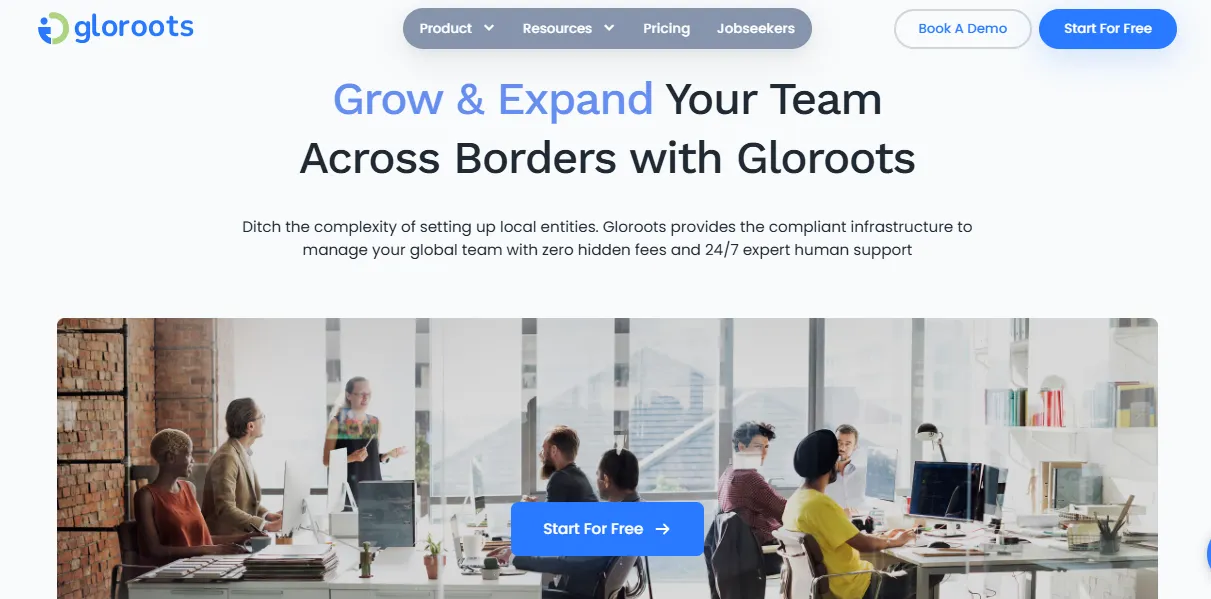
Gloroots is an employer of record platform that adds a recruitment layer as well on top of the EOR services for companies looking to hire employees from 150+ countries including Germany. For EOR services in Germany Gloroots handles German labor law compliance, works council coordination, payroll, social insurance, and GDPR documentation as one integrated workflow
What sets Gloroots apart is the balance between speed and accuracy. Onboarding completes in 2–3 days with German-language contracts, full Finanzamt registration, and social insurance enrolment without skipping the steps that cause problems later. Local HR specialists speak German, understand works council dynamics, and guide termination procedures correctly the first time.
Pricing is transparent from $199 per employee per month, single invoice, no hidden charges. 24/7 human support with named account ownership and a live dashboard for real-time payroll, FX, and compliance visibility.
Key Features
● Single-click payroll with real-time tracking and multi-currency support
● Automated compliance covering social security, tax calculations, and labor law
● Live dashboard showing workforce expenses, liabilities, FX rates, and compliance status
● Localized benefits management designed for German regulatory requirements
● In-house German compliance experts managing contracts and social contributions
● 24/7 support across all client tiers, regardless of time zone
● Rapid onboarding with 2–3 day activation and no entity setup required
Germany-Specific Services
● EOR hiring and onboarding with full German compliance, including works council coordination
● Automated payroll covering income tax, solidarity surcharge, and all social insurance contributions
● Benefits management aligned with German statutory requirements, including health insurance
● GDPR-compliant employment documentation and real-time compliance monitoring
● AUG-licensed labor leasing and termination procedure support
Pros
● Transparent pricing from $199/month with no hidden charges
● Fast German onboarding in 2–3 days
● Strong in-house compliance team covering German labor law
● 24/7 human support available for all clients
● Live dashboard for real-time payroll and compliance visibility
Cons
● Better suited for SMB and mid-market than large enterprise custom needs
● Global coverage breadth may lag behind larger platforms like Deel for niche markets
Pricing
Transparent pricing starts from $199 per employee per month with no hidden fees explore our full EOR pricing plans for detailed service breakdowns.
Best For
Companies entering Germany seriously where works council coordination, labor law precision, and GDPR rigor matter more than headline onboarding speed. Learn more about hiring employees in Germany through Gloroots.



2. Remote — Best for owned-entity compliance and IP protection
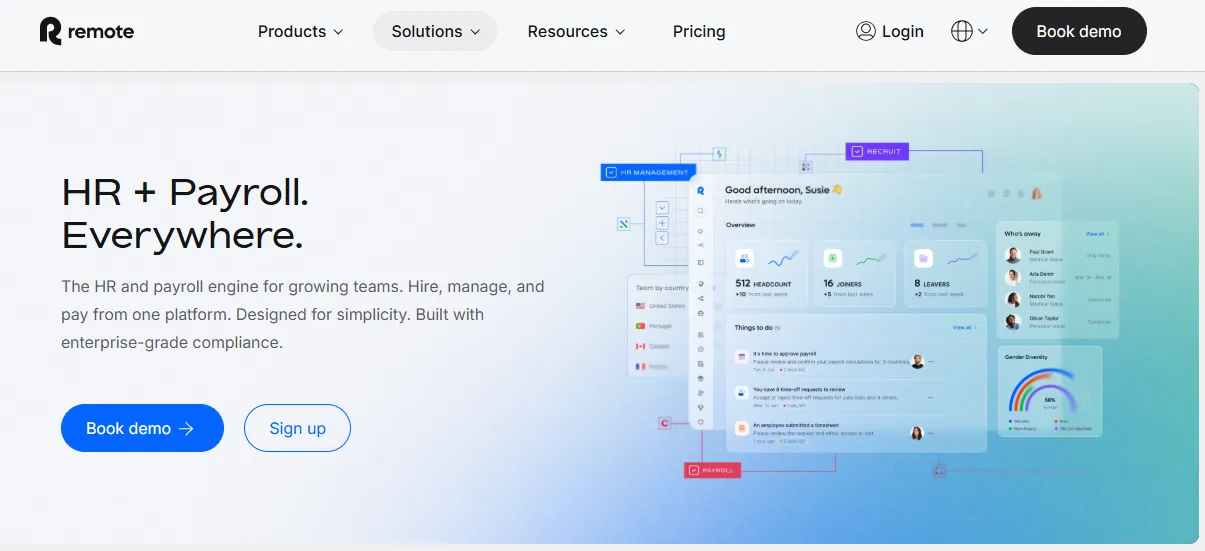
Remote operates its own legal entity in Germany, giving stronger structural compliance than partner-network EORs. The platform handles Kündigungsschutzgesetz payroll, dedicated GDPR architecture, IP indemnity for engineering hires, and live cost transparency for finance teams.
Key Features
● Owned German legal entity providing direct regulatory alignment
● Live payroll transparency with real-time breakdown of all costs and taxes
● Dedicated GDPR compliance architecture exceeding standard requirements
● Global multi-country coordination from a single unified platform
Pros
● Direct entity ownership gives stronger compliance certainty than partner-based models
● Best-in-class GDPR and IP protection for German hires
● Transparent cost reporting with no surprises
Cons
● Premium pricing at $599/month
● Onboarding speed (3–5 days) slower than some competitors
● Customer support is 24/5 rather than around-the-clock
"Remote's transparency was the deciding factor for us. The live cost dashboard and their IP protection policies gave our legal team real confidence in the German hiring process."
— Customer review, G2
Pricing
From $599/month per employee. No hidden charges; premium tier reflects direct entity operations and GDPR compliance depth.
Best For
Companies hiring senior engineering or legal-sensitive talent where structural compliance and IP protection justify the cost.
3. Deel — Best for fast onboarding and contractor-first hiring
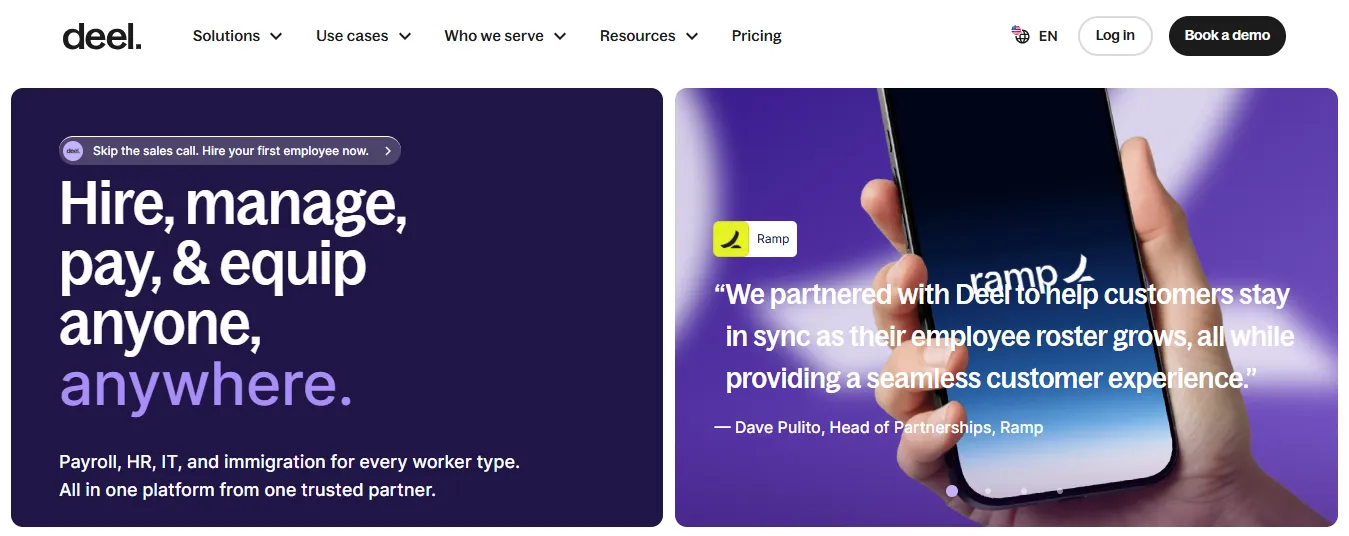
Deel offers some of the fastest onboarding in the market (1–2 days) and the strongest contractor-to-employee conversion tooling. Native German legal entity with multi-currency payroll across 150+ countries. For companies weighing whether to use an EOR or engage contractors directly, this EOR vs contractor comparison covers the key differences.
Key Features
● Instant digital onboarding with automated German employment contracts
● Automated multi-currency salary disbursement with local compliance
● GDPR-dedicated data protection processes for German operations
● Global dashboard for unified management of German and international teams
Pros
● Among the fastest onboarding speeds at 1–2 days
● Strong global coverage across 150+ countries
● Native German legal entity for direct compliance assurance
Cons
● Premium pricing at $599/month
● Support is 24/5 not 24/7
● Deep customization for complex German CBAs may require additional support
"Deel's onboarding speed in Germany is unmatched. We had contracts signed and payroll set up within 48 hours of deciding to hire."
— Customer review, G2
Pricing
From $599/month per employee. The premium tier reflects advanced automation, a global feature set, and native German entity operations.
Best For
Growing companies and tech-driven firms running mixed contractor-employee teams across multiple countries, where Germany is one market among many.
4. WorkMotion — Best for Germany-specific expertise and onboarding
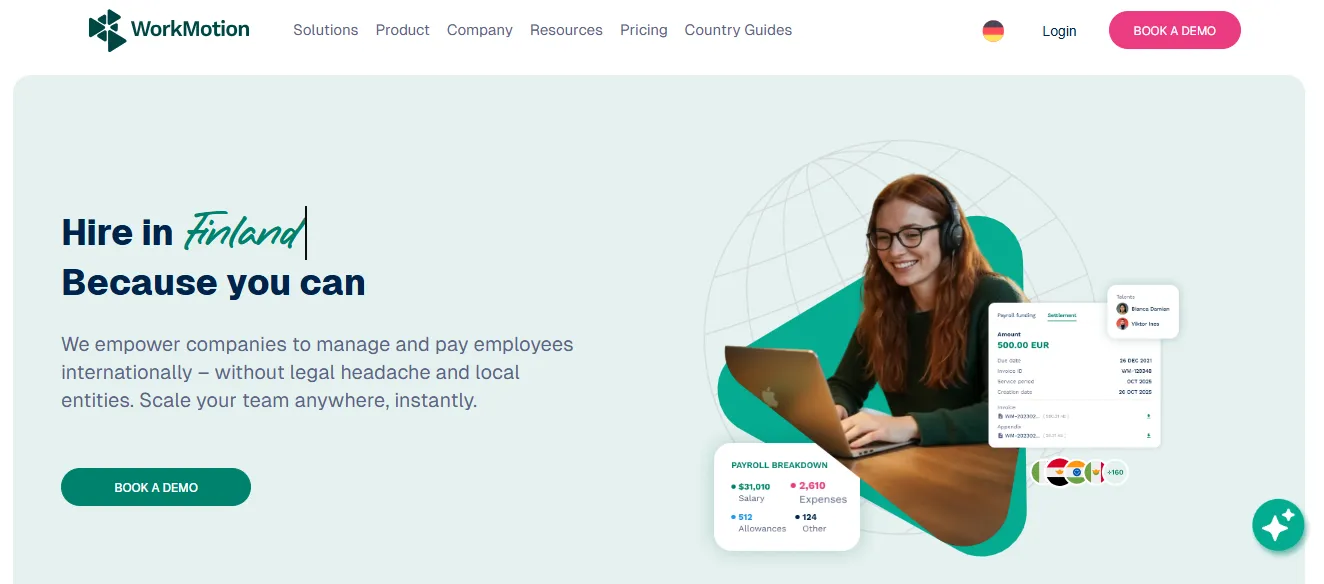
WorkMotion is Berlin-based and built specifically for the German and European market. Local German legal team, native-language support, and compliance practices built ground-up for German labor law rather than adapted from global templates. Onboarding in 1–3 days.
Key Features
● Local German legal team with deep employment law expertise
● Fast contract generation and onboarding within 1–3 days
● German payroll automation with statutory compliance built in
● Native-language support and regulatory guidance
Pros
● True local expertise versus adapted global platform
● Among the fastest German onboarding at 1–3 days
● Strong German-language support and compliance depth
Cons
● More limited global coverage compared to Deel or Remote
● Platform feature set less extensive than larger global providers
● Smaller customer base means fewer third-party integrations
"WorkMotion's local knowledge made the difference. They understood the nuances of German employment law in ways that global platforms clearly learned from checklists rather than experience."
— Customer review, Capterra
Pricing
From $299/month per employee. No hidden charges; pricing reflects strong local German expertise and fast onboarding capability.
Best For
Companies hiring primarily in Germany or Europe where local expertise matters more than global breadth.
5. Lano — Best for multi-country payroll consolidation
Lano combines EOR services with contractor management and global payroll across 170+ currencies. Useful for companies running mixed employee and contractor teams across Germany and many other countries from one interface. Explore how EOR works for independent contractors to understand the options.
Key Features
● Combined EOR and contractor management in one platform
● Multi-currency payments supporting 170+ currencies
● German compliance and payroll automation
● Consolidated global workforce view for mixed employee and contractor teams
Pros
● Flexible EOR and contractor hybrid model
● Strong multi-currency and multi-country payroll consolidation
● Useful for companies with diverse worker classifications
Cons
● Less specialized in deep German sector compliance than boutique providers
● Platform may feel complex for companies only hiring in Germany
● Customer support responsiveness varies by tier
"Lano's hybrid model was exactly what we needed. Managing both our German employees and international contractors in one place saves significant administrative overhead every month."
— Customer review, G2
Pricing
From $300/month per employee for EOR services. Contractor management available on a separate pricing tier.
Best For
Finance teams consolidating multi-country payroll where Germany is one node in a broader global workforce.
6. Oyster — Best for distributed team experience
Oyster brings strong employee experience design, transparent pricing, and benefits equity tools for distributed teams. User-friendly platform accessible to non-HR operators and founders managing German hires without dedicated HR staff.
Key Features
● Automated German employment contracts and compliance workflows
● Localized benefits management aligned with German statutory requirements
● Global benefits equity tools for distributed team consistency
● HR support tools accessible to non-HR operators
Pros
● Strong distributed team and remote-work hiring focus
● User-friendly for non-HR operators
● Comprehensive statutory benefits management for Germany
Cons
● Premium pricing at $599/month
● Less depth in sector-specific CBA management for German industries
● Fewer native integrations with German payroll accounting tools
"Oyster made it easy to offer our German hire the same quality benefits as our US employees. The platform handled everything compliantly without us needing a German HR expert."
— Customer review, G2
Pricing
From $599/month per employee. Transparent fee structure with no hidden charges.
Best For
Remote-first companies prioritizing employee experience over deep local advisory.
7. Papaya Global — Best for enterprise payroll and analytics
Papaya Global brings AI-powered workforce analytics and multi-country payroll automation for large global teams. Strong reporting capabilities for HR and finance leaders managing German workforce costs alongside other markets.
Key Features
● AI-powered payroll analytics and workforce intelligence dashboard
● Multi-country payroll automation including full German compliance
● Compliance monitoring with regulatory alerting for German law changes
● Enterprise-grade data security and GDPR-aligned architecture
Pros
● Strong analytics and workforce intelligence capabilities
● Enterprise-grade platform built for complex multi-country operations
● Robust compliance monitoring with proactive regulatory alerts
Cons
● Custom pricing makes cost comparison difficult for budget planning
● Feature depth may be excessive for companies with simple German hiring needs
● Onboarding speed (3–5 days) not the fastest in the market
"Papaya Global's analytics layer gives our finance team visibility we didn't have before. Understanding Germany workforce costs in real time alongside our other markets is genuinely useful."
— Customer review, G2
Pricing
Custom pricing based on workforce size and service scope. Transparent quote process.
Best For
Enterprise organizations running global payroll with Germany as part of a larger multi-country operation.
8. Multiplier — Best for CBA and sector compliance
Multiplier has strong CBA and sector-specific compliance depth, particularly for unionized industries. Highly rated platform (4.9/5) with technology-enhanced workflows that automate payroll while keeping CBA compliance in line.
Key Features
● Comprehensive CBA management for German industry sectors and unionized workforces
● Automated payroll with real-time German tax and social security calculations
● Employee benefits integration covering statutory and optional German plans
● Legal onboarding with digital German employment contracts
Pros
● Strong CBA and sector-specific compliance depth
● Highly rated platform (4.9/5) with strong user satisfaction
● Technology-enhanced workflows minimize manual compliance work
● Competitive pricing from $400/month
Cons
● Best for mid-to-large companies; may have overhead for simple single-hire use cases
● Global coverage less broad than Deel or Remote
● Onboarding documentation for complex CBAs can extend timelines
"Multiplier's CBA knowledge was what sold us. Our industry has complex union requirements in Germany, and they handled it without us having to bring in local legal counsel."
— Customer review, G2
Pricing
From $400/month per employee. Transparent fee structure with no hidden charges.
Best For
Companies hiring in regulated German sectors where CBA management is non-negotiable.
9.Skuad — Best for cost-effective global hiring
Skuad offers efficient EOR services with transparent pricing and 24/7 support across all time zones. Accessible platform suited for companies new to German market entry. Understanding the benefits of EOR helps contextualize why platforms like Skuad reduce market entry risk significantly.
Key Features
● Global contract automation with full German compliance built into onboarding workflows
● Transparent and affordable pricing accessible to companies at any growth stage
● 24/7 global helpdesk providing support across all time zones
● Dedicated German labor law expertise from compliance professionals
Pros
● Competitive pricing with a clear fee structure and no hidden charges
● 24/7 support available regardless of client tier
● Accessible platform suited for companies new to German market entry
Cons
● Less feature depth than enterprise platforms like Rippling or Deel
● Limited CBA and sector-specific compliance expertise for unionized industries
● Fewer advanced analytics and reporting capabilities
"Skuad made German compliance straightforward at a price that worked for our stage. Support was responsive, and the onboarding process was simpler than we expected."
— Customer review, Capterra
Pricing
From $299/month per employee. No hidden charges; pricing reflects strong compliance assurance and 24/7 global support.
Best For
Cost-conscious companies with straightforward German hiring needs.
10.Rippling — Best for HR + IT integration
Rippling unifies HR, payroll, and IT management with device provisioning and access control built in. Strong fit for companies that want one system for the full German employee lifecycle including hardware shipping.
Key Features
● Unified HR and IT platform for complete German employee lifecycle management
● Automated tax filing and social security compliance for German payroll
● Integrated onboarding from contract to email and device activation
● Device management and hardware provisioning within Germany
Pros
● Only major EOR platform combining HR and IT in one system
● Powerful automation for high-volume hiring operations
● Advanced analytics and unified workforce reporting
Cons
● Custom/premium pricing reflects broad feature set
● Onboarding takes 4–7 days, slower than most competitors
● Less specialized in German-specific compliance depth than boutique providers
● Complex setup can be overkill for companies hiring only a few employees
"Rippling's unified platform reduced our tool count significantly. Having HR, payroll, and device management for our German team in one place is genuinely valuable at scale."
— Customer review, G2
Pricing
Custom pricing based on modules and team size. Enterprise quotes available.
Best For
Existing Rippling customers and high-volume hiring operations that need HR and IT unified in one platform.
11. Remofirst — Best for budget-friendly hiring
Remofirst is the most cost-competitive EOR for Germany at $199/month with full statutory compliance, payroll in EUR, and 24/7 support. Simple, accessible platform for early-stage companies testing the German market. Explore the pros and cons of employer of record EOR to confirm whether EOR is the right model at your stage.
Key Features
● Entry-level EOR pricing from $199/month with full German compliance
● Payroll in Euros with accurate social security and tax deductions
● 24/7 support across time zones for all client tiers
● GDPR-compliant employment documentation and onboarding
Pros
● Most cost-competitive pricing among major German EOR providers
● 24/7 support available regardless of tier
● Simple, accessible platform ideal for first-time German market entrants
Cons
● Less feature depth than premium platforms like Rippling or Deel
● Smaller German on-the-ground team compared to established specialists
● Limited CBA and sector-specific compliance expertise
"Remofirst delivered exactly what we needed at a price we could justify for a single hire in Germany. Compliance was handled correctly and support was responsive throughout."
— Customer review, G2
Pricing
From $199/month per employee. Transparent pricing with no hidden charges.
Best For
Startups making a single hire in Germany on a tight budget.
12. Borderless AI — Best for AI-driven automation
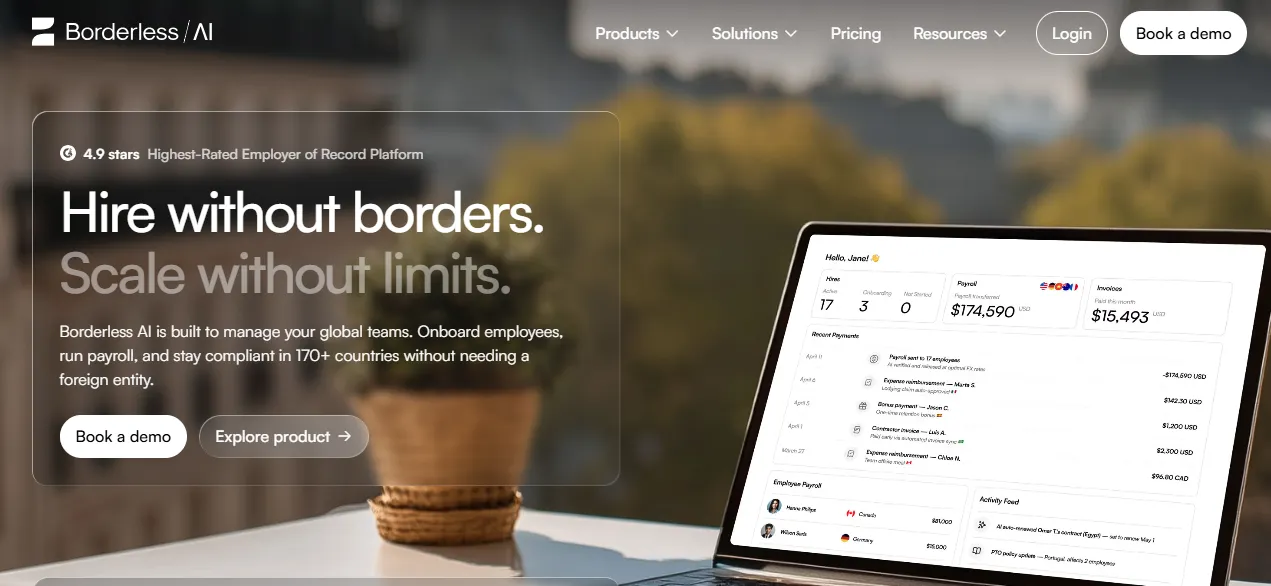
Borderless AI is an AI-native EOR platform with 3–5 day payroll cycles, automated compliance checks, and local German legal support. Strong fit for technology-forward companies that want automation reducing manual overhead.
Key Features
● AI-driven payroll automation with 3–5 day processing cycles
● Local German legal support integrated into the platform
● Automated compliance checks and contract generation
● AI-powered onboarding workflow reducing manual steps
Pros
● Most AI-native automation among major EOR platforms
● Fast payroll cycles driven by automation efficiency
● Strong local German legal team integrated with platform
Cons
● Newer platform with smaller track record than established providers
● Custom pricing creates cost uncertainty for early evaluation
● AI automation may require more setup time for complex German sector needs
"Borderless AI's automation reduced our German onboarding time dramatically. The AI-driven compliance checks caught things we would have missed manually."
— Customer review, Capterra
Pricing
Custom pricing based on scope and workforce size.
Best For
Technology-forward companies prioritizing AI automation alongside German compliance.
Key Services of EORs in Germany
- Employment Contracts: Drafting contracts that comply with German labor laws and works councils regulations.
- Payroll Management: Processing salaries, tax withholding, social insurance contributions, and statutory deductions.
- Benefits Administration: Managing employee benefits like health insurance, pension plans, and other statutory benefits.
- Legal Compliance: Ensuring adherence to German tax laws, labor regulations, employment legislation, and works council requirements.
- HR Support: Providing ongoing support for employees and handling administrative tasks.
Why Global Companies Are Hiring from Germany
Germany is one of the most attractive talent markets in Europe for companies that need depth, productivity, and credibility in the EU's largest economy. The pull is rarely about cost it is about capability and market access.
1. Access to highly skilled technical and industrial talent
Germany is a global leader in engineering, manufacturing, automotive, and increasingly SaaS, fintech, and deep tech. The country has built specialist talent pools in Berlin, Munich, Hamburg, and the Rhine-Ruhr region. Companies hiring product engineers, hardware specialists, ML researchers, or industrial designers consistently shortlist Germany for the depth of expertise.
2. Strong presence in Europe's largest economy
Germany is the largest economy in the EU and the third-largest in the world. Hiring locally builds credibility with German enterprise buyers, opens doors to industrial supply chains, and signals long-term commitment to European partners who weigh that heavily.
3. High workforce productivity and reliability
German employees are known for quality, structure, and process discipline. That translates into stable teams, low attrition, and consistent execution on long-cycle projects. For companies running multi-year R&D, manufacturing, or enterprise software builds, this reliability matters more than headline cost.
Top Challenges When Hiring in Germany
Germany offers world-class talent, but its regulatory environment requires precision. Hiring in Germany is not just about payroll — it is about handling labor laws, works councils, and strict compliance requirements. Companies that overlook these face challenges quickly.
1. Strict labor laws and employee protections
Germany has some of the strongest worker protections in Europe. Notice periods, termination restrictions, and documentation requirements are tightly defined under the Kündigungsschutzgesetz. Dismissals without proper justification lead to legal disputes, reinstatement orders, or severance payouts that can run into multiple months of salary.
2. Works councils, collective agreements, and regulatory complexity
Many employers must consult works councils (Betriebsrat) on hiring, terminations, and policy changes. Collective bargaining agreements (CBAs) often dictate salaries, working hours, and benefits across entire sectors. Without local expertise, companies miss consultation steps or fall out of CBA compliance, both of which create disputes that are expensive to unwind.
3. Payroll, tax, and social security compliance
Employers must run income tax, solidarity surcharge, health insurance, pension, unemployment insurance, and long-term care insurance correctly every month. Filings to local Finanzamt offices are tightly monitored, and mistakes trigger audits and back-payments. The system is detailed and unforgiving of approximation.
Factors to Consider When Choosing an Employer of Record (EOR) in Germany
Buyers in Germany prioritize compliance depth especially around labor law and works councils over speed. Use the factors below to filter shortlists.
1. German labor law and termination expertise
Termination is the highest-risk part of German employment. The provider should have direct experience with the Kündigungsschutzgesetz, dismissal procedures, severance calculations, and dispute handling. Ask for examples of how they have managed terminations and probation exits in the last 12 months.
2. Works council and collective agreement handling
The provider should know how to consult Betriebsrat, manage CBA-driven salary structures, and handle sector-specific union requirements in metalworking, chemicals, banking, and other regulated industries. A provider that treats CBAs as edge cases will create problems for any non-tech hire.
3. Payroll and statutory compliance accuracy
Payroll calculations cover income tax, solidarity surcharge, church tax, social insurance contributions, and AUG-licensed labor leasing rules where applicable. The provider should run this in-house with German payroll specialists, not outsource to a third party. Ask for a sample payroll calculation for a typical role before signing.
4. GDPR-compliant data handling
Germany enforces GDPR more aggressively than most EU countries. The provider should have documented data processing agreements, EU-based data residency, and clear policies on employee data access. Generic global GDPR claims are not enough.
5. Locally compliant employment contracts
Contracts must align with German statutory requirements covering working hours, overtime, leave entitlements, probation, and notice periods. Generic templates translated into German will not hold up. The provider should issue contracts reviewed by a German employment lawyer.
6. Transparent pricing and employer cost breakdown
Total employer cost in Germany runs roughly 20% above gross salary once social contributions are added. The provider should show this clearly upfront — no percentage-of-salary fees, hidden compliance charges, or FX markups. Review what goes into employer of record pricing for Germany before comparing quotes.
7. Fast onboarding without compliance shortcuts
Onboarding should complete in 2–5 days for German nationals with proper contracts, social security registration, and works council notification where required. Providers offering 24-hour onboarding usually skip steps that surface as compliance issues later.
8. Local HR support with German expertise
On-the-ground HR support that speaks German and understands local norms is essential for employee onboarding, queries, and disputes. A named German HR contact per account is the right standard.

FAQs
What should I look for in an EOR in Germany?
Look for direct expertise in German labor law and termination procedures, works council and collective bargaining experience, accurate payroll and statutory compliance, and GDPR-aligned data handling. The provider should issue German-language contracts reviewed by a local employment lawyer, not just translated templates. Pricing should be transparent with full employer cost shown upfront. Buyers in Germany consistently prioritize compliance depth over speed because the system is unforgiving of approximation, particularly around dismissals and works council consultation.
How much does it cost to hire someone in Germany through an EOR?
EOR fees range from $199 to €700 per employee per month depending on provider and service level. On top of that, total employer cost in Germany runs roughly 20% above gross salary once health insurance, pension, unemployment insurance, and long-term care contributions are added. Watch for percentage-of-salary fees, hidden compliance add-ons, and FX markups on EUR conversion that distort the headline rate.
How long does onboarding take in Germany?
Most EORs onboard German nationals in 2–5 days with proper contracts, social security registration, and works council notification where applicable. Faster onboarding (24–48 hour) usually means the provider is skipping consultation steps or registration filings that create issues later. For senior hires in regulated sectors with CBAs, plan for 1–2 weeks to handle proper documentation and works council coordination.
What's the biggest hiring risk in Germany?
Termination. German law makes dismissals tightly restricted under the Kündigungsschutzgesetz, and a poorly handled exit can result in reinstatement orders, multi-month severance, or extended legal disputes. The second risk is missing works council consultation, which can void hiring or termination decisions entirely. Both are why local advisory and German legal depth matter more than platform automation.
Can an EOR handle works councils and collective bargaining agreements?
The strong ones can. Verify the provider has direct experience consulting Betriebsrat on hiring and policy changes, and managing CBA-driven salary structures in your sector. Generic global EORs often treat works councils as edge cases — that creates problems for any non-tech hire. Ask for examples of how they have handled Betriebsrat consultation in the last six months.

Ready to take the first step?
Request a demo now and learn how you can focus on building, without worrying for compliance, ever!